Messy commission processes frustrate your reps and put revenue at risk. When payouts feel inaccurate or opaque, top performers lose trust quickly, and motivation drops even faster.
As a decision-maker, you already know sales compensation software is the fix. The real question is: which platform will give you accuracy, transparency, and the flexibility to scale?
If you’re choosing one of the best sales compensation software this quarter, I know the stakes feel high. Get it right, and you eliminate payout disputes, save hours of manual work, and keep your sales team fired up and aligned to revenue goals. Get it wrong, and you're stuck with inefficiencies, shadow spreadsheets, and reps questioning whether they're being paid fairly.
That's why I spent time analyzing G2's top-rated sales compensation platforms, digging into verified reviews from real users, comparing core features side by side, and understanding how revenue teams are actually using these tools day to day.
This guide covers my top seven picks: Everstage, CaptivateIQ, Salesforce Spiff, Qobra, Visdum, Xactly Incent, and Performio. Whether you're finalizing compensation plans for a scaling startup, overseeing payouts across global teams, or under pressure to avoid another quarter of messy disputes, this guide is built to help you make a confident, data-backed decision.
7 best sales compensation software: My picks for 2026
-
Everstage: Best known for rep-friendly commission transparency
Gives sales teams real-time visibility into earnings and quotas, with flexible plan setup and CRM syncing. (pricing available on request)
-
CaptivateIQ: Best known for flexible, spreadsheet-like plan building
Lets ops teams design, adjust, and automate commissions without code, while keeping reps in the loop. (pricing available on request)
- Salesforce Spiff: Best known for native Salesforce commission automation
Automates complex compensation plans directly within Salesforce with real-time dashboards for reps and admins ($75/user/mo)
- Qobra: Best known for modern UI and fast plan deployment
Makes it easy to create, track, and explain sales compensation plans with approval workflows and analytics (pricing available on request)
- Performio: Best known for simplifying complex commission management
Helps mid-market and enterprise teams automate sales commissions with intuitive dashboards, real-time visibility, and seamless Salesforce integration
(pricing available on request)
- Visdum: Best known for SaaS-focused commission management
Helps fast-growing SaaS teams manage and automate variable pay with clear visibility for reps and finance ($15/user/mo)
- Xactly Incent: Best known for enterprise-grade incentive management
Offers deep automation, forecasting, and audit readiness for global compensation programs ($60/user/mo)
* These tools are top-rated in their category, according to G2's Spring 2026 Grid® Report for Sales Compensation Software . Pricing is listed where publicly available; for all others, contact the sales team directly.
My 7 best sales compensation software picks for 2026
While testing and comparing these tools, it became clear how much they simplify and automate the sales compensation process by reducing payout errors, saving hours of manual work, and helping teams build transparent, performance-driven incentive programs.
In fact, as per Market Research Future analysis, the global sales compensation software market is on track to reach $45.79 billion by 2035, a sign of just how central these platforms have become to modern revenue operations.
If you’re wondering which tool best supports complex hierarchies, what RevOps leaders use to align finance and sales, or which software gives reps the clearest payout visibility, these platforms consistently stand out for accuracy, scale, and strategic impact.
How did I find and evaluate the best sales compensation software?
To identify the top sales compensation software, I analyzed real user reviews on G2 to understand how these platforms perform in actual sales and finance workflows. In my evaluation, I looked at how each tool supports key use cases: automating complex commission calculations, ensuring payout accuracy, modeling incentive plans, and improving visibility for reps and managers.
From there, I used AI-assisted analysis to comb through hundreds of verified G2 reviews and G2 Grid Reports across 15+ tools in the category to compare ease of setup, compensation rule flexibility, reporting capabilities, and overall satisfaction. The screenshots featured in this article may be a mix of those obtained from the vendor’s G2 page or from publicly available materials.
I’ve curated this list to help sales ops, finance, and revenue leaders find the right compensation solution, one that reduces errors, motivates teams, and scales with your growth.
What makes the best sales compensation software worth it: My opinion
When evaluating the best sales compensation platforms, I focused on features that directly impact payout accuracy, rep motivation, and operational scalability across sales, finance, and RevOps teams.
- Flexible compensation modeling: Great tools don’t force you into rigid commission structures. I looked for platforms that support complex compensation plans, tiered rates, accelerators, bonuses, SPIFs, and multi-currency payouts. The best tools adapt to your evolving sales strategy, not the other way around.
- Real-time performance visibility: Sales comp shouldn’t feel like a black box. I prioritized software that gives reps and managers instant access to dashboards showing quota progress, commission forecasts, and earnings breakdowns. Transparent tracking keeps teams aligned and reduces disputes.
- Automated calculations and approvals: Manual spreadsheets are error-prone and time-consuming. I looked for tools that automate commission calculations, apply rules consistently, and offer audit trails for compliance. The best platforms also include built-in approval workflows to speed up review and payout cycles.
- AI-powered forecasting and plan modeling: This has become a must-have in 2026. I prioritized platforms that use AI to simulate plan outcomes, forecast commission spend, and flag potential overpayments before they happen. Tools that let you model "what-if" scenarios using historical performance data give RevOps and finance teams a significant edge when designing or adjusting plans.
- Plan rollout and version control: Compensation plans change. I favored tools that make it easy to test, launch, and update plans without IT help. Features like sandbox environments, rule cloning, and historical versioning help teams experiment and adapt, without disrupting current payouts.
- CRM and payroll integration: The best sales compensation software connects seamlessly with your CRM, ERP, and payroll systems. I prioritized platforms with native integrations, custom field mapping, and automated syncs to ensure clean data flow from closed-won to paycheck.
- Audit readiness and compliance: Audibility is non-negotiable for public companies or those in regulated industries. I looked for SOC 2-certified tools with robust access controls, immutable logs, and clear calculation histories. That level of rigor builds trust with reps and with finance and legal.
- Enable the customization and administration of sales-based compensation plans
- Produce reports for sales performance analysis
- Integrate with sales, administration, and accounting tools
This data was pulled from G2 in 2026. Some reviews have been edited for clarity.
1. Everstage: Best known for rep-friendly commission transparency
Everstage has earned its place as a consistent G2 Leader in the sales compensation software category, and from everything I've seen in the reviews, that reputation is well-deserved. What strikes me most is how deliberately the platform is built around the rep experience. Rather than treating commission visibility as an afterthought, Everstage puts it front and center, making it one of the few tools where sales reps actually log in daily because they want to, not just because they have to. With 97% of users rating it highly for ease of use, well above the category average of 91%, that rep-first design philosophy clearly shows up in the numbers too.
I frequently see reviewers highlight how Everstage democratizes access to commission data. The platform's clear and transparent presentation helps users understand their earnings without being overwhelmed by complex breakdowns. Many note that this visibility builds trust between sales and finance, and keeps motivation high throughout the month rather than only at payout time.
Another standout that sets Everstage apart in recent reviews is its evolution into an AI-first platform. Features like Crystal Forecasting give reps projected earnings based on their current pipeline, while the AI-powered planning engine connects quota and territory changes directly to compensation plans without manual intervention. Reviewers highlight that this reduces reliance on shadow spreadsheets and gives both reps and RevOps teams a level of forward visibility that most compensation tools still don't offer.
Another theme I consistently see in reviews is Everstage's responsive customer support and smooth implementation experience. Multiple reviewers share that the team is quick to respond with practical solutions, and that getting up and running took far less time than expected.
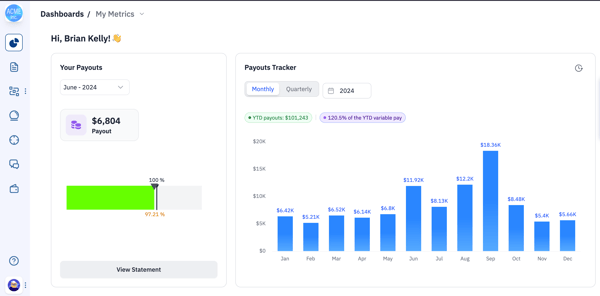
Based on G2 reviews, navigating between certain views, particularly month-on-month statements and historical payout details, can involve more clicks than users would like, and the out-of-the-box dashboards don't always map cleanly to every role or team structure. That said, reviewers consistently note that once they find what they need, the underlying data is accurate and well-organized, and the platform's overall clarity more than compensates for the extra navigation effort.
Overall, Everstage is a strong fit for mid-market and enterprise revenue teams that want to replace spreadsheet-based commission tracking with a platform that gives every rep a clear, trustworthy view of their earnings. If payout transparency and CRM-connected accuracy are your top priorities, this one belongs on your shortlist.
What I like about Everstage:
- I find the commission transparency genuinely compelling. Being able to trace every payout back to the deal level removes the back-and-forth with finance that most sales teams know too well.
- I find the AI-powered forecasting a real differentiator. Being able to project earnings from live pipeline data rather than waiting for a month-end statement changes how reps plan and prioritize.
What G2 users like about Everstage:
"Everstage is intuitive and easy to use, especially for sales teams who need real-time visibility into commissions. The dashboards are clear, reporting is flexible, and implementation was smoother than expected. I particularly appreciate the transparency it provides to reps and the automation that reduces manual errors. Customer support has also been responsive and helpful whenever needed."
- Everstage Review, Amrit S.
What I dislike about Everstage:
- Navigating between views and historical payout details can involve more clicks than expected, and the default dashboards may need adjusting. Once configured though, the data clarity makes the setup effort worthwhile.
- Some users note that commission data can take a little time to sync after a deal closes, which can cause brief uncertainty during a fast-moving sales week. The accuracy once updated is consistently reliable, making it more of a timing nuance than a data quality concern.
What G2 users dislike about Everstage:
"Some of the calculations and rules behind commissions aren’t always easy to understand from the SDR side, especially when there are multiple accelerators or adjustments. It would be helpful to have simpler explanations or tooltips that break down how each number is calculated. At times, data updates can feel slightly delayed, which can cause short-term confusion during fast-paced sales weeks."
- Everstage Review, Sarah C.
2. CaptivateIQ: Best known for flexible, spreadsheet-like plan building
CaptivateIQ is one of those platforms that genuinely changes how sales ops and finance teams think about commission management. What I find compelling about it is the philosophy behind its design: rather than asking teams to learn an entirely new system, it mirrors the spreadsheet logic most admins already know, while adding the automation and auditability that spreadsheets simply cannot deliver.
A consistent theme in reviews is praise for CaptivateIQ’s customization options. Users often mention that setting up and adjusting commission plans is straightforward, even as business needs change. They value being able to make updates without added complexity, which saves time and reduces frustration during compensation cycles. According to G2 Data, 69% of CaptivateIQ users come from mid-market companies, making it a particularly strong fit for teams that are scaling fast and need flexibility without enterprise-level overhead.
I also see frequent mentions of the interactive What-if commission estimator. Reviewers highlight how it lets reps forecast potential earnings against pending deals in real time, which keeps motivation high and removes the guesswork that usually builds up toward the end of a quarter. It's one of those features that sounds simple but has a real impact on how engaged reps stay with their targets.
CaptivateIQ has also recently launched Catalyst, its AI-powered sales planning layer that brings capacity planning, quota management, and predictive modeling into the same workspace as compensation, meaning planning and incentives no longer have to live in separate tools.
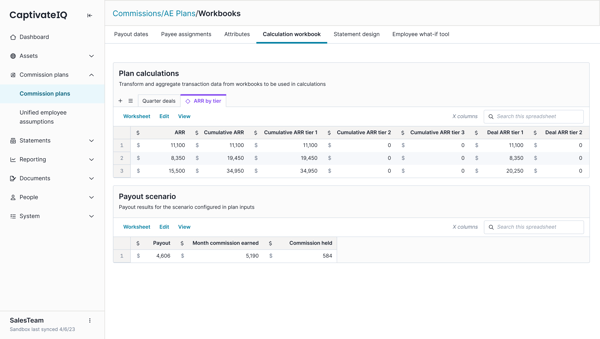
That said, building advanced or multi-plan reports can feel rigid and time-consuming, particularly when combining metrics across different plans into a single dashboard view. Reviewers note this most often when handling last-minute leadership requests. However, most agree that once the core reporting is configured, it holds up well for ongoing sales analytics and that the platform's broader compensation accuracy more than offsets the setup investment.
Overall, CaptivateIQ is a strong choice for mid-market and enterprise revenue teams that need the familiarity of spreadsheet logic with the structure and scale of a proper incentive compensation management platform. If your team manages complex, frequently changing plans and needs every stakeholder from rep to CFO on the same page, this one is worth a close look.
What I like about CaptivateIQ:
- The customization options stand out to me, especially how easy it is to adjust commission plans mid-year without things breaking or needing IT involvement.
- The What-if estimator is genuinely useful. Being able to model earnings against a deal before it closes keeps reps focused on the right opportunities at the right time.
What G2 users like about CaptivateIQ:
"The platform effectively manages complex compensation plans and provides a user-friendly interface for sales representatives. Its fast processing helps minimize the need for commission adjustments in future months. The CaptivateIQ team is consistently responsive and a pleasure to work with. I also appreciate their ongoing commitment to including end-users in meetings and trainings."
- CaptivateIQ Review, Michaela C.
What I dislike about CaptivateIQ:
- Some reviewers found the reporting setup a bit bulky or unintuitive at first, even though it became effective once configured.
- A few hinted that some of the more advanced features take extra effort to get used to during the initial setup.
What G2 users dislike about CaptivateIQ:
"Initial Implementation. Because the tool is a white canvas for custom plans, the initial setup could require significant time and dedicated internal resources. That being said, their CSMs are highly responsive and always happy to help navigate these challenges."
- CaptivateIQ Review, Sergi F.
Once commissions are under control, the next lever is performance visibility. Explore the best sales performance management tools to set goals, track performance, and keep your sales engine running at full throttle.
3. Salesforce Spiff: Best known for native Salesforce commission automation
Salesforce Spiff is a natural choice for revenue teams already running on Salesforce. What I find interesting about it is where it sits in the market: it is not trying to be a standalone compensation platform that connects to your CRM. It is built inside Salesforce, which means the data your reps work with every day is the same data driving their commission calculations, with no exports, no manual syncs, and no version discrepancies.
A consistent theme in reviews is praise for how the native Salesforce integration removes the friction that usually plagues commission management. Users highlight that commissions update automatically as deals move through the pipeline, and that having a single source of truth across sales, ops, and finance eliminates the back-and-forth that typically follows month-end close. Salesforce Spiff also has the largest market presence in the sales compensation category on G2, and according to G2 Data, 93% of users rate its commission estimator positively, reflecting how much reps rely on it to track and forecast their earnings day to day.
I also see strong feedback about how real-time earnings visibility influences rep motivation. Reviewers describe logging in during the month, not just at payout time, to see how individual deals are affecting their commission trajectory. That behavioral shift, from passive recipients of a monthly statement to active participants tracking their own performance, is something I see cited repeatedly as a meaningful outcome.
Another standout across admin and RevOps reviews is Spiff's ability to handle mid-year plan changes and complex compensation logic without disrupting current payouts. Multiple reviewers highlight the dispute and approval workflow as particularly well-designed, allowing adjustments to be handled quickly and transparently rather than through email chains or spreadsheet patches.
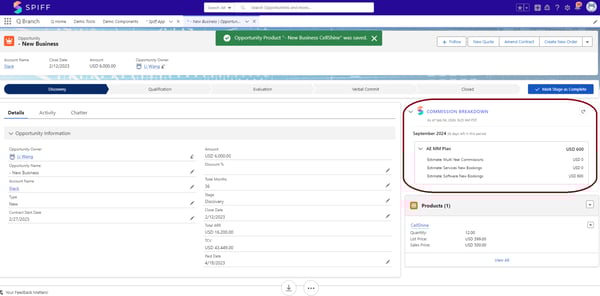
Some reviewers mention that setting up advanced commission logic for highly layered plans can be complex, and the platform relies heavily on clean, consistent Salesforce data to calculate accurately. Reviewers note that any data inconsistencies in the CRM can flow through to commission calculations and require manual correction. That said, most also point out that once the data hygiene and plan logic are properly configured, the platform runs reliably and significantly reduces the monthly admin burden.
Overall, Spiff is best suited for mid-market and enterprise teams that live inside Salesforce and want their incentive compensation management to work as a natural extension of their existing CRM workflows rather than a separate system to maintain. If Salesforce is your system of record, this one is worth evaluating first.
What I like about Salesforce Spiff:
- I find the native Salesforce integration genuinely impressive — no exporting, no manual data cleaning, commissions just update as deals move through the pipeline.
- The way real-time visibility shifts rep behavior is compelling. People check in during the month, not just at payout, which changes how they prioritize deals.
What G2 users like about Salesforce Spiff:
"Real-time visibility gives sales reps confidence in their earnings, while automation has eliminated spreadsheets and significantly reduced errors. The tight Salesforce integration ensures commission calculations are always based on accurate, up-to-date data, saving time for both Sales Ops and Finance."
- Salesforce Spiff Review, Verified User
What I dislike about Salesforce Spiff:
- Setting up advanced logic for layered plans is complex and depends on clean Salesforce data. Any CRM inconsistencies can affect commission outputs, though a well-configured setup runs reliably with minimal ongoing effort.
- Support responsiveness has slowed for some users post-acquisition, with requests occasionally routed to seminars rather than direct help. For most day-to-day use though, the platform is self-sufficient enough that this rarely becomes a blocker.
What G2 users dislike about Salesforce Spiff:
"I would like to see deeper AI integration within Salesforce Spiff that connects directly with Slack or Microsoft Teams. Having an AI-powered chatbot that can answer quick questions about commission structures or quota attainment without leaving our primary communication apps would significantly improve the user experience."
- Salesforce Spiff Review, Miguel Angel M.
4. Qobra: Best known for modern UI and fast plan deployment
Qobra is the all-in-one sales compensation platform that motivates and aligns revenue teams. What sets it apart in my evaluation is how deliberately it is designed for speed, both in getting teams live quickly and in keeping commission data visible in the places reps actually work every day, rather than buried in a separate tool they have to remember to log into.
A feature that consistently gets praise is Qobra’s real-time performance tracking. I’ve noticed that users love being able to instantly see their earnings without waiting until month-end, since it builds motivation by showing exactly how their efforts translate into results.
I also see frequent mentions of Qobra's deal-level simulation feature. Reviewers highlight how it lets them model different deal scenarios and instantly see how each one affects quota attainment and payout, helping them prioritize their pipeline more strategically. It turns commission data from a backward-looking statement into a forward-looking planning tool. According to G2 Data, 95% of users rate Qobra's commission estimator and compensation statements positively, both above the category average.
Another standout across reviews is Qobra's Slack integration and in-platform discussion feature. Commission updates pushed directly into Slack keep performance visible without requiring reps to log into another dashboard, and the built-in discussion feature centralizes communication between reps, managers, and ops teams around payout queries.
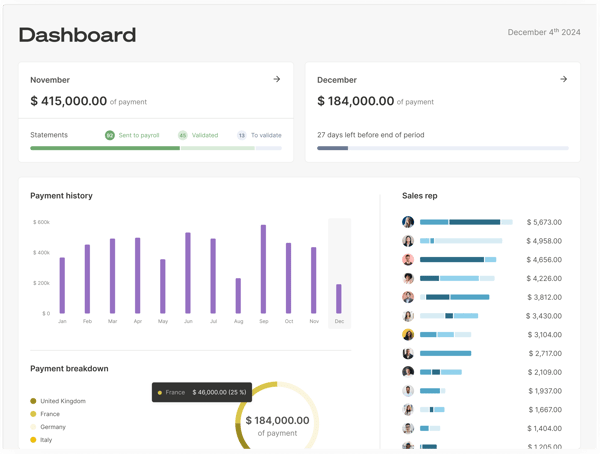
Based on G2 reviews, reporting and dashboard customization can feel limited once the core setup is in place, with fewer options to surface only the most relevant metrics at a glance. That said, Qobra scores 92% on customization in the Spring 2026 Grid Report, above the category average of 89%, and has been actively rolling out enhanced navigation and additional customization options in 2026. Reviewers acknowledge the team is responsive to feedback, making this more of a current limitation than a long-term concern.
Overall, Qobra is a strong fit for mid-market revenue teams that want a fast-to-deploy, rep-friendly incentive compensation platform. If transparency, speed of implementation, and daily rep engagement are your priorities, this one is worth shortlisting.
What I like about Qobra:
- I find the Slack integration genuinely clever. Commission updates surface where reps already are, which means motivation stays high without anyone having to remember to open another tool.
- The deal simulation feature stands out to me as a real differentiator. Being able to model how a pending deal affects payout changes how reps think about their pipeline, not just their statement.
What G2 users like about Qobra:
"Qobra is very reliable and easy to use in our SaaS environment. The interface is clean and intuitive, and we’ve never run into technical issues. What I really like is the Slack integration — we use Qobra as a Slack bot internally, which makes commission updates very visible and genuinely motivating for the team."
- Qobra Review, Jannik S.
What I dislike about Qobra:
- Reporting and dashboard customization can feel limited, with fewer options to surface the most relevant metrics at a glance. Qobra has been actively rolling out improvements here though, and the team is responsive to feedback.
- Navigating the deal overview becomes harder as volumes grow, with limited filtering options to locate specific deals quickly. Once familiar with the layout though, most teams find it manageable for day-to-day use.
What G2 users dislike about Qobra:
"So far, the only minor drawback is that the initial setup requires some careful data alignment, but the Qobra support team was very responsive and guided us through it quickly. Once implemented, it runs smoothly."
- Qobra Review, Göktan M.
5. Performio: Best known for simplifying complex commission management
Performio is widely recognized as an incentive compensation management (ICM) platform designed for mid-market and enterprise businesses that need to simplify complex commission programs. What I find compelling about it is how consistently reviewers describe it as a tool that removes the headache of commission management for both sides of the equation: reps get clear, consolidated payout visibility, and admins get a structured, scalable way to manage plans without relying on spreadsheets. According to G2 Data, the platform earns a 4.4/5 rating across 950+ reviews.
A standout theme across recent reviews is Performio's historical data depth. Users consistently highlight the ability to track performance across MTD, QTD, and YTD views, compare results against previous months and years, and spot trends over time. This level of longitudinal visibility goes beyond what most reps expect from a commission tool and helps both sellers and managers make more informed decisions about where to focus.
I also see strong and consistent feedback about Performio's Salesforce integration. Reviewers describe how changes to account dollar values in Salesforce flow automatically into Performio, keeping targets and commissions in sync without IT intervention. Multiple users specifically call out never having to contact their IT team for issues and using the platform daily with confidence that the data is accurate.
Another development is Performio's recent launch of an AI Admin Assistant, which brings automation to plan administration tasks that previously required significant manual effort. Reviewers familiar with the feature highlight how it reduces the time spent on routine configuration and helps admins focus on higher-value compensation strategy work rather than repetitive setup.
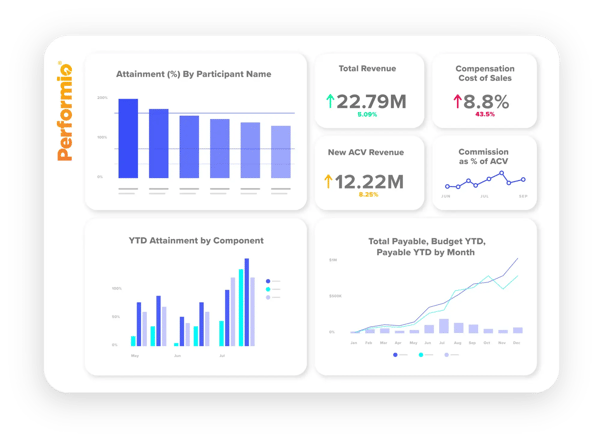
Based on G2 reviews, data refresh delays are the most consistently mentioned friction point, with users noting that sales made in Salesforce can sometimes take a day or longer to appear in Performio. Reviewers acknowledge this is partly dependent on how their organisation has configured data syncing, and most agree that once updates do come through, the data is accurate and reliable enough for their day-to-day tracking needs.
Overall, Performio is a strong fit for mid-market and enterprise teams that need a structured, audit-ready sales compensation platform with deep historical reporting and tight Salesforce connectivity. If long-term data visibility and reliable payout accuracy are your priorities, this one is worth shortlisting.
What I like about Performio:
- I find the historical data depth genuinely useful. Being able to compare MTD, QTD, and YTD performance in one view, and benchmark against previous years, is something I don't see emphasised as strongly in other tools.
- Strong Salesforce integration keeps targets and commission data in sync automatically, reducing manual effort and IT involvement.
What G2 users like about Performio:
"I use Performio to track sales-related information for my organization. I find the platform very intuitive, extremely easy to use, and clutter-free. I appreciate that it has all my historical sales data available, which allows me to see trends of sales over a large amount of time and compare them with my past results. Performio makes it streamlined to find and review sales data, whether it be commission, numbers, or monthly volumes."
- Performio Review, Wilson K.
What I dislike about Performio:
- Data refresh delays are the most common friction point in recent reviews, with updates from Salesforce sometimes taking a day or more to reflect. Once synced though, the accuracy is consistently reliable and rarely questioned.
- Some users note that the mobile app can be unreliable at login, requiring multiple attempts before gaining access. That said, most day-to-day usage happens on desktop where the experience is considerably more stable.
What G2 users dislike about Performio:
"Sometimes it takes a while to upload information into Performio. For example, some of the sales I have made in Salesforce are not flowing through into Performio in real time. I'm not sure if someone from the organization has to pull the information through or if it can be acquired directly from Salesforce, which would be handy."
- Performio Review, Hamid A.
6. Visdum: Best known for SaaS-focused commission management
Visdum sits in an interesting spot in this list. While most sales compensation platforms treat SaaS revenue structures as a configuration challenge, Visdum treats them as the default. MRR, ARR, expansion credits, and churn clawbacks are built into the platform's core logic rather than bolted on, which makes a meaningful difference for teams whose commission plans live and die by recurring revenue metrics.
Reporting depth and calculation accuracy come up again and again in reviews, and the numbers back it up. Visdum leads all seven tools in this list on both commission estimator satisfaction at 98% and individual and team performance reports at 97%. Finance and RevOps reviewers specifically call out full traceability into every calculation, which makes month-end close and audit cycles significantly less painful.
Getting live fast is where Visdum consistently surprises users. Reviewers with complex commission rules describe going live faster than expected, and mid-cycle plan changes that would typically require weeks of coordination get handled without the usual downstream disruption. For growing SaaS teams that revise plans frequently, that agility has real operational value.
Something else that stands out in recent reviews is Visdum's gamification layer. Sales contests, leaderboards, SPIFFs, and bonus tracking are built directly into the platform rather than being an afterthought, and multiple reviewers mention that reps engage with it daily partly because of these motivational elements. It is a feature that rarely gets highlighted in this category but clearly resonates with users.
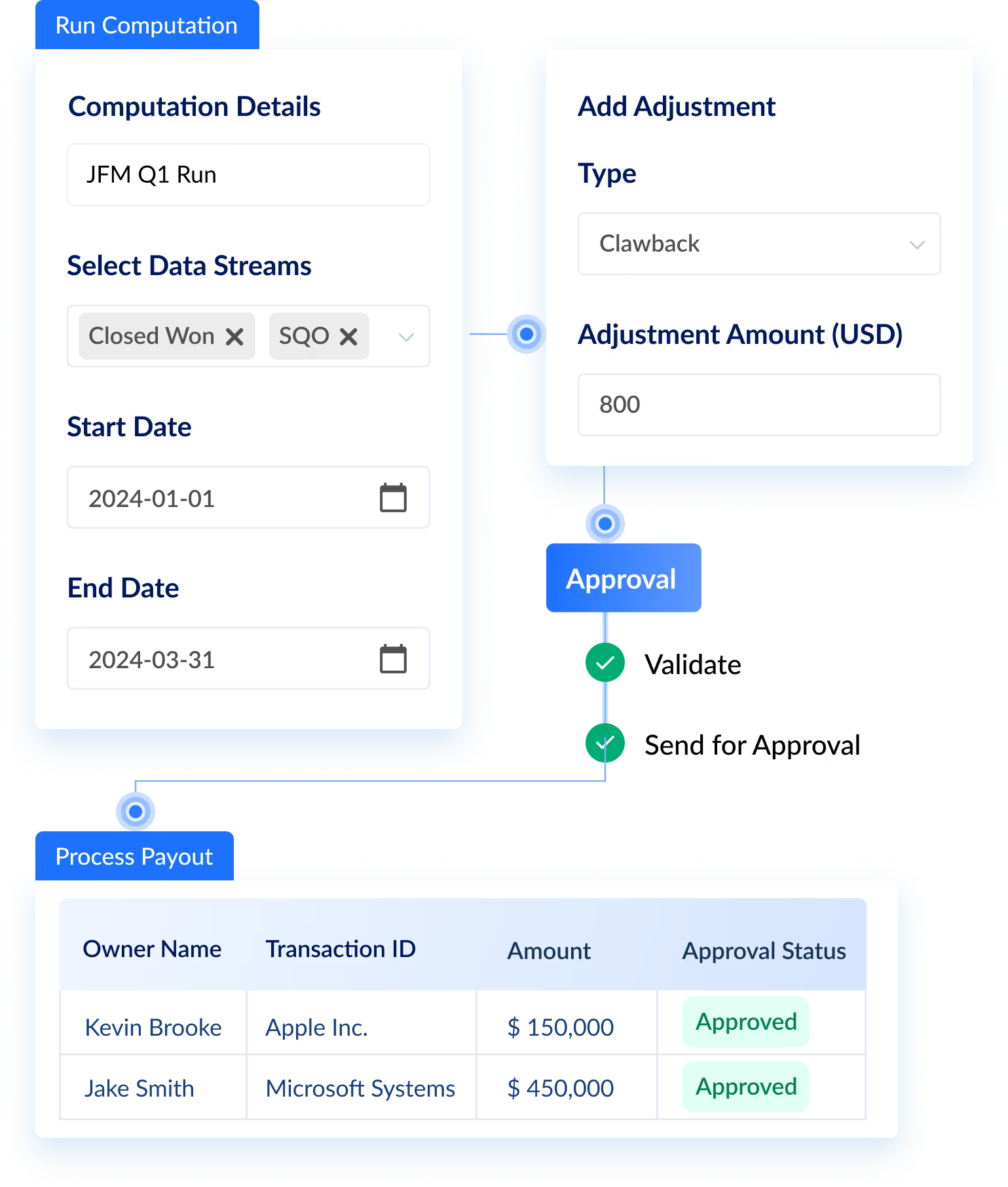
Where users push back is on pre-built report templates. The custom reporting tools are powerful and accurate, but teams looking for ready-made leadership summaries or standard layouts end up doing more configuration than expected. Visdum's support team is consistently praised for helping bridge that gap, and reviewers note the product evolves quickly based on feedback, so this feels more like a timing issue than a structural limitation.
Visdum makes the most sense for fast-growing SaaS and IT services teams that need a platform that handles recurring revenue commission logic natively, gets deployed quickly, and keeps reps motivated beyond just showing them their payout. If those are your priorities, this one is worth a serious look.
What I like about Visdum:
- I find the implementation speed hard to argue with. Complex plans going live faster than expected, without the usual coordination overhead, is something I see consistently across reviews.
- The gamification features genuinely stand out to me, including the built-in leaderboards and contest tracking, driving daily rep engagement.
What G2 users like about Visdum:
"From a finance perspective, accuracy and traceability matter most, and Visdum delivers on both. Every commission calculation is easy to follow, and having everything documented in one place has made audits much easier. The support team has also been very responsive whenever we’ve had questions around plan logic. I think it has given us an efficiency improvement where it matters most."
- Visdum Review, Verified User
What I dislike about Visdum:
- Pre-built report templates are limited, and getting to leadership-ready summaries takes more configuration than it should. The custom tools are accurate though, and support is responsive when help is needed.
- The mobile experience is noticeably thinner than desktop, with several reviewers sticking to web for anything beyond a quick check. Teams that work primarily on desktop will rarely feel this.
What G2 users dislike about Visdum:
"There’s a short adjustment period if you’re coming from Excel-heavy workflows. Some of our team needed a few days to fully understand how everything connects, but support helped clear things up quickly."
- Visdum Review, Verified User
7. Xactly Incent: Best known for enterprise-grade incentive management
Xactly Incent is widely recognized as a platform that automates and manages incentive compensation programs of all sizes. Two decades of incentive compensation data, enterprise-grade scalability, and a platform built to handle global compensation programs at significant complexity — that is Xactly's value proposition, and it is one that the other six tools here cannot easily replicate.
Enterprise reviewers consistently describe Xactly as the right fit when compensation programs span thousands of payees, multiple geographies, and layered approval hierarchies. Managing commissions at the scale of billions of transactions monthly, handling multi-currency global plans, processing complex layered hierarchies, these are the scenarios where Xactly's depth becomes most apparent, and where lighter tools tend to hit their limits.
Payout accuracy is where Xactly earns consistent praise. Processing transactions at scale with accuracy and handling multi-currency global plans without manual intervention gives enterprise finance teams a level of confidence that is hard to replicate elsewhere. Several long-term users specifically credit this accuracy with reducing employee turnover, noting that sales teams stop questioning their numbers when the platform consistently gets it right.
Xactly also recently launched new AI Agents that allow compensation teams to model and deploy incentive plans using natural language prompts, surface attrition risk predictions, and flag compensation anomalies before they become disputes. Reviewers who have seen the feature describe it as a meaningful step forward, noting it handles what-if scenarios on demand and significantly reduces the manual workarounds that enterprise comp teams have relied on for years.
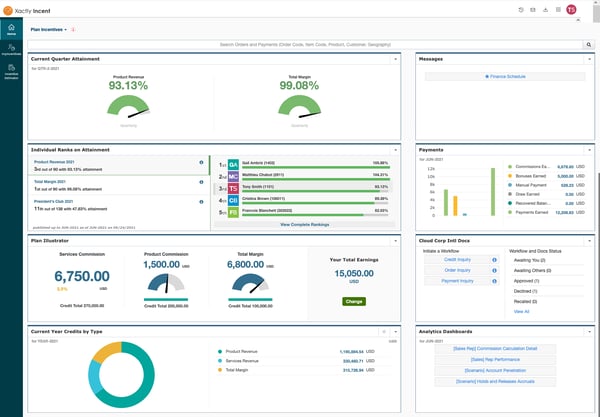
The learning curve is real and worth calling out honestly. Getting up and running with Xactly, particularly for complex plan configurations, takes time, admin expertise, and often dedicated internal resources. Reviewers with five or more years on the platform still describe it as requiring meaningful effort to maintain. That said, those same reviewers consistently note that once fully configured, it runs reliably, and the accuracy it delivers at scale justifies the investment.
For teams running large, global, compliance-heavy incentive compensation programs that need a platform with the depth to match, Xactly Incent is the most credible option on this list. If you are a smaller or faster-moving team, the other tools here will likely serve you better.
What I like about Xactly Incent:
- I find the enterprise scalability hard to match. When you are managing thousands of payees across multiple geographies, few platforms handle that complexity as reliably.
- I think the AI Agents are the most interesting development in this space right now. Natural language plan modeling and attrition risk flagging are genuinely new capabilities for enterprise comp teams.
What G2 users like about Xactly Incent:
"I like that Xactly Incent gives me clear, transparent visibility into sales compensation. It handles complex comp plans reliably and reduces manual calculations and errors. Both reps and leadership can easily track earnings, quotas, and performance, which builds trust and minimizes compensation disputes. The automation and reporting also save a significant amount of time and make the process much more scalable."
- Xactly Incent Review, Shriram B.
What I dislike about Xactly Incent:
- The learning curve is steep, and configuration takes real effort, especially as plans evolve. Once set up though, the accuracy at scale is consistently reliable and rarely questioned.
- The interface feels dated, and the gap between the modern AI features and the older reporting tables is noticeable. A UI refresh would make the platform feel far more cohesive.
What G2 users dislike about Xactly Incent:
"While Xactly is a powerful platform, there can be a learning curve when getting started, especially for users who are new to incentive compensation tools. Some of the more advanced configuration and reporting features may require additional training or support to fully take advantage of them. Additionally, certain processes—such as updating compensation plans or generating highly customized reports—can feel less intuitive than expected. The functionality is there, but improvements to the user interface and more streamlined workflows in these areas would make the overall experience smoother and more efficient."
- Xactly Incent Review, Verified User
Frequently asked questions (FAQs) on sales compensation software:
Got more questions? We have the answers.
1. What is the best software for tracking sales incentives?
Everstage is one of the best tools for tracking sales incentives. It gives real-time visibility into earnings and quotas, so reps always know where they stand. Its transparent dashboards help build trust and motivation while reducing payout disputes.
2. What are the top recommended apps for sales commission tracking?
The top-rated sales commission tracking apps are Everstage, CaptivateIQ, Salesforce Spiff, Qobra, Performio, Visdum, and Xactly Incent. Each automates commission calculations, offers real-time dashboards, and integrates with CRM systems to eliminate manual tracking.
3. What is the best solution for automating sales compensation?
Salesforce Spiff is best for automating complex sales compensation directly inside Salesforce. It calculates commissions in real-time, integrates with CRM data, and provides transparent payout tracking for both representatives and administrators.
4. What is the best sales compensation software for a small business?
Visdum is purpose-built for small and mid-sized SaaS businesses. It goes live faster than most tools in the category, handles recurring revenue structures like MRR and ARR natively, and earns a 99% ease of setup rating on G2, making it one of the most accessible options for growing teams.
5. What are the most reliable sales compensation tools for mid-sized companies?
CaptivateIQ and Performio are both strong choices for mid-sized teams. CaptivateIQ offers spreadsheet-like plan flexibility with no-code automation and the recently launched Catalyst AI planning layer. Performio brings deep historical reporting, tight Salesforce integration, and structured plan building suited to teams managing complex commission structures.
6. What is the most affordable sales compensation software for startups?
Everstage and Visdum both offer startup-friendly pricing. Everstage's AI-first platform gives reps real-time earnings forecasts alongside commission visibility, while Visdum's fast implementation and SaaS-native commission logic make it easy to get up and running without a large budget or technical team.
7. What is the leading sales incentive management app?
Xactly Incent is the most established platform for enterprise-level incentive management. Backed by 20 years of proprietary pay and performance benchmarking data, it handles global compensation programs spanning thousands of payees across multiple geographies, and recently launched AI Agents for natural language plan modeling and attrition risk predictions.
8. What are the best sales commission software reviews?
According to recently verified G2 reviews, Everstage and Qobra lead the category in satisfaction scores, with Qobra earning the highest satisfaction rating among all products in the category. CaptivateIQ and Salesforce Spiff lead on market presence, while Visdum earns top marks on commission estimator and performance reporting features. Users across all platforms consistently highlight accuracy, transparency, and time savings as the key benefits.
9. Which is the best platform for managing sales team bonuses?
Qobra stands out for managing sales team bonuses. Its built-in approval workflows, real-time bonus tracking, and deal-level simulation feature give reps clear visibility into how each deal affects their payout, while keeping finance and ops aligned throughout the cycle.
10. What is the best software for handling sales rep commissions?
Performio is one of the strongest options for handling sales rep commissions at scale. Its MTD, QTD, and YTD tracking views give reps a clear picture of where they stand at any point in the month, while the Salesforce integration keeps commission data in sync automatically without IT intervention.
Q11. What are some sales compensation software where reps can see their commissions in real time?
Everstage and CaptivateIQ are strong choices for replacing spreadsheet commission tracking. Everstage gives every rep a clear, trustworthy view of earnings traced to the deal level, and CaptivateIQ mirrors familiar spreadsheet logic while adding the automation and auditability that spreadsheets cannot deliver.
Q12. What sales compensation software lets reps see their commissions in real time?
Everstage, Salesforce Spiff, and Qobra all give reps real-time commission visibility. Reviewers describe logging in during the month rather than only at payout to track how individual deals affect earnings, with Spiff earning a 93% positive rating on its commission estimator and Qobra 95%.
Q13. What is the best sales commission tracking software for a growing SaaS sales team?
Visdum is purpose-built for SaaS teams, with MRR, ARR, expansion credits, and churn clawbacks built into its core logic rather than added on. It deploys quickly and leads the category on commission estimator satisfaction (98%), making it a strong fit for fast-growing SaaS sales teams.
Q14. What is the best sales compensation software for a mid-size SaaS team with CRM integration?
For mid-size SaaS teams that need tight CRM integration, Salesforce Spiff and Performio stand out. Spiff is built inside Salesforce so commissions update as deals move through the pipeline, and Performio syncs account changes from Salesforce automatically without IT intervention.
Q15. What are some sales compensation software that handles complex comp plans like accelerators SPIFFs and split credit?
CaptivateIQ and Xactly Incent handle complex plan logic well. CaptivateIQ supports flexible, frequently changing multi-plan structures with no-code adjustments, and Xactly Incent manages layered hierarchies, multi-currency global plans, and high-volume transactions at enterprise scale.
Q16. What are some sales compensation tools with reliable CRM sync and which ones cause commission disputes?
Salesforce Spiff and Performio are noted for reliable CRM sync, though both depend on clean CRM data and can show refresh delays, with reviewers reporting Salesforce sales sometimes taking a day to appear in Performio. On disputes, transparency is the differentiator: Everstage, Spiff, and Qobra are credited with reducing payout disputes through deal-level visibility and clear approval workflows.
Q17. What are some sales commission software that's actually easy to roll out and that reps adopt?
Qobra and Visdum are consistently described as fast to deploy, with reviewers going live faster than expected even on complex plans. On adoption, Everstage stands out, with 97% rating it highly for ease of use against a category average of 91%, and reps logging in daily by choice rather than obligation.
Q18. What are some sales commission tracking software with the highest rep adoption rates?
Everstage leads on rep adoption, with a rep-first design that drives daily logins and a 97% ease-of-use rating, well above the 91% category average. Qobra also sustains high engagement through its Slack integration, which surfaces commission updates where reps already work.
Q19. What is the best sales compensation platform for a large SaaS team with a complex multi-product comp plan?
Xactly Incent is the most credible option for large teams running complex, multi-product programs, built to handle thousands of payees, multiple geographies, and layered approval hierarchies. CaptivateIQ is a strong alternative for teams that want that scale with spreadsheet-like flexibility and its Catalyst AI planning layer.
Q20. What is sales compensation software ROI, and how quickly does it pay off vs managing commissions manually?
Reviewers frame the ROI in terms of fewer payout errors, hours of manual work saved, and reduced disputes as reps come to trust their numbers. Tools like Everstage, Qobra, and Visdum are credited with fast time-to-value through quick implementation, while enterprise platforms like Xactly Incent require more upfront setup but deliver accuracy at scale that some users link to lower sales-team turnover. Actual payback depends on team size, plan complexity, and current manual effort.
Still calculating commissions in spreadsheets? That’s a bold way to lose trust fast.
After going through all seven platforms, one thing is clear to me: the right sales compensation software does not just save time — it changes how your sales team thinks about their work. When reps trust their numbers, they focus on selling. When finance stops firefighting spreadsheets, they can actually contribute to strategy. And when RevOps has a single source of truth, compensation stops being a source of friction and starts being a lever for growth.
If I had to distill it: teams that are scaling fast and want something live quickly should look at Visdum or Qobra first. Teams running complex, multi-product plans with a Salesforce-centric stack will find Spiff or CaptivateIQ a natural fit. And if you are managing global compensation programs at enterprise scale, Xactly Incent remains the most credible option despite its learning curve.
The spreadsheet era of commission management is over. The only question left is which platform fits where you are going.
If you are ready to go beyond compensation, a sales intelligence tool can help you connect payouts to pipeline performance and understand what is actually driving revenue.
.png?width=400&height=150&name=Untitled%20design%20(56).png)


.png)



.png)