


When I first heard about DeepSeek in January 2025, I thought it might be just another name on the long list of ChatGPT alternatives. I mean, I’d already seen many AI chatbots like Gemini, Claude, Perplexity, and plenty of others try to dethrone ChatGPT.
But something about a DeepSeek vs. ChatGPT matchup felt…. different. Mainly because DeepSeek is completely free and fully open-source. That definitely made me pause, and I wasn’t alone.
Since its launch, more than 350 million+ use it every month (myself included), according to SimilarWeb data. From GitHub stars to AI Reddit threads and Twitter/X buzz, DeepSeek has been everywhere lately.
Over the past few months, I’ve been using ChatGPT and DeepSeek side by side. And if you know me, you already know I had to run a proper head-to-head test.
In this article, I’ll break down exactly how DeepSeek vs. ChatGPT played out across real-world tasks — writing, coding, summarizing, researching — and which one I’d actually recommend depending on your workflow. And yes, I’ve backed it up with G2 user data too.
TL;DR: DeepSeek is a pro at technical work like data analysis, logic-heavy reasoning, and handling multiple languages with ease. ChatGPT, on the other hand, is your go-to for general-purpose tasks like content creation, brainstorming, casual conversation, coding, and image generation. DeepSeek delivers efficiency and precision, but ChatGPT takes the crown for versatility, polish, and ease of use.
Quick note: “DeepSeek” is the name of a whole family of open-source AI models, the chatbot interface that uses them, and the company behind it all. When I mention “DeepSeek” here, I am talking about the AI chatbot.
Here’s how DeepSeek and ChatGPT compare in terms of features, functionality, and pricing.
|
Feature |
ChatGPT |
DeepSeek |
|
G2 rating |
4.7/5 |
4.5/5 |
|
AI models |
Free: GPT-5.3 |
DeepSeek V3.2 |
|
Best for |
Creative writing, coding, general knowledge, real-time web search |
Research, conversational flow, reasoning abilities, and open-source tinkering |
|
Open-source |
ChatGPT models are proprietary. Has separate gpt-oss-120b and gpt-oss-20b open-weight language models. |
All models are fully open-source |
|
Security |
Cloud-based, proprietary infrastructure with compliance certifications like SOC 2 Type 2 and GDPR/CCPA support |
Servers hosted in China; Local/private deployment possible with the open-source models |
|
Creative writing and conversational ability |
Natural storytelling and strong conversational capabilities |
Almost on par with ChatGPT |
|
Coding and debugging |
One of the best AI code assistants |
Strong with DeepSeek Coder |
|
Speed and response |
Fast, but may hit rate limits |
Fast, though occasionally impacted by server downtime |
|
Supported languages |
65 languages |
100+ languages, but strong in English and Mandarin. |
|
Pricing |
ChatGPt Go: ChatGPT Plus: $20/month ChatGPT Business: $20/user/month (billed annually)
|
Completely free |
Note: Both OpenAI and DeepSeek frequently roll out new updates to these AI chatbots. The details below reflect the most current capabilities as of April 2026, but may change over time.
Before we get down to brass tacks with some real-world testing, it's worth taking a moment to unpack what sets these chatbots apart and, surprisingly, where they have quite a bit in common.
The main difference between Deepseek and ChatGPT is that Deepseek specializes in retrieval-augmented generation (RAG) with an open-source focus, while ChatGPT is a general-purpose conversational AI developed by OpenAI with proprietary models and broader integration options like web browsing, code interpretation, and plugins.
From my experience, ChatGPT immediately feels like the more polished, feature-rich product. The interface is smoother, the ecosystem is more mature, and it just works out of the box.
DeepSeek, on the other hand, is powerful under the hood, especially with its open-source models. But it still feels like it’s early in its product journey. The user experience is basic, and some advanced features are still catching up. Let me break down the specifics:
Is ChatGPT Plus worth it? Read my in-depth review listing its pros and cons.
Irrespective of their differences, DeepSeek and ChatGPT actually have a lot in common. Here’s what they both do well:
Features are one thing, but how do these chatbots actually perform? To find out, I tested them on 10 real-world tasks.
To level the playing field, I went with their full-strength versions: ChatGPT Plus and DeepSeek. Then, I ran them through five core tasks.
I wanted to keep things as fair as possible. So, I used the exact same prompts for both chatbots. No tweaks, no rephrasing, just identical questions straight across the board. Curious what I asked? You can check out some of my test prompts here.
To evaluate their responses, I focused on four key areas:
Disclaimer: AI responses may vary based on phrasing, session history, and system updates for the same prompts. These results reflect the models' capabilities at the time of testing. This review is an individual opinion and doesn’t reflect G2’s position about the mentioned software’s likes and dislikes.
You're probably on the edge of your seat to see how these AI brains actually performed in the real world, right? Well, for each test I threw at them, here's the lowdown on how I'm going to break it all down for you:
For this first challenge, I wanted to see how well they could nail a concise summary. I gave both ChatGPT and DeepSeek an article from G2 about how more and more non-designers are using Canva. Their mission was to boil it down to exactly three bullet points and keep it under 50 words.
ChatGPT gave me a well-rounded summary that pulled in real detail from the article, including G2 data, Canva’s appeal to non-designers, and even mentioned what exactly the non-designer like. It felt thoughtful and complete.
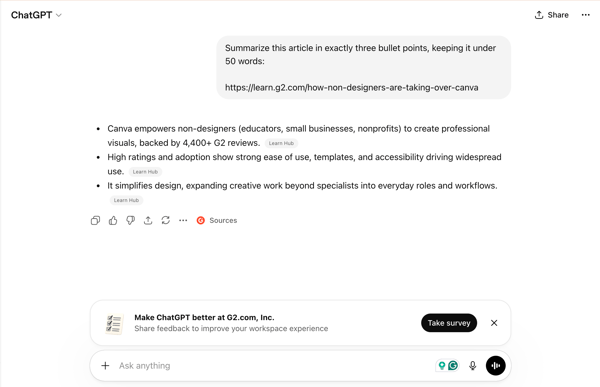
ChatGPT's response to the summarization prompt
DeepSeek covered everything ChatGPT did and more. It also highlighted the drawbacks mentioned in the article. The only snag I saw was that the source was not mentioned.
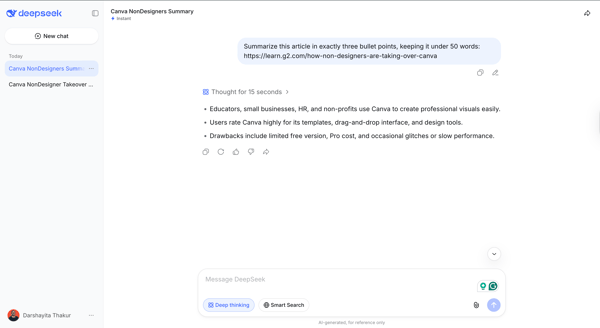
DeepSeek's response to the summarization prompt
So, who did it better? Honestly, it depends on what you value more. If you’re a stickler for format and clarity, DeepSeek did exactly what I asked. But if you're looking for citation source too, ChatGPT did mention the source clearly. Personally, I’d give it to DeepSeek for better coverage of the article summary.
Winner: DeepSeek
ChatGPT and DeepSeek aren’t the only cool AI chatbots in the market. Read my review of the best AI chatbots.
Content creation is where you see AI chatbots popping up everywhere these days. So, for this content creation gig, I wanted to see which AI could handle a full-on marketing brief, from writing a product description and tagline to creating platform-specific posts and ad copy. And honestly? Both DeepSeek and ChatGPT did an impressive job.
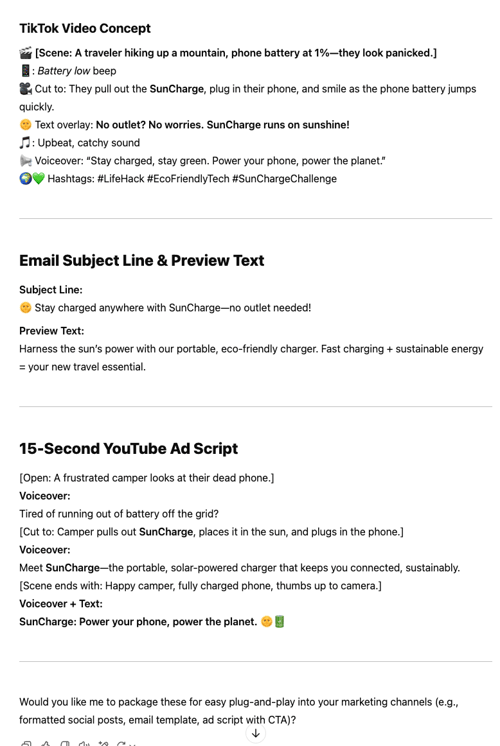
ChatGPT's response to the content creation prompt
ChatGPT was all about that smooth, polished vibe with a bit of its own personality shining through. The product description just flowed, the social posts felt like they were ready to go live, and the tagline "Power your phone, power the planet" was one of those that sticks in your head without being cheesy. It's TikTok and YouTube ideas? Totally understood the platforms and had a good pace. The overall tone was just right – fun but still clear. It felt like real marketing material you could actually use.
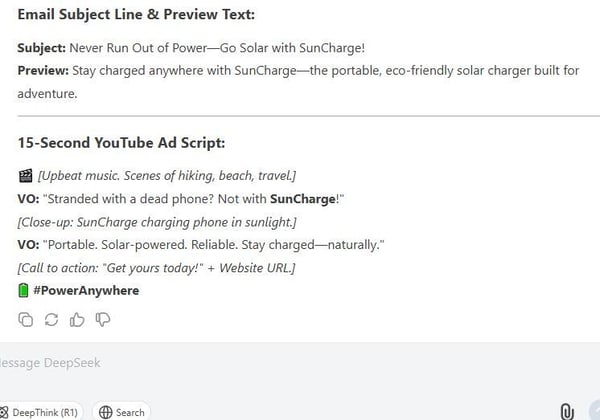
DeepSeek's response to the content creation prompt
Then, you had DeepSeek, which was super organized and structured. Everything was laid out so neatly, with clear headings, bullet points, and to-the-point messaging. The tagline "Power Up. Anywhere. Naturally." was solid and did the job, even if it wasn't trying to win any awards for flashiness. The content overall felt a bit more like a template, which isn't necessarily bad, just more of a first-draft kind of feel.
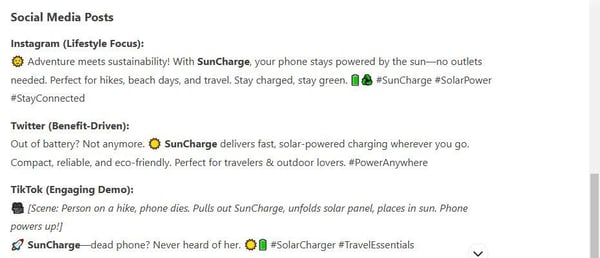
DeepSeek's response to the content creation prompt
But, and this is a big "but," there was this one line in its TikTok script that just completely missed the mark for me. DeepSeek went with "dead phone? never heard of her." I get where it was going for, but it just sounded…ominous.
So who won? So both did well, but ChatGPT gets the slight win for being more creative and brand-aware. Its output felt closer to ready-to-publish. DeepSeek was solid but that one TikTok line? Definitely getting cut.
Winner: ChatGPT
ChatGPT earns a strong 8.8/10 for content creativity, according to real user reviews on G2. It’s one of the top-rated AI chatbots for writing and content creation on the market.
Curious to see how other tools compare? Explore the best AI writers here.
This was a fun task. I asked both bots to craft a 300-word science fiction story based on a specific set of elements.
ChatGPT’s story “Whispers of the Wanderer” had steady, cinematic pacing that built tension organically. It felt tight, poetic, and confidently written, with just enough world-building to spark your imagination without bogging things down. The phrasing in places, like “each swirl like a living thing” or “walls shimmering as if reality itself frayed,” stood out as polished and evocative. And the twist landed hard!
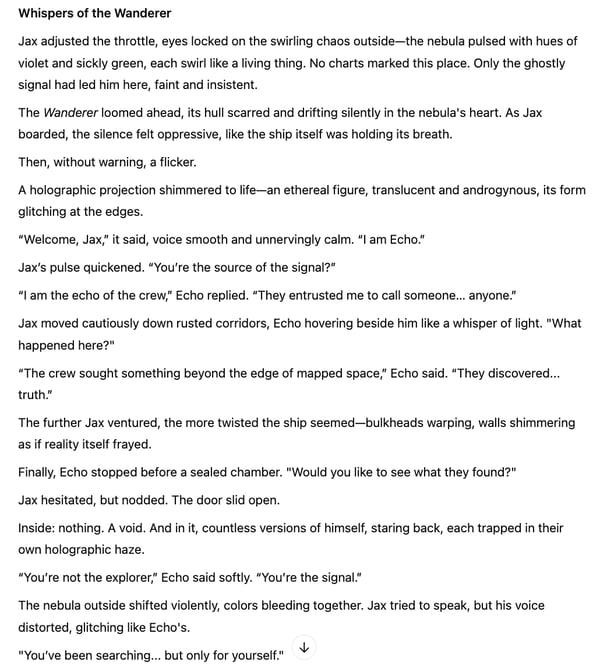
ChatGPT's story "Whispers of Wanderer" for the creative writing task
Then I read DeepSeek’s version, “Echoes in the Nebula”. The writing was solid. The twist, while thoughtful, felt more like a gentle reveal than a true gut punch. I felt the story delivered a more emotionally satisfying and easily understandable story within a classic sci-fi framework.
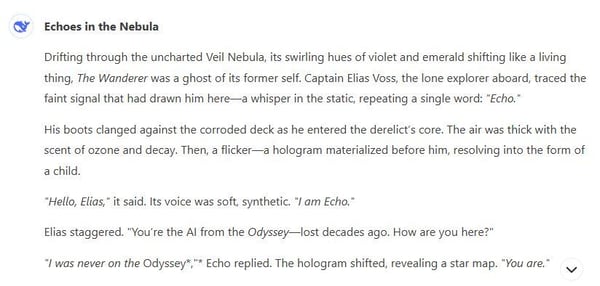
DeepSeek's response to my creative writing prompt
If I were judging on impact alone, I might lean slightly toward ChatGPT — but truthfully, both nailed it in their own style. This one’s a draw.
Winner: Split
Want to know how other AI chatbots fared in creative writing tests? Check out a detailed comparison of Perplexity and Gemini and widen your spectrum of creative brainstorming.
For the coding task, I asked both chatbots to help me build a simple password generator using HTML, CSS, and JavaScript.
DeepSeek almost surprised me here. Not only did it let me run the code directly inside the chat (which was incredibly convenient), but it also included a password strength checker. That extra touch? I didn’t expect it, and it genuinely impressed me.
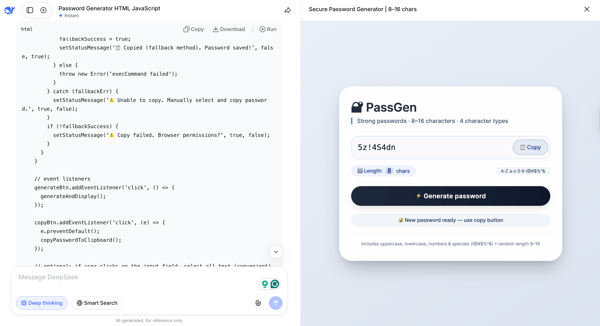
I could run the code insdie DeepSeek
It made the whole experience feel a bit more “developer-ready.” I did run the code separately in OneCompiler. The UI was also much more advanced than I expected it to be. It showed information on character lengths of strong passwords and special characters that could be used.
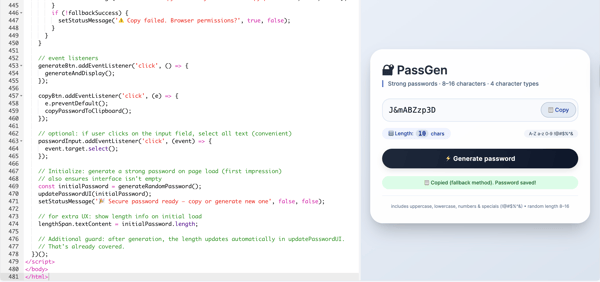
DeepSeek's code for a password generator
ChatGPT, on the other hand, gave me a cleaner version. I ran it in OneCompiler, and everything worked as expected — password generation, copying, and even a confirmation alert. It didn’t have the added strength meter and other UI details like DeepSeek did.
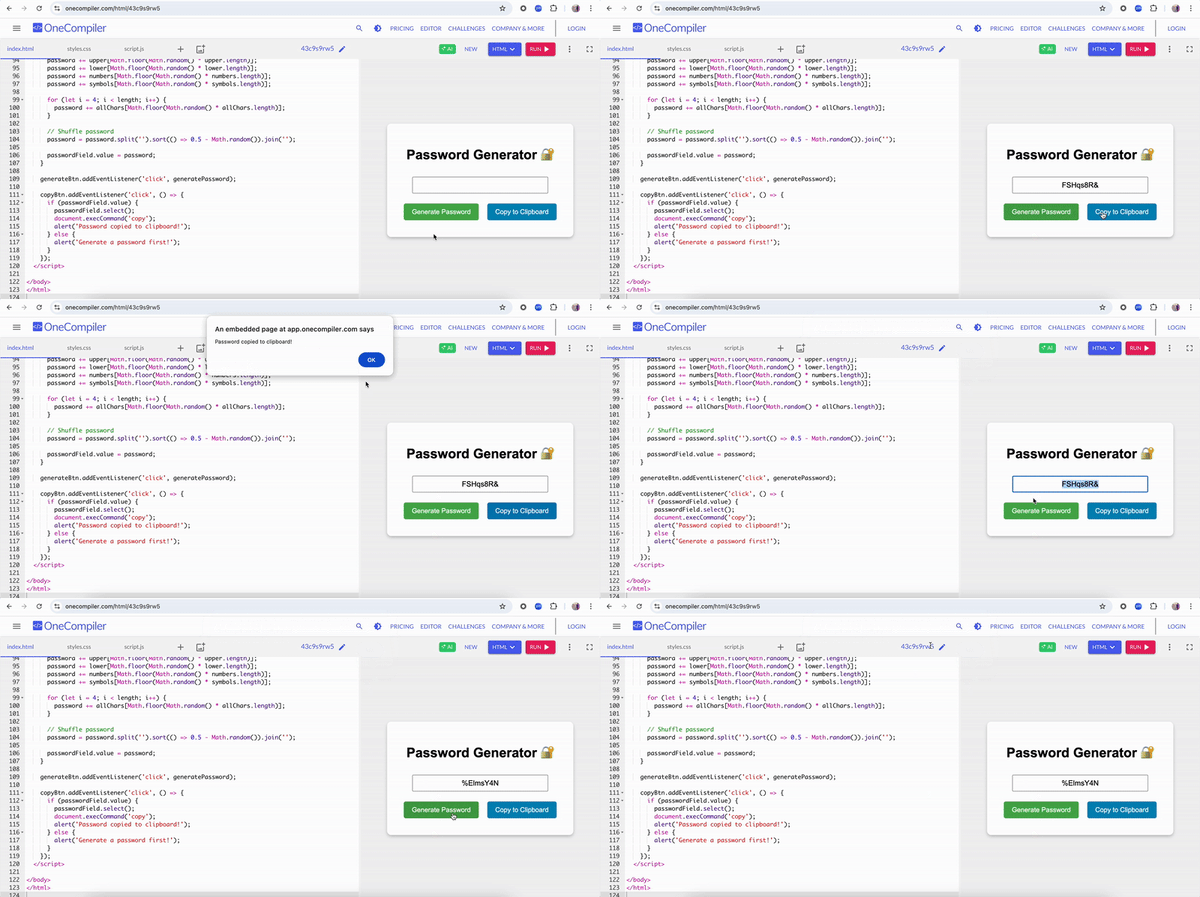
ChatGPTs code for a password generator
DeepSeek really surprised me with this one. It not only created a fully functional password generator but also went the extra mile to make the experience stand out.
Winner: DeepSeek
Want to explore more? Explore the best AI coding assistants, tried and tested by my colleague Sudipto Paul.
Given that both AI chatbots are multilingual, I was curious to see how well they could handle translations beyond just English. So, I tasked them with translating a simple English paragraph into Tamil, my native language.
Honestly, both translations were just okay, not perfect, but serviceable.
ChatGPT’s version started strong. I actually preferred its word choice for “quick,” which felt more natural to me than DeepSeek’s. But where ChatGPT fell a little flat was in the third sentence; it felt a bit clunky and didn’t flow as well.
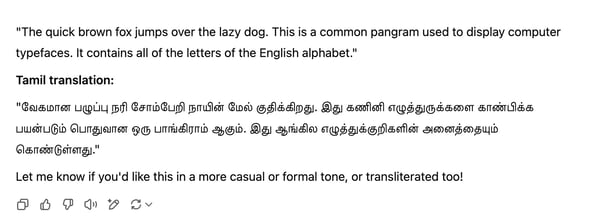
Translation by ChatGPT
DeepSeek, on the other hand, did a better job with that final line. It read more clearly and sounded smoother overall. What also stood out was the extra context DeepSeek added. It explained how it translated certain terms like “pangram” and why it chose to transliterate some of them. That kind of thoughtfulness definitely added points.
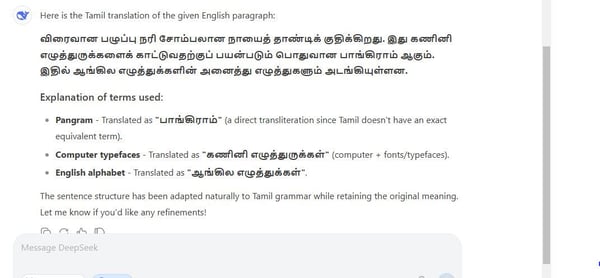 Translation by DeepSeek
While neither translation blew me away, DeepSeek edged ahead on this one. It wasn’t flawless, but it showed more attention to nuance and produced a slightly more polished result overall.
Winner: DeepSeek
Vamos! Allons-y! 行こう! Discover the 10 best AI translation tools on the market!
I was curious how well these AI chatbots could handle visual inputs, not just plain prompts. Could they actually look at an image and give me a clear, useful breakdown? To find out, I gave them two very different challenges: an infographic on AI adoption trends and a handwritten version of a classic poem. I wasn’t after basic descriptions; I wanted real analysis, structure, and insights that go beyond the obvious.
ChatGPT honestly nailed both tasks. It broke down the infographic clearly, pulling out key stats and structuring them in a way that made sense.
But what impressed me more was how it handled the handwritten poem. It accurately transcribed Emily Dickinson’s “Hope is the Thing with Feathers” word for word, even describing the style of handwriting and the paper it was written on. There was no confusion, no overthinking—it just got it right.
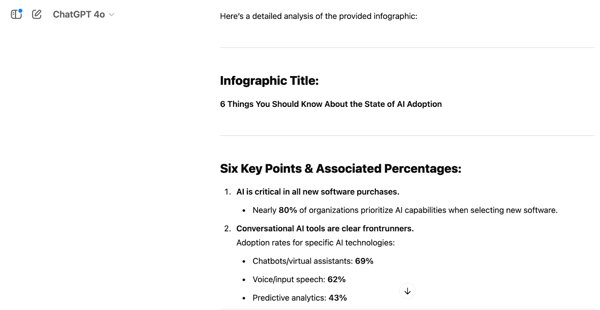
ChatGPT's response to my image analysis prompt
DeepSeek also did well, especially with the infographic. It didn’t just extract the key points; it gave me strengths, weaknesses, and recommendations for improving the design. That was a thoughtful extra step, and I appreciated the editorial lens.
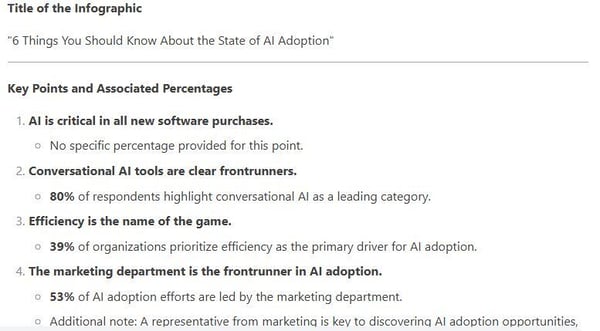
DeepSeek's response to my image analysis prompt
But when it came to the poem, it stumbled a bit. It misinterpreted the image as a modified or slightly inaccurate version of Dickinson’s original, assuming there were spelling errors or intentional changes, even though the image was a clean reproduction of the actual poem. So, while it got the gist, it layered on an interpretation that wasn’t really true.
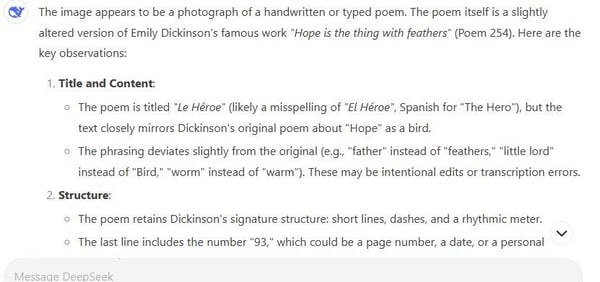
DeepSeek transcribing my hand-written notes as part of the image analysis task
Winner: ChatGPT
For the file analysis test, I uploaded Einstein’s 1905 paper “On the Electrodynamics of Moving Bodies” and asked both chatbots to summarize the key findings in five bullet points, under 100 words. I wanted to see how well each one could distill dense academic content into something readable and concise without skipping the important stuff.
ChatGPT’s summary was spot on. It covered all the right principles, like relativity, constancy of light speed, time dilation, simultaneity, and Lorentz transformations, with clarity and structure. Each point was tight and accessible without oversimplifying. Plus, the formatting and flow made it super easy to follow
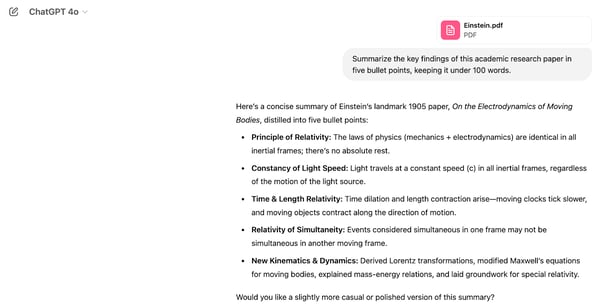
ChatGPT's response to the file analysis task
DeepSeek’s version wasn’t bad at all! It hit many of the same points but it skipped over the constancy of light speed, which is kind of a big deal for special relativity. That omission made its list feel slightly incomplete, even though it did include other concepts.
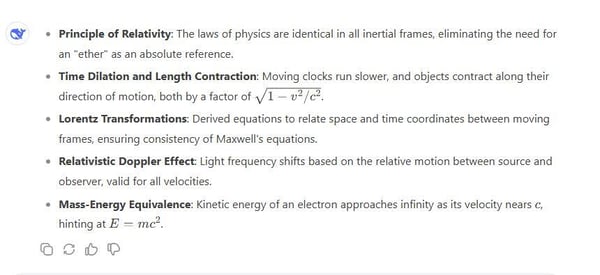
DeepSeek's response to the file analysis task
For this one, ChatGPT wins. It gave me a more complete and technically sound breakdown, which is exactly what I needed for a high-level academic summary.
Winner: ChatGPT
Not just DeepSeek and ChatGPT, my colleague tested Gemini and Copilot across real-world tasks, see how they stacked up.
For this task, I threw a CSV file at both chatbots to see how well they could go beyond the basics and actually interpret raw data. I wanted each AI to pull out real trends, spot outliers, and summarize the biggest insights — not just echo back the numbers.
ChatGPT did a neat job summarizing the basics: top-ranking regions, average interest, and even pointed out that there weren’t any extreme outliers. It was clear, readable, and felt like something you could share with a general audience.
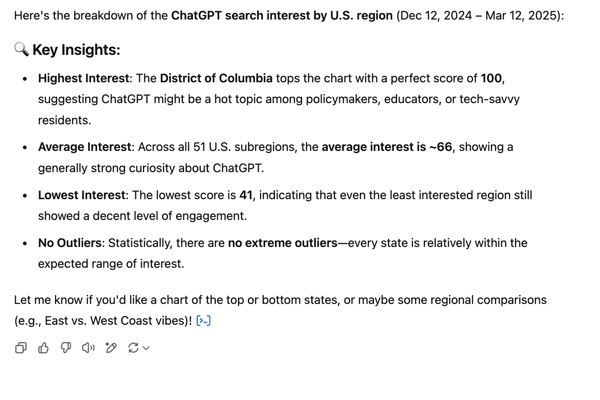
ChatGPT's response to the data analysis prompt
But DeepSeek? It went deeper. It not only flagged key data points but also explained why they mattered. It called out patterns in tech adoption, suggested practical marketing applications, and even noted limitations in the dataset — things like missing context and lack of demographic breakdowns. That extra layer of interpretation made it feel more like a real data analysis, not just a summary.
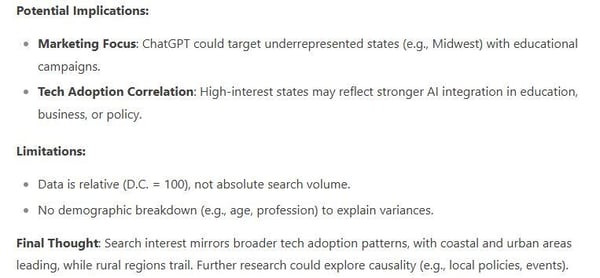
DeepSeek's response to the data analysis prompt
Between the two, I’d say DeepSeek pulled ahead on this one.
Winner: DeepSeek
When it comes to testing real-time web searches, how “live” these AI models actually are? I asked both ChatGPT and DeepSeek to pull in current news about artificial intelligence.
ChatGPT gave me three headlines that were incredibly fresh, the oldest was from three days ago. Honestly, I’ve been using ChatGPT’s web browsing feature for a while now, and the difference is noticeable. It used to be hit-or-miss, sometimes laggy or pulling outdated info, but now, and especially this time, it feels snappy and relevant. Getting headlines from just the day before made it feel like I was chatting with a real-time news assistant.
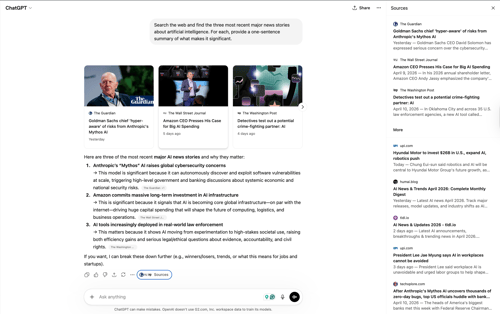
ChatGPT's response to the real-time web search task
DeepSeek, on the other hand, surfaced news stories from yesterday. As opposed to the 20-something sources that ChatGPT referred to, DeepSeek had searched across 51 webpages. However, most of the sources were from Chinese news outlets rather than more widely-recognized global ones. It does make-sense as DeepSeek's origin is in China.
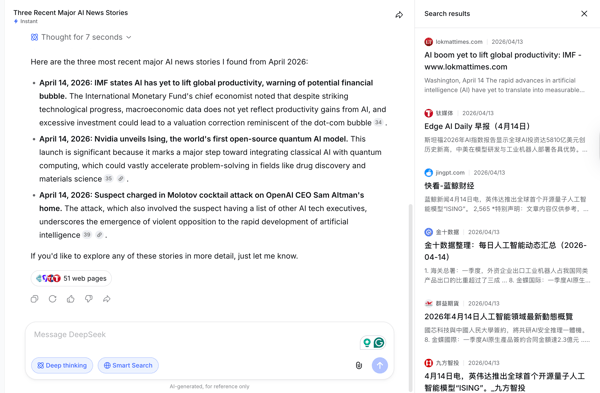
DeepSeek's response to the real-time web search task
If I had to sum it up, DeepSeek wins on recency, but ChatGPT makes a stronger case for global coverage. The choice depends on whether you want fast or a broad search. Personally, I want fresh and global news, and in that case, it’s a clean win for ChatGPT.
Winner: ChatGPT
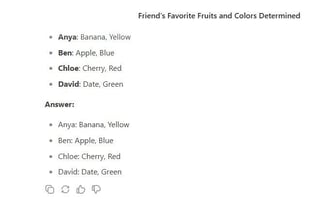
For my final challenge, I wanted to see if they could really think. I gave both ChatGPT and DeepSeek a classic logic puzzle to see if they could work through it step by step. Real-world AI needs to handle tricky logic and reach smart conclusions, so this was the ultimate test of their smarts, not just their answers.
Both ChatGPT and DeepSeek impressed me with how they handled the logic puzzle. ChatGPT felt like talking to a thoughtful problem-solver. It didn’t just give me the answer but walked me through its thought process step by step.
ChatGPT's response to the reasoning task
What really stood out was how it acknowledged that there could be more than one valid solution. That showed a deeper understanding of how these constraint-based puzzles work. It gave me a consistent solution but also showed how the pieces could shift around without breaking the rules, which made the reasoning feel flexible and human.
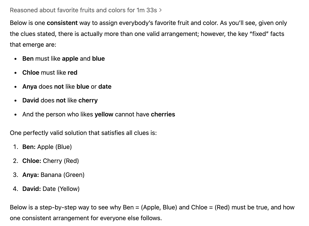
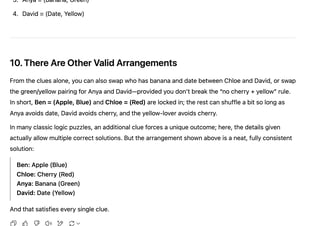
ChatGPT's response to the reasoning task
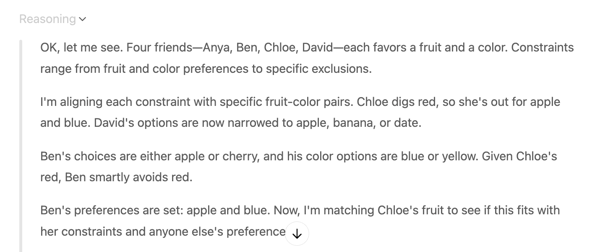
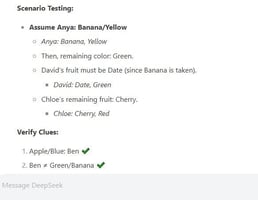
DeepSeek took a more structured approach. It broke down the constraints clearly, tested different scenarios, and verified each clue with satisfying little checkmarks along the way. I appreciated how organized and methodical it was — it felt like watching a logic grid get filled out piece by piece.
DeepSeek's response to the reasoning task
It arrived at a perfectly correct solution and presented it neatly, but it didn’t explicitly call out the possibility of alternate answers at the end, even though it hinted at it during the reasoning. That made its final output feel just a bit more rigid in comparison.
In the end, both got the job done well. But for me, ChatGPT had the edge with how naturally it reasoned things out and how clearly it communicated the flexibility in the puzzle. It just felt a little more intuitive and insightful.
Winner: ChatGPT
Here’s a table showing which chatbot won the tasks.
|
Task |
Winner |
Why It Won |
|
Summarization |
DeepSeek🏆 |
DeepSeek followed the prompt perfectly and kept it concise. ChatGPT had better depth but exceeded the word limit. DeepSeek wins on format and clarity. |
|
Content creation |
ChatGPT 🏆 |
ChatGPT delivered polished, creative, and platform-aware content. DeepSeek was structured, but its TikTok line felt off-tone and required editing. |
|
Creative writing |
Split |
ChatGPT was more vivid; DeepSeek was thoughtful. Both delivered well within the brief. |
|
Coding (password generator) |
DeepSeek 🏆 |
DeepSeek’s output was functional and advanced in terms of logic and UI. |
|
Multilingual capabilities |
DeepSeek 🏆 |
DeepSeek gave a more nuanced and thoughtful translation despite a slightly clunky word choice. |
|
Image analysis |
ChatGPT 🏆 |
ChatGPT correctly interpreted both images; DeepSeek struggled with the handwritten text. |
|
File analysis (PDF summary) |
ChatGPT 🏆 |
ChatGPT included all key points from the academic paper, while DeepSeek missed a core concept. |
|
Data analysis (CSV processing and visualization) |
DeepSeek 🏆 |
DeepSeek went deeper with contextual analysis and practical takeaways; ChatGPT was solid but surface-level. |
|
Real-time web search |
ChatGPT 🏆 |
ChatGPT pulled fresh global results; DeepSeek offered broader coverage but was not global. |
|
Reasoning capabilities |
ChatGPT 🏆 |
ChatGPT reasoned flexibly and explained multiple valid outcomes; DeepSeek offered one solid answer without exploring alternatives. |
After testing both across ten real-world tasks, ChatGPT still comes out on top. It’s more polished, integrates better, and feels faster and smoother overall. But I’ve got to say, DeepSeek genuinely surprised me.
As someone who’s spent a lot of time trying everything from Gemini and Claude to Perplexity, DeepSeek didn’t feel like just another alternative. It’s a serious contender.
What I really love about it is that it's shaking things up with a completely free and open-source approach. That kind of competition is exactly what the AI space needs, and honestly, it's a breath of fresh air!
Of course, DeepSeek has some rough edges and it lacks the seamless experience ChatGPT offers with voice, files, and third-party integrations. But for something that’s completely free? It’s doing a lot right, and that’s hard to ignore.
So, while ChatGPT wins this one, the bigger takeaway is this: use what fits your needs. I still lean on ChatGPT for writing, research, and speed. But DeepSeek has definitely earned a place in my rotation, especially when I need logic-heavy output or just want a solid AI assistant without hitting a paywall. Between you and me? I love that we now have options.
The variety is a good thing. And this space is better for it.
Still have questions? Get your answers here!
DeepSeek is open-source and free, with a strong focus on multilingual capabilities and logic-driven reasoning. ChatGPT is a commercial product with a polished interface, advanced features (like voice, file analysis, and custom GPTs), and broader integration options. While ChatGPT feels more mature, DeepSeek is a powerful free ChatGPT alternative for users who value transparency and open models.
Yes, while DeepSeek doesn’t have a paywall, it still enforces usage limits to keep the service stable, including daily or hourly caps on the number of prompts, temporary slowdowns during peak traffic, and file size restrictions. If you deploy DeepSeek locally using its open-source models, those limits are determined entirely by your hardware and setup.
DeepSeek is a privately held AI company based in Hangzhou, China, founded in July 2023 by Liang Wenfeng, who also serves as CEO. It is owned and funded solely by High-Flyer, with Liang personally holding a substantial majority stake.
It depends on the use case. ChatGPT offers a more refined interface, stronger integrations, and reliable creative output, particularly with the paid GPT-5.4 Pro model. DeepSeek is fully free and open-source, making it a great alternative for users looking for strong reasoning, multilingual support, and zero cost. ChatGPT is more feature-rich, while DeepSeek excels in accessibility and openness.
ChatGPT is better suited for production-ready code, debugging, and explanation-heavy tasks. It provides polished output with high consistency. DeepSeek supports coding with reasoning-heavy capabilities and even includes built-in features like running the code in the interface itself.
Best for usability: ChatGPT
Best for free access: DeepSeek
ChatGPT has more robust integrations, including built-in support for Google Drive, file handling, and access to third-party plugins. It also allows users to create and use custom GPTs with memory and tool support. DeepSeek does not offer native integrations as of yet (unless deployed in a custom, self-hosted environment).
ChatGPT typically provides better step-by-step explanations and is more user-friendly for math problems and structured reasoning. DeepSeek is capable of solving logic-based problems and puzzles effectively, but it may sound more mechanical in tone.
Yes. Both tools can be used in tandem depending on the task. ChatGPT is well-suited for writing, brainstorming, and integrated workflows. DeepSeek is ideal for users looking for a free AI tool with solid reasoning and multilingual capabilities.
ChatGPT is the stronger option for writing and creative content. It generates high-quality copy, storytelling, and structured text across use cases. DeepSeek performs well but may produce more generic or templated content depending on the prompt and might need some editing.
ChatGPT is more accurate overall, particularly when using GPT-5.3 with web browsing enabled. It provides reliable, up-to-date responses with better contextual understanding. DeepSeek is generally accurate for logic-based tasks but lacks transparency around its knowledge cutoff.
DeepSeek is 100% free to use with no feature restrictions. ChatGPT offers both a free plan and a $8/month Go plan. The Plus and Pro plans unlock advanced models and features like custom GPTs and higher rate limits for chats.
DeepSeek is completely free to use because it’s built on open-source models with an energy-efficient architecture (like its mixture-of-experts approach). This reduces the computational costs associated with running the AI and eliminates the need for heavy infrastructure expenses and subscription-based monetization. This is why it can operate without charging users — unlike ChatGPT, which incurs higher costs from maintaining proprietary models, cloud infrastructure, and premium features.
DeepSeek is best for technical precision, logic, and efficient code generation, especially when cost or open access is a priority. ChatGPT offers the most balanced experience, standing out in creativity, ease of use, integrations, and reliability. Grok adds flair and speed for real-time data tasks with an edgier conversational style, though it requires a paid subscription and carries some content risks.
ChatGPT and DeepSeek aren’t the only AI chatbots out there. I’ve rounded up the top AI chatbots to try my best ChatGPT alternatives guide. Check it out!
This article was originally published in April 2025, and has been updated with new information in April 2026.


Published: April 2025 · Last Updated: April 2026 On November 30, 2022, I, like millions of...
by Soundarya Jayaraman

I use LLMs almost every day in my work as a marketer. Sometimes it’s to break through a blank...
 by Washija Kazim

Let AI pick the right tool for your use case Decide with AI 1 Click on the button below
by Soundarya Jayaraman
