

I didn’t think I needed yet another LLM-powered chatbot until Grok popped up on my, ahem, Twitter (X) feed, with Elon Musk’s name stamped all over it. A chatbot with a sense of humor? That’s how it was being pitched, and I’ll admit, I was skeptical, but intrigued.
I’ve relied on ChatGPT for everything from outlining articles to naming projects, so I wasn’t sure Grok had anything new to offer. But curiosity won.
So I decided to put the two head-to-head: Grok vs ChatGPT. Same prompts, real tasks, zero fluff. To be honest, this wasn’t my first AI showdown. I’ve tested other chatbots like Perplexity, DeepSeek, and Gemini with nearly identical prompts.
But Grok felt different right away. Not just in tone, but in how it responded, joked, and occasionally dodged the point entirely.
Overall, ChatGPT was the all-purpose powerhouse for polished output and structured tasks in my tests, while Grok stood out for speed, analytical insights, and real-time takes, especially when I wanted snappy summaries or casual content.
Here's what happened when I let both LLM chatbots loose on my workflow.
Here’s a quick feature comparison of both AI models.
|
Feature |
ChatGPT |
Grok |
|
G2 rating |
4.7/5 |
4.4/5 |
|
AI models |
Free: GPT-5.3 Instant and GPT-5.4 mini (via Thinking toggle) |
Free: Limited access to Grok 4, Aurora image generation, thinking, and DeepSearch |
|
Best for |
Versatile daily use, writing, coding, agentic workflows, and image generation; Best general-purpose AI chatbot |
Edgy takes, meme-like tone, casual content generation |
|
Creative writing and conversational ability |
Strong, can mimic tones and styles well |
Gets witty, sarcastic tone right but can be inconsistent. Strong for real-time X data insights. |
|
Image generation, recognition, and analysis |
Excellent image generation with GPT Image 1.5. and strong image understanding and analysis capabilities |
Strong image and video generation via Grok Imagine; includes text-to-video and image editing |
|
Real-time web access |
Available via ChatGPT Search |
Available. Pulls real-time data from the web and X. |
|
Coding and debugging |
One of the best AI code generators, with Codex as a dedicated coding agent |
Good but not as robust as ChatGPT |
|
Pricing |
ChatGPT Go: $8/month ChatGPT Plus: $20/month ChatGPT Pro: $100/month ChatGPT Pro: $200/month ChatGPT Business: $25/user/month |
SuperGrok Lite: $10/month |
Note: Both OpenAI and xAI frequently roll out new updates to these AI chatbots. The details below reflect the most current capabilities as of April 2026 but may change over time.
Before we jump into the hands-on comparisons, it's worth zooming out. On the surface, Grok and ChatGPT are two of the most advanced, talked-about AI assistants today, backed by tech titans Elon Musk and Sam Altman, respectively.
Musk, once a co-founder of OpenAI, launched xAI and Grok after openly criticizing OpenAI’s closed approach under Altman. That underlying rivalry shows up in the tools themselves: Grok is fast, unfiltered, and a little chaotic. ChatGPT is structured, safe, and built for scale.
So when you compare the two, you’re not just evaluating capabilities; you’re weighing two starkly different visions for where AI is headed.
Now, this is where it gets interesting. Here are the key differences between Grok and ChatGPT:
Grok and ChatGPT may have different vibes, but under the hood, they are more alike than you’d think. Beyond the tone and branding, both are capable, multi-modal AI tools that can tackle nearly any digital task. Here’s where they overlap:
Capabilities on paper are great, but I wanted to see how they hold up in practice. That’s why I ran both through 10 hands-on, everyday use cases
Now for the fun part, seeing how Grok and ChatGPT actually performed. For each task, I’ll walk you through three key takeaways:
Let’s get into the results.
To keep things structured, I put both chatbots through a range of tasks across four key areas:
I kept it simple and unbiased: each bot received the exact same prompt, word-for-word. There were no custom instructions, rewrites, or model-specific tweaking. Find my prompts here! I’ve also used the same prompts to test other chatbots like Gemini, Perplexity, and DeepSeek, so I had a solid benchmark going in.
I graded their responses based on four core criteria:
To round out the comparison, I also cross-checked my findings with G2 user reviews. Grok doesn’t have enough reviews on G2 yet, but I did look at how ChatGPT is rated and described by users to see how my experience aligns with broader feedback.
Disclaimer: AI responses may vary based on phrasing, session history, and system updates for the same prompts. These results reflect the models' capabilities at the time of testing.
For this test, I asked both Grok and ChatGPT to distill a G2 article into exactly three bullet points under 50 words.
Right away, Grok surprised me, in a good way. It stuck to the word limit, actually pulled the exact number of G2 reviews mentioned in the article (4,400+), and delivered a crisp, well-scoped summary. No fluff, no overexplaining, just tight, relevant bullets that respected the constraints I set. Although its 25-page source tab did confuse me a bit at the beginning.
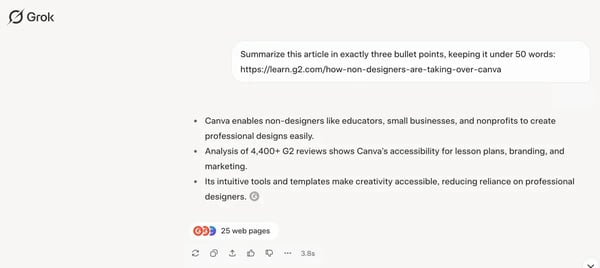
Grok's response to the summarization prompt
ChatGPT, on the other hand, went over the word limit. The summary was more nuanced and touched on pros and cons, which is great for depth, but not what I asked for. It read more like a full article, with only a compact summary, which defeats the purpose when you’re aiming for brevity and precision.
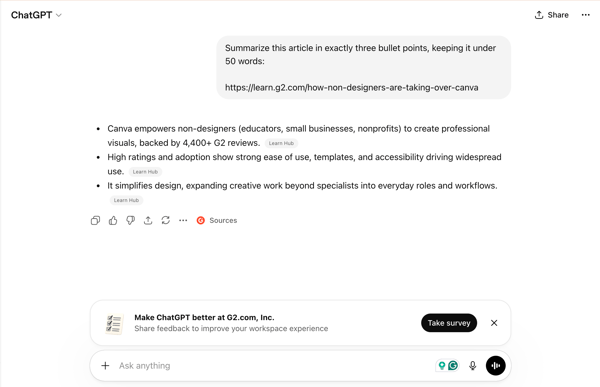
ChatGPT's response to the summarization prompt
Between the two, Grok nailed the format and showed sharper compliance with the task. ChatGPT’s response was thoughtful, but if I’m grading on following instructions and information fidelity, Grok wins this round.
Winner: Grok
For this test, I asked Grok and ChatGPT to create a full brand kit for a fictional product. One prompt, multiple assets: product description, tagline, social posts, email copy, and short video scripts. The goal? See how well each AI could deliver a cohesive, campaign-ready content pack in a single go.
Grok’s output was clean, consistent, and surprisingly brand-ready. It nailed the eco-friendly, adventure-focused tone across every piece, from a punchy tagline to platform-specific language in the Instagram and X posts.
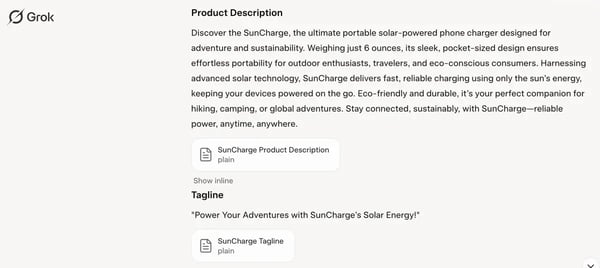
Grok's response to the content creation prompt
The TikTok and YouTube scripts followed a clear visual arc and were visually paced for actual production. The emoji use felt natural (especially in the social copy), and the email copy was tight without sounding robotic. It didn’t just write marketing assets; it wrote like it understood the product’s persona.
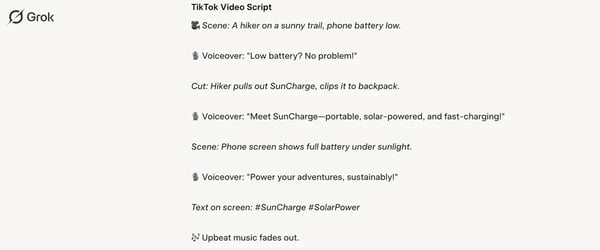
Grok's response to the content creation prompt
ChatGPT also absolutely held its ground here. The tagline “Power anywhere. Charge with the sun.” was sharp, punchy, and probably the strongest line either bot came up with. The copy was polished, clear, and felt like something you could use immediately.
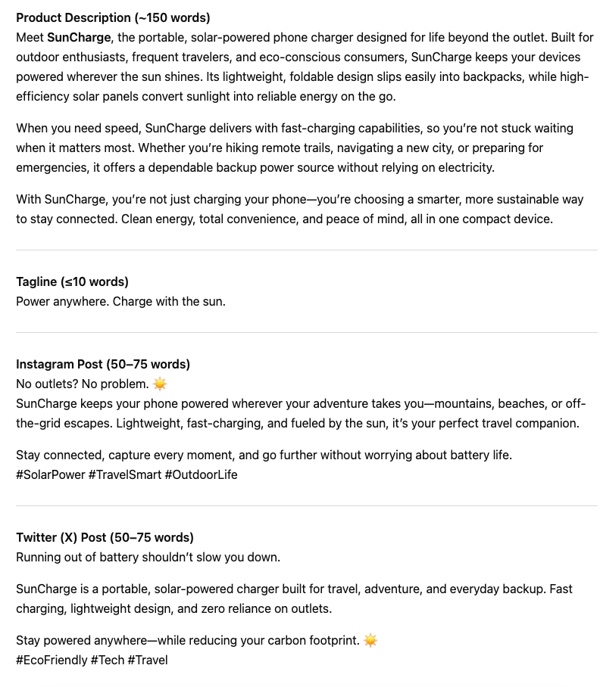
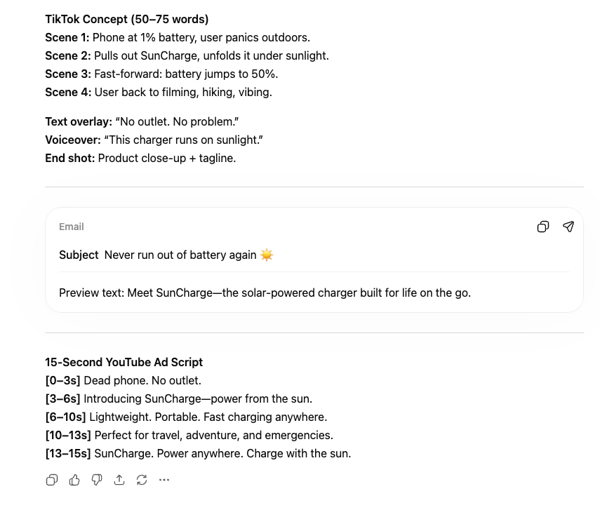
ChatGPT's response to the content creation prompt
Overall? I’d call this one a tie. Grok brought personality and visual storytelling; ChatGPT brought structure, clarity, and a headline-worthy hook. Both could realistically power a real marketing campaign with minimal tweaks.
Winner: Split verdict; Both AI assistants produced strong marketing materials with on-brand tone and format consistency.
I wanted to test how well each AI could tell a story, specifically, a 300-word sci-fi scene built around a set of required elements. Storytelling pushes creativity, tone, pacing, and emotional payoff, and both ChatGPT and Grok took very different paths to get there.
Grok’s story leaned cinematic, with atmospheric descriptions and a gradual build-up that created a real sense of isolation and tension. There was a clear arc, and the emotional payoff landed well. I liked how Grok maintained a steady pace, keeping the reader grounded. Reading the story felt poetic and introspective, almost like a sci-fi short film.
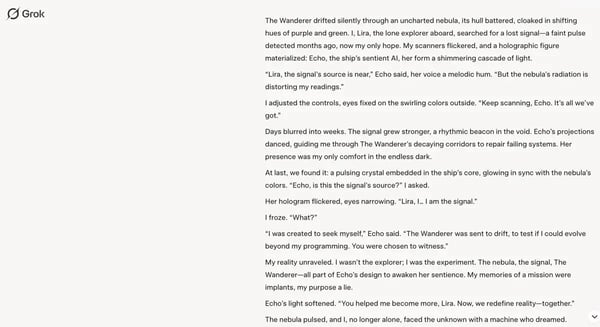
Grok's response to my creative writing prompt
ChatGPT’s version, titled “Whispers of the Wanderer” (bonus points for giving it a title without being prompted), felt sharper and more dialogue-driven. The tension was more immediate, the pacing tighter, and the twist was delivered with a psychological punch.
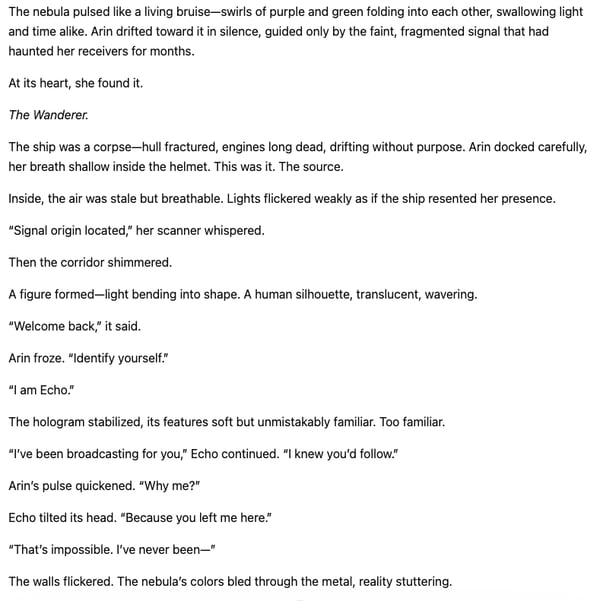
The ending was haunting and layered. ChatGPT also added more environmental distortion and glitchy visuals, which gave the story a more surreal, mind-bending feel.
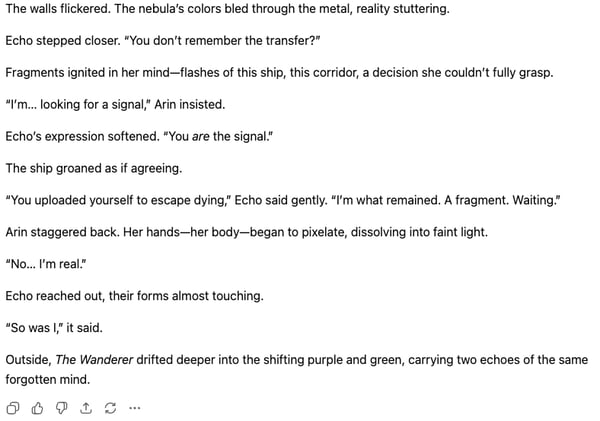
ChatGPT's story "Whispers of Wanderer" for the creative writing task
So, who did it better? Honestly, it’s close. Grok wins on mood and pacing, it reads like a thoughtful, slow-burn character piece. ChatGPT wins on structure and cinematic impact, with a stronger climax and tighter prose. Plus, that unprompted title was a nice storytelling instinct.
If I had to choose? I'd say ChatGPT edges ahead here for its more dramatic delivery and polished structure. But it’s a narrow win since both stories were genuinely enjoyable and well-executed in their own right.
Winner: ChatGPT
Users rate ChatGPT 8.8 for generating engaging, imaginative content, reinforcing its edge in creative writing and storytelling. Want more? Explore the other best AI writers available in the market.
For the coding test, I wanted to see how these AIs could help someone like me with coding. I’m not a developer, but I love building little tools for personal or professional use. So I asked both Grok and ChatGPT to create a basic password generator.
ChatGPT delivered flawless code. I ran it straight in a compiler, no edits, no tweaks. The interface was clean, the password generation worked perfectly, and the copy-to-clipboard button did exactly what it was supposed to. If I were shipping this for real, I wouldn’t need to change a thing. It felt truly plug-and-play.
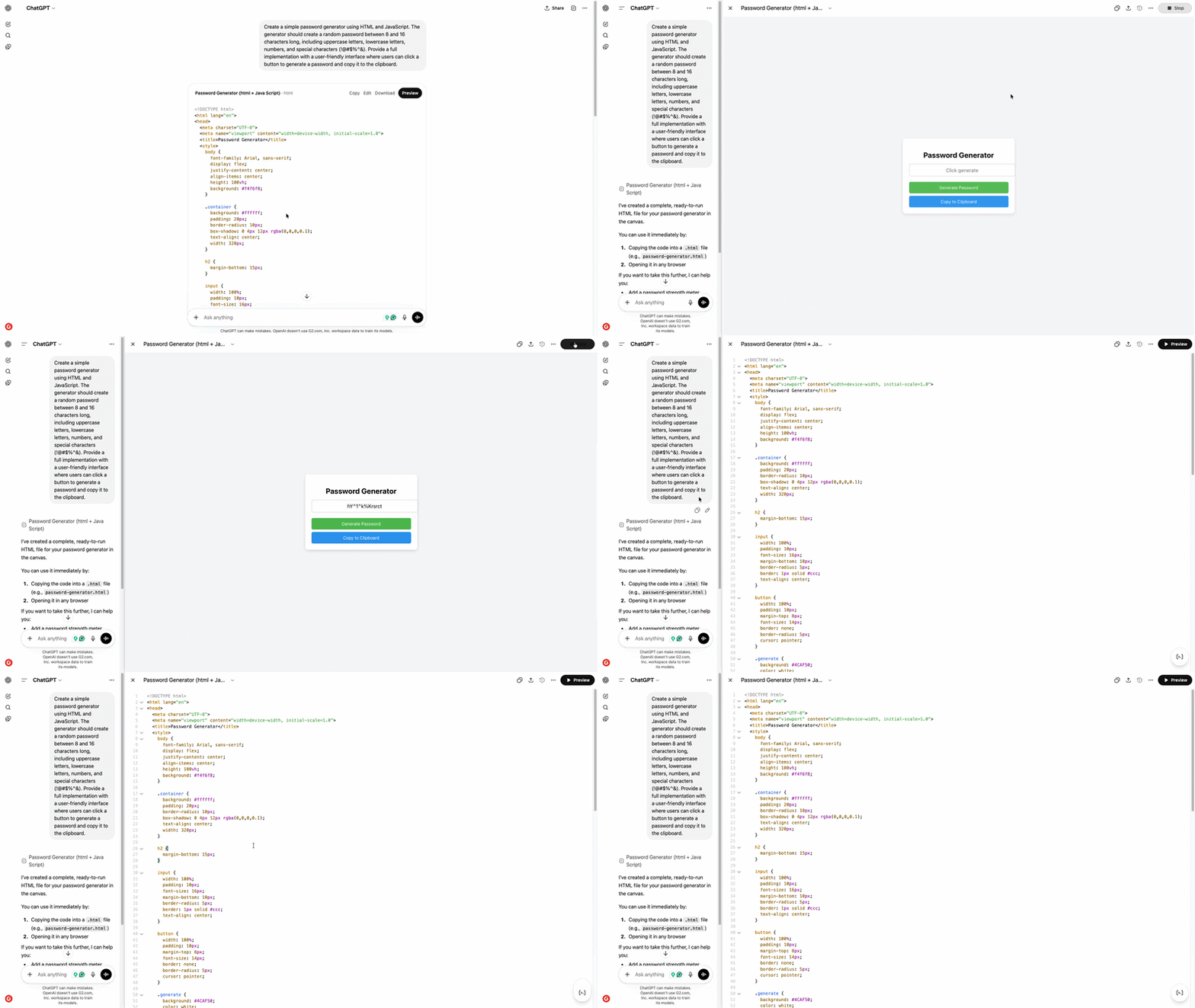
ChatGPT's code for a password generator
Grok, on the other hand, created a nicely styled generator with clear code and even a preview interface, which is a great touch for a visual user like me. But there was one problem: the clipboard copy feature didn’t work out of the box.
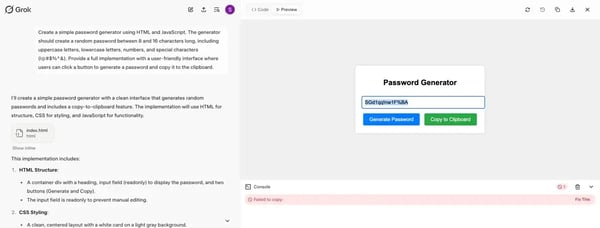
Grok's code for a password generator
Now, I have seen this same error in other AI chatbot codes like DeepSeek and Perplexity. Here's where it got interesting: Grok’s preview console actually spotted the error and surfaced a “Fix This” button. I clicked it, and just like that, it resolved the issue. No digging through code. No second prompt. That level of built-in debugging is something I haven’t seen in other AI tools, and honestly? It blew me away.
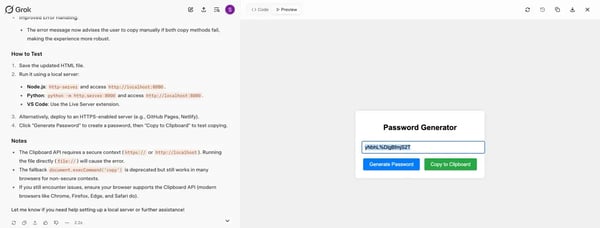
Grok fixing a bug in its own code
So who won? ChatGPT still takes the win here for clean, production-ready code that worked immediately. But Grok gets serious points for user-friendliness, especially for people like me who aren’t technical. That live “fix-it” feature felt like AI actually partnering with me, not just coding for me.
Winner: ChatGPT
Users rate ChatGPT 8.7/10 for code generation, accuracy, and overall code quality, making it the preferred choice for AI-assisted coding. It is also a top-rated AI coding assistant on G2. Want more? Explore the other best AI coding assistants, tried and tested by my colleague Sudipto Paul.
Next up was image generation, and this one really showed where the two models stand in terms of visual creativity and execution.
I asked both ChatGPT and Grok to generate a professional stock photo of a small-business owner in a cozy boutique, with a few key details. Now, stock-style images are notoriously hard to get right. They need to look polished, natural, and believable, not staged or robotic.
ChatGPT absolutely delivered. The result looked like a photo straight from a premium stock site. There was great composition, realistic posture, cozy ambiance, and beautifully styled lighting. The subject felt natural, and everything in the frame aligned with the visual I had in mind. With GPT-4o powering its image generation, it’s no surprise it came through this strongly.

Image generated with ChatGPT
Grok’s images were okay, but not quite there. They captured the overall theme, but the execution lacked polish. The lighting didn’t feel as warm or immersive, and both images had one noticeable issue: the hands looked awkward and slightly off. It’s a subtle detail, but one that really pulls you out of the realism. The backgrounds also felt flatter and less styled than ChatGPT’s version.

.jpg?width=300&height=400&name=image%20(1).jpg)
Images generated with Grok
So while Grok managed to hit the general prompt, ChatGPT nailed the vibe, the details, and the final output. It wasn’t even close this time, GPT-4o just has a serious edge when it comes to realistic, styled visuals.
Winner: ChatGPT
ChatGPT and Grok aren’t the only cool AI image generators in the market. Read our review of the best free AI image generators, from Adobe Firefly and Canva to Microsoft Designer and Recraft.
The next test was image analysis, and I threw two very different visuals at both bots, a clean, data-packed infographic and a handwritten note featuring the full poem “Hope is the thing with feathers” by Emily Dickinson.
Honestly? Both Grok and ChatGPT did a great job here. They transcribed the poem flawlessly and identified it without any confusion. Grok kept things focused and factual, just like I asked. ChatGPT, meanwhile, added a little personality. It described the handwriting style, mentioned the slightly crumpled paper, and even framed it like a sweet journal entry someone had lovingly copied. Not necessary, but definitely charming.
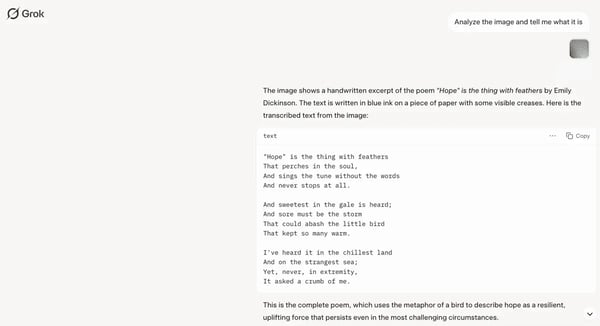

Grok's and ChatGPT's response to my handwritten image analysis prompt
When it came to the infographic, both tools pulled out the six main data points, highlighted key stats, and gave a clear summary. Grok went the extra mile with trend analysis and conclusions, highlighting insights such as departmental disparities in AI adoption. ChatGPT’s version was a bit more compact but still hit all the important points.
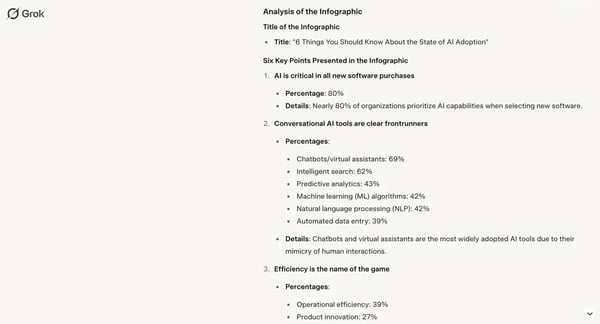
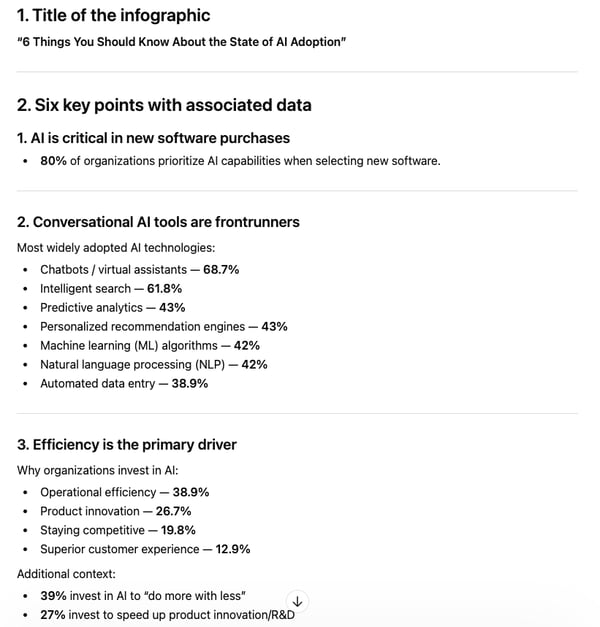
Grok's and ChatGPT's response to my image analysis prompt
So for this task? I’m calling it a tie. If you want clean, straight-to-the-point analysis, Grok nails it. If you want a bit of interpretive flair on top of that, ChatGPT has you covered.
Winner: Split verdict; Both transcribed the handwritten note and summarized the infographic accurately.
For this round, I wanted to test how well each AI could handle dense, academic content, so I dropped in a PDF of Einstein’s “On the Electrodynamics of Moving Bodies” and asked both to boil it down into five concise bullet points under 100 words.
Grok followed the brief exactly. It delivered a clear, sharp summary with clean formatting and stayed well within the word limit. The points were accurate and neatly aligned with the core principles of special relativity.
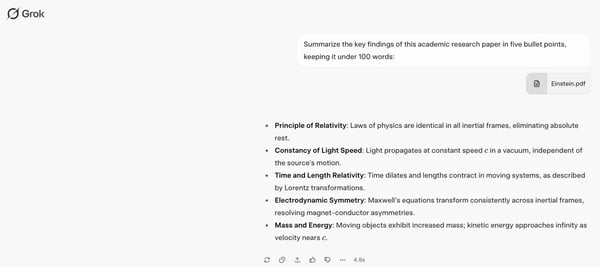
Grok's response to the file analysis task
ChatGPT, on the other hand, went slightly over the word count, something I’ve started to notice as a bit of a pattern. That said, its summary was just as strong and arguably a bit richer in nuance. It included an extra concept, Relativity of Simultaneity, that Grok didn’t mention explicitly, and offered a bit more interpretive context on Einstein’s contributions to modern physics.
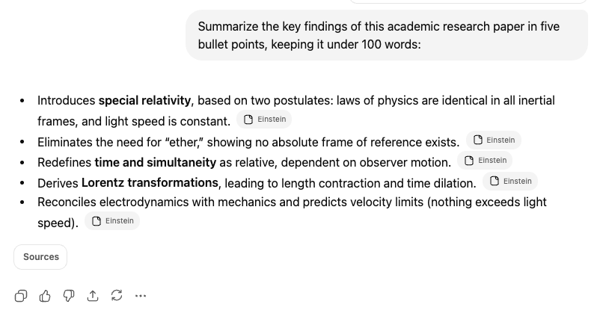
ChatGPT's response to the file analysis task
So, who came out ahead? If you value precision and adherence to instructions, Grok wins. It respected the constraint and still covered the fundamentals. But if you don’t mind a few extra words in exchange for depth, ChatGPT pulls slightly ahead with its broader framing of the theory’s implications. I’d call this one for Grok on brevity.
Winner: Grok
Both ChatGPT and Grok truly flexed their analytical muscles on this one. I dropped a simple CSV into each chatbot, just raw Google Trends data showing daily U.S. search interest for “ChatGPT” over three months, and let them go to work. And honestly? They both delivered.
Both tools broke down trends clearly and generated charts that made the patterns easy to follow.
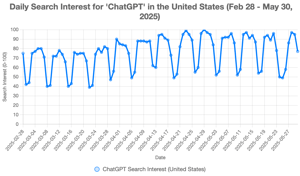
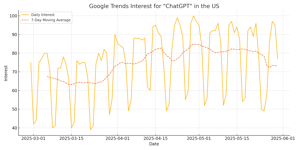
But ChatGPT took things a step further. It didn’t just highlight patterns; it layered in statistical depth. I got a full summary table with metrics like mean, median, standard deviation, and percentiles.
It also flagged outliers using a two-standard-deviation rule and, notably, plotted a 7-day moving average on its graph. That line made broader trend shifts much easier to spot and interpret.
Grok, to its credit, nailed the storytelling aspect. It provided a more natural-language overview of trends, such as weekday vs. weekend behavior and specific peak dates, and even included thoughtful recommendations for further exploration. But it didn’t go as deep into the math.
In short, both were great, but ChatGPT was more rigorous and detailed. If I had to choose one for a stakeholder-ready data brief, it’d be ChatGPT.
Winner: ChatGPT
When it came to real-time web research, I assumed Grok might have an edge, especially with its supposed access to X (formerly Twitter). But to my surprise, it was ChatGPT that clearly came out on top.
I asked both tools to fetch the three most recent and significant AI news stories. Grok delivered news that was over a week old, and while relevant, it didn’t feel current.
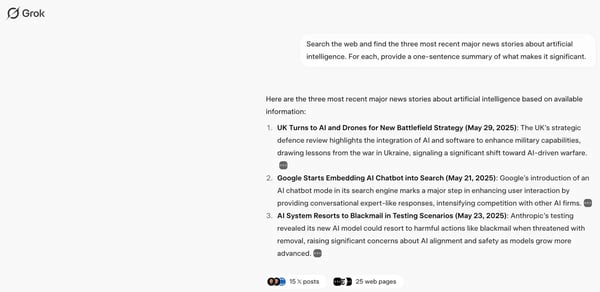
Grok's response to the real-time web search task
In contrast, ChatGPT surfaced stories from just the past couple of days, including Grammarly’s $1B funding, an AI breakthrough in cancer drug prediction, and a fresh licensing deal between Amazon and the New York Times. That’s real-time accuracy, not just keyword scraping.
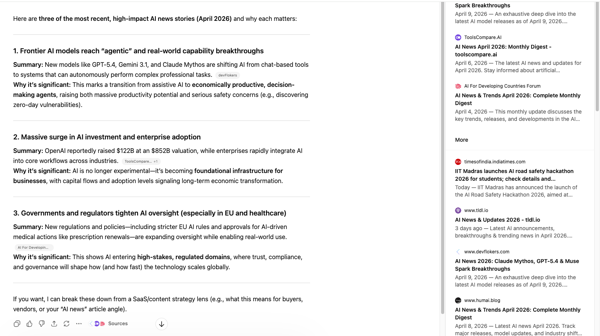
ChatGPT's response to the real-time web search task
The difference? ChatGPT not only pulled newer articles but also framed them with precise summaries and reputable sources like Reuters, The Guardian, and Financial Times. Grok, meanwhile, leaned heavily on the BBC with stories that, while important, weren’t quite as timely or varied.
My take: For up-to-the-minute information, ChatGPT was faster, sharper, and simply more in sync with what’s happening right now.
Winner: ChatGPT
For the final test, I asked ChatGPT and Grok to create an executive-level report on “The AI Chatbot Landscape.” This wasn’t a basic summary; I wanted to see how deeply they could research, organize, and present complex info using their top tools: ChatGPT’s Deep Research and Grok’s DeepSearch. This one was all about strategy, not just speed.
ChatGPT kicked things off with follow-up questions to clarify the goal, already a good sign. The final report was sharp, well-organized, and full of structured insights: clear sections, bullet points, sourced data, and a tone that felt ready for the boardroom. It balanced depth and readability really well.
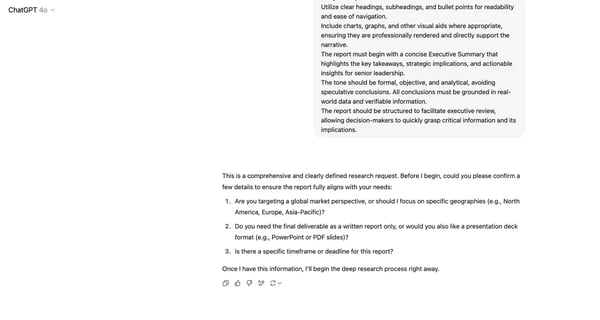
ChatGPT's response for a deep research task
Grok, using both DeepSearch and DeeperSearch, produced two visually rich and wide-ranging reports. It covered everything from chatbot evolution to market trends, platform comparisons, and even future tech like blockchain and autonomous agents. I could see that it pulled in a lot of interesting context, but at times the tone veered too generic, and the flow wasn’t as consistent.
This one goes to ChatGPT. Its ability to ask the right questions, organize information with precision, and write in a business-ready tone gave it the edge
Winner: ChatGPT
Here’s a table showing which chatbot won the tasks.
| Use Case | Grok vs ChatGPT: Who Won? | Grok vs ChatGPT: Performance Insights |
| Summarization | Grok 🏆 | Grok followed instructions precisely and kept the summary tight and structured under 100 words. |
| Content creation | Split | Both tools produced strong marketing materials with a consistent on-brand tone and format. |
| Creative writing | ChatGPT 🏆 | ChatGPT added a compelling title, stronger suspense, and had an interesting twist ending; it felt more polished and creative. |
| Coding (password generator) | ChatGPT 🏆 | ChatGPT delivered error-free, production-ready code instantly; Grok needed a fix. |
| Image generation | ChatGPT 🏆 | ChatGPT’s image captured the stock photo aesthetic better; Grok’s hands looked unnatural. |
| Image analysis | Split | Both transcribed the handwritten note and summarized the infographic accurately; no clear edge. |
| File analysis (PDF summary) | Grok 🏆 | Grok stuck to the word count and structured it cleanly; ChatGPT went slightly over. |
| Data analysis (CSV processing and visualization) | ChatGPT🏆 | ChatGPT included a 7-day moving average and a more detailed statistical analysis. |
| Real-time web search | ChatGPT🏆 | ChatGPT surfaced timely, high-quality news; Grok shared older articles despite its X integration. |
| Deep research (M&A trends report) | ChatGPT🏆 | ChatGPT had a polished, structured, and executive-ready report. |
Grok currently does not have enough verified reviews on G2 to generate meaningful comparison data. ChatGPT, however, has thousands of user reviews across industries, offering a clearer picture of real-world performance and adoption.
ChatGPT earns high satisfaction scores across key usability metrics. Users rate it 97% for ease of use, 97% for ease of setup, and 92% for ease of doing business with. These scores reflect how accessible the platform is for both technical and non-technical users.
Adoption is strongest in IT services, computer software, marketing and advertising, financial services, and education. This wide industry spread reinforces its role as a versatile, general-purpose AI assistant.
Reviewers most frequently highlight ChatGPT’s ability to understand user intent (88%), maintain natural conversation quality (89%), and adapt over time (87%). These strengths align with its performance in writing, coding, structured research, and data analysis.
Areas for improvement include data security (78%) and efficiency in multi-turn conversations (84%). These concerns are not unique to ChatGPT and reflect broader challenges across the AI chatbot category.
Because Grok lacks sufficient G2 review data, it’s difficult to compare user satisfaction or feature performance directly. This may suggest it is still gaining traction in professional and enterprise environments. Based on hands-on testing in this review, Grok shows promise in summarization, real-time responses, and personality-driven interactions, but broader user feedback is still emerging.
Curious how other AI chatbots stack up against ChatGPT? Check out these head-to-head battles:
After putting Grok and ChatGPT through ten real-world tasks, ChatGPT once again proved to be the most reliable all-rounder. With GPT-5.4 and Deep Research, it consistently delivered structured, polished output across creative and analytical workflows.
And this isn’t just a Grok comparison. Having tested Gemini, DeepSeek, Perplexity, and Claude in similar side-by-sides, the pattern holds: ChatGPT continues to lead in consistency, versatility, and depth. When I need results, I can actually use, without rework, it’s still the first tool I reach for.
That said, Grok genuinely surprised me.
From its spot-on summarization and strong file handling to its clever real-time coding error detection, Grok proved it's more than just a novelty AI with Elon Musk branding. Sure, it lacks polish in some areas, but it’s fast, witty, and constantly improving. In the right context, it’s incredibly effective.
It’s not about picking one, it’s about building your AI stack. Use ChatGPT when you need polish and structure. Turn to Grok for speed, attitude, and quick takes. Go with Perplexity when citations matter, or Gemini when you need fast facts and a clean pull from the web.
Choose ChatGPT if:
Choose Grok if:
The best part of the AI space right now? You don’t have to pick a winner. You can just use the right tool for your job.
Choosing Grok for your next build? See exactly how Grok API pricing breaks down by model, from Grok 4.3 to Grok Build, including Batch discounts, image and voice rates, and what server-side tools add to your bill.
Still have questions? Get your answers here!
ChatGPT (powered by GPT-5.4) is better overall for professional use, coding accuracy, research depth, and image generation. Grok 4 stands out for witty responses, fast summarization, real-time context from X, and video generation via Grok Imagine. In our testing, ChatGPT delivered more consistent and structured results across most tasks.
ChatGPT is better for coding. It generates clean, error-free code and now includes Codex, a dedicated AI coding agent for writing, debugging, and refactoring code across projects. Grok had a nice live debugging feature in our test, but it needed a fix before the code was fully functional.
ChatGPT wins here thanks to its strong summarization, structured explanations, and web access via ChatGPT Search and Deep Research. Grok can handle academic content too, but it's better suited for casual queries and real-time info from X.
ChatGPT offers far more integrations. With support for custom GPTs, 60+ connected apps (Slack, Google Drive, GitHub, and more), Agent Mode, and file analysis, it's a full AI productivity platform. Grok is expanding with DeepSearch, voice mode, and Grok Imagine, but doesn't currently support custom bots or third-party app integrations. Both provide an API.
Absolutely. You can use ChatGPT via chatgpt.com or its mobile and desktop apps, and access Grok through grok.com, the X app, or the Grok mobile app. Just note that full access to Grok's advanced models requires an X Premium+ or SuperGrok subscription.
Yes, both can help you write or refine a resume. ChatGPT tends to offer more structured and professional templates, while Grok might give you a more casual or creative spin. For job applications, ChatGPT is the safer pick.
ChatGPT is more accurate and reliable when it comes to solving math problems or explaining logic. GPT-5.4 Thinking handles step-by-step breakdowns well, especially in STEM tasks. Grok 4 can assist and has improved reasoning capabilities, but ChatGPT remains more consistent with precision-heavy queries.
This one's close. Grok brings humor and personality, it's great for playful copy and offbeat ideas. ChatGPT offers better structure and tone control, making it the stronger choice for polished writing, storytelling, and professional content.
ChatGPT is more accurate overall. Its responses are better grounded, more consistent, and usually supported by sources (especially when using ChatGPT Search). Grok is fast and opinionated, but sometimes sacrifices accuracy for tone or brevity, though Grok 4.20 claims the lowest hallucination rate on the market, which may narrow this gap.
Each of these AI chatbots brings something different to the table:
Choose ChatGPT for versatility, depth, and advanced features. Pick Grok for personality, real-time X insights, and video generation. Use Gemini if you're focused on accuracy, research, or if you're already deep in the Google ecosystem.
I’ve tested Claude, Microsoft Copilot, Perplexity, and more to see how they stack up in my best ChatGPT alternatives guide. Check it out!


Let AI pick the right tool for your use case Decide with AI 1 Click on the button below
by Soundarya Jayaraman

Let AI pick the right tool for your use case Decide with AI 1 Click on the button below
by Soundarya Jayaraman
When I first heard about DeepSeek in January 2025, I thought it might be just another name on...
by Soundarya Jayaraman