


Meltwater is the best media monitoring software, according to G2's latest Fall 2026 Grid Report, earning the highest G2 score of 99. Here are the other top-rated options I evaluated, broken down by use case:
I evaluated 15+ media monitoring platforms to shortlist the 7 best media monitoring software options: Meltwater, Muck Rack, AlphaSense, TVEyes, Semrush, CisionOne, and YouScan. Each one is validated by real G2 reviews, feature depth, and the ROI they actually deliver for teams managing brand reputation at scale.
If your team is still piecing together coverage from Google Alerts, manually scanning news sites, or chasing down clips your client saw before you did, you already know the problem isn't effort. It's the wrong media monitoring software.
One missed mention in a breaking news cycle can spiral into a full crisis before you've even had your morning coffee. A competitor jumping on a trending story while you're still running searches is the kind of thing that ends retainer conversations. That's the reality PR and comms professionals deal with every day, and it's exactly why choosing the best media monitoring software, whether a broadcast-focused tool or online media monitoring software, matters so much.
Two questions I hear constantly in PR circles: "Is Google Alerts actually enough for brand monitoring?" (short answer: no, not for anything beyond the most basic awareness) and "How do I know if a media monitoring solution is worth the budget?" This list is built to answer both whether you're evaluating your first enterprise tool or looking to replace something that's no longer keeping up.
The best media monitoring software differs most in who it is built for. This table compares the media monitoring platforms I evaluated based on G2 ratings, starting prices, best-fit use cases, and the company sizes that review them most.
| Software | G2 rating | Starting price | Best for | Who reviews it most |
| Meltwater | 4.1/5 | Pricing available upon request from the vendor | Comprehensive global media monitoring | Small business (43%) and mid-market (38%), PR and comms teams scaling up |
| Muck Rack | 4.5/5 | Pricing available upon request from the vendor | PR outreach and journalist database management | Small business (55%) and mid-market (31%), agency-heavy PR teams |
| AlphaSense | 4.6/5 | Pricing available upon request from the vendor | Financial and market intelligence search | Small business (41%) and enterprise (38%), research-led teams |
| TVEyes | 4.2/5 | Free trial and book a demo available; Pricing available upon request from the vendor | Broadcast, radio, and TV monitoring | Small business (49%) and mid-market (30%), broadcast-focused PR teams |
| Semrush | 4.4/5 | $20 per month for Social plan | Online brand monitoring and SEO insights | Small business (69%), the highest share on this list, with only 8% enterprise |
| CisionOne | 3.9/5 | Pricing available upon request from the vendor | End-to-end PR workflow and global journalist outreach | Small business (43%) and mid-market (32%), with 26% enterprise |
| YouScan | 4.7/5 | $499 per month (billed annually) | Social listening across TikTok, Threads, and the open web | Small business (49%) and mid-market (34%), agencies, and research teams |
These media monitoring platforms are top-rated in their category according to G2's Fall 2026 Grid Report. I've also added their publicly available pricing to make comparisons easier for you. Monthly billing prices are shown where published, except for YouScan, which uses annual billing. Pricing verified as of October 2026. Plans may change over time.
Media monitoring software tracks news, social, and broadcast mentions in one place, and online media monitoring software extends that reach to blogs, forums, and other web sources. The best media monitoring software turns that stream into alerts and reports that a team can act on, rather than another feed to check.
The best media monitoring platforms separate on practical points: how fast a team can get set up, how well they connect to existing tools, how responsive support is, and what the cost buys for a mid-market budget. Focus matters too, since media monitoring solutions built for journalist outreach, broadcast proof, research, or social listening serve different jobs.
Demand keeps growing. According to Fortune Business Insights, the global media monitoring tools market is projected to reach $7.34 billion in 2026 and $18.56 billion by 2034, a CAGR of 12.30%. Vendors are adding AI summaries and automation to cut manual searching and reporting.
I spent weeks analyzing 15+ media monitoring platforms, narrowing down the best options based on features, pricing, and real G2 reviews. I used AI-driven research to analyze software updates, buyer preferences, and common challenges to ensure these recommendations are as accurate and helpful as possible.
I started from G2's Fall 2026 Grid Report, then read recent G2 reviews and compared satisfaction ratings, market presence, and segment data to validate each pick.
Each tool on this list is built to help you track brand mentions, analyze media sentiment, and monitor conversations across channels, whether you're managing PR crises, benchmarking your share of voice, or staying on top of social buzz. Ratings and rankings are informed by real-time buyer sentiment and the proprietary G2 scores from the Fall 2026 Grid Report.
The screenshots featured in this article may be a mix of those obtained from the vendor's G2 page or from publicly available materials.
I prioritized the following features when evaluating media monitoring software that helps comms and PR teams stay ahead of the news cycle, cut through the noise, and surface the insights that actually matter.
In the end, my criteria came down to: Can this tool help teams spot opportunities, protect brand reputation, and act faster when it counts? The seven platforms below all cleared that bar, each in its own way.
The list below contains genuine G2 reviews from the Media Monitoring Software category. To be included in this category, a solution must:
*This data was pulled from G2's Fall 2026 Grid Report. Some reviews may have been edited for clarity.
I went into Meltwater expecting a news-clipping service with a social add-on. What I found in the G2 reviews is a closer alignment to workspace, media coverage, social mentions, and reporting, and that single-place idea is what G2 reviewers praise first. For comms teams juggling news, social, and reports, I found that consolidation is the real selling point.
Breadth is where Meltwater separates itself. G2 reviewers describe a very large database and broad coverage across news, blogs, and social, and the Grid backs that up: Meltwater scores 99 for both satisfaction and market presence in G2's Fall 2026 Grid Report, the highest in the category. Mid-market teams make up 38% of its G2 reviewers, above the 31% category average, so the praise is not only coming from small teams.
Reporting is where I saw the most specific praise. Several G2 reviewers describe reviewing reach, sentiment, coverage trends, and advertising value equivalency to explain how a campaign performed, then sharing visual reports with colleagues. Interactive dashboards and custom tags for sorting articles also come up. For a comms lead who answers to executives, that turns monitoring into evidence.
Real-time alerts matter just as much. Some G2 reviewers say alerts help them react quickly when a mention starts to snowball, and an association team relies on them for breaking news about its members. One G2 reviewer calls the keyword search more reliable than a free alert service, which is what I would expect from a tool built for the moment a story turns.
I also found that social listening is a real strength, not a bolt-on. Some G2 reviewers praise sentiment and tonality tracking, competitor monitoring, and the context social conversations add beyond owned channels. Marketing teams describe using it to decide which mentions deserve a response and which can wait.
Outreach tools sit in the same place. A few G2 reviewers mention building media lists and sending press releases from the platform, including a shared media center that makes releases easy to send for multiple users. That keeps the path from a monitored mention to a pitch short, which I like for small PR teams doing both jobs.
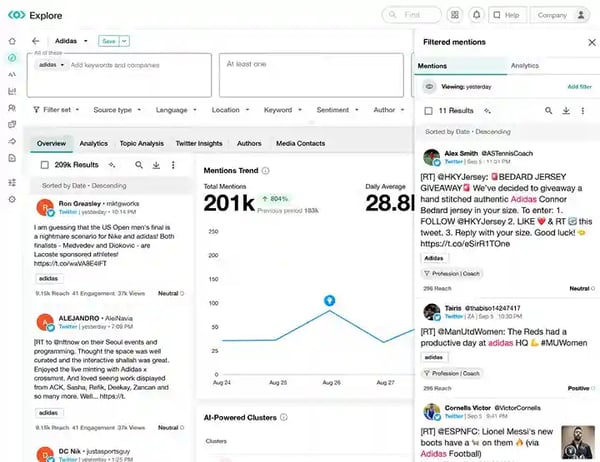
The interface asks for patience at first. G2 reviewers describe dashboards crowded with sections that look alike, saved searches that need extra clicks to scroll, and a setup phase where streams, filters, and reports take time to organize. Most say daily use gets smoother once the groundwork is done, and for teams that live on the platform, the depth they gain in return is the point.
Search relevance takes tuning, too. Boolean queries do not always filter by context, so G2 reviewers mention irrelevant mentions slipping in and some broadcast or social posts going unseen, especially for brand names that double as common words. Refining queries over the first few weeks is how teams tighten results, and for organizations with analysts to maintain them, that flexibility is what lets Meltwater adapt across industries.
Overall, Meltwater is a strong fit for communications and marketing teams that want media, social, and reporting in one place and have time to shape their searches. I would choose it over narrower tools when one dependable view of coverage matters more than a simple interface.
"What I like most about Meltwater is having media coverage, social mentions, and reporting in one place. The monitoring dashboard makes it easy to keep an eye on specific topics and quickly see what is getting attention."
- Meltwater review, Daniel S.
"It's very slow when using it, and the UX/UI design is not really good. For example, if you have multiple saved searches and you want to scroll to the last one, you have to click 'show more' all the time."
- Meltwater review, Tessa N.
Want to pitch the right people, faster? Explore the best media and influencer targeting tools.
I found that the idea G2 reviewers most often repeat about Muck Rack is currency: the contact details are current, the profiles are current, and the team keeps them that way. As I read through recent reviews, that theme held up across agencies, in-house teams, and solo publicists, and it explains why Muck Rack tends to win the research step of a pitch.
The database praise is broad. Most G2 reviewers call it the most up-to-date source of media contacts, with profiles that show recent coverage, beats, and how reporters prefer to be pitched. G2 data points the same way: Muck Rack's likelihood to recommend is 90%, above the 89% category average, and its NPS of 67 tops the 65 average.
Pitching sits on the same screen as the research. Several G2 reviewers describe building a list, sending the pitch, and seeing who opened it or clicked, so follow-ups rest on evidence rather than guesses. I like that agency teams can also see which colleague recently pitched a reporter, which keeps two people from emailing the same contact.
Coverage tracking and reporting are the supporting acts, but a useful pair. Some G2 reviewers say newsletters, dashboards, and coverage reports are quick to build, and others export coverage to Excel to cut monitoring time. For teams sending weekly updates to clients, I found that matters more than any single feature.
Support and setup get steady credit. Several G2 reviewers describe a responsive team that updates profiles quickly, and Muck Rack's ease of setup is rated at 89% on G2, above the 88% category average. Small businesses make up 55% of G2 reviewers, compared to a 49% average, so I read that as good news for lean agencies without a dedicated admin.
Newer AI features are earning attention, too. A few G2 reviewers praise Generative Pulse for showing where their brands appear in AI-generated answers and where messaging gaps remain, which gives PR teams a fresh angle on visibility alongside traditional coverage.
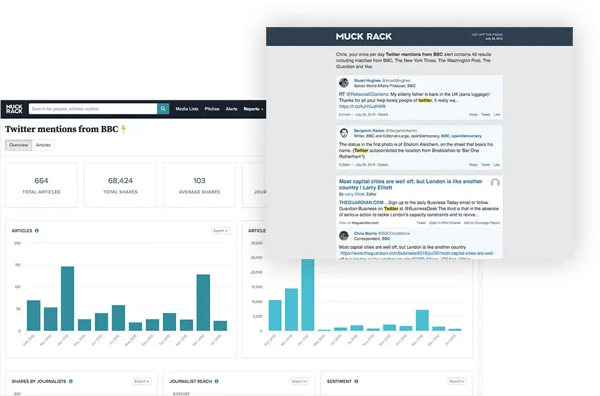
Monitoring is where Muck Rack asks for more. G2 reviewers mention trade, local, paywalled, and non-English outlets that do not always pull in, and one describes the listening component as closer to an add-on than a standalone product. For teams whose daily work starts with finding journalists and pitching, the database and outreach tools remain the core of what Muck Rack does well.
Pricing and plan tiers also draw comments. Some G2 reviewers say the entry package feels expensive for a single user, and a few note that reporting features, such as client dashboards, are available only on higher tiers. The upside is that the database driving most of the praise is the part that buyers say makes the cost worthwhile.
Muck Rack is the platform I would shortlist first for PR teams whose day starts with the question of who to pitch and whether their details are right. If outreach and journalist research are the priority, it is hard to beat this list.
"What I like most about Muck Rack is the level of detail it provides on media outlets and media contacts, along with a very easy-to-navigate interface when doing so. Muck Rack performs top-notch, with speed and bookmarklet integrations that make it a well-oiled media machine."
- Muck Rack review, Cassidy W.
"The media listening component feels more like an add-on vs. truly a standalone, differentiated product. It is quite behind other media listening tools in that space"
- Muck Rack review, Mustafa M.
Tracking brand mentions and creator conversations? Compare the best influencer marketing software to identify influencers, vet their audiences, and measure campaign impact next to your monitoring data.
I found that hardly any G2 reviewers describe AlphaSense as a media monitoring tool first, and that is the most useful thing I learned about it. G2 reviewers talk about earnings calls, filings, broker research, and expert transcripts, then about how quickly AI turns them into cited answers. It earns its place here because monitoring a market is the same job at a different altitude.
AI search is what almost every G2 reviewer names first. Smart synonyms catch variations in phrasing, so a search for one term still surfaces related mentions, and generative search returns cited answers instead of a pile of links. I like that one analyst describes asking questions in plain English and getting synthesized answers in seconds.
The content library is the second draw. Most G2 reviewers point to one place that hosts filings, earnings calls, broker reports, and expert interviews, sparing analysts the need to juggle multiple logins. AlphaSense's 91% meets requirements score is above the category average of 89%, and its 96% quality of support rating beats the 92% average. Enterprise teams account for 38% of its G2 reviewers, compared with a 20% category average.
Time savings follow. Most G2 reviewers say AlphaSense cuts the hours spent sorting through documents, and one G2 reviewer calls the value strong relative to the cost because less time searching leaves more time for analysis. For research teams under a deadline, I see that as the clearest return in the feedback.
Citations earn trust. Some G2 reviewers value that each insight is tagged to a management quote or filing, which eases worries about unsupported answers, and I found that the audit trail is what makes the speed usable. One investment analyst credits black-lining with spotting changes in language between filings earlier than manual comparison would.
Alerts and integrations round it out. A solid group of G2 reviewers use curated news feeds and custom alerts to follow competitors, and a few connect AlphaSense to Excel, PowerPoint, and Microsoft Teams so findings land where work happens. For teams tracking market intelligence, that keeps insight close to the decision.
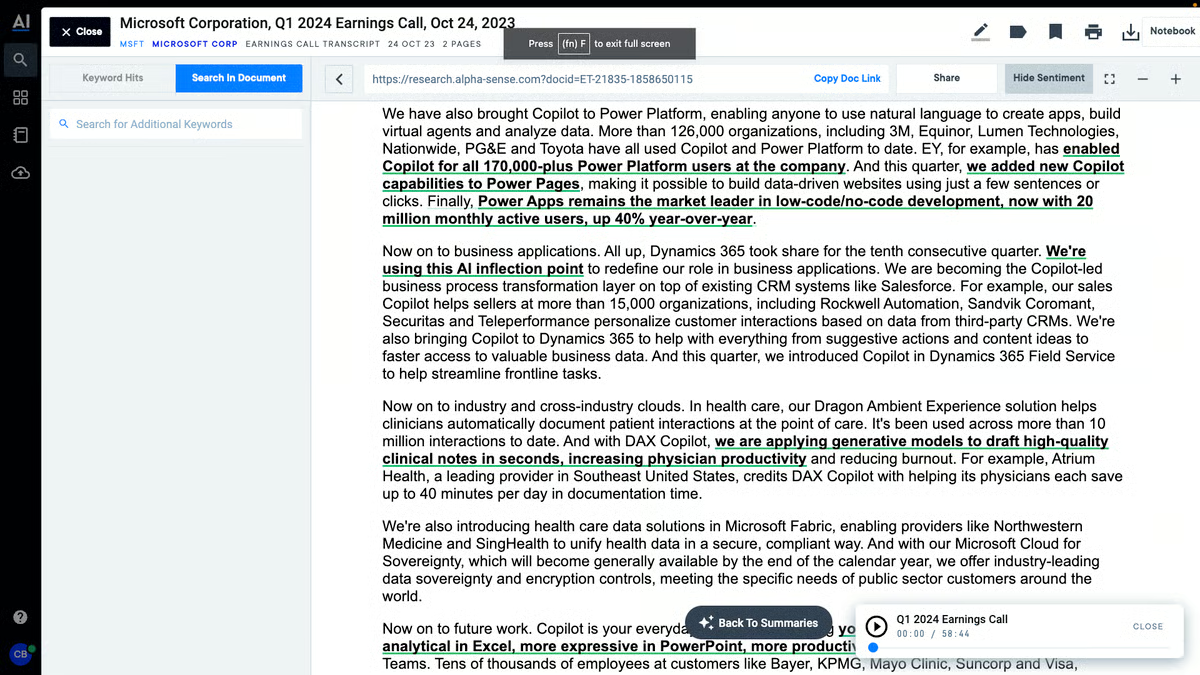
Getting comfortable takes time. G2 reviewers describe a dense set of filters, search operators, and results that require new users to spend time on ramp-up, and some recommend formal training. Once teams settle into saved searches and watchlists, that same depth is what lets analysts go much further than a basic search tool.
Complex AI queries can also take a while to return. Several recent G2 reviewers mention waits of several minutes, and a few note that answers still need to be checked for errors or missing details. Email alerts when a report is ready soften the wait, and the G2 reviewers who mention it still describe using the tool routinely.
Where a news-only tool stops at the headlines, AlphaSense keeps going into the transcripts, filings, and analyst notes behind them. For finance, strategy, and market research teams that need cited answers fast, I would pick it first on this list.
"I really like how the smart synonyms feature works. Even if I don't type the exact phrasing, it still finds all the relevant mentions in broker research and financial reports. It ensures I never miss critical market insights."
- AlphaSense review, Arpit M.
"The learning curve is a bit of a challenge. New users often need real ramp-up time to get comfortable with search operators, filters, and Boolean logic to get the most precise result."
- AlphaSense review, Soni Z.
Looking to amplify your media coverage? Check out the best press release distribution software.
I found that teams rarely pick TVEyes for a long feature list; G2 reviewers say they pick it because a segment aired, and they need to prove it. As I read recent reviews, the same sequence repeated: find the clip, grab it, show the reach, send it up the chain. It is narrow on purpose, and I read that focus as exactly what its buyers want.
Clip-finding is the headline. Most G2 reviewers describe pulling TV and radio clips, searching by city, station, and time range, and sharing them by link. TVEyes holds a Grid satisfaction score of 87, tied with Muck Rack for the second-highest among these seven platforms, behind Meltwater, which reflects how consistently G2 reviewers describe the clip workflow.
Reach numbers make the clips persuasive. Many G2 reviewers say TVEyes shows viewership, audience size, and ad value for each airing rather than a general estimate, giving PR teams real numbers for client conversations. One publicist calls the price worth it for that insight alone, and I would weigh that heavily.
Reporting follows from the same data. G2 reviewers describe running earned media reports every two weeks, saving coverage in a media center, and using charts to see which stories worked best. I like that a communications manager can hand that output to leadership without having to rebuild it by hand.
Coverage breadth is another strength. Several G2 reviewers praise local, national, and global channels, including live feeds that make clips available shortly after they air, and one reviewer notes access to local news that other databases lack. For a team watching a developing story, I would value that speed.
Support and setup earn steady credit. Some G2 reviewers describe responsive customer service and a simple initial setup, while others rely on keyword alerts and emailed mentions that arrive even when no one has searched. That combination keeps small teams from spending an hour a day hunting for coverage.
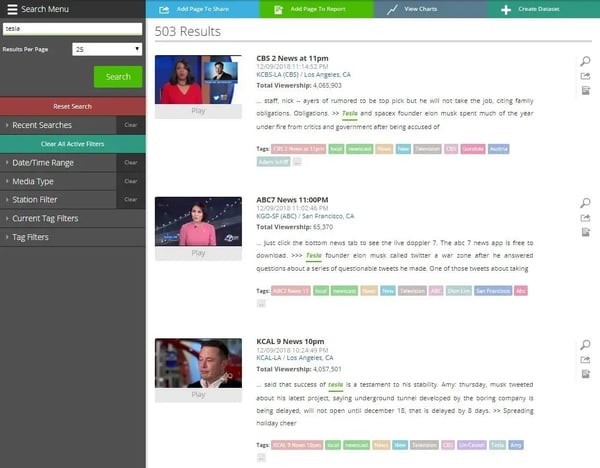
Search is where TVEyes asks for patience. G2 reviewers describe needing the exact word, trying several term variations, and sometimes watching a show from the start when a clip does not appear, and the closed captioning spells the term differently from the real term. Teams that learn which keywords and filters work tend to find the clip, and for tracking where coverage aired, the platform still delivers on its promise.
The newer Insights interface draws mixed reactions. Some G2 reviewers find it more complicated and finicky to navigate and clip, miss the simpler earlier version, and mention a dated look or an opening screen that can hang. A recent redesign has improved things for some, and once teams know where their searches and reports live, daily use runs quickly.
TVEyes rewards teams whose coverage lives on TV and radio and who need clips, reach, and a clean report to show for it. If broadcast proof is the job, its narrow focus is the reason I would choose it.
"I like being able to choose a day, time, and channel and watch until I find what I’m looking for, instead of needing to know the exact time or moment. I can search by city, station, approximate date, and time range, then watch a range of clips, fast-forward and rewind, and lock in the exact moment a segment aired."
- TVEyes review, Roland M.
"Sometimes the search is hard, and I don't always get exactly what I want on the first try. Learning what search terms to use can be tricky, and maybe there could be something to help you learn those a little quicker."
- TVEyes review, Samantha S.
Need help preparing for the unexpected? Learn how to handle a PR crisis and protect your brand reputation.
Semrush is less a media monitoring tool than a visibility platform, and I found that the G2 reviews say so plainly. G2 reviewers write about keywords, competitor gaps, site audits, and, increasingly, how a brand appears in AI-generated answers. I kept it on the list because that last piece is a new kind of online brand monitoring, and the G2 reviewers who watch search closely already treat it as one.
Competitor research is the center of gravity. Most G2 reviewers describe using Keyword Magic, Keyword Gap, or Organic Research to see which terms rivals rank for, and Semrush's NPS of 78 sits above the 65 category average, with its likelihood to recommend of 92% ahead of the 89% average. That lines up with how often the workflow is praised.
The AI visibility tools fit brand monitoring best. About half of the recent G2 reviews I read mention tracking share of voice, citations, and sentiment in AI answers such as ChatGPT and Google AI Overviews, and some use the gaps to decide what to write next. I would treat it as the layer on top of classic SEO tools that matters most to PR teams.
Integrations are a real strength. Several G2 reviewers connect Semrush to Google Analytics and Google Search Console, and a growing group pipes its data into AI assistants via its API so they can ask questions in plain language rather than clicking through tabs. I like that this puts monitoring data inside existing workflows.
Site Audit and Position Tracking turn visibility into a to-do list. Many G2 reviewers pair them with competitor research to build a case for investing in a website or content, and one marketer describes prioritizing fixes based on real data rather than gut feeling.
Getting started is easy, and everything sits in one dashboard. Several G2 reviewers call the initial setup easy, and small businesses make up 69% of Semrush's G2 reviewers, well above the 49% category average, which tells me it works for lean teams, replacing several separate tools.
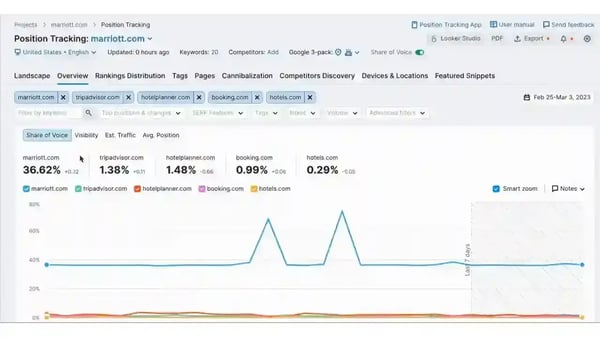
Paid tiers are where Semrush gets expensive. G2 reviewers point to extra seats, project and keyword limits, and newer AI and PR features sold as separate add-ons, which add up fast for agencies and small teams. The upside is a modular platform where teams add only the capabilities they need.
With so many tools, finding the right one takes time. G2 reviewers describe menus, dashboards, and sub-tabs that take a while to learn, with one comparing the navigation to a professional design suite. Training courses and AI assistants help, and that breadth is why one subscription can cover search, content, and AI visibility.
Semrush works best as the visibility layer next to a platform that handles news and broadcast. For marketers who own both earned coverage and search, I would pair it with a monitoring tool and treat it as the way to see how a brand is found.
"I've used Semrush extensively for enterprise SEO strategy, keyword research, competitive analysis, and performance tracking. What I appreciate most is having so much information available in one place. The Keyword Magic Tool, Organic Research, Position Tracking, and Keyword Gap features are especially helpful for identifying content opportunities, monitoring competitors, and making data-driven recommendations."
- Semrush review, Melanie K.
"It’s quite expensive, and the AI data is behind a paywall. I’d really like to have at least some access to the AI data included in the existing plan."
- Semrush review, Karan K.
Looking for the right PR analytics tools for your brand? Check out the best PR analytics software of 2026.
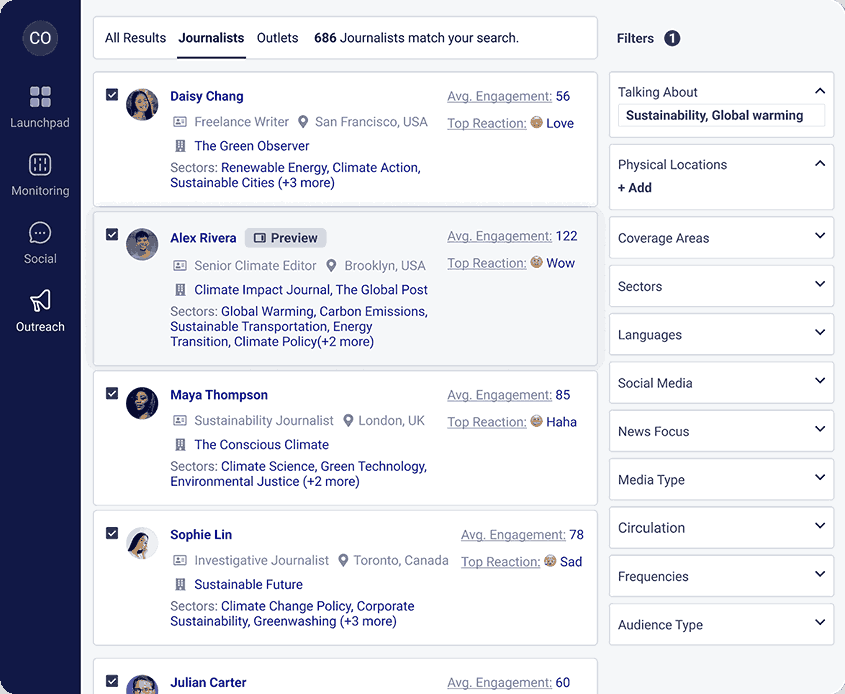
Most platforms on this list start with coverage; CisionOne starts with contacts. In the recent G2 reviews I read, the journalist database is mentioned first, then press release distribution, then monitoring and reporting layered on top. I found that order explains who it is for: PR teams whose work begins with finding the right reporter.
The scale is shown in the data. CisionOne's market presence score is 98 on the Fall 2026 Grid, second only to the category leader, and enterprise teams make up 26% of its G2 reviewers, above the 20% category average. Most G2 reviewers single out the media database, describing deep contact lists they can sort by topic, sector, keyword, and location.
Pitching and distribution come next. G2 reviewers describe building a list, sending a press release or pitch, and tracking open rates in the same place, including uploading a Word document and sending it to a large group. I like that this removes administrative overhead for agencies sending releases every week.
Monitoring is easy to set up and read. Many G2 reviewers praise the mention streams that surface coverage without manual searching and alerts that arrive in Gmail, saying that saves hours otherwise spent sourcing coverage that might have been missed. Global coverage reports with translations help when campaigns span markets.
Reporting rounds out the workflow. G2 reviewers mention dashboards, instant insights, AI summaries in reports, and tagging to sort coverage; one reviewer says reports help prove the value of a PR agency to clients. For teams that report on reach and advertising value equivalency each quarter, those pieces cover the routine.
I also like that research, monitoring, and reporting sit under one login. One G2 reviewer calls it a one-stop shop, and another values being able to clip and save broadcast coverage beyond the short expiry window because clients want to keep their interviews.
Coverage gaps are where CisionOne draws the most comments. G2 reviewers say broadcast, Spanish-language, regional, and some mainstream outlets can slip through, and some find irrelevant mentions even after refining Booleans. For the teams that rely on it, the monitoring still delivers the time savings the reviews describe.
Price and support round out the comments. Several G2 reviewers call CisionOne pricey, citing renewal costs and a lack of single-seat options, and a few say the support portal is slow, so they work through their customer success manager. One G2 reviewer notes that you get what you pay for: the breadth of the database, outreach, and reporting is what that price buys.
Agencies and in-house teams that want journalist research, press releases, monitoring, and reports under one login will find CisionOne's end-to-end design useful. I would shortlist it for PR professionals who need to work a story from a contact list to a coverage report without switching platforms.
"I like the instant insights feature because it's amazing for quickly pulling metrics into our media reports and getting a snapshot of how campaigns are performing. I also like that I can clip and save broadcast coverage after expiry, which is especially helpful because clients love to see their interviews, and they don't want them to expire after 7 days. Additionally, the initial setup was pretty easy, and our account manager made it quite seamless."
- CisionOne review, Cassie M.
"I'm not thrilled with CisionOne because it feels like it wasn't designed with the needs of publicists in mind. It's not intuitive and misses out on some basics, like showing if contacts are already in lists or being able to open press releases for tracking open rates, or that the name out the outlet wasn't available for us to add in our custom contacts."
- CisionOne review, Lori H.
When Threads took off with one G2 reviewer's clients, YouScan was ready, and I found that timing says a lot about the platform. That G2 reviewer says that properly covering the network saved an awkward client conversation. I went in expecting a niche visual-listening tool, and what the reviews describe is a platform praised first for the people behind it, then for how many places it can listen.
Support is the first thing most G2 reviewers mention, and it is not a small compliment. YouScan's quality of support score is 98%, above the 92% category average, and G2 reviewers describe customer success managers who build queries, troubleshoot quickly, and keep teams updated on new features.
That support makes adoption easy, which answers a common buyer question: which media monitoring systems are the easiest to deploy, require minimal training, and enable fast user adoption? The majority of G2 reviewers call YouScan easy to use and quick to set up, with one saying a full client setup takes under an hour, and its ease of use is rated at 91% on G2, above the 88% category average.
Coverage is the second draw. G2 reviewers praise TikTok, Threads, forums, blogs, Google Maps reviews, and Telegram channels, and one calls it the best coverage in the market. I found that this breadth makes it a strong pick for teams following conversations beyond traditional news.
Dashboards and tagging save reporting time. Several G2 reviewers describe real-time dashboards, automated rules, and tagging that replace manual Excel reporting, and one team monitoring 63 countries reports that data collection dropped to about 2 hours a day.
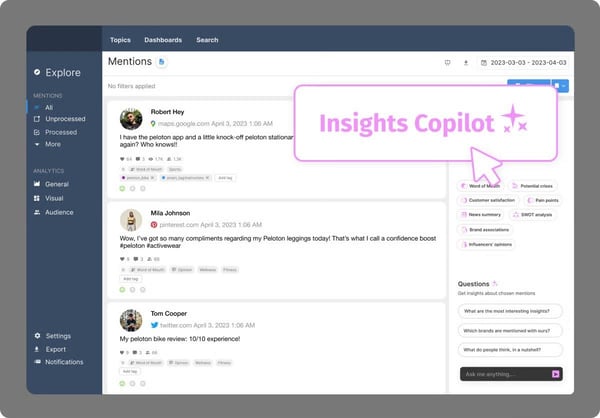
The Copilot and integrations help teams scale. Some G2 reviewers say the AI Copilot saves analysts time and helps build accurate queries; others value visual recognition for spotting user-generated content, and integrations feed alerts into messengers and other platforms. I like that a small team can keep up with a large volume of conversations.
Coverage outside the core sources is where YouScan asks for more. G2 reviewers note that basic search can miss some websites, job boards, and employer review platforms, and that certain languages, regional news sources, and live streams are not yet covered. One adds that the team has responded to source requests, and for teams whose priority is social and visual conversation, the existing source list already covers the places where such conversations occur.
Dashboard flexibility and plan limits come next. Some G2 reviewers want more widget types and customization next to platforms with richer dashboards, and others mention caps on queries and mentions or add-on features that raise the price. Agencies running many projects feel the limits most acutely, yet the same G2 reviewers still cite breadth of data and responsive support as reasons to stay.
YouScan is a strong match for marketing, research, and agency teams that want to listen across social platforms and the open web with a responsive team behind the tool. If a fast start and dedicated support matter as much as coverage, I would put it on your shortlist.
"I am very familiar with a host of different social listening platforms; and YouScan ticks the boxes the most when it comes to breadth of data, visual and audience insight integrations. Being able to access TikTok data at scale is very beneficial and helps give us a competitive advantage over our competitors."
- YouScan review, Michael W.
"One area where YouScan could improve is the coverage included in its basic search. Some relevant websites are not currently monitored, and it would also be valuable to include additional sources, such as job boards and employer review platforms."
- YouScan review, Alberto M.
Got more questions about the best media monitoring software? G2 has the answers!
For large enterprises managing global campaigns, Meltwater is one of the most comprehensive media monitoring solutions. It combines media monitoring, social listening, and PR outreach with real-time analytics and extensive global coverage. AlphaSense is another strong choice for large organizations needing premium content libraries, AI-powered insights, and integrations with Excel, Teams, and Slack.
If you're focused on in-depth media analysis, Muck Rack excels in tracking journalist activity, earned coverage, and media impact. Semrush also leads in digital content analysis, competitor tracking, and SEO visibility, making it ideal for brands combining PR with digital marketing insights.
YouScan is highly regarded for social media monitoring, with G2 reviewers praising its coverage of TikTok, Threads, forums, and blogs, plus responsive support. Meltwater also adds social listening and sentiment analysis to its media monitoring, which suits teams that want both in one platform.
Across G2 reviews, Meltwater, Muck Rack, and AlphaSense consistently rank as the top-rated media monitoring platforms in the Fall 2026 Grid Report. Meltwater is particularly praised for global reach and reporting, while Muck Rack stands out for journalist database quality and PR workflow efficiency.
The top contenders include Meltwater for cross-channel media coverage, YouScan for social listening, TVEyes for broadcast monitoring, and Muck Rack for journalist tracking and earned media. CisionOne is a strong pick for teams that want end-to-end PR workflow in a single platform.
Using Meltwater or Muck Rack allows you to track mentions across news, online publications, and journalists in real time, while YouScan specializes in capturing mentions across social platforms and the open web. For broadcast, TVEyes lets you keyword-search TV and radio coverage and instantly clip relevant segments. Online media monitoring software of this kind replaces manual searching.
Pricing information for most of these tools is available on request. However, Semrush provides monitoring and SEO tracking tools with entry-level plans starting at $139.95/month, making it one of the more accessible options on this list for smaller teams and agencies.
Semrush works well for small teams focused on SEO and digital content mentions, offering solid reporting and competitor insights at a transparent entry-level price. Muck Rack is also worth considering for small PR agencies that need a structured journalist database and pitching workflow.
YouScan and Muck Rack earn consistent praise for approachable interfaces and quick setup, making them easy to get up and running without a long ramp-up. TVEyes is simple for broadcast searches once teams learn its layout.
Experts recommend Meltwater for large-scale media and PR teams, YouScan for social and consumer listening, AlphaSense for market intelligence, and Muck Rack for journalist-focused tracking. CisionOne rounds out the list for teams that prioritize end-to-end PR workflow in one place.
Yes. While this guide highlights seven leading media monitoring platforms, Brand24, Brandwatch Consumer Intelligence, and Mention are also well-known options for social listening and digital reputation management.
Based on G2 reviews, Meltwater and AlphaSense consistently earn high trust among teams that depend on them. Meltwater is praised for one-place coverage and reporting, while AlphaSense is valued for AI-powered search and enterprise-grade integrations.
For mid-market teams balancing cost and capability, Muck Rack and YouScan are strong contenders. Muck Rack delivers focused PR and journalist database tools at a scale that works for growing teams, while YouScan pairs strong support with broad social coverage.
G2 reviews rarely quote uptime figures, so reliability evidence is indirect. G2 reviewers praise responsive support at YouScan and AlphaSense, and describe steady AlphaSense performance under heavy use. Ask any vendor for its service-level agreement before you sign.
YouScan and Muck Rack consistently receive praise for low adoption friction. G2 reviewers describe quick setup, approachable navigation, and supportive onboarding, while TVEyes works well once teams learn the layout.
YouScan stands out for support, with G2 reviewers describing customer success managers who help build queries. G2 reviewers of Muck Rack highlight easy setup, and CisionOne feedback ranges from good onboarding to a slow initial email setup. Ask each vendor for a realistic onboarding timeline.
G2 reviews do not track 90-day ROI directly, but they point to fast wins. G2 reviewers describe quick time savings on list building at Muck Rack and clip reporting at TVEyes, and reporting that proves campaign impact at Meltwater. Set a baseline, such as hours spent on manual research, and measure against it.
G2 reviewers connect Semrush to Google Analytics and Search Console, use AlphaSense with Excel, Teams, and Slack, and route Muck Rack alerts into Slack and email. Meltwater also offers integrations for collaboration and alert routing.
YouScan is widely regarded as easy to deploy, with G2 reviewers describing quick setup and approachable interfaces. Muck Rack is another strong option, with a clean interface that PR professionals find straightforward from the first login.
Meltwater and Muck Rack are particularly strong here. Meltwater centralizes coverage and reporting for shared dashboards, while Muck Rack shows teammates' recent outreach, which keeps agencies from duplicating pitches.
For rapid deployment, start with YouScan, Muck Rack, and TVEyes, where G2 reviewers describe quick setup and focused workflows. Meltwater suits teams that can spend a few weeks refining searches. Pick the platform that matches your main channel, since focus speeds adoption.
If there's one takeaway from evaluating these media monitoring platforms, it's this: choosing software is only half the battle; building the right process around it is what delivers results.
Before you pick a platform, map out your broader brand monitoring strategy. Are you looking to spot a potential PR crisis early? Benchmark your share of voice against competitors? Track influencer engagement across regions?
The best media monitoring software will give you the data, but it's your internal workflows, response playbooks, and reporting habits that turn insights into action. Use this list as a starting point to match your team's specific challenges with the tool best built to solve them.
Once you've mastered monitoring the conversation, the next step is shaping it, and that's where great public relations software comes in.
This article was originally written by Tanuja Bahirat in 2025. It has been updated with new information based on findings from testing and evaluation of the latest list of top G2 products.


G2 Grid® Report · Summer 2026 Best PR Analytics Software Updated May 26, 2026 View...
 by Shashank D Shastry

TL;DR Sprout Social is the best social media listening software as per G2's latest Fall 2026...
 by Hasitha Varre

I’ve learned that your followers say a lot, but it’s what they don’t tag you in that often...
 by Holly Landis