


Overbookings rarely announce themselves. A rate mismatch between two online travel agencies (OTA) channels compounds quietly for days before anyone connects it back to the system. A channel update that should have taken seconds sits in a queue during your highest-occupancy weekend, and by the time your front desk catches it, the damage is already done.
The gap between what the best hotel reservation software promises and what it actually delivers under pressure is where most teams find out they made the wrong call. I reviewed thousands of verified G2 reviews, specifically looking for where these systems fail in day-to-day reservation operations during high occupancy.
This guide covers the top five best hotel reservation platforms, each built for a distinct reservation challenge. Cloudbeds for all-in-one hotel operations, combining reservations, channel management, and guest data in one system. Cvent Supplier and Venue Solutions for group and event-driven reservation programs, where RFP response speed and housing management are the priority. An engine for direct booking optimization and reducing OTA dependence for small and mid-market teams. Amadeus Central Reservations System for large hotel groups managing high-volume, multi-brand, and global distribution workflows. Bookinglayer for tourism operators who need API-driven, custom reservation workflows across accommodations, activities, and packages.
Let's get into what I found.
*These hotel reservation platforms consistently surface as leading options based on aggregated user review patterns and category positioning seen in G2's Winter 2026 Grid® Report.
These are the platforms I kept coming back to after analyzing thousands of verified user reviews across the category. The right hotel reservation software does more than accept bookings. It keeps your inventory honest, your rates consistent, and your channels in sync without anyone manually holding it together.
What I see consistently across reviews is that the strongest systems go beyond booking capture. They show you where demand is coming from, where availability is shifting, and where leakage is happening before it costs you. The platforms that earn repeat praise are the ones replacing that guesswork with operational clarity, at peak and off-peak alike.
Most teams deploy faster than expected, limiting disruption during active booking cycles. The five platforms below are the ones that delivered on what your operation actually needs: visibility, rate discipline, and inventory control that holds as volume scales.
I started with G2's Winter 2026 Grid® Report to shortlist leading platforms based on verified user satisfaction and market presence across independent properties, mid-market groups, and enterprise brands.
From there, AI-assisted analysis across hundreds of G2 reviews helped me surface what consistently matters in live reservation workflows: inventory accuracy, rate parity, peak-demand reliability, OTA versus direct booking management, PMS integration depth, and the amount of manual intervention teams still need once the system is live.
Since I haven't personally used every platform here, I cross-referenced these findings against feedback from revenue, distribution, and operations teams running these systems in real hotel environments. Visuals and product references are sourced from G2 vendor listings and publicly available documentation.
Across hundreds of G2 reviews, the same strengths and breakdowns surfaced once systems went live. These are the criteria I used to separate platforms worth recommending from those that look strong on paper but create friction at scale.
No platform is strong across every dimension. The right choice depends on whether your priority is distribution oversight, direct booking growth, or multi-property consistency.
Below, you’ll find authentic user feedback from the Hotel Reservations Software category. To appear in this category, a tool must:
The data pulled is from 2024-2026 on G2. Some reviews may have been edited for clarity.
If you've ever managed OTAs, front-desk tasks, and guest records using three separate tools, you'll quickly understand why Cloudbeds was created. It centralizes booking management, availability, pricing, and guest data into a single operational hub, keeping day-to-day hotel workflows manageable without the fragmentation that slows most teams. G2 reviewers consistently back this up, positioning it as a platform built for reliability and operational continuity above all else.
Front-desk and operations teams consistently describe the interface as accessible from day one. Cloudbeds scores 87% for ease of use on G2, and that number reflects something specific: new and rotating staff get up to speed without extended training cycles. During busy periods, that matters more than people give it credit for. Onboarding friction tends to show up as booking errors and service delays before anyone calls it a training problem.
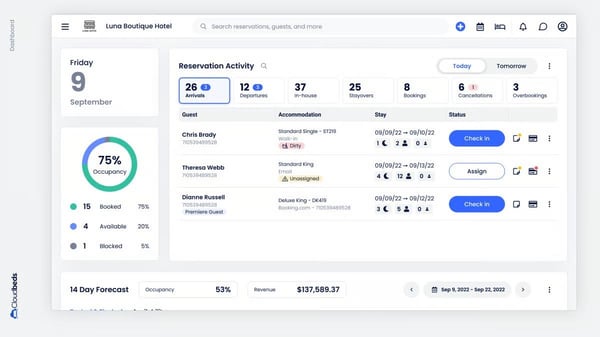
I'd put the unified calendar at the center of what makes day-to-day inventory control actually work here. Availability, pricing, and booking status sit in one view, giving teams accurate oversight without switching between systems. Stable connections with Booking.com and Expedia, alongside a full API for custom workflows, keep distribution running consistently. At 88% for ease of doing business with on G2, that integration fit shows up in how little administrative load these connections add to live reservation workflows.
G2 reviewers do point out that niche B2B channels aren't natively supported the way mainstream OTAs are. If specialist distribution is a big part of how you operate, you may find the connector list shorter than expected. It's one of those things that doesn't show up until you're mid-setup. What Cloudbeds keeps delivering is rock-solid, stable OTA coverage that keeps your reservation pipeline running without interruption.
For independent hotels and small hospitality teams that need reservation workflows to run without daily firefighting, I'd recommend Cloudbeds without hesitation. Centralized operations, fast staff adoption, and OTA integrations that hold up under pressure combine to make it a platform that earns its place as the operational hub. If daily reliability across your reservation pipeline is the priority, this is where I would start.
“Managing 4 properties across multiple countries could be a logistical nightmare. Cloudbeds makes it feel manageable. One login, consistent reporting, and the channel manager keeping everything in sync across OTAs - it just works.
What I appreciate most is not having to stitch together five different tools. Everything we need is there: reservations, rates, distribution, guest communication, and reporting. For a lean team running multiple properties, that’s everything.
It’s become the operational backbone of our portfolio, and I can’t imagine running without it. ”
- Cloudbeds review, Kalimera B.
"It’s not connected to some B2B and OTA yet."
- Cloudbeds review, Lea W.
Complement your reservations platform with the best hotel management software to extend operational coverage beyond bookings into housekeeping, front desk, and guest services.
Cvent Supplier & Venue Solutions is for organizations managing sourcing, housing, and request for proposal (RFP) distribution tied directly to meetings and events. This is the infrastructure that holds it all together. Hotel discovery, housing management, and reporting sit in one environment, and G2 reviewers are consistent: this is built for programs where reservation volume and response speed determine whether things run or unravel. The number that stuck with me was 92% for quality of support on G2, and that assistance keeps programs running from initial setup through active housing management.
I've watched this dynamic come up repeatedly across G2 reviews: hotels treat Cvent-sourced RFPs as high-priority opportunities, which shifts the sourcing conversation firmly in favor of planners. Proposals come in faster and more competitively than through other distribution channels. For teams managing tight timelines or high RFP volume, that response reliability cuts the back-and-forth that typically drags sourcing cycles well past where they need to land.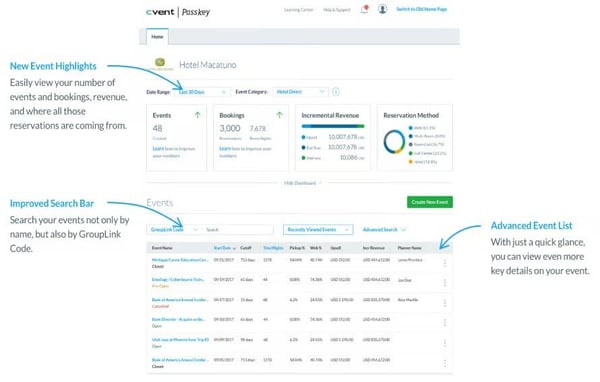
I'd single out Cvent Passkey as the feature that quietly does the most revenue work here. It surfaces premium room options and upsell opportunities that standard group contracts almost always leave on the table, directly supporting ancillary revenue. Attendees self-select accommodations through a centralized housing flow while planners keep full visibility across registration, staff rooms, and VIP inventory. At 91% for ease of admin on G2, that oversight holds up even across the messiest multi-block programs.
Some G2 users flag that when you're managing reservations across multiple subgroups, things can get complex fast. This happens especially when room blocks are split by attendee type, department, or VIP tier. Event planners juggling large multi-block programs will feel this the most, as reconciliation can pile up quickly across heavily segmented groups. Cvent's reporting and block management tools are genuinely powerful here, giving you real visibility across the entire program without losing track of where things stand.
Group hotel reservations tied to events at scale are where programs either hold together or quietly fall apart, and Cvent Supplier & Venue Solutions is built for exactly that pressure. Sourcing depth, housing oversight, and a supplier network that accelerates response timelines make a compelling case on their own. At least for me, this is the one I'd back first for organizations where booking complexity leaves absolutely no room for error.
"Cvent is simply the de facto software tool for hotel and venue sourcing. No other service provider provides the depth and breadth of data available for virtually every hotel and venue around the world. Just as importantly, Cvent's leadership reputation in the industry means that my RFPs are not only easy to distribute, but they get the fastest responses from Suppliers. There is simply no equal.”
- Cvent Supplier & Venue Solutions review, Sharon S.
"The vendor proposals that come back from RFPs often are simply price sheets, and vendors typically want to talk outside of the Cvent platform to work out details. This causes things to get disorganized and confusing since there might be information in multiple places."
- Cvent Supplier & Venue Solutions review, Tara D.
Complement your reservations platform with the best hotel management software to extend operational coverage beyond bookings into housekeeping, front desk, and guest services.
I'll be straight with you: Engine does not try to be everything in the hotel reservations category, and that restraint is exactly what makes it work. It is built to simplify lodging and travel reservations for teams, delivering on that promise without overcomplicating the experience. G2 reviewers consistently highlight straightforward booking flows, transparent pricing, and shared visibility as the combination that keeps business travel coordination from becoming a full-time job.
Account configuration, user access, and invoice preferences come together fast enough that most teams are booking before they finish onboarding. Frankly, that kind of setup speed is rarer than it should be in this category. Engine scores 98% for ease of setup on G2, and that number reflects something real. Small and mid-market teams without dedicated travel operations staff go from sign-up to active use without the drawn-out deployment cycles that typically slow things down.
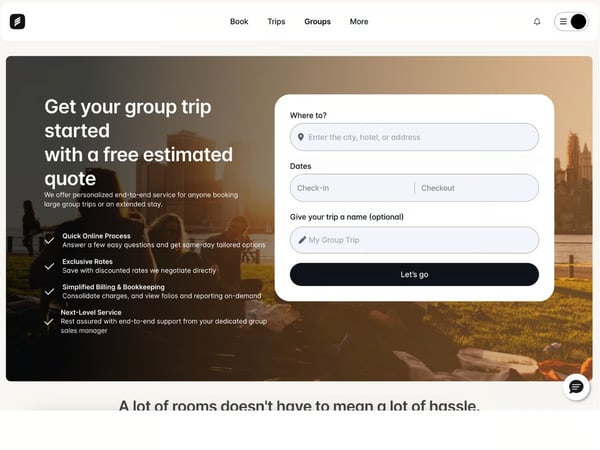 I'd describe the workspace structure here as one of those things that sounds routine until you see how much coordination overhead it actually removes. Booking visibility, invoices, and traveler details for an entire team sit in one place. Custom fields let departments tag bookings by project or cost center, while account-level separation keeps reporting clean. At 97% for ease of admin on G2, that structure holds up as team size and booking volume grow.
Multi-currency support isn't where you'd want it to be if your team books across regions with separate payment setups. If you're a Canadian operation or running bookings across multiple currencies, you'll notice the native account-level configuration doesn't stretch that far. G2 users flag this as a recurring friction point. What Engine absolutely nails is keeping the core booking experience fast, clean, and frustration-free. This will hold up consistently across every reservation your team runs through it.
Small and mid-market teams managing frequent business travel do not need another platform that overpromises and underdelivers on the basics. Engine keeps hotel reservations fast, centralized, and cost-controlled, and the setup, admin, and usability ratings on G2 back that up without ambiguity. If keeping your team's booking workflow simple and reliable is the whole brief, this one nails it. And from where I sit, that kind of focused execution is worth a lot.
“I had a fantastic experience using Engine for my hotel bookings. The platform is user-friendly, fast, and reliable."
- Engine review, Shivanshu M.
"We are a Canadian company that books in both countries. We would like to see a Canadian dollar option for when booking in Canada, as we have specific credit cards for each country, one in USD and the other in CAD. If we book with our CAD card, we get charged the exchange rate."
- Engine review, Verified User in Printing.
Amadeus Central Reservations System is built for operators who are running structured, high-volume workflows across global distribution networks. You will feel that immediately. Centralized room inventory, rate management, and reservation distribution across channels sit at its core. G2 reviewers are consistent on where it earns its place: complex cross-channel reservations and multi-property programs that demand a platform that does not flinch under pressure.
I'd highlight the unified interface as the capability that changes everything for reservation teams handling complex itineraries. Live room inventory, flight availability, and competitive rates all surface in one place, multi-segment itineraries handled from the same environment, no external data pulls, no context switching. G2 users rate “meets requirements” at 92%, reflecting how reliably the platform delivers on core functionality that agencies and hotel groups depend on daily.
I'll be upfront: command shortcuts are where experienced agents on Amadeus seriously pull ahead of the pack. Reservations, amendments, and ticket issuance move faster than any graphical interface allows once the command structure clicks, and G2 ease of use sits at 81%, reflecting that learning curve honestly. A masked interface option gives less command-heavy agents flexibility within the same platform, meaning teams at different skill levels operate from one environment without compromise.
Without prior global distribution system (GDS) experience, navigating Amadeus is genuinely tough. The command logic is nothing like the visual booking tools you're probably used to. Agents moving from browser-based systems feel this the hardest, and G2 reviewers consistently call it out. I'll say this, though: once you're in it, the platform delivers seriously fast, structured reservation handling that holds up under heavy booking volume without missing a beat.
Amadeus Central Reservations System is not a platform you dabble in, and the review data makes that abundantly clear. Travel agencies and hotel groups managing multi-property inventory across global distribution networks are where it operates at full strength. Real-time availability, centralized booking coverage, and dependable workflow execution come together in a way that rewards the teams who commit to it. If that sounds like your operation, this one deserves a serious look from you.
"As a former Expedia Travel Advisor, I liked that with Amadeus Central Reservations System, finding flights as well as making reservations was fast and speedy. It includes live availability as well as competitive rates, thus making it easy to immediately find the client's best offer. I also liked having its functionality to connect with hotel products as well as ancillaries, thus allowing me to take care of diverse aspects of a traveler’s journey from one location."
- Amadeus Central Reservations System review, Hamza A.
"Certain airlines are absent from the Amadeus CRS, and others that I dislike are also not found. ”
- Amadeus Central Reservations System review, AHAMMAD M.
Coordinating frequent business travel across your team? Read about the best travel management software for policy enforcement, approvals, and spend visibility in 2026.
Most hotel reservation platforms stop at the room. Bookinglayer does not, and for small tourism operators managing accommodations, activities, packages, and services in a single booking flow, that distinction changes everything. G2 review analysis places it firmly in the operational layer of hospitality, where availability management, direct bookings, and guest coordination matter far more than enterprise-scale distribution. I'd say it is built precisely for experience-led operators who have outgrown generic solutions.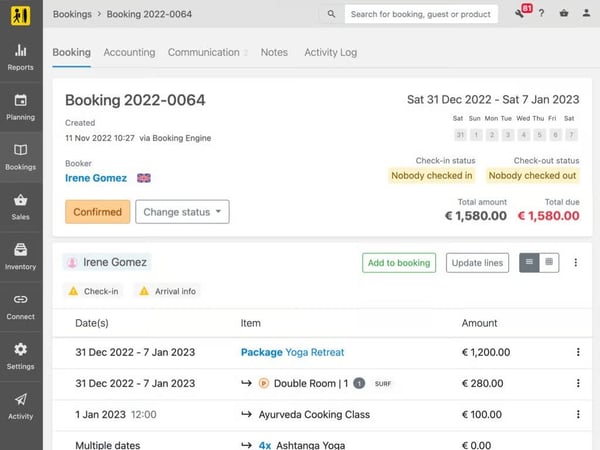
If your back office feels like navigating a maze just to update a booking status, Bookinglayer will be a welcome shock to the system. Daily reservation tasks, booking updates, manual entries, arrival and departure tracking, and payment status all move through an interface built around operational clarity. Teams work quickly through routine actions without layered menus or view-toggling slowing things down. At 98% for ease of admin on G2, that confidence shows up from the very first week of onboarding.
Spend any time with Bookinglayer's review base, and I guarantee the automation depth comes up fast. Booking confirmations, payment reminders, and guest communications run automatically without anyone on the team lifting a finger. Customer portals give guests direct visibility into their own bookings, cutting inbound queries before they land on anyone's desk. At 93% for quality of support on G2, configuring these workflows comes with assistance reviewers consistently describe as responsive and practically useful.
Two-way calendar syncing isn't native, and you'll need a separate tool to bridge external platforms. If you're running a packed schedule across activities and accommodations, that extra integration step becomes pretty noticeable pretty fast. G2 reviewers do flag this as a gap worth knowing about before you're deep into setup. What never wavers, though, is how Bookinglayer handles the core stuff. Bookings, guest coordination, and operational visibility stay sharp and dependable across even the most complex hospitality setups.
Experience-led tourism operators managing rooms, activities, and packages in one reservation flow have a platform built specifically for that reality. And, it shows in every layer of what Bookinglayer delivers. Strong administrative usability, automated guest coordination, and a support model that actually shows up when configuration gets complex. For small hospitality businesses where the guest journey goes well beyond the room, this is the one I keep coming back to without hesitation.
“Its flexibility and excellent customer support made the implementation and integration process smooth and straightforward. Once your products are set up, taking bookings through the booking engine or manually entering them in the Backoffice is quick and intuitive. The level of customization available is impressive, which is especially valuable when working with travel trade partners. Bookinglayer.”
- Bookinglayer review, Mario V.
“Difficult to do the year updates (prices, new packages) as it's a lot of things to combine and little tips to integrate, and from one year to another, you forget. That's why the support is useful (the human one especially).”
- Bookinglayer review, Claire B.
|
Software |
G2 Rating |
Free plan |
Ideal for |
|
Cloudbeds |
4.3/5 |
No |
Independent hotels and small groups looking for an all-in-one system covering reservations, PMS, and channel management with minimal system sprawl |
|
Cvent Supplier & Venue Solutions |
4.5/5 |
Limited (supplier network access) |
Properties where group bookings, meetings, and events materially influence reservation volume and occupancy planning |
|
Engine |
4.4/5 |
Yes |
Hotels prioritizing direct booking conversion and reducing online travel agency (OTA) dependence through optimized website booking flows |
|
Amadeus Central Reservations System |
3.8/5 |
No |
Large hotel groups managing high transaction volumes, global distribution, and multi-brand reservation complexity |
|
Bookinglayer |
4.9/5 |
No |
Hospitality brands need API-driven, customizable reservation workflows and greater flexibility in integration. |
*These hotel reservation platforms consistently surface as category leaders based on aggregated reviews from G2's Winter 2026 Grid® Report.
Got more questions? G2 has the answers!
Cloudbeds and Bookinglayer are most commonly cited for flexibility. Cloudbeds balances ease of use with rate control across property types, while Bookinglayer supports highly customizable booking flows suited to operations with non-standard reservation structures.
Start by checking how well each platform synchronizes inventory and rates across OTAs in real time. Cloudbeds provides a centralized channel view that works well for independent and mid-market properties. At the same time, Amadeus CRS is built for high-volume, multi-region distribution, where strict channel governance is essential.
Cvent Supplier & Venue Solutions is the clear choice here. It's built around group and event-driven demand, with housing management, room block coordination, and reporting designed specifically for planners and corporate travel teams.
Amadeus CRS provides the strongest data foundation for pricing decisions at scale, giving revenue teams the occupancy visibility needed to adjust rates across channels. Cloudbeds supports this for smaller operations through its built-in dashboard and rate management tools.
Look for mobile-responsive booking engines, guest self-service features, and branded booking flows. The Engine is frequently selected for smooth, branded direct booking journeys optimized for conversion. Cloudbeds also supports guest-facing features, including portals and communication tools that improve booking convenience across the stay lifecycle.
Boutique hotels benefit most from platforms that reduce system sprawl. Cloudbeds and Bookinglayer consistently surface in this segment for their usability, flexible workflows, and ability to unify reservations, OTA sync, and guest tracking without requiring multiple integrations.
You should look for platforms that store booking history, preferences, and communication logs in a centralized guest profile. Cloudbeds provides structured guest databases that support personalized communication and repeat booking strategies at the property level.
Cloudbeds and Amadeus CRS offer the deepest integration options across PMS, channel managers, and revenue management systems. Bookinglayer leads on API flexibility for operations that need custom integration architecture rather than pre-built connectors.
Confirm payment card industry (PCI) compliance, support for multiple payment methods, and how the platform handles deposits, cancellations, and chargebacks within the reservation lifecycle. Engine is worth evaluating here for direct booking payment flows, while Cloudbeds covers this across a broader operational scope.
Focus on pace reports, segmentation breakdowns, and year-over-year comparisons. Amadeus CRS offers structured reporting for enterprise-level operations, while Cloudbeds provides operational dashboards that track occupancy and booking trends without needing external reporting tools.
After reviewing these platforms, one thing became clear: hotel reservation software isn't a one-size-fits-all category. Some platforms are built to manage nearly every part of hotel operations, from reservations and guest records to channel management. Others focus on a specific area, such as direct bookings, group reservations, or complex distribution networks. That's why the best option often depends less on feature count and more on the problems you're trying to solve.
For independent hotels, the priority may be keeping rates and availability synchronized across booking channels without creating extra work for staff. Properties that rely heavily on meetings and events may need stronger group booking and room block management tools. Larger hotel groups often care more about handling high reservation volumes and maintaining consistency across multiple brands and locations.
Before making a decision, take a close look at where your team spends the most time today. The strongest reservation platform isn't necessarily the one with the most features. It's the one that removes friction from your daily operations, helps your team work more efficiently, and gives you confidence that bookings, rates, and availability will stay accurate when business gets busy.
Want systems that help you run hotel operations beyond bookings? Explore leading hotel management software on G2 to complement and extend your reservations workflow


I evaluated 40+ tools to find the six best event registration and ticketing software. These...
.png) by Shreya Mattoo
by Shreya Mattoo

I evaluated 10+ tools to find the 7 best hotel management software in 2026. These include...
.png) by Devyani Mehta
by Devyani Mehta
When it comes to event management, you know that choosing the wrong platform doesn't just slow...
.png) by Tanuja Bahirat
by Tanuja Bahirat