


I evaluated 15+ tools to find the best sales tax compliance software. These are Avalara, Vertex, Anrok, TaxJar, Paddle, and Lappa.
Sales tax tends to stay in the background until something changes. A business expands into a new state, starts selling internationally, launches a new product line, or receives a notice about a filing requirement it didn't know existed.
That's when many finance and tax teams discover how much work goes into staying compliant. Rates change, nexus thresholds shift, filing deadlines pile up, and tax data often lives across multiple systems that don't always stay in sync.
For growing businesses, keeping track of those moving pieces manually isn't always sustainable. What starts as a manageable process can become hours of reconciliation, research, and filing work every month.
That's where sales tax compliance software comes in. The right platform can automate tax calculations, monitor nexus obligations, manage filings, and help teams maintain accurate records without relying on spreadsheets and manual processes.
To find the best sales tax compliance software, I analyzed G2 review data, evaluated product capabilities, and looked at how each platform supports day-to-day compliance workflows. In this guide, I'll walk through the tools that stood out, where they fit best, and the strengths and considerations that matter when choosing a solution for your business.
*These sales tax compliance tools are top-rated in their category, according to the G2 Summer 2026 Grid Report and have at least 100 verified reviews on G2. I’ve also added their monthly pricing information wherever available to make comparisons easier for you.
Not all sales tax compliance tools solve the same problems. Some focus primarily on tax calculation, while others help manage the entire compliance lifecycle, from nexus monitoring and exemption management to filing and remittance.
That broader approach is becoming increasingly important. The sales tax software market is projected to grow from $11.11 billion in 2025 to $21.1 billion by 2035, reflecting the growing need for tools that can help businesses manage compliance more efficiently as requirements become more complex.
When evaluating these platforms, I found that the most valuable solutions do more than apply the correct tax rate. They automate repetitive compliance tasks, stay current with regulatory changes, integrate with existing business systems, and provide clear visibility into filings, liabilities, and audit documentation.
In my view, the right software should reduce administrative effort while giving finance and tax teams greater confidence in the accuracy of their compliance processes.
I started with G2’s Grid Report, narrowing down to tools that consistently earned high satisfaction scores and strong adoption across finance and operations teams. That helped me identify a mix of established leaders as well as fast-rising challengers.
From there, I analyzed hundreds of verified G2 reviews using AI-assisted pattern recognition to understand what users actually value in daily use. The biggest positive themes centered on automation accuracy, multi-jurisdiction filing, integration reliability, and the ability to stay compliant as companies expand globally. At the same time, reviewers surfaced common friction points around implementation complexity, customization limits, and reporting detail.
To validate these insights, I connected with finance professionals who manage tax compliance across multiple systems. Their feedback helped me distinguish tools that perform well in demos from those that stand up to real-world filing cycles and audits.
Each platform in this list earned its place through a combination of G2 Data, verified customer sentiment, and hands-on evaluation.
All product screenshots featured in this article come from official vendor G2 pages and publicly available materials.
I considered the following factors when evaluating the sales tax compliance software and selecting the best software for VAT compliance, according to G2 reviews.
The list below contains genuine user reviews from the Sales Tax and VAT Compliance Software Category page. To be included in this category, a solution must:
*This data was pulled from G2 in 2025. Some reviews may have been edited for clarity.
Avalara is one of the most established players in the sales tax compliance software market, known for its accuracy and depth across complex jurisdictions. According to G2 Data, 38% of its users are small businesses and 50% are mid-market teams, particularly in the retail, computer software, and accounting industries. Its wide adoption reflects how effectively it balances automation power with usability, helping companies manage tax calculation, filing, and exemption tracking from one connected platform.
Automated tax calculation is the foundation of Avalara’s value. The system continuously updates its tax content database with new state, county, and city rates, ensuring real-time accuracy for every transaction. Users appreciated how the automation eliminates manual lookups and errors. Avalara also supports granular product taxability rules, which help teams correctly apply exemptions, bundles, or category-specific rates without constant oversight.
Its returns filing earned equally strong feedback. The platform prepares, files, and remits returns across thousands of jurisdictions. Users noted that being able to review filings before submission gives them confidence without adding manual workload. For finance teams handling multiple entities or frequent filing cycles, this feature significantly reduces time spent reconciling returns.
The tool’s nexus tracking capability stood out as a core advantage. It automatically monitors where a business is nearing or exceeding nexus thresholds and visualizes those triggers in an intuitive dashboard. This makes it easy for compliance teams to act proactively. Businesses expanding into new states or countries found this especially useful for maintaining continuous compliance.
Integrations are another area where Avalara shines. The platform connects seamlessly with NetSuite, Shopify, QuickBooks, Salesforce, and hundreds of other systems. These connections allow tax data to flow automatically between billing, ERP, and e-commerce environments, minimizing reconciliation work and manual imports. Reviewers frequently noted that this interoperability enhanced overall data accuracy and audit readiness.

Avalara’s exemption certificate management feature further simplifies compliance. It stores certificates in a centralized repository, automatically validates them, and links each one to its respective customer or transaction. This prevents missing or expired certificates from slipping through during audits.
The dashboard and user interface add to the tool’s usability. Despite its powerful automation, users described the interface as approachable, with clear navigation and guidance through each step. The main dashboard consolidates filing progress, remittance status, and nexus activity, giving teams an instant view of their compliance posture.
Avalara’s customer support offers detailed guidance and technical expertise, particularly for complex filings and multi-jurisdiction setups. Some users noted that during peak filing periods, response times can vary as support teams prioritize high-volume cases. For organizations that prefer immediate assistance, this may occasionally extend resolution timelines. This helps maintain service quality and efficiency when demand is at its highest.
The platform’s reporting tools and databases are robust, but some users find the web interface slower when processing large data sets or generating detailed reports. This delay reflects Avalara’s extensive tax engine, which manages thousands of live rate updates. For most teams, these delays are acceptable given the system's accuracy and completeness.
Overall, Avalara combines extensive jurisdiction coverage, powerful automation, and wide integration support, making it one of the most dependable options for businesses that need to manage complex tax compliance efficiently.
“Avalara handles our sales tax calculations for our eCommerce store and also manages our tax returns, so our accountant doesn’t have to. This saves us many hours of work each month. As an admin, I find the platform very straightforward to manage and navigate. I also really like the Nexus tracking heat map, which shows when we’re getting close to needing to collect taxes in a specific region based on our sales. Their support is also very responsive. I have the option to open a case or chat/call directly with a representative who can help me navigate the complications of taxes.”
- Avalara review, Jordan D.
“The customer service, when we have had to reach out to them multiple times, it has taken days to get anyone to answer us, and then multiple follow-ups with them to be able to get an answer.”
- Avalara review, Amanda W.
Related: Looking to simplify client invoicing and compliance for your legal team. Explore our guide to the best legal billing software for accurate, automated time and expense tracking.
Vertex is trusted by enterprises for its precision and scalability. According to G2 Data, 56% of its users are enterprises and 25% are mid-market teams, primarily in the retail, accounting, and manufacturing industries. Vertex stands out for its robust tax automation engine, deep ERP integrations, and flexible deployment options.
Vertex’s automated tax determination engine is highly praised. It uses extensive jurisdictional content to apply the correct rates, exemptions, and rules across global transactions. G2 reviewers frequently mentioned its accuracy and reliability in handling complex tax scenarios involving multiple tax types and layered rules. For large organizations managing thousands of invoices daily, this level of precision directly translates into increased audit confidence.
The platform’s returns and remittance management feature simplifies high-volume filing. It consolidates multiple entities, jurisdictions, and filing frequencies into a single workflow. Users appreciated how they could manage return approvals, corrections, and submissions directly from within the system.
Vertex’s global compliance coverage also received consistent praise. Beyond U.S. sales tax, it supports VAT, GST, and other international tax regimes, making it particularly valuable for multinational manufacturers and distributors. The ability to manage multi-country tax data in one platform reduces the need for separate regional systems and ensures alignment between domestic and global compliance obligations.
Integration flexibility is another key strength. It integrates deeply with major ERP systems like SAP, Oracle, and Microsoft Dynamics, ensuring tax data flows automatically between invoicing, procurement, and reporting environments. Users liked that they could maintain one source of truth across systems, which helps prevent mismatched tax data and manual adjustments.
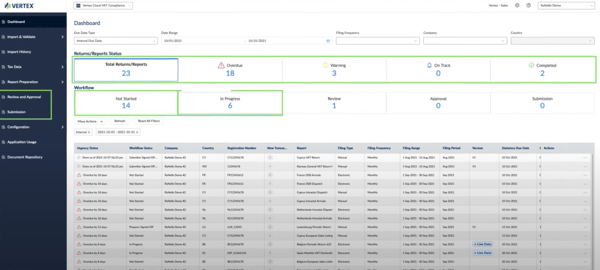
Vertex’s tax data management capabilities add another layer of value for enterprise finance teams. The platform consolidates all tax-relevant documentation, returns, notices, and exemption certificates into a single searchable digital repository. This makes audit preparation faster, since teams can retrieve archived records for any jurisdiction or time period within seconds. Users found that managing exemption certificates directly through the system reduces manual tracking and improves customer accuracy during tax-exempt sales.
The platform’s user experience and stability were also frequently highlighted. Despite the complexity of enterprise tax processes, users found Vertex reliable and smooth to navigate. Once configured, it runs in the background with minimal disruption to ongoing operations, making it a dependable choice for global finance teams.
Even with Vertex’s strong tax data management capabilities, reporting can require more hands-on work than some enterprise teams may expect. G2 reviewers noted that built-in reports sometimes resemble raw data exports rather than analysis-ready summaries, which means teams may need to refine the results in external tools. Users also mentioned that consolidating figures across multiple states or entities can involve running separate reports. While the underlying data is detailed, producing the exact view needed for monthly close or internal analysis may take additional steps.
A few users also shared that the initial system setup and data mapping require detailed coordination with IT or implementation partners. This is largely due to Vertex’s depth and customization capabilities, which allow it to handle unique tax environments. While onboarding may take longer than simpler tools, the end result is a solution finely tuned to enterprise-level accuracy and compliance demands.
All-around Vertex is built for scale, delivering powerful automation, global tax coverage, and deep ERP integration.
“The main thing I like about Vertex is I don't have to worry about changing the rates on a monthly basis or tracking that. I also don't have to worry about whether something's taxable or not as long as we invoice it correctly and we've put the correct rules in place. It pretty much automates probably 98% of sales tax decisions, which is a great relief.”
- Vertex review, Larry T.
“The system of settings is quite complex, and there is no onboarding system for new users. Some changes can only be made through support, such as updating company profile information.”
- Vertex review, Liudmyla G.
Related: For businesses focused on managing corporate filings efficiently, check out the best free corporate tax software options that streamline reporting without added costs.
Anrok is purpose-built for subscription-based and digital-first businesses that deal with recurring revenue, variable usage, and cross-border customers. According to G2 Data, 44% of Anrok’s users are small businesses and 55% are mid-market teams, mainly in computer software, IT, and accounting.
Its dynamic tax engine is one of its strongest advantages. Rather than relying on static tables, it recalculates rates and taxability rules instantly as new transactions flow in. For SaaS companies processing thousands of subscription renewals or variable invoices, this ensures every charge reflects accurate jurisdiction rules. Reviewers noted that this level of responsiveness prevents errors that often occur when tax settings lag behind billing updates.
The platform’s automated nexus tracking makes monitoring compliance thresholds effortless. Instead of manually reviewing sales data, teams can visualize their exposure across U.S. states and international regions in real time. This proactive design helps finance teams identify when they’re nearing registration thresholds before liabilities appear, giving them time to prepare.
Anrok’s return management and filing automation also earned strong feedback. The system generates, reviews, and submits filings automatically while maintaining clear audit trails. Teams can still approve filings manually, which strikes the right balance between automation and accountability. G2 reviewers said this structure simplifies monthly and quarterly filings.
Its SaaS-native integrations are another standout. Anrok connects directly with platforms like Stripe, NetSuite, and Chargebee, syncing tax data seamlessly between billing, payments, and accounting systems. These real-time connections minimize reconciliation headaches and ensure that tax calculations stay aligned with financial records. Users described this as a major time-saver during close cycles.
The platform also supports global VAT and GST compliance, making it suitable for software businesses with international customer bases. It centralizes regional tax obligations and reporting, allowing finance teams to manage all jurisdictions through a single dashboard. This consolidation helps avoid fragmented workflows that often arise when companies expand into new markets.
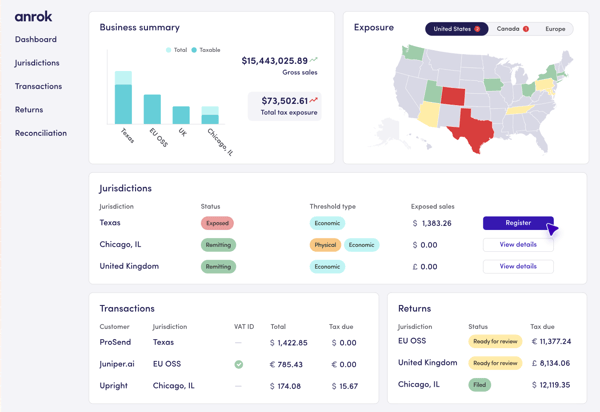
Anrok’s reporting and visualization tools give teams a clear snapshot of their compliance health. The dashboards summarize nexus exposure, filing progress, and tax liability trends at a glance. Reviewers mentioned that having all this data centralized reduced their reliance on spreadsheets.
Anrok’s customer support team is known for its deep tax expertise and hands-on guidance. Some users mentioned that support response times may vary, particularly when dealing with complex international queries. For teams seeking faster resolutions, leveraging Anrok’s growing self-service library can often address routine setup questions quickly.
A few users mentioned that the platform’s interface could feel dense at first. The number of menus and settings reflects the system’s depth rather than complexity, and most users said the layout becomes intuitive once configured. The guided workflows and in-platform tips make onboarding smoother over time. For many teams, the learning curve is a worthwhile trade-off for the visibility and control Anrok provides.
Overall, Anrok delivers the automation and agility that modern SaaS companies need to stay ahead of evolving tax rules. It’s a platform designed not just to calculate tax but to make compliance seamless for recurring-revenue businesses.
“I really appreciate Anrok's clean and aesthetically pleasing interface. It makes my experience much more enjoyable. The navigation is straightforward, which makes the software enticing to use regularly. This ease of use contributes to its value for me, as it ensures my interactions with the platform are both efficient and pleasant.”
- Anrok review, Jennifer H.
“The dashboard is a little messy and sometimes confusing, especially when trying to determine where to click. It can be intimidating, particularly for someone new to the system like me. I wish there were a more straightforward dashboard that could clearly indicate tasks to be completed or items that are overdue. Sometimes it feels a bit overwhelming until I become more familiar with it.”
- Anrok review, Giorgiana B.
Related: Strengthen your compliance and risk posture with the best GRC software
trusted by enterprises for governance, risk assessment, and policy management.
Managing sales tax across multiple states can be overwhelming for small online retailers. That’s where TaxJar comes in. Built for e-commerce sellers and small business owners, it automates rate calculations, filing, and remittance across U.S. jurisdictions. According to G2 Data, 88% of TaxJar users are small businesses, primarily in the retail, consumer goods, and apparel and fashion industries. The platform’s simple setup, strong marketplace integrations, and filing automation make it a reliable compliance partner for sellers managing growth without a full finance team.
TaxJar’s automated tax calculation engine is at the core of its value. It applies state and local sales tax rates in real-time, ensuring every checkout reflects the correct total. G2 reviewers highlighted the dependability of the automation, particularly for sellers who use multiple e-commerce channels. The system eliminates the need to manually upload rate tables or track tax changes, which saves hours of repetitive work each month.
The platform’s AutoFile feature is another highlight. It automatically files state sales tax returns accurately and on time, using transaction data directly from e-commerce or ERP systems. This end-to-end process manages remittance, report preparation, and deadline tracking automatically. Users said that AutoFile removes the manual burden of researching forms or state-specific formats, reducing filing mistakes and maintaining smooth compliance as businesses grow.
TaxJar’s nexus tracking tools help businesses stay compliant as they expand into new states. The platform monitors sales thresholds and alerts users when they’re approaching registration requirements. G2 reviewers said this feature gives them peace of mind, especially during high-volume seasons when monitoring compliance manually would be impossible.
Integrations are one of TaxJar’s biggest strengths. The platform connects directly with Shopify, Amazon, WooCommerce, BigCommerce, and QuickBooks, automatically syncing transaction data. These integrations reduce discrepancies and ensure that tax is calculated consistently across every storefront. Reviewers noted that setup is straightforward, with minimal technical steps required to get started.
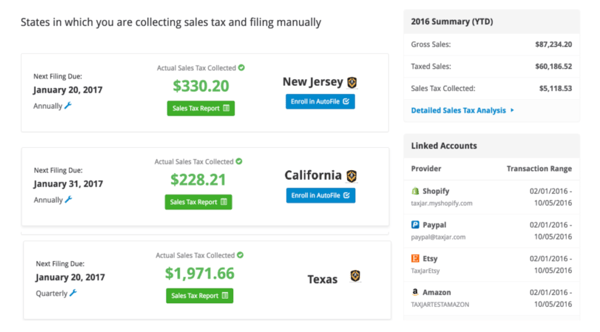
The tool’s reporting and reconciliation features were frequently mentioned for their clarity. TaxJar breaks down transactions by state and filing frequency, making it easy to double-check tax liabilities before submission. Users said the reports are clean, readable, and useful for both filings and internal audits, even without extensive accounting expertise.
Ease of use is another area where TaxJar stands out. G2 reviewers consistently praised its simple and intuitive interface, which makes onboarding fast, even for teams without dedicated finance staff. Everything from connecting stores to reviewing filings can be managed from a single dashboard, making it one of the most user-friendly options for small businesses.
While TaxJar keeps most routine sales tax tasks simple, a few workflows may still require manual attention. G2 reviewers noted that the platform does not include a native way to collect and store exemption certificates. Some users also said refunds from platforms such as Shopify do not always sync correctly, which can mean adjusting transaction data before filing. These gaps may not affect sellers with straightforward transactions but could create extra work for B2B and wholesale businesses.
TaxJar’s streamlined setup can also limit its flexibility for more complex tax situations. Reviewers mentioned gaps around certain state-specific rules, industry exemptions, and home-rule jurisdictions such as Colorado. Businesses with these requirements may need to review AutoFile calculations or manage parts of the process separately, although the platform remains well-suited to standard multi-state e-commerce compliance.
Overall, TaxJar remains a trusted choice for e-commerce businesses that need dependable automation without complexity.
“I like that TaxJar helps us verify our sales tax setup instead of guessing. It provides us with address, jurisdiction, and tax rate information that we can compare against SAP. TaxJar is valuable because it helps us double-check our SAP tax setup by validating the ship-to address, confirming the correct city/county/state jurisdiction, and showing the tax rate breakdown. This allows us to identify incorrect tax codes, rate mismatches, missing rates, or addresses that require manual review. Although it’s not perfect every time, it has been very useful for our sales tax validation process, especially for checking addresses, jurisdictions, and rates against what we have in SAP. I would recommend it for these reasons.”
- TaxJar review, Diego C.
"We don't like that TaxJar cannot support local jurisdiction states such as Colorado.”
- TaxJar review, Jennifer I.
Paddle is an all-in-one revenue delivery platform for SaaS businesses that handles billing, payments, subscriptions, and tax obligations across multiple regions. According to G2 Data, 93% of Paddle’s users are small businesses, primarily in the software, IT, and marketing and advertising industries. The platform’s ability to combine payment processing with built-in tax compliance makes it a strong choice for startups that sell across borders without dedicated finance teams.
One of Paddle’s biggest advantages is its built-in global tax compliance. Rather than asking sellers to register in each country, Paddle handles the tax calculation, collection, and remittance process on their behalf. Reviewers noted the value of this for small teams without in-house tax expertise. The system automatically stays current with international tax rules, minimizing the risk of penalties or missed filings.
The platform also shines in subscription and recurring billing management. Paddle automates renewals, upgrades, cancellations, and refunds while ensuring each transaction includes the right regional taxes. G2 users said these automated processes reduce errors and improve billing transparency for both teams and customers. This makes it particularly useful for SaaS businesses with tiered pricing or usage-based models.
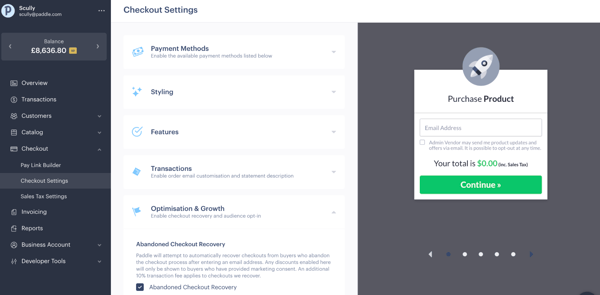
Paddle’s payment infrastructure simplifies global selling by supporting multiple payment methods and currencies. Reviewers appreciated how it localizes checkout experiences for buyers automatically, helping to boost conversions in new markets. Teams also liked not needing separate payment gateways or merchant accounts, as Paddle consolidates everything into one platform.
The platform’s integrations make it even easier to manage the entire revenue lifecycle. Paddle connects with tools like HubSpot, Databox, and Stripe, allowing teams to sync payment, subscription, and customer data with their existing workflows. Reviewers noted that these integrations cut down on manual exports and give finance and operations teams a more unified view of revenue and compliance data.
Another feature that stood out was Paddle’s developer readiness. The platform provides straightforward API documentation and flexible plug-ins, making integrations easier than most enterprise payment systems. Users reported that the setup required minimal engineering time, which allowed them to focus on product growth rather than infrastructure.
Customer support received strong recognition across reviews. Many users praised Paddle’s onboarding support, mentioning the team's responsiveness and expertise during the initial setup and international expansion. For growing SaaS companies, this proactive help made compliance seem much more manageable.
While the support team is recognized for their knowledge, that same thoroughness, for some G2 users, means response times can vary once users begin requesting deeper technical or API-level guidance. Teams managing highly technical configurations may simply need to plan for slightly longer resolution cycles.
Paddle’s documentation is structured for clarity and accessibility, making it easy for most users to complete standard integrations independently. For developers working on advanced or highly customized setups, however, the materials can feel fragmented or lack complex examples. This keeps the learning curve manageable for non-technical teams, while those seeking deeper implementation detail may prefer to supplement with direct support or community guidance.
Lastly, it’s worth noting that recent G2 review volume for Paddle is limited, making it harder to gauge newer user experiences in 2025. In general, Paddle delivers what most small software businesses need: dependable automation, peace of mind regarding compliance, and a billing system that scales as quickly as their growth.
“I use Paddle for money transactions and I appreciate that it's a Merchant of Record (MOR) because it handles taxes itself, which saves me from going elsewhere. I also find Paddle's documentation with AI features very helpful, and its site is very easy to use. What I like most about Paddle is its customer support, which is incredibly awesome with fast responses and detailed guidance. Additionally, I'm impressed by its robust API and the fast and reliable webhooks.”
- Paddle review, Surya s.
“Some things could be improved. Payout timing can feel a bit slow at times, and there's not always a lot of flexibility around when funds are released. Customization options for certain billing or checkout details are also somewhat limited. In a few cases, getting very specific answers from support took longer than expected especially for more detailed payout or reporting questions.”
- Paddle review, Wesley S.
Related: For businesses focused on managing corporate filings efficiently, check out the best free corporate tax software options that streamline reporting without added costs.
Lappa is designed to help businesses manage VAT obligations across multiple countries without relying on manual calculations, spreadsheets, or separate filing processes. According to G2 Data, 65% of its users are small businesses, making it particularly relevant for growing companies that need a structured way to handle international tax compliance without building a dedicated tax team.
One capability that appeared consistently across recent reviews was VAT automation. Users frequently mentioned that once transaction data is connected, Lappa automatically calculates VAT and prepares the information needed for reporting and filing. I found that reviewers often tied this automation directly to reduced manual effort and fewer filing mistakes.
Another area that stood out was multi-country VAT management. Several G2 users highlighted the ability to monitor obligations across different jurisdictions from a single platform. Rather than switching between local tax portals or tracking requirements manually, teams can manage registrations, filings, and compliance activities in one place.
I also noticed repeated praise for visibility into tax obligations. Reviewers described the dashboard as a central location for monitoring deadlines, filings, registrations, and reporting requirements. For businesses selling internationally, having that information consolidated appears to make planning and compliance management more straightforward.
Tax threshold tracking was another frequently mentioned benefit. Users noted that Lappa helps monitor where registration requirements may apply as sales activity grows. Based on the reviews I analyzed, this functionality gives teams more confidence when entering new markets because they have better visibility into potential compliance obligations.
Several reviewers also appreciated the platform's filing workflows. Users mentioned that the system helps organize reporting and return preparation, making VAT processes easier to manage month after month. Many connected this directly to time savings and a lower administrative burden for finance teams.
Ease of implementation received positive feedback as well. While tax compliance platforms often require lengthy onboarding, some reviewers specifically called out Lappa's setup process as relatively straightforward. Others noted that features such as e-invoicing integrations helped them get up and running more quickly while keeping tax data organized from the start.
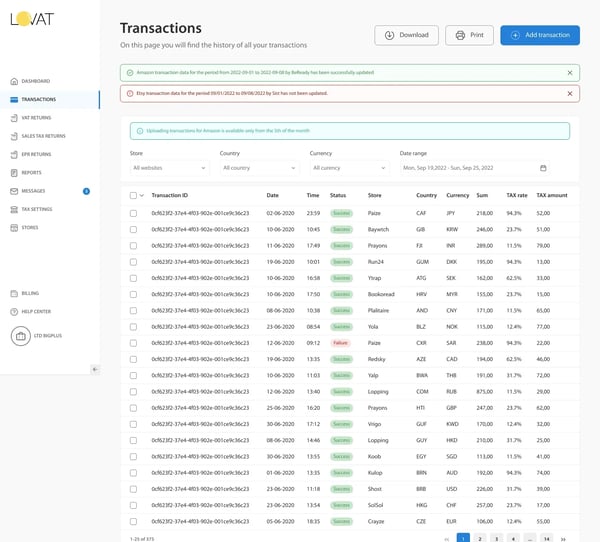
That said, I found a recurring theme around the learning curve for new users. Several reviewers mentioned that the platform includes a broad range of functionality, which can make the interface feel dense initially. However, many also noted that once they became familiar with the layout, managing VAT workflows became much easier, making this more of an onboarding consideration than a long-term obstacle.
I also came across feedback related to navigation and reporting customization. A few users said certain reports or settings were not immediately intuitive to locate, while others expressed interest in additional reporting flexibility. For teams that need highly customized reporting views, there may be some adjustments required, though most reviewers still described the platform as organized and easy to work with after initial setup.
Lappa appears particularly well-suited for small businesses and growing international sellers that need a practical way to manage VAT across multiple countries. Based on the reviews I analyzed, its combination of automation, visibility, and centralized compliance management makes it a strong fit for teams looking to reduce manual tax work without adding unnecessary complexity.
“Managing sales tax and VAT is considerably less stressful thanks to LOVAT. I appreciate that it automatically gathers data from many sales channels and maintains everything in one location. The UI feels useful rather than overpowering, and the tax deadline reminders are really helpful. The setup was quick and easy with e-invoicing.”
- Lappa review, Karla S.
“The initial setup can take some time because there are many features to configure. New users may need a short learning period to fully understand the dashboard and locate certain reports or settings.”
- Lappa review, Nicole S.Have more questions? Find more answers below.
For technology companies, Anrok and Paddle stood out the most in my evaluation. Both are built with digital businesses in mind and help manage recurring revenue, cross-border transactions, and international tax obligations. Anrok is particularly well suited for SaaS companies managing subscriptions, while Paddle combines billing, payments, and tax compliance in a single platform.
Vertex, Avalara, Paddle, and Lappa are among the highest-rated VAT compliance solutions in this guide. Each supports international tax requirements, but they serve different needs. Vertex is often favored by large enterprises, while Lappa and Paddle are strong options for smaller businesses managing VAT across multiple countries.
Based on my analysis, Avalara and Vertex earned the strongest reputation for tax accuracy. Users frequently praised both platforms for maintaining current tax rates, applying complex tax rules correctly, and supporting compliance across multiple jurisdictions.
TaxJar, Lappa, and Paddle are the tools I would recommend most often for small business owners. They offer straightforward workflows, strong automation, and less implementation complexity than many enterprise-focused alternatives.
TaxJar, Lappa, and Paddle generally offer more streamlined implementations than enterprise-focused platforms. G2 reviewers often highlighted their ease of setup and ability to get teams operational quickly without lengthy deployment projects.
For businesses with 11-50 employees, TaxJar, Lappa, and Anrok are strong options. These platforms balance automation with ease of adoption, helping smaller finance teams reduce manual compliance work without extensive implementation requirements.
TaxJar and Paddle received consistent feedback for their intuitive interfaces and straightforward workflows. Lappa also stood out for helping teams centralize compliance activities without requiring deep tax expertise.
Anrok, Paddle, and Avalara have strong adoption among software companies, while Avalara and TaxJar are frequently used by retail businesses. Their automation capabilities help reduce manual tax management and improve operational efficiency.
Avalara and Vertex offer some of the broadest integration ecosystems, connecting with ERP, accounting, billing, and e-commerce platforms. Anrok and Paddle also received positive feedback for integrations with tools commonly used by software businesses.
TaxJar consistently stood out for ease of use. Paddle and Lappa also earned positive feedback from users who wanted a straightforward compliance solution without extensive technical setup or ongoing administration.
TaxJar, Anrok, and Lappa are the platforms most likely to generate quick value for growing businesses. Users frequently cited reduced manual filing work, improved compliance visibility, and time savings as immediate benefits after implementation.
Anrok, Paddle, Avalara, and TaxJar all received strong feedback from software and retail businesses. Reviewers commonly highlighted automation, accuracy, and ease of managing compliance across multiple jurisdictions.
Avalara and Vertex stood out most for complex multi-jurisdiction tax calculation. Anrok also received strong praise for automating tax determination across regions, particularly for SaaS and subscription-based businesses.
Avalara, Vertex, and TaxJar earned consistent praise for reliability and long-term stability. While implementation experiences vary by company size and requirements, users frequently described these platforms as dependable solutions for ongoing compliance management.
Sales tax compliance is one of those responsibilities that becomes more challenging as a business grows. New jurisdictions, changing regulations, and increasing transaction volumes can add complexity quickly, especially for teams managing compliance across multiple systems and regions.
The six tools I evaluated approach these challenges in different ways. Avalara and Vertex are well-suited for organizations that need broad jurisdiction coverage, advanced automation, and support for complex tax environments. Anrok and Paddle stand out for software and subscription-based businesses managing recurring revenue and international tax obligations. TaxJar simplifies compliance for smaller e-commerce teams, while Lappa offers a practical approach to managing VAT requirements across multiple countries.
What these platforms have in common is their ability to reduce manual compliance work while giving teams better visibility into filings, tax obligations, and reporting. The right choice ultimately depends on your business model, operational complexity, and where you expect to grow next.
Whether you're managing sales tax across multiple states, expanding internationally, or looking for a more efficient way to handle filings and remittance, these solutions offer different paths to making compliance more manageable.
If you’re managing global teams or looking to simplify cross-border payments, explore our guide on the best multi-country payroll software to complete your global compliance stack.


Every business dreads tax season, but it doesn't have to be so scary.
.png) by Devyani Mehta
by Devyani Mehta

When recurring revenue becomes the backbone of your business, billing stops being a...
 by Yashwathy Marudhachalam

Nothing in this world is duty-free.
 by Jennifer Clark