.png?width=400&height=150&name=Copy%20of%20G2%20Image%20(1).png)


I evaluated 40+ tools to find the 7 best legal billing software in 2026. These include Clio Manage, 8am MyCase, 8am LawPay, Smokeball, PracticePanther, CARET Legal, and Tabs3 Software.
I have been on the front end of a few civil legal disputes myself and noticed an instant pattern of attorney conversations. While they remain vigilant with tasks like drafting summons, making court appearances, or writing appeals, when it comes to actually getting paid, the process is very traditional and manual on their end.
That's when I explored the use of legal billing software to calculate legal fees. As I reviewed product features, market positioning, and G2 user feedback, I noticed several recurring challenges for legal teams: missed billable hours, disconnected methods of accounting that won’t talk to each other, limited real-time financial visibility, billing disputes, and outdated legacy workflows.
And it adds up when you think about how much a firm's money passes through before it's collected: different clients, different cases, different attorneys logging different hours. Every handoff is a place where money can slip away.
To narrow down the options, I analyzed 40+ legal billing software solutions based on their features, pros and cons, and user reviews on G2. From that research, I shortlisted seven platforms that stood out for helping law firms track billables, manage invoices, improve collections, and maintain better client relationships.
Let's look at them in detail.
*These legal billing software are top-rated in their category, according to the Summer 2026 G2 Grid Report. I’ve also added their monthly pricing to make comparisons easier for you, except for the ones not available publicly.
During my analysis, I started to see legal billing software less as an invoicing tool and more as the revenue control layer of a law firm. Legal billing isn’t just about sending a bill at the end of a case.
In a law firm, money moves through many forms before it becomes revenue: consultation fees become retainers, time entries become billable hours, case expenses become reimbursements, and invoices become collected payments.
That journey matters because revenue can get stuck at almost any point. It can take a law firm almost five months, on average, from being appointed to getting paid for the work. For me, that made the role of legal billing software much clearer: it helps law firms shorten the distance between work performed, work billed, and money collected.
At its core, legal billing software helps law firms track billable hours, create invoices, manage expenses, process payments, and maintain accounting visibility around each client or matter.
I started with G2 Grid Reports for legal billing software to understand how different products compare across market presence, customer satisfaction, and review-based signals.
From there, I built an initial pool of 40+ legal billing software solutions and reviewed their G2 profiles, product information, feature pages, pricing details, and user feedback. I also used AI to summarize the features and benefits users rave about each software.
To refine the shortlist, I compared those review patterns with each product’s official capabilities and pricing information to keep the evaluation grounded in both user sentiment and product facts.
I looked for platforms that made the billing lifecycle easier to follow. That included time capture, expense tracking, invoice approvals, payment links, client portals, trust accounting support, accounting integrations, and reports that show what has been billed, what has been paid, and what is still outstanding.
By combining these, I landed on this final list of the top 7 legal billing software for you to consider and evaluate.
The screenshots in this article include a mix of those sourced from G2 vendor pages and publicly available material.
Legal billing software became worth including in this list when it helped make the financial side of legal work easier to trace. I wasn’t just looking for tools that could create invoices. I looked for software that could connect the work behind a matter with the money tied to it: time, expenses, rates, invoices, payments, trust balances, and client-facing records.
The list below contains genuine user reviews from the Legal Billing Software category page. To be included in this category, a software must:
*This data was pulled from G2's Summer Grid Report in 2026. Some reviews may have been edited for clarity.
Clio Manage is the product I’d point to for law firms that want billing, deadlines, client communication, and case work organized around the matter. It is less a standalone billing tool and more a practice management hub. It’s the most-reviewed option on this list with a 4.6 out of 5 rating across 990+ G2 reviews, with a near-perfect satisfaction score of 99. Its reviewer base is overwhelmingly law firms and legal-services providers, the two largest industry segments on its G2 profile.
Ease of use is the theme that surfaces most in the reviews I analyzed, and G2's numbers back it up: Clio rates 92% on ease of use against an 87% category average. Reviewers describe a clean, well-structured interface that gives a one-click view of active matters and outstanding balances, so a new user gets oriented without much ramp-up.
Closely tied to that is how the platform organizes client and matter data. I came across many reviews praising Clio's centralized client database, where case details stay accessible to authorized team members at any time as a single source of truth that reviewers credit with keeping a busy pipeline of matters from slipping.
Calendaring and deadline tracking are where the "organized workflows" reputation is earned. Across reviews, attorneys point to Clio's calendar, task, and deadline tools for keeping court dates, consults, and follow-ups in one view, the capability that most defines what this tool is best for.
Timekeeping draws steady praise as well. Reviewers value logging billable hours from wherever they are, between court appearances, client calls, and emails, and having those entries flow straight into invoices and the client ledger. For most teams, the core invoicing and time-capture tools stay easy to pick up.
On integrations, Clio posts its strongest mark on G2: cross-system Integration is its highest-rated feature at 84%, well above the 76% category average. The breadth of its app ecosystem: payment processors, document storage, and calendaring apps, lets firms connect Clio to what they already run rather than replacing the whole stack.
Client communication rounds out the strengths. Mobile access is among the most-mentioned positives in the reviews I read, and reviewers single out the client portal for letting clients choose how they connect (portal, text, or email) with messages and payments tied back to the right matter.
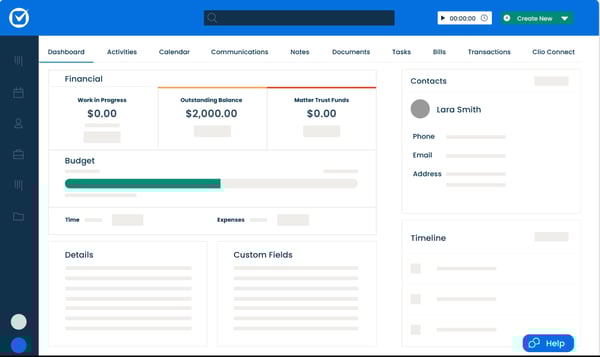
Clio's standard reports cover the filings and financial views most firms reach for day to day. Where reviewers look for a bit more is depth. A few reviewers mention exports can take a little shaping before they're fully analysis-ready, and that finer report customization would sharpen the picture. Clio appears to be moving that way already, with its newer beta reporting widening exactly the options reviewers have been asking for.
Clio's communication tools draw steady praise, and email is part of that picture. Where reviewers would like things smoother is in filing emails to the right matter. A few note that the Gmail and Outlook add-ons take a few extra steps. For most teams, it's the kind of thing a short setup pass clears up.
On balance, Clio is strongest at everyday matter management, timekeeping, and client billing for firms that want one organized system.
"Clio makes it really easy for me to bill my clients and get paid. I also really like how simple it is to docket, which used to be a huge pain point for me. The client portal is especially helpful, since I absolutely hate email."
- Clio Manage review, Rachel S.
"Sometimes the add-on feature in Outlook for saving emails to matters isn't the most user-friendly. The way it is integrated into Outlook isn't the easiest to navigate."
- Clio Manage review, Claire P.
Not every organization needs legal billing — sometimes, free invoicing solutions are all it takes to keep cash operations smooth.
8am MyCase is an all-in-one legal service platform. It brings case management, billing and payments, a client portal, document management, and a set of AI tools into one system built for law firms.
Reading across its reviews, what I see firms reach for most is the billing side: keeping time, invoices, and payments connected so billable work doesn't slip. On G2 it holds a 4.4 out of 5 rating across 358 reviews, with a base drawn overwhelmingly from small-scale legal practices.
The strength I saw cited most is that 8am MyCase puts everything for a matter in one place. Reviewers describe keeping client details, case notes, statuses, documents, and billing together, which spares a firm the constant tool-switching.
Ease of use backs that up. 8am MyCase rates 91% on ease of use against an 87% category average, and across the reviews I analyzed, users describe it as approachable enough that staff get comfortable quickly rather than fighting the interface.
Billing is where it earns its "best for" tag. Reviewers point to time entries, invoicing, accounts receivable, and expense tracking working together, so billable time isn't lost. That’s one consistency I'd single out as 8am MyCase's strongest everyday payoff for a firm watching its revenue.
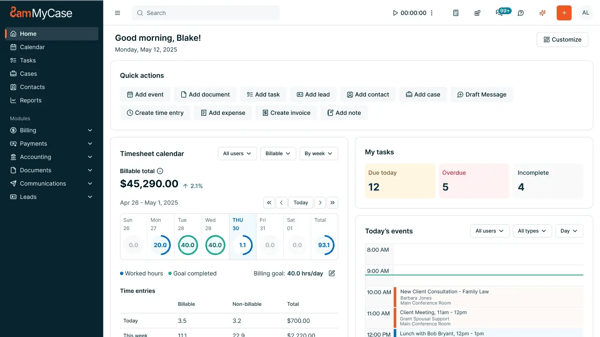
The client portal comes up often as well. Reviewers value it as a round-the-clock channel where clients can message the firm, see case updates, and view their documents, which I read as a genuine lift for client transparency and fewer status-check calls.
On the newer end, 8am MyCase's AI tools draw growing interest. It also sits in G2's AI Legal Assistant category, and reviewers note features that help draft and surface information inside matters, the kind of capability I'd weight more heavily each year, since it's where this category is moving.
Onboarding and support round things out. 8am MyCase rates 89% on quality of support, and reviewers repeatedly credit a smooth, well-guided setup for getting a firm running without a rough first week.
8am yCase's document tools handle a firm's everyday filings well, and reviewers are comfortable storing and organizing standard case documents inside each matter. Where a few run into a ceiling is large media. Criminal-defense practices especially note that per-file size limits make it hard to keep and share large discovery materials and bulk documents inside a case file. It rarely comes up for firms whose documents are mostly standard filings, and where it does, reviewers keep oversized media in external storage alongside 8am MyCase.
For firms whose files are mostly standard PDFs, pleadings, and client documents, this rarely seems to interrupt the workflow; teams dealing with oversized files often keep those materials in external storage alongside 8am MyCase.
Its standard reports cover the day-to-day views most firms rely on, from billing and case tracking to the financial numbers that keep matters moving. Where some reviewers want more depth is in customization, especially for reports that break performance down by individual lawyer, matter, or practice area. The positive signal is that a few reviewers also point to improvements in reporting options, suggesting 8am MyCase is already moving in the direction users have been asking for.
For a firm that wants time and invoices working as one connected system, 8am MyCase is strongest at keeping billable work captured and a practice organized in a single place.
"Administrative features for invoicing, accounts receivable, and tracking — attorneys are more consistent with billing, and billable time is not lost. Expense tracking is outstanding to ensure expenses are billed.”
- 8am MyCase review, Natasha R.
"Large file storage/sharing is a problem for me because of file size limits. Most criminal law discovery videos can't be stored in the case file within 8am MyCase. I end up having to store these files in external [storage].”
- 8am MyCase review, JoAnne M.
Get insights into improving transparency, functionality, and legal discipline for your law firm with enterprise legal management to function at your full legal capacity.
8am LawPay is a payment processor built specifically for law firms. On G2, it sits at 4.7 out of 5 across 180+ reviews, and 94% of reviewers say they'd recommend it, with a base drawn almost entirely from small legal-services and law-practice firms.
Reading through the reviews, I keep landing on the same takeaway: that trust-compliance piece is the whole reason firms choose it over a general processor like Square or Stripe. And this is where it earns its "best for" tag. The platform automatically separates trust and operating funds and is designed to keep firms compliant with IOLTA rules, the safeguard reviewers value most as it removes a major source of ethics risk that generic processors don't address.
The core of the product is payment flexibility. Reviewers point to being able to take credit cards, ACH, and eChecks in one place, so clients can pay whichever way suits them. A detail several call out approvingly is that fees are billed monthly rather than skimmed out of each transaction, which keeps deposits whole.
Looking at integrations, I found 8am LawPay connects into much of the legal-software ecosystem, including 8am MyCase, Smokeball, PracticePanther, and CosmoLex among them, and it posts its highest-rated G2 feature in cross-system Integration at 82%, above the 76% average.
For firms already on one of those platforms, payments link straight to client matters. Reviewers like being able to send payment links by text, email, or straight from the firm's website, which gives clients a quick, familiar way to settle invoices and cuts down on chasing payments.
Ease of use is the note that comes up most across the reviews I analyzed, and G2's setup numbers back it: 8am LawPay scores 96% on ease of setup against an 86% category average, and 94% on ease of use. Reviewers describe getting up and running without much friction and finding the interface straightforward to navigate day to day.
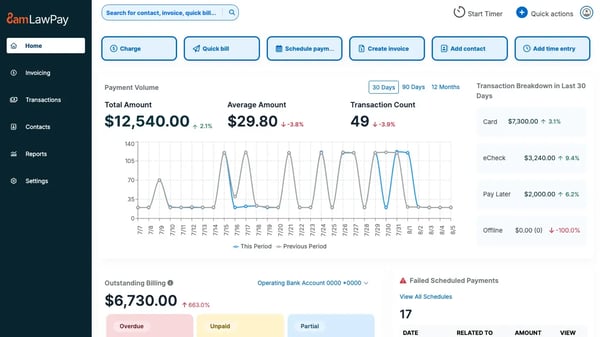
Support draws consistent praise. 8am LawPay rates 95% on quality of support against an 88% average, and reviewers credit responsive help, a few even note the continuous legal education (CLE) resources the company offers as a bonus on top of the payment tools.
I’ve come across noticeable satisfaction with the card vault feature, which allows users to securely store client payment details for future transactions. This is particularly valuable for managing payment plans and recurring billing, as it eliminates the need to re-enter payment information.
While firms appreciate 8am LawPay’s transparent fee structure, a few say they wish the rates ran a little lower. The merchant service fees on card payments can add up. It’s worth keeping in context that those same reviewers tend to say the value holds up for legal-specific compliance. Also, that fees are billed monthly rather than per transaction makes costs easier to read.
Collections run reliably. The adjustment a few reviewers flag is deposit timing: funds typically land in about two to three business days, which those coming from faster processors had to plan around. Since the timing stays consistent, most teams build it into their cash-flow rhythm, and it's the dependability of getting paid that they ultimately credit.
For firms that want payments and trust accounting handled compliantly in one place, 8am LawPay is strongest at secure collections, clean trust-operating separation, and an easy paying experience.
"I like the integration with various platforms, in our case, Cosmolex. I also like the way the platform keeps you in compliance. For the most part, the platform is easy to use."
- 8am LawPay review, Melanie L.
"Our previous payment processor deposited payments into our account almost in real time, and never later than 24 hours… it was a big adjustment when we realized deposits typically took 48–72 [hours].”
- 8am LawPay review, Sara B.
To protect your trademarks, build a foolproof intellectual property (IP) rights policy and use intellectual property management software to prevent external infiltration.
Smokeball is a cloud-based legal practice management platform with pre-built matter types spanning litigation, real estate, criminal, personal injury, and corporate law. Its whole design leans on automation, capturing activity as it happens and turning it into billable time and ready-to-send documents.
It holds a 4.7 out of 5 rating across 384 reviews on G2, with 95% of reviewers saying they'd recommend it and a base made up almost entirely of law practices and legal-services firms.
A signature capability, and the one I'd point to first, is automatic time tracking. Rather than relying on attorneys to start a timer, Smokeball records the work as it happens, so small increments like a drafted email or a quick call get captured. Reviewers tie this straight to billing accuracy. That steady activity capture is what supports Smokeball’s automated invoicing, where invoices are built from captured activity, not pieced together from memory at billing time.
Getting started is another thing reviewers tend to bring up. Smokeball rates 93% on ease of use against an 87% category average, and the comments I read describe an onboarding that lands quickly and an initial setup that was easy.
What's drawing the warmest comments lately is Archie, Smokeball's AI assistant. Reviewers describe it as genuinely useful day to day. Many say it understands their prompts, and it's the capability they’d weigh most heavily since AI assistance is fast becoming the dividing line in this category.
Document work is one of the areas I kept seeing in reviews. Users mention Smokeball auto-populates templates without requiring repeated manual entry. I also noticed reviewers calling out the Outlook connection, especially the ability to tag emails to the right matter, because it helps keep correspondence attached to the case instead of scattered across inboxes.
I also saw a clear pattern around matter organization. Reviewers value having case information, documents, and billing in one organized place, which spares the hunting across systems that slows a busy practice down.
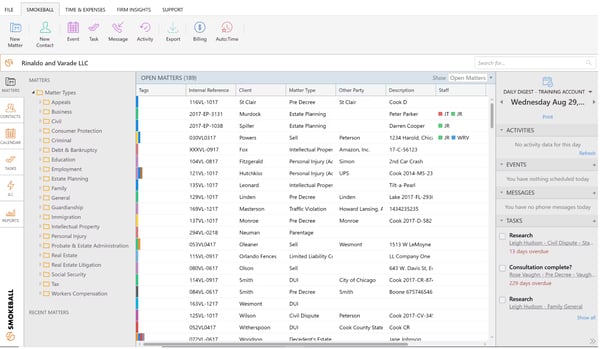
If one figure stands out on Smokeball's G2 profile, it's support: 97% on quality of support against an 88% average, the highest support mark in this roundup. Reviews back the number up, with many describing the team as responsive, knowledgeable, and willing to walk firms through setup, workflow questions, and day-to-day product use.
Smokeball's built-in reports cover the billing and case views a firm runs regularly. Where a few reviewers want more room is self-serve customization, pulling figures like average fees by file type, or hours billed to a specific client. The underlying data is already there, users mainly want more control over how they slice and format it. For firms with deeper reporting requirements, I’d make this part of the setup conversation.
For most firms, the day-to-day runs smoothly, and reviewers on Windows seldom flag the desktop app. The platform note I'd raise is for Mac-based practices: Smokeball's full desktop application is built for Windows, so Mac users work through the browser version instead. The reviewers who mention it add that the web experience stays fully featured with matters, documents, and billing all in one place.y
All told, I'd place Smokeball as the strongest where automation does the heavy lifting: capturing time, assembling documents, and keeping a matter organized so attorneys spend more hours on client work and fewer on admin.
"Smokeball has seamless integrations and the AI Assistant Archie is remarkable — easy to use and understands my prompts every time. Smokeball's support is second to none.”
- Smokeball review, Ambre W.
"My biggest complaint about Smokeball is the billing functionality. There's no ability to run some basic reports that we need as a firm, like seeing how many hours have been billed to a specific client.”
- Smokeball review, Mitchell R.
Accelerate approvals and ensure contract accuracy with end-to-end contract management solutions.
PracticePanther is a cloud-based legal practice management platform built around keeping a firm's tasks, billing, and client communication in one place. It leans toward solo and small firms that want something approachable, and it shows on G2: a 4.3 out of 5 rating across 113 reviews, and a base concentrated in small-scale legal services firms.
What reviewers raise first is how approachable it is. PracticePanther scores 90% on ease of use and 93% on ease of setup, both above the category average. In the reviews I analyzed, firms describe getting a team trained and working without much ramp-up.
Task and workflow management is where it earns its "best for" tag. The platform lets a firm assign tasks, build repeatable workflows, and tie them to matters. For a small practice running many active cases, that's the backbone that keeps work from scattering.
Billing automation is a close second in the feedback I analyzed. Reviewers value recurring invoices, automatic reminders, and follow-ups that run on their own. Client and case data sit next to billing status, so a firm sees what's owed without switching screens.
Client communication stays close to the work. PracticePanther handles email sync, intake forms, and client messaging in the same system. I read this as the "email-driven" half of what the tool does best. It tightens the loop between a matter and the people on it.
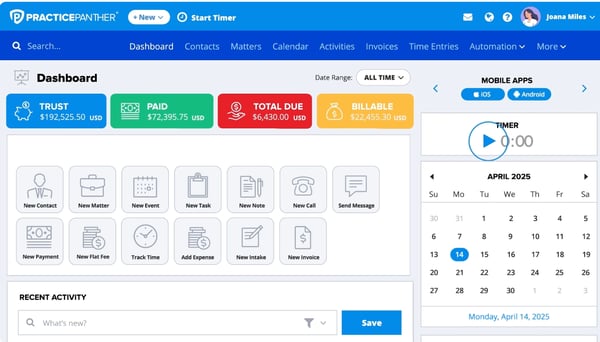
Its integrations reach beyond the platform's own walls. Connections to QuickBooks and Zapier link accounting and many other apps to a firm's workflows. The reviewers who use them point to less manual double-entry.
The essentials also live in one spot. Client records, matters, documents, and pre-built forms are organized by practice area. Standardizing daily operations doesn't mean hopping between tools.
On desktop and web, where most firms work, reviewers find PracticePanther polished and quick. The one spot a few call out is the mobile app, which behaves more like a browser page than a native one. For firms that work mainly at a desk, it rarely comes up, and mobile still handles quick check-ins.
Most reviewers describe PracticePanther as good value, and several call the pricing fair for what it covers. The note worth flagging is that a few small or solo practices feel the cost adds up in the higher tiers. The plans are tiered, so the fit comes down to matching a plan to your caseload. A quick pricing check at signup settles it for most firms.
I'd place PracticePanther with smaller firms that want tasks, billing automation, and client communication working together, and that want to get there without a heavy setup.
"PracticePanther is easy to use and helps lawyers stay organized with billing, case management, and client communication. It also works online, so you can access it from anywhere."
- PracticePanther review, Christina M.
"PracticePanther has a solid infrastructure, but could use updates to its website and mobile app aesthetics. The mobile application functions more like a browser webpage.”
- PracticePanther review, Nils W.
Most legal billing software runs cases and sends invoices, then hands the accounting off to QuickBooks. CARET Legal operates the other way around. It builds a full general ledger and trust accounting into the same system a firm uses to manage cases and bill clients, such that billing and the firm's books never leave one place. Reviewers rate it 4.5 of 5 on G2 across 205 reviews.
The reason CARET earns its "billing and accounting in one place" spot is its native accounting. The platform runs a real general ledger and trust accounting inside the system, not a sync to outside software. For a firm whose bookkeeper works in the same tool as the attorneys, that removes an entire layer of reconciliation between systems.
Billing sits right on top of those books. In the reviews I analyzed, attorneys point to invoicing, time capture, and payments feeding into the same ledger. Money tracked on a matter reaches the firm's accounts without re-entry.
The wider platform keeps the matters’ pieces together. Cases, documents, calendars, and tasks all live in one place. Across the reviews I read, this is the strength people name most after accounting.
Day to day, reviewers find it approachable. CARET Legal scores 90% on ease of use and 93% on ease of admin, both above the category average. New users describe getting comfortable without a long ramp-up.
Access is another plus I'd point to. CARET Legal is fully cloud-based, so attorneys can work from the office, the courthouse, or home. Reviewers value reaching their matters and billing from anywhere.
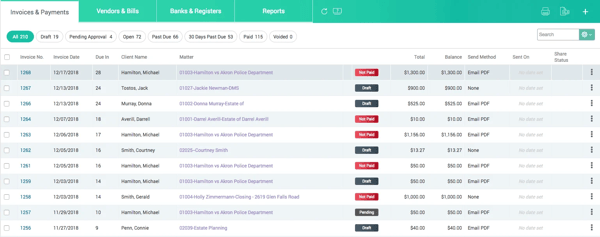
Reviewers also appreciate the help they get. It rates 91% on quality of support, above the category average, and several credit a guided onboarding for getting their firm running quickly.
For routine work, reviewers describe it as steady. The note that surfaces most is performance under load. A handful mention occasional lag or glitches when generating reports or handling larger datasets. Reviewers say it's intermittent rather than constant, and the kind of thing platform updates tend to smooth out.
CARET's case and billing tools are where reviewers spend their praise. The area a few would refine is email. Some find the built-in email and Outlook sync less polished than the rest of the platform. Most firms keep email in their existing client and lean on CARET Legal for the matter and financial side, which keeps this from becoming a sticking point.
Net it out: I'd place CARET Legal with small and midsize firms that want billing and the firm's books handled natively in one system, rather than running a separate accounting tool alongside their practice software.
"It organizes all information efficiently in one matter, which I really appreciate. This software is a time-saver because it cuts down on time spent looking for information in different places. It allows me to speak to clients with all the information at my fingertips.”
- CARET Legal review, Marion Raquel F.
"The internal email system is not something our staff finds beneficial due to its simplicity. However, we choose to use the Outlook integration and find it to be adequate for our needs, so the simplicity of the email system is not a major concern for us.”
- CARET Legal review, Angela B.
Tabs3 takes a different path from the all-in-one platforms on this list. It's a billing-and-financials suite first, built around rules-based billing and full double-entry accounting rather than case management. It also offers something none of the others do, the choice to run it in the cloud or on your own servers. On G2, reviewers rate it 4.4 of 5 across 95 reviews, and support is its most-praised quality by a wide margin.
Billing is where Tabs3 goes deepest. The reviews I analyzed point to fine-grained control over rates and fees. A firm can set multiple billing rates per timekeeper and shape statements to the way it actually bills. For practices with detailed or layered fee arrangements, that depth is the main draw.
The accounting runs just as deep. Tabs3 pairs billing with full financials: a general ledger, accounts payable, and trust accounting. A firm's books sit in the same suite as its invoices, so there's no separate accounting package to reconcile against.
Deployment is where Tabs3 separates itself in this roundup. A firm can take it as a cloud subscription or install it on-premise on its own servers. For practices that want their data in-house, or prefer to own their setup, it's one of the few options here that allows it.
Reliability comes up again and again in the feedback. Reviewers describe a stable program they rarely have trouble with, including some who've relied on it heavily over the years. For a system handling a firm's money, that dependability carries real weight.
In the reviews I read, support is its most-mentioned strength. The platform rates 91% on quality of support, above the category average, and reviewers describe a team that answers quickly and teaches while it helps.
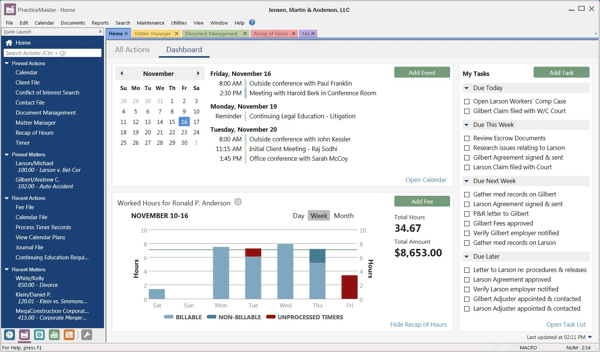
Time capture holds it together. Reviewers value the timers and pre-bill tools for keeping billable work accurate before it reaches an invoice. Getting attorneys to log time consistently is half the battle, and it's an area reviewers say Tabs3 handles well.
Underneath, Tabs3 is powerful, and longtime users move through it comfortably. A note that comes up, mostly from newer reviewers, is the look. A few describe the interface as dated and say certain options take some hunting to find. Be that as it may, capability is all there, and the cloud version has been modernizing the experience, so it reads as a question of polish rather than function.
Also, for the depth it delivers, reviewers generally count Tabs3 as worth it. One point worth sitting with is the cost. A few users mention finding the cloud subscription and the advanced tier pricey. The on-premise option is the more economical route for firms that can host it themselves, which keeps the cost in reach for many practices.
Overall, I'd point Tabs3 Software to established practices that want detailed control over fees, full financials in one suite, and the choice to keep their system in-house.
"It is stable and intuitive. The installation and setup were truly quite easy. Getting new users on board and familiar with the product is really very simple. The few times in 20+ years I have required support, they have been excellent. There are a variety of modules (billing, financial, practice management), and they play well together. It is very straightforward to export data for other applications, such as Excel. I use it daily in all aspects of my job.”
- Tabs3 Software review, Yo R.
""The cloud version is very pricey. Over the years, there have been a few features I would have liked to see updated."
- Tabs3 Software review, Tracy M..
Have more questions? Find the answers below!
Smokeball is the strongest fit because its automatic activity capture feeds billing before month-end cleanup starts. That helps reduce missed billable entries and supports faster invoice generation. PracticePanther is a good alternative for firms that prefer templates, bulk invoicing, reminders, and payment workflows.
8am yCase is the cleanest fit when billing, time tracking, payments, and case management need to work together from one system. Clio is stronger for firms that also want deeper matter organization, calendaring, client communication, and integrations. PracticePanther works well for task-driven small firms.
Clio is the clearest fit for multiple currencies, while Tabs3 is stronger for detailed rate flexibility. Clio supports multiple currencies for billing workflows; Tabs3 supports custom rates by timekeeper, client, or matter, plus flat-fee, contingency, retainer, and split-fee billing.
8am awPay is the best fit when security centers on legal payments and trust funds. It is built for attorney payment compliance, earned/unearned fund separation, and trust-account protection. CARET Legal is stronger when firms want trust accounting inside a broader billing and accounting suite.
PracticePanther is the most affordable full practice management option in this list, starting at $49/user/month annually in your draft. 8am MyCase is close at $50/user/month annually and includes case management, time entry, invoicing, trust accounting, and online payments in its Basic plan.
CARET Legal is the strongest analytics pick for firms that want billing, accounting, and performance reporting together. Its reporting tools cover dashboards, pre-built reports, productivity, compensation, and profitability metrics. Tabs3 is also strong for accounts receivable, work-in-progress, cash receipts, and attorney productivity views.
Clio Manage is the most complete small-firm option if you want matters, calendars, documents, billing, payments, client communication, and integrations in one practice management hub. 8am MyCase is better when billing control and starter-plan value matter more than ecosystem breadth.
Clio Manage is the safest reliability pick because it combines broad review volume with strong satisfaction and workflows attorneys, paralegals, and staff use for matters, calendars, billing, and client communication. In the G2 data I reviewed, Clio is also the most-reviewed product in this roundup.
Smokeball is the strongest support pick for non-technical staff. In the G2 data I reviewed, it has the highest quality-of-support score in this roundup, and reviewers often connect that support with onboarding, workflow questions, and day-to-day product use.
Clio is the strongest Mac and mobile pick because it is cloud-based and offers iOS and Android apps for accessing cases, documents, contacts, notes, and calendars. 8am MyCase is also web-based and remote-friendly. Mac-heavy firms should confirm Smokeball’s browser workflow before choosing it.
Clio and Smokeball are the strongest review-backed picks for small firms and solo practitioners. Clio has the broadest review base in this roundup with 4.6 G2 rating, while Smokeball posts a 4.7 G2 rating and strong support sentiment. 8am MyCase and PracticePanther also review well for smaller firms that want billing, matters, and client communication together.
After analyzing G2 reviews and recurring billing challenges across law firms, I found that legal billing software is most useful when it connects matter work with billing, payments, trust accounting, and revenue visibility.
The goal is not just to capture more billable hours. It is to make billing accurate, transparent, and easier to explain to clients who may already be dealing with sensitive legal matters.
Before choosing a platform, I’d look at your matter pipeline, attorney workloads, payment process, reporting needs, and trust accounting requirements. Then come back to this list and weigh each option against the features that matter to you.
Ready to go beyond billing? Legal billing software is just one piece of the puzzle. To truly streamline casework, client communication, and compliance, you’ll want a complete practice management solution. Explore G2's in-depth guide to the best legal practice management software for 2026 and see how the right platform can transform your firm’s operations.
.png)

I evaluated 20+ tools using G2 Data and reviews to finalize the 6 best legal practice...
.png) by Tanuja Bahirat
by Tanuja Bahirat

I evaluated 15+ tools to find the 9 best legal case management software in 2026. These include...
 by Soundarya Jayaraman

Recently updatedSummer 2026 Grid® Report · Published May 26, 2026 The 10 best AI...
 by Harshita Tewari