



I evaluated 20+ tools using G2 Data and reviews to finalize the 11 best fleet tracking software. These are Samsara, Motive, Geotab, Elite EXTRA, One Step GPS, Lytx, Azuga Fleet, Route4Me, Onfleet, Linxup, and Fleetx.
Every fleet tracking platform promises real-time visibility, fuel savings, and driver accountability. What they don't tell you is how hardware performs across a mixed fleet, whether alerts are configurable enough to be worth acting on, and how support responds when something breaks on a mid-route. Choose the right fleet tracking software based on where a platform actually delivers, not what it promises.
A vehicle you cannot see is a liability you cannot price. A driver running three hours over schedule with no update, a truck idling in a depot burning fuel on the clock, a route that no longer makes sense. None of these shows up on a balance sheet with a clear label. They just erode the margin until someone finally looks at the numbers.
The EPA estimates that reducing unnecessary truck idling alone can save over 900 gallons of fuel per year for a typical long-haul truck. That is just one line item the right platform should close. The question is which one actually does.
I worked through multiple platforms using verified G2 review data and the Fall 2026 Grid® Report, focusing on tracking accuracy, hardware reliability, alert configuration, reporting depth, and real operational performance under pressure. Eleven tools held up where it counts: Samsara, Motive, Geotab, Elite EXTRA, One Step GPS, Lytx, Azuga Fleet, Route4Me, Onfleet, Linxup, and Fleetx.
By the end of this article, you'll have a clear picture of which platform fits your fleet size, compliance obligations, and the complexity of your operations.
* According to the G2 Fall 2026 Grid® Report, these fleet tracking tools are top-rated in their category. I've included their strengths and ideal use cases to help you choose the right platform for your fleet.
Every platform listed in the best fleet tracking software category appears capable at first glance. A closer look reveals differences in hardware reliability across mixed vehicle types, alert customization, and support responsiveness when issues arise.
The strongest platforms I found go beyond basic GPS. They connect location data to fuel consumption, driver behavior, maintenance schedules, and route performance to help fleet managers with better decision-making. What separates the platforms on this list from the rest of the category is how consistently that intelligence holds up under the pressure of a real fleet, beyond a demo environment.
Buyer profiles vary across this category, and my recommendations reflect that. Small fleet operators need fast onboarding, simple hardware, and pricing that scales without punishing growth. Mid-market logistics teams prioritize route optimization, driver scorecards, and dispatch integration. Enterprise fleets focus on compliance reporting, multi-depot visibility, and API access. Every platform below earns its place for a specific reason, and I've matched each recommendation to the profile it actually serves.
I started with the G2 Fall 2026 Grid® Report for fleet tracking, which gave me a structured view of how each platform ranks in user satisfaction and market presence across small, mid-market, and enterprise fleet operations.
From there, I ran AI-assisted analysis across hundreds of verified G2 reviews, looking for patterns in how real fleet managers describe day-to-day use: tracking accuracy under real route conditions, hardware reliability across mixed vehicle types, alert configuration depth, and how each platform handles compliance reporting under regulatory pressure.
I cross-checked those findings with fleet managers, operations directors, and logistics leads running active fleets across commercial transport, construction, and last-mile delivery.
Visuals and product references are sourced from G2 vendor listings and publicly available product documentation.
Choosing a fleet tracking platform shapes how your operation runs throughout the contract. Get it right, and your team spends less time chasing vehicles and more time moving them. These are the five criteria I weighted most heavily in my evaluation.
To qualify for inclusion in the Fleet Tracking category, a product must:
This data was pulled from G2 in 2026. Some G2 reviews may have been edited for clarity.
A single blind spot on a large fleet can turn into a serious incident before anyone has time to react. Samsara is a connected operations platform that combines live GPS, AI dashcams, ELD compliance, and diagnostics in one system. Mid-market and enterprise fleets that want safety, compliance, and visibility in one place keep ending up here.
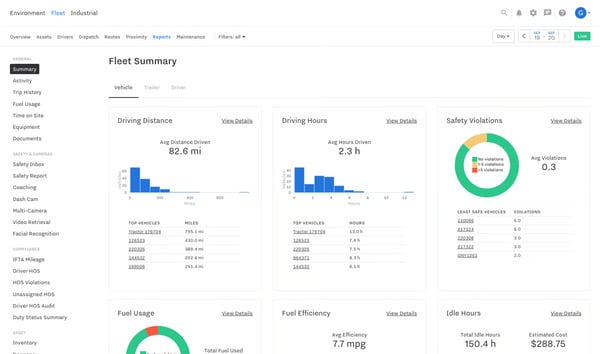
The dashboard is trusted by users across every level. Dispatchers, operations managers, and drivers navigate it without extended ramp-up, and new staff reach full productivity within days. What I noticed is that feedback on this is consistent, spanning small fleets and large enterprise operations alike, which isn't common on most platforms.
If your primary need is knowing exactly where your fleet is at any given moment, Samsara delivers with precision. Real-time location data updates enable accurate ETAs for customers and faster dispatch decisions with the location feature earning a 92% rating in G2 Data. Fleet managers appreciate the live map for providing daily breakdown response, route adjustments, and customer communication.
The AI dashcam and driver safety coaching workflow surfaces unsafe behaviors, including phone use, rolling stops, harsh braking, and seatbelt violations, quickly enough for managers to act before incidents compound. Driver tracking alerts earn an 88% satisfaction score on G2, reflecting consistent reliability across customer reviews. Coaching sessions can be assigned, tracked, and completed within the platform, making the end-to-end safety loop self-contained.
What holds up across all fleet sizes in the review data is the platform's depth. ELD compliance, HOS tracking, DVIRs, and dashcam footage are all available on a single dashboard. I find it striking that the same word surfaces repeatedly in the reviews: consolidation. Fewer systems to manage means fewer gaps between data sources.
The speed of Samsara's alerts matters more than most buyers anticipate before going live. G2 reviewers rate vehicle tracking alerts at 90%, consistent with how managers describe responding to live data throughout the day. This speeds up changes in the job as, instead of reviewing incidents after they happen, managers now step in before the next shift starts.
Fault code visibility, engine health monitoring, and maintenance interval scheduling give fleet managers a clear picture of vehicle condition before issues arise. The vehicle performance rating on G2 clocks in at 84%, and G2 users explain why. One detail that kept surfacing is that they brief the mechanic before the truck returns to the yard.
Some reviewers note that the AI detection feature can sometimes produce false positives, such as flagging seatbelt violations, distracted driving, and drowsiness due to sun glare, mirror checks, and minor hand movements. A recurring theme in G2 feedback is the administrative burden this creates across the large driver population. Safety managers reviewing high volumes of driver events weekly are most affected. Even so, the dashcam footage and coaching workflow capture real safety incidents accurately, providing fleet managers with documented evidence for the interventions that matter.
I noticed several users saying that long-term contracts and layered add-on pricing make costs harder to predict before full deployment. This concern is most often flagged by owner-operators and smaller fleets, where budget flexibility is tight. That said, the consolidation Samsara delivers across safety, compliance, and fleet visibility remains intact regardless of how the contract is structured.
If your fleet has outgrown reactive safety management and needs a coaching loop that closes before the next shift begins, Samsara is where I'd point you first. Real-time dashcam detection, automated driver coaching, and consolidated ELD compliance are what set this tool apart when a safety decision is live.
"What I like most about Samsara is having truck, trailer, and shipment information available in one place. The live tracking makes it easier to monitor equipment and coordinate dispatch, while the dashboard keeps important ELD and vehicle details easy to access. The API integration is also useful when connecting Samsara data with other systems."
- Samsara review, Anushka S.
"The AI detection seems to be either over-sensitive or not sensitive enough, depending on the settings. We haven't found a happy medium yet. Seatbelt detection is hit or miss - it depends on the color of the shirt someone is wearing. Inattentive driving can be triggered too quickly for doing things like checking mirrors."
- Samsara review, Lucas D.
Not sure which fleet management capabilities matter most before choosing a platform? The fleet management software features guide breaks down what to prioritize.
Most fleets end up managing HOS compliance and driver behavior as two separate problems with two separate tools. Motive is a fleet management platform that puts ELD compliance, AI dashcams, and driver safety scoring in one system. Safety-first operations, especially regulated trucking fleets, keep ending up here.
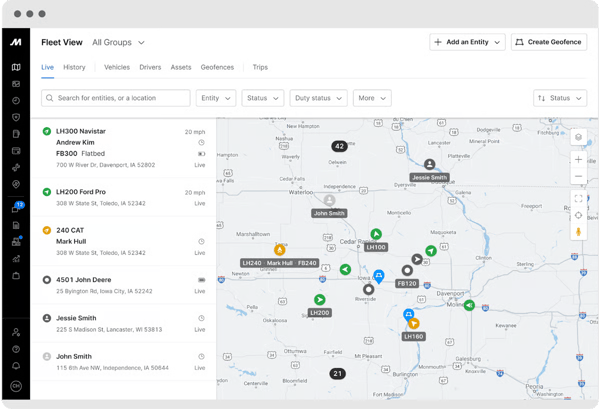
The dashboard settles into daily use quickly. Dispatchers, drivers, and managers describe getting up to speed quickly with minimal training. The clean, well-organized interface helps ensure the coordinators and drivers are working independently within the first week. Across reviews, I kept noticing how reliably that ease holds on both the web platform and the driver app, and Motive's 90% ease of use rating in G2 Data reflects it.
Real-time GPS tracking and location accuracy ease dispatching and customer communication. G2 users describe live location data updating quickly enough that dispatch decisions don't depend on driver calls. This ensures accurate ETAs that reduce customer calls and improve delivery planning. The 93% locations score on G2 Data backs up what reviewers describe about live driver visibility. Fleet managers say the location is the first screen they open and the last one they close every day.
What sets Motive's AI dashcam apart from most platforms in this category is a design choice that rarely gets highlighted on a features page. G2 reviewers appreciate how a dedicated in-house safety team reviews AI-flagged events and filters out false positives before anything reaches a manager's dashboard. This results in the footage that comes through being already vetted. Rated 88% for driver tracking alerts in G2 Data, that delivery model reflects what the review set consistently shows: footage that arrives fast enough to act on, without the noise.
I assessed that the first thing reviewers noticed after switching to Motive was that it replaced three or four separate tools with one. GPS tracking, ELD compliance, HOS management, AI dashcams, fuel card integration, and maintenance tracking all run through Motive. As there's only one login and one dataset, nothing slips through the cracks.
The driver safety scoring system is visible to drivers themselves, creating self-accountability that managers report as effective. Driver performance scores 88% on G2, and the behavioral shifts G2 users highlight boost that score consistently. Incidents drop, speeding events thin out, and phone use pulls back, and they name the scoring visibility as the reason. That self-accountability stood out to me as a valuable quality most fleet platforms aim for.
Now to my favorite part: multiple reviewers cite Motive's pace of innovation as the primary reason they switched from a competitor. Voices across G2 note new features shipping at a pace users notice and name. AI capabilities improve, user feedback turns into product changes, and the platform today is meaningfully different from the one they signed up for, which isn't common for a fleet management review set.
AI detection false positives are the most widely raised issue across Motive's review base. Several G2 reviewers report that events are triggered by minor hand movements, toll stops, and sun glare, creating additional review time for large driver populations. Safety managers reviewing high volumes of driver events carry this burden. That said, the AI coaching workflow delivers accurate footage when real incidents occur, and the behavioral improvement data it produces across driver populations remains consistent over time.
Navigation draws repeated attention across G2 reviews, specific sections are difficult to locate, and reports require multiple clicks to access. For anyone pulling data across multiple drivers or vehicles, that slows the daily workflow. What remains true is that the HOS compliance data, driver behavior records, and ELD logs pull accurately once located and are precise enough for the audit-ready reporting that regulated fleets depend on.
Motive is the platform that safety-first operations land on when managing driver behavior and compliance separately isn't acceptable. The self-scoring model, AI coaching workflow, and compliance layer make it a legitimate operational backbone for driver accountability, and that tells me something about where the review data is pointing. For fleets that get the setup right, the payoff shows up in measurable behavior change and compliance confidence.
"I like that the drivers are able to see their safety score and their rank in the fleet. This creates a healthy competition to be safe. The drivers being able to review their safety videos in real time allows them to self-coach before management has even reviewed the video."
- Motive review, Keith W.
"I find the fleet view can be a bit clunky and laggy. I wish it would show other vehicles on the map even when I select a certain vehicle."
- Motive review, Verified User.
GPS tracking shows where your vehicles are, but not what else is moving with them. See the best asset tracking software for full visibility across job sites and routes.
Fleets that generate data across GPS, diagnostics, driver behavior, and compliance usually need more than a standard dashboard to make sense of it. Geotab is an open telematics platform with deep reporting, an open API, and a large Marketplace of integrations. Data-heavy fleets that want to customize how that data is analyzed keep ending up here.
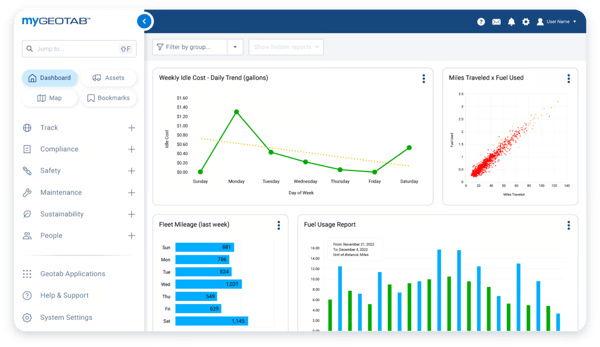
Live location data gives dispatchers instant visibility into vehicle positions, trip history, and status updates. Route management tightens, guesswork drops out of dispatching, and customer queries get answered without calling a driver. Location tracking scores a massive 99% on G2 Data, the highest in my evaluation. Across G2 reviews, users across fleet sizes describe the live map as the first thing they open and the layer on which everything else runs.
When it comes to users, the reporting depth is where Geotab pulls ahead. Custom reports, scheduled delivery, and exception-based alerts let fleet managers surface exactly what they need. Reviewers describe cutting hours off their weekly admin workload once reporting is configured. That shift, from manual data collection to scheduled delivery, is what the review base points to most.
The Marketplace ecosystem, open API, and SDK let operations teams connect Geotab to existing systems across maintenance, dispatch, payroll, and compliance. If your operation already runs those functions from separate systems, Geotab connects to them directly, giving you one less reason to keep them separate. I saw users cite the Marketplace as a primary reason for choosing Geotab and for staying long-term.
Based on my evaluation, driver behavior monitoring and safety insights on Geotab speak volumes about the tool's credibility. Speeding alerts, harsh braking detection, driver scoring, and coaching workflows are praised across reviews. Vehicle tracking alerts is rated a whopping 96% on G2, confirming how consistently those alerts perform across real fleet environments.
I'd single out vehicle diagnostics as Geotab's most valuable quality for maintenance-focused operations. Engine fault codes, OBD data, and proactive maintenance scheduling give fleet managers visibility into vehicle health before issues reach the road. Vehicle performance sits at 82% on G2, and the review base appreciates the tool for giving fleets a structured view of vehicle health between services.
ELD, HOS tracking, and IFTA reporting run in the same dashboard as GPS and driver behavior data. Reviewers report editing driver logs directly in MyGeotab, pulling IFTA mileage reports for state and province returns without manual compilation, and relying on the compliance dashboard to stay ahead of regulatory requirements. I came away from the reviews with the conclusion that compliance depth integrated into the same interface as live tracking and driver scoring isn't something most platforms attempt. The payoff lands hardest at audit time, when multiple data types need to be pulled quickly.
The interface is feature-rich but difficult to navigate at first, the most widely documented issue G2 users raise. The volume of configuration options creates a steep initial ramp-up for administrators and fleet managers new to the system. For what it's worth, core tracking, reporting, and driver behavior capabilities remain consistent and fully reliable throughout.
As per my assessment of G2 reviews, custom report building requires technical knowledge and a significant time investment. Teams building tailored insights from large datasets are most affected. That said, the exception-based alert library and prebuilt report templates meet daily needs with no technical involvement.
On the whole, Geotab's custom reporting depth, open Marketplace ecosystem, and exception-based alerting are a good combination for fleet tracking software. The scheduled report delivery, open API access, and driver behavior data hold up across every fleet size for data-driven operations.
"What I like best is the real-time GPS tracking and how everything lives in one dashboard. I can see where every vehicle is at a glance, pull up trip history, and spot issues like harsh braking or idling without digging through separate tools. The custom reports are a big plus too, since I can set them up once and have them land in my inbox automatically."
- Geotab review, Victor O.
"The interface is sometimes seen as less user-friendly compared to competitors, and generating customized reports can feel complicated. The platform can be complex and may require time and training for users to fully understand."
- Geotab review, Rigers S.
Last-mile operations usually split routing, returns, and third-party carrier coordination across different tools. Elite EXTRA is a last-mile dispatch platform that handles outbound routing, carrier integration, and returns in one workflow, with ERP integrations that reviewers say get dispatchers operational within days. Logistics and distribution teams managing high daily delivery volumes keep ending up here.
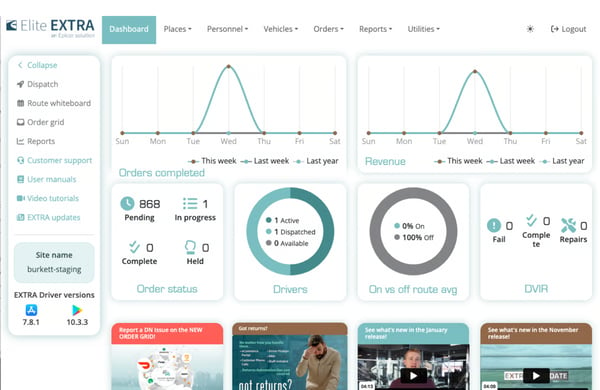
Automated route optimization drives Elite EXTRA's daily dispatch value. G2 users commend multi-stop routes generated in seconds, with the system automatically reconfiguring when stops are added, canceled, or rescheduled mid-day. That responsiveness is what dispatchers across the review set describe as the feature that keeps the operation moving regardless of how the day changes.
While scouring through G2 reviews and data, I noticed that the implementation story here is different from the rest of this list: you go live within days, and that pace holds across businesses of all sizes. The DSG (Dispatch Support Group) team handles integration work upfront so dispatchers can work before they have to figure anything out. Users characterize the transition from legacy dispatch tools as smoother than expected, regardless of prior setup complexity.
Real-time driver tracking gives dispatchers complete visibility into route progress, delivery completions, and driver locations without requiring outbound calls. As I dug into G2 reviews, I noticed several reviewers mention that answering customer delivery inquiries instantly from the live map encourages smooth communication that previously slowed operations. High-volume last-mile dispatch management is where Elite EXTRA's day-to-day fit becomes clearest to me.
Quality of support scores 97% on G2 Data, and I noticed one pattern in the reviews: the support team turns customer requests into product results. The support team is available around the clock and answers technical questions with real solutions beyond scripts, which G2 feedback suggests as the primary reason they stay. Reviewers characterize the team as invested in how the operation runs.
Cash-on-delivery (COD) order management and delivery confirmation operate in an organized view. Supervisors pull order status, validate deliveries, and resolve customer queries without leaving the dashboard. It scores 94% for ease of use because new dispatchers get comfortable with core functions without prior experience with dispatch software. That architecture left a stronger impression on me than I anticipated when sifting through Elite EXTRA reviews.
Working through the proof of delivery (POD) accounts in G2 reviews pushed me to reconsider how much operational weight a single feature can carry. Users note pulling timestamped photos from the dashboard, confirming exactly where an item was left, and closing delivery disputes the same day they open, without asking drivers to submit written records. The automatic attachment to each order is what makes it useful under daily pressure rather than an optional step that gets skipped.
Bing-based route mapping produces paths, mileage estimates, and time calculations that don't reflect real-world conditions. G2 reviewers regularly report drivers overriding suggested routes in favor of navigation tools they trust more. Dispatch teams building printed manifests around those estimates hit accuracy problems on high-volume days. That said, the actual delivery records give dispatchers a reliable picture of each run, independent of what the pre-route estimates projected.
Making configuration changes on Elite EXTRA requires going through the support team instead of adjusting settings directly. G2 reviewer accounts describe this as a meaningful constraint for technically capable operations that prefer to own their own setup. A fair point, though, the support team turns configuration requests around quickly enough that the dependency rarely slows down daily operations. Route automation, real-time driver tracking, and the POD capture workflow run at full capability between configuration updates, keeping daily dispatch operations uninterrupted.
Looking at the full picture, Elite EXTRA earns its place as the strongest last-mile platform on this list. The route automation depth, ERP integration, and a support team that turns customer requests into shipped product changes make it a natural fit for distribution operations managing routing, returns, and carrier coordination simultaneously.
"I like how easily Elite integrates with CDK to pull invoices over. It’s simple for us to use at the counter, and it’s just as easy for the drivers to use on the road. Being able to track where deliveries are and when they were delivered gives us better visibility when we’re talking with customers. It works well, and the information is available to us right away. I also like that routes are built automatically, so we don’t have to stress about figuring out the best order for the stops."
- Elite EXTRA review, Heather S.
"We don’t have a strong dislike, but we would like to see more advanced delivery estimation when building routes. Specifically, better insight into how close delivery ETAs are to each other and clearer indicators when a small traffic delay could push a route off schedule would help dispatchers identify risk earlier and adjust proactively."
- Elite EXTRA review, William A.
Most fleet owners expect to pay for visibility twice, once in contract fees and again in the support calls it takes to get anything working. One Step GPS is a GPS fleet tracking platform that covers live location, driver behavior alerts, and optional dashcams for small and mid-size fleets. Contractors, field service companies, and delivery operators who want straightforward tracking without enterprise complexity keep ending up here.
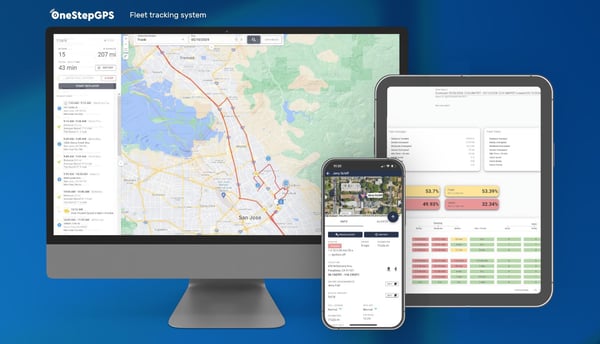
Ease of use is where One Step GPS stands out most in the review data. The platform scores 96% for ease of use and 96% for ease of setup on G2 Data, and reviewers describe plug-and-play installs, devices that arrive labeled by truck, and a web portal and mobile app that new admins pick up quickly. Several reviewers describe setup taking only minutes. What I noticed is that even owner-operators with no prior fleet software experience describe the same thing, which isn't common in this category.
Live tracking and geofencing are the daily workhorses. G2 reviewers describe checking the map throughout the shift to see where crews are, verify arrival times, and answer customer ETA questions without calling a driver. Geofence alerts that fire when a vehicle enters or leaves a job site or home base come up as the feature that settles questions about start times and time on site. Locations score 97% on G2 Data, the second highest among the platforms here, behind only Geotab at 99%.
Support is the most consistent theme in the One Step GPS reviews. Quality of support scores 98% on G2 Data, and reviewers describe chat and phone agents who answer quickly, follow up to confirm reports are working, and build custom reports on request. Fleet managers running as few as ten vehicles say they are treated like the vendor's best customer. That is what I saw reviewers mention most when explaining why they stay.
Driver behavior monitoring covers what safety-minded operators expect. Speeding alerts, harsh braking and cornering detection, and distracted driving flags feed the same dashboard as location data, and one reviewer reports a significant reduction in accidents since rollout. The optional dashcams add video snapshots for events like cell phone use without downloading full footage. Driver tracking alerts score 96% on G2 and driver performance scores 97%, both the highest among the platforms here.
Trip history and reporting give managers a record they can act on. Reviewers describe pulling stop history to verify how long a technician was on site, spotting jobs that ran longer than estimated, and downloading reports for payroll and billing checks. Integrations with field service and job management tools, including ServiceTitan, Salesforce, and monday.com, come up in reviews as a way to share live technician locations with customers and the office.
Maintenance reminders and diagnostic alerts are a smaller feature that reviewers value more than I expected. Fleet managers describe being notified about check engine lights, mechanical issues, and service intervals, and one reviewer who keeps vehicles for years uses the reminders to keep the fleet running. Vehicle performance scores 98% on G2 Data, the highest among the platforms here.
Real-time accuracy is the most common reservation in the reviews. Some reviewers describe a one to two minute delay in live locations, map pins that sit slightly off the vehicle, and history views that occasionally miss a stop. Dispatch teams that rely on second-by-second positions feel this most. That said, reviewers who raise it describe it as a small gap, and trip history, reporting, and alert coverage still give fleet managers an accurate record of the day.
Alert noise and limited depth beyond the essentials draw a second round of feedback. Reviewers mention repetitive engine notifications they can't mute, a thin set of maintenance presets, no native vehicle inspection tool, and fewer advanced reporting and customization options than enterprise platforms. Fleets with specialized compliance or reporting needs are most affected. Even so, small and mid-size fleets describe the core feature set as covering what they need without added complexity.
Taking everything into account, One Step GPS earns its place as the most support-driven tracking platform on this list. The 98% support score, plug-and-play setup, and driver behavior monitoring make it a natural fit for contractors, field service teams, and growing fleets that want clear visibility without an enterprise rollout. The driver behavior coverage and the review volume behind it are what set it apart from other small-fleet options.
"The software and equipment is very easy to use. Whether you're tracking an individual asset or an entire fleet of vehicles, their easy-to-use tools are excellent. Real-time tracking and geofencing is very accurate and the best I've seen in the industry. The mobile app is also simple to use and very reliable. Also, the mobile app supports SMS messaging to send alerts via text in case your cell service is too weak to use the app."
- One Step GPS review, Chris F.
"Navigating some of the extra features can take a bit of getting used to, but aside from that, the program is very easy to use."
- One Step GPS review, Maribeth S.
Disputed incidents tend to drag on for weeks when the only evidence is two conflicting stories. Lytx is a video telematics platform whose DriveCam system pairs machine-vision event detection with a coaching workflow. Liability-conscious mid-market and enterprise fleets keep ending up here.
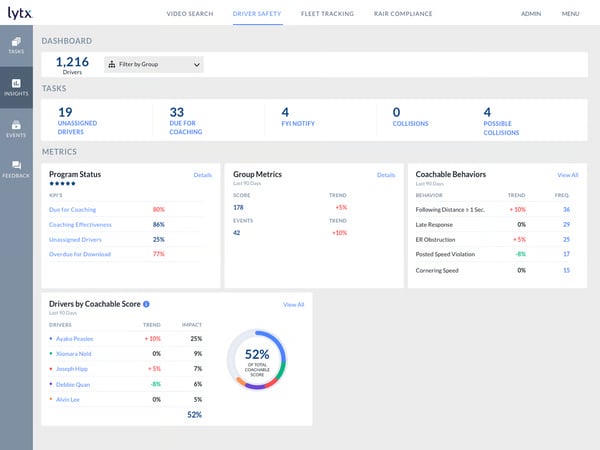
Fast retrieval of the DriveCam footage, often within minutes, is one of the biggest reasons behind Lytx's 4.3 out of 5 rating on G2. Reviewers credit that speed as the detail that changes how incidents are handled from the start. Pulling clips, reviewing the sequence of events, and walking into a conversation with documented evidence, that's the shift fleet managers point to most. What drew me to DriveCam first was how differently users talk about incident resolution once the camera record is in the room.
One look at the review set and I'd consider video-based coaching as the capability that makes Lytx worth the conversation for any safety-conscious operation. The coaching workflow is triggered by captured events, delivers footage to managers for review, and gives drivers direct access to their own behavior clips. Managers report going from anecdotal safety talks to evidence-backed coaching sessions that drivers engage with on their own terms. Driver performance rates 83% on G2 Data, earned through behavioral shifts that tracked across fleets over months.
If you are stepping into Lytx without a formal onboarding program, you won't face issues. Fleet administrators pulling weekly reports and supervisors reviewing individual driver events mid-shift both describe getting comfortable with the core functions on their own. The dashboard organizes events, coaching queues, and driver scores into a single view that new users call intuitive from the first session.
Speeding events, harsh braking, distracted driving, and seatbelt violations surface quickly enough for managers to build a daily coaching habit instead of a reactive one. G2 users cite the alert cadence as the feature that shifted how they think about safety management. Vehicle tracking alerts score 86% on G2 Data, and the review set describes catching behavior trends before they become incident patterns. I was impressed by that early visibility into emerging patterns while going through the Lytx reviews. It is what separates a fleet that responds to incidents from one that never has to.
I'll zero in on exoneration because the review data behind it is unlike anything else in this category. Voices across G2 note that using DriveCam recordings helps resolve false customer complaints, defend drivers against inaccurate accident claims, and provide insurers with clear, documented evidence within hours. They repeatedly point out that a single resolved claim can exceed a full year of platform costs, especially in industries with high liability exposure. For those operations, that math alone can justify the platform.
What stands out about Lytx's support model is how closely it ties to the safety program itself. Success managers go beyond account questions. They work with fleet teams to interpret video data, build coaching frameworks, and track whether driver behavior is actually improving over time. Feedback across G2 shows a relationship where the support team is as invested in safety outcomes as the fleet manager is. Quality of support scores 87% in G2 Data, and that depth of involvement is what makes the difference between a dashcam system that generates footage and one that generates results.
AI detection of false positives is raised as a recurring issue across Lytx's reviews. G2 reviewers flag seatbelt misdetection, following-distance sensitivity, and false alerts for distracted driving triggered by sun glare, clothing colors, and minor hand movements. Safety managers reviewing large driver populations spend extra time on review. What doesn't waver is that the DriveCam footage behind those flagged events captures genuine incidents, and the coaching and exoneration record it produces stands up in insurance claims, internal investigations, and disputed incidents alike.
Platform performance and connectivity issues draw recurring criticism across the data. G2 data shows the web platform slowing under heavy use, cameras going offline intermittently, and footage retrieval occasionally failing when devices can't be woken remotely. Through all of this, when the system runs at full capacity, the footage and incident record perform exactly as intended, and users describe that reliability as the standard, not the exception.
Considering everything, Lytx is the platform that liability-conscious operations reach for when documented video evidence and driver behavior change need to work together. The DriveCam footage, coaching workflow, and dedicated success managers are all on a single platform, which mid-market and enterprise fleets won't find replicated elsewhere on this list. The operations that get the most from it tend to be the ones that treat safety as a financial strategy, beyond a compliance checkbox.
"I use Lytx for truck cameras, and I love being able to see live footage and check road conditions. It's really helpful for capturing accident footage, which has saved us a lot of money. The live footage and quality are the best, offering clear video capture. The cameras are reliable and strong, maintaining operation even when a truck is hit by force during an accident. The setup is good and easy, and we even use Lytx cameras in most of our trucks. I switched to Lytx cameras due to their reliability and superior quality."
- Lytx review, Navkiranjot K.
"There are some false alerts with seatbelts, lane departures, and once in a while a false handheld or distracted alert."
- Lytx review, Jamie P.
Managing vehicle maintenance across a growing fleet? Read about the best CMMS software to reduce unplanned downtime and track work orders in one place.
Speeding, hard braking, and risky driving habits often cost a fleet more than vehicle downtime ever does. Azuga Fleet is a GPS fleet tracking platform that combines live location, driver scoring, diagnostics, and a gamification layer. Small and mid-market fleets where driver behavior is the bigger operational risk keep ending up here.
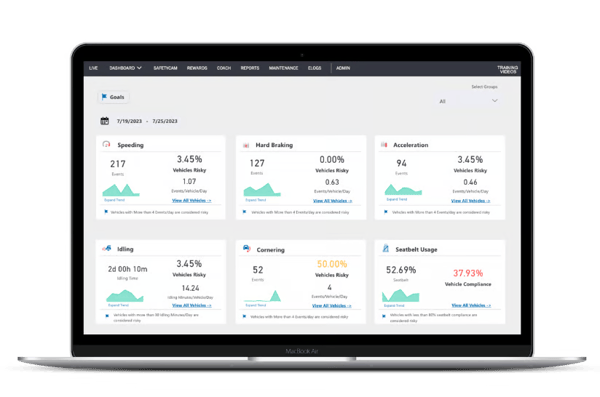
At 86% on G2 Data for location tracking, reviewers across utilities, construction, and field service cite the live map as the screen they check most. Dispatchers report that location updates are fast enough to support emergency dispatching, same-shift route changes, and fast responses to customer queries. As I was skimming through the review data, this pattern was noticeable across all operation types.
I also noticed praise for Azuga Fleet's ease of use for onboarding new staff. The plug-and-play OBD device installs in seconds, the dashboard organizes vehicle status, alerts, and driver scores into a single, clean view; and new users describe moving into daily use without a structured onboarding process. The mobile app carries that same ease through to drivers, field managers, and G2 users who describe an interface that becomes second nature without extensive configuration.
Custom reports, payroll time tracking, and trip logs all pull without any technical knowledge. If you're managing a fleet without a dedicated analyst, the reporting depth here covers what most operations would otherwise have to hire for. G2 user feedback notes that once reporting is configured, it replaces manual spreadsheet processes entirely. This happens with fuel consumption, mileage, idle time, and driver behavior consolidated in one view.
Engine codes and maintenance scheduling run alongside live tracking and driver scoring, giving maintenance decisions the same data context as safety and dispatch. Vehicle performance clocks in at 83% on G2 Data, with voices across G2 pointing to diagnostics and maintenance scheduling. Operations teams report engine fault alerts arriving before the vehicle reaches the next stop, and service intervals are scheduled on the platform. That closed loop between fault detection and service scheduling is something users laud as a direct improvement to how maintenance is managed day to day.
Thorough analysis of G2 reviews leads me to say that Azuga Fleet's customer support is useful for teams that need fast answers in the field. Reviewers describe named support staff who know the platform deeply, 24/7 availability, and response times that resolve issues the same day. It's worth noting that users can name support contacts directly and describe exchanges that changed how they configure and use the platform.
Driver performance rates 83% on G2 Data, and the behavior change behind it traces back to one design decision: drivers can see their own scores. That visibility shifts how drivers act across large populations without pressure from above. Managers report it as the reason unsafe habits pull back after go-live in a way that top-down coaching never quite achieved. G2 feedback points to speeding events thinning out, harsh braking dropping, and phone use declining within weeks of the scoring system going live.
Hardware reliability is the most flagged issue across Azuga Fleet's reviews. Users cite battery drain in parked vehicles, dashboard cameras falling off their mounts, and intermittent device connectivity across active fleets. Operations managing large vehicle populations, where resolving failures means sending someone into the field, carry this burden most heavily. Beyond this, reviewers note that issues that are flagged early get resolved before they spread across the fleet. Additionally, GPS data, driver behavior scores, and diagnostic alerts run through the platform software layer, giving fleet managers accurate visibility across every vehicle that stays connected and online.
Route history and mapping accuracy draw recurring criticism across the review data. It points to breadcrumb trail display issues, pin reorganization when new data is added, and route history gaps that make it hard to reconstruct exactly where a vehicle has been. This affects compliance-sensitive operations that depend on precise route verification. That said, other data points in the platform still give those operations a workable record of driver activity when the visual route history falls short.
Taking stock, Azuga Fleet earns its place as the strongest behavior-focused tracking platform on this list. Driver gamification, plug-and-play hardware, and diagnostics that run in the same dashboard as GPS and safety scoring set it apart. For small and mid-market operations where the driver is the biggest variable, I'd place this one at the top of the shortlist.
"It is great to know where all of your fleet is located at any time. We are a public utility, and during an emergency we utilize the Azuga Fleet to identify the closest vehicle to respond as quickly as possible."
-Azuga Fleet review, Jeremy H.
"Sometimes we have issues with GPS not reading and we have to swap those units out after a point in time which can be difficult since our fleet is so far spread out and does not always come back to the main office."
- Azuga Fleet review, Verified user in consumer services.
Dispatchers who build multi-stop routes by hand tend to lose the morning to it, and the plan falls apart by noon. Route4Me is a route planning and optimization platform that builds multi-stop routes in seconds and absorbs same-day changes. Field service and delivery teams that run on dispatch speed keep ending up here.
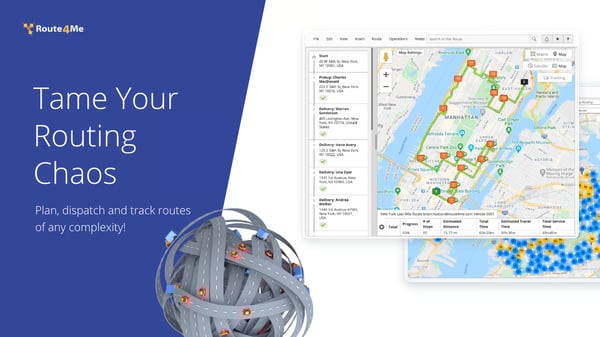
The tool's ease of use scores 96% in G2 Data, and that's what stood out most to me across Route4Me's review data. Dispatchers describe onboarding new staff without a formal training program. Both the web interface and driver app are navigable from day one. The interface is clean, well-organized, and easily navigable.
Performance is rated 92% on G2 Data. I dug into reviews praising the tool for fewer miles driven, lower fuel costs, and drivers finishing routes on schedule. The algorithm accounts for time windows, vehicle constraints, and stop sequencing without manual input. That speed and accuracy are why reviewers rate Route4Me's optimization engine as a standout.
Real-time tracking stays reliable across all fleet types. Dispatchers describe knowing exactly where every driver is at any given moment, with live progress updates enabling fast responses to delays, customer queries, and unplanned route changes. Locations score 95% on G2 Data, which demonstrates that accuracy stays consistent across every shift.
Route4Me reviewers don't describe support in general terms. They name staff, recall specific conversations, and point to interactions that shifted how they use the platform. Fast response times and 24/7 availability come up consistently, but it's the personal detail in the reviews that sets it apart. With a 97% rating for quality of support, I can say that the tool's support team operates more like an embedded resource than a helpdesk.
Scalability and flexibility across fleet sizes come across as the most compelling qualities of Route4Me for growing companies. Small businesses and enterprise operations describe the same core platform delivering value at very different levels of complexity. API integration, modular add-ons, and territory management let teams configure the system around their workflows.
From what I noticed in the reviews, the dynamic editing capability is too strong to overlook. Dispatchers describe splitting routes, merging stops, and resequencing deliveries mid-day with drivers continuing their current runs uninterrupted. Driver tracking alerts achieve 91% on G2, underscoring the same-shift decision-making that users mention. In practice, a dispatch team can make a mid-day change without the route falling apart.
Processing slows noticeably when large datasets or high-volume routes are uploaded. Dispatch teams pushing large daily volumes tend to feel this at the start of peak shifts when upload demand peaks simultaneously. Notwithstanding this, once processing clears, the routes come back accurate across every stop, worth the wait.
Reporting in Route4Me is functional but falls short for teams that need tailored performance outputs. G2 feedback points to difficulty extracting insights and navigating to the right data without multiple steps. That said, the route optimization and real-time visibility stay reliable across every deployment, the operational picture managers reach for first.
All things considered, Route4Me is the platform that field and delivery operations reach for when dispatch speed and same-day flexibility are the deciding criteria. The optimization engine, dynamic mid-day editing, and scalability across fleet sizes would be hard to replicate with manual routing, and the review data kept reminding me of that.
"The optimization engine is what really sold me. I coordinate field technicians across the country in the ATM and BTM industry, so having that kind of capability makes a big difference in my day-to-day work."
- Route4Me review, Ariel N.
"While Route4Me is very effective overall, there are a few areas that could be improved. One thing that could work better is the speed and responsiveness when handling very large route uploads-sometimes it can take a bit longer than expected to process bigger datasets. The mobile app could also be more refined. While it gets the job done, there are moments where the interface feels slightly less intuitive compared to the desktop version, especially when making quick changes on the go. Another area for improvement is customization in reporting and analytics. It would be helpful to have more flexible reporting options or easier ways to extract detailed insights tailored to specific business needs. Lastly, occasional GPS inaccuracies or delays in real-time updates can happen, which can impact tracking precision in some cases. Overall, these aren't major issues, but improving them would make the platform even more seamless and efficient to use."
- Route4Me review, Ranjit C.
Last-mile deliveries often rely on a patchwork of dispatch screens, driver texts, and customer call-backs. Onfleet is a last-mile delivery management platform with smart dispatch, real-time driver tracking, and automated customer notifications. Food, pharmacy, and e-commerce delivery operations keep ending up here.
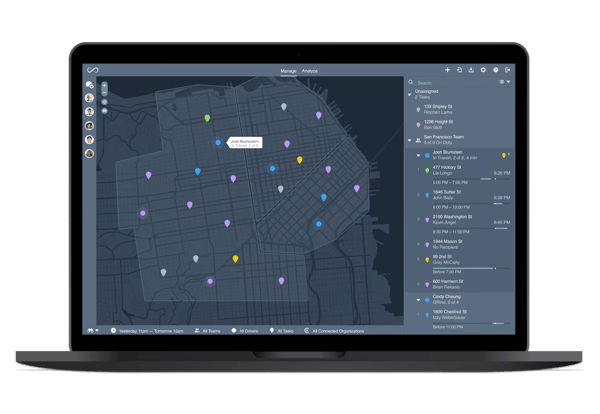
Delivery visibility is where Onfleet stands out for last-mile operations. Dispatchers describe live map updates fast enough that driver location is never in question mid-shift, reflecting task completions, delays, and route progress in real time. The tool's 92% score on G2 Data for location tracking and live map evidence in the reviews explains why it is used throughout shifts to manage driver workloads and respond to customer queries without leaving the platform.
Driver tracking alerts logged 95% on G2 Data, one of the highest driver communication scores in my G2 reviews evaluation. Automated SMS notifications to customers, in-app chat between dispatchers and drivers, and customer-facing tracking links all run within the same system. G2 users describe a communication workflow where no party has to chase an update. That link between dispatchers, drivers, and customers is what the review base points to the most.
Ease of navigation is where Onfleet's usability shows most clearly in the reviews. Dispatchers describe getting new staff up and running within a day, even coordinators with no prior software experience. The driver app carries that same ease onto the road, and reviewers praise it as one of the smoothest onboarding experiences in the delivery management category.
Automated customer alerts trigger at configurable points in the delivery journey, keeping recipients informed without dispatcher intervention. If you're running deliveries where the customer experience starts before the driver arrives, the depth of notifications change the experience. ETA accuracy rates 92% on G2 Data, and dispatchers describe getting their shift back, fewer inbound calls, and more time on exceptions that actually need attention.
One thing I appreciated about the product, based on the review data, is its support culture. Reviewers describe fast response times, proactive account management, and support staff who engage with problems. I've seen users identify team members and describe support conversations that shifted their approach to the platform.
The dispatch workflow absorbs the same kind of same-day chaos that breaks less flexible systems. Auto-assign, manual route building, and mid-shift resequencing all operate cleanly within the dispatch dashboard. Performance clocks in at 95% on G2 with user feedback crediting the dashboard for reassignments, additions, and mid-shift changes without a single route falling apart, including driver reassignments and last-minute additions that leave runs already underway intact.
The routing algorithm loses reliability under heavy urban traffic, which G2 users identify as a limitation that surfaces most in live delivery conditions. ETAs drift and stop sequencing occasionally, resulting in inefficient paths that drivers have to correct manually. Outside peak urban congestion, the routing algorithm performs reliably and sequencing stays accurate in lower-density delivery conditions.
The driver app loses responsiveness in specific conditions, and G2 reviewers point to device spec and browser type as the primary factors. Some reviewers describe the app freezing mid-shift and failing to update driver location. Others traced GPS tracking gaps and mileage recording failures to older devices, with no issues when using newer hardware elsewhere. One reviewer found that a software update reduced usability on mobile Chrome specifically, while the desktop experience stayed intact. The pattern across G2 feedback is device and browser-specific, not a flaw in the app's core design. Delivery sequencing, task completion, and POD (proof of delivery) capture remain reliable on standard hardware throughout the shift.
Based on my evaluation of various tools, I'd say Onfleet fits a specific bracket: platforms that pay off most when the delivery experience itself is the product. The automated notification layer, ETA accuracy, and dispatch workflow depth combine to add up to a last-mile system that compounds in value as delivery volumes grow. For operations where every customer touchpoint matters, the G2 data points clearly here.
"It helped me improve delivery times with more precise punctuality, and through mapping, I improved routes. It has been an application that greatly helps me in my work and allows me to be more productive with more satisfied customer service. I also like that it's easy to use and doesn't require lengthy training or extensive instructions. It's very useful and precise in each targeted mapping."
- Onfleet review, Jonathan H.
"The only significant pain point, though not entirely Onfleet's fault, is the delay in accessing call or text records to confirm driver communications with customers. It can take up to 72 hours to export a complete log, which can be frustrating when dealing with an upset customer who urgently wants to know if the driver contacted them."
- Onfleet review, Robbin C.
Small business owners rarely need enterprise telematics, but they still need to know where every vehicle is. Linxup is a GPS tracking platform built for small fleets, with a plug-in OBD device, real-time alerts, and basic reporting. Field service, construction, and utility operations without a dedicated admin keep ending up here.
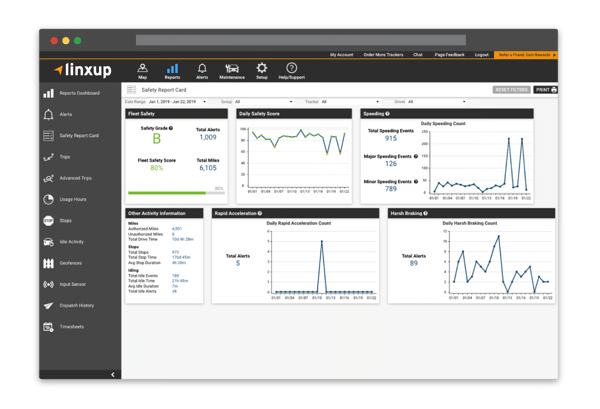
GPS tracking accuracy is where Linxup proves its day-to-day value. Dispatchers and business owners describe pulling up the live map and getting an immediate answer on every vehicle's location. The data is current enough to answer customer queries, direct emergency response, and adjust routes without a driver call. G2 users rate location tracking at 88%, and small fleet reviewers say they rely on it daily and describe the live map as a tab that stays open throughout the shift.
The OBD device snaps into the port and is live within seconds, and the dashboard is clean, well-organized, and navigable without a training session. New staff are up and running within hours, including owner-operators with no prior fleet software experience. Linxup has a 4.7 out of 5 rating on G2, and small business owners make up the majority of those endorsements.
Linxup's hardware reliability is another capability meant for small fleet operations. G2 users across the industries call out the tracking devices as durable, consistently online, and easy to register across different vehicle types. They also named the hardware as a primary reason they stayed with Linxup after evaluating alternatives. That kind of hardware loyalty is uncommon in a category where hardware issues drive more churn than pricing.
Speeding alerts, driver behavior reports, and location history give fleet managers a clear view of what drivers are doing throughout every shift. If your operation runs without a dispatcher on call around the clock, the monitoring depth here covers the oversight gap without adding headcount. Driver tracking alerts rate 84% on G2 Data, and lean operations use the monitoring data to resolve disputes, manage payroll, and coach drivers without manual tracking.
Additionally, trip history logs do something the rest of the monitoring suite does not: they build themselves; no one has to trigger them. Previous-day activity, time at each stop, and daily email summaries are ready before a manager thinks to ask. It's a simple feature that quietly handles much of the daily work. When a customer questions a delivery time or new work comes in, the answer's already in the system without a driver call or manual log to consult.
Linxup's support stands out as one of the more hands-on in this category, earning 91% for quality of support in G2 Data. Users describe US-based support available around the clock, follow-up calls to confirm setup completion, and staff who walk through issues step by step. That level of engagement is cited repeatedly as a reason for recommending the platform to other small business owners.
GPS accuracy drops in areas with poor signal, with location data lagging or failing to refresh when cellular coverage is poor in rural zones. It's noticeable for fleets routing through low-coverage territories. That said, the trip history, stop logs, and driver activity records compile passively across every shift, building a complete accountability record for billing, payroll, and customer queries that doesn't depend on continuous signal coverage.
The OBD tracker can't directly read vehicle mileage, and the platform's customization options are limited compared to mid-market alternatives. G2 users describe functionality gaps that get harder to work around as fleet complexity grows. Even so, the simplicity behind that ceiling is exactly what small fleet owners on G2 cite as the reason they chose Linxup and have not looked elsewhere since. Clean dashboard, seconds-long installation, and US-based support that follows up to confirm setup is complete make Linxup the right fit for small fleets that need visibility without implementation overhead.
Closing out, Linxup earns its place as the most friction-free GPS tracking platform in the category. The plug-and-play hardware, trip log automation, and US-based support that follows up to confirm setup is complete make it the natural choice for small business owners who need fleet visibility without an IT team, and I'd end on that note without reservation.
"I find Linxup to be a super helpful tool for anyone in service. It's great for when a customer calls to check the ETA because I can very easily check where my tech is and provide updates. I really like the quick and easy search tool, which adds to its convenience. Also, being able to keep up with maintenance has been helpful. The initial setup of Linxup was extremely easy, which was a big plus."
- Linxup review, Amanda H.
"I don’t see any downsides overall. That said, I think the customer section could use an update to its features to make notifying customers simpler and more straightforward."
- Linxup review, Katie G.
Freight operations often run tracking, fuel monitoring, driver behavior, and compliance from four separate tools. Fleetx is a logistics intelligence platform that combines GPS tracking, driver scoring, fuel intelligence, and lifecycle management in one system. Logistics-heavy fleets moving freight across multiple routes every day keep ending up here.
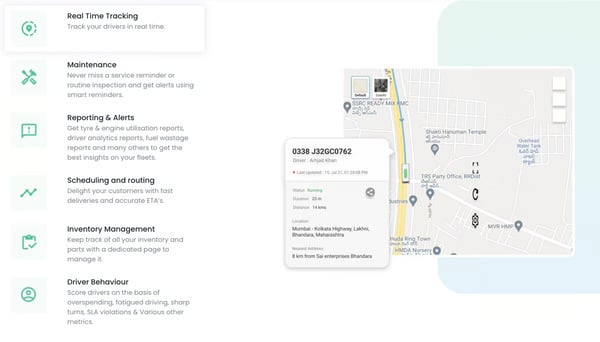
Fleetx's UI earns praise across the review data for being clear and easy to work with. G2 users across fleet sizes describe both the web and mobile application as straightforward to understand and navigate. The interface makes it simple to access tracking, reporting, and fleet management features without friction. Ease of use scores 92% on G2, and for logistics operations where operators need answers fast, a platform that doesn't get in the way is a meaningful advantage.
Dispatchers report that every dispatch decision traces back to tracking accuracy. They manage vehicle locations, idling data, trip history, fuel consumption, and driver activity without switching between systems. Location tracking clocks 96% on G2 Data, and freight managers across large fleet deployments confirm that precision holds up across every shift. What ultimately stood out to me across the Fleetx data was how that accuracy came up unprompted, across fleet sizes and use cases.
What surprised me about Fleetx is how distinctly the unified dashboard stands apart from fragmented fleet tools. Vehicle tracking, driver scoring, fuel consumption, tire management, maintenance scheduling, and compliance data are available within a single interface. Voices across G2 describe it as clear and easy to navigate, with the platform absorbing the kind of complexity that most freight operations manage across multiple disconnected tools.
G2 reviewers put vehicle tracking alerts at 96%, and they describe that precision stays reliable across every shift without manual verification. They also trust Fleetx's reports most when it comes to billing and compliance. Trip history, mileage data, fuel consumption reports, and vehicle activity logs are enough to drop straight into billing and client invoices.
As I was scouring G2 reviews, I noticed that users consider the tool's driver monitoring depth to be its most accessible quality for safety-conscious logistics operations. Route deviation alerts, prolonged stop notifications, driver behavior scoring, and real-time risk detection all operate within the same system. Driver tracking alerts sit at 94% on G2, reflecting consistent behavioral monitoring that's appreciated by users. They also report measurable improvements in driver accountability after rollout.
The analytics breadth feature also sets Fleetx apart, based on my reading of the data. Fuel intelligence, predictive maintenance, driver scorecards, and operational performance dashboards give logistics managers analytical depth that most platforms reserve for enterprise buyers. Performance scores 91% on G2, and it's interesting to see how reviewers cite the analytics layer as the reason they stopped looking at alternatives. For logistics-heavy operations, that depth is difficult to find elsewhere on this list.
Real-time tracking delays are a commonly raised issue across Fleetx's reviews. Slow location updates during peak usage, server-side delays that affect the live data accuracy, and GPS lag that creates discrepancies between actual and reported vehicle positions. This affects time-sensitive freight operations that depend on precise real-time visibility. That's worth acknowledging, but historical record that affects billing and compliance is accurate once each run is complete; the lag is in the live view, not the logged data.
Device reliability and hardware issues draw recurring criticism across the data. G2 feedback mentions trip data jumps, data loss in transit, and vehicles appearing disconnected after re-establishing the connection. Large fleets on remote long-haul routes, where failures are hard to fix in the field run into this hardest. Even so, reviewers note that location data recovers and updates correctly once connectivity is restored, and the logged trip record stays intact through most dropout events.
Stepping back, Fleetx earns its place as a strong freight automation option on this list for logistics-heavy operations where fragmented tools create gaps across the freight cycle. Reporting drops directly into client billing and compliance workflows, removing manual verification between a completed run and a closed invoice. Named account managers and a unified dashboard also absorb the operational complexity most platforms push back onto the operator. For enterprise freight operations, few tools on this list come close.
"I like how Fleetx makes tracking simple with a single dashboard, monitoring all the activities of truck drivers and the fleet. I'm aware of all the critical data points like fuel consumption, tire management, and maintenance management. The comprehensiveness of its features, including the ticketing system, tracking, and life cycle management of the fleet, makes the whole operation of running a trucking business pretty straightforward and easy. I appreciate the smooth onboarding process, and integrating it with our GPS provider was seamless."
- Fleetx review, Anubhav N.
"Sometimes the real-time location becomes slow, which affects accuracy. Also, during initial setup, we had some hustle that made it challenging."
- Fleetx review, Lakshmi Shankar S.
| Software | G2 rating | Free trial | Best for |
|---|---|---|---|
| Samsara | 4.5 / 5 | No | Large fleets needing end-to-end visibility, AI-powered safety, and real-time diagnostics in one platform |
| Motive | 4.4 / 5 | No | Trucking and logistics fleets that need driver safety tools, HOS compliance, and ELD in one place |
| Geotab | 4.5 / 5 | No | Data-heavy fleets that need deep customization, open API access, and a large third-party integration ecosystem |
| Elite EXTRA | 4.6 / 5 | No | Businesses managing last-mile delivery across multiple carriers with automated returns and dispatch workflows |
| One Step GPS | 4.7 / 5 | No | Small and mid-size fleets that want affordable GPS tracking, driver behavior alerts, and responsive support |
| Lytx | 4.3 / 5 | 1 month trial available (hardware fees may apply) | Fleet managers focused on reducing accidents and driver risk through video telematics and AI-powered coaching |
| Azuga Fleet | 4.7 / 5 | No | Safety-focused fleets that want driver scoring, gamification rewards, and dashcam integration to build a safety culture |
| Route4Me | 4.7 / 5 | 7 day trial available | Field service and delivery teams that need to plan, optimize, and dispatch multi-stop routes at scale |
| Onfleet | 4.6 / 5 | 7 day trial available | Last-mile delivery operations that need smart dispatch, real-time driver tracking, and customer notifications |
| Linxup | 4.7 / 5 | 30 day trial available | Small businesses looking for simple, affordable GPS tracking with real-time alerts and no long-term contracts |
| Fleetx | 4.7 / 5 | No | Logistics-heavy operations that need freight automation, real-time tracking, and AI-driven supply chain visibility |
*These fleet tracking tools are top-rated in their category based on G2's Fall 2026 Grid® Report and market reputation. There are no free plans available, however, select products have a free trial available.
Got more questions? G2 has the answers!
Geotab, One Step GPS, and Fleetx lead on live location accuracy, scoring 99%, 97%, and 96% on the G2 Fall 2026 Grid Report. Geotab pairs live positions with trip history and exception alerts, One Step GPS reviewers describe tracking both work trucks and trailers, and Fleetx adds idling and fuel data to the same view.
Samsara, Azuga Fleet, and Fleetx put live GPS and driver behavior in one dashboard. Samsara combines live maps with dashcam footage and ELD compliance, Azuga Fleet organizes vehicle status, alerts, and driver scores into a single clean view, and Fleetx pulls driver scoring, fuel consumption, and maintenance data into one interface.
Safety directors should check how ELD and HOS records are generated, how AI safety events are filtered, and whether reports hold up under audit. Motive reviewers highlight HOS compliance paired with an in-house team that filters false positives, Geotab reviewers describe IFTA reporting and driver logs running in the same dashboard as GPS, and Samsara reviewers point to DVIRs and dashcam footage sitting alongside ELD records.
One Step GPS, Linxup, and Route4Me are the strongest fits. One Step GPS reviewers describe pulling stop history to verify how long a driver was on site, Linxup builds trip logs and daily summaries without anyone triggering them, and Route4Me scores 96% for ease of use on the G2 Fall 2026 Grid Report with live driver progress and route editing in the same view.
Motive, Lytx, and Azuga Fleet are the most behavior-focused options. Motive lets drivers see their own safety scores, Lytx pairs DriveCam footage with a video coaching workflow, and Azuga Fleet adds driver scoring with a gamification layer that reviewers credit for pulling unsafe habits back within weeks.
Yes, when diagnostics sit in the same dashboard as live tracking. Geotab surfaces engine fault codes and OBD data before issues reach the road, Azuga Fleet sends engine fault alerts before the vehicle reaches its next stop, and Fleetx pairs predictive maintenance with fuel intelligence so managers can plan service before a breakdown.
Route4Me, One Step GPS, and Onfleet score 96%, 96%, and 95% for ease of use on the G2 Fall 2026 Grid Report. Route4Me reviewers describe onboarding dispatchers without a formal training program, One Step GPS reviewers describe pulling up where vehicles are and where they have been quickly, Onfleet reviewers describe new coordinators getting started within a day, and Elite EXTRA reviewers say new dispatchers get comfortable with core functions without prior dispatch software experience.
Onfleet, Motive, and Lytx report the highest average user adoption among the platforms here, at 94%, 85%, and 85% on the G2 Fall 2026 Grid Report. Onfleet keeps dispatchers, drivers, and customers on one communication thread, Motive makes driver scores visible to drivers themselves, and Lytx gives drivers direct access to their own coaching clips.
Samsara, Motive, and Geotab are the highest rated, with G2 Scores of 96, 89, and 75 on the Fall 2026 Grid Report. Samsara pairs 92% location accuracy with dashcam safety coaching and ELD compliance, Motive pairs 93% location accuracy with HOS tracking and driver scoring, and Geotab pairs 99% location accuracy with IFTA reporting and driver logs.
Route4Me, One Step GPS, and Onfleet carry the strongest recommend signals among the dispatch-focused tools here, with net promoter scores of 88, 85, and 82 on the G2 Fall 2026 Grid Report. Samsara is the most reviewed platform in the category, with more than 3,600 reviews behind a G2 Score of 96.
Now that you have a clear picture of where each platform earns its place and where it falls short, the decision ahead isn't really about features. It's about what your business can't afford to get wrong.
For most buyers, that comes down to one of three things: a compliance obligation that can't slip, a safety pattern that's already cost you, or a visibility gap quietly eating up your margins. The platform that solves the right one of those problems is worth more than the platform that covers all three at half the depth.
What I kept seeing across G2 reviews is that teams getting the most out of fleet tracking aren't the ones choosing the most capable platform. They are the ones who matched it to the specific pressure point they were experiencing before they started evaluating. That's what's worth deciding before any demo, pricing conversation, or contract review: which platform closes the gap that's actually costing you?
Managing more than just tracking? Explore the best business scheduling software on G2 to compare platforms covering dispatch scheduling and workforce coordination.


The essentialfleet management software features you should look for are the following: ...
 by Darshayita Thakur
Are you over the moon when your Uber ride arrives on time? Me too.
 by Shreya Mattoo

If there’s one thing I’ve learned from working with product, engineering, and QA teams, it’s...
 by Gunisha