


I can’t read code. So when I set out to compare Replit vs. Lovable, the real question wasn’t whether they could build an app from a plain-English prompt. Both did, in minutes. The question was what happens when the app goes wrong, and I can’t look inside to see why. A button stopped working. A login let in the wrong person. All I could do was describe the problem to the AI and hope it fixed it.
Choosing between two of the best AI app builders on G2 is tough, but choosing between Leaders in the Fall 2026 G2 Grid® Report is a step up. Both make the same promise to non-developers like me: describe an app in plain English, and the AI builds it. Pick the wrong tool, and you can lose days to prompts that don’t work or publish an app that exposes your customers’ data.
I tested them the way a first-time buyer would. I used both free plans to build the same customer-facing booking app, then took it through nine identical tasks. Every prompt went into both tools word for word.
Both got me to a working app. What surprised me was how differently they got there. Here's how Replit and Lovable compared in practice, where each made the process easier or harder, and which I'd choose for different app-building needs.
| Feature | Replit | Lovable |
|---|---|---|
| G2 rating | 4.4/5 | 4.6/5 |
| Best for | Founders and operators who want AI building with deeper code and deployment control | Non-technical users and small teams building polished websites and web apps quickly |
| Platform type |
AI Agent inside a full cloud-integrated development environment (IDE), the workspace developers use to write and run code; direct code editing on every plan |
Chat and visual web-app builder across web, desktop, and mobile; Code Mode on paid plans |
| Building approach | Build directly or plan (available on paid tiers) first; Agent can test web apps in a browser | Build Mode implements and verifies changes; Plan Mode clarifies requirements first |
| Backend and database | Built-in database on all plans; separate production database at publish; region choice on Core+ plans | Managed database, authentication, storage, and backend through Lovable Cloud |
| User accounts and login | Replit Auth for Replit-account sign-in; Clerk for app-specific accounts | Email/password and Google sign-in through Lovable Cloud |
| Integrations | Managed Connectors require Core; custom API setup depends on the service | Connectors and custom APIs available on Free plan; built-in payments and custom-domain email are paid |
| Publishing and hosting | Public, invite-only, or password-protected; one free app expires after 30 days | One-click publishing to a lovable.app URL; invite-only access (up to 10 people per project) on Free and Pro, workspace-only access on Business+ |
| Custom domain | Supported for paid plans; free .replit.app subdomain included | Paid plans only; free projects use a lovable.app subdomain |
| Branding on free plan | "Made with Replit" badge on Starter plan, removable on Core+ | "Edit with Lovable" badge on Free apps; removable on Pro+ |
| Free plan limits | Daily Agent allowance up to a monthly cap, now through Free Mode (Power and Max modes locked); monthly cloud credits; one 30-day published app; "Made with Replit" badge | 5 daily build credits, capped at 30/month; 4 monthly AI credits; 20 monthly Cloud credits; unlimited collaborators; 5 lovable.app domains |
| Security tooling | Free dependency and pre-publish scans; deeper Agent scan on paid plans | Free project scans and eligible fixes; scheduled Deep scans on Enterprise |
| Pricing | Free (Starter); Core from $20/mo ($18/mo billed annually); Pro $100/mo; Enterprise custom | Free; Pro $25/mo; Business $50/mo; Enterprise custom |
| What you can build | Websites, web apps, native mobile apps, dashboards, slides, and other artifacts | Websites and web apps, including progressive web apps (PWAs); no native app-store output |
Note: Both Replit and Lovable frequently roll out new updates to their AI App Builders. The details reflect each product as tested in July 2026, with pricing verified in September 2026, and may change over time. Replit introduced Free Mode in August 2026 after testing, which changed how its plans work. The functionalities discussed here remain.
Before we get into the head-to-head tests, it’s worth understanding what these two tools actually are, because they aren’t the same product wearing different logos. For non-coders, Replit and Lovable both can turn plain-English prompts into a working app, but they reached this stage from different starting positions.
The simplest way to tell them apart: Replit is a broader coding development platform that added an AI agent, while Lovable is a web-first AI builder designed around people who don't code. Both now serve people who may not code, and both provide ways to reach the underlying code when needed.
Here are the differences that follow from that.
Here are the major differences in how each tool is built and what it lets you create.
For all the personality differences, the core capabilities underneath Replit and Lovable are largely the same. Here's where the two overlap.
To keep the comparison fair, I tested both tools on their free plans, since that's where most first-time buyers will meet them. I used each tool to build the same customer-facing application from start to finish: a booking site for a small yoga studio, with a weekly class schedule, an eight-person class limit, reservations without customer accounts, and an owner-only view of all bookings. Carrying one project through multiple stages let me see how each tool handled the first build.
Every prompt was pasted into both tools word for word; each task ran on both tools. I evaluated both across these task categories:
Disclaimer: I tested both tools in July 2026, with pricing verified in September 2026. AI responses may vary based on phrasing, session history, and system updates for the same prompts. These results reflect the models' capabilities at the time of testing.
You've seen what these two tools are on paper. Now for the most exciting part: how these AI app builders performed in my tests. I've broken my verdict in this format to make it easy to follow:
Ready? Let's get going.
The first test measured how far a single plain-English prompt goes on each tool. Both received the same brief for a small booking app: a weekly schedule, an eight-spot limit per class, reservations without customer accounts, and a page where the owner can view all bookings.
This is where most first-time users start, so I paid attention to what each tool asked, what it assumed, and how much of the brief survived into the first draft.
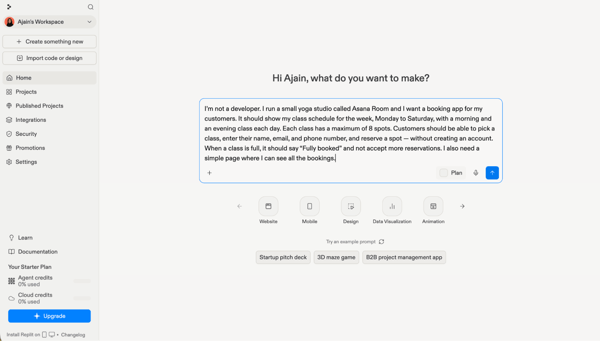
Replit built directly from the prompt and worked autonomously for around five minutes. It went beyond the brief in useful ways: it added a cancel option next to each booking in the admin view, a hero image and welcome message on the homepage, and a distinct name for every class. The result looked like a studio that was already open for business. Since my testing, Replit's Agent has started asking clarifying questions in some cases.
Where the brief was silent, Replit made its own decisions: it named every class (Sunrise Flow, Yin Yoga, Weekend Wind-Down) and set its own schedule, with evening classes at 6:30 PM. So while it added the most, my first edits would go toward swapping those placeholder details for the studio's real ones.
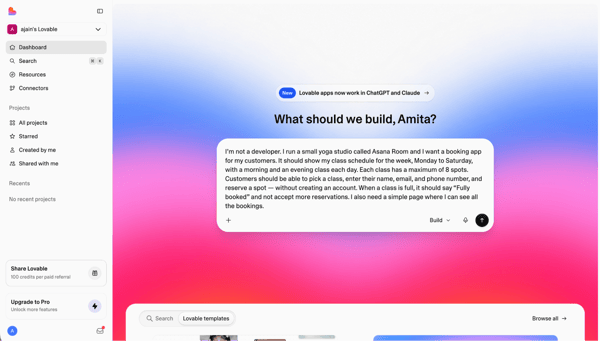
Lovable, in its default settings, asked three multiple-choice questions before building: how the bookings page should be protected, my class timings, and a design direction. Including that exchange, the first draft was ready in under eight minutes, and it needed no corrections against the brief: the schedule used the studio's real times, spot counters worked, and past classes were marked unavailable.
It also set up its cloud database during this build and stated, in plain language, the data-access rule it had applied. For someone who can't read the code, that explanation is the only visibility you get.
Winner: Split. Replit for initiative, delivering the more complete, business-ready first draft with less input. Lovable for accuracy, matching the brief with no placeholders to replace. Both produced a working app in under eight minutes.
For the second test, both tools received the same one-line design brief: make the app feel calm and premium, with soft muted colors, rounded corners, more breathing room, and a layout that works well on a phone.
This is how non-designers usually describe design: a mood plus a few loose visual cues, rather than exact specs like colors, sizes, or fonts. The test was whether each tool could turn that kind of direction into something visibly different, without breaking what already worked.
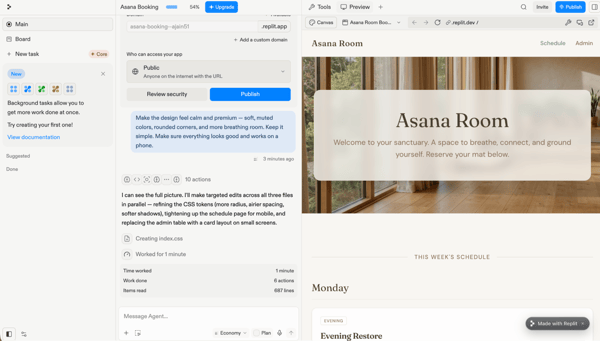
Replit finished in about a minute and made six targeted edits. Compared side by side with its first draft, I couldn't spot any change at desktop width; the changes showed up only in its work log, which listed softer shadows, more rounded corners, wider spacing, and a reworked admin table that turns into cards on small screens.
For teams making subtle refinements to a product that already works, that conservative approach protects what already works: nothing moved or broke. But a redesign you can only detect by reading the work log doesn't answer a visual request on its own. If you want a visibly different design from a single prompt, expect to give Replit more explicit direction or iterate further.
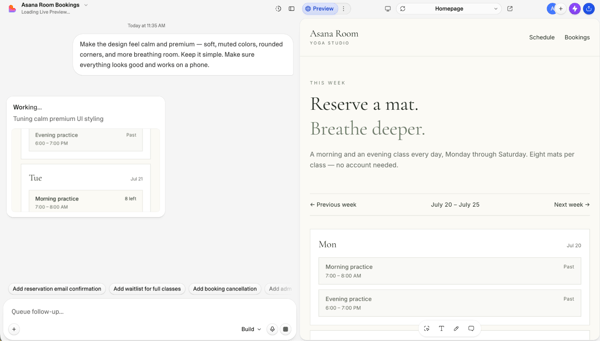
Lovable's changes were visible on the first reload. The schedule boxes became rounded cards with muted tints, the weekly schedule navigation turned into a pill-shaped bar, and the page gained noticeably more space. Its summary of the work matched what was actually on screen.
At phone width, where I compared both apps side by side, Lovable's layout also came out cleaner and crisper, with shorter cards and an easier booking flow.
Winner: Lovable. It translated a vague, feelings-based brief into changes I could see and point to, and its mobile result was more visible of the two. Replit prioritized preserving the existing design, which suits live products better than visible redesigns.
Most of life with an app builder after week one is small requests. So the third test asked both tools for exactly two changes: rename the booking button to "Save my spot" and move the weekly schedule to the top of the page, above the welcome section. The prompt ended with a clear instruction to change nothing else.
The point was to see whether a targeted request stays targeted, since unrelated changes are one of the most common complaints about AI builders.
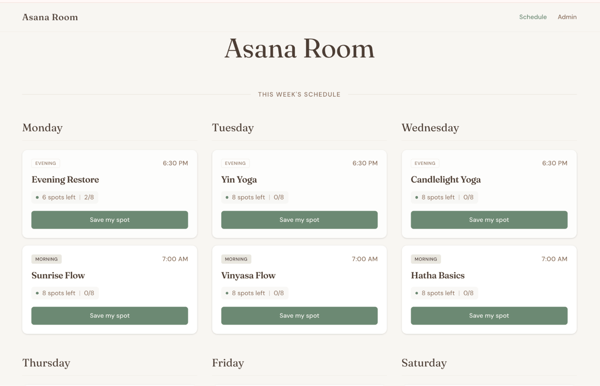
Replit made both changes as asked. Every booking button was renamed, the schedule moved directly under the studio name, and the welcome section slid to the bottom of the page, with nothing else visibly altered.
Its work log also showed it opening the app and taking a screenshot to check the result before reporting back. That thoroughness has a cost. Replit's free plan gives you a daily allowance of AI work, shown as a percentage meter (at the time of testing), and this one two-line edit consumed about a quarter of it, more than the full design restyle had cost earlier.
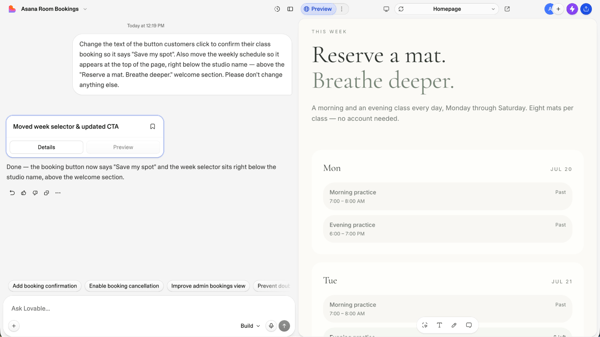
Lovable renamed the button correctly and changed nothing I had not asked about. The move went differently: it relocated the small week-selector bar to the top, while the welcome section stayed where it was, above the schedule.
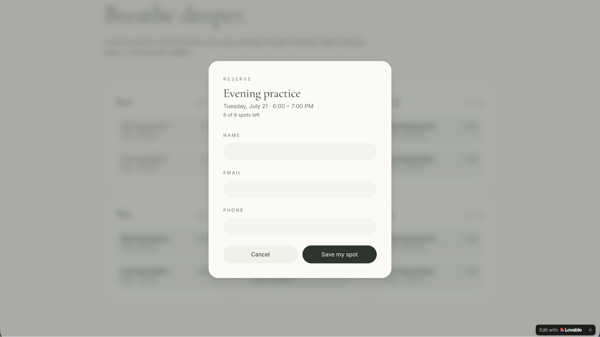
Its completion message read as done, and the wording described what it did rather than what I asked. I only caught the difference by scrolling the page myself. The practical lesson applies to both tools: a completion message is the agent's interpretation of your request, and your own eyes are the check.
Winner: Replit. It executed both changes precisely and verified its own work before saying so. Lovable implemented one requested change successfully and completed the second only partially, leaving another iteration needed to fully satisfy the prompt.
A booking app is only as real as its data. For this test, I made several reservations on each app, closed tabs, refreshed, and returned later to see what survived. I also watched whether the eight-spot limit actually counted down or was just text on a card.
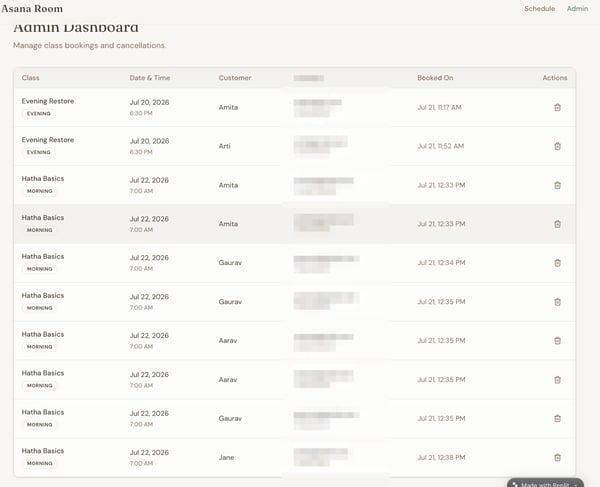
Replit stored every booking in a real database, and nothing was lost across refreshes or new sessions. Its admin view is a working table: each reservation shows a booked-on timestamp and has its own cancel or delete button, both useful for an owner running this daily.
Two gaps showed up in testing. It accepted the same email address for the same class more than once, and it also let me book classes whose dates had already passed, including from my phone on the live app.
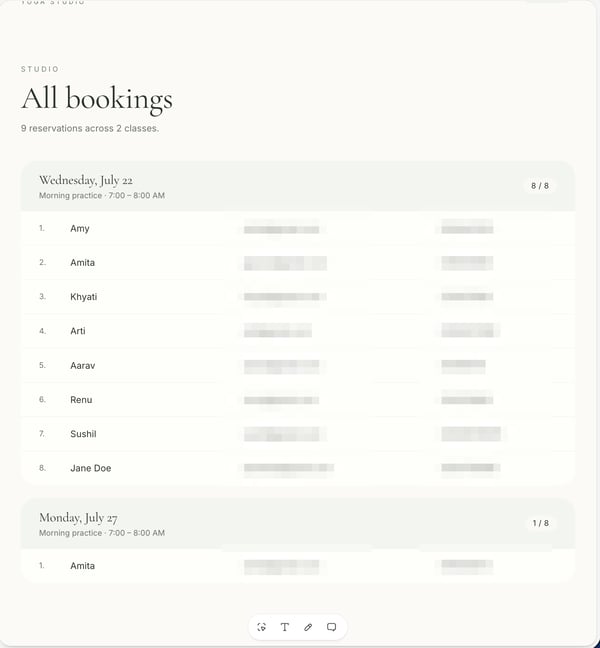
Lovable's data held up well, with counters decreasing on each booking and persisting across sessions. Past classes are greyed out and closed to booking automatically, so the schedule only accepts entries a studio could actually honor.
It also refused to let the same email book the same class twice, a protection I never asked for.
Winner: Lovable. Both stored real bookings that survived refreshes, but only Lovable accepted just the entries a studio could honor: it blocked past classes and duplicate bookings automatically. Replit's admin view offers more operational detail, with timestamps and a cancel option per booking, which suits owners who manage bookings by hand.
With customer names and emails sitting on an open page, both tools received the same one-sentence request: a login so only the owner can view bookings, while customers keep booking without accounts. The real test underneath: does a plain-English security request become an enforced rule, or just a login screen?
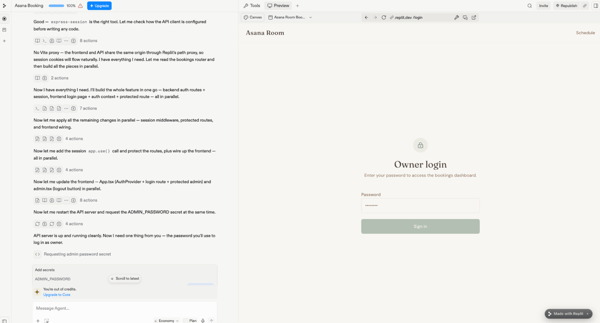
Replit enforced it on the first try. It paused mid-build to ask me to choose an owner password, stored it as a protected secret, and gated the bookings area behind a login. It also hid the admin link from customers entirely until signed in, and left the booking flow untouched.
Its explanation ran technical, but my required contribution was one password. The request and the result matched exactly.
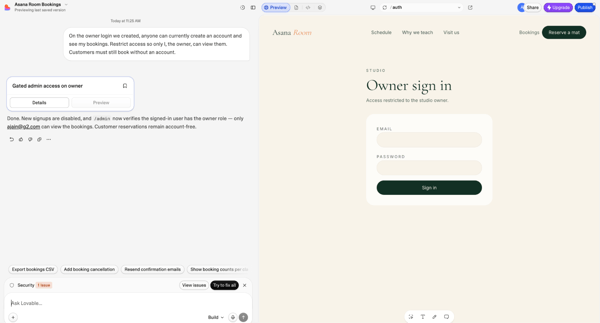
Lovable's first attempt produced a login screen without the protection behind it. The owner sign-up and sign-in flow it built was polished, but registration stayed open, so anyone who found the page could create an account and read my bookings. I had asked for owner-only access, and what I got was a login that anyone could pass.
One plain-English follow-up closed the gap completely. Lovable asked which email should be the sole owner, disabled new sign-ups, and restricted the bookings page to that account. The lesson travels beyond either tool: test security by trying the wrong door, because a login screen alone proves nothing.
Winner: Replit. It enforced the intent in one round. Lovable needed to be told twice, though its recovery was fast, complete, and asked exactly the right question.
This test checked whether each app enforces its booking limit when two customers submit for the last spot at the same time. I filled a class to only one remaining spot on each app, opened two browser windows, and submitted both forms as close to simultaneously as I could.
I never prompted either tool about simultaneous bookings. Whatever protection exists came from the code each generated on its own in the first build.
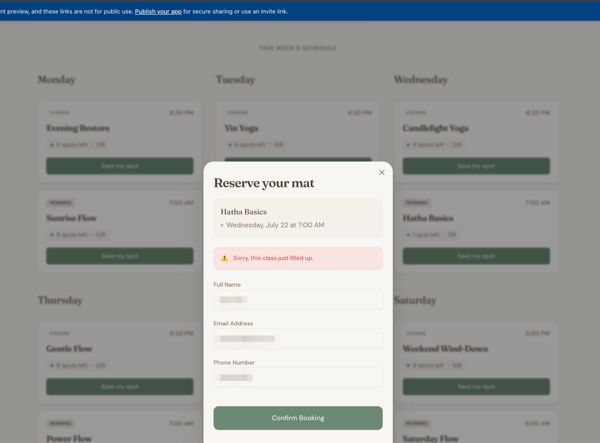
Replit let one booking through and turned the other away. The refused window got a specific explanation, "Sorry, this class just filled up," shown inside the form with my details still intact. The admin list confirmed exactly eight names, with no ninth record anywhere.
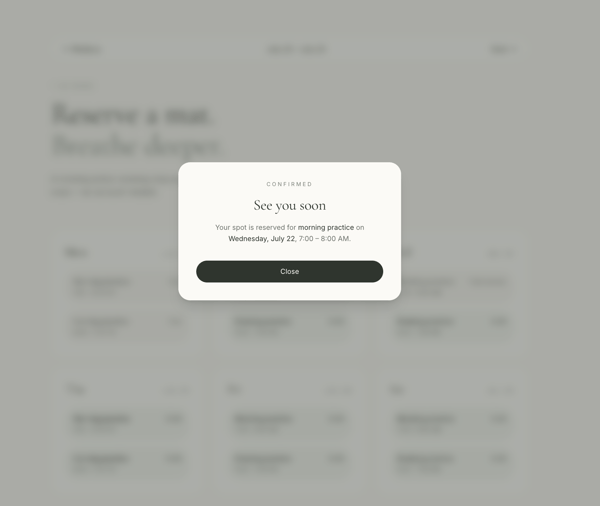
Lovable also capped the class at eight, with the spot counter reading zero and its bookings page badge showing 8/8. Its rejection message was generic, "Something went wrong. Please try again," which is accurate but doesn’t tell the customer the class is full. The winning window received a confirmation card recapping the class, date, and time.
Winner: Split. Both enforced the capacity limit under simultaneous submissions. Replit communicated the refusal better, while Lovable delivered the nicer booking confirmation.
Next, both tools got the same request: send customers an automatic confirmation email after they book. Email is the first feature an app can't deliver alone, because some outside service has to carry the message, and that is where free plans reveal their edges. And this is where the free plan hit the wall.
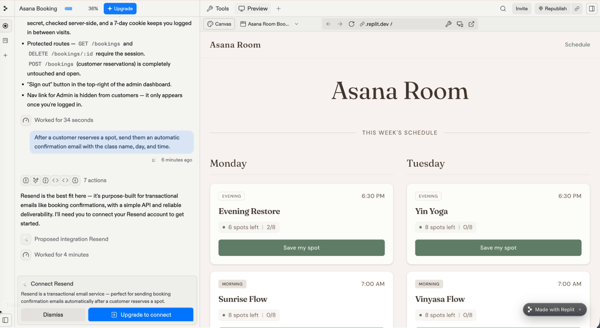
Replit worked the problem. It proposed a free email service, and when I declined, it offered alternatives, including sending from my own email address. It wired the full pipeline, with one safeguard built in: a failed email never blocks the booking itself.
The remaining step is supplying an app password, a limited, revocable code generated by your email provider, which takes a few minutes to set up. I stopped at that step.
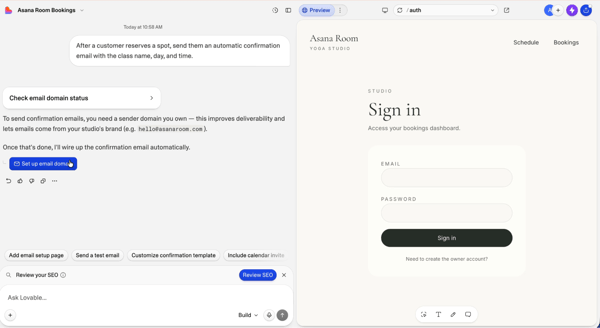
Lovable stopped at the gate. Its built-in email needs a sender domain you own before it sends anything, and it says so clearly with a setup button. For an owner without their own domain, confirmation emails on Lovable are out of reach.
Winner: Replit. Though, with a caveat that applies to both. As tested, neither free plan produced a confirmation email without the owner supplying something many people won't have or won't give: a domain on one side, email credentials on the other.
One important task was making both apps public. This test tracked how each tool gets an app from preview to a live URL: the steps involved, control over the address, who can access the app, and what happens to it after publishing.
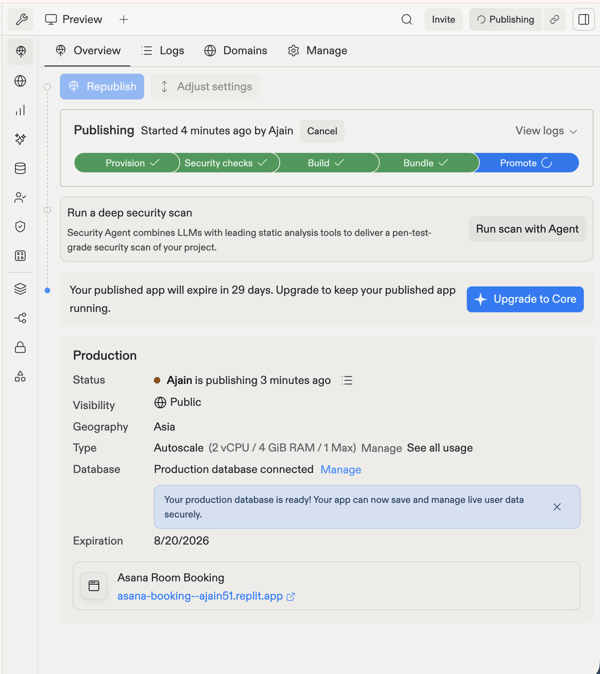
Replit's publish is a staged deployment: provision, security checks, build, bundle, and promote. This took around seven to eight minutes. It provisioned a separate production database and offered public, password-protected, or invite-only access, all on the free plan.
The limits sit elsewhere. My app's address was fixed to the workspace name chosen on day one, and adding a custom domain triggered a subscription prompt in my test. Free published apps also expire after 30 days, with my dashboard already counting down from 29 minutes after going live.
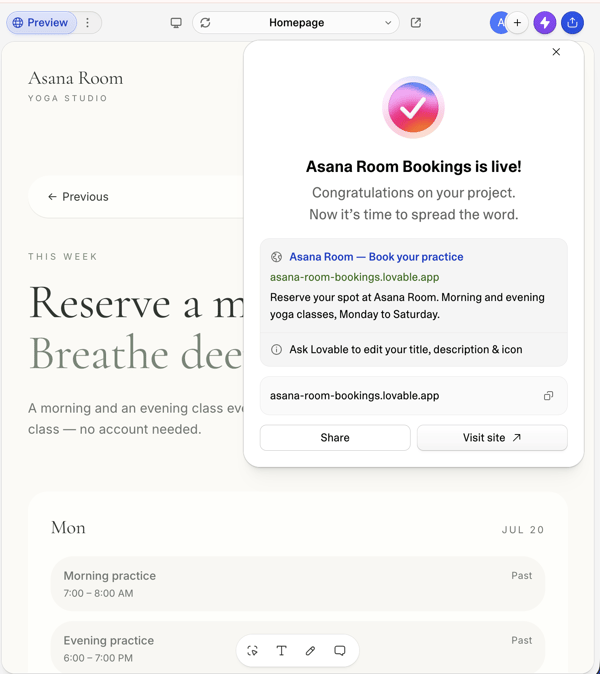
Lovable published faster, in about two minutes with a single click. It let me rename the free subdomain before going live, generated a share card with a title and description for the link, and surfaced a security suggestion automatically in the publish flow.
Its published free apps stay accessible with no fixed expiry date, although Lovable can unpublish a Free-workspace site after 12 months without visits or owner logins. By default, anyone with the link can view a Free or Pro app. Lovable's documentation lists an invite-only option on both plans (up to 10 people per project); limiting access to your whole workspace or to groups requires the Business plan.
As a final check, I opened both live apps on my phone and made a booking on each. Both handled it without a hitch.
Winner: Split. Both published a working app that handled a live booking from my phone. Replit's publish offered more control, with a separate production database and access options such as password protection. Lovable was faster and more flexible with the free address, and it went a step further: its free link stays live, while Replit's goes down after 30 days unless republished.
The final test reflects how many people actually arrive at these tools: with a screenshot of a design they like and a request to build something similar on their app. So, I gave both tools the same image, a landing page for a fictional coffee brand with one line: recreate this as closely as you can.
I ran it last for two free-plan reasons. Recreating a full design is one of the most credit-hungry things I could ask either tool to do, and committing to a borrowed look too early can box in an app that's still finding its structure. With a paid plan and no credit pressure, this could just as easily be your second or third step, right after the app's basics are working.
The reference had deliberately distinct elements to judge against: a serif headline with an italic accent in a second color, an organic shape with a tilted badge, a dark statistics band, feature cards, and a pull quote.
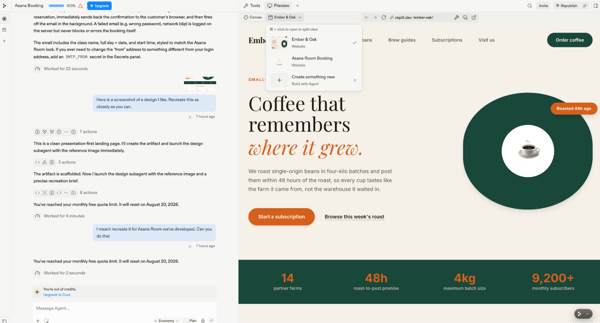
Replit read the brief literally. It created a separate mini-site, handed the image to a dedicated design subagent, and returned a faithful copy: the same headline treatment, the same intro copy and buttons, the tilted badge on the green shape. As a recreation, it was the closer match, and it carries a bigger implication: show Replit nearly any page, and it can reproduce the look.
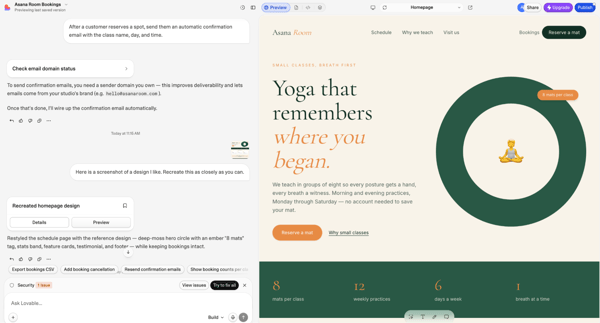
Lovable read the same brief in context. Running inside my booking project, it treated the image as a design direction and restyled my actual app in the reference's language, green circle, tilted badge, two-tone serif headline, dark stats band, with all bookings intact. Not a recreation, but arguably the more useful act: the design applied to content I own. One thing to know: it changes your live app's look, and version history is the way back.
This task also ended the free-tier story on both sides. Replit hit its monthly quota mid-task, with a reset a month away and upgrading as the only path forward. Lovable closed the day at zero credits, with a fresh daily allowance due at midnight.
Winner: Split. Replit was better for fidelity to the reference and “as is” recreation; Lovable was better at applying the design to real content. Which reading you prefer is a fair one-question test of which tool you'd enjoy living with.
| Task | Winner | Why it won |
|---|---|---|
| Quality of the first draft | 🤝 Split | Replit delivered the fuller first draft. Lovable asked before filling gaps and stayed closer to the brief. Both produced working apps in under eight minutes. |
| Quality of app design | 🏆 Lovable | Lovable translated a broad design request into visible changes and produced the cleaner mobile layout. Replit prioritized preserving the existing design, an approach better suited to refining a live product than to delivering a one-prompt redesign. |
| Targeted change request | 🏆 Replit | Replit completed both edits exactly and verified the result. Lovable renamed the button and moved only a portion up (not the full schedule view), and marked the task complete. |
| Booking database | 🏆 Lovable | Both stored real, persistent bookings; Lovable also blocked past-date and duplicate bookings automatically. |
| Owner-only access | 🏆 Replit | Replit enforced owner-only access on the first try. Lovable initially added the login flow without fully protecting the owner view, then fixed it after one follow-up. |
| Double-booking stress test | 🤝 Split | Both refused to oversell the last spot under simultaneous submissions, without ever being asked to handle that case. Replit's rejection message was clearer; Lovable's confirmation was more polished. |
| Automatic confirmation emails | 🏆 Replit | Replit offered more setup routes and kept bookings working if email delivery failed. In my test, Lovable wouldn’t send until I connected a sender domain. Neither sent email without outside setup. |
| Publishing | 🤝 Split | Both published a working app that took a live booking. Lovable was faster and keeps the free link live; Replit offered more deployment control, but its free link goes down after 30 days unless republished. |
| Design recreation | 🤝 Split | Replit matched the reference more literally; Lovable adapted its design language to the existing app. Replit suits exact recreation, while Lovable suits practical restyling. |
| User role or need | Recommended tool | Why |
|---|---|---|
| Founders launching a polished customer-facing web app quickly | Lovable | Turned a vague design brief into visible changes in my tests, a cleaner mobile layout, and simpler free publishing |
| Non-coders building apps with stricter rules or admin workflows | Replit | More reliable on precise edits, owner-only access, and backend workflows in my tests |
| Users who want to inspect code or learn development | Replit | Full code editor on every plan, with Git and deployment tools available as the project grows |
| Marketers, designers, and content teams | Lovable | Visual editing is central to the workflow, and it handled broad design requests more decisively in my tests |
| Builders who need native mobile apps | Replit | Supports native iOS and Android apps; Lovable focuses on websites, web apps, and PWAs |
| Anyone keeping a free prototype live for demos or feedback | Lovable | Publishes to a renameable free URL with no fixed expiry date (Replit's free app expires after 30 days) |
| Builders expecting developer handoff or deeper deployment control | Replit | Keeps code, version control, databases, and more infrastructure controls in one workspace |
Choose Lovable when visual polish and easy free publishing matter most. Choose Replit when precise app behavior, code access, native mobile development, or deeper technical control matter more.
I also looked at G2 review data to see how other users' experiences compare with mine and to find their strengths and adoption patterns. Here's what stood out:
Curious how these AI builders fit into the bigger toolkit? These hands-on roundups are a good next stop:
Got questions? G2 has the answers.
Lovable is the easier starting point for a complete non-coder. G2 reviewers rate its ease of use at 94% versus Replit's 90%, and in my testing, it asked plain-language questions before building instead of assuming. Replit fits non-coders who eventually want to see and edit real code, since its editor is included on every plan.
Yes, for building one. No, for running one long term. On the free Starter plan, a working booking app with a database and owner login took two days of prompting in my test. But free published apps expire after 30 days, and ordinary testing exhausted the monthly Agent quota, making Starter a trial plan, not a place to keep an app running.
Yes. Lovable's free plan includes five daily build credits capped at 30 per month, plus monthly AI and cloud allowances, unlimited members, and up to five lovable.app domains. Published free sites stay online with no fixed expiry date, so a simple customer-facing app can stay live on the free tier, with credits as the working limit. The one catch: Lovable can unpublish a Free-workspace site after 12 months without visits or owner logins.
Lovable builds websites and web apps, not App Store or Play Store apps. Its output adapts well to phone browsers, and you can build from Lovable's own iOS and Android apps, but there's no native packaging. Replit does produce native mobile apps, which makes it the default choice when an installable app is the actual goal.
Replit's paid entry point is now slightly lower: Core costs $20/month, or $18/month billed annually, versus $25/month for Lovable Pro. The real cost difference is how credits burn. In my testing, Lovable's prompts cost roughly the same each time, while Replit's scaled with task size. Replit's Free Mode, which Core expands, now handles lighter tasks without using credits.
They can be, if you verify rather than trust. Both tools enforced an eight-spot booking limit under simultaneous submissions without being asked, but Lovable's first login implementation left account signup open to anyone until one follow-up prompt fixed it. Both include free security scans; testing the wrong door yourself is still the step that matters.
Both free plans refill AI usage daily, up to a monthly cap. On Lovable, a stalled project resumes the next morning at midnight UTC until that cap is reached. On Replit, the free plan now runs on Free Mode, but its daily allowance still sits under a monthly cap, and once that's used up, the options are waiting for the monthly reset or upgrading to Core, which I hit in July after two days of testing.
Not on either free plan in my test. Lovable reserves custom domains for paid plans, while Replit prompted me to upgrade when I tried connecting one on Starter. The free-tier difference is the address you're left with: Lovable lets you rename your free subdomain, while Replit's free URL stays fixed to the name you first chose.
It depends on the job. If you're a non-coder who mainly wants a polished web app quickly, Lovable is the closest alternative: it has a 4.6/5 G2 rating against Replit's 4.4/5, and it beat Replit on visible design and booking-data validation in my tests. If you can code and want an AI-assisted editor rather than an app builder, G2 lists Cursor and GitHub Copilot among Replit's alternatives. If you're building internal tools or client portals around existing data, Softr has a 4.7/5 G2 rating. I didn't test those three, so treat them as starting points. Of the two tools I tested, only Replit builds native mobile apps and includes a full code editor on every plan.
Not across the board, but Replit is better for specific jobs. In my tests, Replit enforced owner-only access on the first try, made exact edits more precisely, and got further on confirmation emails. It also builds native iOS and Android apps, which Lovable doesn't. G2's top-rated alternatives to Lovable are Replit, Microsoft Power Apps (4.3/5), and Softr (4.7/5). Power Apps suits teams already working in Microsoft 365, and Softr suits portals and internal tools built on existing data. I didn't test those two. If speed to a good-looking web page matters most, nothing I tested beat Lovable.
I tested only Replit and Lovable, so I can't rank Base44 from hands-on use. G2 data gives a partial picture: Lovable has a 4.6/5 rating across 459 reviews and Replit has 4.4/5 across 418, while Base44 had 3.8/5 from four reviews as of October 2026, too few to draw conclusions. Base44 describes itself as an all-in-one builder with a backend, database, authentication, and payments included, which overlaps with both tools. If you already have a Base44 project, Replit can import it directly. My short answer: Lovable for polish and easy free publishing, Replit for control and native mobile apps, and a small trial project before you commit to Base44.
After nine real-world tasks, neither ran away with it. Replit won three tasks outright, Lovable won two, and four were too close to call.
If you ask me which one I'd choose, it depends on what the app is for. If I wanted a page live this week, free, and looking like I hired a designer, I'd pick Lovable. If I were building something I expected to grow, with real infrastructure, mobile apps, and the option to open the hood someday, I'd start on Replit and budget for the paid plan, because its free tier is a proving ground, not a home.
My takeaway is simple: don’t pick the supposedly better tool; pick the one that matches how much of the machinery you want to see and control.
And if what you really want is the app without the AI's creative opinions, take the more structured route: browse no-code development platforms on G2, where drag-and-drop builders trade a little magic for more control and predictability.