


Deel Hire is the best EOR software as per G2’s latest Fall 2026 Grid Report for employer of record software, earning the highest G2 score of 96. Here are the other top-rated EOR providers I evaluated, broken down by use case:
These are the six best EOR software platforms for 2027, ranked by G2 Score in the Fall 2026 Grid® Report: Deel Hire, Remote, Rippling, Multiplier Employer of Record, G-P, and RemotePeople.
The first international hire is exciting. The paperwork that follows isn’t.
I speak regularly with HR leaders, founders, and ops teams managing global workforces, and the pattern is almost always the same: too many moving parts, unclear compliance requirements, and way too much manual coordination between legal, payroll, and finance. That’s exactly why I dug into the best EOR software on G2 to see which tools actually make global hiring simpler in real-world scenarios.
The teams I looked at wanted faster onboarding, built-in compliance coverage, reliable global payroll, and a way to manage everything without setting up local entities. For CEOs at companies with 11-50 employees, the pressure is higher still: quick team adoption and measurable ROI matter as much as compliance, and there is rarely a spare HR or legal team to absorb a mistake.
If you’re responsible for hiring, managing, or paying international employees, this guide is designed to help you reduce compliance risk, simplify global hiring, and scale your workforce with more confidence, whether you are meeting tight deployment deadlines or working with limited implementation time and budget.
Each pick below is backed by 1,00+ G2 user reviews and product satisfaction data, so you can see which platform fits your team size, timeline, and compliance needs.
| Software | G2 rating | Starting price | Best for |
|---|---|---|---|
| Deel Hire | 4.8/5 | $599 per EOR employee/month | Global hiring with built-in compliance and payroll support |
| Remote | 4.5/5 | $599 per employee/month, billed annually | Fully owned global infrastructure and compliance-first hiring |
| Rippling | 4.7/5 | Available upon request | Unified HR, IT, and global workforce management |
| Multiplier Employer of Record | 4.7/5 | $459 per employee/month, billed annually | Fast global hiring with localized payroll and compliance |
| G-P | 4.4/5 | $599 per employee/month | Enterprise-grade global hiring with deep compliance expertise |
| RemotePeople | 4.7/5 | $499 per employee/month | Easy employee onboarding and self-service |
*These tools are top-rated in their category, according to G2’s Fall 2026 Grid® Report for EOR Software. I’ve added their starting prices to make comparisons easier for you.
Employer of record software is designed to handle the legal and operational side of hiring employees in other countries. Instead of setting up local entities, companies can rely on an EOR provider to act as the legal employer while managing payroll, taxes, benefits, and compliance with local labor laws.
What stands out to me is how these platforms turn a complex, multi-step process into a much more structured one. Hiring internationally typically involves navigating country-specific regulations, setting up payroll systems, and ensuring compliance at every step. The best EOR services for hiring international staff typically bring all of that into a single system, making it easier to manage employees across regions without stitching together multiple solutions.
At scale, this becomes less about hiring and more about consistency. Teams need a reliable way to onboard employees, process payroll across currencies, and stay aligned with local requirements without constant manual intervention. That’s where EOR software plays a bigger role; it standardizes how global employment is handled across countries.
This has led to a rise in adoption rates. Industry data from Market Growth Reports shows that over 65% of multinational companies use EOR services to manage compliance and payroll, with hiring through these platforms spanning more than 180 countries.
Even from a user perspective, the value is clear. According to G2 Data, 93% of users say leading EOR software meets their requirements, and 93% highlight ease of setup as a key advantage. The best EOR companies help companies run international operations in a more predictable and manageable way.
To start, I explored G2’s EOR category page, G2 Grid® Report, and product reviews to build an initial list of platforms.
From there, I used AI-assisted analysis to go through large volumes of verified G2 reviews, focusing on themes like global hiring speed, compliance coverage, payroll accuracy, etc.
I also cross-referenced insights from professionals managing global teams and validated those perspectives against real user feedback. The goal was to understand not just feature sets, but how these tools actually perform in day-to-day operations.
The screenshots featured throughout the product sections come from vendor G2 profiles or publicly available sources.
To identify the best employer-of-record software, I focused on what HR, finance, and operations teams consistently look for when scaling internationally. Here’s what I prioritized when evaluating these tools:
No single platform excels at everything, but the best ones consistently perform well when it comes to reducing complexity, ensuring compliance, and enabling teams to scale globally without friction.
The list below contains genuine user reviews from our Employer of Record Software category page. To qualify for inclusion in the category, a product must:
*This data was pulled from G2 in 2026. Some reviews may have been edited for clarity.
If you're focused specifically on compensation and payouts, dedicated payroll management software may be worth a look.
G2 rating: 4.8/5
Deel Hire is one of the most reliable options among the best EOR software I evaluated. What stood out to me was its financial flexibility, including fast global withdrawals, early paycheck access, and seamless USD spending with the Deel Card.
Compliance support is another major strength, and it matters when you are weighing EOR providers. Reviewers frequently highlight how Deel automatically generates compliant contracts and handles country-specific regulations in the background. This reduces legal overhead and gives teams confidence when expanding internationally without needing in-house expertise.
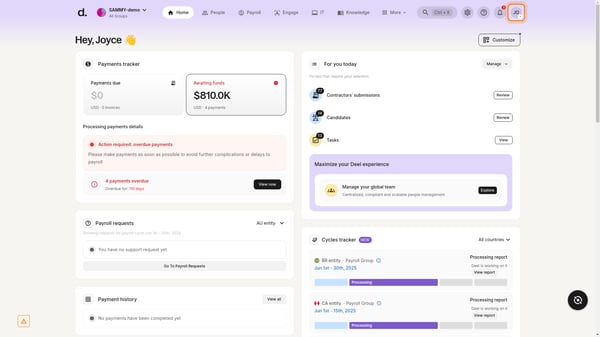
Deel Hire also simplifies onboarding. I liked how the process is structured, with clear workflows that reduce delays and errors, a pattern users often mention. This makes a strong first impression on new hires while helping teams move faster.
From what I observed, reliable, fast payments, along with flexible withdrawal options such as bank transfers and PayPal, are another of Deel’s major strengths. This is backed by strong satisfaction metrics on G2, including ease of admin at 93% and ease of doing business at 93%, which signal consistent performance across core workflows.
For CEOs at companies with 11-50 employees, the question is usually which EOR software they can trust without a dedicated HR team. Deel Hire is the option I would point to first: 47% of its G2 reviewers are in the small business segment (50 or fewer employees), and 95% say they are likely to recommend it, according to G2 Data.
Another interesting detail I noticed across reviews is the value of financial flexibility features for contractors. Users frequently call out tools like the Deel Card, which lets them spend earnings globally or make purchases in USD without additional transfers or extra fees.
I’ve also seen strong appreciation for Deel Advance, which gives workers early access to their earnings before the scheduled payout date. While these aren’t the primary reasons companies adopt the platform, they clearly improve the day-to-day experience for distributed teams and contractors managing international payments.
One thing to note is that Deel Hire can introduce some interface complexity, and navigation may feel crowded at times, especially when trying to locate specific information or complete detailed tasks, but this is largely a trade-off for its ability to handle complex global processes and workflows.
While many users see value in the platform, some mention that fees, especially around withdrawals and currency conversion, can add up depending on the withdrawal method and country. This tends to matter more for contractors and other payees receiving international payouts, whereas organizations often see it as a necessity for global payment infrastructure.
Taken together, Deel Hire stands out as a strong employer of record software choice for companies looking to scale internationally without getting slowed down by compliance and operational complexity. Its strength lies in bringing everything into one system that’s built for global hiring at scale.
“The onboarding process is simple, payments are easy to manage, and it reduces a lot of the administrative work that would otherwise need to be handled manually. It’s especially helpful when working with contractors in different locations.”
- Deel Hire review, Hiba A.
“Withdrawal fees and exchange rates could be more competitive, as small deductions add up over time for workers paid in foreign currencies. It would be helpful if Deel showed a clear total of fees before confirming a withdrawal.”
- Deel Hire review, Rachel C.
G2 rating: 4.5/5
Remote helps companies hire, pay, and manage international employees with built-in compliance and payroll support.
From the reviews I evaluated, Remote stands out among EOR vendors for its fully owned global infrastructure, which sets it apart from EOR providers that rely on third-party entities. This ownership model shows up consistently in feedback, with teams highlighting how it brings more consistency and control when hiring across multiple countries.
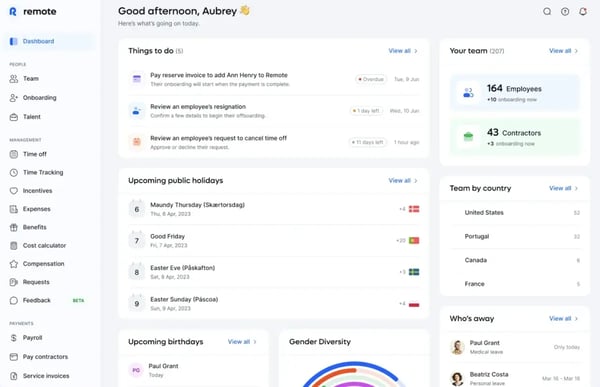
Remote also provides strong compliance and legal coverage. Reviewers frequently point out that Remote handles local labor laws, taxes, and statutory requirements behind the scenes, which removes much of the uncertainty when expanding into new regions. This compliance-first approach builds confidence for teams managing international hiring.
Another capability that gets a lot of attention is its AI-powered support experience. The built-in chatbot is available 24/7 and provides quick answers to common questions without waiting for support teams. According to G2 Data, 74% of users report actively using Remote’s AI features, signaling strong adoption for a feature often treated as secondary. Reviewers often highlight how quickly the AI retrieves relevant documentation and links, which is helpful for new users who need immediate guidance early on.
There’s also steady appreciation for employee self-service functionality. There’s a reason users rate Remote’s ease of use at 94%, according to G2 Data. I appreciated how reviews describe employees accessing contracts, benefits, and payment details without relying heavily on HR teams, which reduces back-and-forth and makes it easier to manage distributed teams at scale.
Localized benefits management is another area that gets attention. Reviewers highlight how Remote supports country-specific benefits, helping companies stay competitive while aligning with local regulations. This seems especially valuable for companies hiring across multiple regions with different expectations.
I also came across consistent feedback around onboarding and contract workflows. Users describe the process as structured and simple, with clear steps that help reduce delays. This is reflected in G2 Data, with ease of setup rated at 92%, suggesting teams can get started quickly without a steep learning curve. That mix of quick adoption, a minimal learning curve, and built-in compliance coverage makes Remote a good match for teams that need strong adoption rates while meeting compliance requirements.
There were discussions around customer support variability in complex scenarios. While support is generally responsive, some users mention occasional delays or a lack of deep local context when handling more nuanced issues, especially without a dedicated account contact. The structure ensures a consistent support experience for all users, rather than varying heavily based on account size or location.
Another point that comes up is pricing and expense workflows. Some reviewers note that costs can feel high for smaller teams, and reimbursements can involve receipt requirements and approval steps or take longer than expected, though this is often aligned with maintaining compliance and accuracy across global financial operations.
In practice, I see Remote as a strong fit among the best EOR software for companies that prioritize compliance, control, and long-term global hiring infrastructure. Its owned-entity model and consistent payroll performance make it a reliable choice for scaling international teams.
“What I like best about Remote is how easy and beginner-friendly the platform is to use. The interface is straightforward, and I can access my payslips without going through multiple navigation steps.”
- Remote review, Ace A.
“I think they could improve their expense submission procedure - adding an email where we can forward invoices and have them preloaded could help a lot.”
- Remote review, Alejandro L.
G2 rating: 4.7/5
Rippling is a unified workforce platform that brings HR, payroll, IT, and finance systems into one place to manage employees globally.
Based on the G2 reviews I went through, Rippling is often described as a platform that replaces multiple tools rather than adding another layer on top. Teams use it to manage core HR, payroll, and IT workflows together in one place. This unified system is especially useful for distributed teams, as it reduces duplication and makes it easier to maintain consistent records across regions.
Many users also rely on Rippling for automation across the employee lifecycle, and I found this especially valuable for teams that want fewer repeated tasks. Onboarding and offboarding trigger actions across systems, such as assigning apps, provisioning devices, and setting up payroll in a single step. Because the data is centralized, updates don’t need to be repeated across tools.
Where it starts to feel different from typical EOR vendors is in IT and device management. Reviews frequently highlight how software access, permissions, and hardware can be managed alongside HR workflows. I would prioritize it for teams handling remote employees at scale, since automated app provisioning, SSO, and the RPass password manager make that work much easier.
Another area that comes through clearly is flexibility. Rippling doesn’t force teams into fixed workflows. Users mention being able to customize processes and connect external tools like QuickBooks Online, which helps keep payroll and financial data aligned without extra reconciliation work. For a platform with this level of functionality, usability holds up well, with ease of use rated at 94% and ease of setup at 91% according to G2 Data.
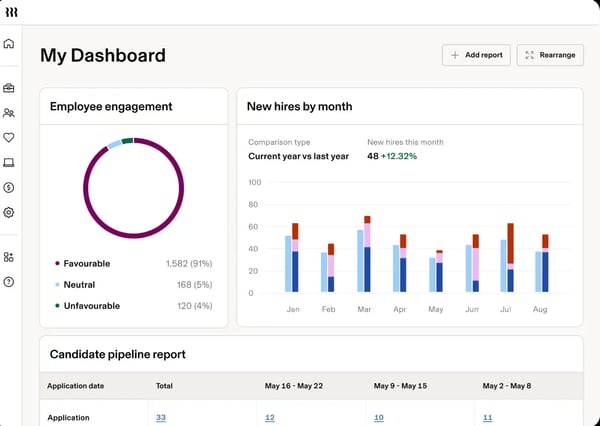
One capability that adds another layer of confidence is its automated tax and compliance handling. Rippling manages federal and state tax filings, supports registrations, and maintains audit-ready documentation aligned to specific regions. From what I’ve seen in reviews, this goes beyond basic compliance checks and gives teams more certainty when operating across regulated environments or multiple jurisdictions. Paired with the integrations above, it is the option I would shortlist for teams that want to integrate with existing tools without custom development while meeting compliance requirements.
Another aspect that stands out is the mobile app experience. Users frequently mention how easy it is to upload receipts, track expenses, and stay on top of payment timelines directly from their phones. The app also sends proactive reminders for missing documentation, which makes it especially convenient for employees and contractors managing tasks on the go.
That said, getting everything set up can take some adjustment. Some reviewers mention that the platform feels dense at first, particularly when navigating multiple modules or configuring workflows for the first time, though this reflects the depth of functionality available.
Support feedback is generally positive, but not without a few caveats. A few users note that more complex or technical queries can take time to resolve, especially when multiple systems are involved, though support is typically thorough once engaged.
Overall, G2 review data positions Rippling as a standout for companies looking to consolidate systems rather than manage a growing tool stack. I strongly recommend it for teams that want automation, flexibility, and visibility across HR and IT in one platform.
“Rippling unifies HR, payroll, benefits, IT, and device management in one platform, so onboarding a new hire in El Segundo or Edinburgh can trigger payroll setup, app provisioning, and laptop shipping from a single workflow. Its global payroll and compliance tooling lets a company run US and UK entities side by side, with consistent reporting, employee records, and approval workflows across both.”
- Rippling review, Tim H.
“Sometimes navigating to specific historical documents or updating personal banking details can take a few extra steps than expected. Additionally, customer support resolution times can occasionally be a bit slow if an issue requires direct assistance.”
- Rippling review, Laura L.
If your focus extends beyond global hiring into day-to-day HR operations, take a look at these HR software platforms.
G2 rating: 4.7/5
Multiplier Employer of Record is an EOR platform designed to help companies hire, onboard, and pay international employees quickly while staying aligned with local regulations.
Across the reviews I analyzed, Multiplier’s speed comes up again and again, which makes it a strong fit for CEOs meeting tight deployment deadlines. Teams consistently highlight how quickly they can bring in talent from new countries without getting stuck in entity setup or legal delays. That time-to-hire advantage is a big reason companies choose Multiplier early in their global expansion. This momentum carries into everyday usability.
Multiplier’s ease of use is rated at 95% and its ease of setup at 94% on G2, and the user feedback reflects that. Most teams describe it as simple to navigate, even when managing employees across multiple regions.
Compliance handling is another area where the platform earns trust. I noticed that most users rely on it to manage local labor laws, taxes, and statutory benefits in the background. Instead of manually tracking country-specific requirements, teams can focus on hiring while the system handles the regulatory layer.
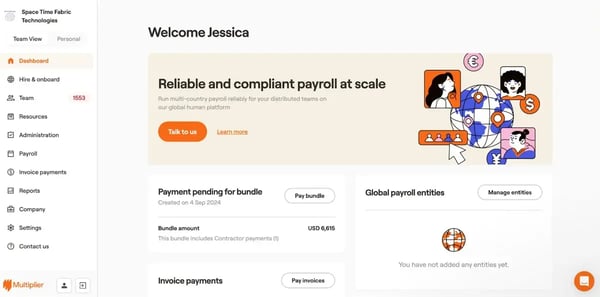
On the employee side, the experience feels equally structured. Reviews frequently mention how easy it is for employees to access contracts, payslips, and requests through a centralized dashboard. That visibility reduces dependency on HR and keeps things moving without unnecessary back-and-forth.
As teams scale, this setup continues to hold up. I came across many users pointing out that managing employees across several countries doesn’t add much overhead, which makes it easier to expand into new markets without rebuilding processes each time.
Customer support is another area where Multiplier performs well. With a quality of support score of 95% on G2, users often describe quick responses and clear guidance when working through onboarding or compliance-related questions.
Payroll also holds steady across regions. Users highlight accurate salary processing, consistent payouts, and clear invoicing, which helps both employers and employees stay aligned on compensation.
There are a couple of areas where expectations need to be set. When issues get more nuanced, especially around region-specific compliance, some users experience longer resolution timelines, even if initial responses are quick, but support tends to stay engaged until issues are resolved.
Another pattern that comes up in some reviews is around reporting depth. Some users say advanced reporting, analytics, and customization could go deeper than the standard reports, especially for larger or more complex setups, though they generally describe the platform as user-friendly.
At the end of the day, if I were advising a team, I’d say Multiplier makes the most sense among the best EOR software for teams that value speed and clarity. It’s a strong option if your priority is getting global hiring up and running quickly without adding unnecessary complexity.
“What I like most about Multiplier Employer of Record is how much it streamlines global hiring and day-to-day employee management. It handles compliance, payroll, contracts, and local employment requirements, which saves me time and reduces overall operational complexity.”
- Multiplier Employer of Record review, Shrinivas S.
“While the platform is generally user-friendly, some advanced reporting and customization options could be more robust, especially for larger enterprises managing a complex, global workforce. Also, although Multiplier automates many payroll and compliance processes, its AI-driven analytics and workforce insights feel relatively limited compared to some competitors, with fewer predictive features and less strategic decision-support capability.”
- Multiplier Employer of Record review, Suraj D.
Also evaluating multi-country payroll tools? Compare the compliance and data consolidation features of top platforms, including Native Teams and Global Expansion.
G2 rating: 4.4/5
G-P is an enterprise-focused EOR platform designed to help companies hire, onboard, and manage international employees with strong compliance coverage across regions.
When I went through reviews, G-P’s ability to accurately manage compliance across countries with different regulatory environments stood out, which matters when you are choosing between EOR providers. This focus shows up early in the hiring process. Before companies even enter a new market, users mention getting an early view of the full cost of employment, including taxes, benefits, and statutory requirements, which seems to remove some of the guesswork for teams expanding into unfamiliar regions.
Once employees are onboarded, the experience shifts toward structured global workforce management. Contracts, onboarding steps, payroll, and compliance workflows are organized in a way that keeps things consistent across countries, which is reflected in an ease of setup rating of 89%.
That flexibility carries into senior hiring as well. For companies bringing in leadership roles, G-P allows customization of executive-level benefits, which gives more control when structuring offers for key positions.
I also came across feedback that’s particularly relevant for smaller teams. Some users highlight G-P’s ability to scale and expand small to medium-sized businesses gradually. G2 Data reflects this, with the mid-market segment at 48% of G-P’s customers (51-1000 employees). This makes the platform more accessible for startups that want to grow internationally without committing to large-scale hiring from day one.
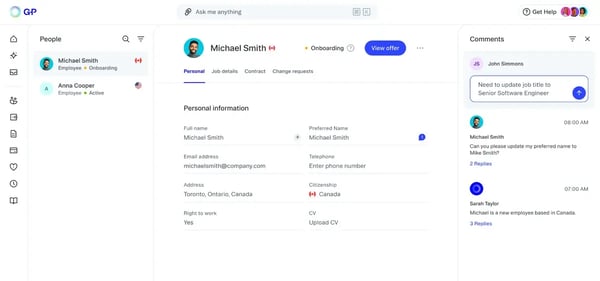
On the compliance side, there’s a noticeable emphasis on local HR advocacy for employees. Instead of just handling employer requirements, in-country teams help ensure employees receive the benefits they’re entitled to under local laws. That added layer of support seems to build trust on both sides and contributes to an 89% rating for quality of support, according to G2 Data.
The product experience receives regular quality-of-life and feature updates. I saw recent reviews where users mention a mobile-friendly interface that makes routine tasks more convenient, along with newer AI-driven support tools that help reduce manual effort.
Based on G2 reviews, I noticed that some administrators find certain features hard to locate and some workflows need several pages to complete, though many describe the platform as generally easy to use and well designed overall.
In my evaluation, I also saw some users say onboarding can involve many forms and longer timelines, especially in countries with complex regulations, though reviewers often recognize that this reflects the compliance depth the platform is built for.
All in all, if your team prioritizes compliance depth, employee experience, and structured global operations over speed or lightweight workflows, G-P is among the best EOR software choices available.
“GP offers a comprehensive solution across most countries. While the platform itself is robust, it was the expertise of the local teams that gave us real confidence in the process. Their detailed knowledge of local requirements reassured us that everything was being handled correctly and in full compliance.”
- G-P review, Edward M.
“Although the platform is generally easy to use, some features can be difficult to locate, and certain workflows require navigating through multiple pages. A more streamlined user experience would improve efficiency for administrators.”
- G-P review, Mateo V.
G2 rating: 4.7/5
RemotePeople is an employer of record software option that handles employment, payroll, and compliance so companies can hire in new countries without setting up a local entity.
Based on the reviews I evaluated, onboarding is where RemotePeople earns the most praise. Users describe a well-organized, step-by-step flow, with clear instructions and an easy initial setup, which lines up with a G2 rating of 95% for ease of setup. For companies with 11-50 employees that need quick team adoption and measurable ROI, this speed matters, because reviewers describe less friction around paperwork and onboarding.
Ease of use comes up just as often. Reviewers call the platform simple and user-friendly, and G2 Data backs this up with an ease of use rating of 95%. Employees mention handling everyday tasks like logging expenses, checking payslips, and managing leave days in one place. That simplicity also helps teams that need to ease onboarding for non-technical team members, since the everyday tasks are laid out as clear, self-service steps.
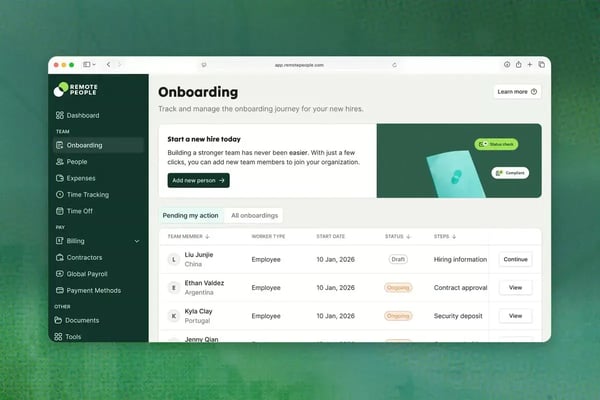
Digital contracts and e-signatures are another practical strength. Users mention signing contracts online and getting approvals through the portal, which keeps paperwork moving without printing or in-person steps.
On the employer side, reviewers say RemotePeople lets them bring on talent in new markets without slowing down on legal setup. What I valued was how it handles payroll, contracts, and compliance in a single workflow, which helps lean teams scale internationally. G2 Data also shows a mix of customers, with small business at 49% and mid-market at 41% of reviewers.
On the support side, some users say responses can occasionally be slightly delayed, though they describe the quality of help as high.
Another point that comes up is reporting depth. Some users say advanced reporting and analytics could go deeper, especially for leadership-level visibility by region or role, though they generally describe the platform as easy to use.
At its core, RemotePeople is built for teams and employees who want onboarding, contracts, and everyday requests to feel simple. For companies looking for an approachable way to hire across borders, it earns a place among the EOR vendors to shortlist.
“I like how RemotePeople is simple and user-friendly, especially when it comes to logging expenses. It's straightforward and ensures that the right people are aware of the expenses and leave information. The initial setup was easy for me, which added to the overall positive experience.”
- RemotePeople review, Shannon D.
“Additionally, I’ve experienced slightly slower response times from support during high-traffic periods, though the quality of help remains high.”
- RemotePeople review, Nataporn C.
While the tools above cover most global hiring needs, a few other EOR platforms are worth exploring for more specific use cases, such as hands-on onboarding, responsive ticket-based support, distributed team management, or contractor management.
Have more questions? I’ve answered some of the most common ones below based on what I’ve seen in G2 reviews and real-world use cases.
Based on G2 reviews, Deel Hire, Multiplier Employer of Record, and RemotePeople come up most often for small teams, with a large share of their reviewers coming from companies of 50 or fewer employees. Reviewers describe quick setup and compliance handled in the background, which matters when there is no in-house HR or legal team. Deel Hire also earns the strongest likelihood-to-recommend feedback of the six tools here.
When timelines are tight, Multiplier Employer of Record is the tool reviewers mention most for speed, with teams highlighting how quickly they can bring in talent without entity setup. RemotePeople and Deel Hire are close behind, thanks to structured onboarding flows that reviewers describe as quick and easy to follow. All three rate among the highest in this lineup for ease of setup.
Based on G2 reviews, Deel Hire, Remote, Multiplier Employer of Record, and Rippling come up most for reliability. Deel Hire is the most dependable on payments, Remote on payroll and compliance, Multiplier on onboarding speed and support, and Rippling on tax compliance and HR consolidation.
Remote, Multiplier Employer of Record, and RemotePeople are the strongest fits here. Remote pairs a high ease-of-use rating with a compliance-first model, Multiplier is described as simple to navigate while it handles local requirements in the background, and RemotePeople earns praise for onboarding that new employees pick up quickly.
G2 reviews do not measure vendor lock-in directly, so I look at setup feedback and how well a platform connects with what you already use. Rippling lets teams customize workflows and connect external tools, while Multiplier Employer of Record and RemotePeople are both described as quick to start without heavy implementation work. Before you sign, I would confirm contract and exit terms with each vendor.
Multiplier Employer of Record earns the strongest feedback for support quality among these tools, with users describing quick responses and clear guidance. For product direction, Deel Hire, Rippling, and RemotePeople have the most reviewer confidence that the product is heading the right way, which is a good sign for teams that do not want surprises.
RemotePeople, Multiplier Employer of Record, and Deel Hire are the ones I would shortlist. Their reviewers describe fast setup and less time spent on paperwork, payroll, and compliance, which is where small teams usually see the return first. Because small businesses make up a large share of their reviewer base, the feedback reflects teams of your size.
Rippling is the strongest match, since reviewers mention connecting it to existing tools such as QuickBooks Online while its tax filing and audit-ready documentation handle compliance. Deel Hire and Remote also keep compliance in the background, but integrations are not where reviewers focus on them. If integrations are your priority, I would test Rippling’s connections against your own stack first.
For limited implementation time, RemotePeople and Multiplier Employer of Record are described as quick to set up with little internal effort. On budget, compare the starting prices in the list above and weigh them against the admin time each platform saves your team.
RemotePeople is the one reviewers describe most often as easy for non-technical employees, with clear step-by-step onboarding and self-service for expenses, leave, and payslips. Deel Hire and Multiplier Employer of Record also get praise for structured onboarding and a central place to find contracts and payslips.
On G2’s Core HR Software category, the top 5 are RUN Powered by ADP, Rippling, BambooHR, TriNet, and Gusto (G2’s rankings shift monthly, and “HR software” spans several categories like HCM and payroll).
After going through all these tools, here’s what stands out: global hiring isn’t the hard part anymore. Running it smoothly is.
Most of the best EOR software on this list, whether it’s Deel Hire, Remote, Rippling, Multiplier, G-P, or RemotePeople, can get you across the finish line on hiring. You can onboard employees in new countries, run payroll, and stay compliant without setting up entities. The infrastructure is there, and it works.
Where things start to diverge is after that first hire. How easily can your team manage payroll across countries? How much manual coordination is still required between HR, finance, and legal? Can you rely on the system without constantly double-checking compliance or chasing updates? The real challenge lies in keeping everything consistent once you’ve expanded, across payroll cycles, benefits, local regulations, and day-to-day operations. I’ve seen teams scale quickly, only to slow down because their processes couldn’t keep up.
So yes, go global. But when you compare EOR vendors and EOR providers, choose the one that keeps your operations as stable as your hiring pipeline.
If you’re not hiring internationally but still need support with payroll, benefits, and HR within an existing entity, explore the best PEO providers to find alternatives.

HR leaders, People Ops managers, CFOs, and business owners evaluating best PEO providers are...
 by Disha C

Paying one contractor is easy. Paying 25 across five countries, in three currencies, with...
 by Soundarya Jayaraman

Global hiring sounds exciting.But there’s a catch: figuring out local labor laws, tax...
 by Sudipto Paul