Your employees have more credibility than your brand does. A post from a real person inside your company will always outperform the same message published from a company page, and most marketing teams know this, which is why finding the best employee advocacy software has become a genuine priority rather than a nice-to-have.
The question isn't whether employee advocacy works. It's whether your tooling can actually get people to participate consistently enough for it to matter. I built this list using the G2 Summer 2026 Grid® Report, AI-assisted (artificial intelligence) G2 review analysis, and practitioner cross-checking across marketing, communications, and employer brand teams. Visuals and product references are sourced from G2 vendor listings and publicly available product documentation.
This guide covers seven platforms, each suited to a different advocacy use case. DSMN8 is best for enterprise teams that need centralized governance and high participation. Vista Social combines social media management and employee advocacy in one platform. Oktopost is built for B2B teams that want to connect social activity to pipeline. Hootsuite Amplify extends employee advocacy within the Hootsuite ecosystem. Sociabble brings advocacy and internal communications together for global organizations. Sharebee is ideal for LinkedIn-focused ambassador programs with strong gamification and analytics. EveryoneSocial helps enterprise teams activate employees at scale with minimal friction.
Here's how these seven platforms differ.
*These tools are top-rated in their category based on G2’s Summer 2026 Grid® Report. I’ve included their strengths and pricing details to help you choose the right platform for your team’s development and quality-assured workflows.
What I consistently found across G2 reviews is that stronger platforms give you visibility into advocacy as an ongoing operation. Not a one-off campaign. The tools I'd point you toward show which employees participate consistently, why certain content resonates, and how sharing connects to your broader marketing or brand goals. When I cross-checked this with practitioners, the platforms that earned the most praise did two things well. They reduced manual coordination. They made the next action obvious rather than overwhelming employees with options.
G2 data shows adoption across small teams, mid-market organizations, and large enterprises. It is largely driven by marketing, communications, and employer brand leaders. If you are deploying one of these tools to close a distribution gap, long-term value depends on two things: sustained participation and governance that does not slow your daily work. Tools that are easy to launch but hard to scale tend to lose momentum once initial excitement fades.
I started by using G2's Summer 2026 Grid® Report to identify the leading employee advocacy platforms based on verified user satisfaction scores and feature scores. I then used AI-assisted analysis to review hundreds of verified G2 reviews, looking for recurring patterns around employee adoption, content discovery, governance, analytics, onboarding, and integrations.
Since I haven't personally used every platform in this category, I cross-checked those findings with insights from marketing, communications, employer brand, and social media professionals who actively run employee advocacy programs. Their feedback helped validate the review patterns and add practical context on how these platforms perform across different teams and organizations.
All visuals and product references in this guide are sourced from G2 vendor listings and publicly available product documentation.
Feature lists alone don't tell you whether an advocacy program will succeed. These are the factors that matter once the initial rollout is over and participation becomes voluntary.
Each platform focuses on different strengths. The best one for your team is the one that aligns with your goals, workflows, and long-term needs.
To be considered in this evaluation, platforms had to meet the following baseline criteria:
This data was pulled from G2 in 2026. Some reviews may have been edited for clarity.
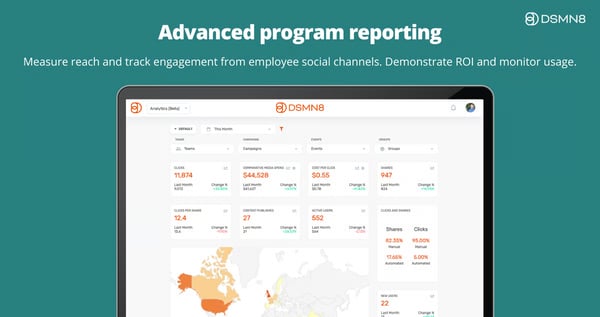
If you are running advocacy across a large organization, DSMN8 is likely already on your radar. It lowers the effort barrier for employees while giving comms and marketing teams confidence in what gets published. The experience leans toward simplicity, guided participation, and centralized content, and that combination explains its strong traction in enterprise environments where consistency matters more than experimentation.
If there is one thing G2 reviewers agree on, the sharing experience is fast, and I find that hard to argue with. Two or three clicks and the post goes out, no drafting, no approvals, no second-guessing. That ease directly addresses one of the biggest blockers to employee advocacy: people want to participate, but not at the cost of their time. Social sharing on G2 scores 94%, reflecting how reliably the platform delivers on that promise.
Having campaigns, announcements, blogs, and milestones in one place is something I think gets underrated. G2 reviewers consistently note that it helps teams speak with one voice while posts still feel personal enough to avoid sounding like corporate broadcasts. For distributed teams managing multiple content streams, that single source of truth reduces coordination friction considerably.
Not everyone can monitor social channels daily, and DSMN8 accounts for that. The ability to queue posts days or weeks ahead lets employees maintain a LinkedIn presence without actively managing timing. At 92% for content scheduling on G2, reviewers describe it as one of the more reliable parts of the daily experience, and I'd agree that kind of consistency is hard to overlook.
For me, gamification is one of DSMN8's quieter wins. Leaderboards and points introduce just enough competition to keep employees returning without making it feel forced. G2 reviewers consistently highlight it as a driver of sustained participation over time. The scoring system is simple enough not to feel like a game, but visible enough to reinforce consistent behavior.
Employees can see which posts have been shared and track basic engagement metrics without leaving the platform. I feel that visibility matters more than it sounds. Program managers trying to demonstrate advocacy impact no longer need to build custom dashboards to do it. G2 reviewers rate content distribution at 92%, a signal that content reaches participants reliably and performance data surfaces without friction.
Discoverability is one of those things that does not get enough credit. G2 reviewers note that the filter function makes it fast to sort and find content by topic or industry. For employees managing high content volumes across multiple streams, less time searching means more time sharing. The experience stays quick even as the content library grows, and that consistency is worth a lot.
Some G2 reviewers note that post caption editing is restricted to preset content fields. Approved posts can't be rewritten from scratch or restructured for a specific audience before employees share them. If you are in a client-facing or specialist role where tone adaptation matters, you will feel that boundary most. However, content distribution and scheduling continue to run reliably at scale, keeping brand presence consistent across the employee base.
If you are coming from a RevOps or multi-system environment, here is something worth knowing. Native customer relationship management (CRM) and marketing automation connectors are not part of DSMN8's standard integration layer, a boundary that comes through in G2 feedback. Where DSMN8 stays focused, though, the advocacy workflow covering content curation, sharing, and participation tracking runs at full depth. That focus is a big part of why the day-to-day experience stays as clean as it does.
If I had to point a large enterprise toward one advocacy platform, DSMN8 would be at the top of that list. What I consider most compelling is how it shifts employee sharing from a periodic push into something that actually runs consistently. For organizations ready to treat advocacy as a proper operational channel, this is the one I'd back.
"I love how easy it is to share company media on LinkedIn with DSMN8. The ease of use is fantastic; all I have to do is click 2-3 times, and everything is done for me. This saves me a lot of time since I would be spending way more time doing LinkedIn posts otherwise."
- DSMN8 review, Patrick G.
"The platform can feel a bit restrictive for users who want to customize or personalize company-approved posts before sharing them."
- DSMN8 review, .Utkarsh M.
Want advocacy as part of a broader social stack? See how the best social media suites on G2 combine publishing, analytics, and amplification in one platform.
Vista Social is one of those platforms that makes you wonder why you were juggling separate tools in the first place. Its strength comes from combining multiple social media workflows into a single platform. Publishing, engagement, listening, analytics, and basic advocacy functions all sit together. For agencies and growing marketing teams managing multiple accounts, that consolidation removes a layer of daily coordination that quietly drains time.
Having messages, comments, and mentions from Facebook, Instagram, TikTok, LinkedIn, and other platforms in one place is something I find genuinely useful. It removes the tab-switching that breaks response rhythms. Teams managing high message volumes describe it as a real operational shift. Engagement tracking earns a 98% feature rating on G2, and that number reflects exactly what reviewers describe.
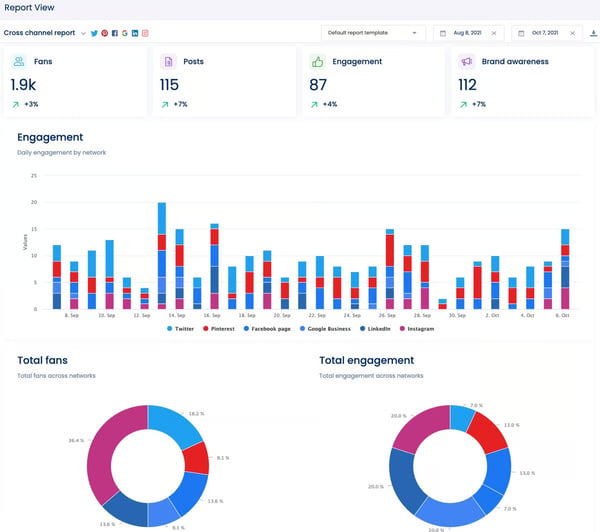
I'd call reel scheduling one of the features that genuinely stand out here. For users managing content-heavy client accounts where publishing continuity is non-negotiable, the ability to plan posts in advance and manage drafts cleanly makes a real difference. At 99% for content scheduling on G2, Vista Social sits among the stronger ratings in the category. Teams stay on the platform because of exactly that reliability.
Social listening sits behind a premium paywall on most comparable platforms, and then there is Vista Social. It is included. No extra cost, no separate subscription, no compromises. For teams managing multiple clients, that alone is a switching reason. Monitoring brand mentions and tracking audience conversation across networks at this price point genuinely changes the economics for smaller agencies. The platform's 99% social sharing rating on G2 reflects how well outbound distribution and inbound monitoring work together, and I think that combination is hard to beat.
The platform also offers a surprisingly broad set of workflow automation features. Direct message (DM) automation, task assignment, and priority tagging reduce repetitive manual responses and keep multi-client workflows moving without anyone having to babysit the process. Agency operators highlight these as the difference between managing five clients and managing fifteen, and that framing sticks with me. Add reporting that generates insights without custom setup, and you have a content-to-analysis cycle that most tools in this pricing range simply cannot match.
Support response times are consistently described as fast, often resolving account connection issues within minutes. And if you are coming from a more complex tool, the adjustment period here will catch you off guard in the best way possible. The adjustment period is notably shorter than expected, with onboarding guidance and in-app tutorials closing most gaps quickly. For teams switching mid-contract from heavier platforms, that transition speed is not a small thing.
I'd describe competitor analysis as one of those features that punches above its weight here. It surfaces inside the same workspace without a separate setup or additional subscription. Users describe running a full competitor snapshot in under a minute. A capability that typically lives behind a higher pricing tier is just there, ready to use. For agencies benchmarking client performance, accessibility changes everything about how often it actually gets done.
G2 users flag that advanced automation rules are not configurable within the platform's current automation builder. Multi-condition triggers and branching response logic fall outside what the builder currently supports. I'd note this one matters most if you are managing clients with complex DM workflows or multi-stage approval sequences. For standard reply flows, this boundary rarely surfaces. Scheduling, engagement tracking, and unified inbox management continue to perform reliably across all connected accounts.
Bulk scheduling edits and bulk post deletions across multiple accounts are not supported. Each entry requires handling individually, and for agencies managing large content calendars, that adds up. I'd say this is the one area where G2 reviewers feel the friction most repeatedly. Publishing, listening, and reporting all continue to operate without that constraint, regardless of calendar size.
Vista Social is one I'd recommend without hesitation for agencies and mid-market marketing teams that want scheduling, engagement, listening, and reporting in one place without paying for features they will never touch. What strikes me most is how the satisfaction scores reflect a product that actually simplifies daily execution rather than just stacking up feature count. For teams that want operational clarity without the bloat, this one delivers.
"I love Vista Social because it removes a lot of operational workload from day-to-day social media management. I really love the unified inbox — there I can see all incoming messages, comments, and mentions from all social media platforms and respond without switching tabs. I was blown away by the DM automation feature."
- Vista Social review, Wajeeh A.
"AI automation is not very advanced — sometimes you have to do manual work that I'd expect the tool to handle."
- Vista Social review, Fiza H.
Before employees share, they need to feel informed. See which employee communications platforms G2 teams use to close that gap.
Most social media tools treat publishing, analytics, and employee advocacy as separate problems. Oktopost treats them as one, and for B2B teams that have wrestled with fragmented workflows, that distinction hits differently. The platform is built around the premise that B2B social activity should connect to business outcomes, not just reach metrics.
Employees and marketers describe distributing content across channels without navigating fragmented workflows, and the advocacy board is consistently described as visually clear and fast to act on. A 100% social sharing rating on G2 sits behind that experience, confirming what reviewers describe as one of the cleaner content distribution flows in the B2B social category. For anyone who has dealt with clunky advocacy interfaces before, that visual clarity is something I'd genuinely highlight as a differentiator.
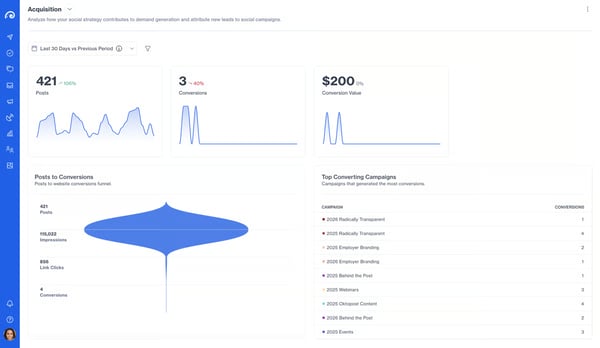
The moment you connect Oktopost to your CRM, the conversation about social return on investment (ROI) changes entirely. Social interactions move through the pipeline with attribution tied to leads and opportunities rather than sitting in a separate dashboard. The integration layer earns 98% on G2, and for B2B marketing teams accountable to revenue outcomes, that closed loop is the capability that justifies the investment.
Custom dashboards, campaign color-coding, and social business intelligence (BI) capabilities let teams build reporting views that map directly to what leadership needs to see. If you have ever sat in a social reporting meeting and struggled to make the numbers land credibly, Oktopost is the answer to that problem. Several G2 reviewers describe it as the first tool that lets them present social performance data to executives without a follow-up interrogation. For a single program manager running social at scale, that analytics layer changes the reporting game entirely, and I mean that without exaggeration.
The advocacy layer operates cleanly alongside publishing and analytics rather than feeling like an add-on, and that integration is rarer than you might expect. Leaderboards, participation tracking, and curated content distribution help organizations activate employees as amplifiers while keeping program managers across who is engaging and what content is driving reach. G2 reviewers specifically call out the visual design of the advocacy board as a factor in employee adoption, and I get why. A cluttered interface kills advocacy programs before they start. Oktopost sidesteps that entirely.
Mobile carries the full analytics and publishing experience without tying anyone to a desktop. Program managers who have wrestled with degraded mobile interfaces elsewhere will notice the difference immediately. Scheduling, advocacy, and reporting are all accessible on the go without compromise. I'd be doing this platform a disservice if I did not call out how seriously it treats off-desktop workflows. The 98% mobile rating on G2 confirms what users describe in practice.
Customer success support is treated as a genuine strategic resource rather than a reactive help function. G2 reviewers describe customer success managers as engaged in program strategy, not just technical setup. For organizations scaling social into a revenue-contributing program, that partnership changes the trajectory entirely. Across the full Oktopost review base, that feedback came through more consistently than almost any other theme.
The social listening feature is gated behind an additional paywall rather than included in the core platform. If brand monitoring is central to how you run social, that is a line item worth planning for. Several G2 reviewers flag it as the one gap that pushed them toward a second tool alongside Oktopost. Publishing, employee advocacy, and revenue attribution analytics all remain fully included and operate without that constraint.
A recurring theme in G2 reviews points to tagging as a consistent friction point. Tagging people and companies within posts is restricted. Portable document format (PDFs) require manual publishing outside the platform. If social selling is central to how your team operates, you will feel that boundary most. Standard publishing, campaign scheduling, and CRM-connected attribution continue to run at full depth regardless.
If pipeline accountability is your world, Oktopost is the platform built for exactly that conversation. Integration depth, analytics that speak the language of leadership, and an advocacy layer that runs alongside everything else without friction. Most tools in this category optimize for ease of participation. Oktopost optimizes for measurable business impact, and for B2B marketing teams where social needs to earn its place in revenue reporting, that difference is everything.
"Oktopost is intuitive and easy to use, and it serves as a true command center for our social operations. It gives us full visibility into our publishing calendar across channels, strong campaign insights, and thorough, customizable reporting that helps us build a data-driven social strategy and scale growth."
- Oktopost review, Rachel Z.
"It would be really helpful to be able to schedule the first comment when scheduling a post. On platforms like LinkedIn, adding links in the first comment is often part of the strategy. Having to go back and post that manually adds an extra step that could easily be streamlined."
- Oktopost review, Alina I.
Hootsuite Amplify is not trying to be a standalone advocacy platform, and I think that is actually the point. It sits inside the broader Hootsuite ecosystem, built for organizations already running social programs there. Adding Amplify extends content reach through employees without the headache of migrating to a separate tool. If you already live in Hootsuite, this one slots in without disruption.
Amplify keeps it refreshingly simple, and I mean that as a compliment. Pre-approved content organized by topic, a clean visual layout, and a sharing flow that employees describe as instantly intuitive. No onboarding, no guesswork, no hunting through unstructured feeds. A few clicks and you are done. Content distribution sits at 89% on G2, and for core content delivery, that steady reliability is what employees actually notice.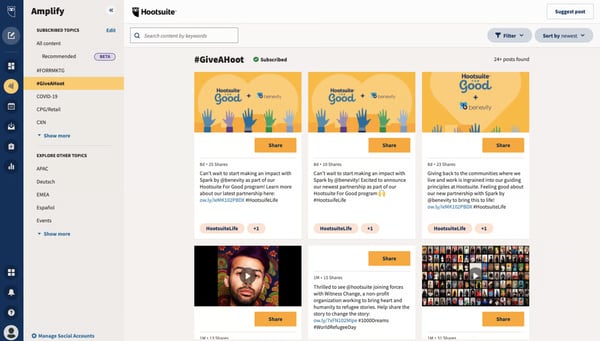
I'd put scheduling flexibility near the top of what makes Amplify work for everyday users. Employees can queue posts for specific days and times without returning to the platform, which G2 reviewers highlight as one of the more reliable parts of the daily experience. For anyone juggling a busy workload while trying to stay visible on LinkedIn, that is a real relief. The ability to personalize post copy before it goes out keeps things feeling human rather than robotic.
For existing Hootsuite customers, the integration is where Amplify earns its place. Marketing teams create, approve, and distribute content from within their existing workflow without skipping a beat. Advocacy activity feeds back into the broader analytics environment with no separate reporting setup needed. G2 rates integrations at 89%, and inside the Hootsuite stack, that seamless flow changes how advocacy fits into the daily routine.
Mobile accessibility on Amplify does not get talked about enough, and the G2 review backs that up. The web and mobile interfaces are consistent in experience, not a stripped-down version of each other. Reviewers across G2 call this out as a genuine differentiator. Distributed and field-based workforces, especially, will feel the difference when advocacy participation does not require hunting for a laptop.
Here is what impresses me most about Amplify's reach story. Employee networks become a coordinated distribution channel, pushing brand content further than company accounts can on their own. G2 reviewers back this up, describing real gains in awareness campaigns and social messaging reach without any added coordination overhead. For communications teams running advocacy alongside broader brand goals, that compounding reach is hard to ignore.
One thing I appreciate here is how cleanly multichannel sharing works in practice. Marketing and sales teams connect LinkedIn and Twitter simultaneously without copy-pasting or navigating between platforms. Content created by marketing surfaces directly in employee feeds, ready to share in one step. Multichannel sharing sits at 88% on G2, and for programs running standard two-channel distribution, that flow is as smooth as it gets.
Leaderboard rankings and points totals are visible to admins only and do not surface to employee participants. Multiple G2 reviewers flag this consistently, and if peer competition is part of how you plan to drive participation, it is a gap worth factoring in. Employees cannot see their own score or how they rank against peers, which undercuts the competitive motivation gamification is meant to drive. Content sharing, scheduling, and multichannel distribution continue to run smoothly for all participants. Everything else about the experience stays exactly where you would want it.
Content creation and AI writing tools available in core Hootsuite are not accessible from within Amplify. If drafting original posts is on your agenda, employees will need to step outside the interface to do it. This surfaces in G2 feedback from programs where employee-generated content is a goal alongside brand amplification. That said, pre-approved content sharing, scheduling, and multichannel distribution run without a hitch throughout.
If you are already living inside the Hootsuite ecosystem, Amplify is a natural fit, and I would not overthink it. It extends content reach through employees without adding another platform to your stack, and that simplicity is the whole point. The even spread across small business, mid-market, and enterprise segments tells you this is built for accessibility, not deep specialization. For Hootsuite users ready to turn their employee base into a distribution channel, this is exactly where I would start.
"I love how easy it is to click and share a post generated by our social team. I also love that I can personalize the post in my own words if I want to. If it's a Friday night and I want to schedule the post for Monday at 8am, I can easily schedule posts too."
- Hootsuite Amplify review, Sarah A.
"Amplify has its drawbacks; the biggest being that Amplify users do not get access to the inspiration or content creation tools. It also has trouble posting to multiple platforms on multiple accounts at once."
- Hootsuite Amplify review, Patrick C.
Few employee advocacy platforms double as an internal communications infrastructure. Sociabble does, and I think that combination is rarer than people realize. Organizations in regulated, global, or distributed environments are where it shows up most. The blend of content distribution, advocacy, and internal communication in one environment removes the need for a separate comms tool running alongside advocacy.
My first impression of Sociabble was how effortlessly it gets everyone up and running, and that impression has not changed. The interface draws consistent praise for being accessible to both administrators and employees right from the first login. Clean layout, mobile-first design, a participation experience that just clicks. Content scheduling earns a 95% feature rating on G2, reflecting how reliably the platform keeps programs running day to day.
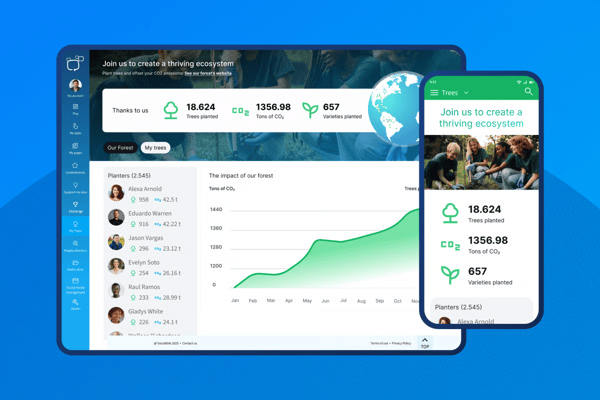
Centralized content distribution is where Sociabble really shines. Company updates, campaign assets, and regional content all in one hub, no confusion about where to look. The personalized feed surfaces what is relevant to each user's role and region, keeping the experience feeling sharp rather than like a flood of undifferentiated updates. I regard that kind of thoughtful content delivery as genuinely underrated.
Here is where Sociabble does something most platforms cannot. The social amplification layer works cleanly alongside the internal comms function without either one getting in the way of the other. Employees share approved content to their networks in a few clicks, brand visibility scales, and governance stays intact throughout. Social sharing holds a 94% feature rating on G2, and for organizations where brand consistency is non-negotiable, that approval workflow delivers.
Gamification is where Sociabble really earns its stripes, and I mean that without reservation. Points and engagement prompts give program managers levers to keep momentum going without resorting to manual nudging. Notifications and mobile accessibility make sure participation stays consistent across the board. For teams running multi-region programs, those signals help you catch drifting engagement before it turns into a bigger problem.
And here is where it gets interesting. Analytics provide visibility into reach and participation trends. This makes it easier to demonstrate program value internally and adjust content strategy when engagement patterns shift. Reviews specifically highlight social selling analytics as a capability that connects advocacy to business outcomes. Content distribution scores 94% on G2, a signal that content reaches the right participants reliably across regions and departments.
I consider the human resources (HR) system integration to be one of those features that quietly makes a massive difference, and enterprise teams managing large user bases consistently call it out for a reason. Connecting Sociabble to existing HR infrastructure simplifies account creation and access management at scale. For organizations onboarding hundreds of employees into an advocacy program, that integration removes a manual administration layer that would otherwise slow rollout considerably.
G2 users flag that content search does not support keyword-based search within post body text, only by channel or content tag. Program owners managing libraries across ten or more channels will run into this most regularly. That said, the personalized feed ensures that every day, employees always surface what is relevant to them without ever noticing that gap.
Third-party integrations, including CRM and single sign-on (SSO), have no self-serve configuration interface. IT teams must submit requirements and wait for Sociabble's deployment timeline. G2 feedback from organizations with tight go-live deadlines flags this consistently, and if that sounds like your situation, it is worth planning around. Once live, the integrations handle enterprise-scale complexity that lighter tools simply cannot match.
All in all, Sociabble is one I'd point to without hesitation for enterprise teams that need advocacy and internal communications to operate as a single coordinated program. Content distribution strength, a support model that actually shows up, and governance that scales without falling apart. If your organization treats advocacy and internal communications as inseparable, this is built exactly for that. The enterprise adoption signals back, and I believe that says everything.
"The platform makes it super easy to discover, curate, and create content while keeping employees engaged and informed. It's very intuitive and makes posting content a breeze!"
- Sociabble review, Julie P.
"Some advanced configurations and administrative tasks can be complex and require support from the vendor. Reporting and analytics could also offer more flexibility and customization for large organizations."
- Sociabble review, Nour A.
Sharebee occupies a specific niche in this category, and I think that focus is actually its biggest strength. It is built almost entirely around LinkedIn advocacy, and that shapes both what it does well and where it stops. Organizations running employer branding initiatives, social selling programs, or ambassador schemes centered on LinkedIn will find it exceptionally well-suited.
New ambassadors describe getting started without instructions, finding the layout self-explanatory from the first login. That zero-friction onboarding matters more than people give it credit for, especially for enterprise programs rolling out across hundreds of employees at once. The support overhead of a complex tool compounds quickly at that scale. The social sharing feature rating on G2 sits at 95%, and I feel the ease of that experience is exactly what drives it.
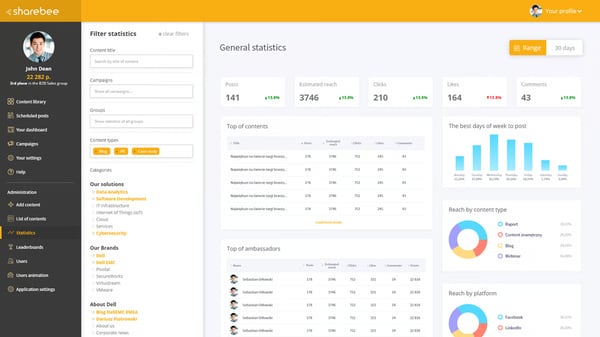
Analytics on Sharebee deserve their own spotlight, and the depth here is remarkably strong. Administrators track individual ambassador activity, compare content performance across the library, and pull reports for stakeholder presentations without manual data exports. Engagement tracking earns 96% on G2. For a platform in this category, that kind of reporting depth is not something you come across every day.
Gamification is where Sharebee really separates itself, and G2 reviewers are pretty vocal about it. Points, competitions, and leaderboards are not just cosmetic features here. Multiple reviewers describe them as genuine behavioral drivers that keep ambassadors coming back long after the launch excitement fades. Several specifically credit the competitive element with turning reluctant employees into active participants. From my read of the reviews, sustained engagement at this level is something very few platforms in this category actually deliver.
The content library sits at the center of the sharing experience, and you will feel that design choice immediately. Pre-prepared posts and scheduling tools let ambassadors share consistently without needing content creation skills. Content scheduling sits at 96% on G2, confirming that operational reliability holds up at program scale. For employees who describe uncertainty around what to post on LinkedIn, that structure removes the primary blocker.
The AI assistant mAIa is the kind of feature that sounds like a nice-to-have until you actually use it. Draft posts on any topic, article summaries, and alternative versions of existing content in your preferred style. For ambassadors who want to personalize posts without writing from scratch, that is a meaningful time saver. For programs where authentic individual voice matters alongside brand consistency, this is the feature I'd point to first.
Support quality on Sharebee runs through the review base as a structural advantage, not a pleasant bonus. The team is repeatedly described as proactive, available, and invested in program outcomes rather than just platform adoption. If you are building an ambassador program for the first time, that kind of partnership matters more than any feature on a spec sheet. Between you and me, the support model here is one of the strongest reasons I'd recommend Sharebee to a first-time program owner.
G2 users notice that clicking a link inside the content review interface is not supported directly. Ambassadors who want to check a link before sharing must copy it and open it in a separate tab. If you are someone who verifies links before sharing, that extra step will show up. The broader sharing experience, from content discovery through to publishing, continues to run at the same speed and reliability that ambassadors rely on daily.
Periodic platform availability interruptions cause pages to fail to load temporarily. G2 feedback from program managers running time-sensitive campaigns flags this as disruptive when it coincides with coordinated sharing pushes. For programs built around coordinated campaign timing, that is a pattern to plan around. The interruptions are brief and self-resolving, and the core sharing, analytics, and gamification experience holds up consistently outside those windows.
Having gone through the reviews, Sharebee is the platform I keep coming back to for LinkedIn-focused ambassador programs. Usability that just works, a support model that genuinely invests in your outcomes, and analytics deep enough to satisfy even the most data-driven stakeholder. The LinkedIn focus draws a clear line, and for organizations that live within that boundary, Sharebee delivers in a way that few platforms in this category come close to replicating
"Sharebee is very intuitive and user-friendly, which makes it easy for ambassadors to publish content and stay consistently engaged with their networks. The clean dashboard, simple navigation, and quick onboarding genuinely streamline the coordination of ambassador activities."
- Sharebee review, Aneta F.
"What I dislike about Sharebee is that sometimes the suggested content is too generic. It would be great to have more materials tailored to our industry."
- Sharebee review, Eliza M.
Employee advocacy programs often struggle not because employees resist participation, but because the tools make sharing feel like extra work. EveryoneSocial is built around fixing exactly that. The platform removes the effort barrier between an employee and a published post, and I see that focus is what sets it apart. For enterprise organizations that want broad workforce participation rather than a curated group of active advocates, this one is worth your attention.
The one-click sharing experience is what you will hear about first from EveryoneSocial users, and for good reason. Hit share, and the post goes out to linked social networks immediately. No drafting, no copy-pasting, no jumping between tools. Content distribution scores 93% on G2, above the category average of 92%. That gap understates the real-world impact. When sharing requires almost no effort, participation rates across large employee populations hold up far better over time.
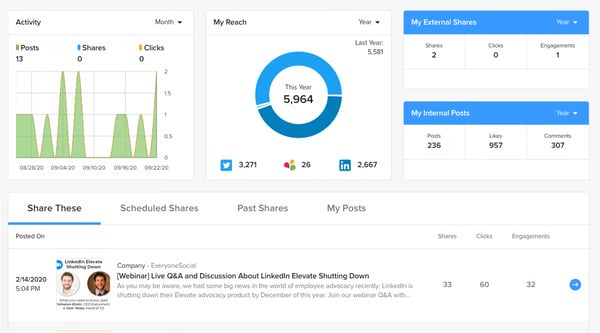
Something that stood out to me about the onboarding experience is how little it asks of anyone involved. The platform is intuitive enough that employees start participating without a single formal training session. Implementation teams are consistently praised for making transitions fast and low-friction. For enterprise teams rolling out advocacy to thousands of employees at once, getting to activation that quickly changes the entire rollout equation.
The scheduling queue is something I'd highlight specifically for client-facing and field teams. No more timing stress, no more daily check-ins, no more missing the window. Employees describe maintaining a steady LinkedIn presence without ever needing to think about it. Queue content across a forward window, walk away, and let the platform do the heavy lifting. At 94% for content scheduling on G2, that reliability shows up exactly where users need it most.
What caught my attention about the mobile experience here is how complete it feels. Employees in distributed, remote, or field environments describe mobile as their primary surface for content interaction. The experience on the device is smooth, consistent, and reliable enough that participation stays strong even when employees are away from their desks. The mobile feature rating on G2 sits at 93%, backing up what users describe in real-world deployment.
The platform surfaces internal influencers, and I consider that capability more valuable than it first appears. Not every employee drives the same reach, and EveryoneSocial makes sure you know which ones do. G2 reviewers highlight this as a feature that helps program managers zero in on top contributors and focus enablement where it actually counts. Employees describe feeling more confident sharing because the platform takes the guesswork out of what is appropriate to post and when.
Really simple syndication (RSS) feed integration is one of those features I'd put on the radar of every content-heavy team. Industry news and external content pull directly into the platform, giving program managers a steady stream of third-party material without manual sourcing. G2 users describe receiving relevant updates they can share instantly with their networks. For teams running thought leadership content alongside brand updates, that automated feed is a quiet game changer.
Some G2 reviewers note that leaderboard configuration does not support custom point weightings or structures outside standard advocacy use cases. Program managers building incentive mechanics around content type or campaign-specific scoring will find that the options stop at preset structures. I'd highlight that this one matters most for teams with complex incentive architecture in mind. That boundary never reaches the day-to-day employee experience, though. Sharing, scheduling, and mobile engagement all run without interruption across the employee base.
Post tagging for individuals is not available in either internal or external posts. G2 feedback from social selling and recruiting teams flags this consistently, and if named outreach is central to your sharing strategy, build that extra step into how your workflow is designed. That extra step outside the platform adds friction for those specific workflows. Even without tagging, the platform delivers consistent audience reach through the combined networks of an active employee base. Even without tagging, employee networks can still deliver significant reach.
EveryoneSocial does exactly what it promises, and I find that refreshing. Strong mobile experience and deep enterprise adoption back up what the platform claims. If you are running advocacy at scale across a distributed workforce and participation breadth is how you measure success, this is the one I'd put at the top of your list.
"The customer support and depth of knowledge I was able to tap into on a regular basis were fantastic. Implementation was really easy, and the platform is designed to be very intuitive, so it didn't take long to get my team up and running."
- EveryoneSocial review, Riven Alyx B.
"I would love better understand how I can create some amazing content to share myself, perhaps having a little bit more guidance or pre-approved templates and images in the compose section to help create content would be helpful."
- EveryoneSocial review, Martine B.
If brand monitoring and audience conversation tracking are part of how you measure social impact, the best social media listening tools on G2 cover what advocacy platforms alone cannot.
|
Software |
G2 Rating |
Free plan |
Best for |
|
DSMN8 - The Employee Advocacy Platform |
4.6 |
No |
Structured advocacy programs with governance and measurement focus |
|
Vista Social |
4.8 |
Yes |
Teams that want social management plus advocacy in one platform |
|
Oktopost |
4.4 |
No |
B2B marketing teams needing integrated advocacy and social workflows |
|
Hootsuite Amplify |
4.4 |
Free trial |
Teams extending an existing Hootsuite setup into employee advocacy |
|
Sociabble |
4.7 |
No |
Internal communications-led programs with advocacy tied into engagement |
|
Sharebee |
4.9 |
No |
High-satisfaction programs prioritizing usability and engagement |
|
EveryoneSocial |
4.5 |
Yes |
Teams that want a free-forever starter advocacy plan |
*These software products are top-rated in their category, based on G2’s 2026 Summer Grid® Report.
Got more questions? G2 has the answers!
EveryoneSocial, DSMN8, and Hootsuite Amplify lead here. EveryoneSocial's one-click sharing model keeps participation high across large employee populations, DSMN8 combines centralized content with scheduling to maintain consistent brand presence, and Hootsuite Amplify extends reach through employee networks without adding a separate platform to the stack.
Sharebee and Sociabble both score 95–96% on G2 for content scheduling, with reliable delivery at program scale. Vista Social sits at 99% and adds cross-platform scheduling alongside advocacy. All three surface tracking data without requiring manual exports or separate reporting tools.
Oktopost, DSMN8, and Sociabble offer the strongest analytics in this category. Oktopost connects social activity directly to pipeline attribution, while DSMN8 and Sociabble surface reach and participation data that goes beyond share counts to support program reporting and stakeholder visibility.
Oktopost leads on CRM and marketing automation integration, tying social activity directly to pipeline attribution. Vista Social connects across social platforms with broad API support. DSMN8 keeps its integration layer focused on the advocacy workflow itself, which suits teams that do not need deep cross-system connectivity.
Sharebee, EveryoneSocial, and Hootsuite Amplify consistently draw praise for interfaces that require no formal training. Sharebee ambassadors describe getting started without instructions from the first login. EveryoneSocial's one-click sharing removes every step between an employee and a published post. Hootsuite Amplify's pre-approved content layout is described as instantly intuitive across G2 reviews.
Prioritize low-friction sharing, relevant content delivery, and visible participation signals. DSMN8 and Sharebee both address these through gamification and centralized content libraries that reduce the effort barrier. Sociabble adds a personalized feed that surfaces role-relevant content, keeping employees engaged without overwhelming them with undifferentiated updates.
Sociabble and Oktopost both offer enterprise-grade permission structures with role and region-based controls over who can publish, approve, or customize content. DSMN8 keeps approved content locked to preset fields, which suits organizations where brand consistency is non-negotiable.
Sharebee, DSMN8, and Sociabble all support gamification as a core participation driver. Sharebee's points, leaderboards, and competitions are consistently described in G2 reviews as genuine behavioral drivers rather than cosmetic features. DSMN8 uses a visible scoring system that reinforces consistent sharing without feeling forced. Sociabble adds engagement prompts and notifications that help program managers sustain momentum across multi-region deployments.
Ask whether the mobile experience is a full feature set or a stripped-down version of the desktop. Oktopost scores 98% on G2 for mobile, with scheduling, advocacy, and reporting all accessible on the go. EveryoneSocial and Sharebee both treat mobile as a primary surface, not an afterthought, which matters for distributed and field-based workforces where desktop access is not always available.
Oktopost and Sociabble offer the most flexibility here. Oktopost supports custom dashboards, campaign color-coding, and Application Programming Interface (API) access for teams building advocacy into broader internal systems. Sociabble allows role and region-based content targeting with HR system integration for automated user management. Vista Social covers automation for engagement workflows, though advanced multi-condition triggers fall outside its current builder.
Employee advocacy is maturing as a category. The early conversation was about reach: how many employees could be activated, how far brand content could travel. That framing is shifting. Buyers are now prioritizing durability: whether participation holds without constant management, whether governance scales without friction, and whether analytics surface something leaders can act on.
Over the next few months, platforms that pull ahead will reduce operational weight on program owners while keeping participation low-effort for employees. AI-assisted content suggestions, tighter integration with internal communication tools, and role-based targeting are moving from differentiators to baseline expectations. Buyers treating these as nice-to-haves today may find themselves rebuilding their stack sooner than expected.
The more useful question is not which platform has the longest feature list, but which one fits your program's current maturity and organizational complexity. Early-stage programs need fast onboarding and visible momentum. Scaled programs need governance depth, regional flexibility, and reporting that speaks to executive priorities. Matching platform capability to program stage is what determines whether advocacy compounds into a reliable channel or quietly gets deprioritized.
Want to scale employee advocacy with confidence? Explore social media management software on G2 to help your teams extend reach, maintain brand consistency, and coordinate sharing with control.

Workvivo, DSMN8, and Viva Engage are the best enterprise social networking (ESN) software...
/DarshayitaThakur-OrangeBG.webp) by Darshayita Thakur
by Darshayita Thakur

Achieving concrete business results with social media is no easy feat.
 by Sudipto Paul

The best employee experience software supports HR teams in managing engagement, recognition,...
 by Disha C