


With the incredible speed of businesses’ adoption of AI, endpoint sprawl has remained one of the most urgent priorities for already overburdened InfoSec teams. Compounding this challenge are flexible remote work policies that have matured and made it more difficult for organizations to clearly define their security perimeters. Bad actors continue to exploit these weaknesses with AI tools of their own, rendering traditional endpoint management products less effective.
Cybersecurity vendors have responded with a modern solution for this modern problem: Autonomous Endpoint Management (AEM) software. This category deploys AI-powered endpoint management security tools against all manner of endpoint attacks, in addition to AI-powered attacks. These autonomous products promise to take manual, reactive, and tedious work off InfoSec teams’ endpoint management plates so they can maintain greater cybersecurity acuity.
By leveraging the human-in-the-loop philosophy, security professionals are theoretically able to maintain better discretion for the greater barrage of even more complex threats. After G2’s analysis of 916 unique reviews across the category, it’s time to determine whether reality lives up to what vendors promise AEM software can deliver.
According to G2’s analysis of 916 approved reviews in the AEM category, an almost equal number of buyers report ‘Productivity Enhancement’ as both the most-liked and most-disliked aspect of the software; this is significant since one of AEM’s core promises is to save time and boost productivity for InfoSec teams through deep AI integrations into endpoint management programs.
The pitch is compelling: continuous monitoring, automated remediation, self-healing endpoints, and a dramatically reduced time to resolution, all without burdening IT staff. In practice, the category is genuinely maturing and successfully fulfilling what it says it will. Where earlier generations of endpoint management products simply deployed automated patch responses, modern AEM platforms now incorporate machine learning for greater contextual awareness. This includes AEM’s ability to detect anomalies, correlate signals across endpoint fleets, and trigger remediation workflows without human intervention. That said, the degree of "autonomy" still varies greatly by product. According to buyers, there is a spectrum of more or less autonomy that products possess within G2’s AEM category. For example, 45 buyer reviews cast Tanium as the most sophisticated autonomous endpoint management product due to the product’s agentic AI architecture and genuinely autonomous remediation processes. Those same reviews, however, also mentioned it could be cumbersome to get Tanium set up and running via its “Ease of Use” and “Productivity Enhancement” scores. The label "autonomous" does apply to every product in this category, but it does not apply equally to every product.
AEM platforms have carved out a clear niche in several valuable use cases. Patch management, like traditional endpoint management products, is the best-developed capability across the category. With 88 reviews rendering a score of 6.7, Action1 leads the charge in G2’s AEM category for this imperative feature. This is because endpoint management vendors have largely solved for scale, scheduling, and rollback, as these capabilities are often among the highest concerns of many InfoSec professionals when purchasing any security software. Fleet visibility is another strong suit, with most AEM platforms providing near-real-time inventory across OS types, cloud workloads, and remote devices, giving security teams a more accurate and timely contextual awareness of endpoints they previously lacked. Vulnerability prioritization has also meaningfully improved. AEM tools are also integrating more threat intelligence features every day. This helps security teams focus on what actually matters in a broader context rather than chasing commonplace security vulnerabilities, as many familiar and simpler endpoint threats are addressed with the aforementioned automated workflows. For organizations managing large, distributed device populations, AEM tools demonstrably improve time-to-detection and time-to-remediation metrics.
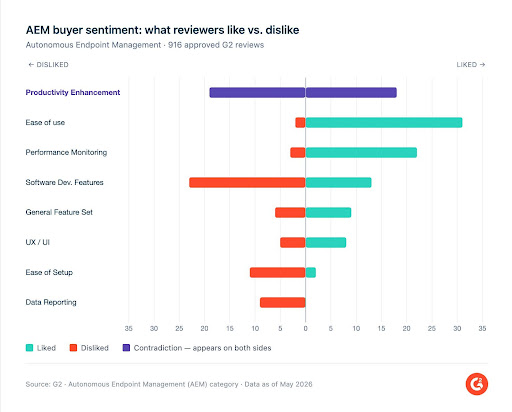
Across 916 approved reviews in G2's Autonomous Endpoint Management category, buyer consensus is that this category of software performs well on its core promise. Buyers also say, however, that there are key areas in need of improvement. Despite the dichotomy, overall scores are strong: buyers rate “Ease of Use” at 6.5/7, “Ease of Setup” at 6.5/7, “Quality of Support” at 6.5/7, and “Likelihood to Recommend” at 18.9/21. These are definitely healthy signals for a category still establishing its footing.
In a positive review context, "Ease of Use" leads all good sentiment review selections with 31 unique reviews that explicitly mention it, followed by "Performance Monitoring" at 22 reviews and "Productivity Enhancement" at 18 reviews. Buyers also highlight UX/UI quality and the breadth of general AEM product features, signaling that product design investment is paying off.
Friction shows up in equally revealing places. "Software Development Features" tops reviews with negative sentiments at 23 reviews; buyers want more extensibility and developer-friendly integrations than AEM tools provide at present. "Ease of Setup,” with 11 reviews, and "Data Reporting,” with 9 reviews, round out the top buyer-shared negative sentiments in reviews. We can infer from this collection of shared, negative feedback that, despite the wins present in this new and robust category, there are persistent gaps in initial configuration complexity and reporting depth.
Most interestingly, “Productivity Enhancement” appeared near the top of both likes and dislikes among reviews, with 18 reviews mentioning it positively and 19 reviews mentioning it negatively. The same promise that draws buyers in is also the one that often disappoints, as a critical mass of buyers feel these tools introduce process complexity rather than simply remove it. This is a fascinating, ironic contradiction in vendors’ shared optimism for the future of endpoint management in the AI age.
While much of the information here, provided by G2 research and reviews, positions AEM’s core capability of being less manually operated in a good light, it is a misconception to believe it is entirely sovereign. The problem AEM has been successful at addressing is automating many routine, tedious tasks that foster burnout on InfoSec teams. Cybersecurity, at least for the foreseeable future and likely well beyond it, will require expert human judgment. This is in large part because AI is still so new. It is also true that when it comes down to it, real people are the only actors in a security program that can be held responsible for critical decision-making processes.
A more accurate picture of what “autonomous” means in this context is that AEM products do not automate decisions themselves, but rather the execution of the decisions people are responsible for making.
The large-scale and dramatic changes that have occurred since the start of this decade have undeniably transformed the challenges cybersecurity professionals now face. While cybersecurity vendors were necessarily careful to integrate AI into many established product categories, malicious actors were under no obligation to do so and acted accordingly. With AEM, security professionals now have a proven method to fight back.
It cannot be understated that despite how novel the AEM category still is, these products are necessary, effective, and really do address many urgent endpoint security problems that their predecessors cannot. As this still-evolving space continues to adapt to the pressures of expansive security perimeters and cybercriminals’ relentless AI-powered offensives, buyers on G2 have been clear about what these tools need to work on. The fact that buyers report “Productivity Enhancement” as one of their collective greatest praises and largest criticisms is indicative of this. As the category fills out and fills in, it will be the vendors who best understand the need to address this irony, and do so effectively, that lead AEM’s next chapter.
Whether autonomous or not, endpoint management products have always featured impressive patch management features. To better understand this feature, take a look at products solely dedicated to this crucial cybersecurity practice.


Antivirus software is one of those decisions that feels done once it's deployed. Then six...
 by Disha G

I evaluated 20+ tools to find the 7 best EDR software in 2026. These include Sophos Endpoint,...
 by Soundarya Jayaraman

Security is a significant cornerstone of any business.
 by Sagar Joshi