


I evaluated 8 free tools using G2 Data and reviews to finalize the 8 best free contract management software for small businesses. These are ContractSafe, GetAccept, Jotform Sign, Oneflow, PandaDoc, Proposify, Qwilr, and Signeasy.
Most small businesses manage contracts via email threads and a spreadsheet of renewal dates, so the first sign of trouble is usually a contract that auto-renewed on last year's terms because nobody got an alert.
Behind that missed alert sits a bigger problem: one person, usually the owner or an office manager, creating, sending, chasing, signing, and storing every agreement by hand. The best contract management software takes that busywork off their plate, and you don't have to pay to start.
For this guide, I looked only at tools that a small business can use for free, whether through a free-forever plan, a freemium tier, or a trial. I evaluated each on three things: a searchable home for every agreement, renewal reminders that fire on their own, and a signing experience clean enough for a client who never logs in again.
Then I routed each tool to the job it does best.
Tools are listed alphabetically. These tools offer free trials, free forever options, or freemium models.
| Tool | G2 rating | What the free plan covers | Paid starts at |
|---|---|---|---|
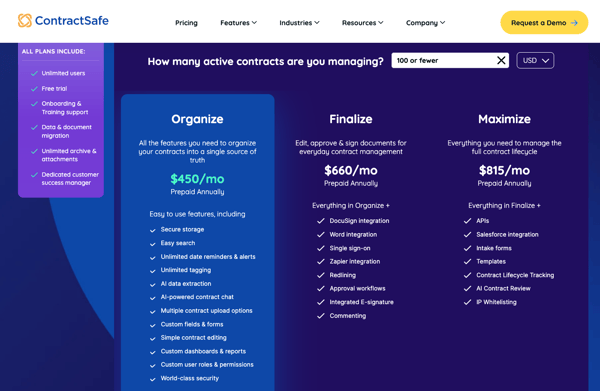
| ContractSafe | 4.7/5 ⭐ | • 7-day free trial, all features (no free-forever tier) • Unlimited users on every plan (no per-seat fee) • Unlimited archive, storage, and automated key-date reminders during trial |
$450/month |
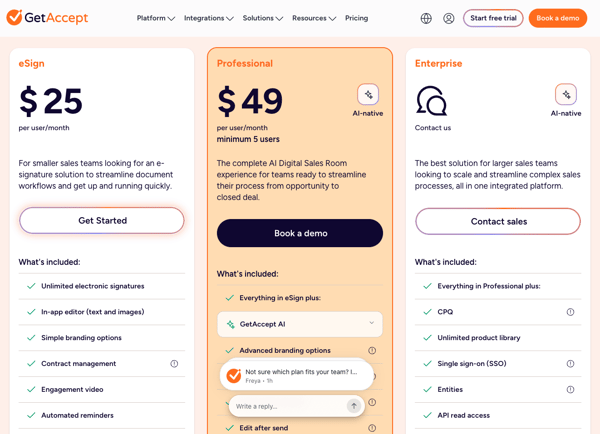
| GetAccept | 4.6/5 ⭐ | • 14-day free trial (no free-forever tier) • Unlimited documents, Deal Rooms, and e-signatures during trial • Templates, content library, and engagement/tracking analytics included |
$25/user/month |
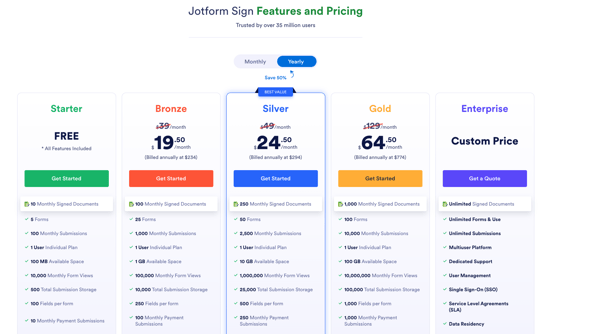
| Jotform Sign | 4.7/5 ⭐ | • Free forever (Starter plan) • 10 signed documents/month, 5 active forms, 100 submissions/month • 100 MB storage; Jotform branding shown on free plan |
$39/month |
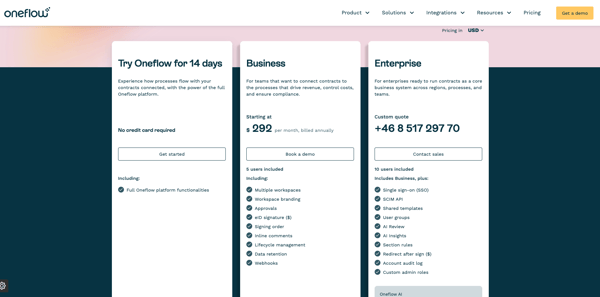
| Oneflow | 4.4/5 ⭐ | • Free forever (PDF-contract plan) plus a 14-day full-platform trial • Upload, send, track, and sign unlimited PDF contracts • PDF-only: interactive web contracts and live editing require a paid plan |
$292/month |
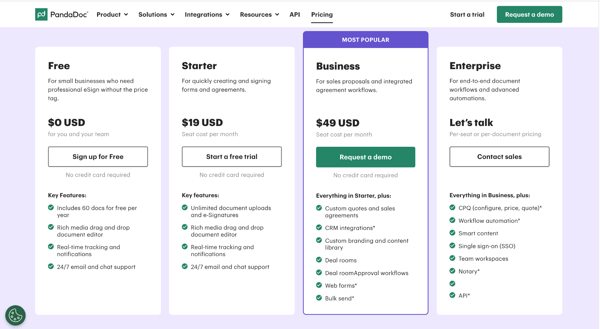
| PandaDoc | 4.7/5 ⭐ | • Free forever (Free eSign plan) plus a 14-day trial of paid features • 60 documents/year, 2 recipients per document, up to 5 templates • Unlimited seats and document storage; no shareable links or integrations |
$19/user/month |
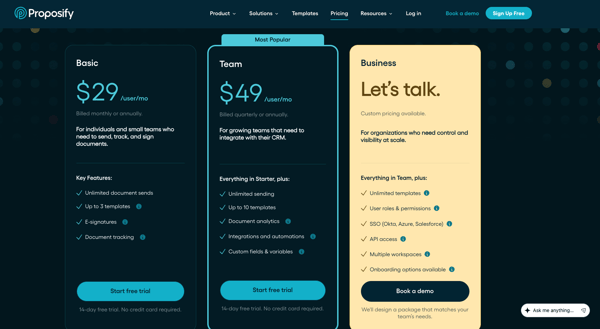
| Proposify | 4.6/5 ⭐ | • Free trial on Basic and Team plans, no credit card (no free-forever tier) • Full features to test: e-signatures, payments, tracking, template library • After trial, Basic caps sends (extra sends $1.99 each) |
$19/user/month (annual billing) |
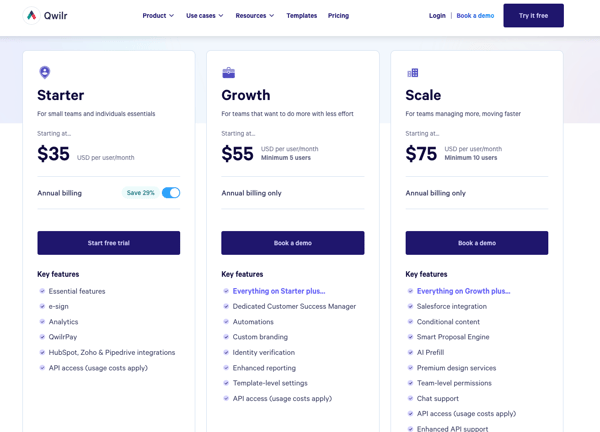
| Qwilr | 4.6/5 ⭐ | • 14-day Starter trial, full Starter access, no credit card (no free-forever tier) • 1 user, unlimited shareable Qwilr pages, e-sign, analytics, QwilrPay • After expiry, pages stay live 30 days but account access ends |
$35/user/month |
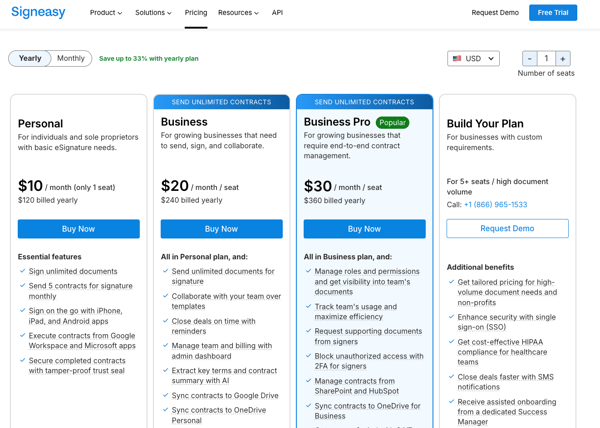
| Signeasy | 4.7/5 ⭐ | • Free forever (Free plan) plus a 14-day free trial • 3 documents/month, single user • Templates, unlimited sends, and AI term extraction are paid-only |
$10/month |
All pricing details mentioned in this article are based on publicly available data at the time of publication and are subject to change.
Poorly managed contracts quietly cost the average business almost 9% of its value annually, and for a small team without a legal function, one missed renewal can swallow that margin fast.
I started with G2's contract management software category, which gathers the tools offering free plans, trials, or freemium models. I took the products as they rank on the page and pressure-tested the free option on each one. Can an owner get working the same day without a sales gate? Do renewal alerts fire on their own? Is there one searchable place every contract lives? And can a client sign without ever creating an account? Then I cross-referenced verified G2 user reviews for each tool to catch the patterns my own evaluation might miss. The review data was pulled in 2026, filtered to the small-business segment, with mid-market reviews standing in where small-business coverage was thin. The screenshots featured in this article may be a mix of those taken from the vendor's G2 page or from publicly available materials.
Six things carried the most weight for a small business managing contracts without a legal team or a budget.
To be included on this list, a tool must:
This data was pulled from G2 in July 2026. Some reviews may have been edited for clarity.
ContractSafe skips the create-and-sign side of contract work entirely. Its job starts after the ink dries: one searchable home for every agreement you have signed, with automated reminders on every key date. For an owner digging through inboxes and shared drives to find last year's vendor agreement, that's the exact itch.
It's super easy to use. There's quick setup and no per-seat fees, which matters when the entire contracts team is one person and a bookkeeper. It doesn't build proposals and doesn't pretend to. It keeps a signed agreement findable and its renewal from creeping up on you.
The trial runs seven days, so the trigger is simply the clock. Once your agreements are loaded and the reminders have proven themselves, keeping them means the entry Organize plan at $450/month, priced by contract volume rather than headcount. Users stay unlimited on every tier, so adding a co-owner later never raises the bill.
"The best thing about ContractSafe is that it has enabled my team to stay organized during times of pressure. It is very easy to forget about things with numerous agreements and deadlines, and with everything recorded and getting reminders, there is nothing that gets missed. The notes and history features make conversations and approvals transparent and thus minimize friction and ensure that everyone achieves their duties on time."
- ContractSafe review, Mike D.
Best for: Small businesses whose main pain is storing, finding, and tracking already-signed contracts and never missing a renewal.
Not ideal for: Owners who mainly need to draft, send, and e-sign new proposals or contracts from scratch, which is a document or e-sign tool's job, not a repository's.
"I do not like that some of the features, such as filtering large volumes of contracts or multiple entries at the same time, are not as malleable as they might be. The establishment of importing old contracts had to be done with great care to avoid mistakes. Using the system daily will result in mismatched or lost files that require manual adjustment. Noise settings might also be customized to a greater extent to fit the way various teams handle contracts."
- ContractSafe review, Lisa M.
Did the client even open the contract? That question drives more anxious follow-up emails than any other part of small-business sales, and answering it is what GetAccept is built around. It's a digital sales room: you build the proposal, send it, watch the client engage with it, and collect the signature in one branded space.
In practice, it works like a follow-up assistant. The tracking shows when a client viewed your contract and for how long, which is the timing signal a one-person sales effort needs to nudge. HubSpot and CRM sync spare you from re-keying deal details, and templates plus a content library take the repetition out of similar agreements. It's a tool that retires untracked email attachments.
The trial lasts 14 days, so the trigger is wanting to keep sending trackable, signable contracts after it ends, plus features like automated renewal reminders. That's the eSign plan at $25/user/month. The heavier Digital Sales Room layers on artificial intelligence (AI), meaning smart content, meeting summaries, and mutual action plans, on the Professional plan at $49/user/month with a five-user minimum.
"GetAccept is a game-changer and an essential foundation for structuring a sales organization. The tool is fully integrated with our HubSpot CRM, providing a single source of information to centralize sales operations. This solution has been a key component, a central building block, in the transformation of Doinsport's sales organization."
- GetAccept review, Franck T.
Best for: Businesses that send proposals or contracts to win deals and want to see client engagement and e-sign in one CRM-connected flow.
Not ideal for: Owners who just need a cheap, no-frills e-signature or a pure storage repository, because GetAccept's sales-room depth (and per-seat pricing) is more than that job needs.
"The initial setup of templates and field mapping takes some patience, especially if you want everything to play perfectly with an existing CRM setup."
- GetAccept review, Frederik R.
If your business already uses intake forms, waivers, or client agreements, Jotform Sign approaches contracts from the forms side. It layers legally binding e-signatures onto documents, and recipients sign by link with no account. The pull for a budget-conscious owner is a real free-forever plan, not a trial, that covers a small monthly volume end-to-end.
Almost nothing sits between "I have a document" and "it's signed and back in my inbox." Upload a PDF and it auto-detects signature, date, and name fields. Share a link and the client signs on any device. I liked how easy it was to get rid of the print-sign-scan routine. The catch I noticed was the 10 signed documents per month limit on the free plan, and keeping lots of different document types organized in one place can get cumbersome as your workload grows.
The first wall is the 10-signed-documents-a-month cap, or the wish to drop Jotform branding for a cleaner client-facing look. The Bronze plan at about $39/month (billed annually) solves both, lifting you to 100 signed documents a month, 25 forms, and unbranded documents. Silver and Gold scale to 250 and 1,000 signed documents.
"I use Jotform Sign to create forms for my clients to sign, and it makes collecting signatures remotely easy and seamless. I like how affordable the plans are, and the features on the website are great for all of my business needs. The workflow feature is especially great for my tax preparation business, as it keeps all my client flows in one place and helps me track progress. The initial setup wasn't complicated, which was nice."
- Jotform Sign review, Rashanae P.
Best for: Businesses that already use forms (intake, waivers, agreements) and want free, link-based e-signatures with no signer account.
Not ideal for: Teams that send a high monthly volume of contracts or need a polished, unbranded document builder from day one, because they will hit the free cap and Jotform branding quickly.
"I'd like it to be more intuitive when uploading long forms, such as employment applications. I'm still trying to figure out that part."
- Jotform Sign review, Amy P.
Unlimited is a rare word on a free trial, and it's Oneflow's opening move: upload, send, track, and sign as many PDF contracts as you like, at no cost, forever. The platform's bigger idea is to turn static agreements into interactive documents you can edit even after sending, but that experience is reserved for the paid side until you're ready for it.
The free plan is what a small business reaches for first, since it covers unlimited PDF signing plus renewal reminders without a cent up front. I found the automatic reminders and clean, modern contract flow easy to appreciate from the start. There is a short ramp-up when moving into the richer interactive editor. The 14-day trial is how you decide whether the interactive contracts justify stepping up.
The free plan tops out at static PDFs, so the trigger is wanting interactive, editable web contracts, real-time collaboration, and automatic per-document renewal handling. That's the Business plan at $292/month, billed annually, with 5 users and core AI and CLM functionality included. It's a steeper jump than the e-signature tools here, so it fits businesses where contracts drive revenue or compliance.
"The reminder feature is very useful for keeping track of renewals."
- Oneflow review, Lee-Anne L.
Best for: Small businesses that want free unlimited PDF signing now, with renewal reminders, and a path to interactive contracts as contracts become central to the business.
Not ideal for: Very budget-tight owners who only ever need basic e-sign, because the paid step up ($292/month) is a bigger jump than the e-signature-first tools here.
"Oneflow has no spell check and their formatting options are horrible."
- Oneflow review, Franki F.
PandaDoc is the all-rounder here. Build a contract in a drag-and-drop editor, send it, track it, and collect a legally binding signature, with a free eSign plan covering a modest yearly volume. After trying it out, I could see why so many businesses compare it to DocuSign. For everyday client agreements, it feels like a more flexible and affordable alternative.
The appeal is breadth without a setup tax. On the free plan, one or two people can upload a document, drop in fields, and send it for signature the same day, and reviewers consistently call the onboarding easy. The shareable-link workflow, on paid, gets documents signed on a client's phone in minutes.
You hit the ceiling when you send more than about 60 documents a year, need more than 2 recipients on a contract, or want shareable signing links and integrations. The Starter plan at $19/user/month lifts document limits and adds audit trails, bulk import, and in-line comments. The Business plan at $49/user/month adds CRM integrations, custom branding, a content library, and approval workflows.
"As a Sales Executive, I really like PandaDoc because it keeps all of my client-facing forms in one place. It's integrated with our HubSpot instance, which allows me to auto-generate and initiate pricing proposals directly from HubSpot. We are able to load all of our pricing tables and everything. So putting together that proposal is a very quick, easy, and seamless process, and the PandaDoc UI is on point and makes it virtually effortless."
- PandaDoc review, Bobby C.
Best for: Businesses that want one tool to create, send, and e-sign professional contracts and proposals, and can start free before a low-cost step up.
Not ideal for: Owners whose need is purely a large-volume, bare-bones e-signature at the lowest possible per-document cost, because the free-plan yearly cap and per-seat paid pricing suit document creation more than high-volume signing.
"There is an extra row that appears on our proposal when building that I always have to delete."
- PandaDoc review, Adrienne H.
Comparing document tools? See G2's roundup of free e-signature software to weigh PandaDoc's document-creation depth against simpler signing tools.
Some contracts just need a signature. Others have to win the work first. Proposify is built for the second kind, serving agencies, consultancies, and service firms whose proposals need to look the part every time. The pull is design polish plus analytics: templates that keep every quote on-brand, and tracking that shows when a client opened the proposal and where they lingered.
The promise is proposals that look like you hired a designer, without hiring one. I liked how quickly the workflow came together. Once a template is built, sending proposals takes just minutes, with analytics helping time follow-ups and e-signatures completing the process.
Since the free access is a trial, the decision lands when it ends. A solo owner can stay on the Basic plan at $19/user/month, but a business sending proposals regularly will want the Team plan at $41/user/month for unlimited sends, CRM integrations, and custom branding. The Business plan at $65/user/month adds single sign-on, application programming interface (API) access, and approval workflows.
"I like Proposify for being the real workhorse for our sales team, taking the grunt work out of writing, sending, and chasing proposals. The Salesforce integration is the part I lean on hardest because I only have to update a deal in one place, and everything flows through. Our Salesforce admin built out the tracking views so I can see exactly where each proposal sits without flipping between tabs. Marketing has taken to it too, since they finally have a way to lock down our branding and boilerplate language without playing whack-a-mole every time a rep tweaks a template."
- Proposify review, Maria A.
Best for: Small agencies, consultancies, and service businesses that win work through professional, branded proposals and quotes.
Not ideal for: Owners who just need to store or e-sign the occasional contract, because Proposify's proposal-design depth and per-user pricing are more than that job requires.
"For integrating MS Excel and other office files to the quote plans, you will need to buy the premium plan of Proposify, and the premium plan is also a little costly. As a quotation is something which can also be made in other software, so spending a large amount of money for its premium is not worth it at all according to my experience but I generally prefer using its free plan."
- Proposify review, Rohan T.
Qwilr doesn't send a document at all. It sends a web page: drag-and-drop blocks, embedded media, interactive pricing, and built-in e-sign, all behind one shareable link. For a small business trying to look bigger and more modern than its size, that presentation is the whole draw. I could put together polished proposals in minutes instead of spending hours formatting them.
Buyers can pick options right on the page through interactive quote blocks, and clean CRM sync, HubSpot especially, keeps deal data flowing without re-entry.
The trigger is simply the end of the 14-day trial: keeping the interactive proposals means the Starter plan at $35/user/month. Removing Qwilr branding, adding automations, identity verification, and Salesforce, or getting a dedicated customer success manager moves you to the Growth plan at $55/user/month (five-user minimum).
"I love how flexible it is to build different proposal blocks that I can simply drag and drop into my presentation. It also integrates really well with HubSpot. At $35/user/month, the pricing was a no-brainer for me. The LLM and AI elements genuinely speed things up and help my presentation look great. The program is very easy to use and reliably performs when I need it to. I also appreciate that it always saves my place if I get pulled away to another task. Support has been stellar and very responsive."
- Qwilr review, Ryan P.
Best for: Businesses that win work through standout, interactive proposals and want e-sign, payments, and CRM sync in one modern page.
Not ideal for: Owners who mainly need to store or e-sign standard contracts, because Qwilr's interactive-proposal focus (and $35/seat entry) is more than that job needs.
"It's a bit of a hassle that you have to use the exact same email address in both Qwilr and HubSpot for the pages to link correctly. Even a small mismatch in login credentials can prevent the integration from triggering the way it should, which is frustrating when you're trying to keep your CRM data organized and connected without having to do manual troubleshooting."
- Qwilr review, Tyson C.
Everything on this list does more than Signeasy. None of it does less, and that's the pitch. Signeasy makes signing and sending a document about as frictionless as it gets on any device, with a free plan for light volume and transparent, low-cost paid tiers. No printing, no scanning, no platform to learn.
This is the tool for the owner who signs a handful of contracts a month and wants nothing to study. It comes with strong mobile apps, Google Drive integration, and stored contacts that spare you from re-entering client details. The free plan covers three documents a month, and the $10 Personal tier is a small step up.
The three-documents-a-month cap is the wall most businesses hit first. Sending more, or wanting templates and automated reminders, means the Personal plan at $10/month (five sends and five templates) or the Business plan at $20/user/month for unlimited sends, team templates, and reminders. Business Pro at $30/user/month adds end-to-end contract management and AI term extraction.
"I really like Signeasy's free tier, which is excellent for small companies like ours. It's a great way to start with digitally signed documents, especially if you're only signing two or three documents per month since it's all free. I also find it extremely valuable that Signeasy stores contacts after you send documents. This feature makes subsequent document signing much easier since you don't have to re-enter contact information each time."
- Signeasy review, Vivek T.
Best for: Businesses that mainly need to sign and send a low-to-moderate volume of contracts quickly, especially on mobile, at a low, transparent price.
Not ideal for: Owners who need proposal design, deep CRM-connected sales rooms, or a full contract repository, because Signeasy is deliberately focused on signing, not creating or managing at scale.
Pricing is higher than some individuals and small businesses expect for what they need day-to-day, and G2 reviewers suggest the plans could flex more for smaller-scale use. Solo users or small teams with lighter proposal volume may find that cost harder to justify. Growing teams sending proposals regularly, though, get a platform whose price matches the volume and polish it delivers.
"Support services barely answer my queries. Company plans can be costly, especially for small companies."
- Signeasy review, Nick M.
Have more questions? Find more answers below.
There is no single winner, because the best tool depends on the job. PandaDoc is the strongest free all-rounder for creating, sending, and e-signing documents; Jotform Sign is best if you already work in forms; Signeasy is best for the simplest possible signing; and Oneflow is best for signing unlimited PDF contracts free. If your real pain is storing contracts and catching renewals, ContractSafe is purpose-built for that, though it is trial-only.
Both exist on this list. Four tools have true free-forever tiers: Jotform Sign, Oneflow, PandaDoc, and Signeasy. The other four are free-trial only: ContractSafe (7 days), GetAccept (14 days), Proposify, and Qwilr (14 days). "Free" here covers free-forever plans, freemium tiers, and free trials.
The free-forever tools have no expiry: Jotform Sign (Starter plan), Oneflow (PDF plan), PandaDoc (Free eSign plan), and Signeasy (Free plan). The other four (ContractSafe, GetAccept, Proposify, and Qwilr) are time-boxed trials that end after 7 or 14 days.
ContractSafe is purpose-built for this, with a searchable central repository, tagging, and metadata extraction that keep every signed contract findable in seconds. It is worth noting that ContractSafe is trial-only rather than free-forever, so it suits businesses ready to commit once the trial proves the value. For lighter needs, PandaDoc offers unlimited document storage on its free plan.
Upgrade when one of three triggers hits: you exceed the free document cap, more than one or two people need to collaborate (or you need shareable links, integrations, and branding removed), or you need automation and a searchable repository rather than static signed files. The cheapest step up is Signeasy Personal at $10/month, followed by PandaDoc Starter and Proposify Basic at $19/user/month.
For most small businesses that mainly sign and send agreements, a free e-signature tool like Signeasy, Jotform Sign, or PandaDoc's free plan is enough. You need fuller contract management when you have to track renewals, search a growing archive, or manage interactive contracts. That is where a repository like ContractSafe or a platform like Oneflow earns its place.
Most small businesses overthink this decision. The right free contract management software isn't the one with the longest feature list.
It's the one that removes friction from how your team actually creates, signs, and tracks contracts. Try one. Run your real contracts through it for a week.
Ready to compare the full market? Explore G2's highest-rated contract management software for ratings and reviews across every tool.


If you’ve ever chased a late invoice or wondered whether a client can tell you to work 9-to-5,...
.png) by Tanuja Bahirat
by Tanuja Bahirat

Recently updatedSummer 2026 Grid® Report · Published May 26, 2026 This guide was last...
 by Harshita Tewari

You’ve finalized the proposal, secured internal approvals, and sent it to the client. The deal...
 by Aditi Rai