

-2.png)
Developers complain about their AI coding tools and rate them highly anyway. Both show up in the same review. According to G2's analysis of 3,000+ verified AI Code Generation reviews (reviews attributed to the AI Code Generation category on G2, submitted through August 9, 2026), 92% of users rate their AI code generation tool positively, while accuracy problems appear in up to 1 in 4 ChatGPT reviews and roughly 1 in 5 Gemini reviews.
Both things are true at once, and the gap between them is what buyers should pay attention to. The question is not whether these tools work. Which ones need the least checking? Browse the AI Code Generation category on G2 for the full vendor list behind this analysis.
Related reading: G2's State of AI Agent Builders 2026 covers how AI agents are showing up across enterprise workflows.
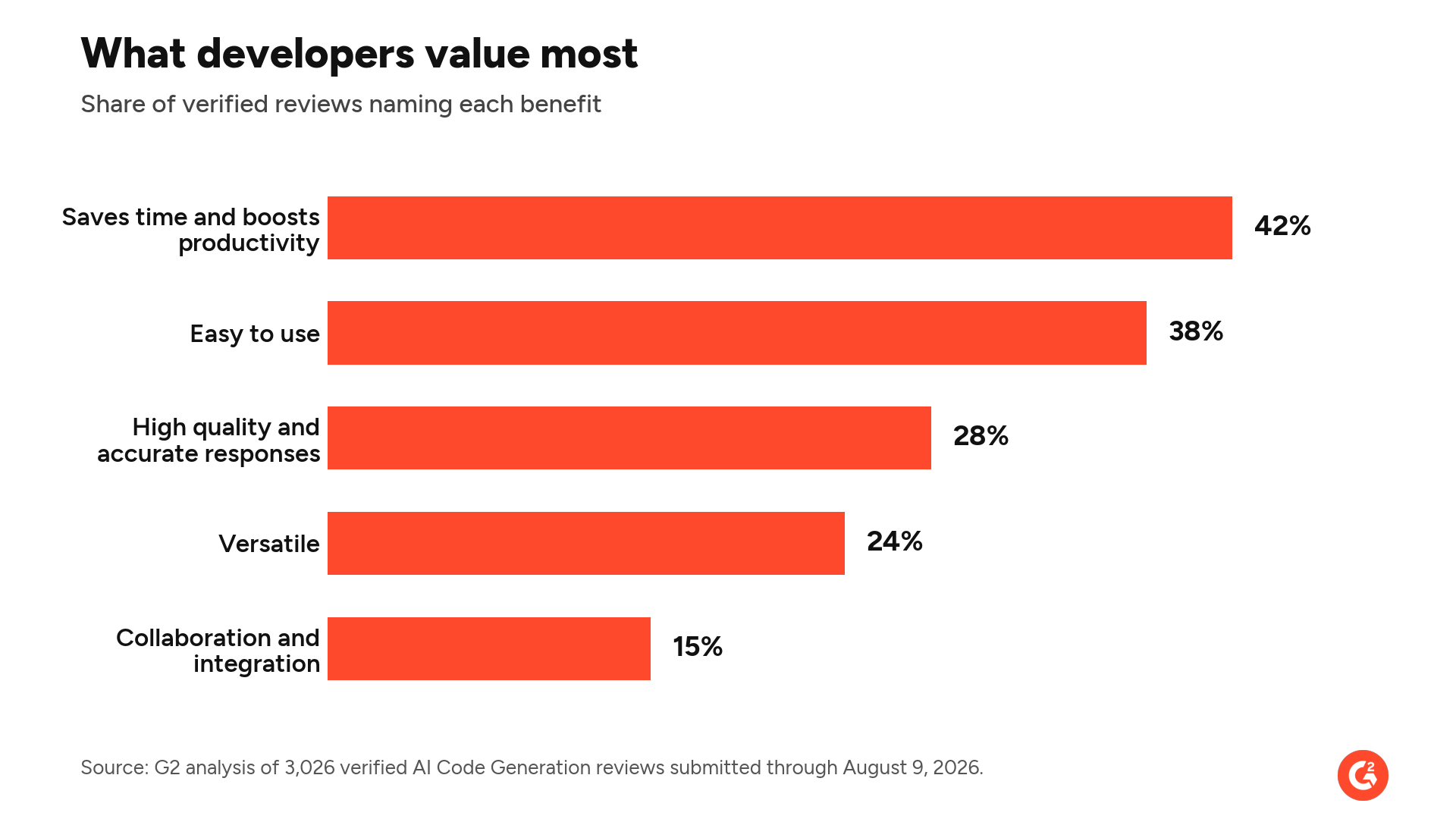
Ask anyone who uses one of these tools daily, and productivity barely comes up as a debate anymore. Among 3,000+ verified AI Code Generation reviews, 18% explicitly cite productivity, time savings, or speed in what they like about their tool, making it the most consistent benefit the data can measure directly. Reviewers talk about finishing in minutes what used to take an afternoon, letting the tool write the repetitive setup code they would otherwise type by hand, and using it as a starting point in languages they do not know well.
That 18% is a floor, not a ceiling. It is an exact keyword match rather than a broader thematic read, so it catches only reviewers who used the words, yet it still outranks other benefit themes measurable through the same keyword method, which is reproducible from the snapshot. It lines up with the aggregate satisfaction number too: 92% of reviewers rate their tool positively, and the average star rating across the category sits at 4.6 out of 5. Together, these findings suggest that perceived productivity gains are widespread across the reviews.
For a buyer, the data strongly support the view that productivity is a widely perceived benefit. The question worth asking is not whether these tools help, but which ones help without quietly generating rework you have to catch later.
The data suggests that accuracy complaints do not necessarily translate into low satisfaction. Developers complain about the accuracy in free text and award 4.6 stars in the same review. If you look only at what reviewers write in the dislikes field, general-purpose chat models adapted for coding look shaky: up to 1 in 4 ChatGPT reviews (23%, verified AI Code Generation reviews) and about 1 in 5 Gemini reviews (20%, a small enough count that the exact rate is volatile) mention accuracy friction, both close to double the 12% category average. GitHub Copilot sits at 13%, just above the average.
So can we conclude that general-purpose models hallucinate more often than purpose-built tools?
Now ask the same reviewers to rate accuracy directly. Since June 2026, G2's review form has included a structured question specifically about AI output accuracy, on a 5-point scale. It covers roughly 10% of this snapshot, mostly recent reviews, because the question is new. Within that narrower but more current slice, ChatGPT reviewers average 4.29 out of 5, Copilot reviewers average 4.23, and Claude reviewers average 4.60, the best in the category. Category-wide, only 1.4% of structured responses rated accuracy at 2 or below.
Two measures, two pictures, and both are legitimate. The keyword rate counts anyone who mentions accuracy friction anywhere in their free-text dislikes, a wide net that catches passing mentions alongside genuine complaints. The structured rating asks reviewers to deliver an explicit verdict on accuracy, specifically, and most deliver it favorably even after spending two sentences describing a hallucination. We read this as a "grumble and tolerate" pattern: One interpretation is that reviewers tolerate some verification work when the tool’s broader productivity benefits remain valuable.
The meaning for a buyer is specific. A high keyword mention rate is not a red flag that should eliminate a vendor; it is a heads-up about what to verify in a trial. A low structured rating would be a real warning sign, and none of the seven named products in this category has one.
On ChatGPT: "One thing I dislike is that ChatGPT can sometimes provide incorrect or overly confident answers, especially on complex or highly specific topics. At times, I have to double-check responses or rephrase my prompts to get the output I'm looking for." SMB Student.
On GitHub Copilot: "Sometimes GitHub Copilot suggestions are not fully accurate for complex business logic and may generate code that needs manual validation." SMB Engineer.
On Gemini: "Information is not always accurate, and the data is also not the latest, so it's good to search past data." Mid-Market Engineer.
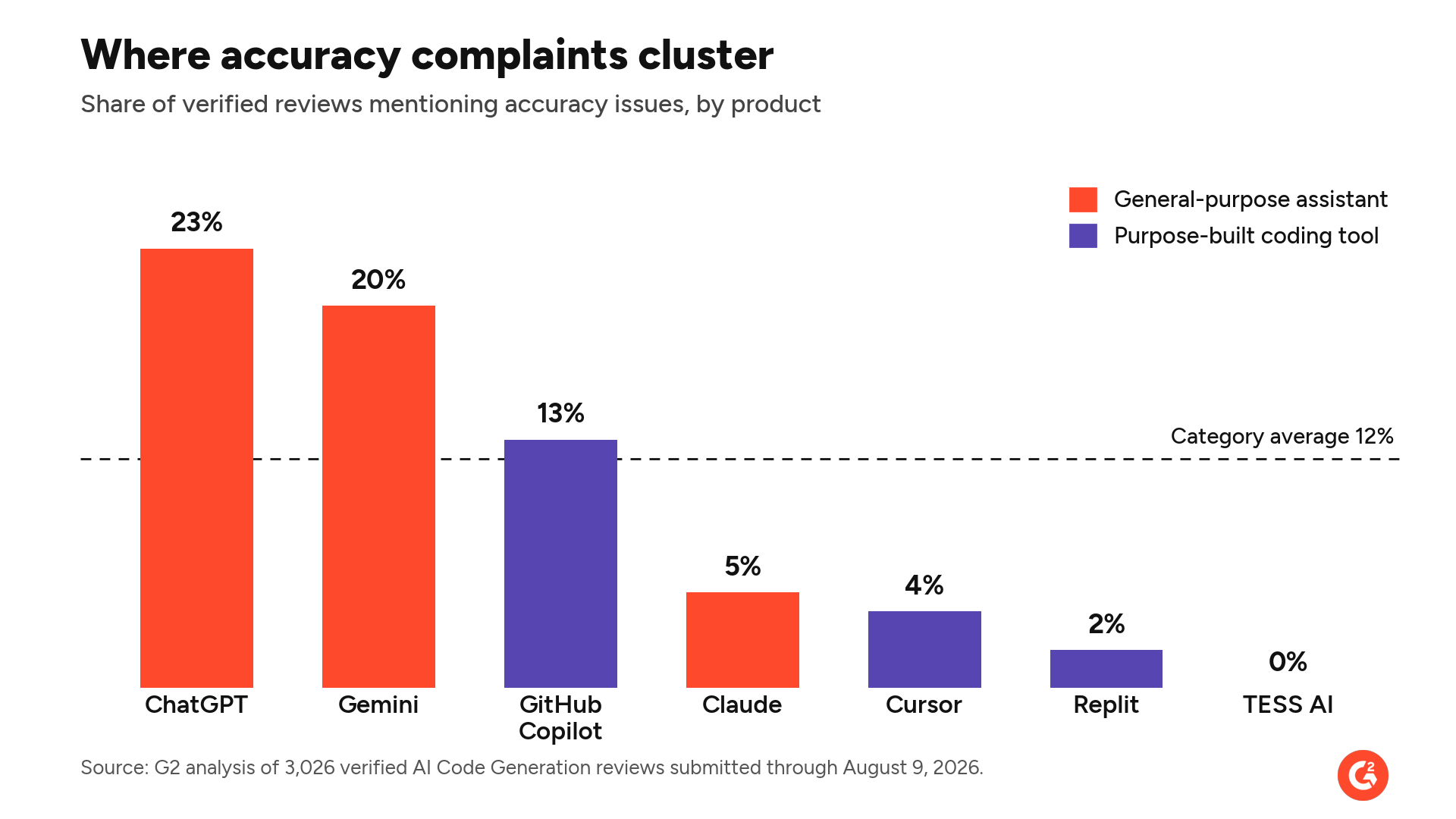
When products are sorted by keyword mention rate, a two-group pattern emerges that is not the general-purpose-versus-everyone-else split you would predict. General-purpose chat models adapted to coding sit above the category average: ChatGPT at 23%, Gemini at 20%. Everything else, purpose-built coding tools plus one notable exception, sits at or below the 12% average: GitHub Copilot at 13%, Claude at 5% (a small enough count that we state it as an observation rather than a differentiator on its own), Cursor at 4%, Replit at 2%, and TESS AI at 0% across 200reviews.
Claude is the one that breaks the general-purpose pattern, and it is worth understanding why. Its keyword mention rate (5%) already placed it in the purpose-built cluster rather than beside ChatGPT and Gemini, and the small sample behind that number would normally call for caution. But the structured accuracy rating tells the same story independently and on a larger, cleaner sample: 4.60 out of 5 average, none of the nearly 50 structured responses rated accuracy at 2 or below. Two measures that do not share a methodology point in the same direction.
One reviewer put it plainly: "My daily driver for AI. More reliable than ChatGPT or Gemini, fewer hallucinations, and better at following instructions." Another, on professional QA use: "It's also noticeably honest, it flags uncertainty instead of confidently hallucinating, which matters a lot when you're using it for serious work."
The likely mechanical reason dedicated coding tools score lower on keyword friction is a tighter feedback loop. When generated code runs, or fails to run, in the same environment where it was written, the error surfaces in seconds. A Cursor reviewer complaining about the same failure mode as a ChatGPT reviewer, "Sometimes it loses the context and hallucinates or suggests made-up or deprecated libraries," may be able to catch that error more quickly by testing the generated code within the same environment. The complaint is identical. The cost of the complaint might not be.
For a buyer choosing between a general-purpose assistant and a dedicated coding tool for a given task, this creates an important decision point: not "which tool hallucinates less" in the abstract, but "which tool puts the error in front of me fastest." If the workflow already has a fast execution loop, a higher keyword mention rate is more tolerable than it looks on paper.
What should you test before buying an AI code generation tool?
The complaint patterns above translate into three concrete checks worth running in any trial, before you sign anything.
None of these tests requires reading a single G2 review. What the reviews tell you is which products are worth spending the 20 minutes on.
G2 Summer 2026 Grid: what the market positions confirm, and what they don't
If the review data above is a trust signal, G2's Summer 2026 Grid for AI Code Generation is an adoption signal, and the two move mostly on their own. Seven of 18 qualifying products hold Leader status: ChatGPT, Replit, GitHub Copilot, Claude, Gemini, Gemini Code Assist, and Cursor.
ChatGPT leads the quadrant with a G2 Score of 96.8, built on approximately 2,000+ product-wide reviews, compared with roughly 1,000+ category-scoped reviews used in the accuracy analysis; these are two different populations and should not be read as disagreeing with each other). Replit follows at 77.7, and the remaining five Leaders cluster within 13 points of each other, which reads as genuine competition rather than one runaway winner and a long tail.
However, another useful signal on the Grid is Net Promoter Score. Among the seven leaders, Claude's NPS of 90 is the highest in the quadrant, with ChatGPT next at 82. That lines up with everything the accuracy data already suggested about Claude: the lowest keyword accuracy mention rate among general-purpose models, the highest structured accuracy rating in the category, and now the strongest recommendation intent from its own users. Three independent signals, one direction.
Three products hold High Performer status outside the Leader tier: TESS AI and Ask Codi, with 4.7 and 4.8 star ratings, respectively, and NPS scores of 83 and 80, plus SoftSpell, a smaller entrant at a 4.5 star rating and NPS 73. All three match or beat most of the Leaders above them on satisfaction. Their Grid placement reflects narrower market reach and review volume, not weaker user trust. If your evaluation criteria weight satisfaction over market presence, do not let quadrant labels alone rule them out.
The buyer takeaway from the Grid is simple: use it to build a shortlist of products with an established market presence and satisfaction signals, then use the accuracy data earlier in this article to decide which products on that shortlist need the closest look in a trial.
The two measures point to different actions, so it helps to be specific about which signal to use when. Four takeaways from the review data:
Q1. What are AI code generation tools?
AI code generation tools use large language models to write, complete, explain, or refactor code from natural language prompts. In practice, they fall into two groups that behave differently. Purpose-built coding tools like GitHub Copilot, Cursor, and Replit live inside the editor or the development environment, so generated code runs where it was written. General-purpose assistants like ChatGPT, Claude, and Gemini return code in a chat window that a developer copies out and tests separately. Both groups appear in G2's AI Code Generation category, and as the data in this analysis shows, the split matters more for how quickly you catch an error than for how often one happens.
Q2. Which AI code generation tool has the fewest accuracy complaints from verified users?
Among purpose-built coding tools, Replit (2%, small-n at 5 of 315 reviews) and Cursor (4%, 11 of 290) log the lowest keyword accuracy mention rates in the category. Among general-purpose models adapted for coding, Claude is the outlier at 5% (9 of 192 reviews, also small-n), and its structured accuracy rating of 4.6 out of 5, the highest in the category, corroborates that low complaint rate with an independent measure.
Q3. How common are accuracy complaints in AI code generation tools?
Across 3,000+ verified AI Code Generation reviews, 12% mention accuracy issues in their dislikes. That rate varies sharply by product: up to 1 in 4 ChatGPT reviews (23%, 232 of 1,026) and about 1 in 5 Gemini reviews (20%, 31 of 154) mention accuracy friction, while purpose-built tools cluster at or below the 12% average. Asked to rate accuracy directly on a structured 5-point question, reviewers are far less critical, averaging 4.35 out of 5 category-wide.
Q4. Is AI code generation worth the investment for software development teams?
Yes, on the evidence: 92% of reviewers across 3,000+ verified AI Code Generation reviews rate their tool positively, at an average of 4.6 out of 5. Productivity and time savings are the leading benefit theme, cited explicitly in 18% of reviews as what users like most. The open question is not whether these tools help; it is which one fits your team's verification workflow.
Q5. Why do accuracy complaint rates and accuracy ratings tell such different stories?
They measure different things. The complaint rate counts any review whose dislikes mention accuracy-related terms, a wide net that catches passing friction alongside serious problems. The structured rating asks reviewers to render a direct verdict on accuracy, specifically, and most reviewers rate it favorably even after describing a hallucination in the same review. We read the gap as evidence that developers tolerate a known amount of AI error as a cost of using these tools, rather than letting it define their overall assessment.
Q6. How does ChatGPT's accuracy profile compare to a dedicated tool like Cursor?
ChatGPT shows a 23% keyword accuracy mention rate across 1,000 verified AI Code Generation reviews, compared to 4% for Cursor across 290 reviews, roughly five times the rate. The likely structural reason is feedback speed: Cursor returns executable code in the environment where it runs, so errors surface in seconds, while ChatGPT returns text that a developer has to evaluate before finding out whether it is correct.
Q7. How does G2 Grid leadership in AI code generation relate to accuracy and trust?
They are independent signals. G2's Summer 2026 Grid names 7 of 18 qualifying products as Leaders, including ChatGPT, GitHub Copilot, and Claude, based on market presence and satisfaction, not accuracy complaint rates specifically. Claude holds the highest NPS among Leaders (90) and also posts the lowest accuracy friction and the highest structured accuracy rating in the category, but that alignment does not hold for every Leader; ChatGPT (23% keyword rate) and Gemini (20%) both hold Leader status despite above-average accuracy friction. Treat Grid position as an adoption signal and the accuracy data as a separate trust signal.
Q8. Can AI code generation tools build REST APIs, databases, and authentication end-to-end?
Not reliably without human oversight. While 92% of reviewers rate these tools positively and 18% explicitly cite productivity gains, the accuracy data reveals a gap between speed and completeness. Purpose-built tools like Cursor (4% accuracy mention rate) and GitHub Copilot (13%) generate executable scaffolding faster than a developer types it, but one reviewer notes that Copilot "sometimes suggestions are not fully accurate for complex business logic and may generate code that needs manual validation." The same pattern holds for authentication and database logic: AI handles the boilerplate, but security boundaries and schema decisions require a human in the loop. Treat these tools as accelerators for routine implementation work, not substitutes for architectural judgment.
Q.9 How can teams avoid security flaws and dependency vulnerabilities in AI-generated code?
Run the code before you ship it. A Cursor reviewer warns that the tool "sometimes loses the context and hallucinates or suggests made up or deprecated libraries," which means a static read of the output will not catch what a compiler or runtime will. Build a verification step into your workflow: ask the tool to implement a feature, execute the output unmodified, and count how many failures are logic errors versus syntax errors. Logic errors survive a casual review and cause production incidents. Tools with fast execution loops surface these in the same session. Chat-based tools return text you have to mentally simulate, and the cost of that simulation shows up later.
Q.10 Which AI coding tools are best for startups without dedicated DevOps teams?
Purpose-built coding assistants with low accuracy friction and integrated execution environments. Cursor (4% accuracy mention rate across 290 reviews) and Replit (2%, 315 reviews) combine code generation with a runtime where errors surface immediately, which matters when no one on the team owns infrastructure reliability. Claude sits at 5% accuracy friction and holds the highest structured accuracy rating in the category at 4.6 out of 5, making it a strong general-purpose option for teams that need broader reasoning alongside coding help. The productivity signal is consistent across all three, but the verification burden varies. For a small team, the tool that surfaces errors fastest is the one that scales.
Across 3,000+ verified G2 reviews, AI code generation has cleared the adoption bar completely: 92% of users rate their tool positively, and productivity is the reason why. The real decision for buyers now is not whether to adopt one of these tools. It is whether the specific tool you are evaluating puts accuracy errors in front of your team fast enough that they stay a minor cost of doing business, instead of an expensive surprise in production.
Ready to compare AI code generation tools on verified user trust data? See the Best AI Code Generation Software list on G2, ranked by real user reviews.


Recently updatedSummer 2026 Grid® Report · Published May 26, 2026 This guide was last...
 by Alveena Ali

Let AI pick the right tool for your use case Decide with AI 1 Click on the button below
 by Yashwathy Marudhachalam

I’m not a developer. I don’t work inside an integrated development environment (IDE) or ship...
 by Harshita Tewari