

Our recent article on what buyers really think about AI agent builders showed that, while the technology does deliver, the path to value can be muddy. Now, G2 has analyzed 770 updated verified reviews in 2026 alongside survey responses from 7 vendors in the AI Agent Builders category to get the bigger picture. Here is what the data actually shows about the state of AI agent builders in 2026.
This report combines G2's proprietary review data with structured input from seven AI agent builder vendors. G2 review data reflects verified buyer experience. Vendor insights are clearly attributed throughout and represent platform-level observations.
According to our research, 91% of verified reviews in the category this year are positive-leaning or balanced.
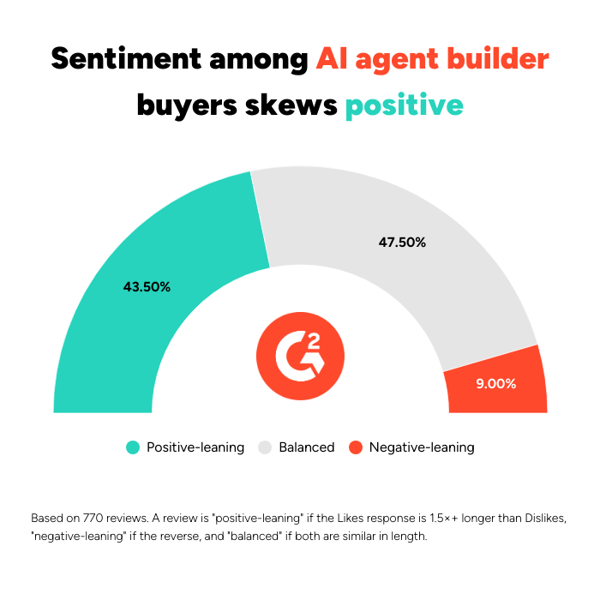
While 2026’s AI agent builder reviews boast an average G2 star rating of 4.5/5 at the time of writing, an examination of our review form’s likes and dislikes portions tells a more complete story. 43.5% of buyers write at least 1.5x more words when describing what they like about an AI agent builder compared to what they dislike. Only 9% of buyers do the opposite.
This signal cuts through the simplicity of star ratings, though overall scores remain important. Buyers’ tendency to write more when discussing what they like compared to discussing what they don’t like gives us strong confirmation that these solutions are truly providing value to users, beyond surface-level excitement and hype.
On a macro level, buyers are actually benefiting from this tech. But for individual buyers, the question of what to prioritize when searching for a best-fit solution requires a closer look.
-1.png?width=600&height=424&name=ai-agent-builder-likes-sentiment-2026%20(1)-1.png)
G2’s 2026 State of AI Agent Builders Report finds that integration capabilities crack the top-five list of most-liked factors among verified reviewers.
We examined this trend recently, but an updated analysis based on an influx of new reviews in 2026 shows that 41% of reviewers mention AI & NLP quality when discussing what they like about AI agent builders. Ease of use (37%) and automation capabilities (36%) are close behind, with integration capabilities (29%) and customization flexibility (20%) rounding out the top five.
Amidst high positive sentiment and general buzz in the AI agent builders category, buyers’ top five “like” themes tell us a story about exactly what they value in these solutions. The top three themes (AI quality, ease of use, and automation capabilities) may come as no surprise. These are all generally part of the promise these solutions make in the first place. Quality, ease of use, and automation are all advertised on the tin. It’s worth highlighting integration capabilities, which come in at #4. Integrations might not make the AI agent builder elevator pitch, but clearly, buyers prioritize this facet of agent functionality. In order to provide any real value, agents must connect with users’ existing systems and desired data sources.
G2 gathered structured input from seven leading AI agent builder vendors to understand how platforms are responding to buyer feedback.
Theme 1: Orchestration is the real product. We asked all 7 of the vendors we surveyed: “What role do orchestration layers play in your AI agent architecture?” The answers we got show that we may have been better off asking what roles orchestration layers don’t play. Here’s the spread among the five options we gave them:
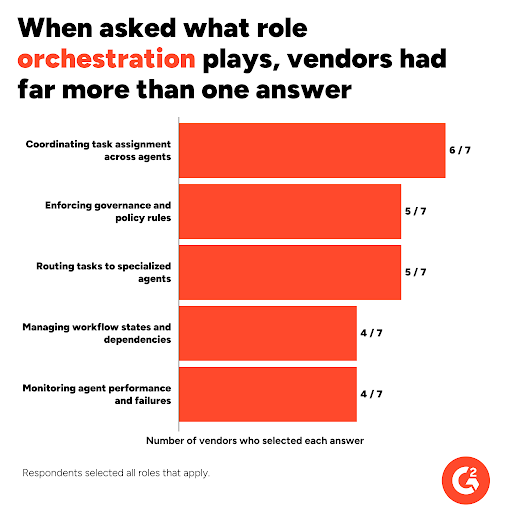
Vendor responses to some of our open-ended questions also highlighted orchestration as a vital factor in the AI agent building equation, especially when scaling to a multi-agent system.
“When scaling from a single agent to a Multi-Agent System (MAS), the primary technical challenge is the "Orchestration Ceiling." Managing how specialized agents communicate, share state, and resolve conflicts without creating "circular logic" loops or "cascading failures"—where one agent’s hallucination corrupts the entire chain—becomes exponentially complex for traditional bot builders.”
Nuno Borges
Solutions Architect at OutSystems
“High-quality models improve reasoning but increase cost and response time, while smaller models are faster but less reliable. Orchestrating which model to use at each step becomes a key architectural decision.”
Andres Suarez
Enterprise Solutions Team, Botpress
“Individual agents are relatively straightforward to build. The hard engineering is in the orchestrator: routing decisions, conditional branching, parallelization, retry logic, timeout handling, and deciding when to escalate to a human vs. retry. That logic is bespoke, it's brittle, and it's almost never documented properly.”
Chris Ward
Director of AI Enablement, Snaplogic.
Theme 2: Vendors agree with buyers: API integrations need to work. When asked about the most common causes of AI agent workflow failures, six out of our seven vendors selected API failures. We saw this reflected in buyer sentiment, as we noted earlier that integration capabilities are a top-five value for reviewers in the category. According to vendors, data quality issues are just as thorny, with orchestration logic errors coming in close behind to reiterate our first theme.

Theme 3: “Plug and play” is a fallacy. The vendors we surveyed emphasized the importance of context-based purchasing decisions along with post-deployment monitoring and upkeep. When discussing misconceptions about building AI workforces using AI agent builders, many of the responses vendors gave warned against an inflexible or unmonitored approach.
“Models change, prompts drift, and edge cases compound, but many teams don't invest in the evaluation infrastructure and continuous monitoring needed to catch regressions before customers do”
Nora Nguyen
Product Manager, Vanta
“Straightforward agentic workflows typically outperform complex multi-agent systems.”
Jacob Bank
Founder and CEO of Relay.app
“This requires system minded individuals, who can think of the bigger picture rather than by piece meal.”
Zheng Li
VP of Marketing, Autohive.
“The biggest misconception is thinking AI workforces are just chatbots with better branding. They are not. Not every agent platform is equal, bad data will not produce reliable outcomes, and the “just do it for me” mindset usually fails.”
CTO, YourGPT AI
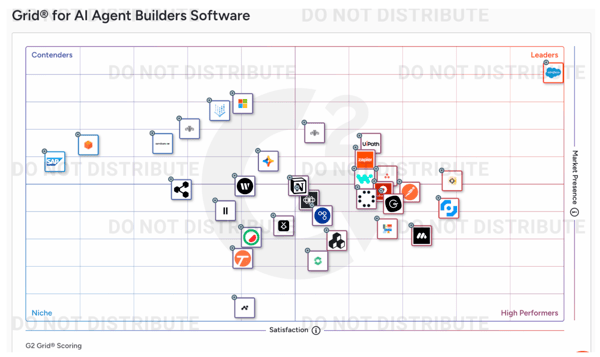
The G2 Grid® plots market presence against buyer satisfaction. Salesforce holds the leaders quadrant alone. SAP, ServiceNow, Microsoft, and IBM occupy the contenders tier with scale but lower satisfaction. More than 20 vendors cluster tightly in high performers, earning strong buyer scores without the market presence to break upward.
Vendor decks frame AI agent builders as a horizontal AI revolution. The grid tells a different story.
Market consolidation has not happened. Mature categories typically support three to five leaders. The leadership tier is contestable, and the next 12 to 18 months will decide whether it consolidates or fragments further.
Emerging challengers are not who the decks suggest. Buyer satisfaction is concentrated in AI-native and automation-first platforms like Zapier, UiPath, Workato, Notion, and Asana. Legacy enterprise scale is not converting into category leadership.
The competitive shift is happening inside the High Performers cluster. Twenty-plus vendors are competing on similar satisfaction profiles. The next leaders will emerge from this group through M&A, enterprise breakout, or product differentiation.
Vendor decks position AI agent builders as a winner-take-all market where scale will decide the outcome. The grid suggests the opposite. Buyer satisfaction is the leading indicator, and the platforms earning it are not the ones with the largest enterprise footprints. The AI Agents Builder category will be shaped by which vendors translate satisfaction into market presence, not the other way around.
According to G2's 2026 State of AI Agent Builders Report, the category is delivering real value, but the path from purchase to payoff is narrower than vendor positioning suggests. Buyers benefit most when they treat AI agent builders as a distinct class of software, not as an extension of the chatbot category, and not as a turnkey replacement for human work.
The 2026 review data shows buyers describing wins that are operational rather than transformational.
Three takeaways should shape buyer evaluation in 2026:
Prioritize platforms that nail orchestration. Vendors converged on orchestration as the load-bearing layer of any serious AI agent system, and the data backs them up. As deployments scale from single agents to multi-agent systems, orchestration is what determines whether the architecture holds or fragments. The orchestration layer is where most production deployments succeed or stall.
Treat integration capability as a non-negotiable. API and system integration failures were the most common cause of workflow failures cited by vendors, and integration capability ranks among the values buyers consistently call out on G2. A platform with strong AI but weak connectivity will not deliver value.
Plan for the post-deployment phase. Vendors agreed that the "plug and play" framing of AI agents is misleading. Models drift, edge cases compound, prompts age. The buyers who win with AI agents are the ones who invest in monitoring and continuous tuning from day one, not the ones who treat deployment as the finish line.
The 2026 picture is clear. AI agent builders work, and buyers are realizing benefits that show up in saved hours, recovered headcount capacity, and customer experiences that scale beyond business hours. The category rewards thoughtful purchasing, not enthusiasm. The buyers best positioned for 2026 are the ones who treat AI agents as systems to be operated, not products to be deployed.
Choosing the right AI agent builder is quickly becoming a strategic decision.
These 10 best AI agent builder platforms stand out based on performance, usability, and what real buyers are actually experiencing.
This article was co-written by Hardik Jain.


Key Findings The market is driven by individual users and small businesses. 70% of reviewers...
 by Alanna Iwuh
-1.png?width=400&name=dark%20(14)-1.png)
TL;DR: Where AI video compliance stands today The market is scaling faster than its...
 by Lauren Worth
-2.png?width=400&name=dark%20(13)-2.png)
According to G2's newly launched Event Lead Capture category, which already tracks 33...
 by Yukta Rustagi