


Most machine learning buying decisions today rely on demos, vendor narratives, and analyst perspectives. To ground this in real-world experience, we analyzed 500 verified user reviews from teams that have implemented and operated ML software over time. This approach reveals where ML delivers value, where it falls short, and how it impacts measurable business outcomes. Here’s what the data shows.
According to G2's analysis of 500 Machine Learning reviews, buyers take an average of 3.33 months to go live and 10.28 months to realise ROI - A nearly 7-month gap between functional deployment and measurable return.
Machine learning software is no longer a niche investment. Budgets are committed, tools are deployed, and expectations are high. Vendors promise seamless integration, effortless deployment, and transformative AI outcomes. G2's analysis of 500 buyer reviews in the Machine Learning category tests those promises against what buyers actually say after months of real use.
Machine learning software has a reputation for being hard to implement and slow to show results. Across 500 G2 reviews, buyers give machine learning software an average star rating of 4.47 out of 5. Out of those, 92% of reviewers gave 4 stars or higher. Only 2% rated it 3 stars or below. The remaining 6% rated 3.5 stars.
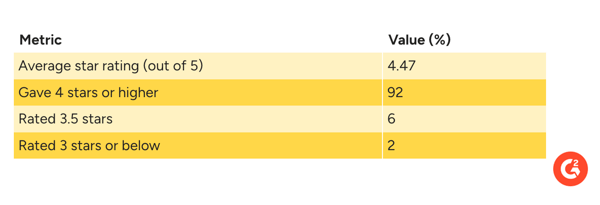
Those numbers tell you the tools are delivering. But star ratings are what buyers feel at the end of the journey. What the reviews reveal is that getting to that satisfaction is harder, slower, and more expensive than most vendor demos suggest.
Vendors in this category consistently market their platforms around four core promises: seamless integration, ease of use, fast deployment, and transformative business outcomes. G2's review data tests each of these against what buyers actually write after using the product.
Here are some of the examples of what buyers say in their own words, the good and the frustrating:
Positive feedback
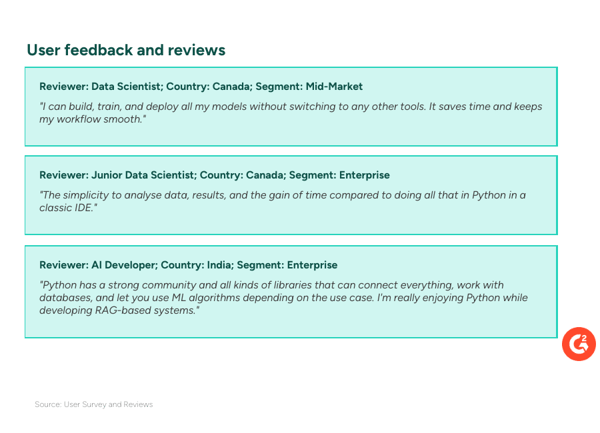
The pattern in what buyers celebrate is consistent; it is not any single feature. Rather, the ability to have one place to build, train, and deploy without switching between tools is a key requirement. That is a more modest claim than vendors typically lead with, but it is the one that buyers keep confirming.
G2's review data shows that 68% of ML buyers scored 9 or 10 out of 10 on the "likely to recommend" question, and the average recommendation score across all 500 reviews is 8.95 out of 10. That is not satisfaction born from low expectations. That is, buyers who have genuine value and want their peers to know about it.
Now the other side
.png?width=600&height=433&name=user-testimonials%20(1).png)
What is interesting to note is that both sets of reviewers have rated the same tools highly. The frustration is not that ML tools fail. It is the path to making them work that costs more time, money, and patience than buyers were led to expect.
The most revealing data point comes from G2's ROI survey data. Buyers were asked directly: “How long did it take to go live, and how long to see a return on investment?”
Three months to go live. Ten months to ROI. That is a seven-month window where the tool is deployed, people are using it, but the business case is still building. That window is where most internal pressure on ML projects comes from, not technical failure, but the gap between expectation and visible return.
The 92% satisfaction rate on the other side of that gap tells you the investment pays off. The ROI data tells you what it costs to get there. Both numbers belong in the same conversation. Only one of them tends to appear in vendor promises.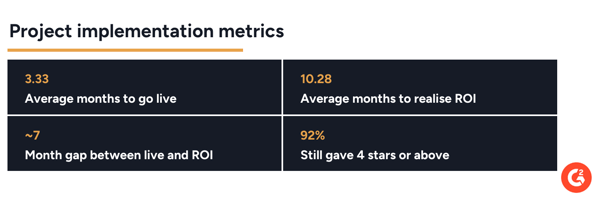
ML software delivers, but not on the timeline most buyers expect when they sign. The journey from signed contract to that rating is longer and harder than most vendors let on. Here is what to expect and how to prepare for it
The buyers who struggled weren't let down by the software; they were let down by the gap between what they expected and what deployment actually costs.
The data doesn't lie. ML delivers. The question is whether your deployment plan is as ready as the software.
The right machine learning platform is out there. G2 makes finding it the easiest part of the process.

-2.png?width=400&name=dark%20(4)-2.png)
AI content creation tools are everywhere. The promises are big, and the budgets are flowing....
by Sanjana V Prasad
-Aug-28-2026-06-11-28-7666-PM.png?width=400&name=dark%20(8)-Aug-28-2026-06-11-28-7666-PM.png)
TL;DR: Everything you need to know about low-code machine learning deployment According to...
 by Shalaka Joshi
-4.png?width=400&name=dark%20(1)-4.png)
G2's analysis of over 2,700 verified reviews showed that AI agents for business operations...
 by Nathan Calabrese