

-3.png?width=1200&height=675&name=dark%20(1)-3.png "AI Chatbot Hype vs. Reality: What G2 Data Reveals About Buyer Experience")
Organizations are investing heavily in AI chatbots to transform customer experience — but are the chatbots delivering?
Artificial intelligence is reshaping how businesses interact with customers, with AI chatbots playing a central role. What began as simple rule-based pop-ups has evolved into intelligent systems capable of understanding context, automating workflows, and delivering more personalized interactions.
According to a report published by The Business Research Company, the global AI chatbot market is valued at $14.28 billion in 2026. It is projected to reach $35.71 billion by 2030, growing at a CAGR of 25.7%. From customer support and marketing to sales and internal operations, organizations are increasingly adopting AI chatbots to improve efficiency, scale engagement, and meet rising customer expectations.
This rapid adoption is also visible in G2’s AI chatbot category, where the number of user reviews has grown by over 40% in the past 12 months. To understand user sentiment and how well expectations are being met, we analyzed these reviews to uncover key trends shaping AI chatbot adoption today.
Vendors in the AI chatbot category frequently claim that AI is automating customer conversations, dramatically reducing support workload, and delivering instant, human-like responses at scale. But how closely do those promises match real buyer experience?
To answer that question, G2 analyzed 3,230+ verified reviews from the AI chatbot category submitted by users in the past 12 months, examining what real users say about AI Chatbot’s features after deployment. The results reveal a mixed reality: while the benefits of automation and efficiency are widely validated, some of the most ambitious claims regarding implementation, integration, and pricing remain inconsistent in practice.
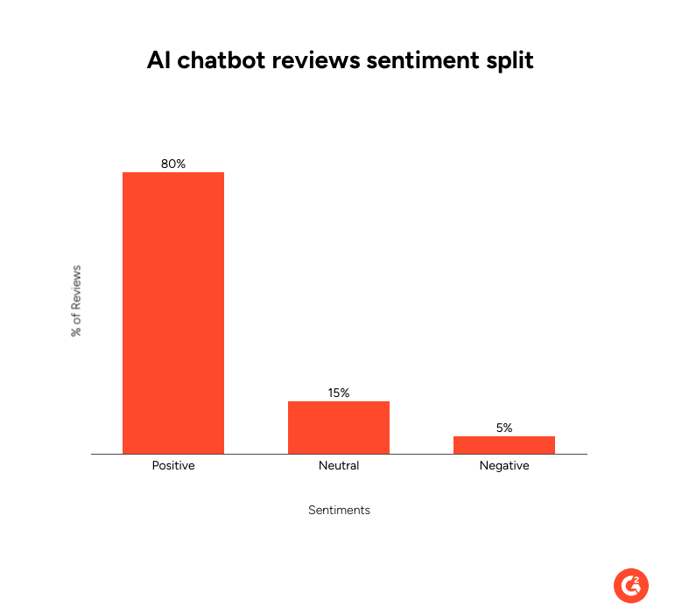
Nearly 80% of feedback in G2-verified reviews of AI chatbot platforms is positive, with an average rating of 4.61 out of 5. In contrast, only 5% of reviews are negative. A share, about 15%, falls in the neutral range, suggesting these users are neither particularly satisfied nor dissatisfied with what AI chatbots currently offer.
The hype holds up strongest where vendors promise speed, research support, and content generation, and in these areas, buyer feedback is remarkably consistent. Nearly half of reviewers validate these claims: 48.3% cite improved research and information retrieval, 47.4% report meaningful time savings through automation, and 47.3% credit AI with enhancing content or response quality.
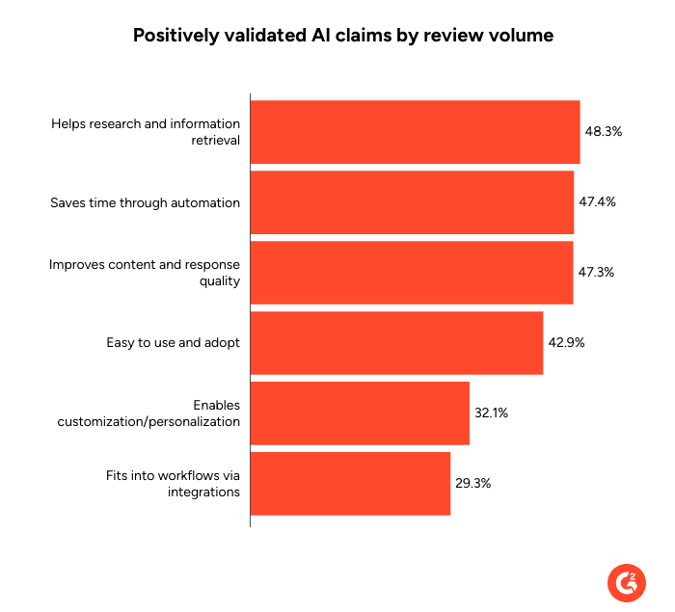
Crucially, this value is accessible, not gated by complexity. 42.9% of reviewers highlight ease of use or intuitive onboarding, indicating that most users can realize benefits quickly without heavy training or technical lift. This combination of immediate utility and low-friction adoption helps explain why AI chatbot usage remains strong across a diverse range of tools and buyer segments.
The biggest gaps emerge when vendor messaging moves beyond assistive AI into promises of seamless, fully integrated autonomy. Buyer feedback suggests this is where expectations begin to outpace reality. About 26% of reviewers report implementation or deployment challenges, including learning curves and setup friction, reinforcing that deployment isn’t always as plug-and-play as advertised.
Additionally, 16.5% of reviewers cite limited features or lack of customization, indicating that many tools still fall short of adapting to specific business needs.
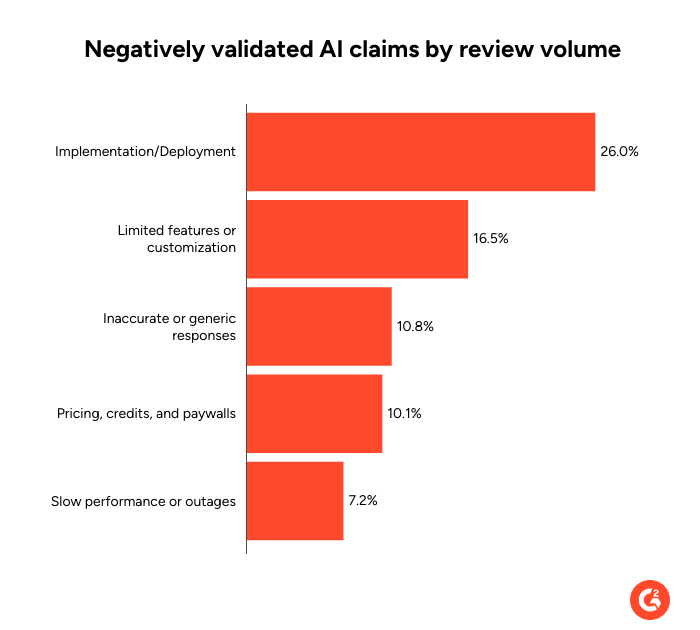
Accuracy also remains a consistent watch area. 10.8% of reviewers report issues with inaccurate, generic, or context-poor responses, underscoring that while AI is helpful, it still requires oversight and refinement to meet production-grade expectations. Many buyers report that chatbots still struggle with complex or context-heavy conversations, often requiring escalation to human agents.
Beyond overall satisfaction and adoption, the benefits that deliver the fastest ROI tend to drive the most immediate value from AI chatbots. What stands out in the data is how strongly this varies by company size.
While the average time to ROI for the AI chatbot category is around six months, speed to value is heavily skewed toward smaller organizations. About 94% of reviewers who achieved ROI in under six months come from small and mid-market businesses. This aligns with the broader reviewer base as well; nearly 75% of AI chatbot reviewers belong to these segments.
Taken together, this suggests that smaller companies are not only adopting AI chatbots more actively but are also realizing value faster, likely due to simpler workflows, faster implementation cycles, and more immediate impact on day-to-day operations.
For organizations evaluating AI chatbots, success will depend less on chasing the most advanced features and more on aligning expectations, investing in setup, and designing workflows where AI supports, not replaces, human input.
Check out the 7 Best Free AI Chatbots I’ve Tried (and Loved!) for 2025 here!


AI tools are redefining creativity rather than replacing it. A decade ago, creating digital...
by Subhransu Sahu

If you’ve sat through even one SaaS demo in the last year, you’ve heard the pitch.AI sales...
 by Yukta Rustagi

TL;DR: Everything You Need to Know About Brand Intelligence in 2026 The primary challenge in...
by Yukta Rustagi