

Picture a Monday morning. Your brand intelligence dashboard is green across the board, mentions are up, sentiment is positive, and share of voice is climbing. Someone's going to screenshot this for the weekly report.
Meanwhile, in a Slack channel you'll never be invited to, a procurement manager just told three colleagues your competitor is "the obvious choice." A VP of Marketing forwarded a LinkedIn DM last night recommending against you to someone actively evaluating your category. And the TikTok comment thread that started quietly two weeks ago? That's why your NPS dropped. You just won't know it for another month. This is the part brand monitoring doesn't talk about in the demo.
McKinsey (Source: McKinsey: A New Way to Measure Word-of-Mouth Marketing) estimates that word of mouth drives between 20 and 50 percent of all purchasing decisions. Forrester's 2025 research (Source: Forrester: B2B Buyers Rate Their Most Trusted Information Sources (March 2025)) found that 82% of B2B buyers trust colleagues and internal peers above every other information source - more than analysts, more than review sites, more than your sales team. Those conversations are decisive. They're also invisible to every tool currently on the market. That's not a niche edge case. It's the default state of brand intelligence in 2025.
This analysis is based on 729 verified G2 reviews from the Brand Intelligence category collected over the past 24 months, supplemented by research from Forrester and McKinsey. Review data, satisfaction metrics, adoption trends, and buyer feedback were analyzed to identify the category's strengths, coverage gaps, and emerging priorities, including AI visibility and dark social monitoring.
Vendor Contribution: Price2Spy
G2 Data from the past 24 months paints a more complicated picture. Across 729 approved reviews, the category averages a 6.28 out of 10 on "meets requirements" respectable, which is certainly short of the comprehensive coverage the pitch implies. According to reviews, “Ease of Use” scores the lowest of all satisfaction dimensions at 6.27, while “Quality of Support” scores the highest at 6.54. That pattern matters: when buyers consistently need more hand-holding than expected, it's often because the tool requires significant configuration to compensate for what it doesn't capture natively.
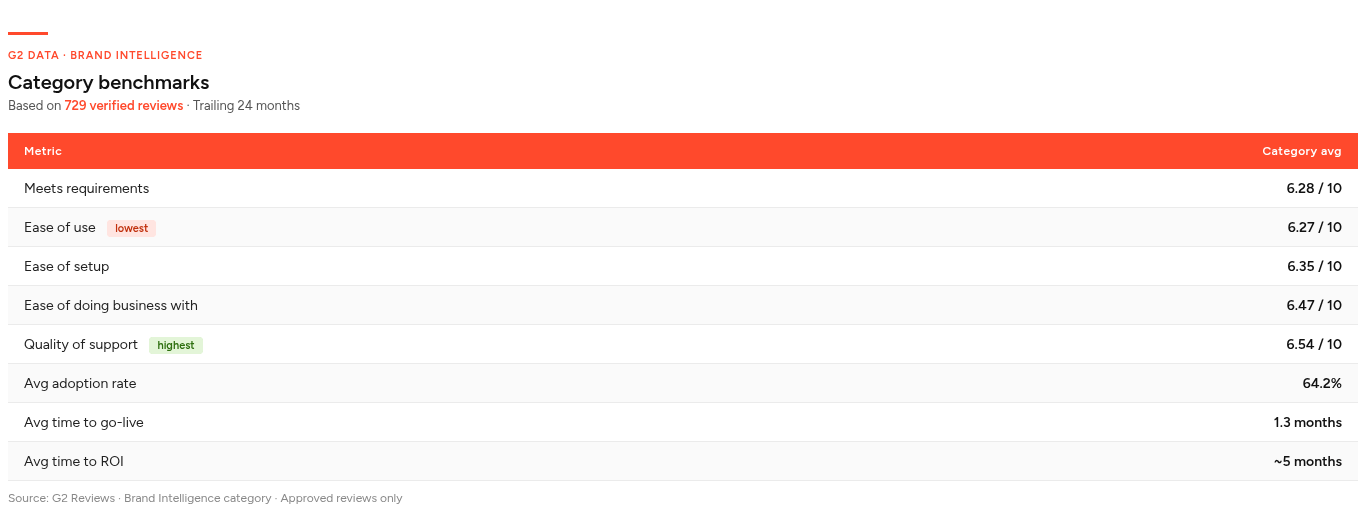
The adoption figure deserves particular attention: at 64.2%, more than a third of users at buying organisations have not fully adopted their Brand Intelligence tool. For a category that charges premium prices on the promise of comprehensive monitoring, that's a meaningful gap between purchase intent and operational reality.
The pitch is consistent across the category: comprehensive coverage, real-time monitoring, cross-channel intelligence at scale. Every Brand Intelligence vendor promises to know where the conversation about your brand is happening and to surface all of it.
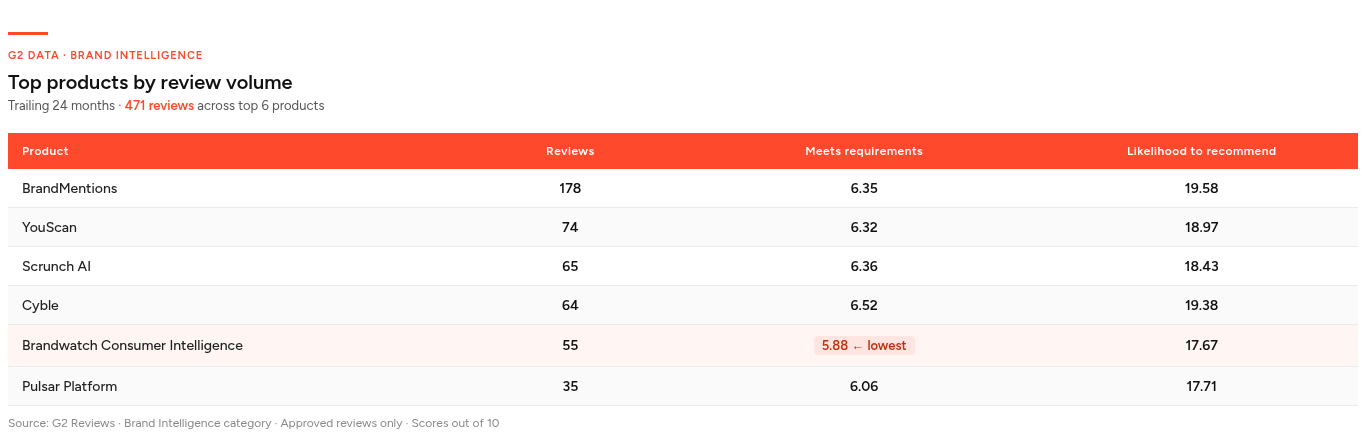
The product-level data sharpens the picture further. Brandwatch Consumer Intelligence the most recognisable name in the category scores only 5.88 on meets requirements, the lowest of any top-reviewed product. That's not a rounding error. It's a consistent signal from 55 reviewers that the market leader's coverage isn't meeting modern buyer expectations.
Not all the news is negative. G2 reviewers are consistent about where Brand Intelligence tools genuinely deliver. Brand intelligence tools deliver the most value in monitoring public conversations, detecting emerging issues in real time, and uncovering insights across web, forum, social, and AI-driven channels. Reviewers particularly highlight strengths in the following areas:
The gaps run deeper than any single product's roadmap can fix, and several of them are structural.
G2 reviewer demographics make the exposure map concrete. Marketing and Advertising professionals account for the largest segment of Brand Intelligence reviewers (134 of 729 identified industry reviews in the past 24 months), followed by IT & Services (52), Public Relations & Communications (26), Financial Services (24), and Computer Software (23). Consumer Goods, Retail, and Food & Beverages each contribute around 20 reviews. The industries most represented by marketing agencies, PR firms, and consumer brands are also the ones where dark social blind spots hit hardest. Agency reviewers are responsible for comprehensive coverage on behalf of clients, but run two or three tools just to approximate it. Consumer brands in retail and food & beverages operate in categories where TikTok and Reddit set the agenda before mainstream channels pick it up.
Enterprise B2B brands face a different version of the same problem. When deals are discussed in Slack, partnership opportunities surface in LinkedIn DMs, and buyer communities form in Discord, the conversations shaping purchase decisions are happening entirely off the monitored grid. Forrester finds that 82% of B2B buyers trust colleagues most, and colleague-to-colleague recommendations happen overwhelmingly in private channels. In simple terms, the buyers most invested in getting brand intelligence right are the ones most affected by what their tools systematically cannot see.
“As customer journeys become more fragmented, we're hearing from brands that traditional awareness and sentiment metrics no longer provide a complete picture of market reality. Many are struggling with blind spots across channels they don't fully control or even actively monitor, yet those channels increasingly shape customer perception and purchasing decisions. The growing challenge is no longer access to information, but identifying the signals that matter most and uncovering the blind spots that influence brand perception without a company's knowledge. We're seeing growing demand for a more connected approach to intelligence that brings together brand, retail, competitive, and emerging market signals to help companies gain a more complete understanding of how their brand is experienced across the entire customer journey.”
Dragana Aleksic
Head of Sales & Marketing, Price2Spy
As the category evolves, buyers should focus less on dashboard capabilities and more on coverage, visibility, and future-readiness. The most important considerations include:
Source: Forrester: B2B Buyers Rate Their Most Trusted Information Sources (March 2025)
Source: McKinsey: A New Way to Measure Word-of-Mouth Marketing
The Brand Intelligence category is not failing; it's accelerating. G2 review volume for the category nearly quadrupled between Q1 and Q3 2025, reflecting genuine buyer demand for tools that help brands understand where conversation is happening. But the conversation itself has moved: into TikTok comment sections, Reddit threads, private Slack channels, LLM citations, and channels that don't publish APIs.
G2 review data doesn't just reveal what tools do well. It reveals what they're missing. For buyers ready to look beyond the demo, those gaps are often where the real story is. Check out some of the best brand intelligence software products here.

If you’ve sat through even one SaaS demo in the last year, you’ve heard the pitch.AI sales...
by Yukta Rustagi
-1.png?width=400&name=dark%20(14)-1.png)
TL;DR: Where AI video compliance stands today The market is scaling faster than its...
 by Lauren Worth
TL;DR: What G2 Data says about AI chatbot capabilities and limitations According to G2's...
 by Adam Crivello