

-1.png?width=1480&name=Featured%20image%20for%20Tech%20Signals%20(5)-1.png "How brands win visibility inside AI overviews")
Search no longer begins with a list of links — and in many cases, it doesn’t end with one either.
Today, answers on search engines show up fully formed — summarized, confident, and citation-backed — long before a buyer ever reaches a website.
The instinctive response to AI Overviews (AIO) has been traffic anxiety. But declining clicks are merely a symptom. The real threat is exclusion from the narrative itself. When AI explains what your product category is, breaks down how to solve a problem, or lists best practices, it typically pulls from five or six sources. If you're not one of them, you're basically a ghost. You're absent from the exact moment they're forming opinions and making mental shortlists.
This matters even more in B2B.
Decision-makers increasingly use AI chat and AI-powered search tools to orient themselves early and often before they visit a vendor website. These systems influence how buyers understand categories, evaluate trade-offs, and narrow options long before traditional demand signals appear. Clearly, brand visibility has shifted from traffic to citations, from positions to proof.
The question is no longer whether AI will change how buyers discover brands. The real question is: When AI answers the questions that matter most in your category, will your brand be part of the answer — or quietly left out?
Recently, one of the biggest mistakes that I have come across is marketers assuming AIOs work like traditional search rankings — just faster, more conversational, and wrapped in a paragraph.
Well, they don’t.
AIOs don’t crown a single “best” page. They assemble an answer from multiple sources that collectively feel credible, relevant, and safe. The goal here isn’t to surface the most authoritative brand — it’s to construct a response that satisfies user intent with minimal risk of being misleading or incomplete.
As Trevor Pyle, Head of Product Marketing at Profound, puts it:
“Marketers think citations are a trophy for being the most authoritative brand, but AI Overviews don't work that way. Sources are selected, in part, because they match query intent cleanly and can be excerpted without losing meaning through self-contained chunks of text, not because they are the most polished marketing pages. This is why brands with strong explainers, definitions, and opinionated guidance can earn citations disproportionate to their size.”
AI systems are not rewarding brand prestige or domain authority in isolation. Ahrefs' recent study shows that when AIOs update, only 54.5% of cited URLs remain the same — meaning nearly half of all sources are replaced each time an overview refreshes.
They’re selecting useful evidence. That usefulness shows up in a few consistent ways:
Trevor also adds, “The biggest misunderstanding is optimizing for presence instead of usefulness; if you want to be cited, you have to write and distribute content that functions like evidence instead of ads.”
This helps explain why citation patterns often surprise marketers. Studies analyzing AIO citations show that highly cited domains are not always those ranking first, and that citation dominance can shift dramatically over short periods. AI systems actively diversify sources to avoid over-reliance, which means visibility is far more fluid than traditional SEO leaders expect.
In short, AIOs don’t ask: Who owns this keyword? They ask: Which sources best help answer this question right now?
Traditional SEO taught brands to compete for positions, but AI search forces them to compete for recognition. When you look at an AIO, the ranking position is invisible. So, what matters is whether your content becomes part of the synthesized answer. That makes citations a more meaningful signal of influence than rankings ever were.
Mohammad Farooq, Director of SEO Content at G2, says that citations are the pieces AI systems use to stitch together the answer a user sees in any AI search experience. Getting cited means your page was relevant enough to power the final answer in tools like ChatGPT or Gemini. He further adds:
We live in a zero-click world. If a user never scrolls past an AI Overview or never needs to click through a ChatGPT answer, what real good does a page-1 ranking bring for your business?
Mohammad Farooq
Director of SEO Content at G2
As search behavior shifts and more queries end directly on the results page, rankings alone no longer carry the same weight. From a go-to-market (GTM) perspective, this isn’t just a search problem; it’s a positioning problem. When AI systems become the first point of evaluation, brands lose control over the narrative they once owned.
Eric Gilpin, President of GTM at G2, explains how the evaluation surface itself has changed:
GTM teams have to shift from optimizing for clicks (SEO) to optimizing for answers and citations (AEO), ensuring the market sees verified proof of outcomes, usability, and governance.
Eric Gilpin
President of GTM at G2
This is why citations now matter more than rankings. Citations signal earned trust — and trust is what AI systems rely on to reduce risk when generating answers. But how you secure citations is another ballgame.
Securing citations in AIOs requires a shift in mindset from optimizing for algorithms to optimizing for clarity and trust. Brands that make it easy for AI systems to understand and reuse their content are far more likely to show up in AI-generated answers.
You can use the checklist below to assess whether your brand is actually citable.
AI systems reduce risk by relying on repeated patterns. If your brand identity fragments across the web, citation confidence drops. Make sure:
 Your brand description is consistent across your website, review platforms, analyst sites, and directories. You are strongly associated with a small, defined set of topics (not everything at once). Your positioning doesn’t change dramatically by channel or audience.
The content plays the most crucial role when it comes to AEO, and having your content optimized accordingly is essential.
 The main question is answered in the first 50 words or the first 1–2 sentences. Each section stands on its own without relying on the surrounding context. Definitions, frameworks, and explanations are explicit and unambiguous. Pages avoid vague positioning language and marketing fluff.
According to Profound’s analysis of ~10,000 AI citations, pages whose URLs, titles, and introductions closely matched the query earned significantly more citations. Even small gains in semantic alignment translated into measurable citation lift.
Page titles clearly reflect the exact question being answered. Introductions restate the user’s problem in plain language. Each page focuses on one primary question or concept.Today, recency is a trust signal. According to a recent Semrush report, 50% of top-cited content was less than 13 weeks old, indicating that freshness directly impacts visibility.
Key pages are reviewed and refreshed on a rolling basis. “Last updated” reflects real changes, not just cosmetic edits. Outdated examples, statistics, or screenshots are regularly replaced.Between August and November, the share of citations attributed to blogs and opinion content rose from 23% to 34.2%, while citations to comparison-style listicles declined from 35% to 27.3%. Why? Because opinions, Trevor mentions, create clear framing, and framing helps AI systems explain why something matters. (Source: Trevor Pyle, Head of Product Marketing at Profound)
Your content takes a clear stance on something instead of endlessly hedging. Recommendations are clear and explicit, not implied. You explain trade-offs, not just options.AI systems don’t fully trust self-published content. Citations are far more likely when your claims are reinforced elsewhere: reviews, analyst commentary, earned media, and community discussions.
Your brand has recent, credible reviews on platforms like G2. Analysts or industry publications reference your product or perspective. Subject matter experts from your team contribute insights beyond your owned channels. Community conversations reference real-world outcomes.If PR optimizes for coverage, SEO optimizes for rankings, and brand optimizes for narrative.
At the end of the day, the goal is clear: AI visibility.
PR, SEO, content, and GTM teams share priority topics. Messaging and proof points are consistent across channels. Success is measured beyond traffic and rankings, but for AEO-focused metrics like brand mentions/sentiment and link citations. Citations aren’t just a new SEO metric — they’re a preview of where search and buying are headed. As AI search moves from answering questions to recommending decisions, the implications extend far beyond search teams.
Although framed around AI Overviews, this checklist applies equally to LLMs like ChatGPT, Gemini, and Perplexity, which rely on similar citation, extraction, and trust mechanisms when generating answers.
AI doesn’t separate PR from SEO, and neither should your strategy. Read this blog to understand how to bring both teams together to win visibility in AI-driven search.
The future of search and buying is changing. The same systems that summarize answers today are rapidly evolving into systems that recommend actions tomorrow. Instead of presenting buyers with a field of options, AI will increasingly narrow the field on their behalf.
AI will compress the research phase by generating tailored shortlists of just two or three vendors, using trusted, peer-validated signals instead of vendor claims.
Eric Gilpin
President of GTM at G2
This fundamentally alters how buying decisions unfold. By the time a buyer engages with sales, much of the evaluation work is already done. This is where citation strategy becomes existential, not incremental.
Brands that invest early in authority, validation, and clarity become defaults in AI-mediated shortlists. Brands that don’t aren’t just outranked, they’re excluded from consideration altogether.
The winners will be the brands that treat trust signals, like fresh reviews, clear packaging and pricing context, and credible comparisons, as always-on infrastructure, because if the AI can’t validate you, you won’t make the shortlist.
Eric Gilpin
President of GTM at G2
In an AI search world, brands won’t win by being louder, more optimized, or more prolific. They’ll win by being trusted enough to be cited — and credible enough to be recommended.
AI Overviews are AI-generated summaries that appear at the top of search results and in answer engines. They synthesize information from multiple sources to directly answer user queries, often without requiring a click.
AI-driven search shortens the research phase by shaping buyer understanding early. Buyers are increasingly generating shortlists using AI search platforms, which influence their decisions before ever speaking to sales representatives. Therefore, citation visibility is especially critical in the B2B software market.
Citation data shows that a large share of top-cited content is recently updated. Brands should review and refresh key pages every 3-6 months, ensuring that “last updated” dates accurately reflect meaningful changes.
If you want to know how brands can build authority, earn citations, and stay visible as AI reshapes search and buying, this e-book on “Build Your Brand for the LLM Era” explores the frameworks and strategies in detail.
Edited by Supanna Das


We’ve been tracking the rise of AI search and predicting its impact on the tech landscape...
 by Kamaljeet Kalsi
A year ago, SEO success meant asking: "Do you rank for your target keywords?"
by Tanushree Verma
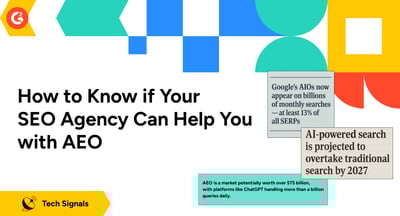
Is your search engine optimization (SEO) agency still focusing on traditional SEO for traffic?...
by Tanushree Verma