

%20(5).png?width=2000&height=1125&name=Sidharth%20-%20%20TechSignals%20Blog%20FI%20Template(s)%20(5).png "Sidharth - TechSignals Blog FI Template(s) (5)")
A day and a half.
That's how much time the average sales rep actually spends selling each week.
The rest — 60%, according to Salesforce's latest research — disappears into CRM updates, note-taking, meeting prep, and internal approvals.
Sales tools in 2026 should be evaluated by one metric above all: how many hours they give reps back, not how many features they list.
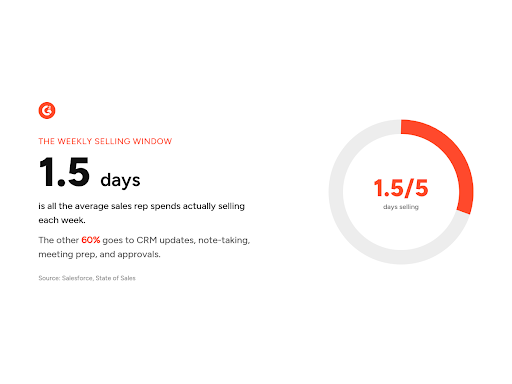
The average sales rep spends just a day and a half a week actually selling — 60% of their time goes to CRM updates, note-taking, meeting prep, and approvals.
Why does the productivity crisis persist despite 40% of companies allocating over $1 million for AI agent initiatives? The tools aren't broken. The approach is. Reps end up spending their time managing the tools instead of using them.
|
Metric |
Figure |
|
Time reps spend actually selling per week |
1.5 days |
|
Rep time lost to admin (CRM updates, notes, approvals, etc.) |
60% |
|
Companies spending $1M+ on AI agent initiatives |
40% |
|
Median speed-to-market gain from AI agents |
23% |
|
Top-end velocity gains in sales use cases |
up to 50% |
Buyer expectations have shifted decisively from counting features to measuring productivity gains. And it’s reflected in the G2’s Best Sales Software list, which saw a 60% turnover this year: 30 of the 50 winners are new entrants compared to last year.
Software sellers are earning buyer trust by claiming to give reps time back, connect workflows end to end, and embed AI where it matters.
Salesforce Sales Cloud tops the list. Here's what its position reveals about where sales software is headed and what buyers should look for in the category.
G2's 2026 Best Sales Software List, by the numbers
|
Metric |
Figure |
|
Eligible products considered |
446 |
|
Winners named |
50 |
|
Year-over-year turnover |
60% |
|
New entrants vs. last year |
30 of 50 |
|
Growth in products added to G2's 40+ sales categories |
31% YoY |
Sales software buyers now prioritize productivity over feature counts because early sales tools bolted on capabilities without solving the core problem: reps buried in administrative work. That “admin crisis” — CRM updates, note-taking, and approvals eating into selling time — is the category's origin story and still shapes what buyers look for today.
To understand why today’s buyers are shifting their focus toward productivity over pure feature counts, it helps to look at how the category actually evolved. This shift didn’t happen overnight. The reason behind this buyer movement starts with how sales tools were originally built and the resulting “admin crisis” that defined the category’s origin.
The sales productivity gap isn't new. But what has changed is how the leading platforms address it.
The old model bolted AI onto existing workflows as a separate layer: a chatbot here, a transcription tool there, a forecasting dashboard somewhere else. The new model embeds it directly into the flow of work.
Leandro Perez, Chief Marketing Officer for Australia and New Zealand at Salesforce, describes the shift through a concrete example. "We've launched a new sales workspace that basically means you don't have to go and have all these separate tools on the side to do AI like note-taking, call transcription, bookings of meetings, prospecting, and looking up information," he explains. "The agents in Agent for Sales are doing that for you, and you can really supercharge the individual rep because they can see that and get on with the job of talking to their customers and obviously closing deals."
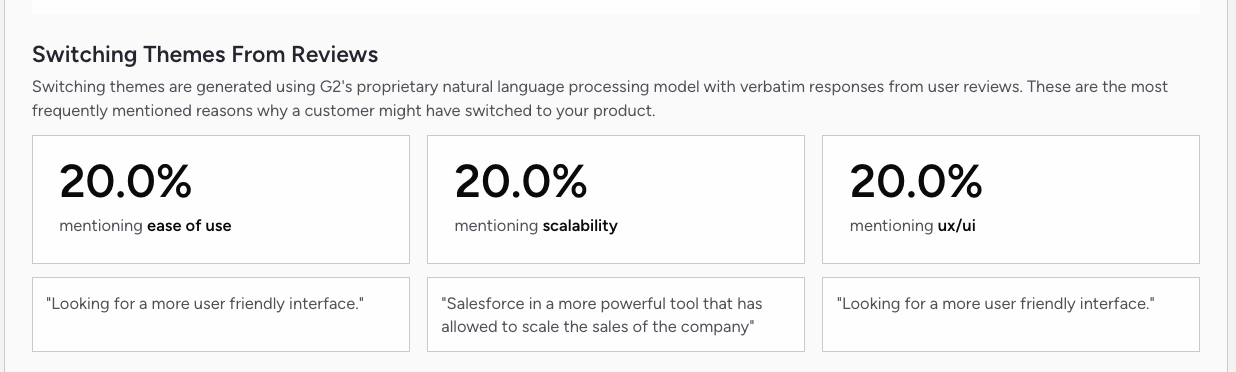
Reasons that made customers switch to Sales Cloud, according to G2 reviews.
He points to Canva, a Salesforce customer, where the sales team has automated over 1,200 workflows in the workspace, giving back hundreds of hours across the global team.
This is the pattern across the top-ranked products on the list. The winners are not adding features. They are eliminating the gap between where data lives and where selling happens.
Sales software is being shaped directly by user feedback: G2 data shows the number of products added to its 40+ sales categories grew 31% year-over-year, reflecting vendors building in direct response to what sales teams are asking for.
G2 data shows sales software is becoming more buyer-responsive than ever: The number of products added to its 40+ sales categories grew 31% compared to the previous trailing 12-month period. This shift signifies a direct response to the specific needs and requests voiced by sales teams on the ground every day.
Julie Jung, Senior Research Analyst at G2, notes that the number of products added to G2's 40+ sales-related categories increased by 31% compared to the previous trailing 12-month period. The category isn't just growing. It's growing in direct response to what users are asking for.
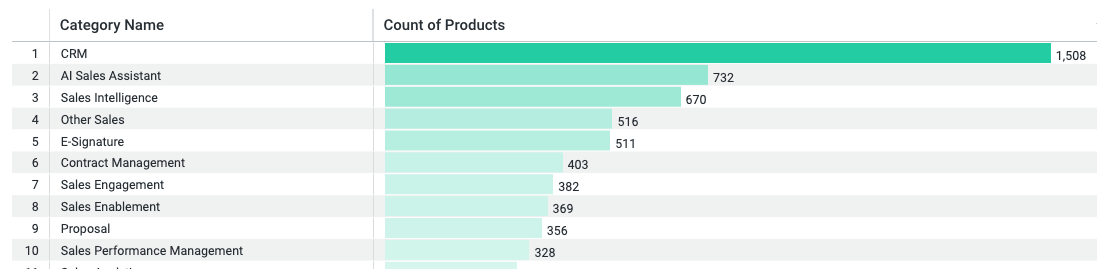
Sales software sub-categories in terms of product count.
Leandro illustrates this with two examples of how real user feedback reshaped Salesforce's product roadmap. "Sales reps wanted more transparency in how they get paid," he says. This led to the acquisition of SPIF, a compensation platform now integrated into Sales Cloud, giving reps real-time visibility into how their activity connects to earnings.
The second demand came from sales leadership: Reps weren't getting enough coaching. This led to AI-powered coaching tools that analyze sales calls in real time and after the fact.
“It analyzes that call and helps them identify answers that are more effective at getting to a deal closure,” Leandro explains.
"This really allows salespeople to get better. It allows a leader to basically unlock the best ways of working of their best rep across the whole team in a systemized way."
AI agents are becoming infrastructure, not just standalone apps. Learn how to choose the right agentic AI platform for your business in this article.
Revenue intelligence and predictive analytics are moving past buzzword status: AI agents are now embedded directly into sales workflows, running prospecting, coaching, and forecasting autonomously rather than just assisting reps with individual tasks.
Revenue intelligence and predictive analytics have been industry buzzwords for years. But are they actually delivering on their promises?
Leandro is candid about where the category has matured. “Forecasting has been — like, no sales leader really likes it, because it's what they get held to the fire for," he says. "And it's also what all management teams detest, because they know they can't always trust it."
Sales Cloud now layers AI-driven prediction scores on top of human-generated forecasts, letting leaders compare what the team reports with what the data suggests.
Julie confirms this pattern across the broader category. "One of the most notable emerging capabilities in sales software is the rise of AI agents designed to support sales teams by performing sales workflows autonomously," she observes.
"Rather than simply assisting with individual tasks, platforms are introducing task-specific AI agents that can operate and execute defined sales activities on behalf of the sales team." G2 recently introduced the Revenue AI Platforms category to capture this shift.
The fastest ROI use cases in sales, according to Julie's analysis, cluster in three areas: automating tasks to improve sales productivity, accelerating rep performance through coaching and enablement, and improving deal intelligence and forecasting accuracy.
Platform consolidation is reshaping how buyers evaluate sales software: this year's top-ranked products absorb capabilities — coaching, transcription, prospecting, compensation — that once required separate, disconnected vendors.
Platform consolidation — not fragmented, single-purpose tools — is the strongest signal among this year's G2 sales software winners.
One of the strongest signals in this year's winners is the move toward platform consolidation, and away from the fragmented tool stacks.
Leandro calls it “Frankenstack”. "In sales, because it's such a high-visibility part of businesses, a lot of budget goes into adding new tools. But many of these tools barely get used or are not connected."
Salesforce's response has been to absorb capabilities that previously required separate vendors: coaching, transcription, meeting booking, prospecting (via the acquisition of Qualified), compensation management, and sales enablement. "When you standardize on Agent for Sales, you should be able to do everything for your sales reps on the desktop, on the phone, on the go," Leandro says.
Dharamveer Prasad, an Application Security Engineer at Cybersmithsecure and a G2 Icon, confirms this from a practitioner's view. “Sales Cloud has improved productivity by giving clear visibility into the sales pipeline and customer interactions," he says. "Buyers should look for strong CRM capabilities, easy integration with other tools, reliable reporting, and automation features."
Alex Nejako, Chief Marketing Officer at Nejako Solutions and a long-time Sales Cloud user, reinforces the durability of the platform bet: "For over 15 years, Sales Cloud has helped the teams I've worked with prioritize leads, keep track of sales activity, and track sales associated or influenced by marketing.”Alex is also a G2 Icon, who is an experienced professional passionate about providing software feedback.
Buyers evaluating sales software in 2026 should weigh four criteria, per Salesforce CMO Leandro Perez: vendor trust with sensitive data, connected (not siloed) architecture, flexible usage-based pricing, and alignment on AI ethics and values.
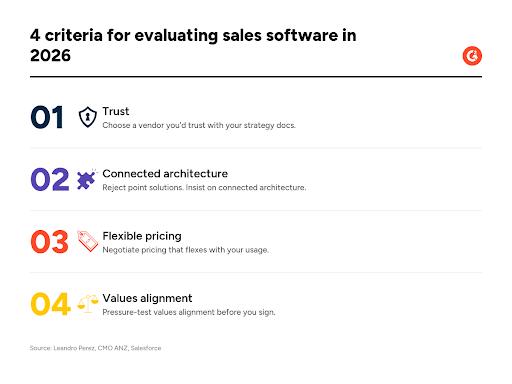
How buyers should evaluate sales software in 2026: trust, connected architecture, flexible pricing, and values alignment.
When asked what advice he'd give buyers evaluating AI-powered sales tools, Leandro identifies four criteria:
This isn't about generic data security checkboxes. Leandro frames it through Salesforce's own origin: "We started 27 years ago, asking companies to move to the cloud. It was the most important customer information you had — the details about who you were selling to — and moving it to this thing called the cloud, which people didn't know."
The trust bar is even higher with AI. "You're giving all your information to an organization — your most sensitive information, your internal thinking, your strategies," he says. If you wouldn't hand your competitive playbook to the vendor's team, don't hand it to their AI.
Leandro says: "If it's not connected, you're not going to get the real value, but it also exposes some potential risks to the organization. There's no governance; there's no ability to audit."
Before you add another tool to the stack, ask whether it connects to your CRM, your billing, and your data layer, or whether it creates another silo your team has to manage around.
Some companies want cost certainty. Others want the ability to scale usage without overpaying upfront. Push your vendor to offer both options, and walk away from rigid licensing that doesn't match how your team will actually adopt the product.
Leandro raises a point most procurement teams skip: "Software very quickly manifests the technology of who has built it. You should be dealing with an organization that shares your values."
Ask the vendor about their stance on AI ethics, data use, and governance defaults. If those answers don't align with your organization's principles, the misalignment will surface.
Companies are shifting from campaigns to an always-on demand gen motion. In this article, learn how AI can help you achieve this.
Salesforce Sales Cloud is the best product on G2's 2026 Best Sales Software list, based on verified user reviews and market presence data. The list features 50 winners out of 446 eligible products, with 60% being new entrants compared to last year, signaling that buyers are actively re-evaluating their sales tech stacks.
AI is shifting from advisory chatbots to autonomous agents that run sales workflows, including prospecting, call transcription, real-time coaching, and forecasting directly within the selling environment. G2 recently introduced the Revenue AI Platforms category to reflect this shift. According to G2's 2025 AI Agents Insights Report, companies deploying AI agents reported a median 23% gain in speed-to-market, with velocity gains of up to 50% in sales use cases.
Buyers should evaluate along four dimensions: trust and data security (how the vendor governs your most sensitive information), connected architecture (whether the tool integrates with your CRM, billing, and data layer or creates another silo), pricing flexibility (consumption-based or hybrid models over rigid seat licensing), and values alignment (the vendor's stance on AI ethics and governance).
Read more about the 2026 best software series here.
Edited by Supanna Das


Plenty of people have an opinion on an enterprise purchase of a large language model (LLM)....
.png) by Emilie Audubert
by Emilie Audubert
Most enterprise leaders don’t evaluate a large language model (LLM) solely on its...
by Emilie Audubert

As you read this, an AI engine is describing your brand to a buyer you will probably never...
by Sidharth Yadav