

-2.png?width=1200&name=Copy%20of%20TechSignals%20Blog%20FI%20Template(s)-2.png "AI rebranding brand")
The age of AI is giving the concept of “brand” its moment in the strategic spotlight. I’d say we’re experiencing a revolution.
Previously, we revealed how brand mentions, sentiment analysis, and branded search have emerged as pivotal factors for digital visibility. The prevailing insight: Brand will be king.
But while a brand’s status elevates in marketing, CMOs are under huge pressure to drive marketing return-on-investment (ROI) and use AI. According to a Salesforce report, 83% of sales teams using AI saw revenue growth versus 66% of sales teams that weren't using AI.
In this article, we explore how CMOs are using AI to operationalize brand — and how G2 review data across marketing intelligence categories reveals a clear shift: Brand is becoming faster to measure, easier to justify, and more directly tied to business outcomes.
CMOs might be at the top of the org chart, but they're responsible for hands-on work to integrate AI into their company's marketing strategies — from demand to brand. They’re moving beyond efficiency gains to use AI to understand brand perception, sharpen brand positioning, and stand out in an increasingly crowded market.
Brand investment has evolved from a vague expense into a tangible driver of long-term value and competitive differentiation. And now, there’s a growing appetite for tools, strategies, and systems that operationalize this transformation.
Budgets reflect business priorities, and CMOs are refocusing their budgets toward brand, leveraging AI tools to:
We asked CMOs and marketing leaders from G2, VEED.io, LinkedIn, and Reddit if they are betting big on brand building to drive business. And the proof is in their investment pudding.
As Leila Woodington, former CMO at VEED.io, said, “We’ve historically been very strong on demand capture — SEO, paid, and product-led growth have fueled much of our ARR. “But from 2024, we’ve made a conscious shift to invest more in brand building. AI has accelerated this change: The market is noisier, the stakes are higher, and trust matters more than ever.”
Sydney Sloan, CMO advisor at G2, confirms, “At G2, we are betting big on brand building in the age of AI and increasing our year-over-year investment to reinforce our trusted brand and extend its value.”
This isn’t just about spending more. It’s about spending smarter.
Measuring brand awareness, perception, and impact has always been a challenge, but AI can now help. Brand intelligence software uses AI to monitor and interpret how a company is perceived across digital channels — including sentiment, visual signals, share of voice, and competitive positioning. What was once qualitative is now quantifiable.
Leila notes, “AI is helping us make our brand measurable in new ways, from content performance to creative testing.”
Based on 2023–2025 G2 review data across Brand Intelligence, Audience Intelligence, Social Media Analytics, and Media Monitoring categories, AI is accelerating time to value.
More than 55% of buyers report seeing value from their brand intelligence tool within six months.
Here’s why that matters: Faster time to value reframes the brand from a long-term marketing bet into an operational lever. When ROI compresses, skepticism fades. That’s when the brand moves from boardroom debate to budget line item.
Brand intelligence isn’t replacing legacy tools — it’s becoming a new strategic layer. Only about 8% of reviewers report switching platforms when it comes to using these tools, and most are first-time buyers.
For VEED.io, AI is “baked into how we operate, not just what we market.”
AI enables their teams to:
VEED.io treats its product as a channel, not just a destination, turning users into advocates and reinforcing the brand directly within the experience. When product experience reinforces brand, advocacy compounds.
Visibility in AI isn’t just about what you say; it’s about where trust already lives.
Community platforms rank highly in AI search because they provide structured reviews, authentic user experiences, and intent-rich discussions that large language models (LLM) trust.
According to the Buyer Behavior Report 2025, community-driven content peaks in AI-driven visibility, with G2 and Reddit leading.
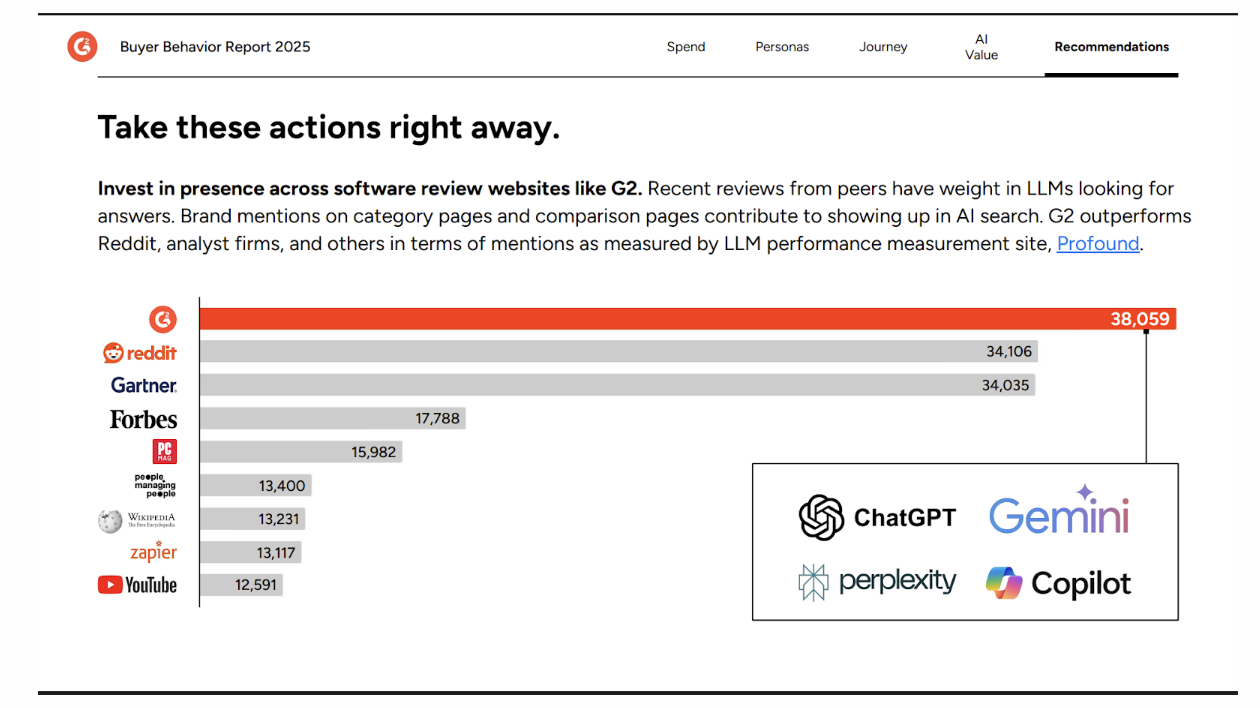
Source: G2 Buyer Behavior Report 2025
G2’s blend of verified buyer intent, authentic reviews, and structured data feeds directly into AI-generated recommendations.
As Tim Sanders, Chief Innovation Officer at G2, puts it, “AI is eating SaaS go-to-market.”
Buyers increasingly go directly to LLMs for recommendations — and LLMs prioritize trusted third-party signals.
Brand perception alone isn’t enough. Brand tells you how you’re perceived. The audience tells you who carries that perception forward. AI connects the two.
Audience intelligence software uses AI to decode who your buyers are, what they care about, and how they behave across channels.
Core use cases include:
Brand awareness without audience insight is visibility without direction. An audience without a brand is targeting without memory. Together, they compound.
Brand is no longer a soft metric that is hard to measure and map from a business perspective. G2 ROI data across four adjacent marketing intelligence categories, Social Media Analytics, Brand Intelligence, Audience Intelligence, and Media Monitoring, reveals a clear trend: AI is accelerating time to value.
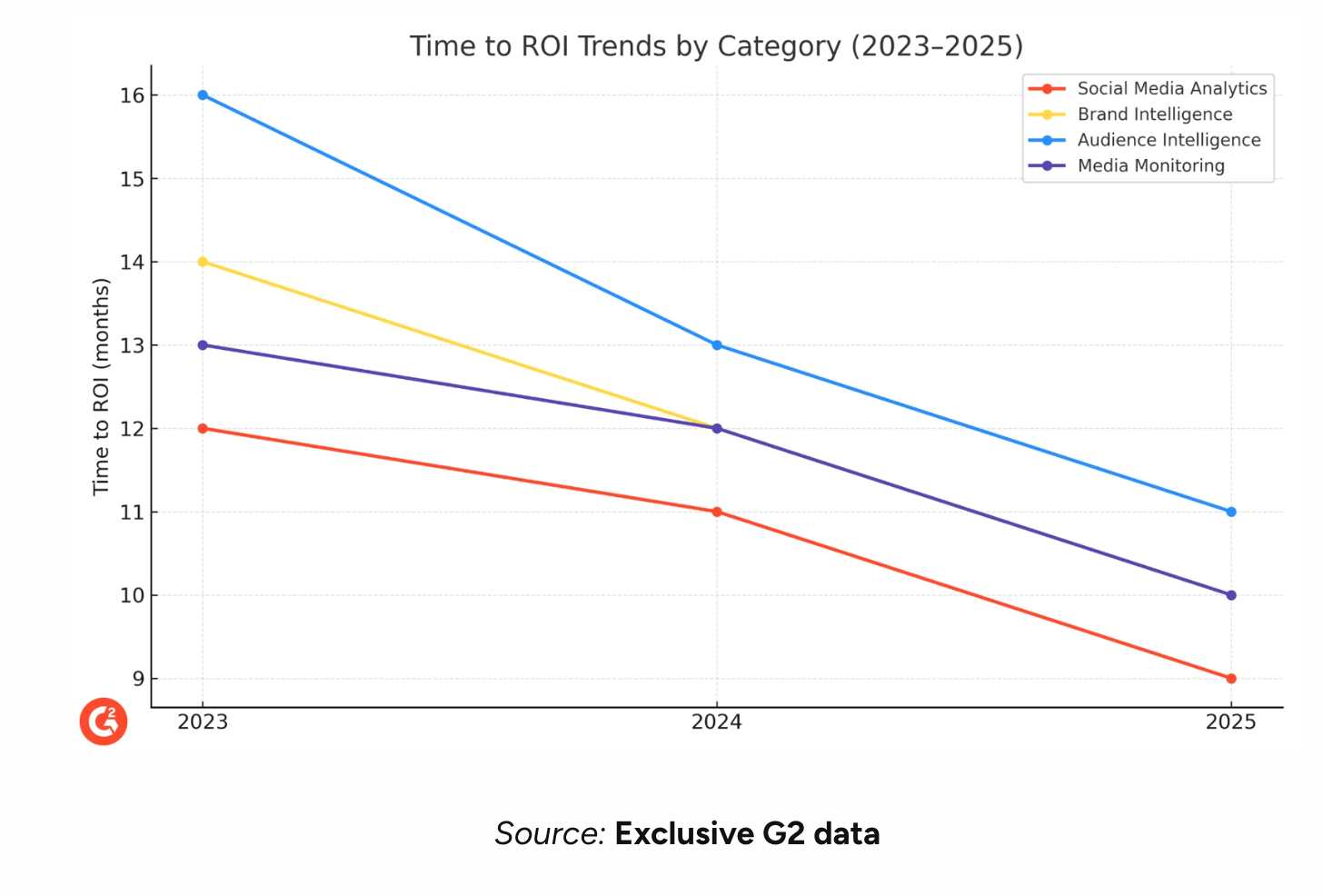
Our review data across 2023, 2024, and 2025 shows a clear ROI compression across all categories with two standouts: Brand Intelligence and Audience Intelligence. This suggests that brand — traditionally seen as long-term and hard to measure — is now delivering faster, more tangible returns when powered by AI.
More than 55% of reviewers reported seeing clear value from their brand intelligence tool within 6 months, demonstrating a rapid time-to-value, especially for SMBs and mid-market players, and significantly faster payback periods even for larger enterprises.
Brand intelligence platforms offer fast, visual, and predictive insights that are making brand performance actionable.
Source: Exclusive G2 review data
G2 reviews reveal that brand leaders expect more than mentions. They want accurate, explainable brand signals. If insights aren’t trusted, adoption stalls, and so does brand value.
Top 3 dislikes for brand intelligence platforms based on user reviews on G2:
Specialized tools earn more user love than the giants in this space. The devil is truly in the details. Vendors like YouScan, Audiense, and Synthesio consistently have overall satisfaction between 4.7–4.9 star ratings and a 9.4+ likely-to-recommend score.
Sharper, community-aware, insight-rich tools that specialize in areas like Reddit insights, influencer visuals, and sentiment nuance are winning in the market.
Top 3 capabilities of brand intelligence software that delight G2 users:
Brand intelligence isn’t replacing something — it’s being added as a new strategic layer. Only about 8% of reviewers reported switching from another platform. Most are first-time buyers, or previously relied on manual or general-purpose tools.
G2 reviews suggest some platforms still struggle with onboarding, integrations, or feature discoverability.
Autonomy is in, but software buyers want brand intelligence tools to meet them halfway with intuitive UX, solid onboarding, and smart integrations.
An AI LLM may gamble on your Google rankings and brand visibility. But, let’s not forget — people build brands. So why not get to know them?
While brand intelligence tells you how you’re perceived, audience intelligence shows you who you’re influencing (and how to reach more of them!)
Top 5 industries using audience intelligence software:
These platforms are becoming central to audience segmentation, campaign planning, and GTM strategy. G2 data shows satisfaction is tied to AI depth, not scale.
G2 users reward platforms that surface more than just audience size. AI tools that decode behaviors, affinities, and buyer intent win on trust and traction.
Platforms with AI-powered clustering, persona enrichment, and predictive behaviors consistently earn 4.6-4.9 star ratings. These include tools like SparkToro, Audiense, and Resonance AI.
Quite natural, right? You can’t discover an insight you don’t know exists in your database. If your tool doesn’t let you peacefully perform a search in your dataset, you’re eons away from building insights-backed strategies.
Reviews show that better discovery and smart filtering are key to turning data into strategy. “Search,” “filtering,” and “narrowing” are some of the most mentioned pain points. Users want cleaner workflows, especially when comparing segments or influencers.
Audience intelligence is a net-new layer in the MarTech stack, helping teams move from guesswork to evidence.
Similar to brand intelligence, most audience intelligence users are first-time buyers, not switchers. But their use cases vary from campaign planning to community building to influencer vetting.
Brand is back as a strategic engine, and AI is the fuel, making it measurable, memorable, and market-moving. So, the next time someone calls a brand a vanity metric, show them the receipts.
Brands that listen better, see sharper, and act faster will win. Because today, the most iconic brands aren’t built by accident, they’re engineered with intelligence, both intellectual and emotional.
We get it, AI has its challenges, and we’re all learning as we go. If you’re struggling with AI hallucinations, AI search performance, or AI governance, each of these reads will help guide you.
How is AI changing the role of brand in B2B marketing?
AI is transforming a brand from a long-term awareness play into a measurable growth signal. In AI-driven search environments, brand mentions, sentiment, reviews, and trust signals influence what large language models surface — directly impacting visibility and revenue.
Why does community content rank highly in AI search results?
Community platforms provide structured reviews, authentic user experiences, and intent-rich discussions. LLMs prioritize trusted third-party sources when generating recommendations, increasing visibility for platforms like G2 and Reddit.
What is the difference between brand intelligence and audience intelligence?
Brand intelligence measures how your company is perceived — including visibility, sentiment, and competitive position. Audience intelligence analyzes who your buyers are, what they care about, and how they behave. Together, they connect perception with targeting and growth strategy.
Enjoyed this deep-dive analysis? Check out our quick start guides to learn how you can build your brand with G2's help.
Edited by Supanna Das


We called it back in July 2024 — AI chatbots like OpenAI’s ChatGPT and Perplexity wouldn’t...
by Kamaljeet Kalsi

Let’s face it: the digital content space is as crowded as ever.
 by Alexandra Vazquez

Which would you understand more easily - a block of text explaining how to tie a Double...
 by Kelly Wade