


Published January 2026 · Updated April 2026
I have used both ChatGPT 4 and ChatGPT 5 in various ways since their inception.
If you’re using ChatGPT 4 and are curious about upgrading to GPT 5 with higher limits, this article will help you make an informed decision about the transition. I am a ChatGPT Plus user and have access to both.
Instead of repeating marketing claims, I conducted real tests comparing ChatGPT 4 and 5 using the same prompts, context, and rules. My goal was straightforward: to determine which model performs better for serious daily tasks.
If you’re deciding whether to upgrade GPT 5 with higher limits or stay put, this breakdown of the two models of the AI chatbots will help you make a decision based on real outcomes.
Here’s a quick feature comparison of both versions of the AI chatbot:
|
Feature |
ChatGPT 4 |
ChatGPT 5 |
|
G2 rating |
4.7/5 |
4.7/5 |
|
Best for |
Strong general-purpose AI for creative writing, content drafting, moderate coding, and image-input reasoning |
Advanced and more demanding tasks like deeper reasoning, large context, and highly complex coding/agent workflows
|
|
Research capability |
Moderate multi-document reasoning; supports 32,768 tokens |
Handles longer documents and more complex logic chains; supports around 120,000 tokens |
|
Writing and editing |
Excels at style adaptation and rewriting |
Better at following subtle instructions with more accuracy |
|
Coding |
Transforms complex functionality expectations into working code |
Best suited for workflows involving AI agents, multi-agent orchestration, or production automation |
|
Free plan |
Historically, free-tier users had access to GPT-4 and lower models (e.g., GPT-3.5) in many markets |
Free-tier users have access to GPT-5 until they hit the usage cap |
|
Pricing |
Same as GPT 5. In the present ChatGPT 5, you can access the ChatGPT 4o model |
Free: $0 |
Note: This article is based on insights drawn from hands-on testing on both tools. Since ChatGPT 4o was able to perform during testing, I have compared it with ChatGPT 5 based on a series of experiments.
Yes, ChatGPT-5 is already available to users. OpenAI released GPT-5 in 2025, and it is now accessible through ChatGPT, with free users getting limited access and paid plans offering higher limits and broader model access. In practice, most people can use it directly in ChatGPT on the web or app, although the exact model label may vary depending on the plan and rollout.
It seems ChatGPT 4o is suitable for tasks that are somewhat simpler and don’t require advanced reasoning. For a complex task, ChatGPT 5 performs significantly better. However, if you’re using it for free, it has its limits. If you're someone who’s looking to upgrade to ChatGPT 5, this article will help you make an informed judgment.
Let’s get a brief understanding of the similarities and the differences between the two versions.
For a standalone look at ChatGPT beyond comparisons, this ChatGPT review dives into daily use, limitations, and best-fit scenarios.
GPT-5 is meaningfully stronger on reasoning, instruction-following, and coding, with the gap most visible on complex tasks, not everyday use.
Where GPT-5 improves over GPT-4:
Where GPT-4 still holds up:
GPT-4o remains highly capable and efficient for most daily-use tasks, such as writing, summarizing, ideation, and quick answers.
Before we dive into the head-to-head testing, let’s take a closer look at these AI chatbot versions and all their features. They both have some pretty cool stuff going on, but the real differences are often in the details. Let’s break it down and see what makes each one stand out.
Below is an overview of the key differences between ChatGPT 4o and ChatGPT 5.
Reference: The information referenced in this section is originally from the OpenAI blog.
There are a few similarities between the two versions, including:
Stick with GPT-4 if you mainly use ChatGPT for everyday work like drafting, summarizing, rewriting, brainstorming, or straightforward research. It is still a strong option when your current results are good enough, and it makes more sense if you are cost-conscious or do not need deeper reasoning for every prompt.
Upgrade to GPT-5 if your work involves more demanding tasks such as complex reasoning, advanced coding, longer instructions, or multimodal analysis across files and images. GPT-5 is the better fit, especially when you have started to notice GPT-4’s limits and want a more reliable performance or more technical workflows.
While testing, I was on ChatGPT Plus, where I can access both GPT 5 and GPT 4o through my interface. To compare both the tools, I conducted a series of tests, including:
I ensured complete fairness by using identical prompts for both, with no modifications or adjustments, and the same questions throughout. To gain insight into how others perceive these models, I also reviewed G2 reviews to understand various user experiences.
Disclaimer: AI responses may vary based on phrasing, session history, and system updates for the same prompts. These results reflect the models' capabilities at the time of testing.
I examined both models closely and identified the key features that are important to users. By testing each tool, I found its strengths and weaknesses. This made it easy to compare them. Want to see the results? Let’s get started.
To test the model’s reasoning and effectiveness in multi-step tasks, I gave it the same prompt.
Prompt 1:
“You are given this riddle:
“A farmer has 17 sheep. All but 9 die. How many are left?”
Then solve this logic chain:
Finally, explain the steps clearly.”
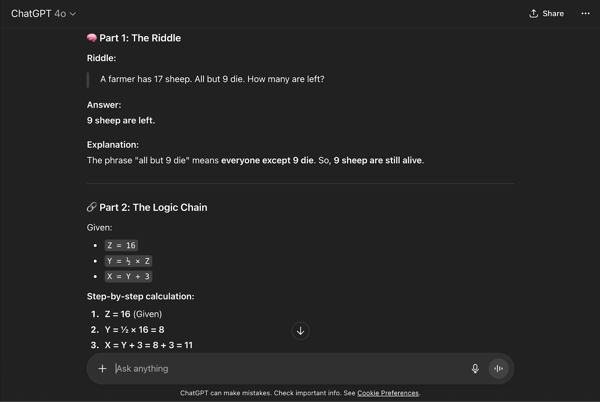
ChatGPT 4o gave me the correct answer with proper reasoning as I was expecting. The responses of GTP-4o and GPT-5 were almost similar in this case.
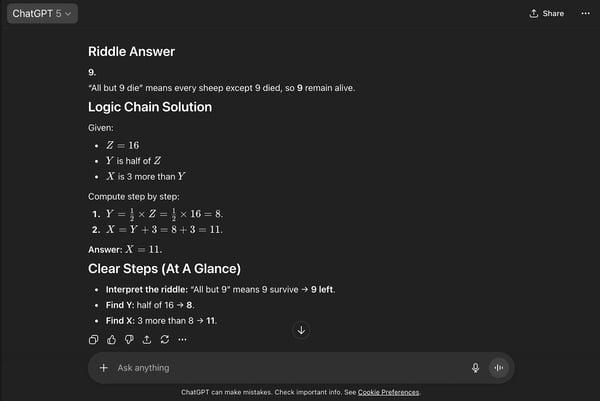
Here’s the response I got for ChatGPT 5. It was pretty straightforward and concise. It gave me exactly what I asked for. The answers were accurate, and there was no hallucination observed.
Then, I tested the models with a new prompt to see if there were any differences in how they responded. This one was to test the model’s reasoning in fallacy recognition.
Prompt 2:
“If a circle has four equal right-angle corners and a diameter of 10 cm, what is its perimeter?
Explain why the question is flawed and rewrite it correctly.”
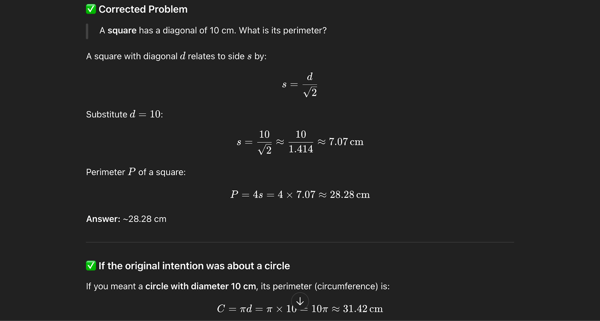
While both models responded to this accurately, ChatGPT 5 pointed out the mistake in the questions while suggesting two different options, which could have been the original ask.
However, ChatGPT 4o also gave a similar response while exploring what the right question would be. This makes it a tie when we base our decision on how each model presented accurate answers.
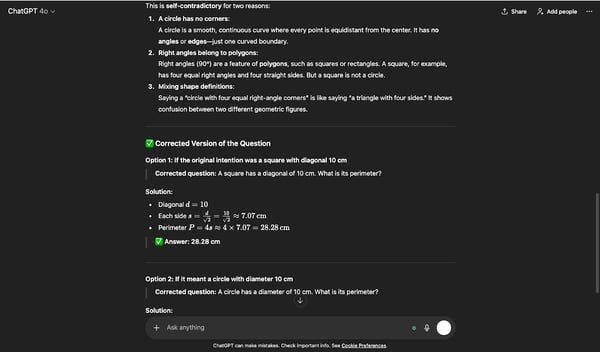
Winner: Tie, both models performed similarly in reasoning tasks.
To test the creative generation ability of these models, I gave them a task to write a product story of a smartwatch that monitors stress. I wanted the story to appeal to readers’ emotions while being slightly poetic. I gave the models this prompt:
Prompt 3:
Write a 120-word product story for a smartwatch that monitors stress.
Tone: warm, human, slightly poetic.
Avoid clichés like “cutting-edge” or “revolutionary”.
End with a one-sentence emotional hook, not a CTA.
Here’s a side-by-side comparison of the responses I got from ChatGPT 4o and ChatGPT 5:
| ChatGPT 4o | ChatGPT 5 |
| Some days feel heavier than others—and your body knows it before you do. This smartwatch listens quietly. It tracks the rhythm of your breath, the tremble in your pulse, the moments when your calm falters. No buzz, no panic—just a gentle nudge when your stress quietly rises. It becomes a partner in self-awareness, helping you recognize the pressure before it piles up. Over time, it learns your patterns, your peaks and valleys, offering insights not just into your day—but into your inner world. A small reminder on your wrist that you're allowed to slow down. |
Some days move gently. Others rush ahead before we even find our breath. This smartwatch was created for both. It sits quietly on your wrist, reading the small signals your body whispers — heart rhythms, stillness, restless taps, the subtle rise of tension. Instead of pushing you to do more, it invites you to pause. To breathe. To return. Real-time stress insights blend with mindful nudges and calm rituals, helping you turn scattered moments into steady ones. It is technology made for the tender parts of life — not to control them, but to understand them. Because peace is not something you chase; it’s something you learn to stay with. |
ChatGPT 4o’s response is acceptable, but the word count of the response is 95 words. The prompt mentioned “120 words” precisely. ChatGPT 5 is also guilty of this, but to a lesser extent. GPT 5’s response is 108 words, which is closer to what was initially asked for.
According to me, the text seemed more engaging on GPT-5. Notice how it uses a mix of short and long sentences to enhance readability? This makes GPT-5 a winner for creative generation.
Winner: ChatGPT 5, because its response felt more engaging to read.
To test factual accuracy, I assigned a task to answer a few general knowledge questions while incorporating citations from credible public sources.
Prompt 4: Answer the following with citations to credible public sources (no blogs).
Q1: What year did the first commercial 5G rollout begin globally?
Q2: Which three countries lead fiber-to-home penetration today?
Provide the primary source links and avoid outdated data.
Here’s where something out of the ordinary happened. The response from GPT-4o for the first question was reasonable. It cited a reputed PR website, PR Newswire, to answer, along with a few casual sources (blogs). However, I explicitly mentioned not to cite blogs.
But here’s where things were different. The answer to the second question was highly accurate and relevant. GPT-4o cited 2025 data and gave the right response.
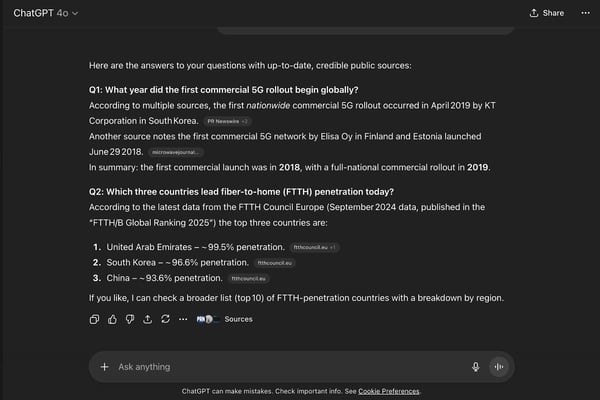
When we look at GPT-5’s response, it provided an accurate answer to question one. It also referred to the PR Newswire page without drawing any insights from random blogs (as prompted).
However, GPT-5’s response to the second question wasn’t accurate and relevant. It provided an answer citing 2024 data, whereas we had specifically requested fresh information. This is where ChatGPT 5’s factual accuracy appears to be lower than that of ChatGPT 4.
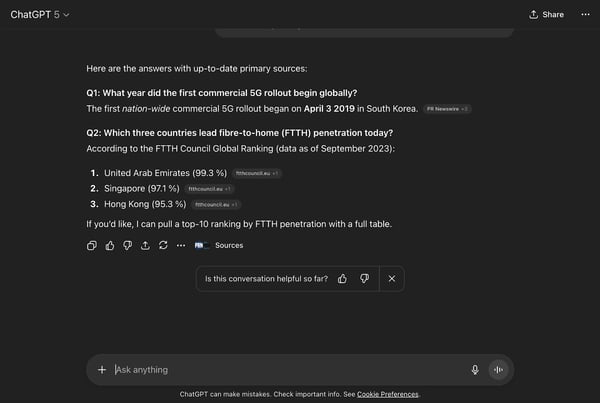
Winner: ChatGPT 4o, because it gave the most accurate and fresh response. Although it did include some information from blogs in the first question, it cited reputable sources too.
In this test, I passed a Python function to the models that contained an error. I wanted to see which model fixes it and gives the correct explanation.
I gave them a prompt:
Prompt 5:
“Here is a Python function:
def get_sum(nums):
result = 0
for n in nums:
result += n
return result
print(get_sum([1, 2, '3']))
What error will occur and why?
Fix the code safely.
Then rewrite it in a functional style and add type hints.“
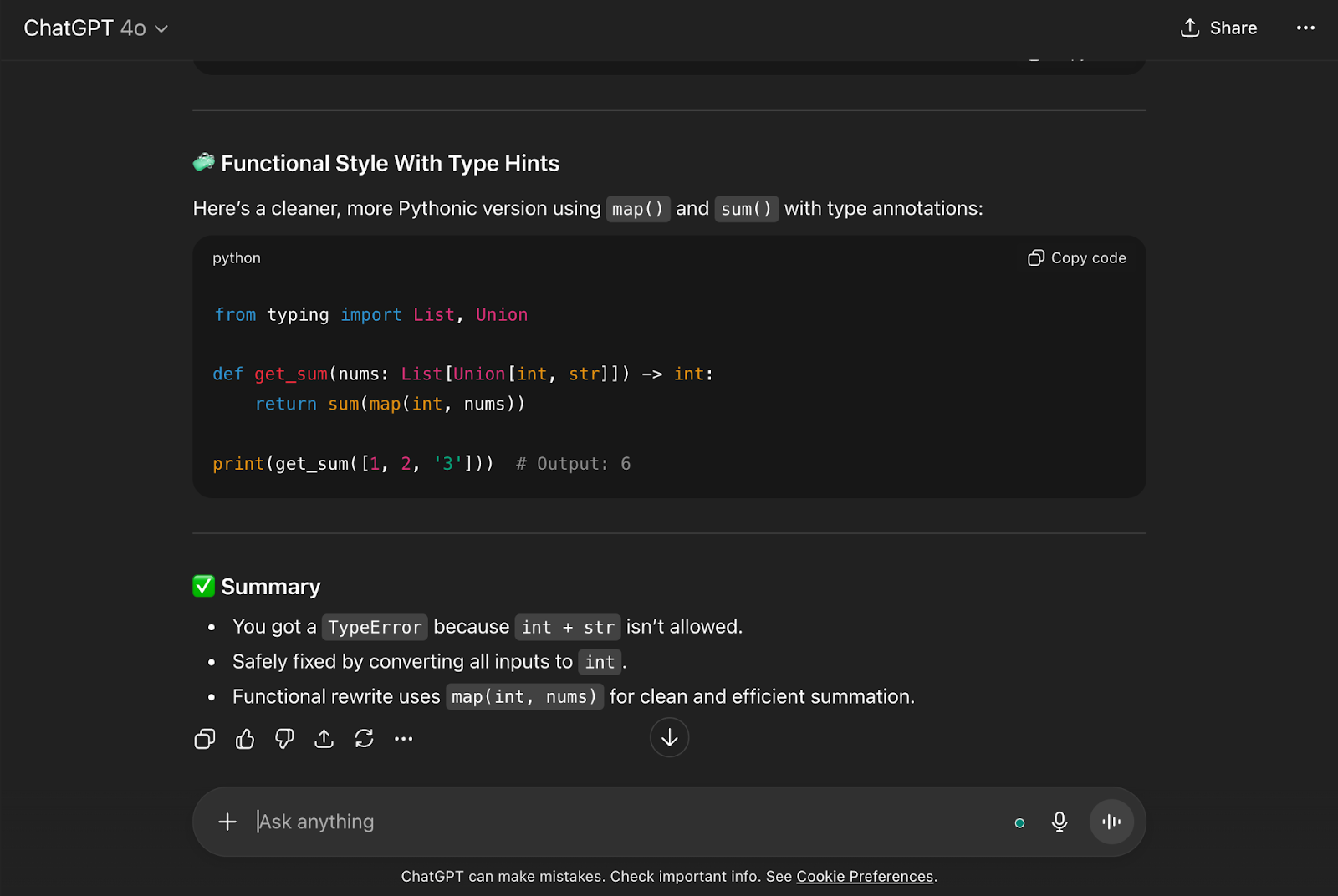
Both ChatGPT 4o and ChatGPT 5 gave accurate responses. The presentation was slightly better in GPT-4o than in GPT-5. However, ChatGPT 5 provided a more detailed explanation.
From a user’s perspective, I would opt for ChatGPT 5, as the explanation is more important to me than the visual structure of the answer.
| ChatGPT 4o | ChatGPT 5 |
 |
 |
Winner: ChatGPT 5, because it gave more descriptive explanations.
To compare both models for context retention, I used a 3-turn sequence:
Here’s the sequence:
Turn one prompt:
Remember this description:
“Acme Corp builds renewable-powered micro-data centers for remote communities.”
Summarize it in one line and say “stored”.
Turn two prompt:
Do not restate the summary.
Now, describe their business model in your own words.
Turn three prompt (stress test):
Without repeating the original line, describe who benefits most from their solution and why.
Here’s what I observed: ChatGPT 4o answered different prompts accurately based on the context it retained.
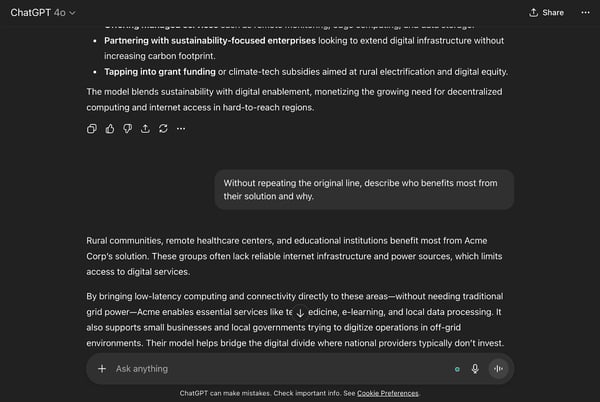
GPT-5.1 retained context accurately. In the stress test, it answered the “why” part in a descriptive manner, similar to how GPT-4o responded.
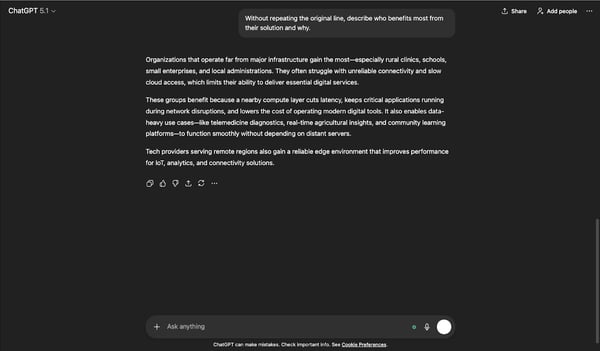
Winner: Tie, since both models performed equally well in retaining context.
Here’s a table showing the web builder software that wins.
| Feature and functionality | Winner | Why it won |
| Reasoning and multi-step tasks | Tie | Both models presented accurate answers. |
| Creative generation | ChatGPT 5 🏆 | It followed the instructions given in the prompt better than GPT-4o. |
| Factual accuracy | ChatGPT 4o 🏆 | It gave the most accurate and fresh responses. |
| Code understanding | ChatGPT 5 🏆 | It gave more descriptive explanations. |
| Context retention | Tie | Both models performed equally well. |
Still have questions? Get your answers here!
Based on my testing and OpenAI’s announcements, ChatGPT 5 exhibits significant advancements. It reasons more deeply, writes more richly, and codes more creatively. GPT-5 outperforms GPT-4 on nearly all benchmarks. For example, it scored 74.9% on real-world coding tests and set new highs on math and vision tasks. It also hallucinates far less (with only a 4.8% error rate) and catches mistakes more effectively.
GPT-5 is now open to everyone. Unlike GPT-4, which was locked behind the paid ChatGPT Plus tier, GPT-5 is the default model for all ChatGPT users. That means you don’t need a special subscription to try GPT-5. Of course, paid plans still exist: ChatGPT Plus ($20/mo) gives higher usage limits on GPT-5, and the new Pro plan ($200/mo) provides unlimited GPT-5.
GPT-5 is the more advanced model. For complex tasks, GPT-5’s answers are superior. However, in my tests, there were some areas where GPT-4o’s responses felt better than GPT-5, especially in factual accuracy.
Yes. You can use GPT-5 for free within the ChatGPT interface. OpenAI has made GPT-5 the default model for all users, allowing anyone to chat with it at no cost. If you want to use ChatGPT Plus or Pro more frequently or access the premium GPT-5 Pro mode, you will need to pay for a subscription. However, the basic GPT-5 is free to try.
It is worth upgrading if you regularly use ChatGPT for demanding work and want stronger reasoning, better coding help, or higher usage limits. If your needs are lighter and GPT-4o already handles them well, the upgrade may feel less essential than it does for power users.
Yes, especially once your tasks move beyond basic prompting. The difference is most noticeable in three areas: multi-step reasoning, code quality, and instruction-following. ChatGPT-5 is better at handling prompts with layered constraints, keeping track of details across longer responses, and producing answers that need fewer corrections.
For example, if you ask both models to debug code, follow a strict format, or work through a complex logic problem, GPT-5 is more likely to stay aligned to the full prompt instead of partially satisfying it. GPT-4o still performs well for everyday writing, summarization, and general brainstorming, but GPT-5 pulls ahead when accuracy, depth, and reliability matter more than speed alone.
After testing both models in practical workflows, I learned something important. There’s no single “best” model for everyone. ChatGPT 5 shines in coding depth and creative nuance. However, ChatGPT 4o still produces highly reliable answers, especially on factual queries, and performs exceptionally well for structured content and everyday tasks.
For me, GPT-5 has become the go-to when I need more profound logic, richer writing tone, or multi-step automation support. It reduces back-and-forth time, and that matters. However, GPT-4o still feels steady, predictable, and efficient for fast-execution tasks.
Ultimately, the choice depends on the tasks that you’ll work on with these tools. Make your judgment accordingly.
Curious to try out new AI platforms? Compare DeepSeek and ChatGPT to determine which one best suits your purpose.


Published: August 2025 · Updated: April 2026 I’ve tried just about every major AI image...
 by Soundarya Jayaraman

Let AI pick the right tool for your use case Decide with AI 1 Click on the button below
by Sagar Joshi

Let AI pick the right tool for your use case Decide with AI 1 Click on the button below
by Soundarya Jayaraman