Many organizations mistakenly equate motion with workplace optimization. They install basic booking tools, track seat usage, and shuffle people between floors, yet employee experience remains unchanged. The problem isn’t effort; it’s ineffective desk booking.
I’ve seen employees hunting for available seats, facility managers drowning in manual allocation requests, and leaders struggling to connect workspace data to productivity. In a hybrid work era where flexibility matters and space is expensive, outdated booking methods not only slow you down but also waste resources. They waste time and real estate.
That’s why I took a closer look at the best desk booking software available today. I analyzed G2 reviews, compared top-rated platforms, and examined real feedback from teams using these tools to create smarter, more flexible workplaces.
Whether you’re looking for intelligent occupancy insights, seamless mobile booking, or analytics that help you optimize space at scale, this guide will help you find the right fit for your hybrid workplace strategy.
6 best desk booking software: My picks for 2026
- Zoom Workplace: Best for hybrid teams using Zoom
Integrates desk scheduling with meetings, rooms, and collaboration features inside the Zoom ecosystem.
- Archie: Best for flexible workplace management
Provides hot-desking, visitor management, and analytics to help optimize office layouts and usage.
- Appspace: Best for enterprise workplace experience
Combines desk booking, digital signage, and workplace communications in one platform.
- Tactic: Best for simple, employee-friendly desk booking
Offers an intuitive interface for reserving desks and spaces, with strong mobile support.
- Joan: Best for hardware-integrated booking
Pairs desk booking software with e-ink displays and room panels for a streamlined office experience.
- Skedda: Best for space scheduling and utilization insights
Helps organizations manage shared spaces and analyze usage patterns to right-size office footprints.
According to G2’s Winter 2026 Grid Reports, these desk booking platforms rank as the top solutions. Pricing is typically available on request.
My 6 best desk booking software picks for 2026
While reviewing today’s most popular desk booking platforms, one thing became clear: these tools are reshaping how hybrid teams work, collaborate, and use office space.
According to recent market data, the global smart office market is projected to grow to $102.2 billion by 2029 , driven largely by rising hybrid work adoption
The right desk booking solution makes workspace management effortless and predictable. If you’re looking for a platform that simplifies reservations, reduces workspace conflicts, or gives you a clear view of how your office is actually being used, these desk booking tools stood out for their ease of use, smart automation, and ability to create a more efficient employee experience without logistical chaos.
How did I find and evaluate the best desk booking software?
To identify the best desk booking software, I reviewed real user feedback on G2 to understand how these platforms support essential workplace management workflows, including desk reservations, room scheduling to occupancy tracking, space optimization, and hybrid work coordination.
I also used AI to synthesize insights from user reviews and G2 Grid® Reports, comparing ease of use, booking experience, analytics depth, integration capabilities, mobile app performance, and overall customer satisfaction. This guide includes screenshots from vendor G2 pages, allowing you to see how these tools are used in action and how employees interact with them.
I curated this list to help workplace leaders, office admins, IT teams, and HR departments choose the right desk booking solution to streamline hybrid work, improve space use, and create a more efficient, employee-friendly office environment — whether you're rolling out flexible seating for the first time or optimizing a mature workplace strategy.
What makes the best desk booking software worth it: My opinion
When evaluating the best desk booking platforms, I focused on features that improve workspace efficiency, reduce friction for employees, and help companies manage modern hybrid work environments with clarity and consistency.
- Flexible booking methods: Top tools shouldn’t restrict how employees reserve space. I looked for platforms that support desk booking, room scheduling, interactive floor maps, mobile reservations, real-time availability, and recurring bookings. The best software adapts to every type of workday, whether someone needs a quiet desk, a collaboration zone, or a meeting room.
- Analytics and workspace intelligence: A great desk booking tool should highlight how spaces are actually being utilized. I prioritized platforms that offer occupancy analytics, booking trends, peak-usage reporting, and insights into team-specific behavior. This helps workplace leaders redesign layouts, optimize seat allocation, and reduce unused space.
- Collaboration and workplace alignment: Workspace coordination shouldn’t be scattered across emails or Slack messages. I focused on systems that make it easy to see where teammates are sitting, share reservations, manage team zones, and coordinate office days. Top platforms promote transparency, allowing employees to collaborate easily and ensuring office plans stay aligned.
- AI-powered recommendations and automation: Manual seat planning is tedious and time-consuming. I favored tools with AI features, such as smart desk suggestions, automated check-ins, predictive occupancy alerts, and conflict detection. These capabilities help companies anticipate workspace needs and employees find the right spot without hassle.
- Customization and branding: The best desk booking software allows teams to tailor floor maps, access rules, booking policies, neighborhood configurations, and notifications. Whether customizing approval flows or creating a branded workplace app, top tools support a unified and intuitive in-office experience.
- Allow users to view and reserve available desks in a designated workspace
- Enable the creation of permanent desk assignments, hot desking, and hoteling for employees
- Provide an interactive workplace map showing real-time desk availability
- Enable administrators to limit or expand desk availability, based on changes in capacity or demand
This data was pulled from G2 in 2026. Some reviews have been edited for clarity.
1. Zoom Workplace: Best for hybrid teams using Zoom
Zoom Workplace is a unified AI-powered workspace that combines meetings, chat, video calls, document collaboration, and desk reservations in a single platform.
From what I’ve seen in G2 reviews, users consistently praise the platform’s ability to centralize multiple tools, streamlining workflows for both remote and hybrid teams.
A commonly appreciated element is the quality of video and audio. I’ve noticed that G2 users frequently highlight how clear and reliable calls are, whether for small team meetings or larger gatherings. Reviewers mention that this clarity enhances engagement and makes collaboration feel seamless and professional.
The integration of Zoom Phone, Team Chat, and Meetings also stands out in reviews. Many users note that having interconnected tools reduces the need to switch between applications, helping teams stay organized and ensuring that communication doesn’t fall through the cracks.
I’ve read multiple reviewers mention that this integration saves significant time and improves coordination between remote and in-office colleagues.
According to feedback I gathered from G2 users, the unified platform for meetings, docs, whiteboards, and desk reservations is another frequently praised feature. Users note that accessing everything in one place simplifies scheduling, real-time collaboration, and office resource management. One standout capability, according to users, is to ease with which hybrid work can be managed seamlessly within a single platform.
The AI Companion also receives positive mentions. Reviewers highlight that automating summaries, task assignments, and content creation reduces manual workload and helps teams stay organized. Based on my review of G2 feedback, this feature is particularly valued for keeping projects moving efficiently, especially when managing multiple teams or deadlines.
I’ve seen that efficient scheduling, especially through desktop and Outlook integration, is often emphasized. Approximately 50.8% of G2 users specifically mention the Scheduling (Meeting) feature, noting how it simplifies planning, avoids conflicts, and makes meeting management more efficient.
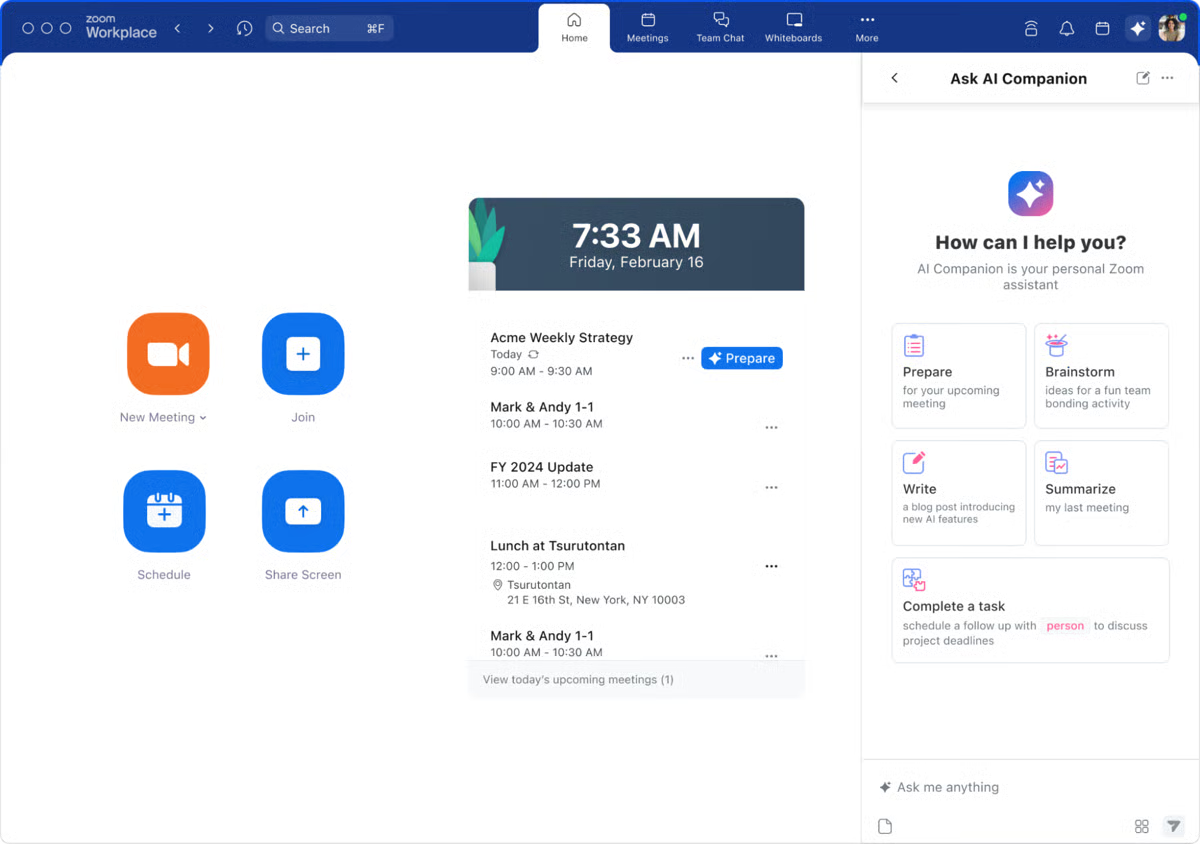
G2 users mention interface complexity, particularly for newly onboarded employees who need a simple, intuitive experience. Teams with dedicated IT support or structured training programs, however, often find that the depth of Zoom Workplace enables efficient collaboration once users become familiar with the interface.
Some G2 users also note that certain third-party integrations need extra configuration. This tends to impact teams running highly customized cross-application tasks, while departments relying primarily on Zoom’s native tools, such as standard meeting scheduling, webinars, and chat, generally find the core experience strong, reliable, and easy to adopt.
Overall, based on G2 user feedback, Zoom Workplace is valued for its high-quality meetings, seamless integrations, AI-driven tools, and comprehensive hybrid work support.
What I like about Zoom Workplace:
- I like how Zoom Workplace centralizes meetings, chat, documents, and desk reservations in one platform. G2 users also say this integration makes workflows for remote and hybrid teams much smoother.
- The AI Companion really stands out to me for automating summaries and task assignments, which reduces manual work; G2 reviewers similarly appreciate how it helps keep projects moving efficiently.
What G2 users like about Zoom Workplace:
"Zoom workspace makes communication really smooth by bringing meetings, chats, calls, and collaboration into one place. What I like best is how reliable and easy it is to use. You can jump into meetings quickly without worrying about setup or technical issues. It also works well for day-to-day teamwork. Switching between video calls, messages, which heps keep conversations and work feels seamless, which helps keep conversations and work moving without friction."
- Zoom Workplace Review, Radhika R.
What I dislike about Zoom Workplace:
- The interface can feel somewhat complex for new users; however, teams with structured training tend to navigate it well, as observed by G2 users.
- Some third-party integrations need extra setup, which works well for teams with dedicated IT support but can be an for teams relying mostly on native Zoom tools.
What G2 users dislike about Zoom Workplace:
"Sometimes the app uses a lot of system resources, and the free version has time limits. It could also improve integration with other tools and automatically reduce background noise. It would be great to have deeper integrations with tools like Google Workspace and Microsoft Teams, as well as more customizable noise reduction settings. Better AI-based background noise filtering would also improve the user experience."
- Zoom Workplace Review, Pedro S.
2. Archie: Best for flexible workplace management
Archie is a desk and room booking software designed for hybrid offices, coworking spaces, and large enterprises.
From what I’ve seen in G2 reviews, users frequently highlight its modern design and practical functionality, which make managing workspaces straightforward for both employees and admins.
I’ve noticed that G2 users often call out the intuitive interface as a major advantage. Reviewers mention that navigating bookings, schedules, and floor plans feels seamless, requiring minimal training to onboard teams. This ease of use is often credited with reducing scheduling errors and improving day-to-day operations.
A commonly appreciated element is the visual floor plans. Users highlight that being able to see office layouts and assign desks or rooms visually makes hybrid work planning far more efficient. Multiple reviewers note that this feature simplifies the process of identifying available spaces quickly, eliminating the need to dig through lists or menus.
The desk and meeting room booking system is also praised for its reliability. I’ve read multiple reviewers mention that reserving spaces for one-time or recurring sessions is smooth and helps prevent conflicts across departments. Users see this functionality as essential for coordinating hybrid teams.
Integration capabilities also receive positive mentions. Many users on G2 note that syncing with productivity tools like Microsoft Teams, Outlook, and Slack helps keep schedules aligned, reduces double-bookings, and supports hybrid scheduling efficiently.
Efficient visitor management also stands out in user feedback. Reviewers appreciate the smooth guest check-in process, noting that it feels professional, reduces administrative bottlenecks, and contributes to a positive experience for both employees and visitors.
According to feedback I gathered from G2 users, customer support is another key strength. Users frequently mention responsive assistance and clear guidance, which helps maintain seamless day-to-day operations.
Approximately 44.7% of G2 reviewers emphasize the calendar scheduling feature, which allows integration with third-party calendars or the use of Archie’s built-in system. This capability is often cited as critical for reducing conflicts, planning hybrid schedules, and managing team availability effectively.
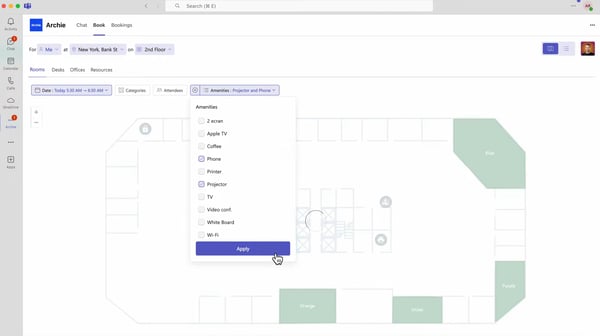
Some G2 users have reported cases with the mobile app, including unexpected logouts. This can be problematic for mobile-first staff who rely heavily on on-the-go access. Facilities management or operations teams, however, often find that desktop use and centralized booking processes mitigate these issues, ensuring daily operations run smoothly.
Reviewers also mention limited customization, including the absence of detailed reporting and team-only schedule views. This can affect teams that need advanced analytics or highly tailored scheduling. Still, front-desk teams, office managers, and hybrid workplace coordinators generally agree that Archie’s core booking and management functionalities remain robust and reliable.
Overall, based on G2 user feedback, Archie is highly valued for its intuitive interface, visual floor plans, seamless booking, and hybrid-friendly features.
What I like about Archie:
- I appreciate the intuitive interface and visual floor plans. G2 users also mention that this feature reduces scheduling errors and helps teams navigate hybrid work smoothly.
- The integration with tools like Teams, Outlook, and Slack really stood out to me, as it keeps schedules aligned. G2 reviewers also appreciate how this prevents double-bookings and supports recurring reservations.
What G2 users like about Archie:
"Booking desks or meeting rooms from Microsoft Teams is incredible. Our team can access a floor plan, filters, and everything else right there. The integration with Microsoft was the most important thing for us, and Archie’s integration works extremely well."
- Archie Review, Angie M.
What I dislike about Archie:
- The mobile app can log out unexpectedly, which can be particularly challenging for small teams or mobile-first staff, although operations teams usually manage well with desktop workflows.
- Customization options are somewhat limited, especially for advanced reporting or team-specific views; however, front-desk and office managers still find the core booking features to be very reliable.
What G2 users dislike about Archie:
"There was a bit of a learning curve since there are many settings you can customize, so you need to be aware of those options and how to manage them."
- Archie Review, Sylwia R.
5. Appspace: Best for enterprise workplace experience
Appspace is a desk booking and workplace experience platform designed to unite physical and digital workplaces into a single system.
From what I’ve seen in G2 reviews, users consistently highlight its ability to streamline hybrid office management while improving collaboration and engagement.
I’ve noticed that G2 users often praise the ease of space reservation, including room booking, desk hoteling, and resource management. Reviewers note that reserving desks or meeting rooms is straightforward, minimizes scheduling conflicts, and facilitates smooth office coordination.
The platform’s modern intranet for knowledge sharing and team engagement also stands out in feedback. Users frequently note that it simplifies sharing company updates, facilitates collaboration on projects, and keeps employees informed, whether they are on-site or remote. Features such as publishing content on workplace displays, video walls, and kiosks are often cited for enhancing visibility and communication across teams.
I’ve seen multiple reviewers highlight visitor management and employee check-in as key strengths. According to feedback, registering guests quickly ensures a professional experience while keeping administrative overhead low. Users also emphasize Appspace’s ability to support on-site, remote, and frontline employees, maintaining alignment and engagement across all locations.
Customizable content creation and workplace management analytics receive consistent praise. Reviewers note that built-in editors, third-party integrations, and reporting tools help track space utilization, understand trends, and make informed operational decisions.
A commonly appreciated element is automatic grouping, cited by 45.2% of G2 reviewers. Users highlight that it automatically assigns adjacent seats to team members, improving collaboration, reducing administrative work, and supporting hybrid scheduling.
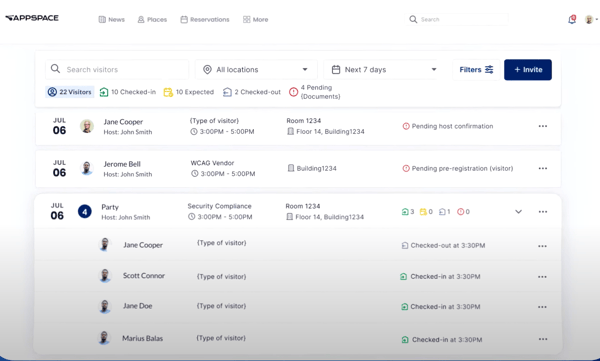
Some G2 users report considerations around implementation timelines and cost. Setup can take up to two months, and smaller organizations with limited budgets may find the platform expensive. That said, large enterprises or organizations managing complex hybrid workplace needs often find that the extensive features and centralized management justify the investment.
A few reviewers mention that the interface may not feel immediately beginner-friendly, particularly for non-technical staff or teams without dedicated IT support. Even so, facilities managers, hybrid workplace coordinators, and administrative teams generally find that once users become familiar with the system, the comprehensive feature set enables efficient desk booking, visitor management, content publishing, and analytics.
Overall, Appspace is highly valued for its desk booking, visitor management, content publishing, analytics, and time-saving automatic grouping.
What I like about Appspace:
- I appreciate how easy it is to reserve desks, rooms, and other resources. G2 users also note that this minimizes scheduling conflicts and ensures hybrid office operations run smoothly.
- The Automatic Grouping feature really stood out to me for automatically placing team members together; G2 reviewers similarly mention that it improves collaboration while reducing administrative effort.
What G2 users like about Appspace:
"What makes Appspace unique and special is its combined tools for office space management, digital signage, and visitor management. One software to handle all office management needs with a single cost helps reduce our software stack and budgets. The biggest win is the office space booking feature, which covers everything — from meeting rooms and desks to office parking and common areas. Everything is controlled digitally and can be easily accessed from a smartphone."
- Appspace Review, Izal D.
What I dislike about Appspace:
- The setup can take a while, and the platform may feel costly, which seems manageable for large enterprises but might be challenging for smaller organizations, according to G2 user feedback.
- The interface is feature-rich and not immediately beginner-friendly. However, G2 users report that it works well for dedicated facilities or hybrid workplace teams, but requires more guidance for non-technical staff.
What G2 users dislike about Appspace:
"Setup isn’t easy at first when installing it on our hardware. Thankfully, customer support is very understanding and resolves issues on the same day. Users need to explore the platform themselves to familiarize themselves with all the apps and features."
- Appspace Review, Larafiq A.
4. Tactic: Best for simple, employee-friendly desk booking
Tactic is an intuitive workspace management platform designed to simplify hybrid work by combining desk booking, room scheduling, and visitor management in a single system.
Based on G2 reviews, users consistently praise the platform for its ease of use and practical functionality.
I’ve noticed that G2 users often highlight the clean and intuitive interface. Reviewers frequently note that navigating between desks, rooms, and schedules feels seamless, making adoption straightforward for both employees and admins. This ease of use is often cited as a key factor in reducing the learning curve.
Smooth implementation and onboarding also appear in user feedback. Multiple reviewers note that setting up Tactic doesn’t require extensive technical knowledge, and that fast, helpful customer support ensures questions or minor issues are resolved quickly. This combination helps teams start managing workspaces efficiently and quickly.
The real-time availability and desk/room scheduling capabilities receive strong praise. I’ve read multiple G2 reviews mentioning that seeing free spaces, booking instantly, and managing recurring reservations are straightforward.
A standout feature, according to feedback, is Recurring Reservations, which 62.8% of G2 reviewers specifically highlight. This feature enables employees to reserve the same workspace daily, weekly, or monthly without having to repeat the booking process, thereby maintaining consistency and reducing administrative overhead.
I’ve seen G2 reviewers also emphasize reporting and analytics. Users note that insights into workspace utilization guide hybrid office planning and decision-making. Integration with tools like Outlook, Teams, and Google Calendar is frequently cited as a major benefit, as it keeps bookings synchronized across platforms and enhances productivity.
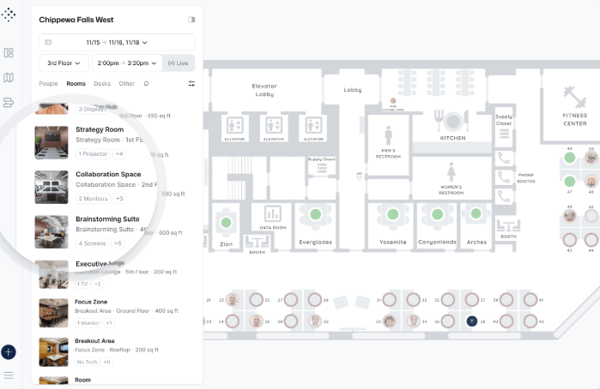
Some G2 users report slow load times, calendar syncing, and poor mobile app responsiveness. This can pose challenges for highly mobile teams that rely on quick, on-the-go access. Office management or administrative teams, however, often find that desktop use and scheduled workflows minimize disruptions, keeping operations running smoothly.
Users also note that there are limited customization options, and some advanced scheduling workflows are not fully supported. This may affect teams that require highly tailored scheduling or complex recurring bookings. Still, facilities managers, operations teams, and hybrid office coordinators generally agree that Tactic’s core features efficiently handle day-to-day office management.
Based on G2 user feedback, Tactic is highly valued for its intuitive interface, strong recurring booking functionality, easy integrations, and reliable reporting.
What I like about Tactic:
- I like how intuitive and clean the interface is; G2 users also say it makes navigating desks, rooms, and schedules straightforward, which reduces the learning curve.
- Recurring Reservations really stood out to me for saving time on repeat bookings; G2 reviewers similarly highlight how this feature keeps workspace scheduling consistent and efficient.
What G2 users like about Tactic:
"We have been using Tactic for more than a year now, and it has become part of our daily routine. We can definitely attest that this software is the best for work desk allocation and room reservations, allowing management to track which staff members occupy specific computers or meeting rooms. In addition, Tactic has a user-friendly interface that allows staff to navigate it with ease and does not require excessive supervision to use."
- Tactic Review, Kirk Evangelio O.
What I dislike about Tactic:
- Loading speed and mobile responsiveness can be a bit slow, which may be challenging for highly mobile teams; however, teams using desktop workflows tend to manage well.
- Customization options are somewhat limited, so highly tailored scheduling might be challenging, while standard office management tasks generally work smoothly, as G2 users have mentioned.
What G2 users dislike about Tactic:
"While the product is generally convenient, there are a few areas for improvement. Some features feel somewhat limited in customization, which may not meet everyone’s needs. A more detailed user guide and enhanced feature flexibility would make the product even better."
- Tactic Review, Mark Andrew G.
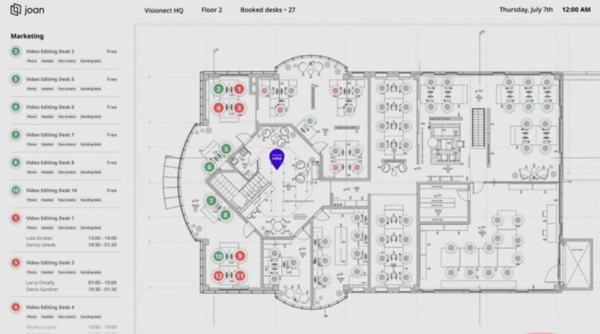
5. Joan: Best for hardware-integrated booking
Joan is a desk and meeting room booking software designed for modern hybrid workplaces.
From what I’ve seen in G2 reviews, users consistently praise its ease of setup and practical functionality, which allow teams to start managing workspaces with minimal training.
I’ve noticed that G2 users often highlight the seamless integrations with Microsoft 365, Google Workspace, Outlook, and Slack. Reviewers note that syncing bookings across familiar tools reduces scheduling conflicts and maintains consistent communication, which is especially valuable in hybrid work environments.
The platform’s desk and room booking capabilities are frequently cited as a major benefit. Many users note that quickly reserving spaces, whether for pre-planned meetings or last-minute walk-ins, reduces double bookings and streamlines office coordination.
According to feedback I gathered from G2 users, room usage insights is a standout feature. About 91% of reviewers highlight its automated reporting on room popularity, usage patterns, and meeting trends. Users note that these insights provide actionable data to optimize space allocation and improve overall efficiency.
Customer support also appears regularly in positive reviews. Users frequently mention responsive and helpful support, which makes resolving questions or minor issues fast and stress-free.
Scalability is another commonly appreciated element; reviewers note that Joan can support both small offices and large enterprises without major system changes. The energy-efficient e-paper displays also receive praise for combining functionality with sustainability goals.
On the downside, some G2 users report challenges with initial setup and connectivity, particularly Wi-Fi enrollment and device codes. This can be frustrating for organizations with limited IT support. IT-managed teams, however, often find that once devices are properly enrolled, the system works reliably and supports smooth operations across multiple locations.
Feedback also mentions hardware limitations, including slower touchscreens, concerns about battery life, and occasional brightness issues. This may impact teams that rely on mobile devices or frequently relocate. Still, office managers, hybrid workplace coordinators, and facilities teams generally agree that the software itself remains robust and dependable.
Overall, based on G2 user feedback, Joan is highly valued for its intuitive setup, seamless integrations, efficient booking, and actionable room insights — particularly for organizations managing multiple meeting spaces or hybrid work environments.
What I like about Joan:
- I appreciate the seamless integrations with Microsoft 365, Google Workspace, Outlook, and Slack. G2 users also note that syncing bookings across familiar tools reduces scheduling conflicts and keeps hybrid teams coordinated.
- Room Usage Insights really stood out to me for providing automated data on space utilization; G2 reviewers similarly highlight how this helps optimize room allocation and improve efficiency.
What G2 users like about Joan:
"The interface and devices are easy to configure and use, and are robustly built, which can be handy if you have heavy-handed employees! The support team is excellent, offering fast, concise help on the rare occasions you may need them. Great service for a low price."
- Joan Review, Daniel B.
What I dislike about Joan:
- Initial setup and device connectivity can be challenging for organizations with limited IT support. G2 users mentioned that IT-managed teams tend to find it smoother once devices are enrolled.
- Some hardware limitations, such as slower touchscreens or battery concerns, may affect teams that frequently move devices, while G2 users note that office managers and facilities teams generally find the system to be reliable.
What G2 users dislike about Joan:
"If they add an interactive floor plan feature, that would be perfect. Users could set up Joan on a main TV display and book meeting rooms directly from the plan."
- Joan Review, Gary C.
6. Skedda: Best for space scheduling and utilization insights
Skedda is a desk booking and hybrid workplace management platform designed to streamline office space scheduling and improve employee experiences.
From what I’ve seen in G2 reviews, users consistently highlight its intuitive interface and ease of adoption, which make managing hybrid office spaces straightforward for both employees and admins.
I’ve noticed that G2 users often praise the clean, user-friendly interface. Reviewers frequently mention that navigating desk, room, and space bookings is simple and intuitive, reducing the learning curve and enabling teams to get started quickly.
Customer support also consistently receives positive feedback. Many users highlight responsive and helpful support, noting that questions or minor issues are resolved quickly, which helps maintain smooth operations.
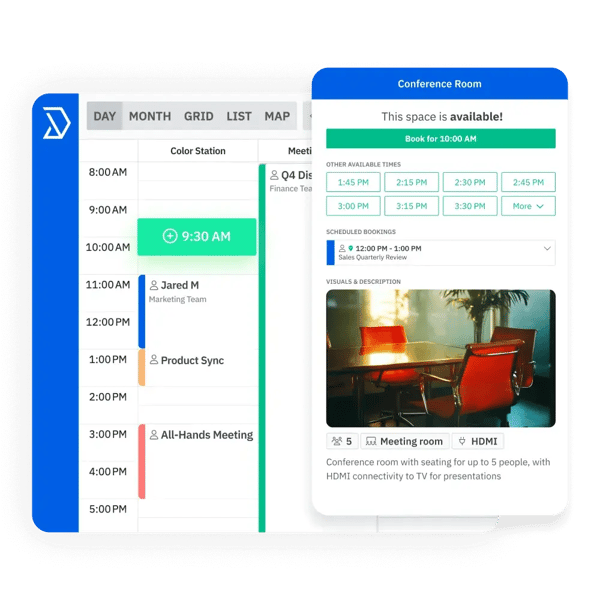
The platform’s drag-and-drop scheduling receives consistent praise. Users mention that it allows for quick adjustments to bookings without hassle. Combined with integrations with MS Teams, Outlook, and other tools, schedules remain synchronized across multiple systems, supporting efficient workspace management.
I’ve seen multiple reviewers emphasize the importance of quick implementation and minimal onboarding. According to G2 data, Mobile Booking is a feature highlighted by approximately 32.8% reviewers, allowing employees and visitors to book desks and rooms directly from mobile devices. Users note that this flexibility makes workplace management more efficient, particularly in hybrid settings where employees frequently move between locations.
G2 users report that notifications and updates can be unclear or disorganized, especially when multiple bookings occur simultaneously. This can be particularly challenging for coordinators who handle multiple shared spaces simultaneously. Office operations teams, however, often find that structured workflows and centralized oversight help mitigate confusion and keep scheduling under control.
Reviewers note limitations around booking flexibility and map rearrangements, which may require workarounds for complex scheduling scenarios. Teams managing intricate or highly dynamic office layouts may feel this more acutely, while standard scheduling for regular desk and room bookings tends to work smoothly.
Based on G2 user feedback, Skedda is highly valued for its intuitive interface, flexible scheduling, strong integrations, and mobile booking capabilities.
What I like about Skedda:
- I like the clean, intuitive interface. G2 users also mention that it reduces the learning curve and helps teams get started quickly.
- The drag-and-drop scheduling really stood out to me for making adjustments easy; G2 reviewers similarly highlight that integrations with MS Teams, Outlook, and other tools keep schedules synchronized and efficient.
What G2 users like about Skedda:
"We use Skedda for easy booking of instruments and spaces. Skedda has been super helpful because the bookings include all necessary information and can be scheduled as recurring. It’s easily accessible to everyone in the organization and makes scheduling a breeze."
- Skedda Review, T M.
What I dislike about Skedda:
- Notifications and updates can be confusing when multiple bookings occur simultaneously, which may be challenging for small teams but is usually manageable for operations with structured workflows.
- Limitations around booking flexibility and map rearrangements can be noticeable for complex office layouts, though standard desk and room scheduling work smoothly for most teams, according to G2 feedback.
What G2 users dislike about Skedda:
"Almost all of the required features exist within Skedda, but it would be useful to set defaults or allow users to customize them. For example, whenever I open Skedda, it starts with the first map in the list, but I almost always want to book for the London office. It would be great to set that as my default office."
- Skedda Review, Verified User in Financial Services
Desk booking software: Frequently asked questions (FAQs)
Q. What platform offers the most flexible workplace management features?
Archie excels at flexible workplace management. It supports hot-desking, visitor management, and workspace analytics to help companies optimize layouts and improve space utilization.
Q. Which vendor provides the most user-friendly desk booking experience?
Tactic stands out for its clean, employee-friendly interface. Its mobile-first design makes it easy for teams to reserve desks and shared spaces quickly, even on the go.
Q. What solution pairs software with hardware for a smooth booking experience?
Joan is known for its hardware-integrated setup. It pairs its booking software with sleek e-ink desk displays and room panels, offering a streamlined, on-site reservation experience.
Q. Which desk booking platform is best suited for large enterprises?
Appspace delivers a strong enterprise-ready workplace experience. It combines desk booking with digital signage and workplace communication tools, offering a unified solution for large, distributed organizations.
Q. What tool provides the strongest insights into office space usage?
Skedda is ideal for organizations focused on space scheduling and utilization insights. It helps teams manage shared spaces efficiently and analyze usage data to right-size office footprints.
Q. Is there an all-in-one platform for managing hybrid workplace operations?
WorkInSync provides end-to-end hybrid workplace management. It centralizes desk booking, team scheduling, safety processes, and office planning for modern hybrid teams.
Hybrid work works better with smart booking
When hybrid teams rely on guesswork, manual planning, or scattered calendars, office days quickly become chaotic. Double-booked desks, overcrowded areas, and underused spaces create friction that slows people down and frustrates employees.
A reliable desk booking platform helps you shift from reactive space management to a thoughtful, data-driven workplace experience. It gives employees the freedom to choose where they work, provides real-time visibility into availability, and helps workplace teams understand how spaces are actually being used.
Choose a tool that fits your scheduling needs, workplace policies, and hybrid model, and watch team coordination, space utilization, and onsite productivity improve.
Explore the top facility management platforms on G2 and coordinate assets and maintenance operations with centralized visibility.
.png?width=400&height=150&name=Untitled%20design%20(56).png)


.png)