

The top AI tool for product managers is Luna AI, rated 4.9/5. It stands out for helping PMs improve roadmap execution visibility, monitor risks, generate OKRs, and create stakeholder updates faster.
There's a particular kind of exhaustion that comes with being a product manager — not from the hard decisions, but from the noise surrounding them. Somewhere between the Slack thread where a sales rep relayed a customer complaint, the Notion doc no one has updated in three weeks, and the leadership request that arrived with no context and a two-day deadline, the actual work of building a great product gets buried.
That lack of strategic time is a real problem. In fact, 72.2% of product managers spend 25% or less of their time on product strategy, leaving most of their week consumed by operational work. The right product management software can help change that, and increasingly, the tools making the biggest difference are AI-powered ones, capable of automating the repetitive work that crowds out strategic thinking: feedback synthesis, PRD drafting, roadmap summaries, prioritization support, and stakeholder updates.

In this article, I evaluated the best AI-powered product management software to understand which tools can reduce manual work, improve decision-making, and help PMs spend more time building products customers actually need.
Compare the leading AI-powered product management and roadmapping tools by G2 rating, pricing, ideal use case, AI capabilities, and free trial availability.
| AI tool | G2 rating | Starting Price | Best for | AI features | Free trial |
| 1. Luna AI | 4.9/5 | $49/month | Roadmap execution visibility | Roadmapping, goal tracking, Jira risk alerts | No |
| 2. DevRev | 4.4/5 | Custom | Customer feedback intelligence | AI support agents, shared customer memory, and handoff summaries | No |
| 3. Zeda.io | 4.3/5 | $499/annually | Voice-of-customer prioritization | Feedback summaries, auto-tagging, trend insights | Yes |
| 4. Canny | 4.5/5 | $99/month | Feedback-driven roadmapping | Feedback capture, insight grouping, revenue impact | Yes |
| 5. Productboard | 4.3/5 | $25/month | Customer-driven roadmaps | Feedback categorization, trend summaries, feature briefs | Yes |
| 6. Jira Product Discovery | 4.3/5 | $10/month | Evidence-based prioritization | AI drafting summaries, action-item extraction | Yes for the standard plan |
| 7. Airfocus by Lucid | 4.4/5 | Custom | Strategic roadmap planning | Roadmap Q&A, trade-off analysis, drift detection | No |
| 8. Craft.io | 4.5/5 | $24/month | End-to-end product strategy | Epic analysis, release notes, product-data Q&A | Yes |
| 9. Miro | 4.6/5 | $8/month | Collaborative product planning | Roadmap generation, dependency checks, workflow automation | Yes for business plan |
| 10. Aha! | 4.4/5 | $9/month | Enterprise product planning | Research synthesis; idea clustering; content drafting | Yes |
Note: The details here reflect the most current capabilities as of June 2026, but may change over time.
To keep the evaluation fair, I analyzed AI-enabled tools from the G2 Summer Grid® Report 2026. I evaluated them using G2 Score, customer satisfaction, market presence, verified user sentiment, and cross-checked vendor documentation for AI capabilities, integrations, product management use cases, and workflow support. Product images were sourced from respective vendor pages to reflect the 2026 software landscape.
To qualify for inclusion in the Product Management category, a product must:
Luna.AI stood out because it maps closely to the parts of product management that depend on visibility, prioritization, and consistent follow-through. For PMs, the value is not just in tracking work, but in seeing which initiatives need attention before they become execution risks. The tool supports progress monitoring, task ranking, and custom workflows, which are all practical needs for roadmap and delivery-focused teams. That makes luna.AI relevant for PMs who want a clearer operating layer across planning, execution, and stakeholder communication.
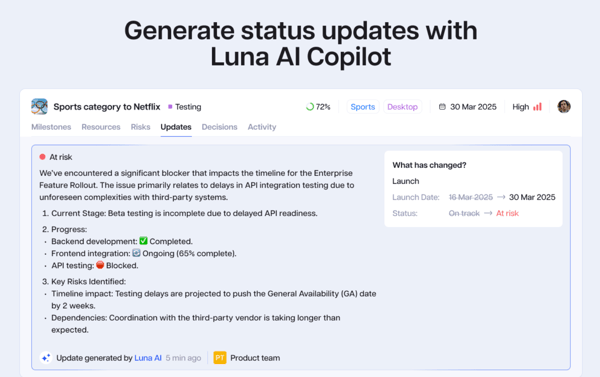
When I analyzed G2 reviews, I noticed that progress monitoring was the clearest strength users connected to Luna AI. G2 reviewers repeatedly described using the product to understand whether initiatives were on track, identify blockers earlier, and reduce the manual effort behind status updates. This matters for PMs because it supports one of the most operational parts of the role: knowing where work stands without relying only on meetings, spreadsheets, or scattered team updates. The feature-level data reinforces this pattern, with progress monitoring rated at 99% compared with an 87% category average.
Users also value luna.AI for helping structure work around priorities and execution signals. They mentioned themes such as task visibility, project health, risks, dependencies, OKRs, and Jira-connected updates, which point to an AI use case around prioritization and decision support. For product managers, that makes the tool useful beyond simple reporting because it helps surface where attention may be needed next. Task ranking also stood out in the feature data, with a 97% rating.
One limitation I saw in G2 reviews was that some users wanted stronger Microsoft Teams integration. For PMs, AI visibility matters more when it works with other tools in their existing workflows. Luna.AI is best for teams that can bring their progress-tracking insights into their existing workflows. It's the go-to tool for monitoring progress and keeping teams aligned.
Recommended reading: Want to build more realistic timelines, align stakeholders, and avoid project scope surprises? Read how to create a project plan to set realistic expectations.
DevRev earns its place because its AI use case sits close to a core product management problem: connecting customer issues to product and engineering work. For PMs, the value is not just ticket management, but using AI to make support signals easier to summarize, route, and act on. The G2 review data points to DevRev being a tool that helps teams reduce context loss between support, product, and engineering. That makes it especially relevant for PM workflows around feedback triage, bug prioritization, customer issue tracking, and cross-functional follow-through.
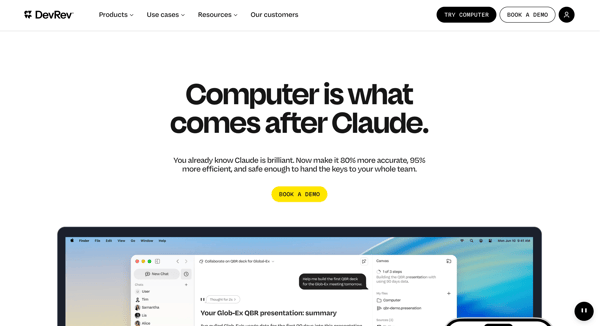
When I analyzed G2 reviews, I noticed that users repeatedly valued DevRev for connecting support issues directly to engineering and product workflows. Reviewers described fewer handoffs, less back-and-forth, and a clearer shared view of customer-reported problems. For product managers, that matters because customer feedback becomes easier to trace from complaint to dev ticket to resolution. The feature data supports this collaboration angle, with the community forum rated 86%.
My reading of G2 review data suggests that users also liked DevRev’s AI summaries and AI-assisted replies. Reviewers said these features helped them understand customer issues faster and respond with more context. For PMs, this is useful because support conversations can reveal patterns in bugs, feature requests, and customer pain points. Task ranking was rated 83%, which shows prioritization is part of the product experience.
One limitation I saw in G2 reviews was that parts of the interface can feel cluttered or harder to navigate, especially around filters, fields, and issue lists. The concern appeared as usability friction rather than a rejection of the product’s core value. Reviewers still pointed to DevRev’s strengths in connecting teams, tracking tickets, and using AI to summarize recurring issues.
Of users said that AI helped them work faster or more efficiently, particularly by speeding up task completion, reducing manual effort, streamlining workflows, or making everyday product work easier.
Zeda.io made the list because G2 reviews show that it supports many parts of product management in one place. Users mentioned feedback collection, idea management, roadmaps, prioritization, PRDs, and goal tracking. Its AI features matter because they help teams make sense of product inputs instead of sorting through every request manually. For PMs, Zeda.io helps bring feedback, planning, and documentation into one clearer workflow.
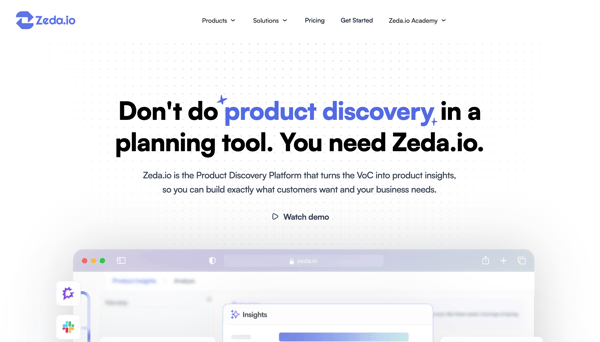
When I analyzed G2 reviews, I noticed that users often liked Zeda.io as a central place for product feedback and ideas. G2 Reviewers mentioned collecting feedback from customers, business teams, and internal stakeholders, then organizing it for roadmap planning. This matters for PMs because product decisions often start with messy inputs from many places. Zeda.io’s Wiki Documentation feature was also rated 90%, which supports the theme of keeping product knowledge organized.
My reading of G2 review data suggests that users also valued Zeda.io for prioritization and roadmap planning. Several reviewers called out prioritization methods, OKRs, feature backlogs, Jira integration, and the ability to connect product work to broader goals. For PMs, this is useful because it helps move ideas from feedback to planned work. The feature data supports this pattern too, with Kanban Board rated 89% against an 85% category average and task ranking rated 89% against an 87% category average.
One drawback I saw in G2 reviews was that Zeda.io can take time to learn. Some users said the product feels large at first or that navigation and onboarding could be smoother. For PMs, this matters because a product management tool needs team adoption to work well. Still, reviewers said the tool became useful once they got comfortable with how the workflows were set up.
said AI improved collaboration or team alignment by helping teams stay on the same page, increasing visibility, supporting communication, or centralizing shared work.
Source: G2 Summer Grid® Report 2026 for Product Management
Canny made the list because G2 reviews show that it helps product teams collect and organize customer feedback in one place. Users talked about feature requests, upvotes, public roadmaps, changelogs, and customer ideas. Its AI features matter because they can help teams handle feedback faster, especially when commercial teams need an easier way to submit product input. For PMs, Canny supports feedback management, customer ideation, roadmap planning, and prioritization.
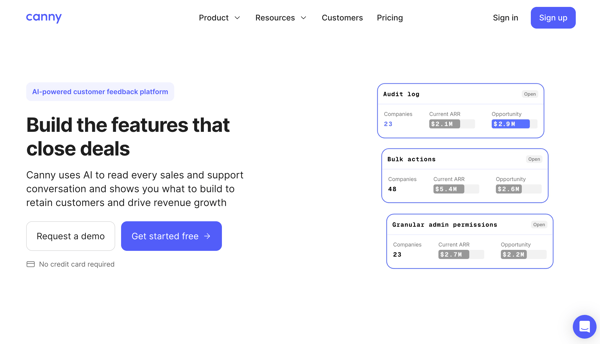
When I analyzed G2 reviews, I noticed that Canny’s AI value shows up in how feedback gets captured from commercial teams. One reviewer said the AI integrations make it easier for sales and customer-facing teams to enter feedback. For PMs, this matters because those teams often hear product requests before anyone else. Canny helps bring that feedback into the product workflow earlier.
Canny’s AI assistant helps with the early work of turning feedback into product ideas. One reviewer mentioned that it can auto-create feature requests from incoming feedback. For PMs, that is useful because raw customer comments often need to be cleaned up before they can be reviewed or discussed. This connects well with Canny’s broader strength in customer ideation, which was rated 88%.
One drawback I saw in G2 reviews was that some users wanted more flexible filtering and customization. Feedback tools are most useful for PMs when teams can sort requests by customer type, revenue, opportunity, or roadmap need. Still, users continued to describe Canny as a strong place to collect, organize, and act on customer ideas.
said AI helped with organization, task tracking, planning, or keeping work on track across tickets, backlogs, roadmaps, workflows, and project status.
Source: G2 Summer Grid® Report 2026 for Product Management
Productboard's G2 reviews show that it helps PMs connect customer feedback, insights, and roadmap planning. Users describe it as a place to collect feedback, link it to features, and decide what should move forward. From an AI use-case lens, the value is in helping product teams make sense of large amounts of feedback and turn it into clearer planning inputs.
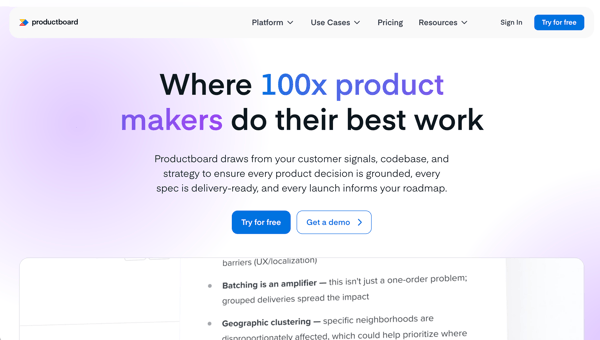
When I analyzed G2 reviews, I noticed that users valued Productboard for bringing feedback into one place from many channels. Reviewers mentioned customer portals, support conversations, Slack, Intercom, Jira, and internal teams as sources of product input. From an AI lens, this is important because teams first need a clean feedback base before they can analyze patterns or prioritize requests. Customer ideation was rated 84%, which shows this feedback workflow is a major part of the product experience.
The data also suggests users like Productboard for helping them connect feedback to features and priorities. Reviewers talked about tagging notes, linking insights to features, using prioritization tools, and deciding what to build next. For PMs, this supports an AI-relevant workflow because the goal is to turn raw feedback into clearer product decisions. Task ranking was rated 84%, so prioritization is clearly part of the experience.
One drawback I saw in G2 reviews was that some users still found the insight process too manual. Reviewers mentioned manual tagging and the need for better help with sorting feedback into the right categories. Still, reviewers continued to value Productboard for centralizing feedback and helping teams connect customer needs to roadmap planning
said AI helped with search, context, or knowledge retrieval by making it easier to find, reference, connect, or centralize product and project information.
Source: G2 Summer Grid® Report 2026 for Product Management
Jira Product Discovery helps PMs turn scattered product inputs into clearer decisions. Users mentioned customer insights, feature ideas, stakeholder feedback, business requirements, and Jira delivery work. Its AI use cases show up in idea writing, insight summaries, and reducing manual review during early discovery. For PMs, that means less time cleaning up inputs and more time deciding what should move forward.
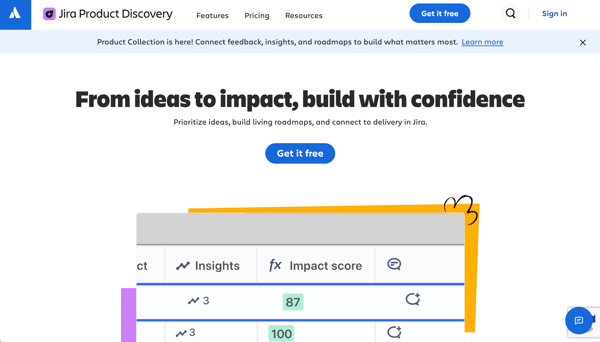
When I analyzed G2 reviews, I noticed that users liked how Jira Product Discovery helps structure ideas before they reach engineering. Reviewers mentioned AI features that generate and refine idea descriptions, summarize requirements, and help review discovery notes faster. For PMs, this is useful because raw product ideas often need work before they are ready for prioritization. The feature data supports this workflow, with task ranking rated 90%.
My reading of G2 review data also suggests that users also valued Jira Product Discovery for turning customer insights into usable product context. One reviewer called out AI features that summarize dense customer feedback into shorter takeaways, while another mentioned assisted insight grouping for similar requests. For PMs, this helps reduce the manual work of reading every comment, tagging every idea, and finding patterns across feedback. Customer ideation was rated 89%, above the 85% category average.
One drawback I saw in G2 reviews was that users still wanted stronger automation in some workflows. Some reviewers said tasks like tagging and updating fields could feel manual. For PMs, this matters because discovery tools are most useful when they cut down repeat work across a growing idea backlog. Even so, the reviews suggest Jira Product Discovery still gives teams a cleaner way to move from early ideas to prioritized work.
said AI helped reduce manual or repetitive work through automation, agents, templates, rules, or AI-assisted generation.
Source: G2 Summer Grid® Report 2026 for Product Management
Airfocus by Lucid helps PMs make roadmap decisions with less manual sorting. G2 reviews point to a product built around scoring, prioritization, feedback intake, and roadmap planning. The strongest AI use case is decision support: helping teams compare ideas, weigh tradeoffs, and turn inputs into ranked work. For PMs, this can make planning sessions more structured and less dependent on scattered opinions.
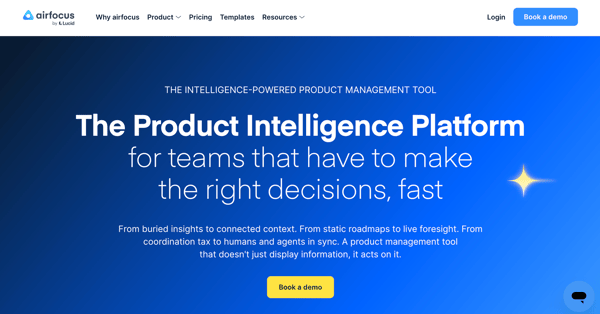
When I analyzed G2 reviews, I noticed that airfocus stood out for helping PMs score and rank product ideas with less manual effort. Reviewers mentioned custom scoring, prioritization templates, Priority Poker, and automated prioritization matrices. This gives PMs a more structured way to compare requests, instead of relying only on opinions in roadmap meetings. The data supports this use case, with Task ranking as the highest-rated feature at 84%.
My reading of G2 reviews alos suggests that airfocus helps PMs connect planning work with delivery updates. Reviewers mentioned APIs, Jira, GitHub, Zapier, and Azure DevOps integrations as ways to pull product and development data into one place. This is where the automation use case becomes useful: PMs can track feedback, roadmap items, and engineering progress without copying updates between tools. Kanban Board was rated 83%, which fits the way users described managing work as it moves from planning to execution.
One drawback I saw in G2 reviews was that users wanted stronger workflow automation. Some reviewers mentioned wanting less manual work around duplicate items and workspace updates. Even with that gap, the reviews show that airfocus still gives teams a structured way to score, compare, and plan product work.
Want to better understand how product teams are using customer feedback to guide roadmap decisions? Explore our guide to feedback analytics in 2026 to learn how leading teams analyze user feedback.
Craft.io stands out for PMs because it helps turn product planning into a more connected workflow. In the G2 reviews, users described moving from scattered roadmaps, backlogs, and strategy docs into one shared system. The AI angle is strongest around automation and decision support, especially when teams need help ranking work, syncing delivery updates, and reducing manual roadmap maintenance.
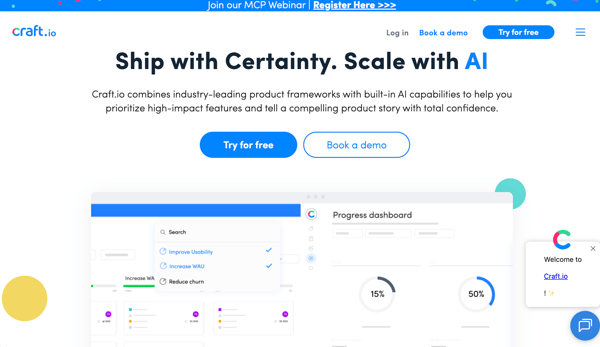
In my read of G2 reviews, Craft.io’s biggest strength is helping PMs make prioritization less messy. Product teams often have too many requests, too many stakeholders, and no easy way to compare what matters most. Reviewers liked that Craft.io AI featues gives them a clearer way to weigh ideas, connect work to goals, and decide what should move forward. That pattern matches the data, where Task ranking was rated 90%, above the 87% category average.
What also stood out was how often users connected Craft.io to automation across product and engineering work. Reviewers mentioned Jira, Azure DevOps, Linear, sync features, and fewer manual updates between teams. For PMs, this is useful because roadmap accuracy depends on delivery data staying current without constant copy-pasting. The Kanban board was rated 90%, above the 85% category average.
G2 reviews suggest that Craft.io’s AI features are still developing, especially around customer feedback analysis. One reviewer mentioned wanting more AI help with analyzing feedback, which feels like a natural next step for a product planning tool. Reviewers continue to value Craft.io for bringing structure to roadmaps, priorities, and product planning.
Want to keep projects on track and deliver work that meets stakeholder expectations? Read What is project quality management? components and best practices.
Miro's G2 reviews show that PMs use Miro to turn messy thinking into shared product work. Reviewers talked about brainstorming, workshops, diagrams, roadmaps, and team planning. The AI angle is strongest when Miro helps teams organize notes, generate ideas and summarize what is on a board. For PMs, that means discovery sessions and planning workshops can move faster from open discussion to clearer next steps.
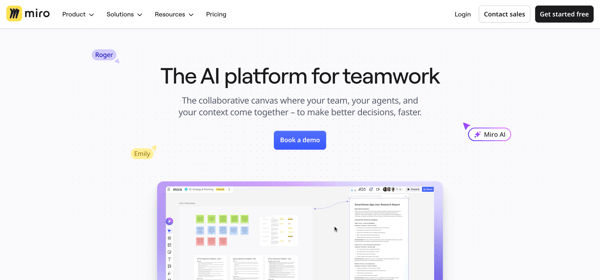
In my read of G2 reviews, Miro’s AI features were most useful during the messy early stages of product work. PMs often start with scattered ideas from workshops, customer calls, team notes, and stakeholder feedback. G2 reviewers said Miro AI helped generate ideas, group sticky notes, and organize loose thinking on the board. That means PMs can move faster from an open-ended discussion to a set of themes the team can actually evaluate.
What stood out next was how Miro’s AI helped turn product thinking into something visual. Instead of leaving ideas as a wall of notes, reviewers used AI-supported flows, tables, diagrams, and presentations to shape the work. For PMs, this helps because teams make better decisions when they can see the journey, process, or workflow in front of them. Miro’s custom workflows feature was rated 83%, which reflects its role in helping teams move from raw ideas to shared working boards.
The one challenge I saw in G2 reviews is that Miro’s AI features are still uneven for some users. A few reviewers said the AI could be much better for specific tasks like certain diagrams or storyboards. Still, reviewers continued to value it for brainstorming, organizing ideas, and making collaboration more visual.
said AI helped with writing or documentation, including drafting descriptions, summarizing information, creating documentation, writing requirements, or improving PRD-related work.
Source: G2 Summer Grid® Report 2026 for Product Management
Aha!'s G2 reviews show how AI can help PMs handle product planning at scale. When feedback, ideas, roadmap work, and delivery updates live across many teams, PMs need help finding patterns and keeping plans current. Reviewers pointed to AI-assisted search, filtering, automation, documentation, and feedback analysis as useful parts of that workflow. For PMs, Aha! is most useful when the work is too complex to manage with static spreadsheets or one-off roadmap decks.
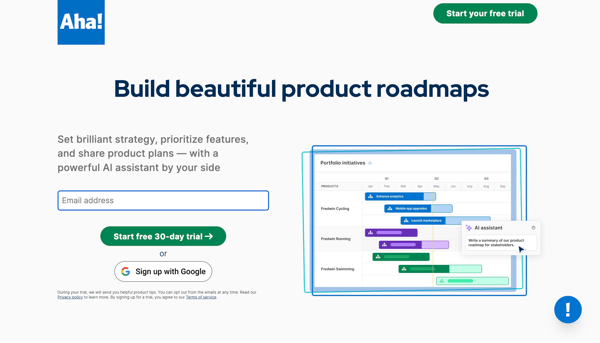
When I analyzed G2 reviews, I noticed that Aha!’s AI value was clearest in feedback analysis. PMs often have to read through long lists of ideas and customer requests before they can spot what is actually repeating. Reviewers pointed to automatic theme clustering and Aha!’s AI assistant, Elle, as ways to make that work easier. That matters because it helps PMs move faster from raw feedback to patterns they can use in roadmap decisions. Customer ideation was rated 89%, above the 85% category average, which supports this feedback-focused use case.
Another pattern in G2 reviews was that users valued Aha! for reducing manual updates across planning and delivery work. Reviewers mentioned automation rules, AI support for documentation, auto-updated presentations, and roadmap data staying current through integrations. For PMs, this helps turn roadmap maintenance from a constant admin task into a more connected workflow. Custom workflows was rated 88%, above the 85% category average, which fits the way users described automating parts of their product process.
Aha! already shows value in helping teams organize feedback and keep roadmap work connected. One limitation I saw in G2 reviews was that users wanted stronger AI support in the ideas area. For PMs, that matters because idea review is where teams often spend a lot of time sorting, grouping, and deciding what deserves attention. Even with that gap, the reviews suggest Aha! gives product teams a strong foundation for turning feedback into more structured planning
of Product Management reviews that mentioned AI received ratings of 4 stars or higher.
Source: G2 Summer Grid® Report 2026 for Product Management
Most "best AI tools for PMs" lists give you a stack of 15 tools and no way to decide between them. The real question isn't which tools exist but which tool solves the specific problem you have right now.
Before evaluating any tool, answer this honestly: where do you lose the most hours each week?
Product managers typically bleed time in one of five places:
Buy one excellent tool per workflow stage. Don't buy a do-everything platform that does nothing well.
AI tools for product managers are split into five functional lanes. Each requires a different kind of AI:
| Workflow Stage | What you need AI to do | Tool category |
| Customer Discovery | Conduct and synthesize interviews at scale | Conversational research (e.g., Perspective AI, Dovetail) |
| Documentation | Draft PRDs, specs, release notes | Writing assistants (e.g., Claude, Notion AI) |
| Prioritization & Roadmapping | Cluster feedback, score features, generate updates | Roadmap platforms (e.g., Productboard, Linear) |
| Product Analytics | Answer data questions in plain English | Analytics tools (e.g., Amplitude, Mixpanel, PostHog) |
| Meetings | Transcribe, summarize, track actions | Meeting intelligence (e.g., Granola, Fireflies) |
A tool that writes a brilliant PRD is rarely the tool that synthesizes 200 customer interviews. Conflating the two is how teams end up paying for software they barely open.
Once you've shortlisted tools for your workflow stage, run each through these three filters before committing:
Filter 1 -Does it remove a bottleneck or just add a feature? The best AI tools eliminate a step you currently do manually. If you can't name the exact task it replaces, it's a nice-to-have, not a need-to-have.
Filter 2 - Does it fit your team's size and setup? Enterprise-grade platforms with six-week onboarding are the wrong fit for a two-person PM team. Conversely, individual productivity tools won't scale to a 20-person product org. Match tool complexity to team reality.
Filter 3 - Can you measure its impact within 30 days? Good AI tools produce verifiable outputs, time saved, decisions made faster, and research synthesized. If you can't define what "working" looks like in a month, you won't know if it's worth keeping.
If you're building an AI stack from scratch, customer discovery is the highest-leverage starting point.
Every downstream decision on what to prioritize, what to roadmap, and what to measure inherits the quality of your upstream research. Shallow discovery means your roadmap is a list of opinions dressed up as strategy.
Once discovery is covered, the recommended stacking order is:
The most common and expensive mistake PMs make when adopting AI is choosing a platform that promises to do everything. All-in-one tools tend to do each individual job worse than a purpose-built tool, while charging as if they do everything better.
The better model is a small, deliberate stack, typically three tools covering your top three workflow bottlenecks. A practical starting stack for most PMs in 2026 costs under $60/month and covers the highest-impact recurring work: research synthesis, meeting intelligence, and writing assistance.
Add tools only when you can name the specific problem they solve and the time they'll recover.
AI will take over PM busywork like summarizing research, drafting specs, and writing updates, but the core job was never about creating documents. It’s about making difficult product decisions, understanding customer needs before they are explicitly stated, and aligning teams without direct authority.
A Stanford and MIT study found that AI tools boosted worker productivity by 14%, with the largest gains coming from mid-level performers who used AI to close the gap with top talent. While companies may need fewer coordination-heavy PMs, the product managers who learn to use AI effectively are likely to become more valuable, not less.
Choosing an AI tool for product management should start with the workflow, not the vendor. The best tool is not always the one with the most AI features. It is the one that removes a real bottleneck from your day-to-day product work, whether that means summarizing customer feedback, prioritizing feature requests, drafting PRDs, updating stakeholders, or tracking roadmap risks.
Before comparing tools, identify where your team loses the most time. Are you spending hours reading customer feedback? Rewriting roadmap updates? Manually tagging feature requests? Preparing meeting notes? Pulling product data for stakeholders?
Once you know the bottleneck, it becomes easier to choose the right category of AI tool. For example, a feedback intelligence platform is useful if your biggest challenge is making sense of customer requests. A roadmapping tool is a better fit if you need help prioritizing work and communicating delivery progress. A meeting assistant is better suited for teams that lose time capturing decisions and action items.
AI should reduce review time, not create more cleanup work. When testing a tool, look closely at the quality of its outputs. Are the summaries accurate? Are recommendations explainable? Can the tool show which customer feedback or product data informed a suggestion? Does it preserve enough context for a PM to make a confident decision?
For product managers, traceability matters. AI-generated insights are only useful when teams can understand where they came from and validate them before making roadmap decisions.
An AI product management tool is more valuable when it works with the systems your team already uses. Look for integrations with tools such as Jira, Slack, Intercom, Zendesk, Gong, Salesforce, GitHub, Linear, Figma, Amplitude, Mixpanel, or your existing roadmapping platform.
This is especially important for PMs because product work rarely happens in one place. Customer feedback, engineering tickets, roadmap items, support conversations, and stakeholder updates often live across multiple tools. Strong integrations help AI surface patterns without forcing teams to manually copy information between systems.
A lightweight AI assistant may work well for an individual PM or a small startup team. A larger product organization may need stronger permissions, workflows, reporting, integrations, and governance. Before buying, ask whether the tool matches your team’s current maturity.
Also consider onboarding time. If a tool requires heavy setup, custom workflows, or weeks of training, make sure the expected payoff is worth it. The best AI tool is one your team will actually use consistently.
Before committing long-term, define what success looks like. Good AI tools should create measurable improvements, such as:
If you cannot measure the value within a month, the tool may become another subscription that sounds useful but does not change the workflow.
AI can summarize, cluster, draft, recommend, and automate, but product managers still need to make the final call. Prioritization requires business context, customer understanding, technical feasibility, and strategic judgment. Use AI to speed up the work around the decision, not to outsource the decision itself.
The best AI tools for product managers help teams move faster from scattered inputs to clearer product decisions. They do not replace product thinking; they create more space for it.
Still have questions? G2 has the answers!
The best free AI tools for product managers depend on the workflow, but PMs can start with tools that offer free trials or accessible entry points for roadmap planning, customer feedback analysis, product discovery, and AI-powered collaboration. Relevant options include Miro for collaborative brainstorming, Canny for feedback management, Jira Product Discovery for idea prioritization, and Productboard for customer-driven product roadmaps.
Aha! and airfocus are strong options for PRD writing because they support PRD generation, requirements, problem statements, and user stories. Jira Product Discovery is also useful for turning early ideas into clearer descriptions before they move into development.
The best AI tools for product discovery help product managers collect customer feedback, analyze voice-of-customer data, identify product opportunities, and prioritize feature ideas. Zeda.io, Productboard, DevRev, Canny, and Jira Product Discovery are especially relevant because they support feedback aggregation, insight discovery, customer ideation, AI summaries, and evidence-based prioritization.
Aha! is best suited for PRDs, requirements, and feature descriptions, while Craft.io is useful for product planning documents, epic summaries, release notes, and roadmap summaries. Together, they help PMs turn rough product inputs into structured specs faster.
Product managers often use Luna AI for roadmap visibility, status updates, and risk alerts. For daily feedback and prioritization work, Productboard or Jira Product Discovery can help PMs organize customer inputs, evaluate ideas, and connect decisions to roadmap planning.
Zeda.io is relevant for voice-of-customer analysis because it helps summarize feedback, auto-tag themes, and surface trends. Productboard is useful when PMs need to connect customer insights directly to features, priorities, and roadmap decisions.
Product managers need AI skills such as prompt writing, data interpretation, customer feedback analysis, workflow automation, AI-assisted prioritization, product analytics, and responsible AI decision-making. They should also understand how to use AI tools for product discovery, roadmap planning, PRD creation, stakeholder updates, competitive intelligence, and voice-of-customer analysis without losing human judgment.
Zeda.io is one of the best options for customer feedback analysis because it focuses on voice-of-customer insights, auto-tagging, feedback summaries, and trend detection. Productboard is also strong for teams that want to connect feedback directly to roadmap and feature decisions.
Look for tools that connect with your current stack, such as Jira, Slack, GitHub, Linear, Zendesk, Intercom, Salesforce, Amplitude, or Mixpanel. Also check data quality, permissions, ease of setup, and whether AI outputs are traceable. Relevant tools include DevRev, Productboard, Craft.io, Airfocus, and Aha!.
AI helps product managers make faster, more informed decisions by summarizing feedback, spotting patterns, ranking ideas, and surfacing risks. PMs still make the final call, but AI gives them better context and reduces manual analysis.
The best options are tools that analyze customer feedback, product signals, and feature requests. From the blog, the most relevant are DevRev, Zeda.io, Canny, Productboard, and Aha! for feedback intelligence, voice-of-customer analysis, customer-driven roadmaps, and growth-focused prioritization.
AI won’t replace the judgment product managers bring to strategy, discovery, and decision-making, but it can remove a lot of the manual work that slows teams down. The best starting point is to identify one high-friction workflow, such as summarizing customer feedback, prioritizing feature requests, creating PRDs, or updating roadmaps, and test an AI product management tool that supports that need.
For PMs, the real value comes from using AI to move faster from scattered inputs to clearer product decisions. Whether the goal is customer feedback intelligence, roadmap visibility, voice-of-customer analysis, or strategic planning, AI tools can help product teams stay aligned, reduce busywork, and focus more time on building products customers actually need.
Explore the top AI project management tools trusted by real G2 users, and find the right fit for planning, prioritizing, and shipping faster.

TL;DR: Best AI tools for developers in 2026 ACCELQ is one of the highest-rated AI tools for...
by Aditi Rai

TL;DR: Best AI Tools for Education in 2026 According to G2 reviews, SchoolStatus is the...
by Aditi Rai

I’ve managed enough projects to know the pain points by heart: chasing updates, piecing...
 by Washija Kazim