

Enterprises trust their AI agents. They just will not let go of the leash.
That is the clearest signal in 3,222 G2 reviews by enterprise buyers of AI agents in 2025 and 2026. Most of these buyers trust their agent. Very few would let it act autonomously.
Think of a new hire who aces every task in week one. You still check their work before it reaches a customer. That is how enterprises treat agents today. We call them short-leash buyers. They are enterprise reviewers who trust their agent “quite a bit” or “very much” but wouldn’t give it total autonomy. Their numbers nearly doubled this year.
For our research, we looked at G2’s AI Agents categories and chose the top five with the most reviewed products, since product count shows where vendors crowd in and where sellers compete hardest.
Then we pulled every approved review from companies with more than 1,000 employees in those five categories, from January 2025 to October 23, 2026. That gave us 3,222 reviews across 231 products.
We read the answers across three themes:
|
Category |
Reviewed products |
Enterprise reviews, 2025 |
Enterprise reviews, 2026 |
Growth |
|
289 |
236 |
832 |
3.5x |
|
|
204 |
218 |
472 |
2.2x |
|
|
136 |
402 |
954 |
2.4x |
|
|
96 |
71 |
123 |
1.7x |
|
|
49 |
156 |
430 |
2.8x |
Products counted from January 2024 to October 2026. A review can sit in several categories. Source: Reviews on G2
AI isn’t just adding new categories. It’s changing how buyers judge old ones. Read The Great Software Re-Rating: Top Categories Reshaped by AI in 2026 to see which categories buyers are rewriting.
Enterprise reviews of AI agents more than doubled this year, from 983 in 2025 to 2,239 so far in 2026, according to G2. G2's 2026 AI Agents Report backs this: 66% of organizations now run agents in limited or scaled production.
AI usage is becoming more of a habit for this group, too. In 2026, 53% of enterprise reviewers say they reach for their agent most of the time or every time, up from 47% in 2025.
And where do they use it? That happens mostly behind the scenes. Process automation leads enterprise use cases at 34%, then customer service at 27%, and software engineering at 21%. Sales development (12%) and marketing (7%) trail.
Enterprises prove agents on internal work before they trust them with revenue. That could be why business operations agents grew so fast, at 3.5 times from 2025 to 2026.
Sellers can sell into that pattern. Anchor the first deal to an operations job that the buyer already measures, such as lead routing or follow-up that a human approves. Then expand from there.
Or, if the deal stalls after a strong demo, check what you asked the buyer to trust first.
A front-office agent is a hard first step for a team with no back-office wins yet.
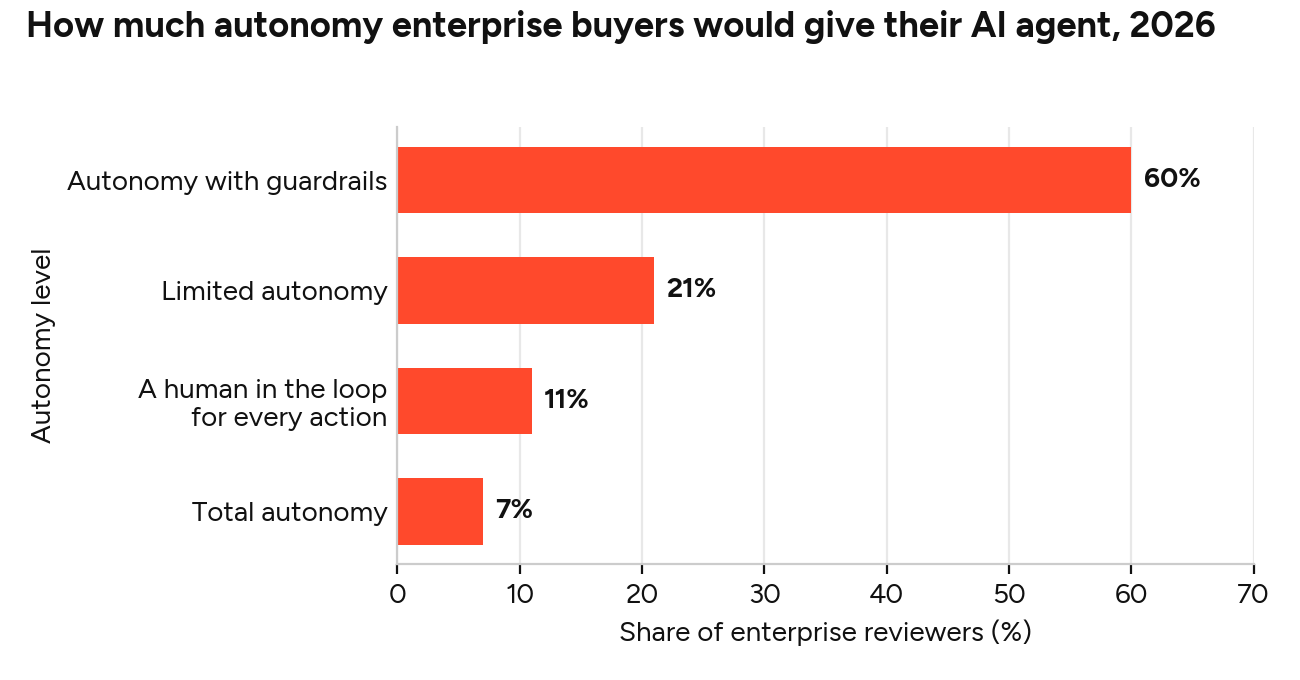
G2 has found that enterprise buyers largely trust their agents: 77% trust them “quite a bit” or “very much”. Reviewers have also answered how much autonomy they would give the agent, and the answers tighten fast:
Source: reviews on G2
Here is the part that surprised us: more trust lengthens the autonomy leash, but it rarely comes off. G2 asks reviewers how much they trust their agent to reliably perform its intended tasks. As trust rises, buyers give the agent more room.
Limited autonomy falls from 34% among reviewers who trust it “somewhat” to 10% among those who trust it “very much,” while autonomy with guardrails rises to 65%. But total autonomy stays rare. Even among reviewers who trust their agent “very much,” only 15% would grant it, and about 1 in 10 still want a human to approve every action.
Trust and autonomy answer different questions. Trust is about whether the agent does its job well. Autonomy decides whether anyone checks the agent’s work before it acts.
With total autonomy, a mistake can reach a customer, a record, or a payment before anyone catches it, and the buyer’s team is held responsible. That’s why the people who carry that risk hold the leash tightest: 5% of admins and 2% of executive sponsors would grant total autonomy, against 10% of everyday users.
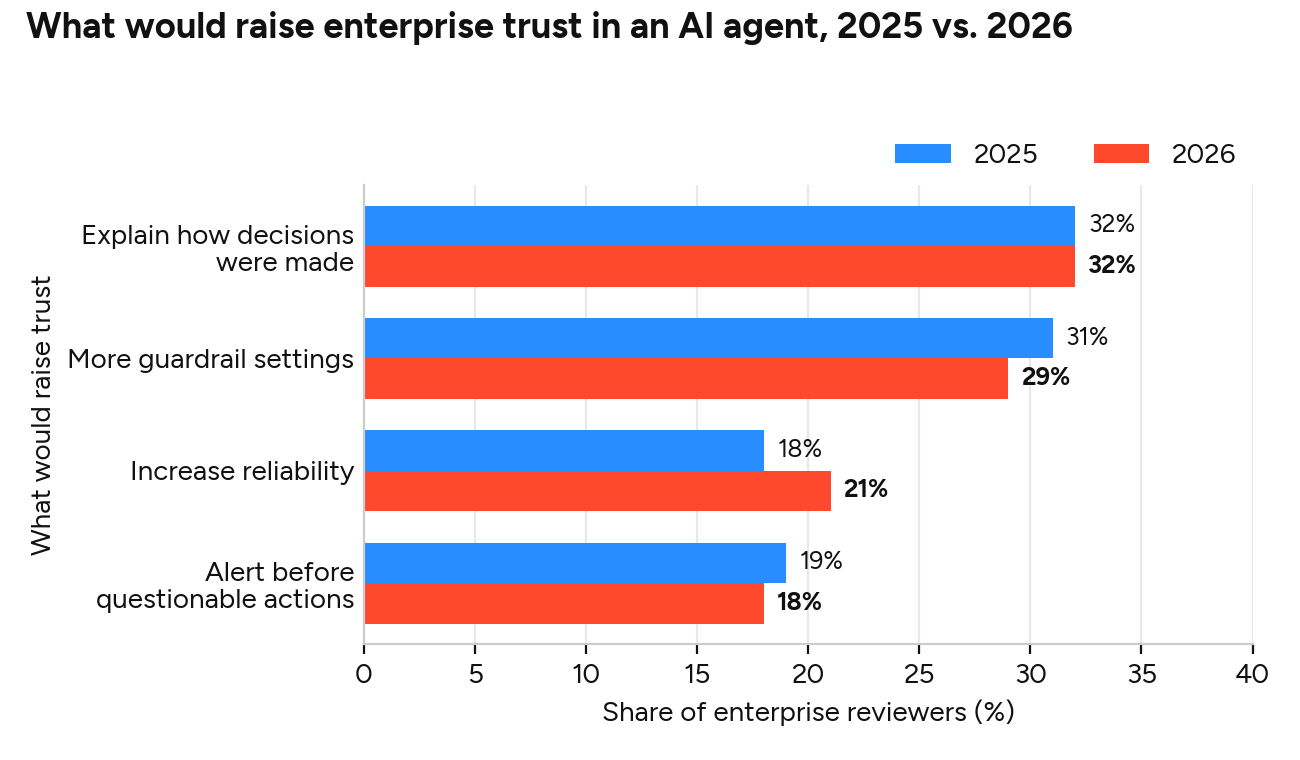
So what would earn more trust? 79% picked a visibility or control fix. They want the agent to explain its decisions (32%), more guardrail settings (29%), or a warning before questionable actions (18%). Only 21% asked for better reliability.
Source: reviews on G2
G2’s AI rating questions point the same way. About 500 enterprise reviewers scored their agents from 1 to 5 on specific qualities in 2026. 92% gave output accuracy a 4 or 5, but only 82% said the same for how well the agent explains its results or fixes its mistakes. Low or middling scores are more than twice as common for explanations as for accuracy, 18% against 8%. Most buyers are already satisfied that the agent gets the answer right. What holds back their trust is seeing how it got there and what happens when it’s wrong.
Keeping that control has a cost. An accurate agent still needs watching when buyers can’t see how it reached a decision, so someone on the team checks its work.
G2’s 2026 AI Agents Report, a survey of B2B organizations, calls this the Distrust Tax: 31% spend six or more hours a week overseeing agents, and 45% say oversight and rework eat up more than a quarter of the gains.
Stop leading with autonomy. Only 7% of enterprise buyers want it, and it worries the admins and sponsors who sign off.
Lead with the leash instead. In the first demo, show how the buyer sets guardrails, sees why the agent acted, and gets warned before a risky step. Make those controls easy to set, or the leash becomes a setup project of its own.
In 2026, about 20% of enterprise reviews of AI agent builders and AI customer support agents on G2 complain about cost, against 9% for business operations agents. Several describe usage-based pricing that’s hard to forecast.
Before the buyer signs, show them:
Showing these controls early also helps deals that stall in security review, where teams need proof they can see, steer and stop the agent
AI isn’t priced like software, and buyers feel it on every invoice. Watch How to Control AI Software Spend Before It Spirals to understand the cost worries you’ll need to answer.
Enterprise buyers have good things to say about agents, but there is room for improvement, found G2. The average recommended score in 2026 is 9.04 out of 10. But it has slipped every year, from 9.24 in 2024 and 9.10 in 2025. Perfect 10s fell below half for the first time, from 55% to 48%.

Source: reviews on G2
Four of five categories slipped this year. Three patterns explain the slide:
Setup still hurts. Setup or complexity is the top complaint in both years, named in 25% of 2026 dislikes. It peaks for support agents (34%) and SDRs (31%). Fans feel it too: promoters raise it slightly more often than other reviewers.
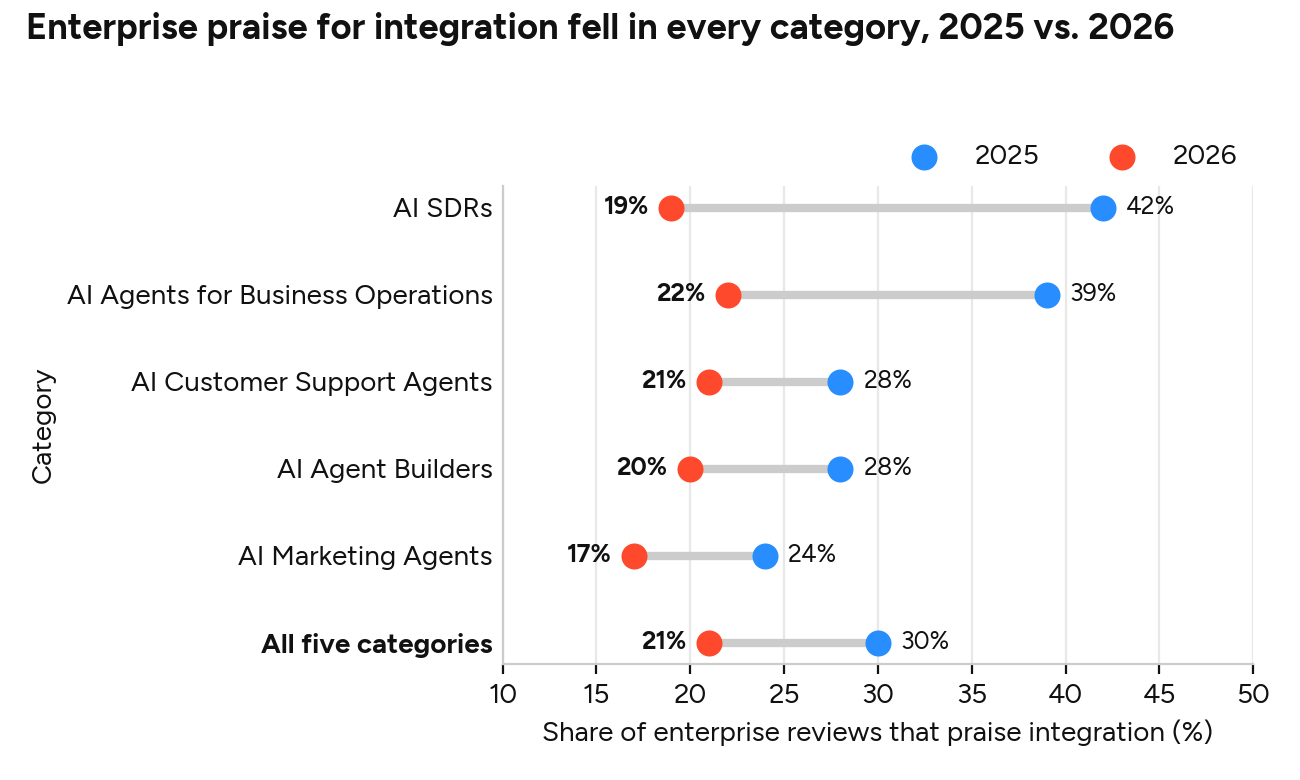
Integrations don’t impress buyers. In 2025, 30% of enterprise reviewers praised integration. In 2026, 21% did, and the drop showed up in all five categories. Our read: integration is now table stakes, so buyers stop mentioning it.
Source: reviews on G2
3. Adoption is shallow. The average share of users who adopted the agent fell from 68% in 2024 to 55% in 2026. Nearly 3 in 10 reviewers now say 30% or fewer of their users have fully adopted it.
A high rating doesn’t mean the whole team uses the agent. In 2026, enterprise reviewers on G2 rated their AI agents 9 out of 10 on average for how likely they are to recommend them. But when asked what percent of their users have fully adopted the agent, they answered 55% on average, and nearly 3 in 10 put it at 30% or less. At renewal, the buyer has to justify the cost, and that case rests on how many people use the agent.
Sellers must fund setup inside the deal, set an adoption target for the first 90 days, and track it with the buyer.
Retire the "it integrates with everything" as a headline claim for agentic AI software. Show what the integration lets the buyer do.
Today, 7% of enterprise reviewers on G2 would give an AI agent total autonomy, up from 6% in 2025, found G2 reviews. At that pace, it stays under 10% through 2027.
G2’s Chief Innovation Officer, Tim Sanders, expects trust to stay the hardest part of the sale, and warns that crossing the chasm will be a bumpy ride. Buyers, he writes, want vendors to “show their work before they take them off a leash.” His advice is to sell steady, repeatable gains in daily operations, give customers a clear path to more autonomy, and make an agent’s performance, costs, and controls easy to check.
So decide now how you’ll prove success in the first 90 days. Show the guardrails buyers set for themselves, the decisions the agent can explain, and one narrow back-office win they can measure. Prove control early, and the buyer will lengthen the leash.
The result? Buyers are more likely to buy your product or renew contracts.
Buyers now have a public way to check how an agent handles autonomy and policy. Watch How G2 Agent Evaluations Score AI Agents for Software Buyers to see the tests your agent will face.
How much autonomy do enterprise buyers want to give an AI agent?
Very little. Only 7% of enterprise reviewers on G2 would give an AI agent total autonomy. 60% want autonomy with guardrails, 21% want limited autonomy, and 11% want a human to approve every action.
What would make enterprise buyers trust our AI agent more?
More visibility and control. 79% of enterprise reviewers picked a visibility or control fix, led by clearer explanations of the agent's decisions (32%) and more guardrail settings (29%). Only 21% asked for better reliability.
Where should we start when selling AI agents to enterprises?
In the back office. Process automation is the top enterprise use case at 34%, ahead of customer service (27%) and software engineering (21%). Sales development (12%) and marketing (7%) trail, so anchor the first deal to an operations job that the buyer already measures.
Should software sellers still lead pitch with integrations?
Not as the headline. Praise for integration fell from 30% of enterprise reviews in 2025 to 21% in 2026, and it fell in all five categories. Buyers now expect it, so show what the integration lets them do in week one.
How do we protect enterprise renewals after the deal closes?
Plan for setup and adoption from day one. The average enterprise recommend score fell from 9.24 in 2024 to 9.04 in 2026, and nearly 3 in 10 reviewers say 30% or fewer of their users have fully adopted the agent. Fund setup inside the deal and set a 90-day adoption target with the buyer.

ERP evaluation in 2026 feels deceptively simple. Most platforms check the same boxes: AI,...
 by Kamaljeet Kalsi
With the variety of touchpoints a company may have with B2B buyers, every buying journey is...
by Kamaljeet Kalsi

AI knows it all — but what happens when it makes it up?
by Kamaljeet Kalsi