

%20(15)-1.png?width=900&name=Sidharth%20-%20%20TechSignals%20Blog%20FI%20Template(s)%20(15)-1.png "internal approval for b2b deals")
Getting onto the shortlist used to be the hard part of a deal. Today, it is the easy part. The hard part moved downstream, into the buyer's internal approval: the finance sign-off, the security review, the consensus your reps never sit in on.
Call it the second gate. Most sellers still pour everything into clearing the first gate, getting found and shortlisted, then lose at the second one, where the deal is actually decided.
For a decade, if a buyer never found you or added you to the evaluation, you had no deal. So marketing and sales spent their budgets buying attention and their energy on top-of-funnel activities to earn a spot on the list.
AI quietly removed most of that friction. A buyer now opens a chatbot, describes the problem, and gets a market overview, a rough price range, and a shortlist in the time it used to take to book a discovery call.
Tim Sanders, G2's Chief Innovation Officer, frames the shift in the G2 2026 Buyer Behavior Report: AI solved the scarcity of software recommendations, and the constraint moved downstream to evaluation, where buyers scrutinize pricing, assess security, and decide whether the spend is defensible. The friction has moved to a stage most sales teams barely instrument.
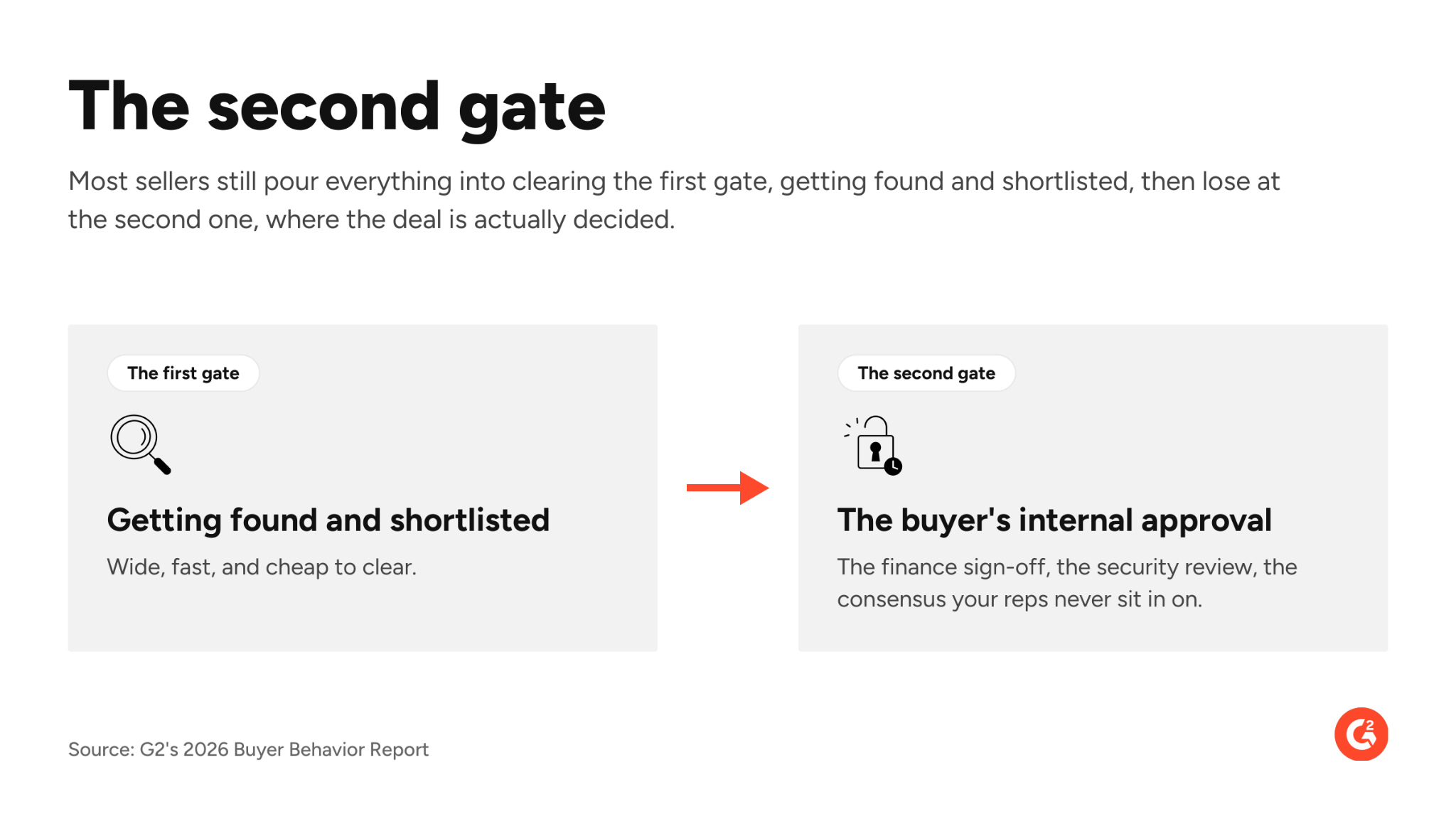
In G2's 2026 Buyer Behavior Report, more than 8 in 10 buyers said they had sourced software recommendations from tools like ChatGPT or Google's AI Mode in the past two years. The first gate did not disappear. It got wide, fast, and cheap to clear.
This is good news for challengers and unknown brands, and every seller should keep working to show up in those answers. But it creates a problem nobody planned for. When a shortlist arrives within minutes rather than weeks, the buyer has not done the hard thinking yet. They trust the list, but they do not yet have a pick they can defend. All of that work, the comparing, the doubting, the justifying, still has to happen. It just happens later.
Here is what the buyer actually sees when the AI hands over that list: a set of options that all look good. Not one obvious winner and four filler names. Five credible, well-reviewed products that are genuinely hard to separate.
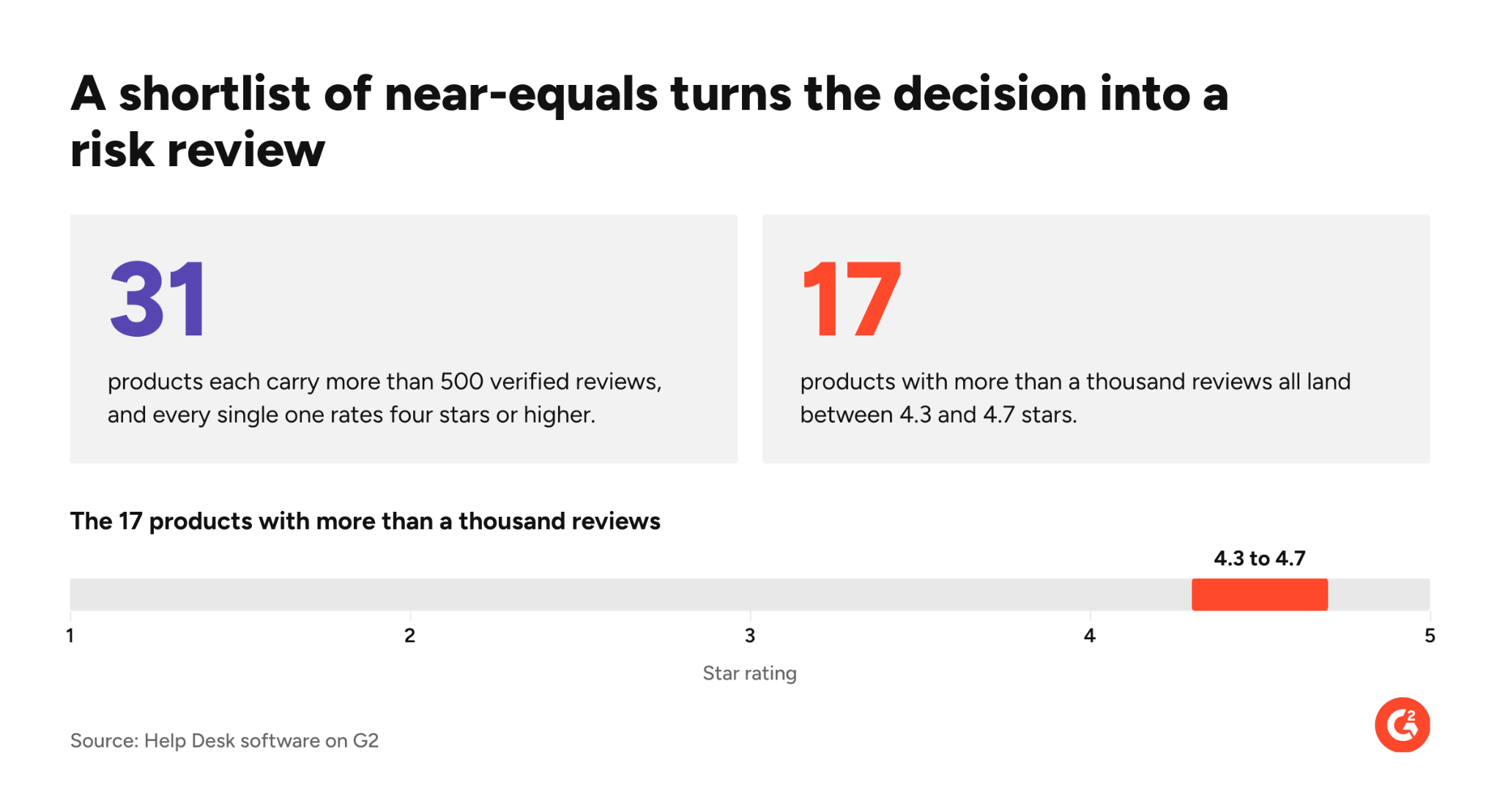
The data backs up that experience. Take Help Desk software on G2. As of August 2026, 31 products each carry more than 500 verified reviews, and every single one rates four stars or higher. Narrow it to the 17 products with more than a thousand reviews, and they all land between 4.3 and 4.7 stars. On satisfaction alone, a buyer cannot tell the leaders apart. This is not unique to help desk tools. It repeats across most of the software stack, because mature categories are full of good products.
 Does this mean that the more options buyers have, the faster they choose a solution they’re happy with? No, and the opposite is actually true.
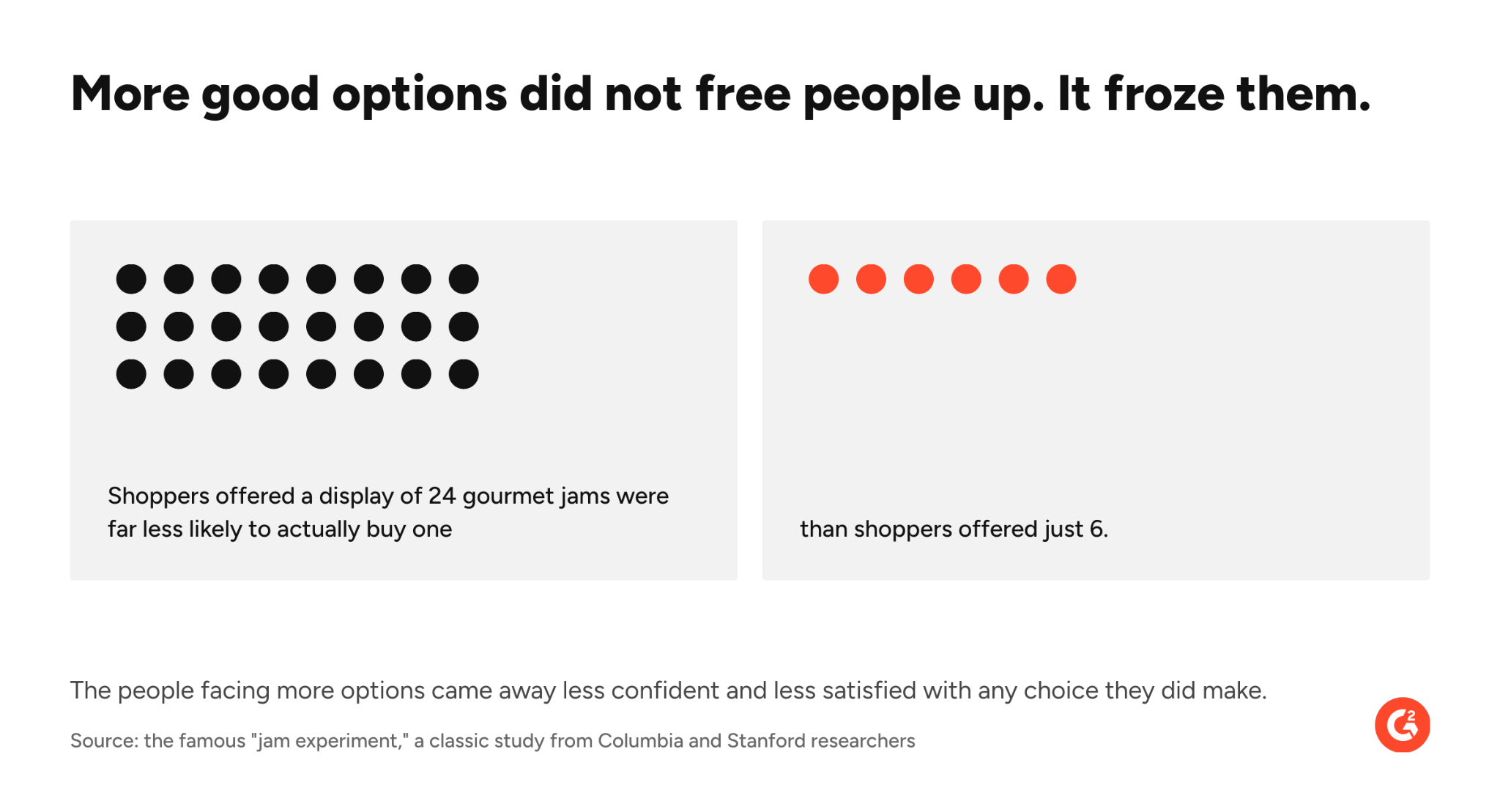
In a classic study from the Columbia and Stanford researchers behind the famous "jam experiment," shoppers offered a display of 24 gourmet jams were far less likely to actually buy one than shoppers offered just six, and the people facing more options came away less confident and less satisfied with any choice they did make. In companion experiments in the same research, people choosing from larger assortments also found the choice harder and came away less satisfied with their picks. More good options did not free people up. It froze them.
That is the buyer's real problem now. When every option on the list looks like a safe bet, features stop being the deciding factor. The buyer cannot justify a pick on strengths that all five vendors seem to share, so they flip the question. Instead of asking which tool is best, they start asking which choice is hardest to get burned by. The decision quietly turns from a comparison into a risk review. And a risk review is a very different thing to win.
The vendor with a confusing price, a thin security page, or no customer who looks like the buyer gets cut first, not because the product is worse, but because it is the safest name to remove from a list that is too long and too similar. The reason deals go quiet often turns out to be that someone in a later meeting found a low-friction way to shorten the list: by crossing you off.
So who is in the room where decisions are made? Increasingly, it is not the champion who shortlisted you. It is the people the champion has to convince.
Last year, the first question was "is it safe," with security narrowly ahead of finance in the decision room. Now the first question is "is it worth the cost," and finance leads. Involvement from information security actually fell from 32% to 25% over the same period, not because security stopped mattering. IT security review is still the single biggest source of delay after a vendor is selected, cited by 39% of buyers and by half of enterprise buyers. What changed is who leads the room. AI pricing is harder to predict, so budget anxiety moved to the front of the line, and the invoice now rivals the risk as the first thing that scares people.
It makes sense when nearly half of the buyers G2 surveyed said their CFO reversed a deal the buying team had already approved in the last 12 months.
The resistance is not only financial. As buyers purchase more AI-heavy software, some of the toughest pushback now comes from inside their own organizations. The share of buyers citing internal resistance to AI adoption as a concern rose from 16% to 29% over the past year. Every one of those objections — the cost, the security exposure, the "do we even trust this" — lands on your champion after the shortlist, in meetings you cannot join.
The Buyer Behavior Report is direct about where this leaves sellers: Winning the deal now means going beyond discoverability and actually helping buyers work through the scrutiny and defend the decision internally. That is a different motion than getting found.
Getting found is a marketing job. Getting approved is an enablement job, and the buyer, not your rep, is the one being enabled.
In practice, that means handing your champion the answers to questions they will face when you are not there.
A cost story finance can defend, with a clear picture of what the price does and does not include, matters more when AI has made pricing unpredictable. It shows in the market too: Buyer preference for outcome-based pricing more than doubled in a year, from 11% to 23%, and 70% of buyers say the pace of AI innovation is pushing them toward shorter contracts. A buyer who is nervous about lock-in and overruns is telling you exactly which objections your champion needs pre-loaded answers for.
49% of buyers say their CFO reversed a deal the buying team had already approved in the last 12 months.
Empowering software buyers also means finding out, early, who actually has to say yes. The old process assumed the person on your calls held the decision. The second gate runs on a wider committee, so the useful question on an early call is no longer just "what do you need to see." It is "who else has to approve this, and what will they push back on."
A champion who can name the CFO's cost objection and the security team's checklist in week two is a champion you can arm. One who discovers those gatekeepers in month three, mid-review, is a champion already losing the internal argument. Map the approval chain while the deal still feels easy, because that is the window before finance and security enter, and the tone changes.
The same goes for security documentation that the review board will ask for, and for proof from companies that look like theirs. When five options rate the same on paper, the tie breaks on evidence, specifically peer evidence from a similar company that already took the risk and came out fine.
The uncomfortable takeaway is that much of the sales and marketing effort is aimed at a gate that is no longer the hardest one to get through.
Finding software has never been faster. But getting to the “yes” has never been slower or more crowded with skeptics. The sellers who adjust to that, who spend less energy celebrating the shortlist and more arming the people who have to defend the choice, are the ones who will keep clearing the second gate while their competitors keep wondering why a sure thing went cold. If you want the full picture of how evaluation has changed, G2's 2026 Buyer Behavior Report maps the whole maze.
No. Making the shortlist means you cleared the first gate: the buyer found you and considers you credible. It says nothing about whether you can survive the internal approval that follows. Because AI now hands buyers a shortlist of near-equal options in minutes, being on it is table stakes, not a lead. The frontrunner is whichever vendor the champion can most easily defend to finance, security, and the rest of the committee.
Internal approval, not discovery. AI compressed the research and shortlisting phase from months to minutes. That time did not leave the deal. It shifted into evaluation, which more buyers (40%) now name the longest stage of the journey than any other phase, per G2's research. Buyers reach a shortlist fast and then slow down as they stress-test the choice internally. For sellers, that means the part of the deal you can see least is now the part that takes the longest.
Yes, and it happens often. Nearly half of buyers say their CFO overturned a purchase the team had already approved in the past year, as AI has made software pricing harder to predict and defend. Finance involvement in software decisions has climbed sharply, so a strong champion and a clean process no longer guarantee a signature. The cost case has to be strong enough to survive a review that your reps are not part of.
By equipping your champion, not by re-pitching the product. Your reps cannot attend the finance review or the security assessment, but your champion can. So the highest-value work after the shortlist is arming that champion with what they need to defend the choice: a cost story finance will accept, the security documentation the review board expects, and proof from a similar company that already succeeded. The goal is to make it easy to give the internal "yes" when you are not in the room.


We live in a world where software purchases are no longer driven by human intuition. AI...
 by Washija Kazim

Sell smart, win more. This is the approach high-performing B2B sales professionals embrace to...
 by Julie Jung
HR software is one of the most crowded categories in B2B tech.
 by Tanushree Verma