

As we enter 2026, it’s clear that marketing automation has become a cornerstone of modern marketing strategy.
Once limited to email scheduling and lead scoring, marketing automation now orchestrates entire customer journeys, powered by artificial intelligence, predictive analytics, and real-time personalization.
The top trends that defined 2025 included AI-driven personalization, hyper-segmentation, voice-activated marketing, omnichannel campaign orchestration, and predictive analytics. Businesses increasingly use machine learning to automate decisions, improve customer experiences, and boost ROI across email, SMS, and chatbot channels.
As generative AI becomes embedded across platforms and marketing automation tools grow more accessible, marketers have an opportunity to rethink how automation supports the full funnel, from awareness to retention.
This article breaks down the key trends that reshaped marketing automation in 2025 and highlights how they’ll continue to evolve in 2026, with actionable takeaways for teams looking to adapt and scale.
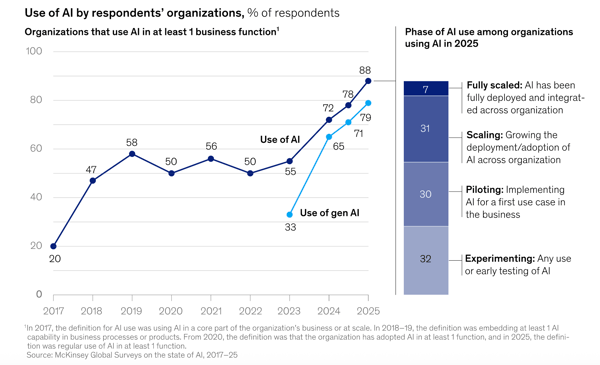
The last two years have completely reshaped what marketers expect from automation. In 2023, generative AI tools like ChatGPT catalyzed adoption at scale, and by 2024, AI had become a standard feature in most marketing technology platforms. By the end of 2025, AI had fundamentally redefined how campaigns are created, personalized, and optimized across the funnel.
G2 survey showed nearly 75% of businesses use multiple AI features daily, and 79% prioritize AI when choosing software. Nowhere is this impact more visible than in marketing. In fact, marketing departments lead all other teams in AI adoption, according to 53% of organizations surveyed. That momentum made marketing automation a linchpin of modern go-to-market strategy.
 Source: McKinsey
These shifts triggered three clear developments in how businesses approached marketing automation in 2025:
AI adoption in marketing has moved past early experimentation. By 2025, it was widely recognized as essential to staying competitive. The pressure to integrate AI into marketing workflows isn’t just coming from leadership; it’s driven by shifting customer expectations for personalization, speed, and relevance.
Marketing automation remains one of the fastest and most scalable entry points. It allows teams to operationalize AI in a controlled environment, test outcomes, and build internal momentum for broader adoption.
AI capabilities are now embedded across the technology stack. Vendors are rolling out advanced features, such as real-time journey orchestration, adaptive A/B testing, and generative content tools, often supported by integrated AI copilots.
By the end of 2025, the emphasis had shifted from novelty to how intuitively and strategically AI fit into everyday workflows. SaaS platforms are focusing less on novelty and more on precision, governance, and ROI.
As marketing teams gained AI fluency, creativity accelerated. This led to the discovery of new use cases, and over time, AI and automation became a fundamental part of the marketer’s daily operations. Some of the most impactful applications by the close of 2025 included:
Not so long ago, marketers talked much about live chat vs. chatbots.
Live chat was generally preferred by businesses that wanted to guarantee accurate information, but 24/7 service requires a large, global support team.
Chatbots, on the other hand, could answer simple questions accurately around the clock, but they lacked the human touch brands needed to build relationships with leads and customers, and they fell short with complicated or unique questions.
By the end of 2025, AI chatbots had evolved from simple FAQ responders. While live chat required large teams and bots lacked nuance, AI-powered platforms began combining automation and human support, handling common questions, escalating complex issues, and assisting agents instantly.
By late 2025, chatbots became vital for real-time marketing, customer support, and internal tasks, merging automation with human interaction.
Counterintuitive as it may seem, the increased adoption of AI in marketing could make a company’s interactions with customers more human.
Firstly, there’s a practical matter.
When a chatbot is answering simple queries or directing customers to self-help documentation, human support agents can spend more time responding to complicated inquiries and building relationships.
Plus, when live chat messenger platforms and inboxes have AI support, information can be automatically surfaced, giving human agents time to focus on improving the accuracy of information and personalizing the experience for their customers.
At the same time, the machines are becoming more human. Natural language processing (NLP) models use neural networks to train themselves on information and the conversations they have with people. Advanced NLP chatbots can discern meaning from language to respond more naturally, and over time, they learn more about human speech patterns, colloquialisms, and tone in order to humanize their voice.
Although true emotional intelligence is still in development, by 2025, sophisticated chatbots could already detect mood, intent, and urgency and respond accordingly.
In addition to making conversations feel more human, sentiment analysis can fuel greater reporting and insights.
Gaining a better understanding of how your customers feel about their interactions with your brand, and how that sentiment changes when the customer interacts with a human versus a robot, can help you improve relationships with customers.
AI’s ability to chew through piles of data is one of its greatest strengths, and live chat generates heaps of individual data points around sentiment analysis. You can use this to assess sentiment and drill down to identify why customers feel a certain way. Use the analysis to develop a data-driven strategy around customer happiness and act on it with the help of AI.
Live chat became an important marketing channel in part because consumers who use messaging services like Slack, WhatsApp, and Messenger got comfortable with this style of communication. They wanted the same convenience when they chatted with businesses.
Voice assistants are heading in the same direction. US voice assistant users are projected to grow from 139.8 million in 2022 to 168.2 million by 2029, marking an increase of approximately 28.4 million users.
Right now, voice search is the area with the most growth, especially for local businesses that want to be the answer when a potential customer asks for the nearest gas station or grocery store.
Businesses can develop custom voice assistants to help SaaS users by guiding them through instructions step-by-step. For example, if you've asked your Google Assistant for a recipe, you know how helpful this is when focusing on a task.
And, like chatbots before them, voice assistants will learn to sound more human since they have more interactions with real people. They’ll learn to pause, emphasize, and raise or lower their voice at the right time. They’ll even use different accents and turns of phrase.
By 2025, many companies were already using AI-powered live chat not just for customer engagement, but also for internal education and productivity. As more companies adopt and use AI-powered live chat tools for their marketing, sales, and customer support purposes, businesses will find ways to use them for internal education purposes.
For example, imagine an onboarding experience led by a chatbot. A new user starts. They can interact with a chatbot that guides them through the onboarding process and elevates questions to the right team members as required.
Part of this will simply be opportunity spotting for businesses. How can they refine something they do repeatedly? And part of it will be the desire to make the most of the tools they pay to use.
As a bonus, a chatbot trained to internally answer questions about products, services, and your brand will be better suited to answer questions that come from leads and customers.
In the current times, live chat isn’t a novelty; it’s expected. Customers now instinctively look for a chat icon the moment they land on your site or open your app.
Failing to offer that experience signals friction, and most won’t wait around. Worse, late adopters miss out on the data advantage that early AI users now benefit from. Trained models that understand your product, brand voice, and customer history become strategic assets in themselves.
By adopting AI-powered chat early, you enable those systems to learn, adapt, and improve, which in turn makes your marketing automation smarter, more responsive, and more aligned with user expectations.
Perhaps the most transformative application of AI in marketing automation is predictive analytics.
When your data can be used to foretell the future, your AI-powered marketing automation platform will be able to make data-driven decisions on its own without your help. It’s a dream for marketers who want to set up reliable set-and-forget automated journeys.
There are plenty of applications of predictive analytics that we interact with every day, from the weather forecast to behavioral targeting in advertising. Marketers are no longer reacting to results; they’re anticipating them. Predictive engines built into modern marketing platforms now analyze historical data, behavioral signals, and campaign inputs to generate real-time forecasts. And those predictions are being used to automate actions across the funnel, from campaign launch to pricing strategy.
Email subject line performance is one area where AI thrives.
We already get accurate predictions on open rates along with suggestions on higher-performing alternatives. With time, marketers could use their automation platforms to predict metrics that come with higher stakes.
For example, what if you could predict the ROI of a campaign before you set it live? This is already becoming reality, as predictive analytics now surfaces likely outcomes by analyzing similar campaigns, audiences, and objectives.
Lead scoring has evolved beyond manual inputs, with AI-powered models dynamically identifying top prospects based on real-time behavioral data.
If things advance as they are, predictive analytics in marketing automation platforms will be able to identify the quality of a lead based on available data points, without the need for a model. A marketing automation tool underpinned by AI can automate the entire lead scoring process.
For example, AI could identify top-performing customers to establish a set of attributes or behaviors that indicate a lead is likely to become a high-value customer. With this information, AI could automatically qualify leads and route them to the most appropriate sales representative.
Retention and churn prevention have become two of the hottest topics in marketing.
Customer acquisition costs (CAC) are soaring, and the need to maintain a base of loyal, high-value customers has increased.
Like lead quality, right now, marketers can identify a set of behaviors that tend to indicate churn (for example, viewing cancellation terms) and set up marketing automation journeys to ensure support and success teams are notified so they can intervene.
Today, predictive analytics eliminates the need for manual behavior tracking, automatically identifying churn risks and triggering retention actions
Thanks to certain driving apps, we’re all familiar with surge pricing. The model is straightforward: increased demand leads to higher prices. But the potential doesn’t stop there. AI-enabled pricing management tools can predict optimal pricing based on inventory levels, competitor pricing, and customer response to price changes.
In cases where pricing is more complex, such as SaaS and B2B businesses with subscription tiers, we could start to see something similar. Predictive price optimization is a specific field of predictive analytics.
Its users consider customer behavior, market trends, competitors’ pricing models, and the state of global financial markets to predict how successful your pricing strategy will be.
Marketing automation has let marketers scale personalization. Without it, we’d be sending millions of manually-written emails every day, a task no modern marketing team can or should have time for.
With AI, personalization at scale takes on a whole new meaning. Omnichannel messages feel truly one-to-one, with every element, from tone to content, recommendations to calls-to-action, changing based on the individual audience member’s attributes and behaviors.
Exciting as this is, marketers will need to grapple with an opposing force. 91% of organizations believe they need to improve how they reassure customers about data use with AI. This ongoing privacy concern continues to influence how marketers collect and utilize data.
As a result, many teams double down on first- and zero-party data, giving AI-powered automation platforms cleaner, consented inputs to deliver meaningful personalization, without compromising trust.
AI can already write emails, subject lines, SMS, and push notifications in your brand voice with personalized elements like merge tags.
By 2025, AI-driven personalization had become more granular and context-aware, enabling marketing automation platforms to generate messages tailored not just to segments, but increasingly to individuals.
This requires AI to comb through data and identify the subject lines, tone, format, and calls to action the segment is more likely to respond to, and then use that information to write an email.
This way, personalization becomes less about plugging in pieces of information like first name, industry, plan details, or previous purchases, and more about tone adjustment and the composition of the message.
Recommendation engines are built on AI.
They take data about the products people buy or the content they consume and use it to draw conclusions about what people with similar purchasing or viewing habits will like. In a marketing automation tool, a recommendation engine can send suggestions to re-engage lapsed customers or upsell active customers.
With AI backing up marketing automation, these recommendations became even more personal. The AI can learn what each individual user shows an interest in and what they ignore, and adjust future recommendations accordingly. It’s another use case where advanced predictive analytics comes into play.
Marketing automation platforms take the heavy lifting out of customer lifecycle marketing. Marketers can now build omnichannel campaigns that nudge leads and customers to the next phase of the customer journey. To do this successfully, marketers need to use data to identify what the next best action is at each stage of the customer’s journey.
With predictive analytics, marketing automation platforms can forecast future steps without human intervention and send individual customers the most relevant guidance based on those steps. We could also see technology that sends messages at the most optimal time based on the user’s previous behavior.
Essentially, AI can remove the need for guesswork and manual intervention at every stage of the journey.
Got more questions? We have the answers.
Marketing automation improves ROI by reducing manual work, increasing conversion rates, and enabling smarter targeting. AI-driven automation helps teams focus their spending on high-intent audiences and optimize campaigns in real time.
Consent-based behavioral data, product usage signals, and engagement history allow AI systems to personalize experiences accurately while maintaining trust and compliance.
Many teams see early efficiency gains within weeks, such as faster campaign execution and improved engagement. Measurable revenue impact typically follows once automation is fully integrated across channels and workflows.
Common mistakes include over-automating without a strategy, relying on poor-quality data, ignoring governance, and treating automation as a one-time setup rather than an evolving system.
The best platforms align with business goals, integrate with existing tools, and offer AI features that are easy to operationalize. Compare software using verified user reviews on G2 to assess real-world performance.
Yes. B2B teams often use automation for lead nurturing and account-based marketing, while B2C teams focus on personalization, lifecycle campaigns, and real-time engagement. AI enhances both models.
Marketing automation has crossed an important threshold. By 2025, AI moved from experimentation to execution, reshaping how teams plan campaigns, engage customers, and make decisions at scale.
The marketers seeing the strongest results aren’t using automation just to move faster. They’re using it to make smarter choices.
Going forward, competitive advantage won’t come from adopting more tools. It will come from how effectively teams connect AI, data, and workflows into a cohesive system that serves real business goals. The brands that continue refining their automation strategies will be better equipped to meet rising customer expectations and navigate whatever comes next.
Looking for the right platform? Compare the best marketing automation software and find the tools teams trust to scale smarter.
Edited by Aisha West
This article was originally published in 2024. It has been updated with new information.


Personalized marketing is all the rage for modern businesses.
 by Savan Kharod

There was a time when marketing primarily consisted of guesswork and creativity. While...
 by Atul Jindal

If you had spoken to a marketing expert at least a decade ago, it’s unlikely they would ever...
 by Rebecca Reynoso