

-2.png)
According to G2's analysis of 3,400+ verified machine learning platform reviews, low-code ML platforms take an average of 4.5 months to go live, the slowest time-to-deployment of any machine learning category on G2, and 2.6x slower than data labeling tools at 1.7 months.
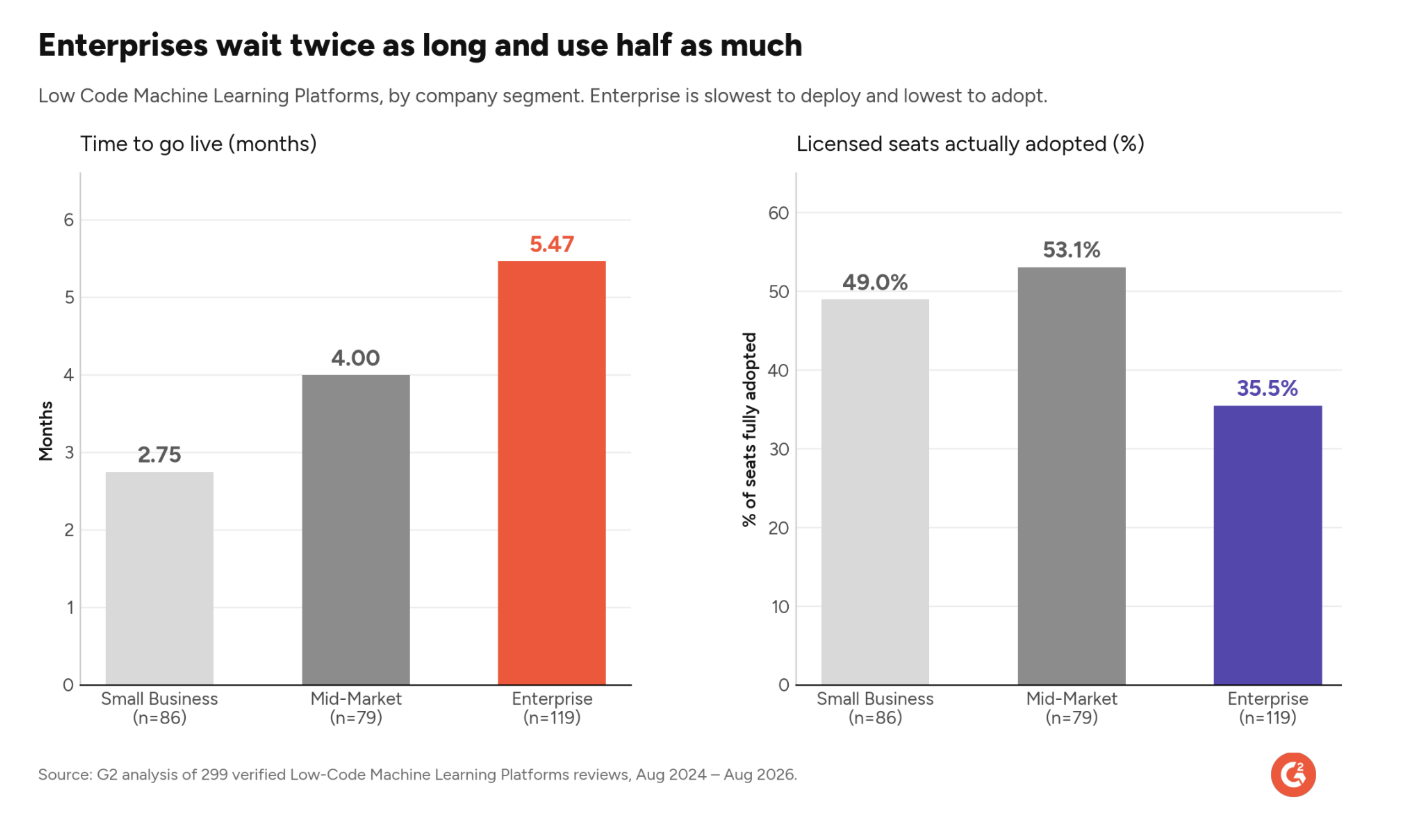
Enterprise buyers wait roughly twice as long to go live as small businesses, and once live they adopt the fewest licensed seats, at 35.5% against 49.0% at small businesses.
All four vendors surveyed independently named the same breaking point for non-technical users: integration into production systems and existing data pipelines. Three of four vendors report AutoML cuts time-to-deployment by more than 75%, a claim G2's verified deployment data does not support at the category level. Pecan AI, Acodis, and Minitab report the 75%+ reduction. Kili Technology noted results vary significantly by use case.
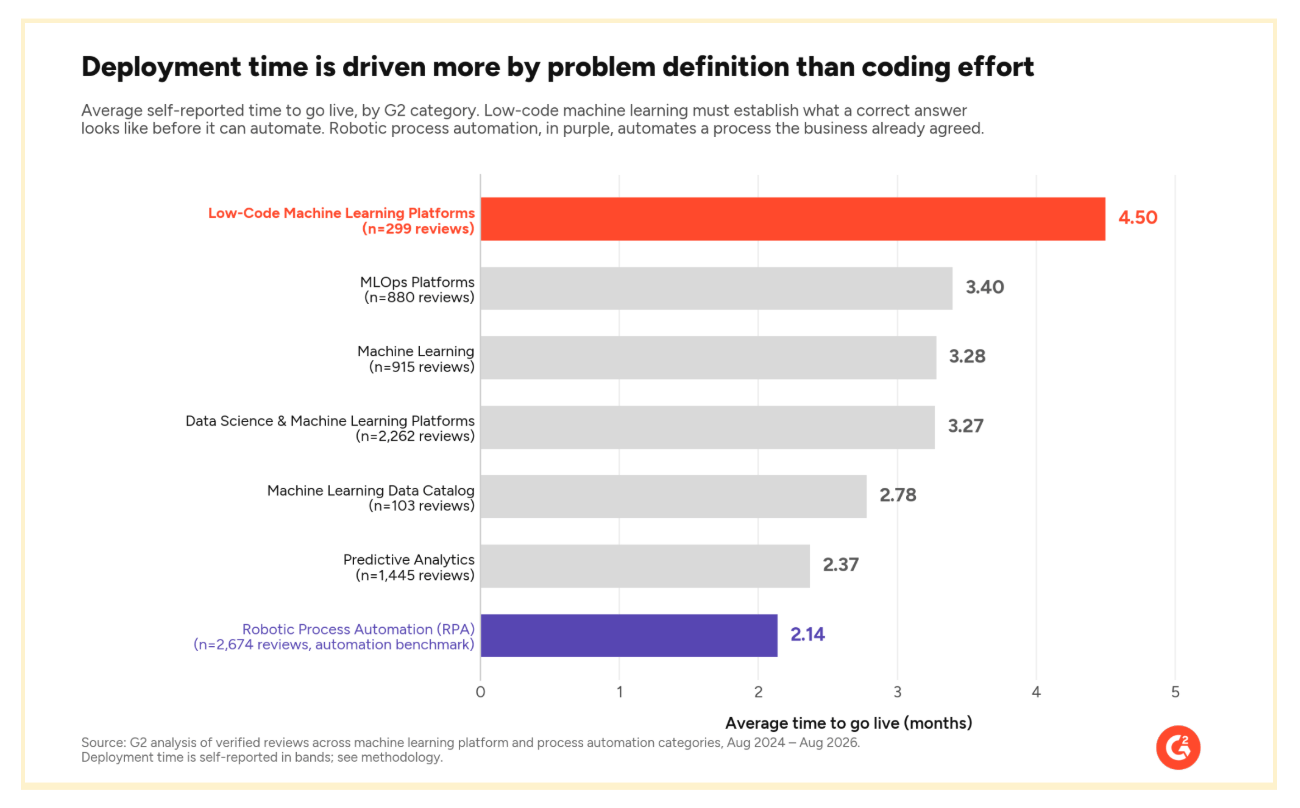
Low-code machine learning platforms promise to make building machine learning models faster and more accessible to teams without data science expertise. However, G2's reviews of low-code machine learning platforms show that they take an average of 4.5 months to go live, which is longer than MLOps platforms (3.4 months), full data science platforms (3.27 months), and every other machine learning category G2 tracks. The category built entirely on the promise of speed is the slowest one to deploy. Four leading vendors - Pecan AI, Acodis, Minitab, and Kili Technology told G2 why, and their answers converge on the same point: the modeling was never the bottleneck.
This report combines G2's proprietary review data with structured input from four leading machine learning platform vendors. Vendor insights are clearly attributed throughout and represent platform-level observations. Leadership quotes are attributed to the executive each vendor nominated; all other quotes are attributed to the survey respondent.
G2 data shows the exact opposite. Verified G2 reviewers also give low-code machine learning the lowest average star rating of the seven, at 4.45. Across seven machine learning categories, Low-Code Machine Learning Platforms report the longest average time to go live at 4.5 months. That is 32% slower than MLOps Platforms (3.4 months). Deployment time usually clocks from contract signature to production go-live.
The comparison also holds against adjacent enterprise automation categories, although in a way different than the timelines alone suggest. G2 data shows Robotic Process Automation (RPA) goes live in 2.14 months on average and 3.05 months at enterprise scale, against 4.50 and 5.47 months for low-
code machine learning. But RPA tools automate a process the business has already defined and agreed on. Low-code machine learning has to establish what a correct answer looks like before it can automate anything. The gap between the two is largely the cost of settling that question, more than the cost of writing less code.
“The real obstacle vendors are not talking about is the implementation work. Everyone expects automation to happen in a few clicks. But implementation takes time, on one side to fine-tune models, on the other to fit the model usage within a much bigger process.”
Philippe Cayrol
Chief Revenue and Strategy Officer, Acodis
The reason why 4.5 months for deployment is directly answered by four vendors G2 surveyed points to three constraints, and none of them is the model: data readiness, integration into production systems, and organizational process.
The software is no more complex at enterprise scale, but the approval cycle surrounding it is considerably longer.G2 data shows enterprise buyers of low-code ML platforms take 5.47 months to go live against 2.75 months for small businesses, a two-fold gap. Enterprises also put the smallest share of their licensed seats to work once live: 35.5%, against 49.0% at small businesses and 53.1% at mid-market. Verified enterprise buyers also rate the category lowest of any segment on Ease of Admin, at 7.94 out of 10.
“Currently, the biggest hurdle is the need for 3-4 teams to collaborate. For smaller organizations, this obstacle can be overcome. For larger organizations, it requires consultants, project managers, Forward Deployed Engineers, and very, very strong executive sponsorship to bring an idea all the way to a model into production.”
Asaf Katz
Head of Deployment Strategy, Pecan AI
Philippe Cayrol, Chief Revenue and Strategy Officer at Acodis, also mentioned the same friction from the buying side:
“From procurement to data governance and AI committees, the business teams need to put weeks and months of work just to move their administrative teams. The pain of the status quo needs to be very high, and the ROI needs to be clear and large.”
Philippe Cayrol
Chief Revenue and Strategy Officer, Acodis
No, not independently. In practice, a technical owner builds the pipeline and integrates it, while business users and domain experts define what the model should do and validate what it produces. We asked the vendors how confident they are that non-technical business users are successfully deploying production-ready models without data science support. The four vendors averaged 3.25 out of 5. When asked who is actually building models in production on their platforms, not aspirationally, 3 of 4 named domain experts or subject matter experts, and 3 of 4 named operations or process teams. Two named business analysts with no coding background; one named data scientist as the primary builder. However, all four named the same wall: integration into production systems and existing data pipelines.
“In practice, it almost never starts with a business user building a model - there's a technical owner, a lead data scientist or an AI expert, who builds the pipeline and integrates it into existing systems. The domain experts sit on both ends of it: they define what 'correct' looks like going in, then come back to judge and correct what comes out."”
Nadine Pacis
Marketing Manager, Kili Technology
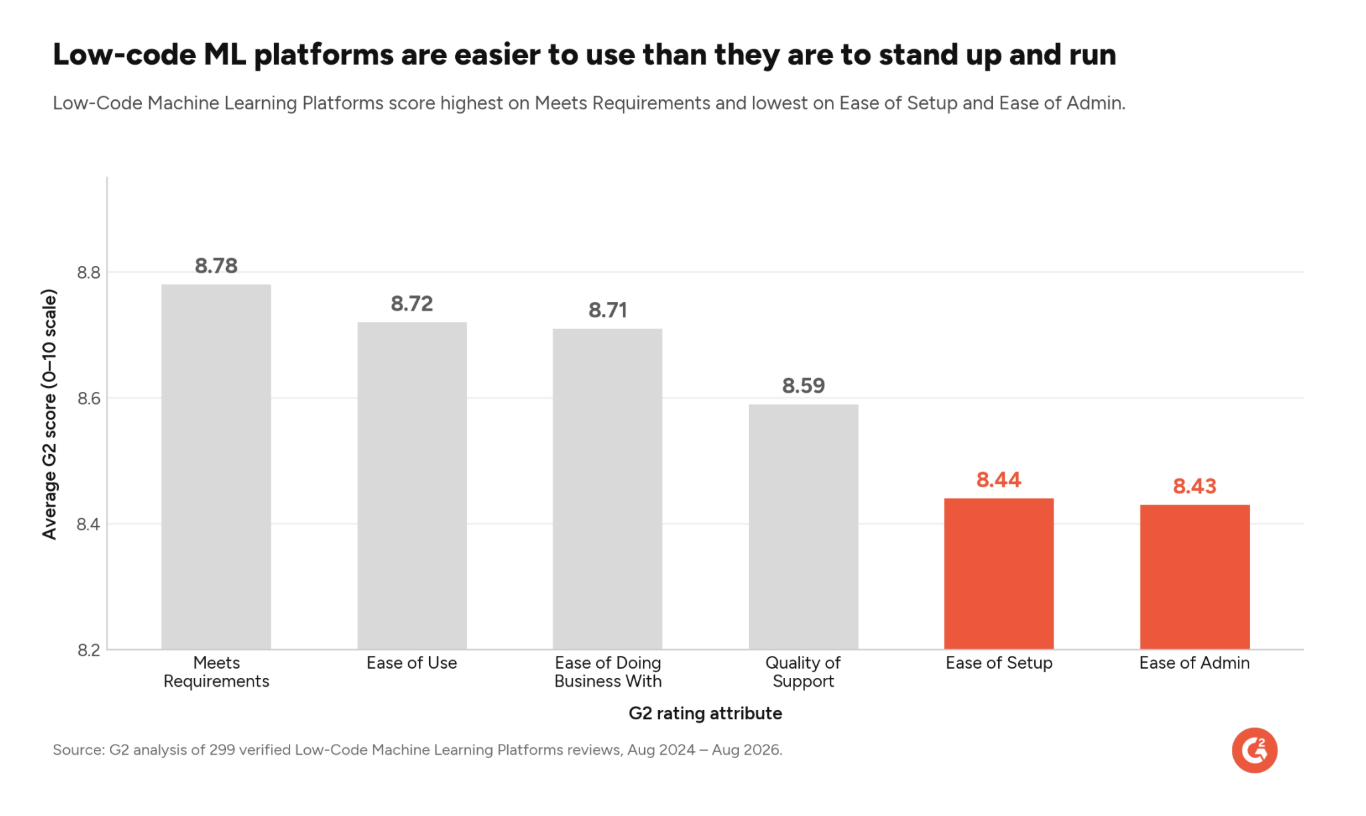
The biggest barriers to wider AutoML adoption in the enterprise are data readiness, setup effort, and ongoing administration, not the quality of the models these platforms produce. G2's rating attributes for the category show a consistent shape: verified buyers score low-code machine learning Platforms highest on Meets Requirements (8.78 out of 10) and lowest on Ease of Setup (8.44) and Ease of Admin (8.43). Buyers are saying the tools do the job, but standing them up and running them is the hard part.
Three of the four vendors selected “data quality at the customer end was far worse than anticipated” as the biggest gap between what low-code machine learning vendors promised in 2023–2024 and what actually happened. Two vendors also selected “time-to-value was significantly longer than projected.”
“One of AutoML's biggest limitations is that it may select variables that are statistically relevant but make little practical sense. Models that scale and remain accurate over time are grounded in real-world logic. Leaders must ensure their data science teams evaluate models not only by their performance on historical data, but also by their interpretability and practical relevance.”
Jennifer Roan
Vice President of Software Engineering, Minitab
“Even an excellent agentic no-code modeling tool is only as good as the data provided to it and the context it has on the data.”
Zohar Bronfman
CEO, Pecan AI
Governance is usually discussed as a separate conversation from deployment. The survey data shows that governance requirements directly affect how quickly a model reaches production. Acodis named governance and regulatory concerns as a factor that slowed or blocked deployments outright, and Kili Technology named compliance and regulatory requirements as one of the points where non-technical users need data science intervention.
Three of the four vendors described demand for explainability, bias audits, and AI governance features as modest and confined to early adopters and compliance-forward buyers. Only Acodis, which serves life sciences and other regulated industries, reported growing demand.
When asked how significant AI regulation, the EU AI Act, state-level bias audits, and transparency mandates have actually impacted their product roadmap on a 1 - 5 scale, the four vendors averaged 2.0. For buyers evaluating low-code ML platforms in 2026, that makes governance a differentiator to interrogate in the demo rather than a feature to assume is mature.
The risk of ungoverned training data is not abstract. Kili Technology frames the underlying risk plainly: If two experts disagree on the same edge case and nobody measured it, your model learned the disagreement.
How long does it take to deploy a low-code machine learning platform?
G2 data shows an average of 4.5 months from purchase to go-live across 299 verified Low-Code Machine Learning Platform reviews. Enterprises average 5.47 months, and small businesses 2.75 months. Plan for a quarter or more, not a sprint.
Are low-code ML platforms faster than traditional ML development?
Vendors say yes - three of four surveyed report a 75%+ reduction in time-to-deployment. G2's verified review data disagrees at the category level: low-code ML platforms take longer to go live than MLOps platforms, data science platforms, and predictive analytics tools. The gap may reflect how vendors measure deployment, counting model training time, while G2 reviewers report total time from purchase to production use.
Can business users build machine learning models without a data scientist?
The four vendors surveyed averaged 3.25 out of 5 confidence that non-technical users deploy production-ready models unaided. In practice, domain experts define and validate the model while a technical owner builds and integrates the pipeline.
Which industries find low-code ML platforms hardest to set up?
Vendors surveyed pointed to manufacturing (3 of 4), financial services and banking (2 of 4), and healthcare and life sciences. G2 review data shows regulated and asset-heavy industries score lowest on Ease of Setup - oil and energy at 8.02 out of 10, versus 8.80 for IT services.
G2's analysis of 3,400+ verified machine learning platform reviews shows that low-code machine learning platforms are the slowest machine learning category to deploy, despite being sold on the promise of speed. The four vendors G2 surveyed agree on the cause: data readiness and production integration, not model building, is where low-code machine learning still breaks.
Their forecasts follow from that. Three of the four expect natural language to become the primary interface for building models, and three expect low-code machine learning to reach business teams well beyond analytics departments. But they describe a market splitting rather than converging. Pecan AI expects two distinct product tracks, advanced tools for technical users and guardrailed ones for business teams. Kili Technology expects data science teams to move upstream, from building models to defining what a model is held to and proving it got there.
Minitab expects the advantage to go to organizations that combine both approaches rather than picking one.
For buyers evaluating low-code machine learning platforms in 2026, that points to a single planning assumption: model building keeps getting easier, and the accountability around it does not.
Looking for the right low-code machine learning platform for your team? Check out the State of AI Agent Builders 2026 report.

-1.png?width=400&name=dark%20(14)-1.png)
TL;DR: Where AI video compliance stands today The market is scaling faster than its...
 by Lauren Worth
.png?width=400&name=dark%20(15).png)
TL;DR: What G2 Data tells about the state of conversational AI survey platforms in 2026? ...
 by Subhransu Sahu