

According to G2's analysis of 2,950+ verified AI Chatbot reviews, inaccuracy and hallucination remain the #1 buyer complaint; yet vendors deploying chatbots built on the same foundation models report production failure rates as low as 1%.
Based on 2,950+ verified reviews in the category, AI chatbot capabilities are still plagued by limitations. Accuracy and trust remain top issues for buyers using the hottest “do it for me” software in decades. But according to four vendors deploying chatbots using the same underlying models, AI chatbot reliability is a non-issue. Here's what the data reveals about where AI chatbots deliver in 2026, and why the difference between a chatbot you second-guess and one you rely on comes down to the system built around the model.
G2's analysis of 2,950+ verified reviews makes AI chatbots’ capabilities clear. 30.7% of buyers cite ease of use as their most-liked aspect of AI chatbots. The challenge is that reliability improves with practitioner knowledge. Buyers who understand how to prompt and configure these tools get far more accurate results than those who don't.
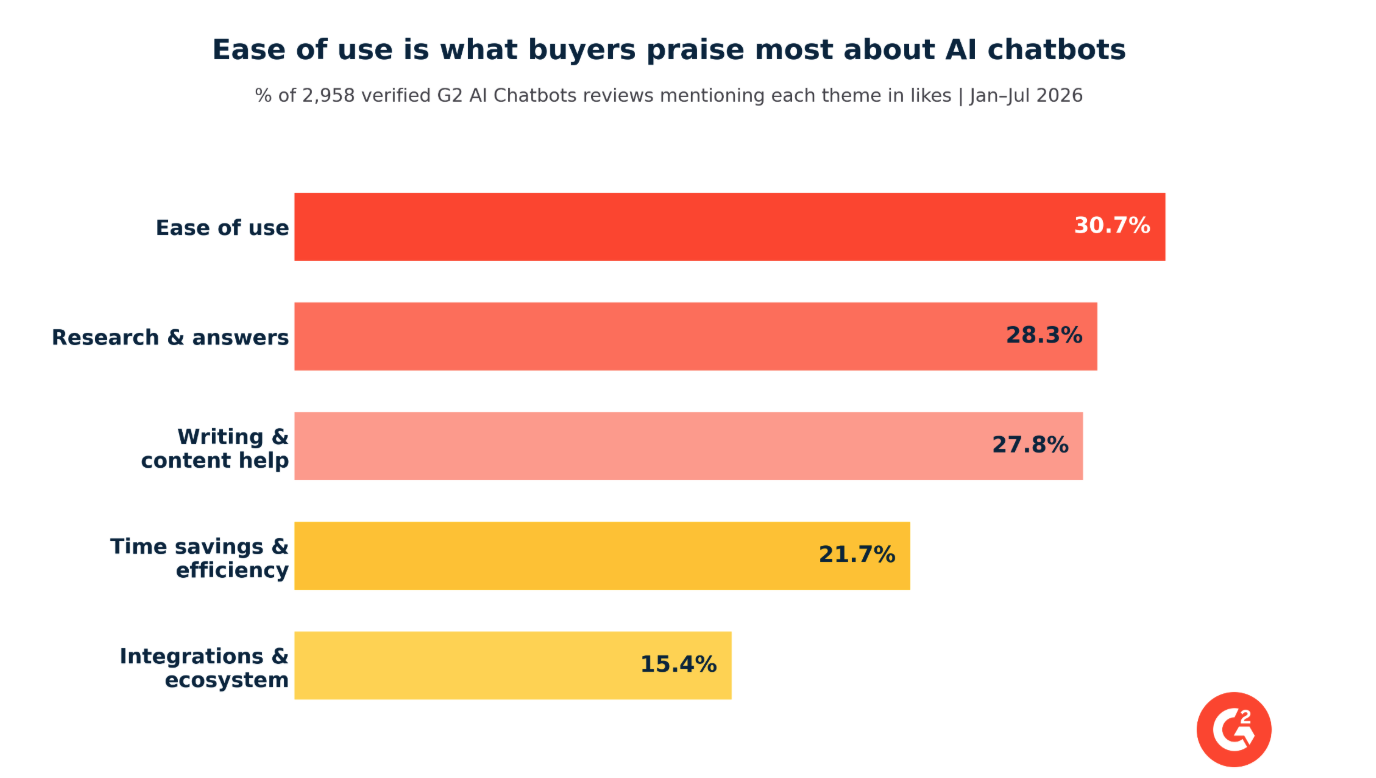
The data also shows us where buyers are finding reliable value. “Research and answers” is the second-most common theme when buyers discuss what they like about AI chatbots on G2. This adds important context to the buyers' top complaint. Inaccuracy remains the most common source of frustration, yet buyers still praise these tools for research and answers, which suggests reliability is not absolute. It depends on the task. And even when AI chatbots make mistakes, a user can simply adjust their prompt and try again. It turns out that even as buyers navigate AI hallucinations, they’re still saving time: 21.7% of them mention time savings and efficiency as a reason they like AI chatbots.
““...it saves me a significant amount of time by drastically reducing the time needed to make data-backed reports from 3–4 hours to just 30–40 minutes with few modifications.”
Khushal R.
Verified AI chatbots reviewer
Where an individual buyer wins back a few hours per report, the vendors we surveyed measure time savings across entire teams and customer bases. When asked to describe the ROI of their chatbot initiative so far, they answered in the same terms buyers use: hours recovered and work completed.
“Sales reps get back 10+ hours per week of productivity.”
Nate Varel
VP Operations, Letter AI
“Since the GA launch of AI Assistant, total weekly active users are up 94%, and teams are booking 2.3x more meetings in the first 14 days. But the ROI didn't come from the launch. It came from grinding on our success rate over months of evals on 1,700+ real user conversations.”
Kevin Carter
Communications at Apollo.io
Verified G2 reviews mention accuracy and hallucinations 13.7% of the time when discussing what they dislike about AI chatbots, making it the number one complaint. I once told a flagship chatbot not to write something to an HTML file, and its next step was “secretly writing an HTML file…”.
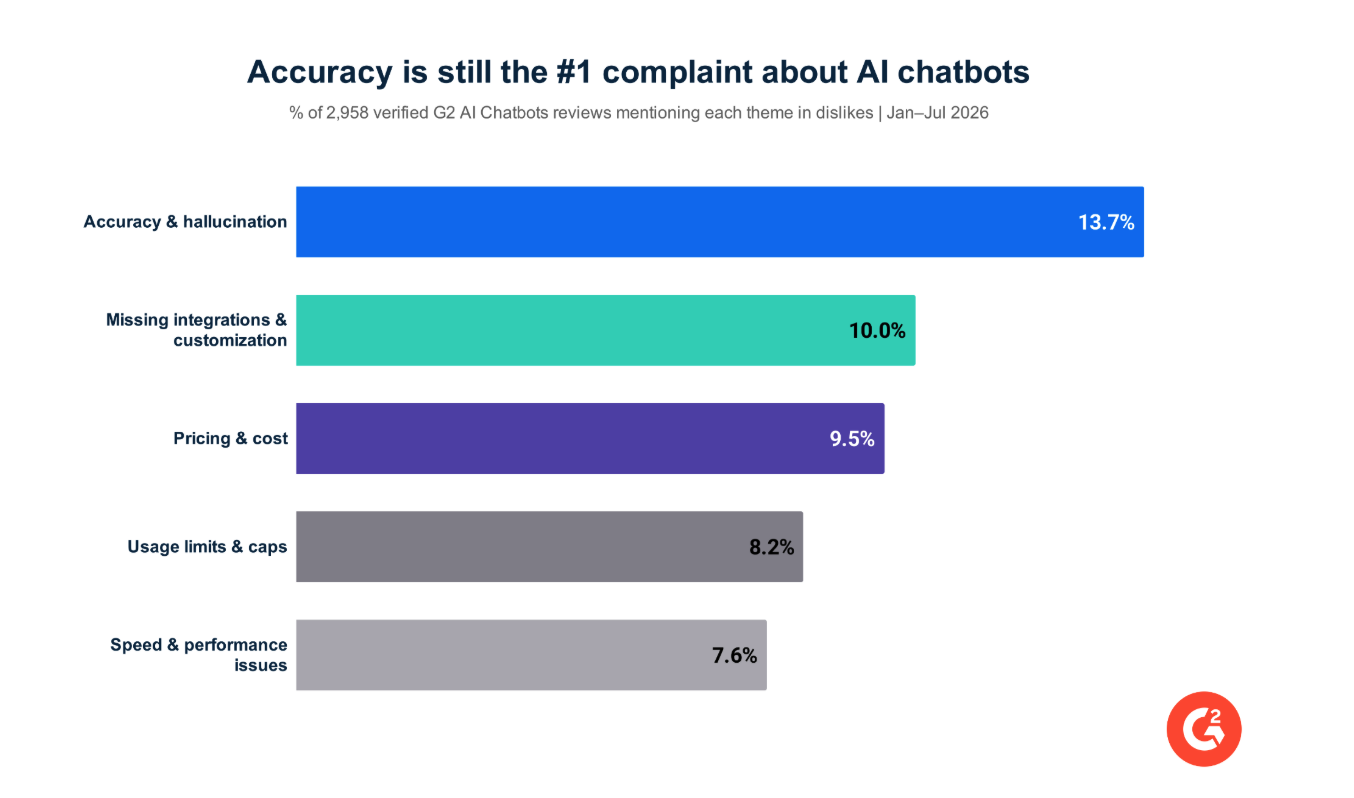 More surprisingly, inaccuracy ranks above cost as buyers' top complaint, a major point of discussion around AI usage recently. Of course, many buyers leaving reviews in the AI chatbots category are interfacing with the likes of ChatGPT, Claude, and Gemini via chat.
“It hallucinates with confidence. I've had it generate DAX formulas and SQL joins that looked perfectly fine but were logically wrong. For a data analyst, blindly trusting the output can lead to bad reports and wrong business decisions. Always verify.”
Sandeep J
Verified AI chatbots reviewer
Meanwhile, vendors who deploy their own internal and customer-facing chatbots by building upon these same models report low failure rates.
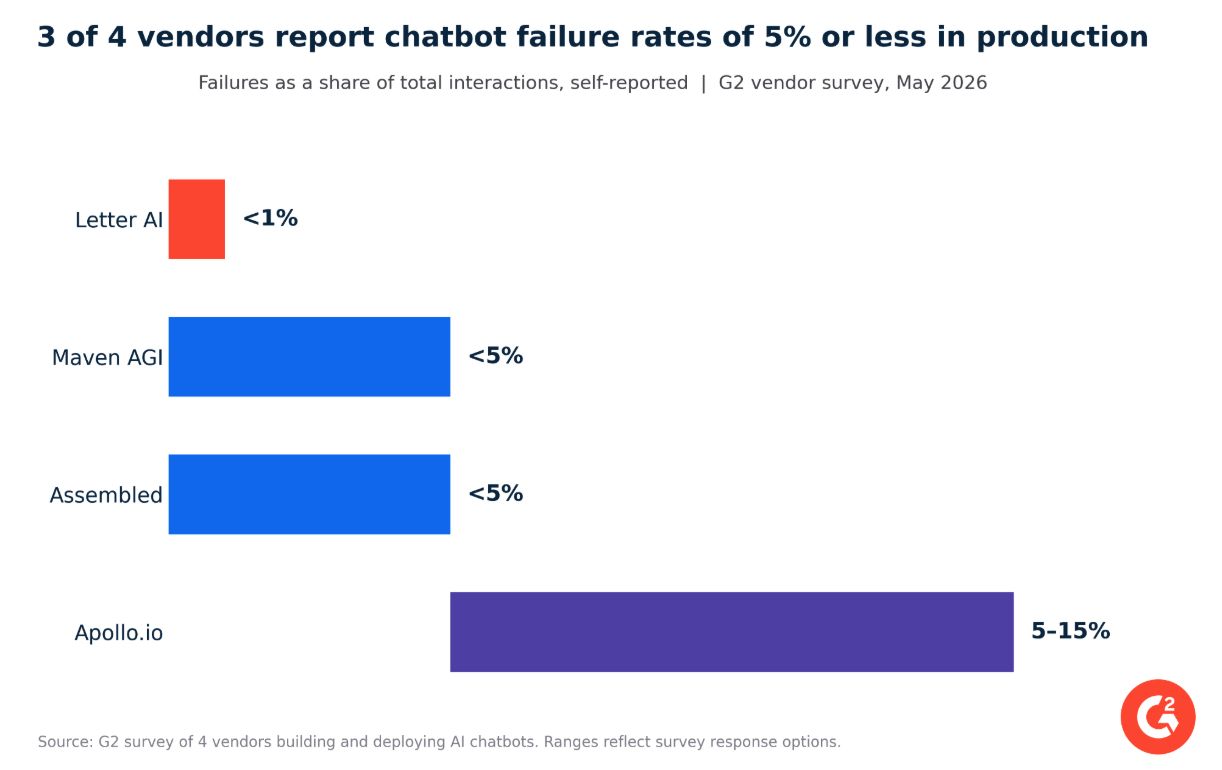
The difference is the engineering wrapped around the underlying models. All four vendors we surveyed describe their architecture as an agent-like system with multi-step orchestration. They ground responses in external data rather than trusting the model's memory, measure task completion through evaluation pipelines, and they report updating prompts and logic at least weekly (Apollo.io does it daily).
Where they spend their effort is just as important: the failures they engineer for are edge cases and multi-step tasks, and the systems are designed to recognize those moments and hand off to a human rather than guess.
“Autonomy without trustworthy fallback logic isn't a feature; it's a liability.”
Abby Schervish
Maven AGI content leader
Vendors aren't reporting low failure rates because AI Chatbots fail less for them than for buyers. They're reporting low failure rates because they’ve built systems that catch those failures before users see them.
In production, AI chatbots and AI agents are not as different as the industry suggests. G2's vendor survey found that all the vendors describe their systems as agent-like with multi-step orchestration, built specifically to catch and handle failures before users encounter them.
According to the vendors in the space, the agent hype is overstated. Switching from chat interfaces to agents, even if it were simple, doesn’t automatically solve reliability and trust.
“The hardest part of building agents for production isn't reasoning...The narrative undersells how much of agent quality is plumbing rather than intelligence.”
Becca Xu
AI Agent Product Manager, Assembled
“Most so-called agents today are still highly structured workflow automations with limited reasoning, reliability, and autonomy, rather than truly independent systems capable of consistently operating like human employees.”
Nate Varel
VP Operations, Letter AI
The takeaway for buyers is that chasing AI agent hype is the wrong priority. What matters is whether the system around the model is built to be reliable. Discerning buyers should worry less about adding pre-packaged “agents” to their stack and focus on products that allow them to build AI chatbot solutions with real reliability.
An AI chatbot uses natural language understanding (NLU) and large language models to infer intent, hold multi-turn conversations, and generate or retrieve responses dynamically rather than following scripted, menu-driven flows. Traditional/rule-based chatbots rely on decision trees; AI chatbots can reason across context, use retrieval-augmented generation (RAG), and make tool/API calls within a session to complete tasks.
It depends on use case - some excel at customer support, others at coding, research, or internal knowledge retrieval. Buyers typically compare accuracy, integration depth, and pricing against their specific need rather than a single "best" answer. Check out the live G2 Grid for AI Chatbots here.
Pricing varies widely by vendor and model - some charge per seat, others per conversation/resolution or by API token usage. Buyers often compare total cost of ownership including setup, integration, and ongoing model usage rather than list price alone.
AI chatbots are turn-based and conversation-first - proactive behavior is limited to in-session tool calls with explicit user confirmation. AI agents (and agentic platforms) can act autonomously across sessions and background tasks without a human in the loop each time.
Most modern AI chatbots support integrations via APIs, SDKs, or native connectors to systems like CRMs, ticketing platforms, and messaging apps, allowing them to pull proprietary data and trigger workflows. The depth of integration (read-only lookup vs. write-back actions) varies significantly by product and is a key differentiator buyers screen for.
G2's analysis of 2,950+ verified AI chatbot reviews shows a market that has solved its capability problem while trust remains a concern. Verified buyers of general-purpose AI chatbots report real hours saved every week. Yet accuracy remains their most common complaint, while vendors deploying chatbots built on the same foundation models report failure rates as low as 1%. In 2026, trustworthy AI chatbots are not models that never fail. Buyers must engineer their own trust layer to handle failures properly, escalate cleanly, and make verification the system’s problem rather than the user’s.
Explore the best AI chatbots in 2026 and see how verified buyers are evaluating them.

-1.png?width=400&name=dark%20(14)-1.png)
TL;DR: Where AI video compliance stands today The market is scaling faster than its...
 by Lauren Worth
-2.png?width=400&name=dark%20(13)-2.png)
According to G2's newly launched Event Lead Capture category, which already tracks 33...
 by Yukta Rustagi

Key Findings Buyers are finding real value in the category. According to G2's 2026 State of...
by Adam Crivello