

-2.png?width=1200&height=675&name=dark%20(4)-2.png "Hype vs. Reality in AI Content Creation - G2 Shares the Buyer Truth")
AI content creation tools are everywhere. The promises are big, and the budgets are flowing. But beyond the hype, what’s delivering the results? Who is seeing real ROI, and where is the reality falling short of expectations?
To cut through the noise, G2 analyzed 4,252+ verified reviews and ROI survey responses for the AI Content Creation Platforms category. What the data shows is straightforward: buyers who came in with a clear use case and realistic expectations got real value.
-1.png?width=675&height=196&name=infographic%20(2)-1.png)
Vendors in the AI Content Creation Platforms category promise end-to-end automation: on-brand copy, visuals, and campaigns generated in minutes, at a fraction of the cost of human teams, with consistent quality across every channel and market. The underlying claim is that AI has effectively eliminated the content bottleneck.
Alongside this, vendors routinely promise fast, measurable return and market their platforms as capable of handling enterprise-level complexity. Their claims extend across industries, suggesting that the same solution can seamlessly support a marketing agency, a healthcare provider, a retail brand, or a financial services firm with equal effectiveness.
Buyer sentiment in the AI Content Creation Platforms category is strongly positive, but the distribution beneath that headline number tells a more nuanced story. Approximately 80% of reviews reflect positive sentiment (4-5 stars), validating that the core value proposition of AI content tools is landing for the majority of buyers.
However, roughly 15% of reviews sit in neutral territory (3 stars). These buyers see value but with significant caveats around setup friction, feature limitations, or inconsistent output quality. Satisfaction is real. But it is not evenly spread, and the difference almost always comes down to company size and how complex the workflows are.
AI content tools are genuinely accelerating output and reducing production effort for a significant share of users. Although the promise of frictionless, enterprise-ready automation consistently outruns what buyers find in practice. The category is past its proof-of-concept phase, but it has not yet reached the ceiling that vendors advertise.
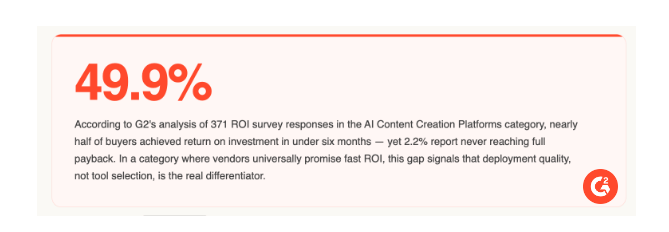
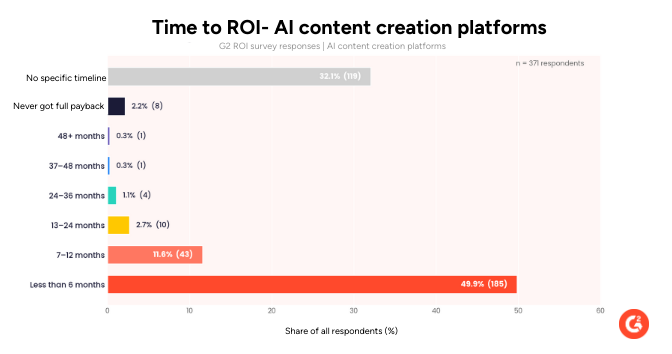
Of 371 buyers who completed the ROI survey, 185 (49.9%) reported achieving return on investment in under six months. This affirms that fast payback is a genuine and repeatable outcome in this category. A further 43 buyers (11.6%) reached ROI within 7–12 months, meaning 61.5% of all respondents recouped their investment within a year.
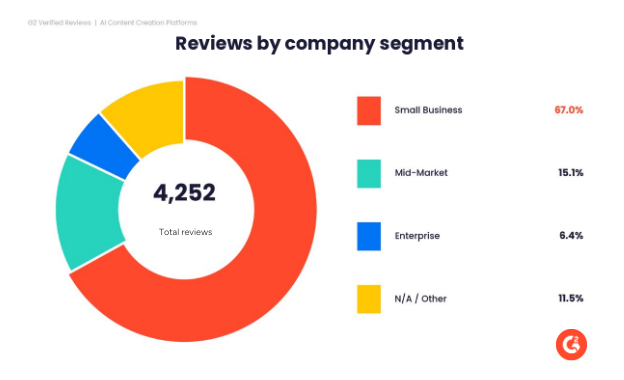
Small and mid-market businesses are the category's strongest validators. G2 Data shows that small businesses account for 67% of all AI content creation platform reviews. The data signals that lean teams with high content demand and limited headcount are getting the most mileage out of AI content creation capabilities.
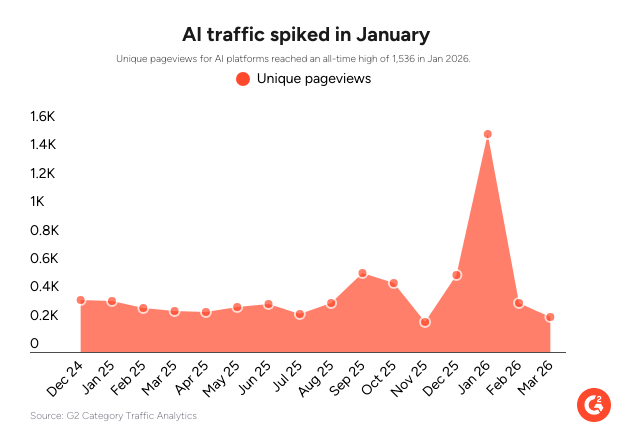
Buyer interest at the market level is accelerating sharply. G2 category page views for AI content creation platforms surged 183% in January 2026 versus December 2025, the largest single-month jump in 16 months of tracked data, following a 154% increase in December 2025.
The December 2025 to January 2026 window coincides with a wave of high-profile AI model releases from OpenAI, Google, and Anthropic, putting AI at the top of every budget conversation. Some of these model releases are shared below:
When major model announcements land in the same window as fiscal year planning cycles, buyer evaluation activity does not just increase it accelerates.
-2.png?width=656&height=174&name=infographic%20(1)-2.png)
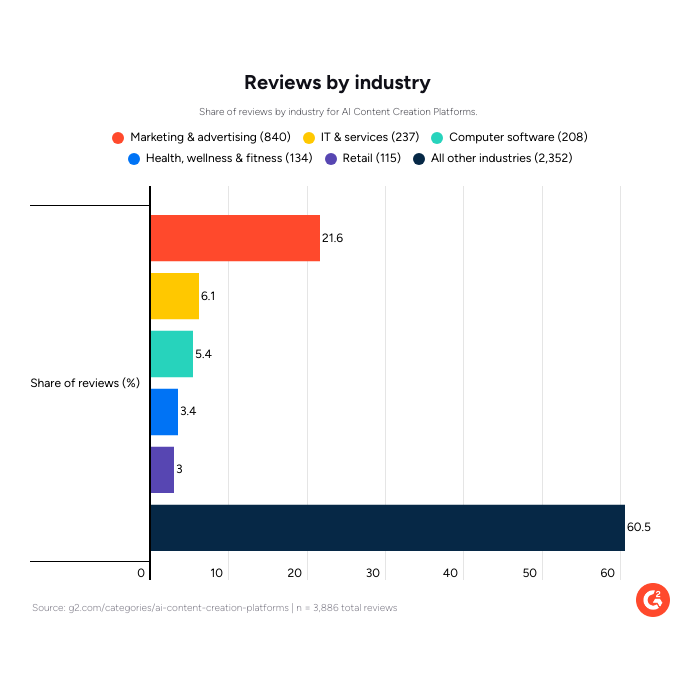
When it comes to AI content creation platforms, we see small and mid-market businesses win the most and win the fastest. Nearly half achieve ROI in under six months. Marketing and Advertising lead all industries at 21.6% of reviews, more than the next three industries combined. But adoption spans 50+ industries, from Retail to Real Estate to Healthcare, showcasing that this is no longer a marketing-only tool.
It is clear that AI content creation platforms are delivering fast ROI from our analysis, but buyers also need to stay realistic about what these tools can and cannot do. That’s especially true when it comes to how AI writing tools can mimic your voice, but still can’t replace your perspective, as analyzed by our team at G2.
AI content creation is no longer a question of “if” it works, but for whom, how fast, and at what cost. In a market that is already moving from evaluation to commitment, buyers who act with clarity will outperform those who follow the hype.
AI content creation works, but not equally and not for everyone in the same way. Small businesses are winning fast. Enterprises are still finding their footing as opportunities scale. Marketing teams are validating the ROI. The question for buyers in 2026 is no longer whether to adopt AI content tools. It is whether they are entering this market with a clear-eyed deployment plan or chasing a vendor promise. Our take: It’s not only about the tool you pick, but also about how well you understand your own workflows, your audience, and your timeline before you sign.
The tools are ready. The question is whether your strategy is.
Compare features, pricing, and real user feedback before you invest in an AI content tool. Check out G2’s top picks!


Most machine learning buying decisions today rely on demos, vendor narratives, and analyst...
by Sanjana V Prasad
-3.png?width=400&name=dark%20(2)-3.png)
AI is maturing. Where once we relied on one-off models for specific purposes, users are...
 by Grace Savides
-3.png?width=400&name=dark%20(1)-3.png)
Organizations are investing heavily in AI chatbots to transform customer experience — but are...
 by Subhransu Sahu