

-1.png)
Enterprises have never collected more feedback, and yet they still rarely find themselves acting on it. Teams have more feedback data and faster analysis than before, but the real problem is whether those insights actually change decisions.
Yet when we surveyed three vendors in the category (ReputationStacker, Birdie, and Caplena), all three independently named the same failure: platforms nailed aggregation and dashboards, not action. Here is what that gap looks like in the data, and what closing it actually delivers.
When asked about the 2023–2024 gap between vendor promises and reality, two of three vendors, ReputationStacker and Caplena, pointed to the same failure: closing the loop with customers. Birdie's answer named different gaps: aggregation complexity, human effort, and unproven ROI.
“Most feedback platforms stop at aggregation — they surface themes but never close the loop back to the roadmap. What actually changes decisions is context: connecting a signal to the specific customer, ticket, and business outcome behind it, fast enough that teams can act before the moment passes. The platforms that survive past pilot are the ones that prove impact — tying a fix back to a metric, not just a dashboard. In 2026-2027, leaders should stop treating VoC and quality monitoring as separate systems; the same conversation that reveals a bug often reveals churn risk too. Unify them, and act on both.”
Pat Osorio
Co-founder & CCO of Birdie
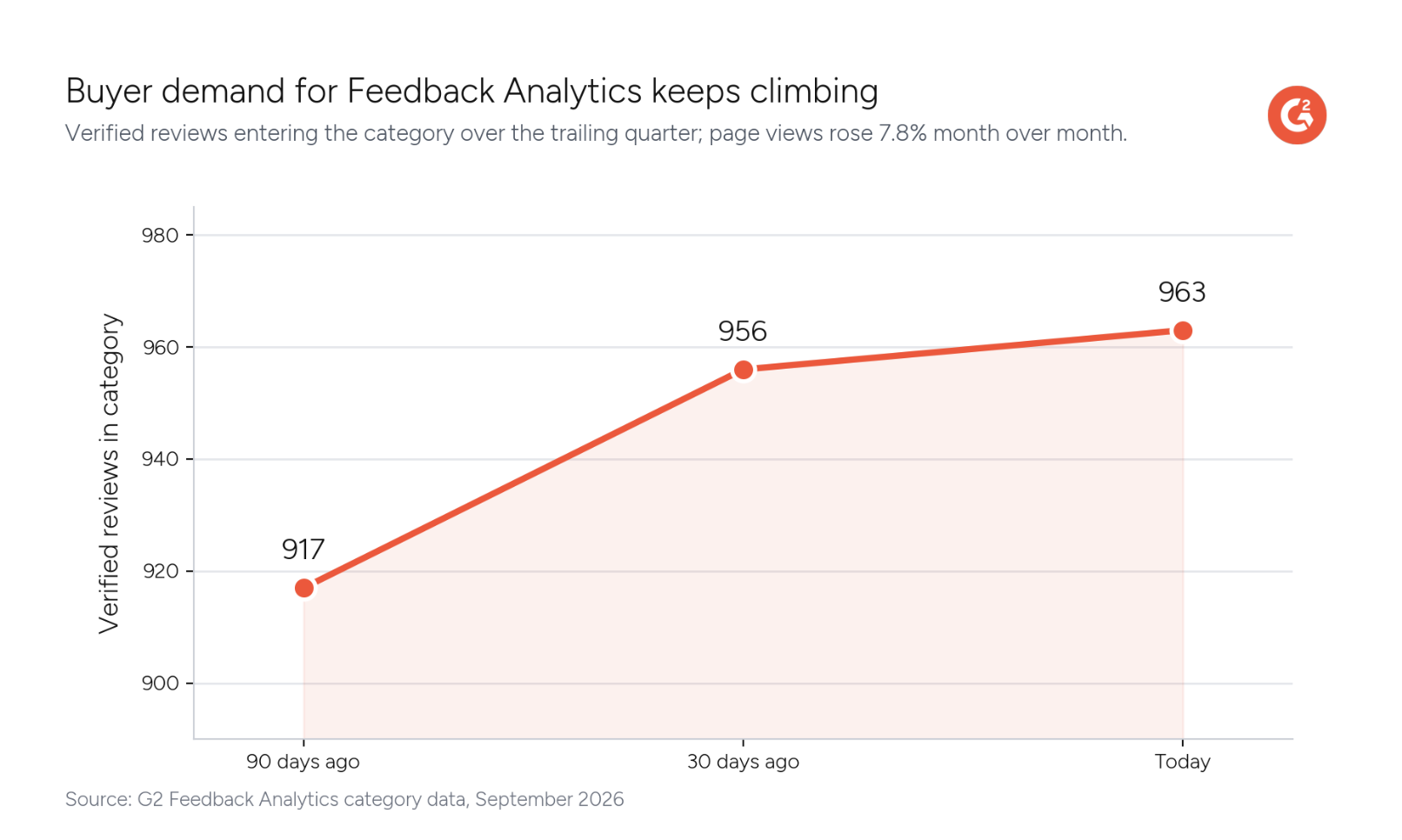
G2 data shows buyer research demand for this category is rising, category unique page views grew 7.8% month over month, and verified review volume climbed from 917 to 963 over the trailing 90 days. However, the category is crowded but thin on proof.
According to G2's analysis, 264 approved products sit in the Feedback Analytics category, yet only 68 have collected 10 or more verified reviews, and just 50 have earned a place on the G2 Grid. Buyers face more choices than ever, with less verified evidence for each one.
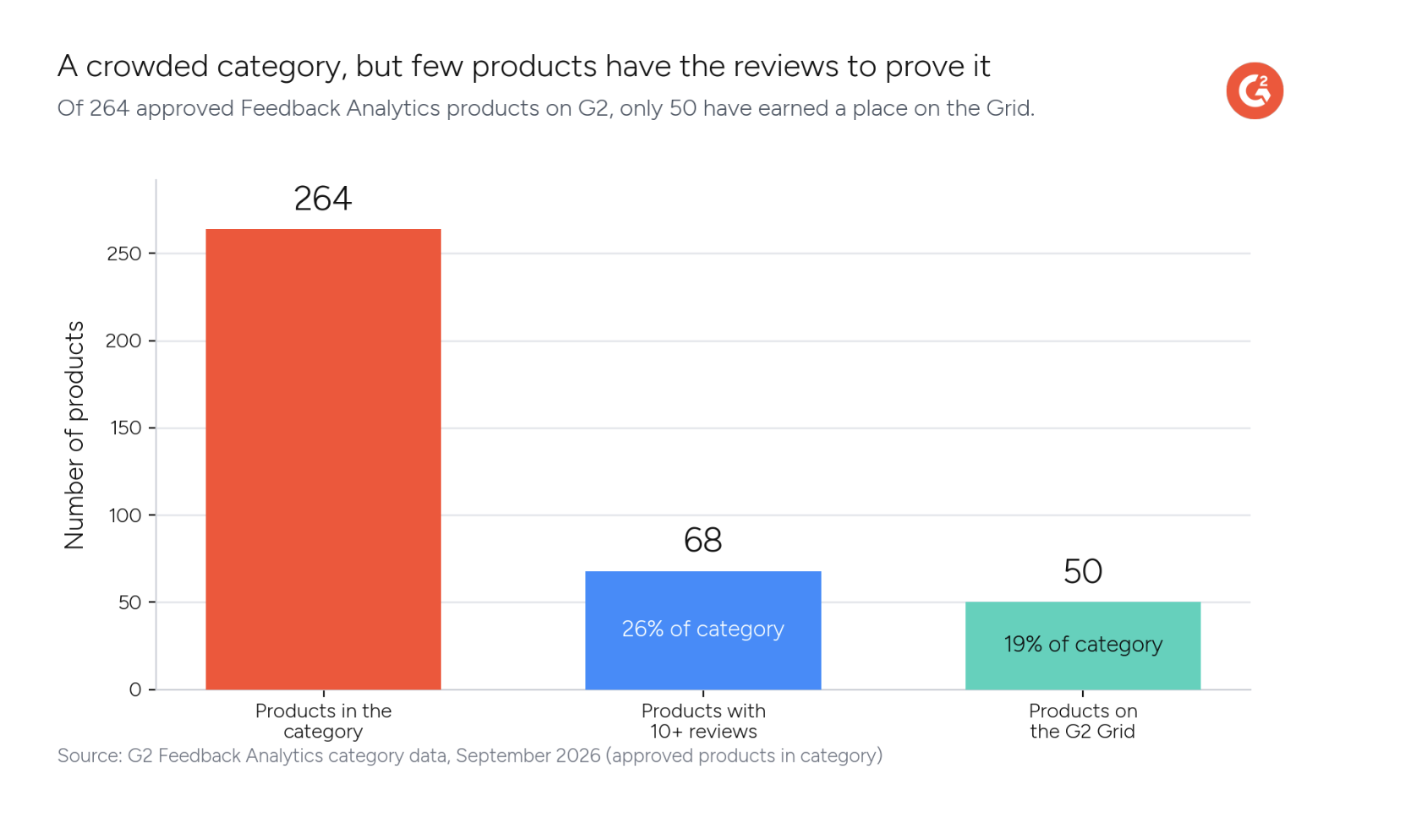
The pattern is clearly telling us one thing: more feedback isn't the bottleneck. Turning it into an actionable roadmap that impacts decisions is.
According to G2's vendors, confidence that product managers use feedback without prompting varies widely: ReputationStacker reports a 2 out of 5, Birdie a 3, and Caplena a 4. The spread from 2 to 4 shows the low end is the industry norm, not a single-vendor flaw, so no vendor claims a perfectly closed loop.
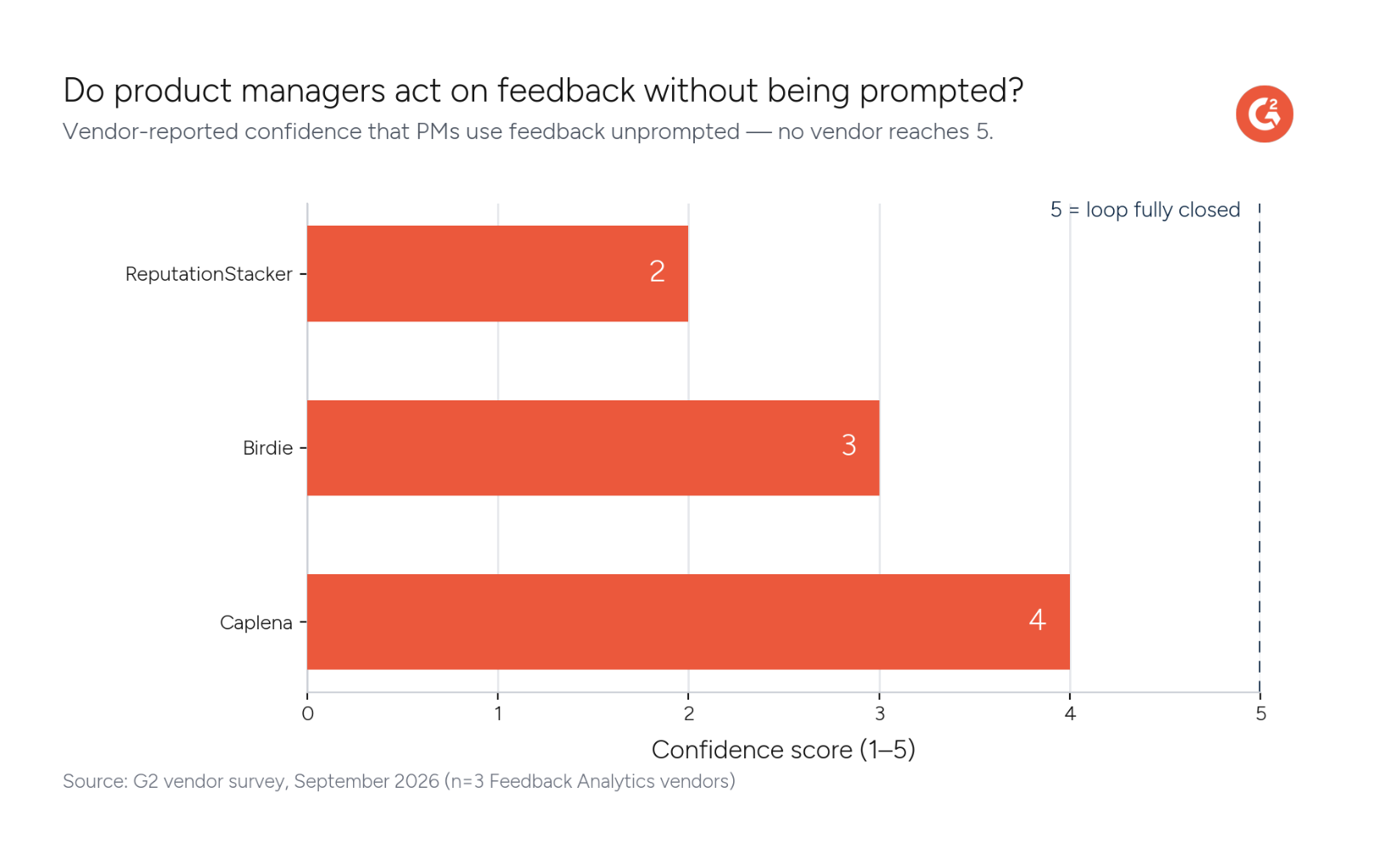
This confidence gap defines the category: platforms excel at collecting and surfacing feedback, but the organizational muscle to act on it is still developing.
G2's vendor survey shows ReputationStacker and Caplena both cut time-to-insight by more than 70%, while Birdie reports the figure varies by customer. Speed-to-insight, then, is largely a solved problem. Speed-to-decision is not, as the confidence scores above make clear. The bottleneck has moved downstream: from processing the data to acting on it.
“The best platforms cut out the noise, then turn the signal into clear, defined action items based on exactly what customers are telling you. That means identifying recurring complaints, wins, and opportunities across thousands of reviews and feedback points, showing which themes are increasing or declining, and tracking whether those patterns change after the business takes action. That's why we built location analytics, sentiment analysis, and AI insights into ReputationStacker as core features. Businesses don't need more feedback dashboards. They need to know: What are customers repeatedly telling us? What should we do about it? And did it get better after we made the change?”
Ian Kirby
Co-Founder of ReputationStacker
This is the category's current challenge: insight is fast, but confidence that it drives action is not. The vendors that can deliver the signal and also allow enterprises to organize around that data will be ahead of all the rest.
G2's analysis of vendor-reported outcomes shows what closing the loop delivers, in numbers:
These outcomes are the proof that closing the loop returns measurable business results, not just cleaner dashboards.
According to G2's vendor survey, two of the three vendors describe demand for AI-powered feedback analysis as growing, while Caplena refers to it as an "overwhelming," demand in their deals. Artificial intelligence (AI) has moved from a nice-to-have feature to a gatekeeper for enterprise adoption.
“Feedback analytics platforms should deliver three things by default: adaptability, effortless mastery, and AI research power that works out of the box. Too many get heavy to operate, and customer understanding ends up on the back burner. The right platform removes bottlenecks. Analysts bring in any data, clean and enrich it effortlessly, and run deep analysis that feels simple. Business teams self-serve insights with clear governance, even inside the tools they already use: ChatGPT, Claude, MS Teams, Slack. Everyone makes better decisions, faster. AI shouldn’t be a paid add-on, a separate module, or just an agent answering questions. It’s the new standard. Every workflow should be built around sophisticated AI analysis, batteries included.”
Barbara Houdayer
Head of Marketing at Caplena
Our vendors frame AI as fundamental to how enterprise deals are won, and Birdie ranks agentic AI, platforms that autonomously close the loop with customers, as the number one expected trend for 2028. The vendors most focused on the feedback-to-action gap see AI not as an add-on but as the mechanism that finally automates feedback: flagging patterns, alerting the right team, and triggering a decision without a manual handoff.
When asked which trend will most define the feedback analytics market by 2028, two of our vendors, ReputationStacker and Caplena, independently ranked the same top trend for the category's next phase: feedback embedded directly into workflow tools like Slack, Jira, and in-app experiences.
Privacy and regulation are already reshaping how vendors prioritize. G2 data shows the perceived impact varies: ReputationStacker rates regulation's effect on its roadmap a 2 out of 5, while Birdie and Caplena both rate it a 4. Most vendors already treat compliance as a real roadmap constraint, not a footnote.
Cross-functional teams: customer experience (CX) and support monitor incoming feedback, product managers prioritize the roadmap, marketing shapes messaging, and operations leaders address process and staffing gaps. As highlighted by the 2-to-4 confidence spread in this report, how widely a company adopts these tools still varies.
Collecting feedback is table stakes: aggregation and dashboards are standard across the category. The differentiator is whether feedback measurably changes a roadmap decision and ships. G2's vendor data shows confidence that product managers act on feedback without prompting ranges from just 2 to 4 out of 5, so most companies are still closing that gap.
AI demand has shifted from a nice-to-have to a core enterprise requirement. Agentic AI, which flags patterns, alerts teams, and triggers fixes without a manual handoff, ranks as the top trend vendors expect through 2028.
Look for evidence of closed-loop outcomes, not just dashboard features. Ask vendors to substantiate their time-to-insight claims, and to show how the tool embeds into the workflow tools your team already uses, such as Slack, Jira, and your support ticketing system.
Avoid leaning on time-to-insight alone. Ask vendors to show concrete, time-boxed outcomes: rating lifts (ReputationStacker's 0.3-star gain), operational metric gains (Caplena's punctuality and satisfaction improvements), or churn and ticket reductions (Birdie's moved metrics). ROI is proven when a feedback signal becomes a shipped decision and a metric moves.
G2's analysis of more than 10,500 verified Feedback Analytics reviews and a survey of three category vendors point to the same conclusion: the market has solved aggregation and is still solving action. The vendors proving their value are the ones that can show a feedback signal turning into a shipped decision, backed by a metric that moved. A low confidence score is a warning sign, not a rounding error. When you evaluate this category, ask vendors to walk you through a specific feedback-to-decision path and to prove it with outcomes, not features.
Learn more about AI-Powered Feedback Analytics on G2 →

TL;DR - Key insights from AI Text Summarization statistics 69% positive sentiment, only 2%...
 by Emma Stein

There are plenty of customer feedback management solutions out there, but most of them are...
 by Alyona Medelyan

As humans, we want to make the most of every day and every dollar we spend. We take time to...
 by Mary Clare Novak