

Enterprise AI agents have moved beyond experimentation.
According to G2’s 2025 AI Agents Insights report, 57% of companies already have AI agents running in production, signaling a clear shift from exploration to operational use. Many organizations are now treating enterprise AI agents as a foundational layer of their operating models.
The conversation has evolved. It’s no longer about whether AI agents will reshape work, but to how quickly organizations can scale them, where they should be embedded, and how much autonomy teams are prepared to grant.
Between October and November 2025, a structured questionnaire was sent to five enterprise software companies actively building or deploying AI agents. Participants were asked to share practical, experience-based input across several core themes:
This report brings together insights from five AI-forward vendors and industry leaders building and deploying AI agent builders within real enterprise environments: Nvidia X DataRobot, CloudTalk, Salesforge, Agent.ai/HubSpot, and Canva. Their perspectives offer a grounded, multidimensional snapshot of how agentic systems are evolving inside modern organizations.
Together, these signals mirror broader market momentum. According to G2’s report, three out of four companies have invested in AI agents within the past year, and AI-agent capabilities are increasingly appearing across a wide range of software categories. Agentic systems are no longer confined to a single department. They are becoming part of the core enterprise architecture.
This report examines where the five participating vendors align, where they diverge, and what their experiences reveal about the next phase of enterprise AI agent adoption.
AI readiness emerges as a unifying theme across all five companies. None describes themselves as early-stage explorers, which underscores how far enterprise agents have moved beyond experimentation. That growing level of confidence mirrors broader buyer sentiment in the market, as seen in G2 data on AI agent builders.
This consistent maturity level signals that AI agents are established components of their enterprise ecosystems rather than conceptual pilots.
Deployment levels reflect this momentum:
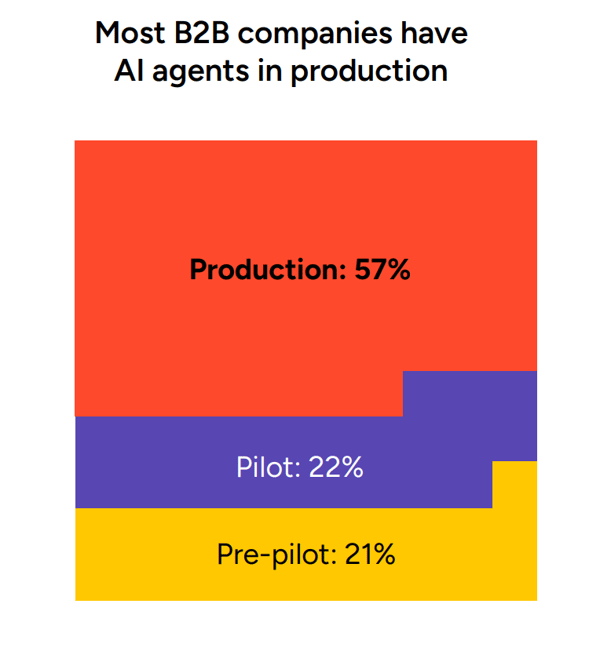
This maturity level is consistent with broader G2 findings. According to G2’s August 2025 survey, 57% of companies already have AI agents in production, 22% are in pilot, and 21% are in pre-pilot. The five vendors in this report sit firmly on the mature-to-advanced end of that curve, treating agents as real operating infrastructure, not experiments.
Across functional domains, the same pattern appears. Vendors note usage in IT operations, customer support, HR, marketing, and finance. This broad distribution reinforces that AI agents are becoming an enterprise-wide capability rather than a niche feature.
This aligns with broader market patterns as well. According to the G2 Data, the top enterprise use cases cluster around a consistent set of functions:
These patterns illustrate how AI agents are moving deeper into everyday enterprise work, not just technical or back-office tasks. Beyond operational efficiency, many leaders emphasize the role of agents in unlocking new creative and strategic capacity.
Canva captures this shift especially well.
“At Canva, we see AI as a creative partner that scales imagination instead of replacing it. Across our teams, AI eliminates busywork, allowing people to focus on ideas, storytelling, and making an impact. But it's not just about making existing work faster. It's unlocking entirely new ways to solve problems and create value. By automating repetitive tasks, surfacing insights faster, and reimagining workflows, AI is shaping a more empowered, efficient, and inspired workforce where creativity flows more freely across every function.”
Jackie HillG2 Data shows that AI agents deliver value quickly. More than 25% of enterprises report meaningful impact within three months, and the median time-to-value is six months or less. That early traction also reinforces the broader conversation around how AI agents for business operations are delivering measurable value. The five participating vendors echo this. All report measurable improvements from AI agent deployments, although the way they track impact varies.
The five participating vendors echo this. All report measurable improvements from AI agent deployments, although the way they track impact varies.
Nvidia x DataRobot and CloudTalk emphasize efficiency gains across internal workflows. Salesforge, Agent.ai/HubSpot, and Canva point to improvements in speed, responsiveness, and overall workload reduction.
Their examples illustrate this spectrum clearly:
Where the five vendors differ most is in their evaluation of success.
Nvidia x DataRobot and Salesforge focus on productivity and time savings. CloudTalk, Agent.ai/HubSpot, and Canva prioritize customer experience, workflow acceleration, and reduction of repetitive work.
Revenue impact and technical debt reduction appear less frequently in their responses. This range of approaches signals that while AI agents are delivering value, the industry has not yet aligned on a common performance framework.
Every vendor reports meaningful workforce impact, although the nature of that impact differs.
None of the partners describes a scenario where AI agents had no effect on their workforce.
Because these changes affect day-to-day work, both readiness and change management matter, and vendors approach preparation very differently.
Employee sentiment reflects this variation. Some teams respond with curiosity and enthusiasm, while others take a cautious approach. Still, none of the vendors report resistance strong enough to slow adoption.
“I believe AI agents will become a fundamental part of how companies operate. They’ll handle most of the routine execution work, and make data-driven decisions that keep things moving. This shift will let teams focus more on strategy and problem-solving, while the agents quietly run the operational side.”
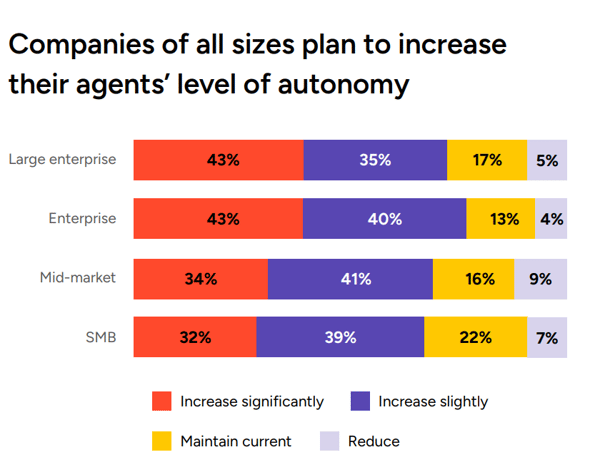
Kateryna NoskoAutonomy is the next frontier for enterprise AI agents. As agents move from task helpers to workflow owners, the key question becomes how much independent decision-making teams are willing to allow — and under what guardrails. Both G2 market data and this in-depth survey of five industry leaders point to the same reality: autonomy is increasing, but human oversight still anchors trust.
All five vendors share the same baseline view: expand AI agent autonomy cautiously, with humans in the loop.
Where the vendors differ is in their forward stance.
Canva exemplifies a measured and methodical approach, using structured prototypes and controlled environments before scaling agentic workflows. Salesforge stands out as the only vendor ready for full autonomy today, reflecting a higher level of trust and a product direction that prioritizes automation-first execution.
G2’s market data reinforces this.
G2 Data also highlights where autonomy is rising fastest. High-autonomy behaviors are already common in operational workflows like autoblocking suspicious IPs (54%), rollback on failed deploys (54%), and sales outreach pre-qualification (49%).
Together, vendor perspectives and market data show a clear trajectory: autonomy is increasing in structured layers, with trust and oversight defining how far enterprises are willing to go next.
Even with these differences, the vendors report clear business value from their agent deployments.
And this tracks with what we found in our broader market survey. Over 25% of users see their first meaningful outcome within three months, and most organizations realize value within six months or less.
Agent rollouts are improving the employee experience alongside business results: nearly 90% of buyers report higher employee satisfaction in departments where agents were deployed, largely because agents take repetitive work off people’s plates.
Measurement approaches amongst the vendors fall under these categories:
That diversity mirrors the market itself. G2 Data shows strong early operational upside in mature workflows, including a median 40% reduction in cost per unit and an 80% median containment rate for customer service incidents handled by agents. Agents are also accelerating velocity: respondents report a median 23% improvement in speed-to-market for mature workflows, with many reviewers citing major gains in marketing and software-development cycle times.
Put together, the market signal and vendor evidence reinforce one takeaway: as autonomy (with guardrails) increases, enterprises are seeing real outcomes quickly. both in business performance and workforce experience, even before the industry fully standardizes how it measures success.
What Nvidia x DataRobot, CloudTalk, Salesforge, Agent.ai/HubSpot, and Canva signal collectively is clear: enterprise AI agents are moving from controlled pilots to steady operational adoption. The five participants anticipate that agents will manage 10 to 25% of enterprise workflows in the next few months. This alignment creates a strong foundation for forecasting how agent-driven work will evolve next.
Over the next half-year, the workflows most likely to make up this share fall into two categories grounded in what vendors already use agents for today.
These workflows are the earliest to scale because they are high velocity, low risk, and already show clear value across vendors. They include:
These workflows expand fastest because they streamline work without affecting high-stakes decisions:
In the near term, the vendors’ forecast suggests that meaningful portions of operational, support, and revenue workflows will have agent involvement at one of these layers.
Rather than a single jump toward autonomy, the next era will expand in structured layers that reflect real enterprise comfort levels.
Based on vendor behavior today, this is the layer most likely to scale first. Agents will operate independently on:
This aligns with the market-wide trend seen in the G2 report, where organizations readily grant autonomy for tasks that do not carry financial, legal, or security risk.
As trust frameworks strengthen, more workflows will move to agent-proposed actions where humans still approve the final step:
This stage reflects the majority stance across the five vendors, where comfort rises yet guardrails remain central.
Enterprises will continue requiring human decisions for:
These boundaries mirror vendor caution and match the broader trend noted in the G2 report that most organizations remain in “autonomy with guardrails.”
Vendor diversity in how value is assessed today makes one conclusion clear. The next phase will bring default metrics that consolidate across enterprises.
Buyers can expect ROI to converge around:
These metrics are emerging as the most reliable ways for stakeholders to compare outcomes across functions and teams.
As enterprise AI agents expand their role, buyers should prepare for a transition where agents become operational partners in day-to-day work. Enterprises that invest early in trust frameworks, oversight models, and workflow-level experimentation will scale faster and more safely. The next six months mark a period of controlled acceleration. The organizations that learn how to balance autonomy, accountability, and clarity around agent boundaries will be positioned to lead.
Key takeaways for buyers:
The perspectives from Nvidia x DataRobot, CloudTalk, Salesforge, Agent.ai/HubSpot, and Canva show that AI agents have moved beyond pilots and into real enterprise workflows. Despite different maturity levels, all five vendors agree that agents are becoming essential to daily operations. Scaling from here will require stronger trust frameworks, clearer measurement practices, and practical enablement for teams.
Three signals are consistent. Agent deployments are expanding into cross-functional processes. Autonomy is rising gradually with human oversight. And vendors are seeing meaningful operational gains, even as ROI metrics differ.
For leaders, the guidance is clear: identify workflows where agents can deliver immediate value, define transparent oversight boundaries, and give teams hands-on exposure. These steps will matter more than speed as organizations prepare for broader autonomy.
For a broader market lens beyond vendor perspectives, explore the 2025 AI Agents Insights Report and review the evolving landscape of enterprise AI agents on G2 to compare products, capabilities, and real-user insights.
Looking for direction on how to compete and scale in this new AI era? G2’s guide, 5 Ways Software Companies Can Win in the Age of AI, offers actionable insights for product, GTM, and strategy leaders.

The Agentic AI category didn't exist on G2 a year ago.
 by Sidharth Yadav

Recently updatedSummer 2026 Grid® Report · Published May 26, 2026 This guide was last...
 by Yashwathy Marudhachalam
I evaluated the top AI customer support agent software to identify the best platforms for...
 by Preksha Buttan