


AI is now a part of every vendor’s software pitch. If you’re the one buying, you want to know whether it works, and the best answer comes from people who’ve already used it. TechSparks 2026, YourStory's startup and technology summit in Bengaluru from October 13 to 15, brought together builders discussing how AI earns buyer trust. G2's proprietary review data offers a way to compare those event perspectives with how buyers describe AI after using it
Two areas defined the AI conversation at TechSparks: Finance and Accounting, and Building Design. In finance, speakers from Pine Labs, Sahi and Intuit all talked about checks: what an AI is allowed to do, what record it leaves, and who answers for the result. In building design, two founders demonstrated an AI tool that generated a complete building model from a single prompt.
These discussions prompted an analysis of two G2 categories: accounting software and building design software.
The big question: What evidence can buyers find that AI software delivers on its promises, and how does that evidence vary by software category?
I can’t measure trust directly, but what I can see is how builders say they earn it, and how reviewers talk about AI after using it.
The short answer? It depends on the kind of software and the contrast speaks volumes. In finance, builders emphasize on limits, records, and who answers for the result. This is also verified from G2 review data - accounting reviewers mention AI increasingly year after year and are largely positive about it. In building design, however, a founder can now type one request and get a building model, but reviewers barely mention AI yet, and the ones who question it want more of it.
I attended three finance sessions, and they had a lot in common.
Pine Labs, a payments company, showed an AI agent that takes a cyber-fraud complaint from intake to closure. It reads the complaint, matches the transaction, sends it to the right team, and files the response on a government portal. A person stays in control of the password and the one-time code. Every decision opens into a 15-step trace, a record of each step with the evidence and the confidence behind it, and a kill switch is always within reach.
At the event, the company’s CTO shared that building an agent is the easy part - The hard parts are connecting tools, continuous monitoring and checks, and deciding when and where a person needs to step in and where the kill switch goes. Each agent also gets a signed list of what it needs to do, and if it goes beyond the list, it can be shut down. .
Sahi, an investing app, brought that idea of control into its AI assistant’s design. Before the assistant reads anything about you, it asks for permission on a screen that says what it will read, why, and for how long. The assistant focuses on explaining rather than offering investment tips, and it declines requests when appropriate
Its rules slide ended with one line: “The system reports the facts. The person owns the verdict.”
At Intuit, a principal AI scientist pointed to a challenge that has barely changed: data quality. Reliable AI still depends on the information behind it..
All three sessions in finance came back to the same results: limits on what the AI can do, a record of what it did, and a person who answers for it. The discussions covered finance broadly, while my G2 analysis focuses on accounting software. The connection is between the ideas discussed onstage and reviewers’ experiences, rather than a direct comparison of products.
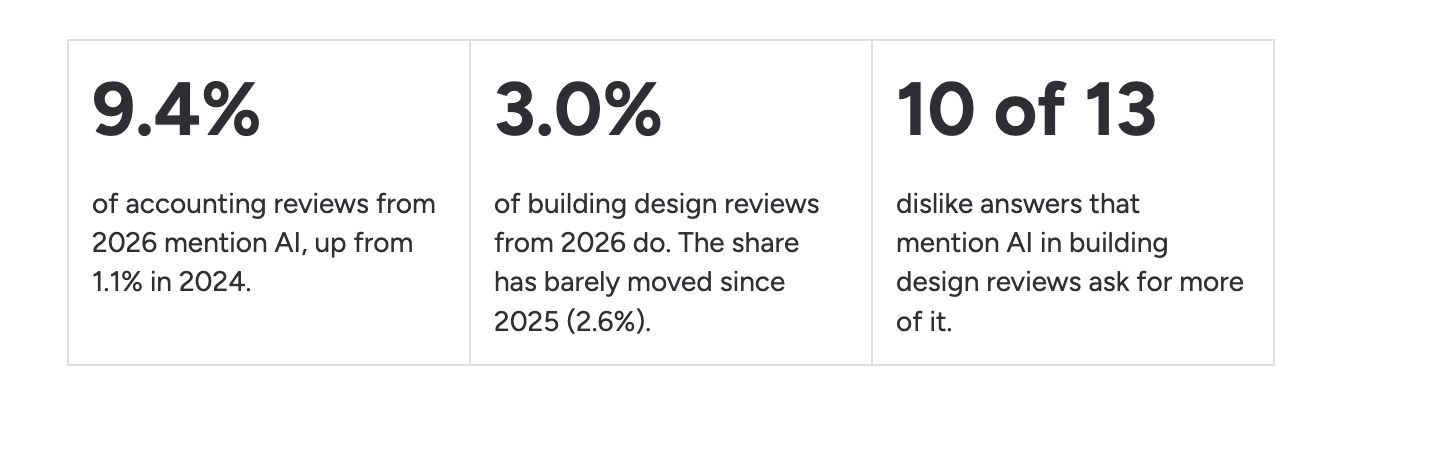
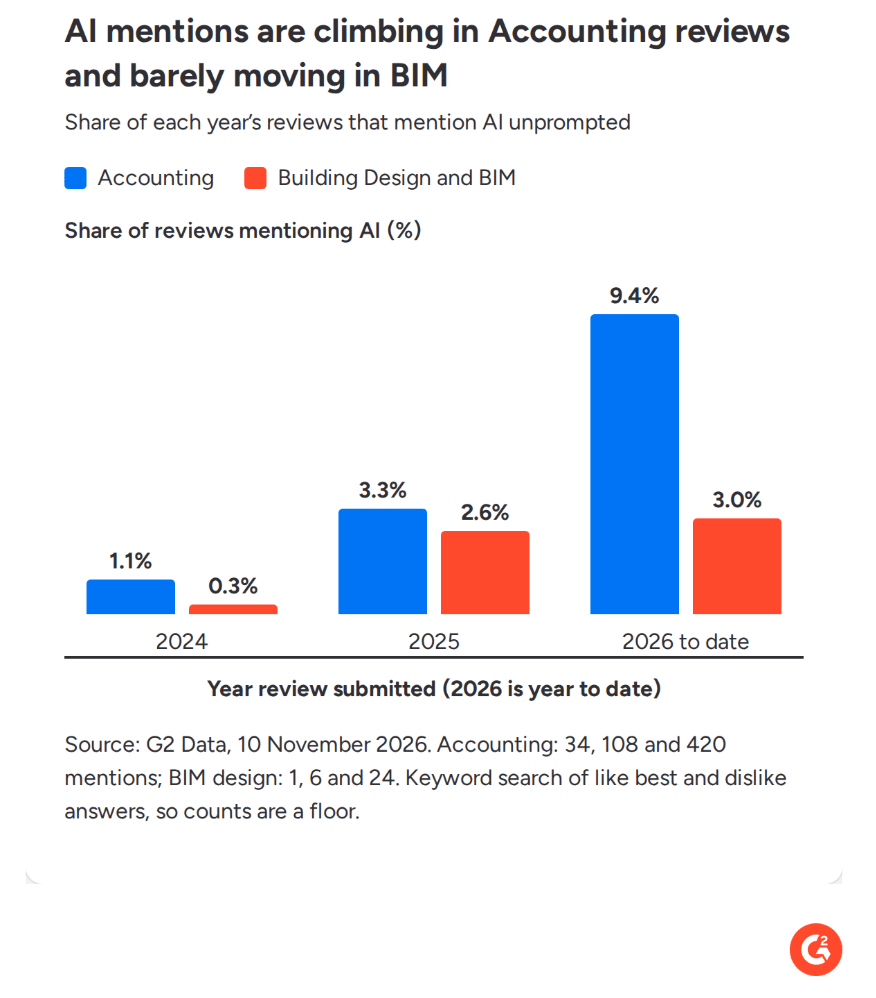
According to G2 Data, accounting software has 31,600+ approved reviews, and in 2024, 1.1% of them mentioned AI. In 2025, it was 3.3%. In 2026 so far it is 9.4%, more than eight times the 2024 share. The reality is clear - Reviewers are talking about AI, and it's increasing every year.
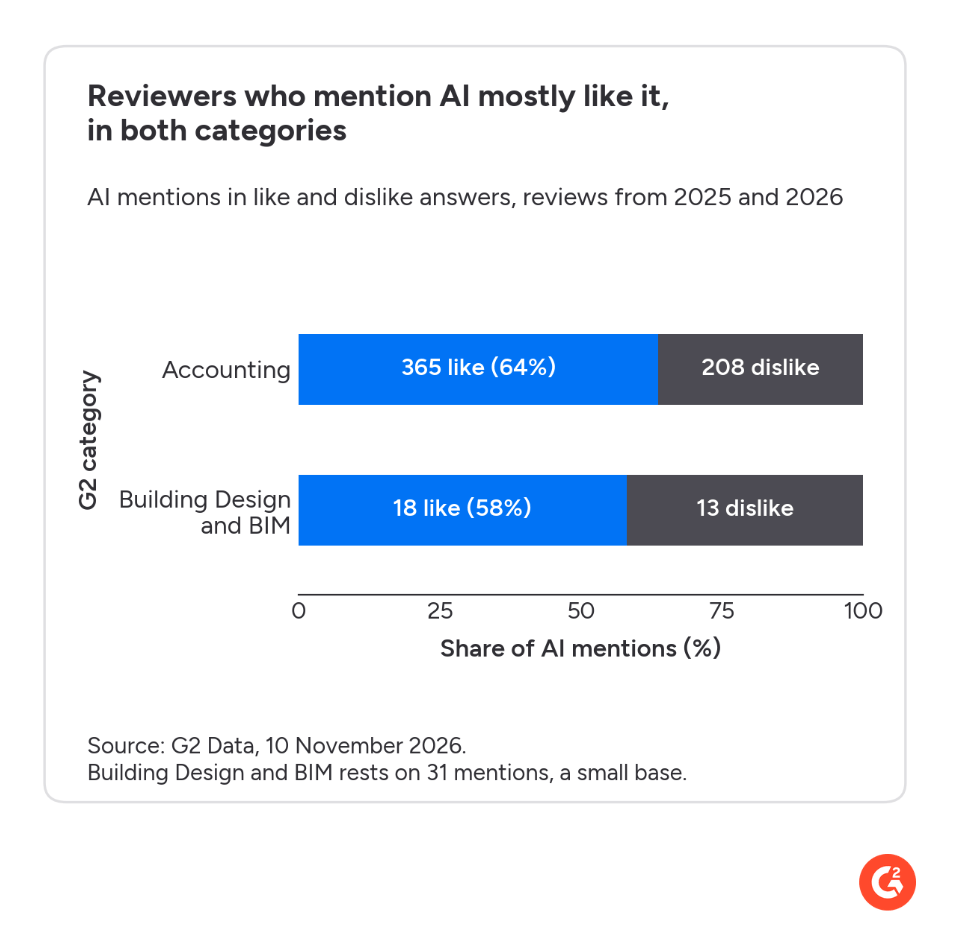
When accounting reviewers from 2025 and 2026 bring up AI, they mostly say something good: about 64% of those mentions are in the "like" answers and 36% in the "dislike" answers. Building design, which I cover in the next section, looks similar at 58% and 42%.
Between the TechSparks event and my analysis of G2 data, what stood out to me was the gap. The builders at TechSparks kept coming back to the record behind an answer: permissions, traces, logs. Reviewers write about the answer itself. Accuracy comes up in 4.9% of accounting reviews from 2025 and 2026, and audit trails in 1.2%, about a quarter as often. Those counts cover all accounting reviews, not only the ones that mention AI. One possible explanation is that audit trails receive less attention in everyday use and only become visible when someone needs to verify what happened.
TechSparks revealed that AI in building design is ahead of the review evidence — vendors are demonstrating capabilities that buyers have not yet written about. The session showcased BRIXX, an AI-native architecture, engineering, and construction (AEC) platform developed by Tagbin. The founders started their session with a familiar set of problems that companies face:
Their slide described the tool this way: “Not a replacement. A connecting layer.” It works alongside design tools such as AutoCAD, Revit, and Snaptrude, and designers keep the tools they use. What they showed was compelling, but it was still a demo. The capabilities described here reflect what the founders presented and claimed; I haven’t seen the tool used on a real project.

Demo 3D Tower model
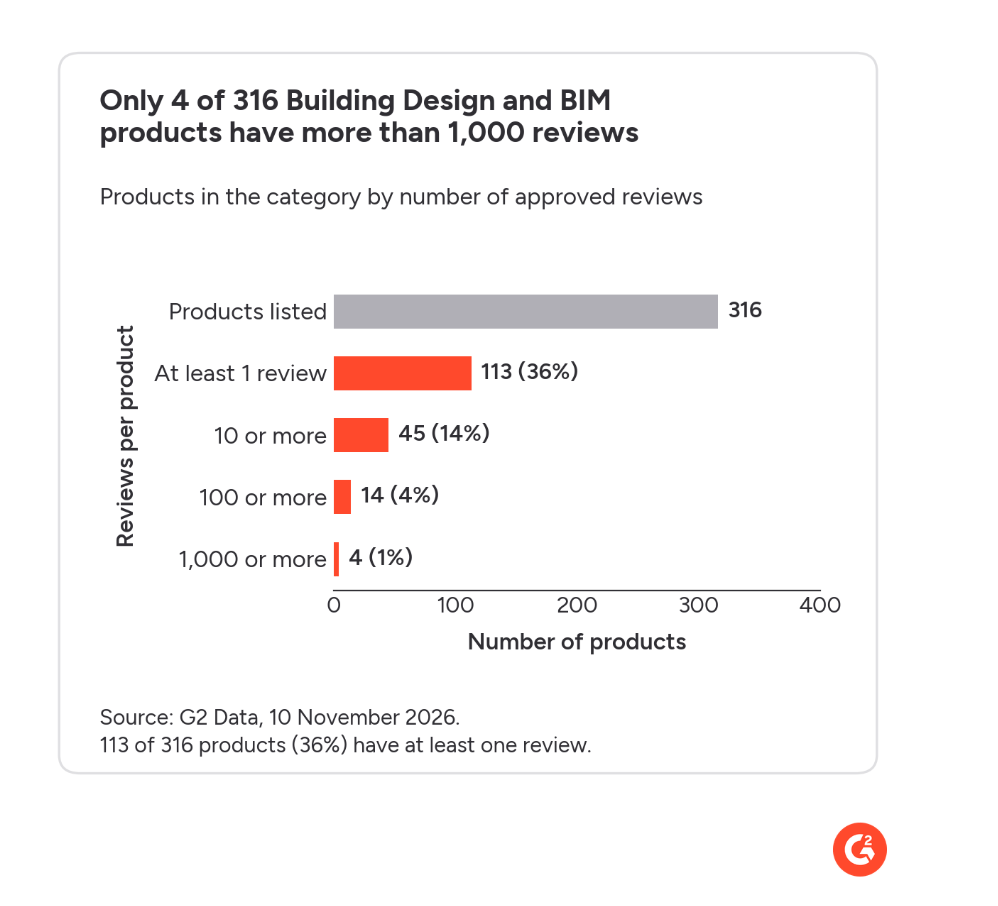
Building design reviewers rarely mention AI — only 3.0% of 2026 reviews do, and those who criticize it want more of it, not less. Very few do. On G2, the category is Building Design and Building Information Modeling (BIM). It has 5,104 approved reviews across 316 products. G2 describes it as design software for architecture and construction, with 2D or 3D tools, a shared building model, and ways to simulate and assess a building’s expected performance before construction.
Among building design reviews, the share that mentions AI rose from 0.3% in 2024 to 2.6% in 2025 and 3.0% in 2026 so far. Reviews more than tripled between 2025 and 2026, but the share barely changed. Reviewers are writing about these tools, just not about the AI in them yet.
The few who do are fairly positive: 18 mentions in the “like” answers and 13 in the “dislike” answers. But the criticism tells a more interesting story. Of the 13 “dislike” responses I read, ten asked for more AI capability. One Navisworks reviewer said the construction project-review tool would be “on another level if it had AI agents.” For these reviewers, the frustration is not about the AI, but the lack of it. With just 13 responses and a classification based on my own reading, this suggests a pattern rather than a precise measure of buyer sentiment.
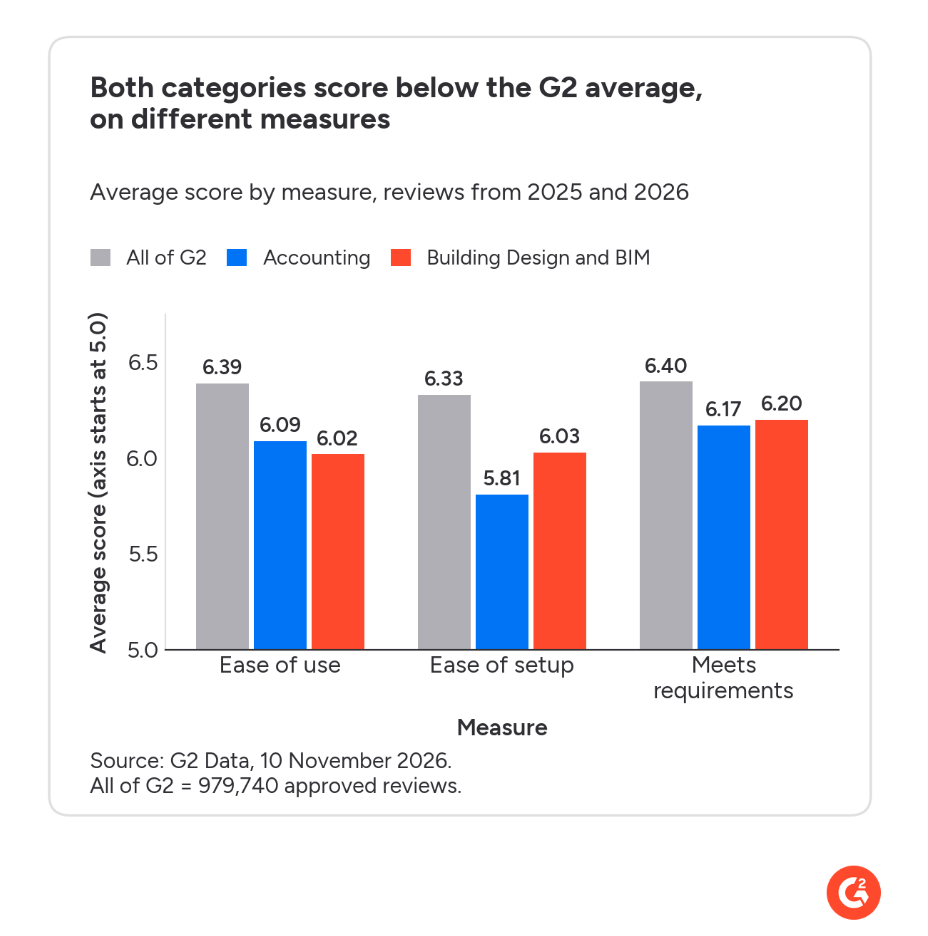
Neither is easy. I compared reviews from 2025 and 2026 with all approved G2 reviews from the same period. Both categories score below the G2 average on ease of use, ease of setup, and whether the product meets requirements. On G2’s rating scale, where higher is better, accounting’s biggest gap is setup (5.81 against 6.33). Building design’s biggest gap is ease of use (6.02 against 6.39). The gaps are small, about 0.3 to 0.5, suggesting both categories are slightly harder to use than average, not significantly so.
That fits the BRIXX founders’ point that BIM never got easy. The reviews cannot tell us whether an AI tool fixes that. It is the question a buyer should test.
In finance, builders talk about the record behind an answer and reviewers talk about the answer. A buyer can ask for both: the evidence and the record.
In building design, the demo is ahead of the review evidence. The founders showed a tool performing tasks in one command that they said could take months, yet few G2 reviewers mention AI. With limited independent feedback to draw on, buyers need to test those claims on their own projects.
Ask about limits, records, and accountability. These are the three things finance AI builders at TechSparks and G2 reviewers consistently point to.
My main takeaway from TechSparks is that trust needs different kinds of proof. The finance builders I heard from showcased boundaries: what the AI can do, what record it leaves, and who answers for it. The building design founders on the other hand showed a demo and told us what it can do. The next step for them is the tool performing on a real project.
G2 reviews show where buyers are today and add to these perspectives. In accounting, 9.4% of this year’s reviews mention AI, most of them positive, and accuracy comes up far more often than audit trails. In building design, only 3.0% mention it, and the ones who criticise it want more of it. The proof is deeper in one category and still forming in the other.
If you are buying, ask to see the limits, the record, and who is accountable when something goes wrong. Where review evidence is limited, test the software on your own project. For builders, the opportunity is to make those answers as visible as the capabilities themselves.
Ask vendors to show limits, records, and accountability. In accounting software, ask what the AI can and cannot do, what trace it leaves behind, and who is responsible for the result. In building design, ask how it handles a real project with messy data and local building rules, and who signs off on the structural output.
Building information modeling is a way of designing a building as one detailed 3D model. Every part carries its own information, such as its strength and fire rating.
Only 3.0% of building design reviews from 2026 mention AI, compared to 9.4% in accounting. Review volume more than tripled in 2026 yet the AI mention share barely moved, suggesting buyers are evaluating these tools on traditional criteria, ease of use, integration, and output quality, rather than AI specifically. The buyers who do mention AI mostly want more of it, not less.
TechSparks showed vendors demonstrating AI capabilities in building design that buyers have not yet written about in G2 reviews. The event evidence is ahead of the review evidence. Buyers evaluating these tools should test them on real projects rather than relying solely on peer reviews at this stage.
For a closer look at what buyers expect from AI agents and how vendors can earn their trust, explore G2’s 2026 AI Agents Report by Tim Sanders.

Recently updatedFall 2026 Grid® Report · August 25, 2026 This guide was last updated on...
 by Preksha Buttan
The way buyers research software has undergone a dramatic change. For decades, organic search...
 by Palmer Houchins

I’m in meetings all the time, and I’ve seen how fast decisions and action items disappear once...
 by Washija Kazim