


A Laravel project that made sense at 10K users starts groaning at 500K. A Symfony setup that seemed over -engineered in month two becomes the only reason the team isn't firefighting in month twelve. The early wins feel like confirmation, and the friction shows up later, when the team is already committed to the architecture, the ORM patterns, and the deployment assumptions baked into the first call.
I evaluated 15+ tools using G2 Data and reviews to finalize the 6 best PHP web frameworks. These are CodeIgniter, Laravel, Symfony, Angular, Yii, and CakePHP.
What made this category harder to evaluate than most is that the wrong choice rarely announces itself immediately. The framework market sitting behind that infrastructure is projected to grow from $1.2 billion in 2023 to $2.8 billion by 2032, which tells you how seriously the industry is taking framework selection as a structural decision rather than a developer preference. Most frameworks perform adequately in the early stages of a project.
The gaps I kept finding in reviewer feedback weren't about features. They were about what happens when the codebase matures, the team grows, and the architectural decisions made at launch stop scaling cleanly. What starts as a velocity problem quietly becomes a retention problem, then a product problem.
Each pick below is mapped to the situation it fits best.
*These PHP web frameworks are top-rated in G2's Winter Grid Report. They are primarily open source platforms.
The six frameworks below all surface consistently across G2 reviews, but they solve meaningfully different versions of the PHP development problem. Some are built for speed and minimal configuration overhead. Others prioritise modularity and long-term architectural consistency. A few sit closest to the balance point between rapid deployment and scalability under load. The right fit depends on where the current constraints actually live, not on which framework has the longest feature list.
What the G2 data showed me most clearly is that the gap between a matched framework and a mismatched one rarely announces itself at launch. It shows up across sprints, in workarounds that slowly become load-bearing, in ORM patterns that hold at moderate data volumes and buckle under complex reporting. The frameworks that earn sustained strong marks on G2 are the ones that handle those moments without forcing architectural rewrites.
Adoption patterns in the G2 data span small agencies, mid-market product teams, and enterprise engineering organisations, each with different priorities around configuration overhead, performance under load, and how much the framework can bend before it breaks. The breakdown below is designed to make that match as clear as possible.
I started with G2's Winter 2026 Grid Reports to shortlist the top PHP web frameworks based on verified user satisfaction scores and market presence across small agencies, mid-market product teams, and enterprise engineering organizations.
From there, I dug into hundreds of verified G2 reviews and pulled recurring feedback patterns around what actually matters in production environments: routing flexibility, ORM reliability, onboarding speed, security defaults, community ecosystem depth, and how well each framework holds up as application complexity grows. That process helped me separate frameworks that accelerate early development from those that quietly introduce architectural friction at scale. Since I haven't personally used every framework covered here, my findings are grounded in aggregated feedback from verified G2 reviewers, many of whom are backend developers, engineering leads, and technical architects working with these tools in active codebases. The visuals and product references are sourced from G2 vendor listings and publicly available product documentation.
Not every highly rated framework is the right framework for every team, and that became clear quickly as I worked through the review data. I focused on what actually separates frameworks that accelerate real engineering workflows from those that quietly introduce friction as projects grow.
Drawing from AI-assisted analysis of hundreds of verified G2 reviews, these are the criteria I focused on:
No framework performs at the top across every one of these criteria simultaneously. The right choice depends on what your team cannot afford to compromise on right now, and what you can accept absorbing as a managed trade-off over time.
Below, you'll find authentic user feedback from the PHP web frameworks category. To appear in this category, a tool must:
*This data was pulled from G2 in 2026. Some reviews may have been edited for clarity.
CodeIgniter is a compact, open-source PHP framework built around the Model-View-Controller architectural pattern, designed to give development teams a structured, fast foundation, which in my view makes it one of the more honest frameworks in the PHP space.
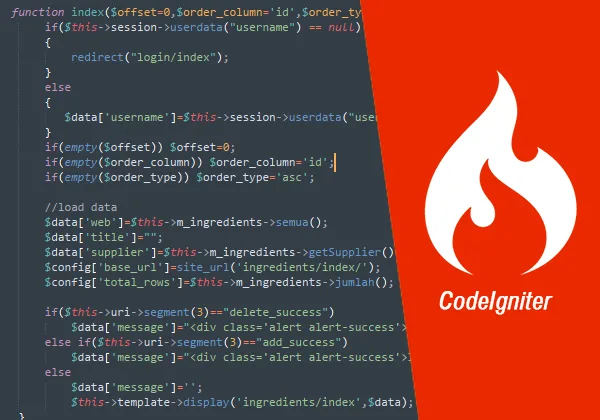
CodeIgniter's lightweight MVC structure
It separates application logic, data handling, and presentation into distinct layers, keeping codebases organized from the start. With one of the smallest footprints in the PHP framework ecosystem, it is built to move teams from environment setup to working application in hours, which tracks with the patterns I've seen across reviewer feedback.
Libraries come ready to use, routing follows predictable conventions, and the environment doesn't ask you to fight through extended configuration before it's useful. That adds up fast. Going through G2 reviews, reduced ramp-up time was one of the first things I saw people call out, which makes that 97% ease of use score easy to understand. Less time wrestling with setup means more time writing code that actually ships.
The core is deliberately lean, and I've seen this play out clearly across G2 feedback: teams pick CodeIgniter specifically because it doesn't load the application with framework overhead it never asked for. Server resource consumption stays low, response times stay tight, and performance holds up across varied hosting environments. For high-performance web applications where every millisecond of load time matters, that lean foundation is a genuine advantage.
I'd point to the documentation as one of the stronger reasons developers return to CodeIgniter across multiple projects. Quality of support is rated 85% on G2, and reviewer feedback ties that score directly to well-maintained official docs and an active community. For teams without a senior PHP architect on hand, that accessibility meaningfully lowers the expertise threshold needed to resolve issues and keep development moving.
G2 reviewers note that CodeIgniter's built-in feature set is narrower than more comprehensive full-stack frameworks. Teams building applications with complex or highly specialized functionality may find greater reliance on third-party libraries than with more feature-rich frameworks. The lean core aligns well with projects that prioritize a lightweight, unopinionated architecture and only the components they choose to include.
One theme I kept seeing across G2 reviews is how often teams praise CodeIgniter for its simplicity and speed. After working through the review data, it's easy to see why. For projects where fast setup, clean structure, and low server overhead matter most, CodeIgniter consistently emerges as a dependable PHP framework.
"The fast development time and the fact that you can start developing literally in minutes. Undoubtedly, CodeIgniter is a framework that allows you to have a PHP project in a very short time without the complexity of making many configurations. In addition to its extensive documentation, one of the things that I liked the most about the Framework is its active community that is always willing to help."
- CodeIgniter review, Rafael S.
"CodeIgniter doesn't come with a built in object relational mapping (ORM) system. While you can use third-party libraries or implement your own, this means developers need to manage database interactions more manually."
- CodeIgniter review, Manoj G.
Want only database tools? Compare the best free database software to find the right data layer to pair with a lightweight PHP framework.
Laravel brings authentication, routing, queuing, security, and other core application needs into one cohesive framework. It is feature-rich without feeling fragmented, making it a strong fit for teams that want to move quickly without assembling the foundation from separate libraries.
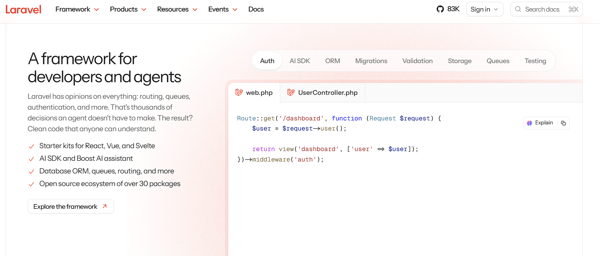
Laravel's expressive syntax and integrated tooling
What stood out to me across the review data is how often teams describe Laravel's integrated development experience as a major productivity advantage. Authentication, database abstraction, routing, queuing, and security are all available from the start, eliminating much of the boilerplate that typically slows early development. From what I saw in the reviews, developers spend less time assembling infrastructure and more time building application logic, which consistently comes through as one of Laravel's biggest strengths.
Laravel's syntax comes up repeatedly across G2 reviews, and after working through the feedback, it's easy to see why. Reviewers consistently describe complex backend implementations as logical and easy to follow, reducing the effort required to maintain existing code and onboard new developers. Backed by a 94% "meets requirements" score on G2, that emphasis on developer experience stands out as one of the framework's defining strengths.
Looking through the reviews, I came away with the impression that Laravel's ecosystem is one of its biggest competitive strengths. Reviewers consistently describe official documentation and community resources as reliable enough to solve most implementation issues without escalating to paid support. That level of self-sufficiency helps teams keep projects moving when development gets more complex.
G2 reviewers flag that Eloquent ORM's abstraction layer introduces query efficiency considerations as data volumes and reporting complexity grow. N+1 queries, heavy eager loading, and memory-intensive collections are patterns that surface more frequently in complex data pipelines. Still, the abstraction layer is well-documented and widely understood, which means teams have a clear, established path to profiling and resolving these patterns as application demands increase.
Laravel brings expressive syntax, production-ready defaults, and a tooling ecosystem that few PHP frameworks match in depth. It holds up well across the entire development lifecycle. For teams where delivery speed and code quality need to coexist, this is one of the more complete frameworks the PHP ecosystem has on offer.
"Laravel has become my go-to daily driver — the framework I instinctively reach for 12–13 times a day, because its expressive syntax makes even complex implementations feel straightforward and logical. It delivers a genuinely 'batteries-included' experience with a huge range of built-in features, so I rarely need to hunt down third-party tools for essentials like queues or authentication. Integration is also best-in-class. I can set up or swap connections to services like Stripe or AWS S3 with minimal friction, often just by adjusting a single configuration file."
- Laravel review, Dharmik V.
"I find performance pitfalls with Eloquent at scale problematic; it's easy to introduce N+1 queries, heavy eager loading, and memory-heavy collections in complex reporting. Laravel can be very fast, but it requires discipline and profiling as data grows. Complex domain workflows can get 'framework-shaped.' Multi-tenancy and enterprise patterns aren't fully first-class out of the box. Migrations and schema evolution in long-lived products also pose challenges. Another area is background jobs and observability without extra tooling. Frontend integration choices can feel fragmented, which can be a bit of a hassle."
- Laravel review, Tuğrul Y.
Ready to deploy? Explore the best cloud web hosting software to find infrastructure that matches the speed CakePHP's rapid setup delivers.
Symfony predates most of the PHP frameworks teams use today, and what got my attention was just how foundational it actually is; it's the structural backbone other major PHP frameworks are built on.
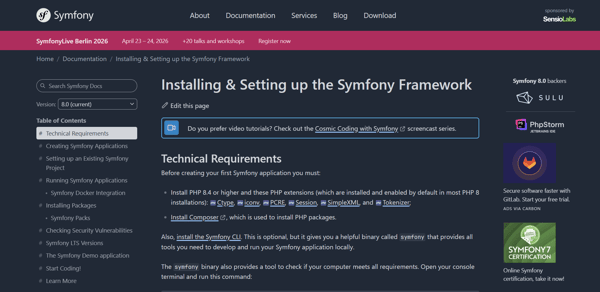
Symfony's installation documentation
Designed around a reusable component system, it optimizes for control and enforces well-established design patterns that keep complex, long-running applications consistent across team rotations and extended timelines. This is reference-grade PHP infrastructure.
Structural consistency is where Symfony earns its reputation. Codebases built on it maintain predictable architecture across team rotations and extended project timelines, which cuts the cognitive overhead of revisiting or extending existing work significantly. Meets requirements scores 92% on G2, which tracks with what I found when cross-referencing reviewer profiles across different team sizes and project types. For complex, long-running applications, that reliability compounds over time in ways simpler frameworks can't replicate.
One thing that stood out to me across G2 reviews is the consistency of the feedback around Symfony's documentation. Reviewers describe it as detailed, well organized, and approachable, even for developers coming from other PHP frameworks. With an 88% quality of support rating on G2, the documentation and broader knowledge ecosystem appear to answer most implementation questions without teams needing to rely heavily on formal support channels.
Symfony's integration flexibility doesn't force teams into a single prescribed approach. External service connections across multiple APIs and frontend frameworks typically land without significant custom development work. The architecture adapts to varied integration patterns naturally, and that adaptability is backed by an ease of doing business rating of 83% on G2 from reviewers working across genuinely varied integration contexts.
Feedback from G2 indicates that Symfony's component system and enforced conventions create a more structured development experience than more opinionated PHP frameworks. This is most noticeable for teams new to the framework, while development teams seeking precise control over application architecture align well with its flexibility. That depth also supports consistent, predictable codebases as applications scale.
Symfony's position as the architectural foundation behind much of the modern PHP ecosystem isn't just historical context; it's a live indicator of how well the framework holds up under real engineering demands. For mid-market teams where structural consistency, long-term maintainability, and integration flexibility are the metrics that actually matter, Symfony makes a strong, well-evidenced case for itself.
"It's intuitive command line to generates code, entity classes and controller classes. The easy way to integrate with multiple APIs and multiple frontend languages."
- Symfony review, Simón B.
"Recent PHP 8 support on the Symfony 6 hasn't been good. I have had to tear down and restart projects countless times because of PHP versioning."
- Symfony review, Francis O.
Pair a modular framework architecture with the best application performance monitoring tools to stay ahead of performance issues as your application scales.
Angular is the kind of frontend framework that shows up when the stakes are high. G2 reviews consistently frame it as the go-to for teams that need structure, scalability, and long-term maintainability.
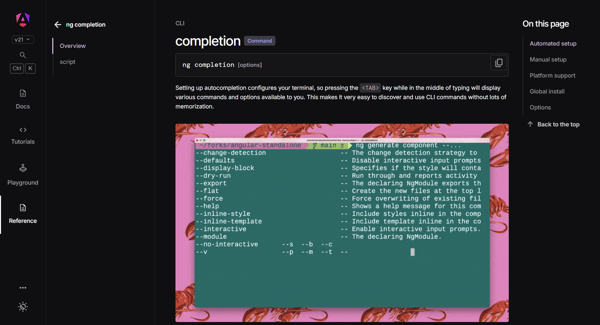
Angular's ng completion reference
This is where it gets interesting to me: developers aren't just picking it for a single project. They're picking it because it holds up as applications grow, contributor counts increase, and architectural discipline becomes non-negotiable.
Two-way data binding keeps the model and view layers in continuous synchronization, reducing the need for manual DOM manipulation. This mechanism is particularly relevant in applications with layered user interactions, where keeping the interface and underlying data aligned without redundant code is a meaningful efficiency gain. The result is a cleaner codebase that remains more navigable as scope grows, and it's a benefit I see cited most often by teams managing complex UIs.
Native routing and HTTP request handling remove the dependency on third-party libraries for core application functions, and what got me here was how much that simplifies early architecture decisions. Data flow between client and server follows a consistent, framework-native pattern throughout. G2 reviews suggest this internal cohesion as a meaningful reduction in the integration surface area teams have to actively manage as the application scales.
One thing I kept noticing across G2 reviews is how often developers mention Angular's integration with established development environments. Visual Studio Code, in particular, comes up repeatedly for its predictable navigation, debugging, and refactoring experience. From my evaluation of the review data, that consistency becomes increasingly valuable as teams and codebases grow. The 90% ease of doing business rating on G2 aligns well with the broader theme of a development workflow that reviewers describe as reliable and well supported.
G2 feedback notes that getting productive in Angular takes longer than most frontend frameworks, with new developers typically requiring more ramp-up time before contributing effectively. The structural rigor that extends the learning period is what produces applications that remain organized and navigable as feature scope and contributor count grow. Development velocity increases steadily as familiarity with the framework's conventions deepens.
Overall, Angular is built for teams that value long-term structure over short-term simplicity. From what I saw in the review data, its steeper learning curve is consistently described as a trade-off for stronger architecture, mature tooling, and applications that scale reliably over time.
"Angular is a well-known framework of javascript for frontend web development. The best part is it comes with great features like data binding and testing. We also have routing, and HTTP requests in Angular, unlike React. Using multiple libraries we can customize its components. Also from the source file, it is very easy to debug."
- Angular review, Kishan D.
"One drawback of Angular is its steep learning curve, which can be challenging for newcomers. Keeping up with frequent updates and navigating the extensive document can also pose difficulties for some users."
- Angular review, Onkar N.
Built around a structured MVC architecture, Yii enables developers to build fast, data-driven web applications through a framework designed for efficiency, code standardization, and scalable PHP development. It is commonly associated with projects requiring efficient database interaction and clean code organization, something I'd describe as one of the more consistent signals in the category data.
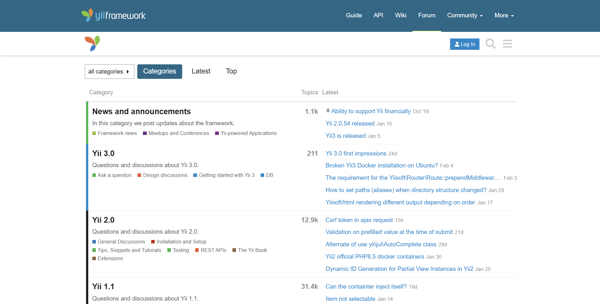
Yii's categories page
Gii is one of the features that caught my attention while reviewing the G2 feedback. Automatic generation of CRUD operations, models, and administrative interfaces removes a significant amount of repetitive development work. What I kept seeing across reviews is that teams building admin-heavy applications consistently describe it as one of Yii's biggest productivity advantages.
Looking through the review data, I kept noticing how frequently developers praised Yii's Active Record implementation. Database interaction remains approachable without hiding what's happening at the query level, and connecting models to backend databases requires relatively little setup. That simplicity helps teams move through early development faster, a theme that appears consistently alongside Yii's 81% ease-of-use rating on G2.
The model layer is designed to serve multiple purposes within the same application, allowing the same models used for database interaction to be applied across validation, cron job execution, and web interface logic. This reusability keeps the codebase leaner as functionality expands, something I'd describe as one of Yii's quieter but more durable advantages.
One consistent theme in G2 reviews is that major version migrations in Yii, such as moving from 1.x to 2.0, require significant refactoring because the framework does not maintain full backward compatibility across major releases. The updated architecture aligns well with modern PHP development practices and long-term codebase maintenance.
Yii focuses on what data-driven PHP development needs most: fast scaffolding, reusable models, low-friction database interaction, and a structure that scales cleanly. From my evaluation of the review data, it earns its place as a dependable choice for developers and small teams looking for an organized framework that stays out of the way.
"When we evaluated frameworks, Yii's logic and programming were clearest and just made the most sense. The framework is fast, Active Record is easy to learn and flexible, and the 'gii' scaffolding software makes building the admin area of any website a breeze."
- Yii review, Charlie S.
"Everything changes when you have to migrate from version to version, for example, Yii 1.1 to 2.0 or even 3.0; this might bring downgrades or affect your ETA on projects."
- Yii review, Jose P.
Speed to deployment with security handled from the start: that combination is what keeps CakePHP in active use across teams that can't afford to spend the first two weeks on foundational setup. For me, that's the whole pitch right there, and G2 reviews back it up consistently. Rapid application development is where this framework has always been most at home.
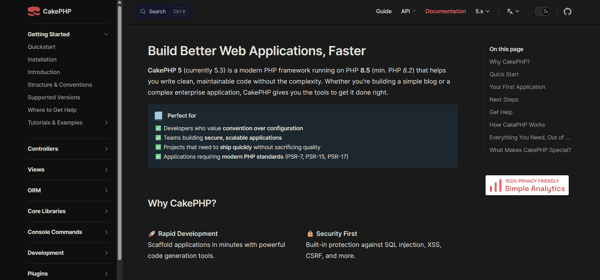
CakePHP rapid application development
As I worked through the G2 reviews, I kept noticing how often developers praised CakePHP's convention-over-configuration approach. Teams avoid lengthy setup processes and do not have to define foundational architecture from scratch before development begins. For projects running against tight timelines, reviewers consistently describe that low-friction entry point as helping teams reach productive development much sooner.
What you get here is a scaffolding system and ready-to-use templates that generate working application structures quickly, and that's exactly what supports the rapid development workflow reviewers keep flagging as a core benefit. I found the meets requirements rating sitting at 84% on G2, and the feedback ties that score directly to how reliably CakePHP delivers consistent interface patterns across multiple sections of an application without requiring you to lay custom groundwork each time.
Documentation is another area that caught my attention while reviewing the feedback. Reviewers describe the official documentation as structured, comprehensive, and reliable enough to resolve most implementation questions without leaving the framework's ecosystem. That level of self-service support helps maintain development momentum, particularly when onboarding new contributors or working through less common implementation scenarios.
G2 reviewers note that CakePHP is not well optimized for AI-assisted development environments like Copilot, which can affect teams that rely on AI tooling day-to-day. Teams with AI-heavy workflows will feel this more than those on traditional setups. The framework's core feature set remains sufficient for standard development without needing AI integration at the framework level.
CakePHP continues to stand out for teams prioritizing rapid, secure PHP development. Convention-driven architecture, built-in security, scaffolding, and structured documentation combine into a framework that supports fast project delivery while remaining organized as applications grow.
"I love how easy it is to use and how fast the interface feels. I also appreciate the range of options available and the amount of documentation provided, which makes it easier to work with."
- CakePHP review, Ariel B.
"Performance is not great compared to the competition. Documentation is not as intuitive as it should be."
- CakePHP review, M. Marzooq.
| Software | G2 rating | Free plan | Ideal for |
|---|---|---|---|
| CodeIgniter | 4.4/5 | Yes | Lightweight PHP development with minimal configuration |
| Laravel | 4.7/5 | Yes | Full-stack PHP applications with expressive syntax and a rich ecosystem |
| Symfony | 4.3/5 | Yes | Modular, enterprise-grade PHP architecture and long-lived projects |
| Angular | 4.5/5 | Yes | Component-driven frontends paired with PHP backends |
| Yii | 4.2/5 | Yes | High-performance, data-heavy PHP applications |
| CakePHP | 3.9/5 | Yes | Convention-driven rapid application development |
Got more questions? G2 has the answers!
CodeIgniter and CakePHP lead for quick implementation. CodeIgniter's pre-loaded libraries and minimal configuration requirements let teams move from setup to a working application in hours, backed by a 97% ease-of-use rating on G2. CakePHP's convention-over-configuration approach eliminates lengthy foundational setup, helping teams reach productive development sooner without defining application architecture from scratch.
Laravel ranks highest on G2 at 4.7/5 and is frequently cited for compressing time from zero to production with its batteries-included toolset covering authentication, routing, queuing, and database abstraction. CakePHP's convention-driven scaffolding and built-in templates help teams build quickly without extensive configuration. CodeIgniter also surfaces in this context, with its lean core enabling fast project starts — from setup to a working application in hours.
Laravel and Symfony consistently earn the highest reliability marks from backend developers on G2. Laravel scores 94% on meets requirements, praised for its expressive syntax and production-ready defaults that hold up across the full development lifecycle. Symfony scores 92% on meets requirements and is noted for maintaining predictable codebases as application complexity and team size grow, with structural consistency described as compounding in value over time.
Laravel is the most trusted PHP web framework by backend developers on G2, with a 4.7/5 rating and consistent praise for expressive syntax that makes complex implementations feel logical. Symfony follows as a widely trusted option for complex, long-running projects — described by reviewers as reference-grade PHP infrastructure and the structural backbone that other major PHP frameworks are built on.
CodeIgniter, CakePHP, and Yii consistently surface in feedback from small development teams. CodeIgniter's minimal configuration gets projects to a working state in hours. CakePHP's scaffolding and convention-driven structure reduce foundational setup, helping teams shift focus to application logic earlier. Yii's Gii tool automates CRUD generation and admin interface scaffolding, removing a significant amount of repetitive boilerplate work.
CodeIgniter carries an 85% quality of support rating on G2, with reviewers pointing to well-maintained official documentation and an active community always willing to help. Symfony scores 88% for quality of support, with documentation described as detailed, well organized, and approachable even for developers coming from other PHP frameworks. Laravel's community resources are cited as reliable enough to resolve most implementation questions without escalating to paid support.
All six frameworks covered — CodeIgniter, Laravel, Symfony, Angular, Yii, and CakePHP — are primarily open source platforms, as noted in G2's Winter 2026 Grid Report. Open source licensing means no vendor lock-in and no licensing costs. Laravel and CodeIgniter lead for rapid development speed, while Symfony and Yii provide strong architectural foundations that scale without tying teams to proprietary tooling.
Laravel, CakePHP, and CodeIgniter are most frequently cited by SaaS teams managing without dedicated IT resources. Laravel's documentation and community ecosystem are described as reliable enough to resolve most implementation issues without escalating to paid support. CakePHP's official documentation is noted as structured, comprehensive, and sufficient for most implementation questions. CodeIgniter's well-maintained docs and active community lower the expertise threshold for resolving issues independently.
All six frameworks have free plans with no licensing costs. CodeIgniter and CakePHP are most frequently cited for minimal implementation time — CodeIgniter moves teams to a working application in hours, while CakePHP's convention-driven approach eliminates lengthy foundational configuration. Laravel also surfaces here, with its integrated toolset reducing the upfront investment typically associated with full-stack framework setup.
CodeIgniter, Symfony, and Laravel earn the most consistent community support recognition from backend developers on G2. CodeIgniter reviewers cite an active community always willing to help, with an 85% quality of support rating. Symfony carries an 88% quality of support score, with documentation described as detailed and organized. Laravel's community resources are cited as a reliable self-service alternative to formal support, sufficient to solve most implementation issues without escalating.
Choosing a PHP framework is less about finding the "best" option and more about finding the one that matches how your team builds software. The trade-offs become clearer when viewed through the lens of project complexity, long-term maintainability, team experience, and deployment requirements rather than feature lists alone.
From my evaluation of G2 reviews, the strongest frameworks consistently help teams reduce development friction while remaining reliable as applications and codebases grow. Some prioritize rapid development and simplicity, while others offer greater architectural control and scalability. The right choice depends on which of those priorities matters most to your team.
Use the strengths, trade-offs, and best-fit scenarios in this guide to narrow your shortlist. A framework that aligns with your team's workflow today is far more likely to support the next few years of development than one chosen solely for popularity or feature breadth.
Once you've selected your PHP framework, the next step is choosing the right development environment. Check out G2's picks for the best text editors to find one that fits your workflow.


Every JavaScript framework promises a better developer experience. The real question is...
 by Disha G

I evaluated 15+ libraries using G2 Data and reviews to finalize the 6 best data visualization...
by Disha C

A picture is worth a thousand words. Especially when that picture can...
 by Mara Calvello