


If you’re evaluating the best lead capture software, chances are something isn’t working as well as it should.
You've got forms that underperform, or a sales team that's tired of chasing dead-end contacts. You know you need a better system. You’re trying to figure out one that fits perfectly.
The challenge isn’t just finding a tool; it’s finding one that actually fits your workflow, improves conversion rates, and helps your team focus on the right leads.
That's exactly why the lead capture software market is growing as fast as it is. It reached $2.89 billion in 2025, up from $2.69 billion the previous year. You get to close the gap with the right software.
To help with that, I spent ample time analyzing G2 reviews, cross-referencing verified user experiences to find out tools that deliver. This guide showcases my insights with the hope that you’ll be able to figure out your choice for the best lead capture software in 2026.
According to G2’s Spring 2026 Grid Reports, these lead capture tools rank as the top solutions. Pricing is typically available on request.
What struck me most while reviewing these tools wasn’t the feature lists; it was how differently teams capture leads depending on where their pipeline lives. A B2B sales team running outbound sequences operates in a completely different world from a real estate agent exchanging cards at an open house, and both operate differently from a marketing team optimizing form completions.
The tools on this list reflect that reality. Each one is built for a specific capture workflow, and the best results come when the tool aligns with how your team actually generates leads.
That distinction shaped how I evaluated these tools. Instead of ranking them on a single scorecard, I focused on where each one performs best within its lane. I also leaned heavily on G2 reviews to validate that, looking for consistent patterns in how real users describe what works, what doesn’t, and where each tool fits in practice.
I started with G2's Grid® Reports to build a shortlist of the top lead capture software based on G2 Score, user satisfaction, and market presence. These reports evaluate products using verified customer reviews and publicly available data, giving me a strong foundation to work from.
From there, I dug into G2 reviews at scale; not just star ratings, but the actual written feedback from users. I looked for patterns that show up consistently across real teams: where users rave about a tool, where they hit friction, and what actually drives day-to-day adoption versus what just checks a box on a feature list.
I paid close attention to how reviewers describe data accuracy, CRM integration quality, ease of setup, and workflow fit. To fill in gaps, I cross-referenced G2 review insights with publicly available product documentation and official vendor pages, ensuring the claims matched what real users actually experience.
The screenshots in this article come from G2 vendor profiles and publicly available product documentation.
The difference between tools often comes down to how they fit into your workflow. Here's the lens I used to separate solid lead-capture tools from those that actually move the needle for revenue teams.
These criteria guided my evaluation, but not every tool checks every box, and that's okay. Each option below shines in different ways, depending on your team's workflow, tech stack, and lead generation strategy.
The list below contains genuine user reviews of lead capture software on G2.
To be included in this category, a solution must:
This data was pulled from G2 in 2026. Some reviews may have been edited for clarity.
G2 rating: 4.5/5 (8,999 reviews)
When I started reviewing enterprise lead capture tools, ZoomInfo kept showing up at the top. ZoomInfo provides one of the largest B2B contact databases available, covering over 600 million professional profiles. That's not a database; that's a small planet of professionals, each with a job title, a company name, and a way to reach them.
The platform's average rating has climbed from 4.45 in 2022 to 4.73 in 2024, which reflects a product team that's actively investing in the experience. ZoomInfo earned multiple No. 1 placements in G2’s Spring 2025 reports, reflecting strong enterprise adoption. That's the kind of pattern I trust more than any single point-in-time score.
The first thing I noticed in the reviews was the advanced search filters. They let you cut through massive databases by industry, company size, revenue, job title, technology stack, and funding round type. Instead of casting a wide net and hoping for the best, you build a list that matches your ICP from the start.
Knowing who to target is only useful if you also know when to reach out. ZoomInfo handles timing with two features that work hand in hand. Buyer intent data shows you which companies are actively researching topics tied to what you sell. The Scoops feature alerts you to real-time events like leadership changes, funding rounds, and expansions. Together, they give you a reason to call that feels relevant and timely rather than cold and random.
What stood out to me in G2 reviews is that teams don’t describe these as just two more dashboards to watch. They describe them as the reason outreach feels more relevant and timely instead of completely cold.
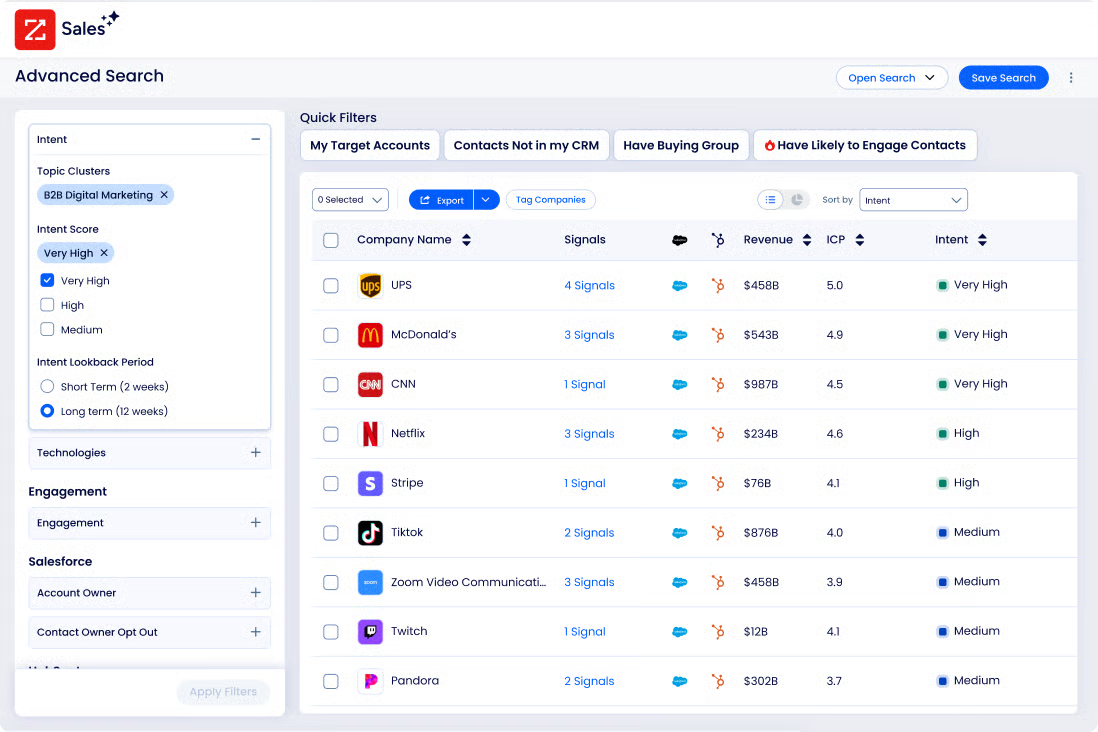
Getting into the right account at the right time still leaves one big challenge: figuring out who actually makes the decision. ZoomInfo's org chart feature maps reporting structures so you see who holds budget authority and which stakeholders need to be part of the conversation. This visibility is critical for multithreaded deals where one missed contact stalls an entire opportunity.
The Chrome extension is the feature I saw reviewers mention most often as part of their daily workflow. It pulls contact details and company websites as you browse, which means research, list-building, and outreach prep stop being three separate workflows. It collapses them into one.
What I think sets ZoomInfo apart further is the effort that goes into ensuring teams actually use the platform effectively. The platform is deep, and the training resources help new reps get productive faster while keeping experienced users sharp on new capabilities. This means teams get more value over time, rather than leaving features untouched because no one learned how to use them.
One more thing worth flagging is integrations. ZoomInfo's native sync into Salesforce and HubSpot is a recurring point of praise in the reviews I read. The software scores above the category average of 88% for the data import and export tool and achieves a satisfaction rating of 90%. It’s one of the highest-rated features on ZoomInfo’s G2 profile.
ZoomInfo does not list pricing publicly, and reviewers consistently describe it as an enterprise-level investment. The pricing structure reflects its positioning as a comprehensive data intelligence platform, aligning most naturally with teams that have committed to a full-scale outbound stack rather than those exploring lightweight prospecting tools. For organizations running mature outbound programs, reviewers consistently describe the depth of data and workflow coverage as justifying the investment.
On the data side, ZoomInfo's coverage is strongest among US-based contacts, making it a natural fit for teams whose ICPs are primarily domestic. Some reviewers note that contact depth in EMEA and Asia Pacific regions has not yet reached the same level, so organizations with heavily international prospecting motions which is more noticeable for organizations with heavily international prospecting motions.
For teams centered on the US market, the data quality consistently delivers the precision and depth that high-performing sales organizations depend on.
If you're earlier in your growth, a lighter tool might be the natural starting point. But for mid-market and enterprise revenue teams that need a comprehensive data intelligence engine, this is where you graduate to.
“The quality of decision maker contact information, such as titles, email addresses, and mobile phone numbers, has really helped my sales team make contact with the right individuals for their prospecting needs.”
- ZoomInfo Sales review, Kristin L.
“The primary area for improvement is the pricing structure, which can be quite expensive for smaller teams or individual developers. It would be great to see more flexible plans for growing businesses. Additionally, the user interface can occasionally feel cluttered and overwhelming due to the massive amount of data presented. Simplifying the dashboard navigation or providing more intuitive onboarding for new users would definitely enhance the overall experience.”
- ZoomInfo Sales review, Kamindu K.
Related: Want to improve the quality of leads you capture? Explore the best sales intelligence software to filter leads based on firmographics, tech stack, and buyer intent.
G2 rating: 4.7/5 (9,409 reviews)
Across the G2 reviews I analyzed for Apollo.io, the most consistent praise wasn't about any single feature; it was about how quickly reps go from sign-up to running their first sequence.
Apollo combines a contact database, email sequencing, a built-in dialer, CRM capabilities, and lead scoring into a single interface. You don't assemble a Frankenstein stack. You log in and start prospecting.
The sequencing engine is the backbone of that promise. You find a prospect, build a list, and drop those contacts directly into an automated email or call sequence, without ever leaving the platform. It removes the tab-switching that breaks rep focus, and for managers, it keeps every touchpoint inside a single source of truth.
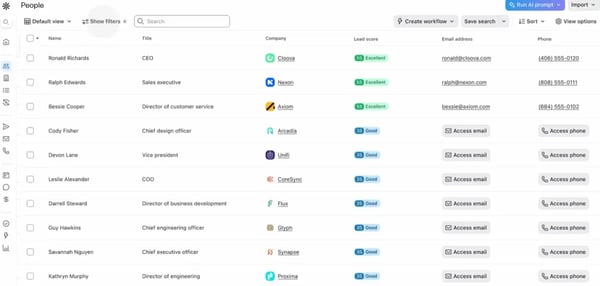
The daily workflow is where Apollo shines. The Chrome extension plugs directly into LinkedIn. Spot a prospect, click once, and their verified contact data lands in Apollo. No switching tabs. Reps who prospect heavily on LinkedIn describe it as the feature they use most.
Finding contacts is one thing. Keeping your records clean is another. Apollo's data enrichment fills in the gaps automatically. What I noticed reviewers single out about Apollo's data enrichment is that it automatically fills in gaps. Instead of spending an afternoon cleaning your CRM, you let Apollo do it and focus on selling. Reviewers say it solves the fragmented data problem that slows down outreach targeting.
What makes Apollo especially interesting for teams running multiple campaigns at once is the AI layer. The AI search lets you describe your ideal customer in plain English and get back a targeted list. The AI messaging feature helps generate personalized sequences without writing every email from scratch. Together, they speed up the entire workflow from research to send. In the reviews I read, it is the closest thing to a unanimous "this changed how my day looks" reaction.
Apollo doesn't stop at email, either. The built-in dialer lets you make, log, and record calls directly from the platform. For sales teams that pair phone outreach with email sequences, this removes yet another tool from the stack. Managers also use call recordings for coaching and improving talk tracks. I saw this use case being mentioned in review more often than expected.
And then there's the pricing. G2 reviewers often mention the free tier. You get sufficient limits to test whether Apollo fits before putting any money down. The Basic plan at $49 per user per month delivers prospecting, sequencing, a dialer, and CRM in one tool. Multiple reviewers describe that as significantly cheaper than assembling the same capabilities from separate vendors.
Different lookup types burn credits at different rates, and unused credits don’t roll over at the end of each billing cycle. This works well for teams that prospect at a steady, predictable pace, while organizations with irregular or burst-based prospecting patterns may find usage variability more noticeable across billing cycles. The usage-based model aligns well with consistent outbound workflows where activity is evenly distributed over time.
Some reviewers note that direct dial accuracy can vary across regions. This is less noticeable for email-first teams and more relevant for organizations whose outreach strategy depends heavily on cold calling. The platform’s data depth continues to align well with multi-channel prospecting workflows, particularly where email engagement is a primary focus.
Apollo.io is built for startups, SMBs, and mid-market sales teams that want a capable lead capture and outreach platform with fast time-to-value. If you're tired of duct-taping four tools together and calling it a stack, this is the platform that lets you consolidate, move fast, and start filling your pipeline on day one.
“Apollo.io is most useful because it helps you find the right decision makers and reach out to them faster, all from one place. It gives you verified B2B contact details, lets you filter leads very precisely by role, company size, industry, location, etc., and allows you to send and automate outreach without switching tools. It saves time, improves targeting, and makes B2B sales much more efficient.”
- Apollo.io review, Shivani P.
“One downside is that not all contact data is consistently reliable across regions, which means occasional manual validation is still necessary. The platform also packs in a lot of functionality, so it can feel dense at first and take time to fully understand which features matter most for your use case. Some useful capabilities are also tied to higher plans.”
- Apollo.io review, Aman S.
ZoomInfo Sales vs. Apollo.io: Which is better for B2B lead capture?
ZoomInfo brings the deepest database, intent signals, and enterprise-grade data intelligence. Apollo.io delivers unified prospecting and outreach in a single platform at a more accessible price point, making it a strong fit for startups and SMBs. The shortcut decision:
For a clear side-by-side breakdown, check out G2's ZoomInfo Sales vs. Apollo.io compare page.
G2 rating: 4.4/5 (5,298 reviews)
Most prospecting tools work like a phone book, a database that somebody updates every few weeks or months. Seamless (previously known as Seamless.ai) works differently. I kept coming back to this part while analyzing user reviews. It verifies emails, direct dials, and company information in real time, at the moment you search.
That difference sounds technical, but the downstream effect is simple. Your pipeline stays cleaner. You don't find out a contact has moved on after three bounced emails. Seamless catches it before you ever hit send. Bounce rates drop. Wasted prospecting effort drops with them. For SDR and BDR teams that live in the browser, this matters more than anything else on a feature list.
Deployment is fast. Across reviews, the most common ramp story I saw was teams going live the same day they sign up, with the majority running within their first month.
The real-time engine is the foundation, but you still need to find the right people. What I liked about Seamless's search filters is how closely they align with how LinkedIn structures its data. You narrow down by job title, industry, geography, company size, revenue, and more, and the transition between platforms feels natural. Reviewers describe the results as fast and organized.
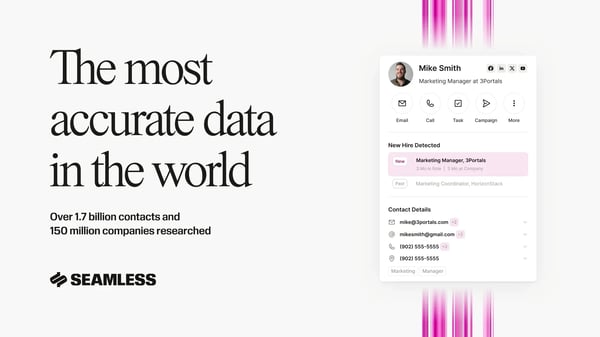
Once you find someone, you need to know how reliable the data is before you reach out. Seamless handles this with a confidence score, a percentage rating for each email and phone number that indicates how likely the data is to be accurate. Some reviewers describe using it as a quality gate: they only send emails to contacts scoring 95% or higher, which protects their sender reputation and keeps deliverability strong. It's a layer of quality control that most static databases don't offer.
The Chrome extension ties the whole workflow together for the reviewers, I read. Browse LinkedIn as you normally would, click once, and you have a verified email and phone number ready to go. For teams that prospect primarily through the browser, it turns casual browsing into active pipeline-building.
Additionally, CRM connectivity is the most frequently mentioned feature in positive reviews. The platform connects natively with HubSpot, Salesforce, and other major systems. Contacts flow from Seamless.AI into your CRM without CSV exports or manual entry, which keeps your database clean and your reps selling instead of doing data entry.
And when something goes wrong or doesn't make sense, the support team steps in. G2 reviewers mention support quality, making it one of the platform's most praised aspects. Multiple users name their individual support contacts, which says something about the relationship. For teams that want to ramp without heavy internal training, responsive support shortens the learning period.
Credit usage is something power users should plan around. G2 reviewers recommend tracking your daily allotments during ramp-up so the tool's pace matches your team's prospecting volume. It’s more of a consideration for teams running large-scale, high-volume research than for those doing smaller, targeted campaigns. Mapping it out early means no surprises later.
The interface packs a lot into a single view. That's a plus for experienced users who want everything accessible, but some reviewers say it feels crowded when you're searching, filtering, and exporting data all at once. The learning curve is short. Most people adjust within days. Still, it exists, especially for teams used to simpler, more guided tools.
Seamless is a strong fit for SDR and BDR teams that want speed-first contact discovery with real-time verification. The platform weeds out stale contacts before they waste your time.
“What I like most about Seamless.AI is how accurate and comprehensive the contact data is, especially when it comes to identifying decision-makers and qualified leads. After more than two years working with the platform across different companies, I’ve seen firsthand how powerful it is for both prospecting and enriching our existing database. The integration with outreach workflows is smooth, and the tool helps accelerate the entire lead generation process in a way that is difficult to achieve with other platforms.”
- Seamless review, Paulo L.
“The only thing I’d say could improve is the occasional inaccuracy in email data, particularly for smaller or newer companies. Also, the UI could be a bit more intuitive. It sometimes feels a little crowded when you’re trying to search, filter, and export data all at once. Lastly, the credit system can get limited when you’re doing large-scale research, so it’s something to plan around.”
- Seamless review, Namrata K.
Apollo.io vs. Seamless.AI: Which is better for sales prospecting?
Apollo.io offers prospecting, sequencing, and a dialer on a single platform. It’s ideal if you want to run the full outreach cycle without switching tools. Seamless.AI focuses on real-time contact discovery through faster data pulls, making it a strong complement to teams that already use an outreach tool. The shortcut decision:
For a clear side-by-side breakdown, check out G2's Apollo.io vs. Seamless.AI compare page.
G2 rating: 4.7/5 (5,554 reviews)
What differentiates Popl from other digital card tools, in the reviews I read, is how aggressively it's built for one specific workflow: events. Universal badge scanning works with any conference badge, not just Popl-specific ones.
Most event apps lock you into the organizer's lead capture system, which means downloading a new app for every conference.
Popl scans them all.
For teams that attend multiple events per quarter across different organizers, this one feature eliminates a recurring headache.
But scanning a badge only captures a name. What stood out to me across G2 reviews is how Popl handles everything that comes after. The built-in event CRM lets you tag, categorize, add notes, and schedule follow-up tasks for each contact right inside the app. You scan a badge at the booth, jot a note about the conversation while it's still fresh, and tag the lead by priority. When you're back at your desk, all contacts are organized and ready for outreach.
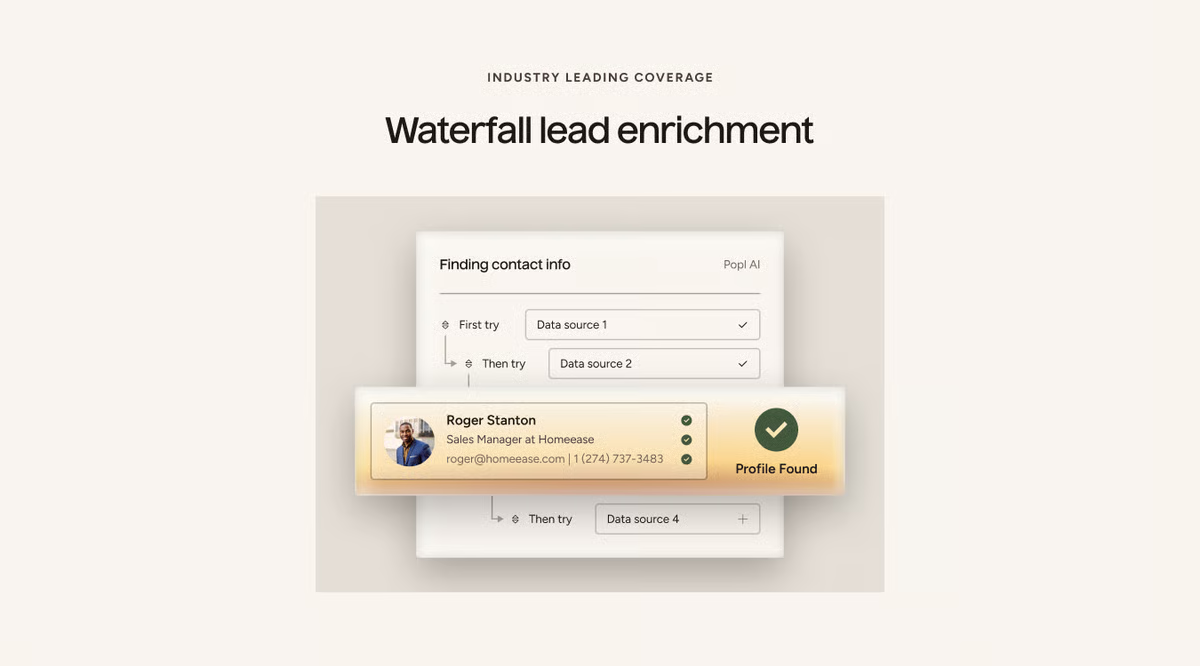
The data doesn't stay in Popl, either. Automated sync pushes contacts into Salesforce, HubSpot, and Zapier. Your reps capture at the booth, and by the time they land back at the office, the leads are already sitting in the CRM waiting for a sequence.
Outside of events, Popl works as a digital business card. I noticed that around 58 G2 reviewers praise the customization options. You get to build a card with contact details, social profiles, company links, and custom fields. It's not just a name and phone number; it's a mini landing page.
Real estate professionals and freelancers mention this flexibility the most. The iPhone widget makes sharing even faster. Instead of opening the app and navigating to your card, you tap a widget on your home screen, and you're ready. At a networking event where you're meeting someone every couple of minutes, that shortcut makes a difference.
Zooming out, what makes Popl different is that it's designed around the entire event lifecycle. Pre-event, you set up your card. On-site, you scan badges and capture leads. Post-event, you export everything and follow up.
Solo professionals rate Popl 4.74, micro-teams of two to 10 rate it 4.69, and companies with 1,001 to 5,000 employees rate it 4.77. That uptick at larger company sizes is worth noting. If you're deploying multiple reps across trade shows and need consistent lead capture across the whole team, Popl scales to that use case.
Some G2 reviewers feel that the features that make Popl especially useful for event teams are available on the Pro plan. The free version still covers core digital business card functionality well, making it a practical starting point for individuals or smaller teams getting familiar with the platform before expanding into broader lead capture workflows.
Several reviewers also mention wanting more control over card design. The current templates are clean and professional, but teams with strong brand identity standards may find the design options more functional than expressive. It's a natural area for growth as the product matures.
Popl is the best fit for sales and marketing teams that generate a significant share of their leads at events and conferences. If badge scanning and mobile-first lead capture are priorities, Popl's purpose-built workflow delivers where general-purpose tools don't.
“Not only does this product cut down on waste from traditional business cards, but it's an amazing talking point when networking with others, trims how much you need to carry at events such as tradeshows, and the customization has no limits.”
- Popl review, Amanda R.
“A few people I’ve shared with needed extra clicks before the contact completed saving. At busy conferences, that tiny friction can feel noticeable.”
- Popl review, Nate D.
Blinq vs. Popl: Which is better for digital networking and lead capture?
Both tools digitize business cards and simplify contact exchange, but they each have a distinct strength. Blinq focuses on individual professionals and team branding, with strong adoption in real estate and financial services. Popl offers event-specific functionality, including universal badge scanning and a built-in event CRM. The shortcut decision:
For a clear side-by-side breakdown, check out G2's Blinq vs. Popl compare page.
G2 rating: 4.8/5 (8,084 reviews)
Two numbers tell Blinq's story. 74% of users go live the same day. You download the app, create your digital card, and start sharing via QR code, near-field communication (NFC) tap, or email signature. 29% of Blinq's G2 reviewers work in real estate, making it the most industry-concentrated tool in this roundup.
What I noticed reading through Blinq reviews is that real estate professionals live on in-person interactions. Every one of those touchpoints is a potential lead that historically lived on a paper card. Blinq digitizes the exchange. Each share automatically captures the contact's information and adds it to your pipeline, with the option to push the data into HubSpot.
The QR code is the feature users talk about most. G2 reviewers mention it. You pull up a QR code on your phone or smartwatch, and someone scans it to instantly get your full digital card. No app needed on the receiving end.
For situations where even scanning a QR code takes too long, Blinq supports NFC tap-to-share. Hold your phone near someone else's, and the card transfers instantly.
There’s one thing about sharing a card. The flip side is capturing information. Based on G2 reviews, users appreciate how Blinq handles this two-way contact capture model, for example, when someone scans your QR code, the platform prompts them to share their details back to you. You get an email notification with their information, and the contact lands in your pipeline without any manual entry. What was a one-way card exchange becomes a lead capture event.
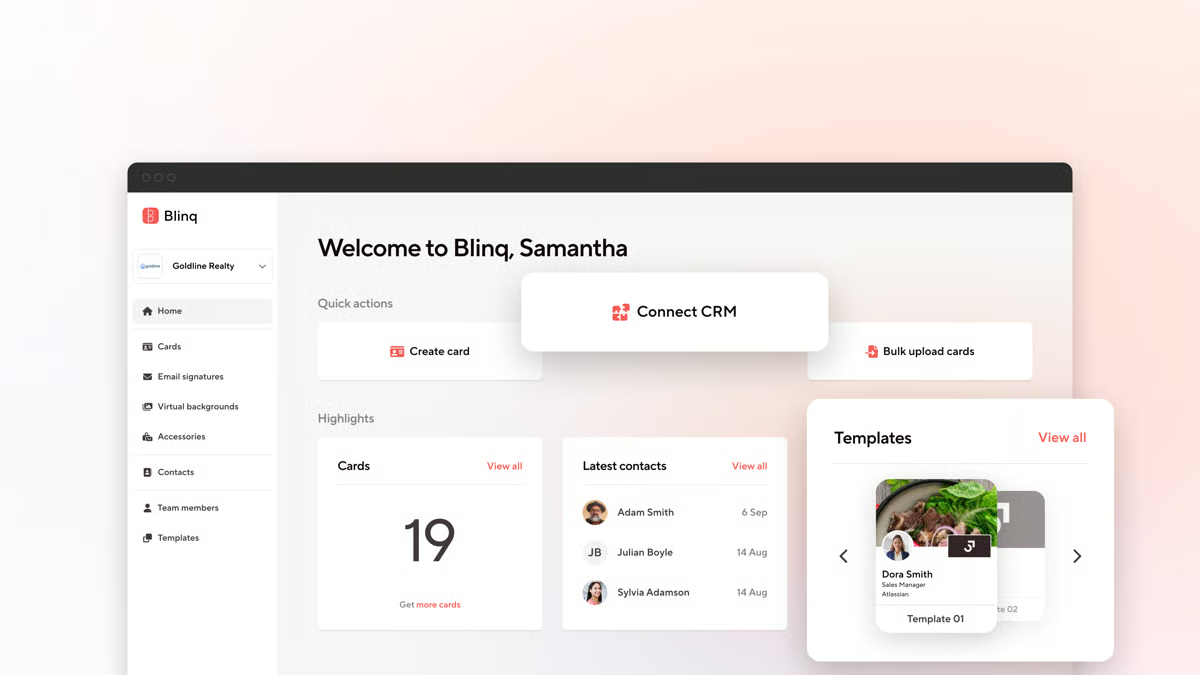
But Blinq doesn't just capture in person. The email signature builder turns every email you send into a passive lead-capture opportunity. Recipients click your signature link, land on your digital card, and you generate a pipeline. G2 users in real estate and financial services describe this feature as something they didn't know they needed until they had it.
For iPhone users, the Apple Wallet integration adds another layer of speed. Instead of opening the Blinq app, you pull up your digital card from the same place you keep boarding passes and credit cards. At an event where you're meeting someone every two minutes, that shortcut adds up fast.
For organizations rolling Blinq out across a team, the admin dashboard keeps everything unified. For advisory firms and sales teams, this centralized control keeps the company's digital presence cohesive.
Blinq’s free version covers core digital card functionality well for individual professionals. Teams that want full brand control and contact analytics will find the paid tier a natural fit for their workflow.
A few reviewers mention that saving contacts can involve additional steps for first-time recipients, particularly during fast-paced networking interactions. At a busy networking event, those extra steps feel noticeable. However, it's more of an issue for first-time Blinq recipients than for repeat users.
Blinq fills a gap that database tools don't address. It captures the leads that happen face-to-face. These may not reach the prospecting platforms.
“What stands out to me about Blinq is how it transforms the standard business card into a dynamic, multi-channel marketing tool. I love the flexibility of the Add Fields section. Being able to embed a direct YouTube channel link or social icons into the Marketing Island card makes follow-ups much more engaging.”
- Blinq review, Avyan S.
“Sharing my card and saving other Blinq users’ information can feel a bit clunky, with a few steps that aren’t immediately intuitive. A more seamless experience would strengthen the product, and that may come with the paid version. That said, the free version delivers exactly what I need, and I’m satisfied with its performance.”
- Blinq review, Aaron L.
Related: Want better insights into your sales activities? Explore the best sales analytics software on G2 and use its insights to make data-driven sales strategies.
G2 rating: 4.6/5 (954 reviews)
Typeform's one-question-at-a-time design creates a conversational experience that feels more like a dialogue than a form.
It's one-question-at-a-time design turns a form into a conversation. Instead of dropping a wall of fields on someone and hoping they finish, Typeform shows one question, waits for the answer, and moves to the next. For marketing teams that live by form completions, the design choice translates directly into more captured leads.
But a pretty form that asks the wrong questions still wastes time. Typeform's conditional logic, called "Logic Jumps," handles this. It branches questions based on previous answers. What looks like a single form is actually multiple paths, and each path filters the respondent toward the desired outcome.
Building those forms is straightforward, even without developers. The drag-and-drop interface is clean, requires no code, and the template library gives you a strong starting point instead of a blank page.
Your form is often the first thing a prospect interacts with, so how it looks matters. I noticed around 15 G2 reviewers specifically mention branding, and the visual praise runs much deeper across the review data. Typeform's customization options let you match your form to your brand’s colors, fonts, imagery, and design themes.
Once someone completes the form, the data needs to go somewhere useful. Typeform connects with HubSpot, Salesforce, Google Sheets, Mailchimp, Slack, Zapier, and more. Submissions trigger Slack notifications, populate CRM records, and kick off email sequences, without manual transfers.

Then there's the question most form tools don't help you answer: where are people dropping off? What I appreciated reading through reviews is how often Typeform's analytics dashboard came up. Typeform's analytics dashboard shows you exactly which question causes respondents to leave. Reviewers in marketing and product roles describe using these drop-off insights to iterate on their forms.
Typeform positions itself as a premium form builder, and the pricing reflects that positioning. Features like Logic Jumps, custom branding, and advanced integrations are available in paid plans, while the free tier focuses on lighter usage and basic functionality. This structure aligns well with teams scaling from simple forms into branded, workflow-driven experiences.
Some reviewers note that exporting complex response data or running advanced reports is more limited within the native analytics layer. This is most noticeable for campaigns generating large volumes of response data, while teams focused on conversational forms, lead capture, and standard reporting align well with the platform’s built-in analytics model.
Typeform is the right choice when your lead capture funnel depends on form completion. If the form is the funnel, Typeform will make it work.
“The one-question-at-a-time format feels like a conversation instead of homework. People don't see this giant wall of fields and immediately close the tab. The logic jumps work flawlessly, too, so you can create personalized branching paths without any coding.
Of course, the design themes are the best part about Typeform. They come up with great themes (some are paid) that you can apply to your form.”
- Typeform review, Nitin M.
“Typeform can get expensive as we scale up forms, and handling very large datasets or advanced reporting isn't as smooth. We'd love more flexibility in exporting complex responses and better bulk data tools. Handling very large datasets and generating advanced reports can be tricky. We'd love easier bulk exports, smarter analytics, and more flexible reporting tools for complex projects.”
- Typeform review, Nabin P.
Have more questions? Find more answers below.
ZoomInfo Sales is the top-rated lead capture solution for enterprises. It earned the No. 1 ranking on G2's Enterprise Lead Capture grid and achieved a 100% user satisfaction rating in the Lead Capture category.
Apollo.io is the strongest option for multichannel lead capture. It combines a contact database with email sequencing, LinkedIn prospecting (via Chrome extension), a built-in dialer, and inbound lead capture, all within a single platform.
Typeform offers AI-powered form capabilities alongside its signature conversational form design. Its conditional logic (Logic Jumps) dynamically adapts the form experience based on respondent answers, effectively qualifying leads within the form itself.
All tools on this list offer some level of CRM integration, but ZoomInfo Sales and Apollo.io stand out for the depth and quality of their CRM syncing.
Seamless is built on a real-time data validation model. Instead of serving contacts from a static database, it verifies email and phone numbers in real time during each search. This way, it improves deliverability and provides fresher contact information. Apollo.io also offers real-time email verification scoring.
Typeform provides the most detailed form-level analytics, including completion rates, drop-off points, and response breakdowns. ZoomInfo Sales and Apollo.io offer broader pipeline analytics that track leads from capture through conversion.
Apollo.io offers the best value for SMBs with its free tier and paid plans starting at $49 per user per month. Blinq and Popl also offer free tiers for individual users focused on digital business card-based capture.
Typeform supports multilingual form creation, allowing you to build lead-capture forms in multiple languages for global audiences.
If there's one pattern across all reviews I analyzed, it's this: the most successful teams don't pick the highest-rated tool. They pick the one that matches how they capture leads. A platform built for trade shows won't help you if your pipeline runs through LinkedIn, and a prospecting database won't help if your leads come from events. Pick the tool that fits how your team captures leads.
And once those leads are captured? The next step is turning raw contact data into a qualified, scored, and enriched pipeline.
Explore the best lead intelligence software to see which tools help you go from capture to close


I know how critical consistent lead flow is once you’re past the experimentation phase and...
 by Harshita Tewari

Bad email data does not announce itself. It shows up as rising bounce rates, reputation drift,...
 by Disha G

I don’t pull lead lists, but I know when they’re broken.
by Harshita Tewari