.png?width=400&height=150&name=My%20project-1%20(1).png)


Hiring freelancers used to feel simple: send a contract, track deliverables, issue a payment. But once you’re managing dozens of contractors across countries, currencies, and compliance rules, that simplicity disappears fast.
Working in the content marketing space for close to five years, I’ve had my share of experience working with freelancers. Suddenly you’re juggling onboarding workflows, tax documents, rate approvals, time tracking, vendor classification, and payment cycles. Finance wants standardized invoices. Legal wants compliant contracts. Hiring managers want visibility.
That’s where the best freelancer management systems (FMS) change the game. The top platforms don’t just store contractor profiles; they operationalize the entire lifecycle. From onboarding and classification to automated global payroll, performance tracking, and centralized collaboration, FMS tools help companies scale flexible talent without the operational drag.
To find what actually works, I reviewed the top platforms in G2’s Freelancer Management Systems category, analyzed verified user feedback, and compared features. Some tools shine as all-in-one global hiring platforms; others excel at visibility, payout automation, or talent sourcing.
*These best freelancer management systems are picked based on G2’s Fall 2025 Grid Report. I’ve added their standout features for easier comparison.
The best freelancer management systems help teams scale flexible talent without the administrative drag. Instead of chasing contracts, invoices, tax forms, and payments across emails and spreadsheets, these platforms centralize onboarding, documentation, compliance, and payouts in one place — giving legal, finance, and hiring managers a workflow they can actually rely on.
The market is growing fast for a reason. According to MRFR, the freelance management systems market was valued at USD 5.102 billion in 2024 and is expected to reach USD 21.65 billion by 2035. As companies increase their reliance on global contractors, structured systems are becoming essential rather than optional.
With that in mind, I focused on platforms that deliver strong compliance controls, scalable onboarding, clear visibility, and reliable global payments. Based on G2 Data, user feedback, and product evaluation, these are the five I’d recommend for teams serious about operationalizing their contractor workflows.
To build this list, I started with G2’s Grid® Report for freelancer management systems to create a shortlist, using a mix of user satisfaction scores and market presence as my foundation. This helped me focus on platforms that balance usability, adoption, and real-world performance across different team sizes.
From there, I evaluated each tool based on how effectively it supports contractor onboarding, global payments, compliance and classification, documentation management, collaboration workflows, reporting, and integrations with the broader HR, finance, and project management stack.
I also used AI to analyze hundreds of verified G2 reviews, paying close attention to what hiring managers, finance teams, and operations leaders praised most, where they experienced friction, and which platforms consistently delivered measurable improvements in visibility, compliance, and day-to-day efficiency.
The screenshots featured in this article come from G2 vendor listings and publicly available product documentation.
After reviewing G2 Data and seeing how companies actually manage freelancers at scale, a few priorities came up again and again. Here’s what I focused on when evaluating the best freelancer management systems:
The list below contains genuine user reviews from the Freelancer Management Software category page. To be included in this category, a solution must:
*This data was pulled from G2 in 2025. Some reviews may have been edited for clarity.
Deel has quickly become one of the most widely adopted platforms for managing freelancers and global contractors, especially for teams that need a compliant, end-to-end system rather than a patchwork of tools. Deel holds a 4.7 out of 5 rating from 5,980+ G2 reviews, making it one of the highest-rated platforms in freelancer management. 99% of users rate Deel 4 or 5 stars, reflecting exceptional satisfaction across the board. Users consistently describe Deel as a platform that removes the operational friction from working with talent around the world, handling onboarding, payments, classification, and compliance from one centralized interface.
One of Deel’s clearest strengths is how effortless it makes global contractor payments. Reviewers frequently highlight the platform’s reliability, speed, and wide range of supported payout methods. Many note how simple it is to send payments on time, in the contractor’s currency of choice, with full transparency into fees and timelines. For teams previously relying on manual wire transfers, spreadsheets, or region-specific workarounds, Deel’s unified payment system becomes an immediate efficiency boost.
Ease of use is another theme that shows up throughout user feedback. The interface is consistently described as clean, intuitive, and easy to navigate for both hiring managers and freelancers. Tasks like uploading contracts, managing deliverables, submitting invoices, or updating personal information feel straightforward and predictable.
Deel also earns high marks for its onboarding and compliance workflows. Users appreciate how the platform simplifies contract generation, classification, documentation, and country-specific compliance requirements. Many highlight how helpful it is to have templates, localized contract structures, and automated compliance reminders built into the platform. This support is particularly valuable for companies hiring across multiple countries where labor rules, tax processes, and documentation differ widely.
The Employer of Record (EOR) function, Deel’s flagship capability, also appears frequently in reviews, even when teams primarily use the platform for contractors. Users value knowing that, if they need to transition a freelancer into a full-time employee in another country, the infrastructure is already in place. For rapidly scaling organizations, this flexibility becomes a strategic advantage.
Customer support is responsive, helpful, and detailed. Many reviewers note that even complex or time-sensitive issues, like documentation, payment questions, or onboarding clarifications, are handled quickly by the support team. This level of assistance is particularly meaningful for smaller teams without dedicated HR or legal resources.
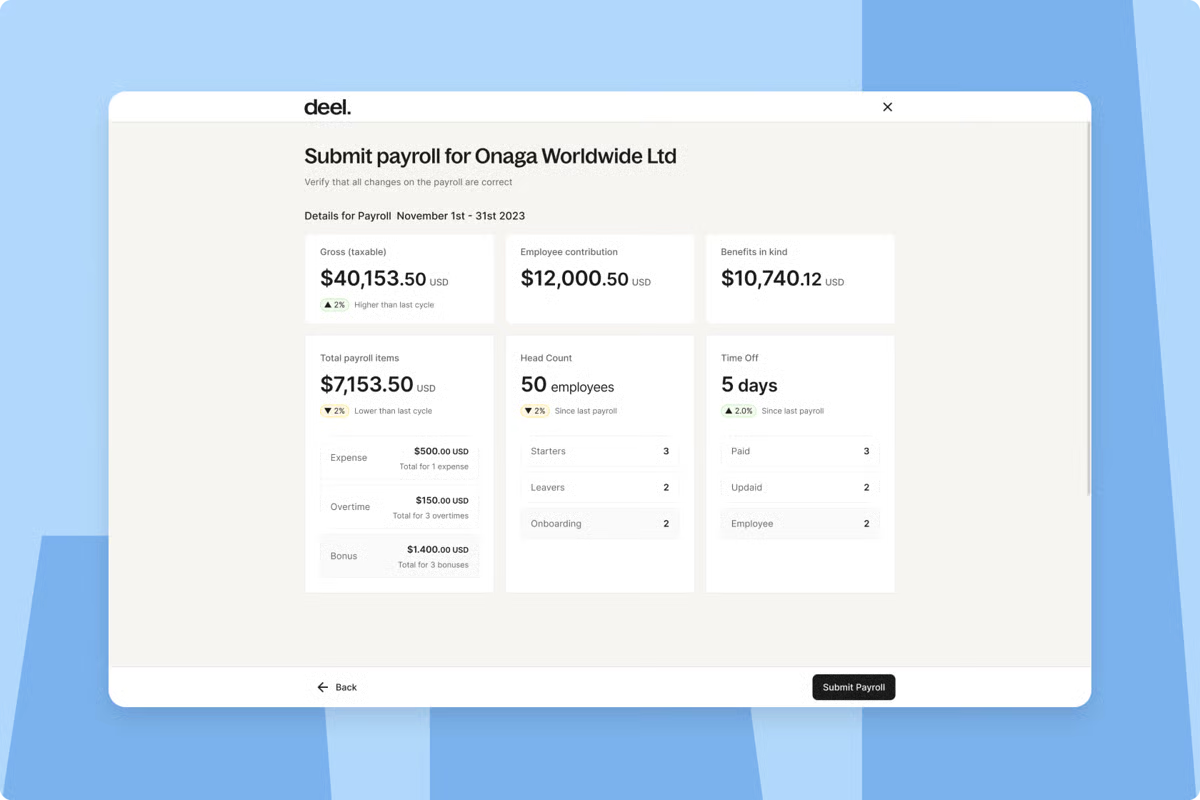
Some reviewers mention that fees for certain transfers or payment methods can feel higher than using local alternatives. While this may not suit every team, others note that having everything processed through one platform, especially when working across multiple countries, can be helpful for keeping freelance operations centralized.
Users also point out that status updates or notifications may move more slowly at times, particularly during busy payout cycles. This can be noticeable for fast-moving teams, but others working with larger or globally distributed contractor pools say they value having a more controlled, step-by-step process, even if it isn’t instantaneous.
Overall, Deel leans toward operational reliability, compliance confidence, and global scalability. It’s built for teams that want a single system to manage freelancers across borders, payments, onboarding, documentation, contracts, and tax considerations, without stitching together multiple tools or risking compliance gaps. For companies hiring internationally or managing a distributed contractor workforce, Deel offers a blend of simplicity, structure, and automation that consistently earns praise from both managers and freelancers.
“I appreciate Deel because it ensures my income is fixed, leaving no room for payment shortages, which gives me peace of mind and financial stability. I find the notification feature incredibly useful; it simplifies the process by automatically notifying me when my salary is approved, eliminating the need for constant manual checks. The Deel Advance feature is a standout, serving as a lifesaver for everyone, especially employers, by making financial management more manageable and convenient. Additionally, the onboarding process was remarkably straightforward and effortless, making the initial setup a breeze. I also value how Deel centralizes everything, including contracts and payments, automating the process and ensuring timely payments without any extra hassle.”
- Deel review, Angela V.
“One downside of Deel Payroll is that the fee structure can be confusing at times, especially for first-time users who are not familiar with how international transfers and service charges work. Some costs may feel higher compared to other platforms, depending on the payment method and country. Additionally, customer support can sometimes be slow to respond, which may delay resolving issues when they arise. Overall, while the system is fast and effective, clarity on fees and quicker support responses would improve the experience.”
- Deel review, Pajiji L.
Check out our roundup of the best EOR software that help companies manage global hiring and compliance with ease.
Remote has become a leading choice for organizations managing freelancers, contractors, and globally distributed talent, particularly those that need a system built around compliance, payroll reliability, and an intuitive user experience. Across hundreds of G2 reviews, 92% of users say they would recommend Remote, indicating high trust and usability. Users consistently highlight how Remote brings together onboarding, payments, documentation, and HR operations in a single platform, making it easier for companies of all sizes to work with international freelancers without administrative complexity.
One of Remote’s biggest strengths is its clean, user-friendly interface. Reviewers frequently mention how straightforward it is to navigate, complete tasks, upload documents, and stay on top of work-related information. Both managers and freelancers describe the platform as “easy to use” and appreciate how Remote reduces friction in everyday HR and payment workflows. This intuitive design is especially valuable for teams managing contractors who prefer a platform they can quickly adopt without hand-holding.
Payment management and payroll accuracy come up repeatedly in reviews. Users emphasize how dependable Remote is in processing payments, managing global payroll timelines, and keeping compensation records clear and organized. Contractors especially note how helpful it is to have payout history, personal details, and tax documents accessible in one place, removing the uncertainty that often comes with international or cross-border payments.
Remote also earns strong praise for its centralized system of record. Many users highlight how convenient it is to have everything, from contracts and personal documents to leave requests and benefits, stored in a single dashboard. This level of consolidation is particularly useful for global organizations with multiple freelancers, where managing documentation across tools and folders can quickly become chaotic. Remote’s structured approach helps teams stay compliant, organized, and audit-ready.
Customer support is another area where Remote consistently performs well. Reviewers describe the support team as responsive, knowledgeable, and helpful when troubleshooting issues or answering policy questions. For freelancers and hiring managers navigating international requirements or operational challenges, this level of support adds a layer of confidence and stability.
A number of users also say that navigating different areas of the platform can sometimes feel like a lot, especially when switching between HR, payment, and policy-related sections. This may feel busy for smaller teams, but organizations managing a wide range of contractor data often prefer having everything collected in one system rather than spread across multiple tools.
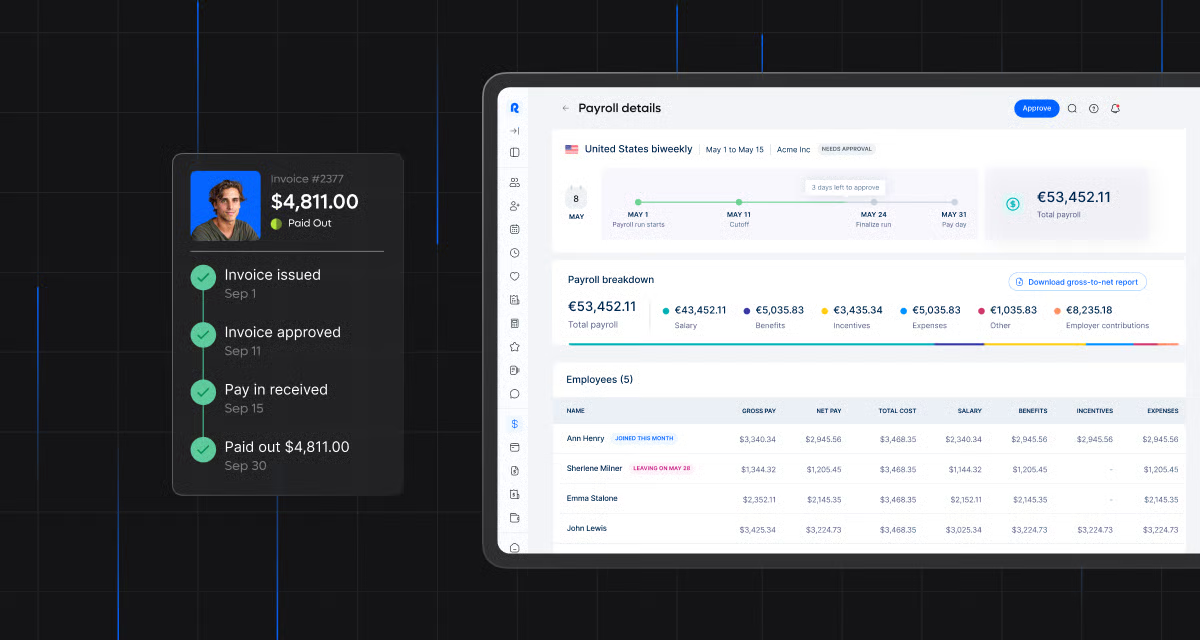
A few reviewers mention occasional delays or limitations when accessing certain leave or time-off views. For teams that only need quick transactional access, this can feel restrictive, but companies with more defined permission structures may prefer the added separation between employee and contractor information.
Overall, Remote leans toward clarity, stability, and compliance-first design. It’s built for organizations that want a dependable way to manage freelancers and contractors across borders without juggling multiple tools or risking gaps in documentation, payments, or regulatory adherence. For companies that value consistency and structure, Remote offers a streamlined, trustworthy system that keeps both administrators and freelancers aligned from onboarding through ongoing work.
“Remote.com is a highly user-friendly platform that is simple, intuitive, and easy to navigate. The interface is well-organized, making it easy to understand features and complete tasks efficiently without unnecessary complexity. Overall, it provides a smooth and reliable user experience, even for first-time users.”
- Remote review, Brenda B.
“The main issue I’ve noticed is that the exchange rate used for payments is not updated daily. This sometimes leads to discrepancies between the expected amount and the actual converted amount, which can be confusing and inconvenient. Having real-time or more frequently updated exchange rates would make the payment experience much more accurate and reliable.”
- Remote review, Tamara M.
Fiverr Enterprise has emerged as a strong choice for organizations that want a centralized, dependable way to manage freelancers, particularly those working with large contractor pools or distributed creative teams. Across user reviews, the platform is consistently described as intuitive, well-organized, and supportive of fast-moving workflows. Companies often turn to Fiverr Enterprise when they need more structure than spreadsheets and email threads can provide, but still want the flexibility that modern freelance teams require.
Ease of use is one of the platform’s defining strengths. Reviewers frequently highlight how simple it is to navigate dashboards, submit invoices, track work progress, and store documentation. Both hiring managers and freelancers mention that the platform removes unnecessary back-and-forth, creating a smoother working relationship for everyone involved. For organizations juggling dozens or hundreds of independent contractors, this streamlined experience becomes a meaningful operational advantage.
Another major theme is Fiverr Enterprise’s approach to onboarding and financial processes. Users appreciate how clear and predictable payment flows are, along with the ability to manage invoices, expenses, and approvals in one place. Freelancers note that they can easily see what’s pending, what’s been approved, and when they can expect payment. Hiring teams, in turn, value the transparency and accountability that the system introduces into their contractor management workflows.
Customer support receives consistent praise across reviews. Many users describe the support team as knowledgeable, responsive, and proactive in troubleshooting issues or clarifying processes. Whether it’s understanding export requirements, resolving payment questions, or navigating platform features, the support experience contributes to a sense of reliability that both teams and freelancers appreciate.
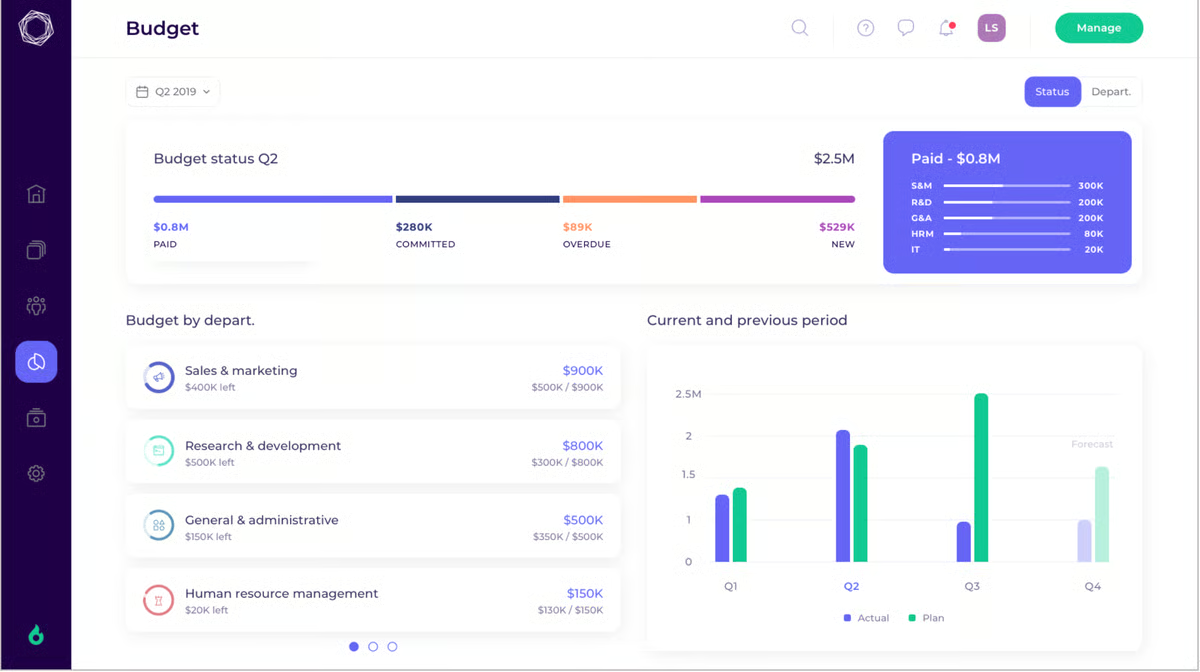
The platform also stands out for how well it adapts to fast-paced environments. Freelancers mention being able to switch quickly between tasks, track milestones, and manage different clients within the system. Businesses highlight that Fiverr Enterprise helps them keep freelance engagements organized, especially when coordinating multiple workstreams, deliverables, or stakeholder groups.
A number of users note that export options or dashboard customization can feel limited. Teams that rely on highly tailored reporting may find this restrictive, but organizations that prefer standardized views often appreciate having consistent, uniform dashboards across all contractor activity.
Some freelancers mention wanting more flexibility in how milestones or notifications are delivered. This tends to arise for contractors working across multiple tools or clients who prefer more personalized communication setups.
Overall, Fiverr Enterprise holds a 4.7 out of 5 rating across 170+ G2 reviews, reflecting strong user satisfaction, and 98% of users rate it 4 or 5 stars, highlighting consistently positive experiences.
Fiverr Enterprise leans toward clarity, predictability, and operational structure. It’s built for organizations that need a centralized system to manage freelancer onboarding, payments, documentation, and workflows without relying on scattered tools or manual processes.
“The app is really good when it comes to managing interns that are internally associated as well as when you want to be on board a new freelancer. The Payments are done smoothly without any hassle. The support team is really good and provides good help to understand the app. We managed around a lot of different freelancers across the globe and interns using Fiverr/stoketalent. We also liked the pricing structure of stoketalent/fivver.”
- Fiverr Enterprise review, Laxmikant K.
“I wish I could choose which milestones I get notification emails about. I sometimes feel a bit flooded when I suddenly get 3 or 4 emails about the same project when all I really need to know is that I'm getting paid.”
- Fiverr Enterprise review, Lisbeth P.
Upwork remains one of the most widely recognized platforms for finding and managing freelancers, and it continues to be a go-to option for businesses that want flexibility, reach, and speed in their contractor workflows. Across hundreds of G2 reviews, teams describe Upwork as a place where they can quickly access talent, manage deliverables, and keep communication organized, all without the administrative overhead typically associated with freelance hiring.
One of Upwork’s most consistent strengths is its sheer breadth of talent. Reviewers frequently highlight how easy it is to find specialists across nearly every category, from design, development, and marketing to virtual assistance and content creation. Businesses appreciate being able to explore profiles, portfolios, ratings, and previous work histories, giving them a strong sense of trust before initiating a contract.
For small teams and new businesses especially, the ability to source reliable freelancers quickly becomes an essential operational advantage.
Ease of hiring is another major theme. Users note that Upwork’s workflows for posting jobs, reviewing proposals, and selecting candidates feel straightforward and intuitive. The platform’s built-in messaging, milestone tools, and contract templates help teams manage work without needing additional software. Many reviewers mention that keeping communication, deadlines, and file exchanges in one place reduces confusion and speeds up delivery.
Payment processing also receives strong positive feedback. Reviewers appreciate the security of Upwork’s escrow system, clear visibility into hours worked, and predictable billing schedules. For companies that have previously dealt with inconsistent or manual payment processes, the platform’s structure provides confidence and accountability. Freelancers similarly highlight how easy it is to invoice and withdraw earnings once a contract is approved.
Upwork’s rating and feedback system is another feature heavily relied on. Businesses value the ability to review detailed freelancer histories before hiring, while freelancers benefit from long-term reputational growth on the platform. This mutual transparency helps both sides establish trust and reduces the uncertainty that often comes with short-term or one-off freelance engagements.
Some reviewers mention that fees can feel high, particularly for smaller teams managing several contracts at once. While this may be a consideration for budget-conscious businesses, others note that the fees come alongside conveniences like built-in payment protection, dispute handling, and access to a wide talent pool, which can be helpful for teams that prefer a structured hiring environment.
Users also point out that applicant quality can vary, even with filters in place. This is often the nature of any large marketplace — teams that value having a broad range of options tend to accept this variability, whereas those wanting tightly pre-vetted candidates may prefer more specialized platforms or more selective tiers within Upwork.
Overall, Upwork leans toward accessibility, versatility, and scale. Upwork holds a 4.5 out of 5 rating across 2,900+ G2 reviews, reflecting strong overall satisfaction. 82% of users believe the product is heading in the right direction, indicating solid confidence in its growth.
It’s built for organizations that want a flexible, fast-moving way to find and manage freelancers without committing to rigid workflows or formal HR systems. Whether used for one-off projects or long-term contractor relationships, Upwork provides a reliable foundation that brings structure, visibility, and accountability to freelance work, while still giving teams the freedom to hire on their own terms.
“I like that my payment is secured as long as I do a good job for clients and track my hours of work using Upwork tracker. Also, I like that I can easily schedule a meeting with a client using the Zoom feature in the message room. I also like that when a client views my proposal, I get a notification immediately, that pop up gives me joy.”
- Upwork review, Blessing E.
“The biggest challenge is the limited number of Connects compared to the number needed to apply for jobs. With only a small amount provided each month, freelancers often have to purchase more just to stay competitive, and those credits disappear whether or not a client ever views the proposal. On top of that, the competition is extremely high, with some job posts receiving hundreds of bids. This makes it hard to stand out unless you spend even more Connects to boost your proposal, creating a system that feels pay-to-play. While Upwork has solid tools and a wide range of opportunities, the cost of applying, combined with the intense competition, makes it very challenging to consistently land work.”
- Upwork review, Jennifer D.
Upwork Enterprise, now Lifted, is widely recognized as a powerful solution for companies that need structured access to freelance talent at scale. Built on top of Upwork’s massive global marketplace, Lifted gives organizations a more controlled, compliant, and efficient way to source, manage, and engage freelancers across a wide range of roles and skill sets.
Lifted holds a 4.5 out of 5 rating across 90 G2 reviews, reflecting strong overall satisfaction, and 97% of users rate it 4 or 5 stars, showing consistently positive experiences. Teams consistently describe Upwork Enterprise as a platform that brings professionalism, accountability, and operational order to high-volume freelance programs.
One of the platform’s biggest advantages is access to an enormous and diverse talent pool. Reviewers frequently highlight how easy it is to find specialists across industries, whether they need creative work, development support, marketing help, data projects, or long-term contract roles. Enterprises appreciate that talent discovery is streamlined, vetted, and supported by robust search filters, making it simpler to identify freelancers who can contribute immediately.
Another strength consistently mentioned is how seamless the contracting and onboarding experience feels. Users note that Lifted creates a clear workflow for hiring, onboarding, and managing freelancers, reducing the administrative strain traditionally associated with contract work. The platform centralizes communication, contract terms, documentation, and work histories—giving enterprises a clean, trackable environment for managing large volumes of freelance engagements.
Payments and invoicing also receive strong positive feedback. Many reviewers appreciate how easy it is to process payments through Upwork’s secure system, view transaction histories, and maintain transparency around hours worked or deliverables submitted. For companies managing dozens—or even hundreds—of contractors, these built-in controls create reliability and consistency that manual payment methods struggle to support.
Lifted brings professionalism to freelancer interactions. Many highlight that long-term contracts, ongoing client relationships, and structured communication tools help teams build stable, repeatable freelance workflows. For growing organizations or departments scaling project-based work, this consistency becomes a meaningful operational advantage.
Some users also point out that payment options or payout timing can feel limited, particularly for freelancers who want instant withdrawals or alternative methods. Others working across multiple regions say they prefer having a consistent, verified payout process even if it isn’t the fastest option.
A few reviewers mention that platform fees can feel high based on project volume or contract type. For some independent contractors, this can be a drawback, while many businesses view the fees as part of having a marketplace that includes built-in contract management, compliance safeguards, dispute handling, and a large global talent pool.
Overall, Lifted leans toward structure, governance, and efficiency. It’s built for organizations that need access to top freelance talent while maintaining enterprise standards across sourcing, onboarding, payments, and performance management. For companies looking to scale their contractor programs with less operational overhead, and more predictability, the platform provides a trusted, centralized system that brings order to even the most fast-moving freelance workflows.
“We used Upwork Enterprise to staff Benji the Bear across pixel-art design, motion graphics, React web, and iOS/Android work. The Talent Cloud + invite workflow lets me keep a private bench of proven freelancers and spin up sprints in hours instead of weeks. Milestone escrow, consolidated invoicing, and classification/compliance support mean I don’t babysit paperwork; I focus on deliverables. Dedicated account support, custom NDAs, and SSO keep legal/security tight without slowing down hiring. Practically, it’s the only marketplace where I can find a niche animator one day and a senior frontend the next, then pay them all through one pipe. It replaced agencies for us at a fraction of the cost and with better speed-to-impact.”
“Upwork Enterprise can feel restrictive for freelancers due to invite-only access, tighter client controls, and slower corporate payment cycles, while companies may face higher fees and less flexibility compared to standard Upwork.”
- Lifted (formerly Upwork Enterprise) review, Mangoma V.
The list mentioned above is not exhaustive. You can also consider these bonus freelance management systems to better align with your needs.
Got more questions? We have the answers.
For companies managing contractors across multiple countries, Deel and Remote are top choices. Both offer employer-of-record (EOR) support, localized compliance, automated payroll, and contract management built for distributed workforces. Deel stands out for its deep compliance automation, while Remote is preferred by teams that want hands-on onboarding support and country-specific expertise.
Upwork Enterprise and Fiverr Enterprise are strong fits for large organizations that need advanced talent sourcing, centralized reporting, and compliance workflows. Upwork Enterprise is ideal for companies running large, ongoing project streams with multiple freelancers. Fiverr Enterprise works well for structured procurement teams seeking predictable vendor compliance and quick access to vetted freelancers.
For SMBs and early-stage teams, Fiverr Enterprise and Upwork offer flexible, pay-as-you-go models without requiring annual contracts. Deel and Remote charge more due to global compliance and payroll capabilities, which makes them cost-effective only if you need international workforce coverage.
Deel and Remote lead in compliance, offering automated contract creation, local labor law guidance, misclassification protection, and localized document workflows. They’re built specifically to reduce risk when hiring globally, making them the safest options for companies expanding into new markets.
Upwork Enterprise excels when teams need structured workflows, multi-project oversight, and customizable approval paths. Its talent cloud and project-level dashboards help larger organizations track progress, spend, and capacity across dozens of freelancers.
Remote and Deel consistently receive strong feedback for streamlined onboarding experiences. They offer pre-built contract templates, automated document collection, and guided steps that help teams bring freelancers on board quickly while staying compliant.
If you want direct access to freelancers inside the platform, Upwork and Fiverr stand out. Upwork offers the widest variety of skills, while Fiverr focuses on speed, packaged services, and predictable pricing. Both can scale for one-off tasks or large ongoing projects.
Startups often prioritize ease of use, predictable pricing, and fast hiring. Upwork and Fiverr Enterprise are strong picks for startups needing flexible project-based talent. Deel is ideal if early global expansion is part of the roadmap and the team needs international compliance from day one.
Deel and Remote offer the strongest native integrations with HRIS, payroll, and accounting platforms. They support tools like Workday, BambooHR, QuickBooks, and NetSuite. Upwork Enterprise also integrates with procurement and finance systems for spend tracking and invoicing automation.
You can explore category leaders like Deel, Remote, Fiverr Enterprise, Upwork Enterprise, and Upwork directly on G2. Their profiles include verified reviews, feature comparisons, use-case breakdowns, and satisfaction scores to help you find the right fit for your hiring and compliance needs.
Today’s workforce is a blend of full-time employees, contractors, consultants, and freelancers and the companies that manage them well have a real operational edge. A strong freelancer management system helps you bring order to the chaos, standardize compliance, and keep every project moving forward without bottlenecks.
The systems featured here give you the structure and automation to support flexible work at scale. Whether you’re managing five freelancers or five hundred, the right platform makes your talent network feel cohesive, compliant, and easy to run.
To round out your hiring ecosystem, explore the best applicant tracking systems (ATS) and create a seamless experience across every stage of your talent funnel.
.png)

Are you considering Upwork as your next gateway for work?
.png) by Shreya Mattoo
by Shreya Mattoo

There are an abundance of talented freelancers looking for their next gigs.
 by Alina Benny

"Where are all the good freelance jobs hiding?"
 by Soundarya Jayaraman