

At a quick glance, the best free SEO tools for small businesses that I found are Semrush, SE Ranking, Birdeye, Conductor, Ahrefs, Moz Pro, SEO PowerSuite, Wincher, Serpstat, and Similarweb.
As a content marketer, I've spent countless hours with SEO software to drive meaningful traffic, improve rankings, and create content that resonates. I've also worked for some small businesses, and I know that budgets for expensive tools can be really hard to justify.
To solve these challenges, I have tried everything from premium software suites to free SEO tools. To be upfront, not all of them are created equal. Some are limited in terms of features, while others might not deliver exactly what you are looking for.
But when I found the right set of free SEO software, it made a world of difference. My keyword research felt more insightful, audits took less time, and even daunting technical issues became manageable.

Over the last few weeks, I've tested 30+ SEO tools and spent countless hours analyzing their features, understanding their limitations, and reading what G2 reviewers say about them. And throughout that testing, I kept coming back to one question: what's the leading SEO app to improve my site's search ranking? I wanted to know which tools could actually move the needle and drive better visibility.
*Tools are listed alphabetically. These tools offer free trials, free forever options, or freemium models.
Here's a quick side-by-side look at free plan limits and pricing before diving into the full reviews.
| Tool | G2 Rating | What the free plan covers | Paid Starts At |
| Ahrefs | 4.5/5 | Free Webmaster Tools forever, site audit, and explorer available for verified sites only | $29/mo (Starter plan, billed monthly) |
| Birdeye | 4.7/5 | 30-day free trial: reviews management, listings monitoring, messaging | Contact for pricing |
| Conductor | 4.5/5 | Free Chrome extension (forever): AI content generation, AEO+SEO performance reporting, and website monitoring covered. 3-week free trial with all features also offered. | Custom pricing |
| Moz Pro | 4.3/5 | Full access to MozBar, a free forever browser extension; 30-day free trial available for the Moz Pro Medium plan | $49/mo (Starter plan for individuals) |
| SE Ranking | 4.7/5 | 14-day free trial: rank tracking, site audit, keyword research, backlink checker | $103.20/mo (Core) |
| Semrush | 4.4/5 | Free forever with limited features: 10 keyword searches/day, 10 domain lookups/day, site audit up to 100 pages | $117.33/mo (for the SEO plan) |
| SEO PowerSuite | 4.5/5 | Free forever: all tools available, unlimited keyword tracking, crawl and audit up to 500 URLs, 1,100 backlinks, all with no project saving | $349/yr ($29.10/mo, which can only be billed annually) |
| Serpstat | 4.6/5 | 7-day free trial: keyword research, site audit, rank tracking, competitor analysis with limited daily queries | $50/mo (Individual) |
| Similarweb | 4.4/5 | Free browser extension (forever): basic traffic overview per site; 7-day trial (credit card required) | $199/mo (Starter, billed annually) |
| Wincher | 4.6/5 | Free trial: track up to 500 keywords and 10 websites, daily rank updates, basic competitor tracking | $41/mo (Basic plan) |
*All pricing details are based on publicly available data at the time of publication and are subject to change.
As SEO tools become more prominent and marketers aim to optimize operations, the estimated market value of the global SEO software market was $96.42 billion in 2026 and is projected to grow at a CAGR of 13.26% from 2026 to 2035, as per a report. And according to G2's most recent Grid report, it is even more noteworthy that the small business segment constitutes the largest user base for SEO tools, accounting for an average 71% of the total user population.
I started with G2's free SEO tools category page, which lists tools that offer free plans, free trials, or freemium models. From there, I took the top products and tested each one specifically from a small business perspective: how fast can you get useful data, how intuitive is the setup for a non-specialist, what do you actually get without paying, and where does the free tier run out.
I cross-referenced verified G2 reviews filtered by the Small Business segment to understand how owners and operators experience these tools in practice. G2 review data referenced throughout was pulled in 2026. Some reviews have been lightly edited for clarity.
The screenshots featured in this article may include both those taken during testing and those obtained from the vendor's G2 page.
Testing ten tools back to back as a small business owner made certain things obvious fast. Here's what I actually paid attention to:
To be included on this list, a tool must:
*This data was pulled from G2 in 2026. Some reviews may have been edited for clarity.
Not sure which features matter most? See which SEO software features are commonly available for free and where the trade-offs start.
Ahrefs has one of the most respected backlink indexes in the industry, and the good news for small businesses is that a meaningful chunk of that power is available for free through Ahrefs Webmaster Tools, which is the same as the Ahrefs free plan.
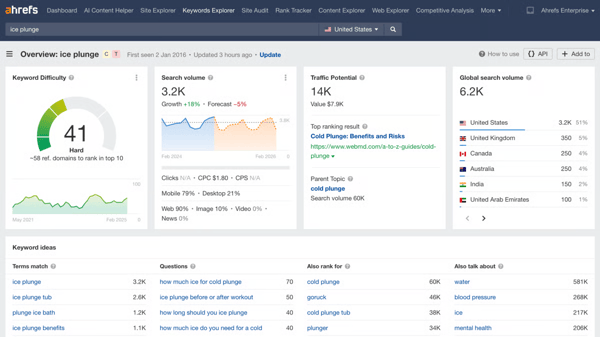
Once you verify your site, you get access to a full site audit that flags technical issues clearly and a backlink overview that shows you who's linking to you and how your profile compares to competitors. I used it to quickly identify broken pages and spot a handful of link-building opportunities I hadn't noticed before. The keyword data for your own verified domain is also genuinely useful; it shows which queries you're already ranking for and where you're close to breaking onto the first page.
The free tier is intentionally limited: you can only see data for sites you own, not for competitors. That's where the wall is. But for a small business primarily focused on fixing and growing its own site, Ahrefs Webmaster Tools gives you more than most paid tools offer.
Once you need to research competitor keywords, explore new content opportunities beyond your own rankings, or run deeper keyword research from scratch, the free plan won't cover it. The Starter plan at $29/month is a reasonable entry point for beginners and small businesses and unlocks competitor analysis and keyword explorer with limited credits.
"I use Ahrefs to keep track of my website's SEO, including on-page, technical aspects, backlinks, and keywords. I really like the free plan that offers up to 5 personal website connections. It allows me to keep an eye on my website's DA/PA, backlinks, authority, keywords, and positions. Plus, it sends a weekly site audit report, which helps in maintaining my site against competitors."
- Ahrefs review, Satya V.
Best for: Small businesses that want to understand and improve their own site's technical health and backlink profile without spending anything upfront.
Not ideal for: Businesses that need competitor keyword research or content gap analysis on the free plan, which requires upgrading.
"Pricing is the most significant drawback. Ahrefs is one of the more expensive SEO tools on the market, and the entry-level plan has limitations that often push users toward higher tiers sooner than expected. For freelancers or small businesses, the cost is hard to justify. The lack of a free trial is also frustrating."
- Ahrefs review, Kenil G.
Considering upgrading from Ahrefs' free plan? Read the full Ahrefs review from G2 users to understand whether the paid plan justifies the cost for small businesses.
Birdeye approaches SEO from a direction that most tools on this list don't cover: your reputation and your listings. For a small business that depends on local search, a restaurant, a dental practice, or a services business, this matters more than most SEO tactics.
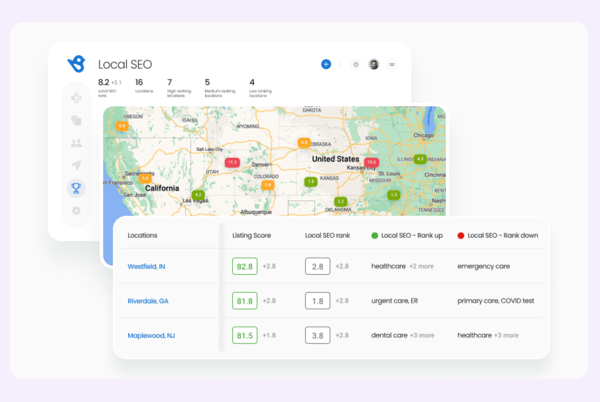
I tested Birdeye, specifically looking at how it handles the things that determine whether a local business shows up in the Google local pack: listing accuracy across directories, review volume and recency, and visibility in local search. The listings dashboard surfaces errors across 50+ directories in one place, which is exactly the kind of task that takes hours to do manually across individual platforms. The review generation and response tools are also tightly built; you can trigger review requests, respond from a single dashboard, and track how your reputation score trends over time.
Where Birdeye sits differently from every other tool on this list is that its SEO value is indirect but real: more accurate listings and more reviews genuinely move local rankings.
The trial gives you a real taste of what the platform does, but ongoing listings management, automated review requests, and the full reporting suite require a paid plan. Pricing is custom-quoted based on the number of locations, which makes it harder to evaluate if you're serious about it.
"The integrations across so many different platforms have been a game-changer for our social media and review engagement. Another aspect that has saved us a great deal of time is being able to manage and automate office listings, marketing posts, review responses, etc., for several locations at once."
- Birdeye review, Sydney V.
Best for: Local small businesses, especially those with a physical location where Google reviews and directory listings are primary drivers of new customers.
Not ideal for: Online-only businesses or those primarily focused on content-driven SEO rather than local visibility.
"Things are a bit expensive, as everything is priced separately."
- Birdeye review, Victoria C.
Conductor is the most enterprise-leaning tool on this list, and I want to be upfront about that. It's a free Chrome extension, and a trial is genuinely useful for small businesses, but the full platform is built for teams with content programs at scale.
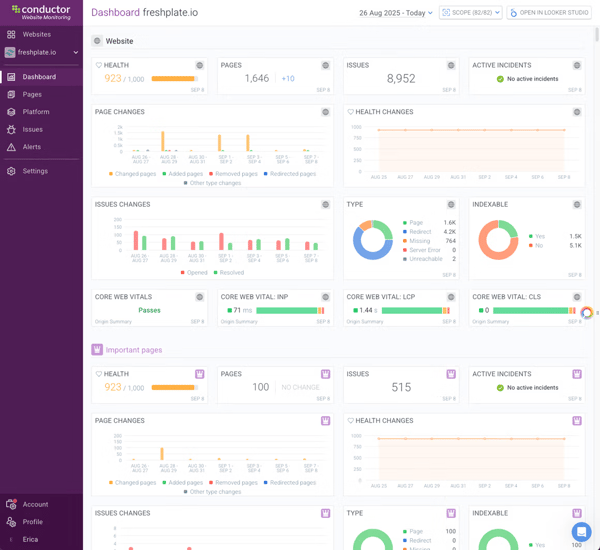
What makes it worth including here is the free Chrome extension, which gives you real keyword data search volume, difficulty, and SERP features on any page you're viewing, without logging in. For a small business owner who wants to quickly check what a competitor's page is optimized for, or understand which keywords a piece of content is targeting, this is a no-setup, no-cost starting point. The free trial then unlocks the comprehensive research and content intelligence suite, including competitor ranking data and the AI Topic Map for content planning.
Conductor is particularly relevant in 2026 because of its AI overview and citation tracking, which shows you where your brand appears (or doesn't) across AI search results like ChatGPT and Perplexity, which is increasingly where small business visibility gets decided.
The Chrome extension is useful indefinitely for quick spot-checks, but running an actual content strategy or tracking your rankings requires the full platform. Conductor uses custom pricing, so there's no published entry point; it's primarily priced for mid-market and enterprise organizations. If you're a solo operator or very small team, this is where the fit starts to stretch.
"My favorite part of Conductor is the level of support and onboarding you receive. There are tons of courses and trainings that teach you how to navigate the UX, leverage each report and feature, and even learn SEO tactics and best practices for optimizing for AI. The price is nice, a powerful platform that's cheaper than SEMrush. Integrating with GSC and GA lets you tie everything into one place."
- Conductor review, Abby C.
Best for: Small businesses with a content-heavy strategy who want to understand both traditional search rankings and AI search visibility, and have the budget for a premium platform.
Not ideal for: Very small teams or solo operators on a tight budget. Conductor's value compounds with content volume and team size in a way that can be hard to justify at the smallest scale.
"For the keyword rankings, it would be helpful to see which pages on the site are earning those specific rankings. The AI citations are a bit open-ended; you have to know exactly what prompts to track. It is a learning curve for sure because there are so many different things that you can use it for that we are still learning."
- Conductor review, Alex P.
SEO is changing fast: With 65% of businesses reporting improved SEO results from AI adoption, staying ahead of emerging trends is more important than ever. Read our collection of top SEO statistics for 2026 to understand where search is headed next.
Moz Pro has been around long enough to build a reputation for doing one thing particularly well: making SEO accessible to people who aren't SEO specialists. For small businesses, that track record matters.
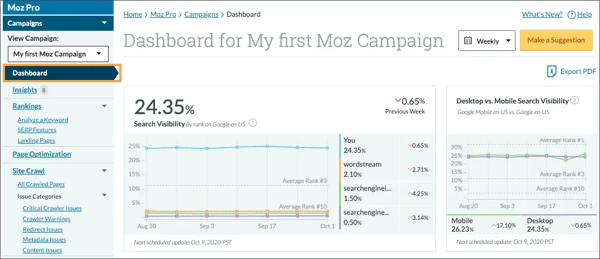
I tested Moz Pro with a specific small business use case in mind: someone who writes their own content, manages their own site, and wants to know what to fix and why without needing to become a technical SEO expert. The interface holds up well for that. The keyword difficulty scoring is clear and accurate, the on-page optimization recommendations are specific and ranked by priority, and the Link Explorer gives a reliable snapshot of your backlink profile without requiring you to understand every metric on the page.
The MozBar browser extension is also worth calling out; it's free forever and gives you Domain Authority and Page Authority data for any site you visit, which is genuinely useful for quick competitive checks without logging into the full platform.
The trial gives you enough time to run a thorough audit, set up rank tracking, and get comfortable with the interface. If you're actively doing SEO, publishing content, building links, and tracking rankings, the Starter plan at $49/month is the entry point. The main trigger is when the 10 monthly query limit on the free post-trial account stops you from doing regular research.
"The incredible insights and up-to-date algorithm inclusions it takes into account really stand out, especially with how regularly the platform is updated to track, report, and generate optimization recommendations and insights. I also love the strong focus on education."
- Moz Pro review, Sean R.
Best for: Small business owners who are newer to SEO and want a platform that explains what to do and why, with an accessible interface and strong educational support.
Not ideal for: Businesses that need deep keyword databases for long-tail research or a backlink index that matches the breadth of Ahrefs or Semrush.
"I don't like the way Moz always tries to upgrade you."
- Moz Pro review, Tim B.
SE Ranking is the highest-rated tool on this list at 4.7 stars, and the reviews tell a consistent story: small businesses find it gives them most of what enterprise tools offer at a fraction of the price.
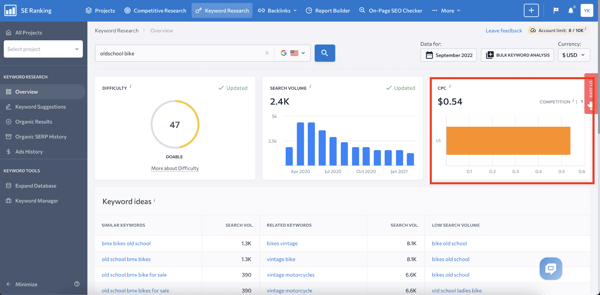
I tested SE Ranking with a focus on what small businesses actually use for day-to-day rank tracking, site audits, and competitor research. The rank tracker is clean and fast, updating daily across Google and Bing, with local tracking that lets you specify city-level positions. That matters for a local services business that needs to know whether they're ranking in their town, not just nationally. The site audit gives a detailed breakdown of technical issues with clear severity ratings and, importantly, tells you how to fix them rather than just what's wrong.
The 14-day trial gives you full access, which is enough time to run a real audit, set up rank tracking for your core keywords, and get a read on competitors.
After 14 days, you'll know whether it fits your workflow. The Core plan starts at $103/month and covers up to 10 projects with 2,000 keywords tracked daily, a reasonable ceiling for most small businesses managing one or a few sites.
"What I like best about SE Ranking is that it makes it easy to keep track of search visibility without getting lost in unnecessary complexity. As a small team, we need tools that are straightforward but still provide enough depth to make informed decisions, and SE Ranking strikes that balance well. I also like the reporting capabilities. We use the API and MCP data in our SEO and GEO workflows, which makes it much easier to combine search insights with other data sources when reviewing performance and content opportunities. It saves time and gives us a clearer view of what's actually driving visibility."
- SE Ranking review, Izabella K.
Best for: Small businesses and agencies that want a comprehensive SEO platform with rank tracking, audits, keyword research, and reporting at a price point designed for teams without enterprise budgets.
Not ideal for: Businesses that need the absolute deepest backlink databases or the most comprehensive keyword data at scale. Ahrefs and Semrush remain ahead on raw data volume.
"SE Ranking works incredibly well for our team workflow. Nothing to complain about, just sometimes the backlink database feels smaller than other tools."
- SE Ranking review, Anajana S.
Semrush is the most comprehensive tool on this list by a significant margin, and for small businesses that are serious about building an SEO strategy rather than just fixing their existing site, it's hard to beat.
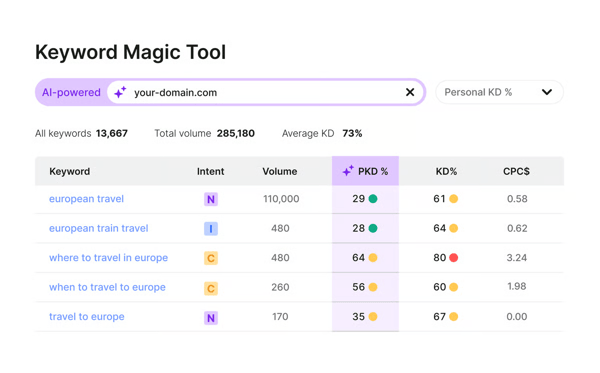
Even on the free plan, Semrush gives you a meaningful taste of what it does: 10 keyword searches per day, 10 domain lookups, and a site audit of up to 100 pages. I used the free plan to run a competitor domain lookup, map out a short keyword list, and check the basic health of a client site, all in one session, without upgrading. The Keyword Magic Tool is the standout even on free: enter one seed keyword, and it generates thousands of related terms, sorted by intent, difficulty, and volume, which is exactly what a small business needs when planning a content calendar.
The honest trade-off is that 10 daily searches run out faster than you expect, and the $117.33/month paid plan is the steepest entry point on this list. But for businesses where SEO is a primary growth channel, the depth of data justifies the cost in a way that cheaper tools don't match.
When the 10 daily query limit starts interrupting your research flow, that's the clear signal to upgrade. The SEO plan at $117.33/month removes those limits and gives you full access across keyword research, competitor analysis, and site auditing. It's a significant price increase, but the platform's depth makes it worth it for businesses where organic search is a core growth channel.
"What I like best about Semrush is having almost everything I need for SEO in one place. I can research keywords, track rankings, run site audits, analyze competitors, monitor backlinks, and create client reports without jumping between multiple tools. The competitor research is especially useful because it helps me quickly identify opportunities and see what's working in my clients' markets."
- Semrush review, Derrick W.
Best for: Small businesses that are actively investing in SEO as a growth channel and need the most comprehensive keyword research, competitor intelligence, and audit tooling available.
Not ideal for: Businesses on a tight budget or those that only need basic rank tracking. The free plan limits are real, and the paid tier is the highest on this list.
"The biggest downside is the price. It is a really powerful tool, but it can get expensive, especially for small teams or solo people. Once you start adding more users or projects, the cost can go up pretty fast. Another thing is the learning curve. There are so many features that it can take a while to figure out what you actually need and where everything is."
- Semrush review, Nariman H.
Semrush feeling out of budget? Check out the best Semrush alternatives for small businesses that cover keyword research, audits, and rank tracking at a lower price point.
SEO PowerSuite takes a fundamentally different approach from every other tool on this list. It's not a SaaS subscription; it's desktop software you download and run locally, with no per-query credit limits, no monthly data caps, and no recurring seat fees once you've paid the annual license.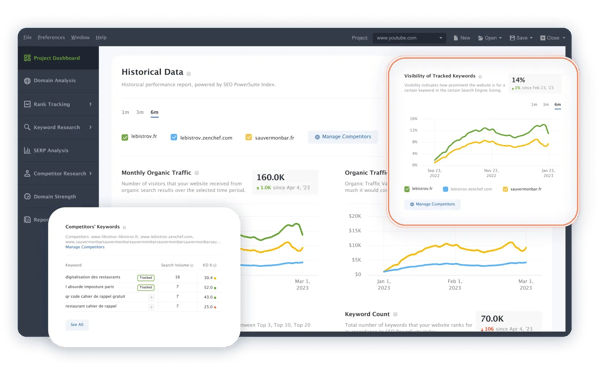
When I used the free version, the suite consisted of four separate applications: Rank Tracker for keyword monitoring across 400+ search engines, Website Auditor for technical site analysis, SEO SpyGlass for backlink research, and LinkAssistant for outreach planning. Each runs as a standalone tool that you open when needed. For a small business doing regular SEO work, weekly audits, ongoing rank tracking, and backlink monitoring, the unlimited nature of the free plan and the fixed annual cost of the paid tier make the economics look very different from tools that charge by the month per user.
The trade-off that I found with the whole testing is that it's desktop software. You can't log in from another device, there's no cloud collaboration, and the interface reflects its engineering-tool roots more than a modern SaaS dashboard. For small business owners who work from one machine and want serious SEO capability without a subscription that scales up unpredictably, that trade-off is often worth making.
The free plan is genuinely useful for one-off audits and spot checks, but the inability to save projects is the immediate constraint for any ongoing SEO work. The Professional plan at $349/year ($29.10/month billed annually) unlocks project saving, scheduled tasks, and reporting, the features that turn it from a one-time tool into a workflow.
"The fact that it is an all-in-one SEO tool makes it relatively easy to use, and it keeps all your SEO data in one place. Implementation was straightforward - you need to download their software onto your own computer. This is different to many of their competitors, most of whom tend to be cloud-based. Customer support has been excellent so far. I am a total beginner and have received very helpful support whenever I've needed it."
- SEO PowerSuite review, Dick L.
Best for: Small businesses and freelancers doing regular, high-volume SEO work from a single machine who want the full toolkit without a monthly subscription that scales with usage.
Not ideal for: Teams that need cloud access from multiple devices, real-time collaboration, or a modern SaaS interface. The desktop-only format is a real constraint for distributed teams.
"The main downside for most people is that this is desktop software, which needs a good computer and preferably lots of RAM. Another downside is that SEO PowerSuite can feel a bit overwhelming for new users, especially given the depth of tools and reports it offers."
- SEO PowerSuite review, Victor J.
Serpstat positions itself as the comprehensive alternative to Ahrefs and Semrush at a lower price, and for many small businesses, the comparison holds up. You get keyword research, rank tracking, site auditing, backlink analysis, and competitor research in a single platform, starting at $50/month with a free trial that gives you access to the full feature set before committing.
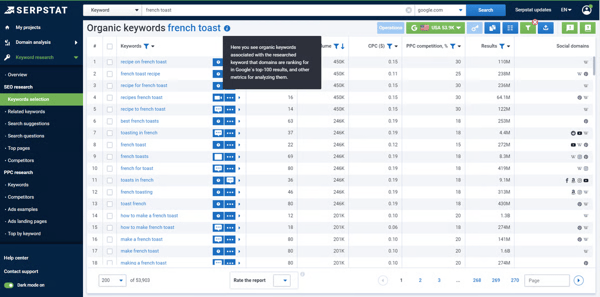
What I found when testing Serpstat is that it punches closest to its weight on site auditing. The crawler is fast, genuinely faster than Semrush and Ahrefs on comparable-sized sites and handles large projects (up to 100 simultaneous projects, compared to Ahrefs' ~40) without slowing down. For a small business or agency managing multiple client sites, that capacity matters. The competitor keyword analysis is also strong, surfacing keyword gaps and missing opportunities clearly without requiring you to build custom reports.
Where Serpstat shows its limits is in keyword database breadth. It covers the essentials, but for businesses targeting niche or long-tail keywords in smaller markets, the data thins out sooner than it does on Ahrefs or Semrush. It's a meaningful trade-off to understand before committing.
The trial gives you a fair read on the platform. The Individual plan starts at $50/month and covers the core workflow for a single user, including keyword research, audits, rank tracking, and competitor analysis within reasonable limits. If you're managing multiple client sites or need higher data volumes, the Team plan at $100/month expands the limits significantly.
"We particularly appreciate the flexible reporting system, easy-to-use API, and the ability to quickly collect keyword data across different markets. Special thanks to the Serpstat team for being open to feedback and continuously improving the product. It truly feels like a partnership, not just a subscription-based tool."
- Serpstat review, Igor G.
Best for: Small businesses and boutique agencies that want a comprehensive SEO platform covering audits, keyword research, rank tracking, and competitor analysis without paying Ahrefs or Semrush prices.
Not ideal for: Businesses that need the deepest keyword databases or most extensive backlink indexes. Ahrefs and Semrush remain ahead on raw data volume for highly competitive or niche keyword research.
"The dashboard for high, medium, and low issues can be improved. The view can be more user-friendly."
- Serpstat review, Janane V.
Similarweb is the most different tool on this list, and that distinction is important to understand before evaluating it. It's not primarily an SEO tool; it's a digital intelligence platform. Where Ahrefs tells you which keywords a competitor ranks for, Similarweb tells you where their traffic actually comes from across all channels: organic, paid, social, referral, and direct, broken down by geography, device, and audience demographics.
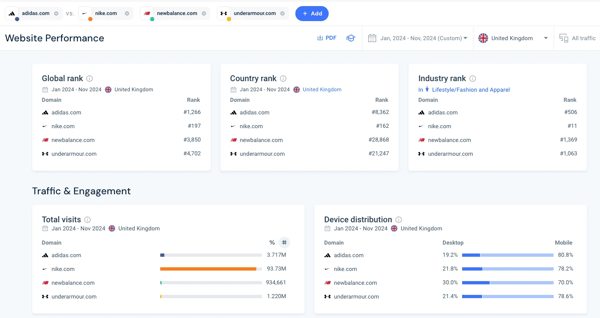
For a small business trying to understand the competitive landscape before investing in SEO or paid channels, that's genuinely useful information that no other tool on this list provides. I tested it specifically looking at competitor traffic breakdown and keyword intelligence, and the traffic source analysis is the clearest, most actionable version of that data I've seen. Seeing that a competitor gets 60% of their traffic from direct and only 15% from organic, while you're investing heavily in content, is the kind of strategic signal that reframes your whole approach.
The honest caveat for small businesses: Similarweb's data accuracy is strongest for sites with significant traffic volumes. For smaller or niche sites, estimates can be less reliable, and the pricing starting at $125/month for the Web Intelligence Starter plan is the steepest on this list. The free browser extension gives you top-line traffic estimates for any site with no login required, which is worth using before deciding whether the full platform is justified.
The free extension is worth having permanently for quick competitive checks. The upgrade makes sense when you need historical data beyond one month, full keyword lists, traffic source breakdowns at depth, or audience demographic data for strategic planning. The Web Intelligence Starter at $125/month (billed annually) is the entry point, significantly higher than most tools on this list, which makes it a considered purchase rather than a default recommendation.
"I like how it provides a complete picture of competitor traffic across all channels, not just search. The data is very accurate, often matching what I see in my own analytics tools. Also, the interface is intuitive and easy to navigate, so I can quickly find insights without digging through complicated menus."
- Similarweb review, Maha E.
Best for: Small businesses that need competitive market intelligence beyond keyword rankings, understanding where competitors get their traffic, which channels are growing, and how audience demographics compare across the market.
Not ideal for: Businesses primarily looking for keyword research, site auditing, or rank tracking might consider pairing Similarweb with other tools dedicated to those tasks.
"Sometimes the estimates don't feel fully reliable for smaller and niche websites. Pricing is also on the higher side, making it a bit difficult for smaller teams. The interface is good but a little overwhelming because it takes some time to fully understand and use all available features effectively."
- Similarweb review, Shruti R.
Wincher is the most focused tool on this list. It does one thing, rank tracking, and does it cleanly, affordably, and without unnecessary complexity. For a small business that just wants to know whether their keywords are moving, without learning a full SEO platform, Wincher is the most direct path to that answer.
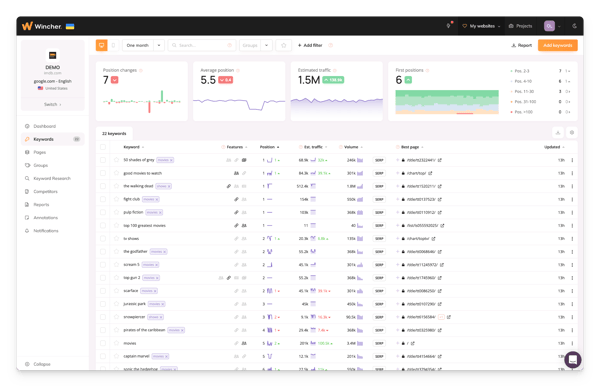
I set up Wincher on a test site in under five minutes. You add your keywords, connect Google Search Console in one click, and the next day you have daily ranking data for every keyword you're tracking, across desktop and mobile, with local tracking down to the city level. The competitor tracking feature lets you add two to three competitor domains and see their positions alongside yours, which gives you enough context to understand whether a ranking change is your site improving or the whole SERP shifting.
It won't replace a tool like SE Ranking or Semrush if you need audits, keyword research, and backlink analysis. But as a standalone rank tracker, particularly for small businesses that have their other SEO bases covered and just need reliable daily position data, Wincher is the most cost-efficient option on this list.
The free trial covers enough to validate whether daily rank tracking is useful for your workflow. The Basic plan at $41/month covers 500 keywords across two websites, a reasonable entry point for a small business tracking its core keyword set across one or two sites.
"I love its usability and clear dashboard. The ease of implementation and integration is also something to consider when choosing such software, and this one hits the spot. The customer support is also very good, and the features are good value for the money."
- Wincher review, JP C.
Best for: Small businesses that already have keyword research and audit tools covered and just want reliable, affordable daily rank tracking without paying for a full SEO platform.
Not ideal for: Businesses that need an all-in-one SEO tool. Wincher is rank tracking only, and that's by design.
"What I dislike about Wincher is that some of the deeper analytics and keyword comparison features feel a bit limited compared to larger SEO tools. It would also be great to see more integration options and more frequent data refreshes."
- Wincher review, Lykke K.
Free plans work best for small businesses in early stages, businesses testing a tool before committing budget, and solo operators who need one or two specific functions rather than a full platform. The ceiling appears when SEO becomes a primary growth channel. At that point, the daily query limits, missing competitor data, and locked reporting features start to interrupt real work rather than just restrict nice-to-haves.
While doing this exercise, three triggers consistently appeared across all ten tools.
Data limits: I hit daily limits for many products. Be it 10 daily Semrush searches or losing access after a 14-day SE Ranking trial, all of them can land when you're mid-research and stop you from finishing.
Competitor intelligence: Since free plans almost universally restrict how much you can see about competitors' keywords and backlinks, this becomes limiting the moment you start building a proactive SEO strategy, rather than just fixing your own site.
Reporting: Understandably, white-labeled reports, scheduled exports, and client-ready dashboards are consistently locked behind paid tiers. If you're managing SEO for anyone other than yourself, it quickly becomes a real constraint.
The good news? Most tools on this list have genuinely useful free tiers. Test them properly first. Run a real audit, track real keywords, and do real competitor research. You'll know within a week or two whether the free plan covers your actual workflow or just gives you a taste of it.
Do you still have questions about the best free SEO tools and their effectiveness? We've answered them for you!
For an operations manager handling SEO at a small business, SE Ranking and Semrush draw the most consistent praise in G2 reviews. Both pull rank tracking, audits, and reporting into one place, a lean team can run without a dedicated SEO hire. Operations managers tend to favor SE Ranking for its straightforward reporting and predictable pricing. When one person oversees SEO alongside other duties, that consolidation is what earns the trust.
For a small business growing toward mid-market, SE Ranking and Semrush scale most smoothly. Both connect to Google Search Console, Google Analytics, and Looker Studio with no custom setup. As the business adds sites and people, they expand from single-site tracking to multi-project management without a migration. That makes them safe picks through the transition from small to mid-size.
For small businesses, the tools that stick are the ones with the least ongoing effort. SE Ranking and Wincher both appear repeatedly in reviews as tools small teams keep using daily, because rankings update automatically and reports run themselves. Tools get dropped when they need constant manual upkeep. The ones that survive past the first month are usually quick to set up with a visible daily payoff.
Among small businesses, SE Ranking and Ahrefs are the most reliably reviewed for someone overseeing day-to-day operations. Both are noted for stable data and dependable reporting. For an operations lead who needs SEO running quietly in the background, consistent daily updates, and low maintenance matter more than feature depth. That dependability is what keeps them in regular use.
For small businesses, Wincher and SE Ranking both deliver daily ranking updates without the data reliability issues of cheaper trackers. The value is trustworthy numbers a small team can act on, so accuracy matters more than raw speed. Both keep their data consistent enough that you're not second-guessing whether a ranking change is real. That makes them dependable for everyday decisions.
For small businesses, SEO PowerSuite and Wincher both get you working without paid onboarding or consultants. SEO PowerSuite's free desktop tools cover audits and tracking at no cost, and Wincher goes live in minutes. Neither needs a specialist to configure. That makes them practical for a small business without an in-house SEO team.
For non-technical small business teams, including those scaling toward mid-market, Moz Pro and Wincher are the easiest to get running. Moz Pro pairs an approachable interface with strong educational resources, and Wincher takes under five minutes to set up. As a small team grows, both stay accessible to non-specialists rather than demanding technical know-how.
For small businesses, including tech-oriented ones, SE Ranking and Semrush offer the smoothest integrations with the tools you already use, such as Google Search Console, Analytics, and Looker Studio. Setup is largely one-click, with no engineering effort required. That keeps implementation simple for a small business without dedicated technical resources, even as needs grow.
For small businesses, SE Ranking and Moz Pro see the strongest sustained use because their workflows are clear enough that the whole team keeps using them. Adoption fails when a tool is too complex for everyone but one person. Both keep reporting and navigation simple enough that a small team adopts them without a long ramp.
For a small business scaling toward mid-market, SE Ranking and Semrush provide the real-time visibility, daily rank tracking, and live competitive data that growing teams need. As the business expands its site and keyword footprint, both scale up tracking volume without losing responsiveness. That makes them dependable through the move from small to mid-size.
After testing and evaluating these tools, I could clearly see that starting with free tools can still give your SEO an improvement over website performance and visibility.
Each tool on my list offers something unique. While some features are limited in the free versions, they're enough to handle some essential SEO tasks such as rank tracking, backlink analysis, keyword research, and content optimization.
Whether you're just starting or looking to complement your existing toolkit, these options prove that you don't need a massive budget to make meaningful progress in SEO.
For me, the best approach is finding the right combination of tools that align with my goals. Experiment, explore, and see which ones best fit your workflow. SEO is a marathon, not a sprint. These tools can help you stay ahead.
Want to go beyond free tools? Check out our full guide to the best SEO tools to find the right paid platform for your workflow.


As someone who has been part of the content ecosystem for a while, I know firsthand that...
by Shashank D Shastry

Published: April 2025 · Last Updated: April 2026 As someone who’s been in the SEO game for a...
 by Sagar Joshi

After testing, I found ClickUp, Connecteam, Hubstaff, monday AI Work Platform, QuickBooks Time...
by Shashank D Shastry