.png?width=400&height=150&name=My%20project-1%20(1).png)


I joined G2 during the pandemic while working completely remotely, which made me realize just how important it is to feel connected, supported, and engaged, even from a distance. While I wasn’t in an office setting, the tools and strategies G2’s team used played a big role in helping me feel part of the company culture right from the start.
Although I’m not an HR professional, my role has given me the chance to interact with employee engagement specialists, HR leaders, and team managers who face the ongoing challenge of keeping employees motivated, especially in hybrid and remote environments.
These conversations sparked my curiosity about the best employee engagement software that helps foster strong connections within teams, no matter where they’re located.
Over several weeks, I evaluated 20+ employee engagement solutions built to boost morale, strengthen communication, and foster a sense of belonging.
In this listicle, I’m highlighting six standout tools based on recurring themes in G2 user reviews, their unique features, pros and cons, and what makes them worth considering if you're rethinking how your organization approaches engagement. The tools I'll be covering are Workvivo, Connecteam, Workhuman Social Recognition, HiBob HRIS, Achievers, and Vantage Circle. Let's dive in!
Employee engagement is more critical than ever. In fact, employee engagement in the U.S. fell to its lowest level in a decade in 2024, with only 31% of employees feeling engaged. That decline highlights why organizations are rethinking how to connect with their workforce and why investing in the best employee engagement solutions is now essential.
That's where employee engagement tools make all the difference. Some tools help foster real-time communication and feedback, while others focus on employee recognition software capabilities, employee pulse surveys, and creating a culture of transparency and connection. With AI employee engagement features increasingly shaping the category in 2026, the right platform doesn't just boost morale; it helps teams collaborate more effectively, strengthens company culture, and keeps employees aligned with organizational goals, whether they're in the office, hybrid, or fully remote.
As I evaluated different platforms, I paid attention to features users frequently called out, like employee feedback systems, peer-to-peer recognition tools, engagement analytics, and integrations with popular productivity apps. Some tools made tracking engagement metrics easy and boosted team connection. Others looked promising on the surface but didn't deliver the impact or user experience needed to truly engage employees.
I spent weeks evaluating employee engagement tools and solutions, narrowing down the best options based on features, ease of use, pricing, and real user feedback from G2. I also leveraged AI-driven research to analyze software updates, HR trends, and common employee engagement challenges to ensure these recommendations are as accurate and helpful as possible.
I relied on insights from verified G2 user reviews to understand how each platform performs in real-world settings. The screenshots featured in this article may be a mix of those sourced from the vendor’s G2 page and other publicly available materials.
Each tool on this list is reliable, user-friendly, and designed to help organizations foster a more connected, motivated, and productive workforce. My research and analysis are backed by real-time user sentiments and proprietary G2 scores, offering a data-driven look at how these solutions support employee engagement across industries.
According to G2 Data, the average user adoption rate for employee engagement software is 72%, and the average payback period or estimated ROI is just 16 months. These tools are used by companies of all sizes: 23% are small businesses, 49% are mid-market, and 27% are enterprise, according to G2 Data. The data shows that most organizations not only implement these tools successfully but also see measurable value within a short time.
Working from home made me appreciate the importance of feeling engaged and valued, even without face-to-face interactions. But with so many software options out there, I needed to dig deeper into authentic user experiences to figure out what matters, whether managing a large team, supporting a hybrid workforce, or trying to boost morale in a fully remote setup.
If you’re looking for the best employee engagement software or comparing top employee engagement solutions, here’s what to keep in mind:
Over the course of several weeks, I researched and evaluated more than 20 employee engagement software programs. I narrowed down the best 6 based on standout features, usability, and consistent praise in G2 reviews.
To be included in this category, a solution must:
*This data was pulled from G2 in 2026. Some reviews may have been edited for clarity.
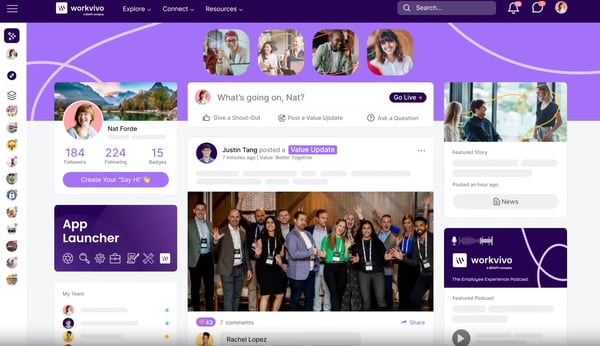
Workvivo feels like a social network built specifically for the workplace. Its clean, familiar design mirrors the platforms people already use in their personal lives, which means new team members can start navigating it comfortably from day one. That social-media-style approach to internal communication is what sets this employee experience platform apart from more traditional engagement tools, and it's one of the reasons Workvivo works so well as a dedicated employee engagement app for enterprises.
I also noticed several reviewers highlighting the customization options, saying they appreciated being able to tailor the platform to fit their preferences, making the experience feel both personal and efficient.
As I dug into G2 reviews, one theme that kept coming up was how much people love the ability to create their own space within the platform. Reviewers say it's more than just a place for task updates; it's a place to share perspectives, post creative work, and build connections beyond project deadlines. Several users also appreciate being able to highlight their skills, react to posts, and engage with colleagues across different teams or offices. That mix of personalization and community-building sets Workvivo apart.
Another recurring pattern in recent reviews is how Workvivo helps organizations keep employees informed with real-time company updates, schedules, and announcements. Reviewers describe having everything they need in one centralized place, from payroll links and calendars to department-specific information. That consolidation of resources into a single platform, combined with the social-media-style feed, appears to drive high day-to-day engagement and reduce the noise of switching between multiple tools.
Integration capabilities also stand out in the feedback. Users mention that Workvivo connects smoothly with tools like Slack, making it easy to follow activity feeds, departmental spaces, and cross-office updates without leaving their existing workflow. For organizations with offices spread across different regions, reviewers highlight how the platform makes it possible to stay connected with colleagues globally and see what's happening across the business in real time.
The setup experience receives consistently positive feedback as well. Multiple reviewers describe the implementation as well-supported, with Workvivo's team providing knowledgeable guidance throughout. That tracks with the G2 Data, where Workvivo scores 96% for both ease of use and ease of setup. That level of onboarding support, combined with an interface that mirrors familiar social platforms, appears to drive faster adoption across teams, including among employees who may not be particularly tech-savvy.
Teams that rely heavily on the mobile app for day-to-day engagement may notice that certain features, like tagging coworkers, don't always work as smoothly on mobile as they do on desktop. For organizations with a large share of desk-based employees, this is unlikely to be an issue, but mobile-first teams may want to factor in how much of their workflow depends on the app.
The platform also does a strong job of keeping users connected with relevant updates across departments and locations. Teams with users active in multiple spaces or groups may find that the default notification volume requires some manual tuning to stay focused on the updates that matter most. For organizations that plan to roll out Workvivo across many departments, setting up notification preferences early can help keep the experience streamlined from the start.
That said, Workvivo still earns strong praise for helping teams stay connected in a personal, engaging, and fun way. It brings an unexpected level of creativity and community into the workday, and that's not something you hear often about workplace software.
"I use Workvivo for work, and it helps me keep in touch with company updates and to see my schedules. My schedule is always up to date, and I receive company updates in real time. My HR updates my work schedules 2 months in advance, which helps me plan and fit into my schedule. There is a general company page where we receive updates and share ideas, allowing me to do that and give feedback in time. I've had a very smooth and easy experience with the initial setup of Workvivo. It's very user-friendly. I haven't experienced any problems since I started using Workvivo, and it works perfectly for me at the moment. I rate it a 10 out of 10 and believe it is a very good tool."
- Workvivo review, Morolayo F.
"Sometimes notifications do not arrive uniformly, and that can cause an important update to go unnoticed."
- Workvivo review, Marc D.
Celebrate achievements and boost morale with employee recognition software.
Connecteam is a true all-in-one platform built for managing distributed and frontline teams. Rather than juggling separate apps for scheduling, time tracking, messaging, and task management, everything lives inside a single mobile-first experience. For teams working in the field, at clinics, on job sites, or across remote locations, that consolidation is a genuine workflow improvement.
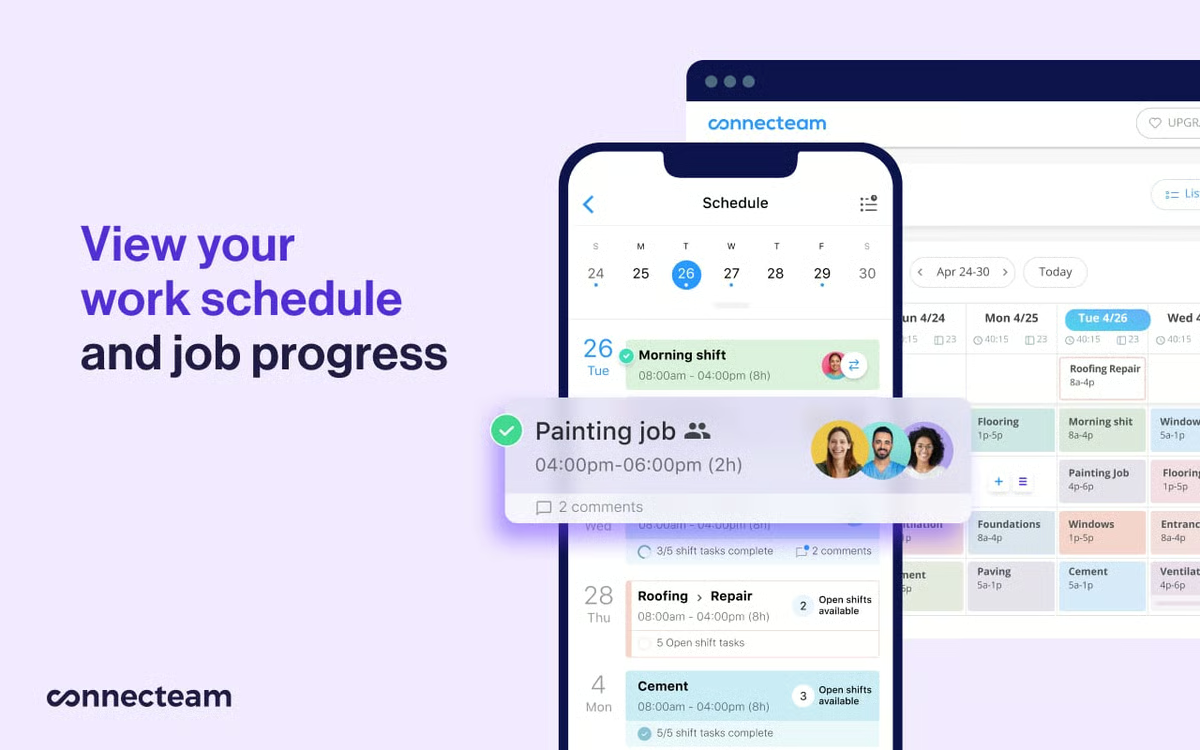
The mobile-first design comes up frequently as a differentiator. Reviewers describe the app as intuitive enough that even non-technical team members can get started without extensive training. Features like GPS-enabled clock-in and clock-out, shift scheduling with real-time visibility, and in-app messaging are mentioned as everyday essentials that keep operations running smoothly. Several users also highlight the onboarding and training modules, which allow organizations to distribute SOPs, compliance materials, and onboarding checklists directly to employees' phones.
The platform's communication capabilities receive strong praise across reviews. Users describe being able to make quick announcements, run polls, create quizzes, and keep the whole team aligned without relying on separate messaging apps or group texts. For managers, the ability to see who's working on what, track task completion, and manage leave requests from a single dashboard is frequently mentioned as a time-saver.
I also noticed a recurring theme around the celebrations and rewards feature that Connecteam offers. Reviewers say it helps create team culture, especially for remote teams, by allowing managers to publicly recognize great work, celebrate birthdays and anniversaries, and award team members through the platform. That recognition layer, built directly into the workforce management tool, seems to drive engagement in a way that feels natural rather than forced.
The setup experience is generally described as smooth. Multiple reviewers mention that getting employees onboarded takes just a few minutes, and integrations with payroll tools like ADP and Xero help keep back-end operations connected.
Customer support also comes up as a positive, with users noting that the team is responsive and helpful, particularly during implementation. According to G2 Data, 80% of Connecteam's customer base consists of small businesses, aligning with the platform's focus on accessibility and simplicity for lean teams. The average user adoption rate of 87% is the highest among the tools I evaluated.
Connecteam already delivers strong day-to-day visibility and operational management for most teams. Teams that need to go deeper with reporting and analytics, particularly around payroll data, operational trends, or custom field grouping, may find that the current capabilities don't yet support the level of detail needed for data-driven decision-making. For organizations where basic operational tracking is the priority, the existing reports cover the essentials well.
The platform offers a generous free tier for teams of up to 10 members, which makes it easy to get started. As organizations grow past that threshold and need access to the full feature set, costs can scale up noticeably. For teams that plan to expand, it's worth mapping out how pricing aligns with headcount growth to avoid surprises down the road.
Overall, I'd recommend Connecteam to teams managing frontline, field, or distributed employees who want scheduling, communication, task tracking, and engagement tools in a single mobile-friendly platform.
"I find Connecteam incredibly useful for chatting and updating clients and making quick announcements whenever needed. The mobile-friendly aspect of the software is amazing for our staff working in the field. The clock-in and clock-out feature, along with GPS tracking, is unique and valuable for verifying our employees' attendance and tracking the field team's specific work locations. The initial setup was quite smooth and simple, which I really appreciated."
- Connecteam review, Prem L.
"While there is a free option, after 10 staff join, the cost is very high (to gain access to all features) for small organizations with limited budgets."
- Connecteam review, Danielle P.
Want a broader view than engagement alone? Read about the best employee experience software to compare tools that support recognition, sentiment tracking, internal communication, and culture at scale.
Workhuman Social Recognition makes giving and receiving appreciation effortless. Whether at a desk or heading home, it only takes a few seconds to recognize someone from a phone, and that kind of flexibility goes a long way. I can imagine how nice it must feel to know your coworkers might start or end their day with a quick note of appreciation. It's an easy touch that genuinely boosts morale.
The platform's interface is intuitive and easy to navigate. Its clean design, responsive layout, and thoughtful structure make it simple for teams to adopt and use across the organization.
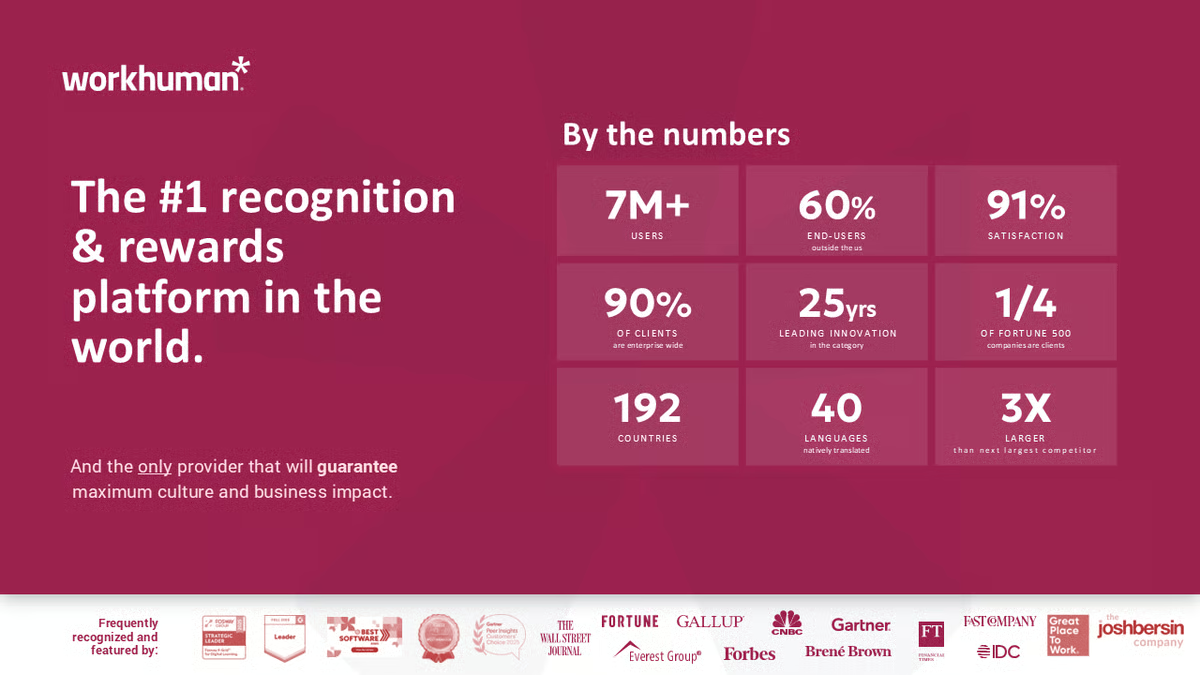
A recurring theme in the feedback is that the platform isn't just for casual shout-outs. It's also widely used to celebrate major personal and professional milestones, which reviewers say helps strengthen team bonds over time. That lines up with the G2 Data: peer recognition scores 94%, making it the platform's highest-rated feature.
With 75% of its customer base coming from enterprise organizations, according to G2 Data, Workhuman is clearly built for companies that need recognition to work at scale across large, often global teams. Another feature that gets consistent praise is the reporting and analytics. These tools may not be the flashiest, but they provide meaningful visibility into how recognition influences culture and engagement.
What stood out in the more recent reviews is how the points-based system drives tangible motivation. Reviewers describe being able to award points to colleagues based on the level of effort, and recipients can convert those points into gift cards across a wide range of brands and categories. That ability to choose a reward that actually resonates personally, rather than receiving a generic certificate, gets highlighted repeatedly as something that makes the recognition feel more meaningful. Users also appreciate that the recognition is visible to the wider team and management, which creates a social ripple effect of positivity and encourages others to participate.
The setup experience also receives consistently positive marks. Multiple reviewers describe onboarding as taking just a couple of minutes, often integrated with their organization's SSO, making it accessible from day one without any friction.
One area that comes up in G2 feedback is the breadth of the reward catalog across different regions. While gift cards, branded merchandise, and experiences are well-received overall, reviewers in certain countries note fewer redemption options compared to others. For organizations with most employees in well-supported markets, this rarely comes up, and globally distributed teams can get ahead of it by reviewing local availability during evaluation.
I also noticed a few reviewers commenting on how points translate into actual product value. Occasionally, items in the catalog are priced above what someone might pay through a regular retailer, which can make the redemption experience feel less aligned with expectations. That said, most users say the real value lies in the recognition moment itself, and the flexibility to choose a reward that feels personal still makes the system worthwhile.
Still, the general consensus is that Workhuman does a great job of fostering everyday appreciation and is one of the best software solutions for improving employee engagement in the service sector.
"I like that people all over the company can see the recognition. Not only does the employee receive it, but it's shared, and other people can see the good work that they did."
- Workhuman Social Recognition review, Savannah F.
"I would appreciate a wider variety of gift cards, as I find them to be the best value for points instead of ordering items. Perhaps providing a form where users could request or suggest new gift cards to be added to the roster could be added as a future feature."
- Workhuman Social Recognition review, Dean M.
Empower financial confidence with cutting-edge financial wellness software.
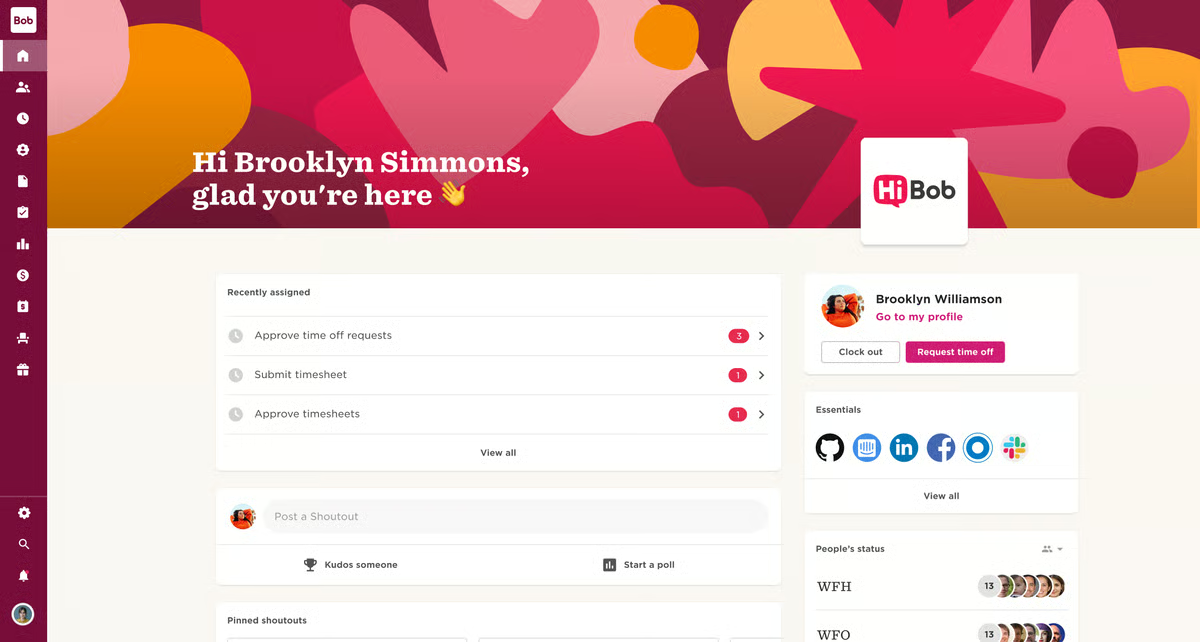
HiBob HRIS stands out by blending employee data management with genuine engagement features in a single, modern HRIS. The platform is intuitive and easy to navigate for both HR teams and employees, making everyday tasks like accessing personal information, requesting time off, and submitting timesheets feel straightforward. The quick-fix feature for timesheets, in particular, is a helpful touch that saves time and keeps things running smoothly.
HiBob's support team earns praise pretty regularly. Reviewers say responses are quick and helpful, and issues are usually resolved without much back-and-forth; this keeps workflows moving without significant disruption.
A lot of people also mentioned that getting started with HiBob felt surprisingly simple. The onboarding process is often described as smooth, and integrations with other tools don't appear to be much of a hassle. I also came across several mentions of customizable templates and peer review features, making performance reviews feel more structured and effective.
The interface gets a lot of love, too. Reviewers say it's clean, intuitive, and accessible, even for people without a technical background. I saw multiple mentions of how easy it is to check who's out on holiday, keep up with birthdays, apply for leave, or collect employee feedback. For most users, these everyday tasks feel straightforward with HiBob. According to G2 Data, the platform's average user adoption rate sits at 88%, and 82% of its customer base comes from mid-market companies, which makes sense for a tool designed to scale with growing organizations without requiring a dedicated HRIS team.
What stood out in more recent reviews is the platform's automation capabilities. Reviewers describe workflows that handle everything from onboarding reminders to performance review notifications, reducing the manual administrative burden on HR teams. One theme that comes up repeatedly is how HiBob helps manage the full employment lifecycle, from hire to retire, in a single system. Users appreciate having one source of truth for people data, which simplifies reporting and reduces dependence on spreadsheets and disparate systems.
The social-media-style interface is another feature that recent reviewers call out as a differentiator. HiBob is described as feeling more like a modern social network than a traditional HRIS, which users say drives higher engagement and makes employees genuinely want to interact with the platform. Features like employee profiles with shared hobbies, fun facts, and organizational culture initiatives add a layer of connection that goes beyond core HR functionality.
A theme I noticed across several reviews is the custom reporting experience. HiBob's standard dashboards and analytics cover everyday HR metrics well, but when it comes to building more specific reports, the column picker presents a large number of fields that can make it harder to pinpoint exactly what's needed. It's a manageable learning curve for most, and teams with standard reporting needs are unlikely to run into friction here.
Reviewers have also flagged the permissions model as something to evaluate carefully. In certain configurations, enabling access to one field within a category can unintentionally open up other fields in the same group. For straightforward permission setups, this rarely surfaces, but organizations with more granular data segmentation requirements should test the permission model during implementation to make sure it aligns with their access policies.
That said, I've seen recent feedback noting that HiBob has been expanding its capabilities, which is a good sign. Even with a few areas to refine, most users describe it as a reliable, user-friendly HR platform that helps streamline everyday work.
"I like how easy HiBob HRIS is to use, and I find it visually appealing. It's a central place to go when I have questions for HR. The initial setup was also very easy."
- HiBob HRIS review, Steven N.
"Not that flexible with integrations. Also, there were some issues with privacy and permissions during setup since our HR users are not very technical."
- HiBob HRIS review, Gili L.
Optimize your workforce with comprehensive HR services tailored to your needs.
Achievers has built a strong reputation for making employee recognition simple, visible, and meaningful at enterprise scale. The platform is intuitive and easy to navigate, with a layout that makes it quick to recognize a colleague, browse rewards, and stay connected with what's happening across the organization.
What stood out to me most is how naturally recognition seems to flow within the platform. Reviewers don't describe it as a forced or transactional process. Instead, they highlight how Achievers encourages people to pause, notice, and celebrate great work in the course of everyday activity.
Multiple users mention that the social visibility of recognition, where colleagues and managers can see who's being celebrated, creates a genuine sense of momentum, pride, and connection across teams and levels. That public aspect appears to be a meaningful driver of engagement, not just for the recipient but for the wider organization.
The rewards and redemption system receives consistently positive feedback. Users describe a wide selection of gift cards, vouchers, and merchandise options, and the redemption process is generally praised as fast and straightforward. Multiple reviewers appreciate having the flexibility to choose how they use their points, whether for retail gift cards, experiences, or other options. That sense of personal choice makes the reward feel more valuable and appreciated.
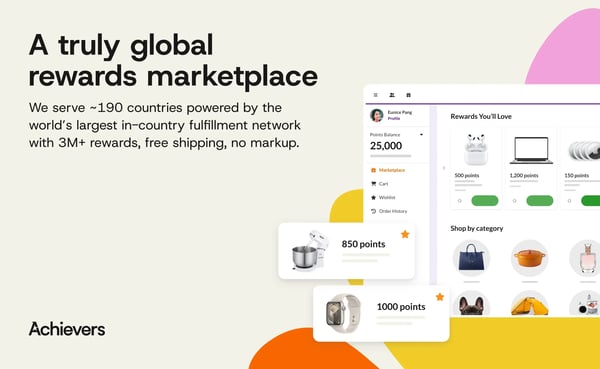
Achievers also gets strong marks for how it handles milestone celebrations. Reviewers mention automated reminders for birthdays, work anniversaries, and other special events, which help ensure that important moments don't go unnoticed. The ability to customize cards and messages, tag colleagues for visibility, and add GIFs to recognition posts adds a personal and fun touch that users seem to genuinely enjoy.
The platform's accessibility across devices is another highlight. With availability on both mobile and desktop, reviewers say they can recognize colleagues and browse rewards from wherever they are. For organizations with distributed or hybrid teams, cross-device accessibility is a practical advantage. The satisfaction signals from G2 Data reinforce what the reviews describe: Achievers scores 94% for likelihood to recommend and 95% for ease of setup, which suggests organizations can get the program running with minimal friction.
Beyond individual recognition moments, reviewers describe Achievers as a platform that genuinely strengthens team culture. Multiple users mention that seeing a steady stream of colleague celebrations, thank-you messages, and milestone acknowledgments creates a sense of shared purpose and belonging that extends well beyond the person being recognized. For distributed or hybrid organizations, especially, ongoing visibility into how people across the company contribute and support one another helps bridge distance and keeps teams feeling connected to the broader mission.
A few G2 reviewers have pointed out that the pricing of certain items in the rewards marketplace doesn't always mirror what they'd pay at an external retailer. It's a fair observation, and for organizations where the recognition moment itself is the priority, it's unlikely to diminish the experience. Still, teams that care about strict point-to-value alignment should take a look at catalog pricing during their evaluation.
Another pattern I noticed is around navigation within the platform. Because Achievers combines a social recognition feed, a rewards marketplace, and reporting in one place, organizations running very active programs can find the layout a bit spread out when switching between sections. For most teams, the current flow works well, and larger programs can get ahead of this by configuring their dashboard to surface the most relevant views upfront.
Overall, Achievers is a strong choice for organizations looking to build and sustain a culture of recognition at scale, with the tools, reward flexibility, and social visibility needed to keep appreciation feeling genuine and consistent.
"Almost everything under 1 umbrella. It gives an opportunity to select from a wide range."
- Achievers review, Shitansh S.
"The products offered are not worth the points. Most are things that are overpriced for what they're really for."
- Achievers review, Verified User in Information Technology and Services
Performance and engagement go hand in hand. If you're also evaluating how to structure reviews, feedback cycles, and goal-setting for your team, see our picks for the best performance management software to find tools that work alongside your engagement stack.
Vantage Circle takes a comprehensive approach to employee engagement by bringing rewards, recognition, wellness programs, and corporate perks together in a single platform. By combining employee recognition software capabilities with built-in employee wellness software features, it covers a broader range of engagement needs than most standalone tools. The interface is intuitive and easy to work with, whether employees are browsing rewards, accessing deals, or just navigating features in general.
It also integrates smoothly with existing systems, making it easier for teams to manage and track rewards without extra work.

The variety of benefits is where Vantage Circle really shines. From discounts on well-known brands to wellness initiatives, there's something for everyone. The convenience of browsing and redeeming rewards contributes to a more positive, engaging workplace culture. Several users have also highlighted how personalized the experience feels; the platform seems to adapt to individual preferences, which helps make recognition more meaningful.
One recurring theme in recent reviews is how the Vantage Points system drives engagement. Employees earn points through recognition awards, and those points can be redeemed for gift cards from popular e-commerce platforms, brand vouchers, and merchandise. Reviewers describe the redemption process as quick and hassle-free, often taking just a few steps. That tangible connection between recognition and real-world rewards appears to be a significant motivator for employees across organizations of varying sizes.
The peer-to-peer shoutout feature is another area where Vantage Circle earns genuine appreciation from reviewers. Multiple users describe how easy it is to recognize a colleague's work publicly, and how that visibility creates a culture of appreciation that might otherwise go unspoken in the flow of daily operations. For larger organizations, reviewers note that the shoutout functionality helps surface contributions across departments and levels, making it easier for managers and peers to stay aware of who's going above and beyond even when teams don't interact directly.
Another strength that came up often is customer support. Reviewers frequently describe the team as responsive, proactive, and genuinely invested in helping users. The G2 Data backs this up: Vantage Circle earns a Net Promoter Score of 84, and its reporting and dashboards feature a 92% score, reflecting the platform's strength in providing administrators with clear visibility into how recognition programs are performing across the organization.
Something that came up across multiple reviews is regional variation in the reward catalog. Depending on where employees are located, the selection of gift cards and redemption options can feel broader in some markets than others. Most users in well-served regions describe the experience as convenient and motivating, and globally distributed organizations should verify local availability to make sure the catalog meets expectations across all locations.
I also noticed feedback around the dashboard experience. Because Vantage Circle consolidates recognition, rewards, wellness, and perks into one interface, users who interact with multiple modules daily sometimes describe the layout as presenting a lot of information at once. For teams that primarily use one or two features, navigation stays clean and simple, while organizations leveraging the full suite can benefit from customizing their view during setup to keep the most relevant sections front and center.
Overall, Vantage Circle is a reliable, easy-to-use platform that adds real value to employee engagement and recognition efforts and is frequently recommended as software to boost employee engagement in offices. Based on what I've read, it's helped many teams improve satisfaction and build a more motivated, appreciated workplace culture.
"What I like best about Vantage Circle is the rewards and recognition program. It's a great way to feel appreciated for my work, and I enjoy the flexibility of being able to choose from a wide variety of gift cards and other redemption options. The peer-to-peer recognition feature is also a nice touch, as it allows me to acknowledge my colleagues for their hard work."
- Vantage Circle review, Matli Shiva Charani R.
"Sometimes the reward options feel limited, especially for certain categories. The platform can be slightly slow during peak hours, and the search function for rewards is not always accurate. Notifications also get delayed at times, which affects timely updates on recognitions and offers."
- Vantage Circle review, Rahul K.
Looking beyond engagement scores? Explore workforce planning software to connect retention signals, capacity gaps, and future hiring needs.
Have more questions? Find more answers below.
Workvivo backs up its reputation with G2 Data showing 96% for both ease of use and ease of setup, and reviewers consistently describe the onboarding experience as well-supported from day one. Achievers earns a similar trust with a 94% likelihood to recommend score, and reviewers describe the recognition process as something that flows naturally rather than feeling forced.
Workhuman Social Recognition leads on this front, with peer recognition scoring 94%, its highest rated feature, and reviewers describing how converting points into personally meaningful rewards keeps appreciation feeling genuine rather than transactional. Vantage Circle supports the same goal with a Net Promoter Score of 84, backed by reviewers who say the combination of recognition, rewards, and wellness programs builds a more motivated, appreciated workplace culture over time.
HiBob HRIS ties feedback directly to action through automated workflows that handle onboarding reminders and performance review notifications, so requests do not sit unanswered in a queue. Workhuman Social Recognition supports the same idea from the recognition side, with reporting and analytics that reviewers say offer real visibility into how day-to-day recognition shapes culture and engagement over time.
Workvivo scores 96% for both ease of use and ease of setup, and reviewers consistently describe the rollout as well-supported, with the vendor's team providing knowledgeable guidance throughout implementation. Connecteam backs this up with an 87% average user adoption rate, the highest among the tools evaluated, showing that once teams are onboarded, they keep using it.
Vantage Circle integrates smoothly with existing systems, which reviewers say makes it easier to manage and track recognition and rewards without extra manual work. HiBob HRIS goes a step further by combining HR data and engagement in one system, with automated workflows that handle onboarding reminders and performance review notifications so actions trigger without HR having to manually follow up.
Vantage Circle's reporting and dashboards score 92% according to G2 Data, giving administrators clear visibility into how recognition programs are performing across the organization before problems surface. Achievers supports the same goal with satisfaction signals reinforced by a 94% likelihood to recommend score, and reviewers say the social visibility of recognition helps leaders see engagement momentum building or fading in real time.
Achievers makes recognition visible to colleagues and managers alike, which reviewers say creates a sense of momentum that keeps leadership aware of who is contributing and where morale stands. Workhuman Social Recognition supports the same goal through its reporting and analytics, which reviewers describe as giving real visibility into how recognition efforts translate into broader culture and engagement outcomes.
HiBob HRIS gives HR teams a single source of truth for people data, with standard dashboards and analytics that reviewers say cover everyday engagement and HR metrics well. Workhuman Social Recognition complements this with reporting that reviewers say offers meaningful visibility into how recognition efforts are influencing culture and engagement across the organization.
Vantage Circle's reporting and dashboards score 92%, giving administrators the visibility to spot dips in recognition activity or engagement before they become bigger problems. Achievers supports this with automated milestone reminders for birthdays and work anniversaries, so important moments that could otherwise signal disengagement never go unnoticed.
Connecteam lets managers run quick polls and quizzes directly inside the app, giving teams a lightweight way to check in on sentiment without launching a separate survey tool. HiBob HRIS takes a similar approach by building feedback collection into the same platform employees already use daily for time off, schedules, and updates, so gauging sentiment does not require yet another tool competing for attention.
Finding the right employee engagement solution is just one piece of the puzzle; what really matters is how you use it. Among today’s top employee engagement solutions, the real impact comes from thoughtful implementation and consistent use. Choose a platform that fits your organization’s needs, implement it thoughtfully, and start fostering a culture where employees feel valued, heard, and motivated.
If you’re new to employee engagement strategies, start small, run a pulse survey, introduce peer-to-peer recognition, and see how your team responds. If you’re already focused on engagement, look for ways to automate feedback, track progress more effectively, and scale your efforts with the right software.
Employee engagement success doesn’t happen overnight, but with the right tools and a proactive approach, you’ll be on your way to creating a happier, more connected, and more productive workforce. So, pick your software, put it to work, and watch your team’s engagement levels soar!
To support a truly engaged workforce, the right corporate wellness software can help promote employee well-being, reduce burnout, and create a healthier, more productive work environment.
.png)

The best employee experience software supports HR teams in managing engagement, recognition,...
 by Disha C

Recently updatedSummer 2026 Grid® Report · Published May 26, 2026 This guide was last...
 by Soundarya Jayaraman
Recently updatedSummer 2026 Grid® Report · Published May 26, 2026 This guide was last...
.png) by Devyani Mehta
by Devyani Mehta