


The five best cloud compliance software tools for 2026 are Vanta, Wiz, Sprinto, Drata, and Scrut Automation.
Finding the best cloud compliance software gets a lot harder when your environment won’t sit still. I’ve watched teams with strong security habits still get burned by cloud sprawl, configuration drift, and sensitive data popping up in places no one expected, usually right before an audit or a customer review.
The pressure isn’t just to pass SOC 2, ISO 27001, HIPAA, or GDPR once a year anymore. Security, compliance, and cloud owners are expected to prove continuous compliance, spot gaps fast, and fix what matters most across multi-cloud setups without drowning in manual evidence work.
I evaluated these tools with a practical lens: which ones actually reduce audit fire drills, strengthen governance, surface sensitive data risks, continuously monitor compliance, and make remediation realistic for busy teams.
To build this list, I leaned on G2 GridReports and user reviews to see what real users trust. Then I paired that with my own research into how each platform handles core cloud compliance capabilities like governance, sensitive data compliance, compliance monitoring, cloud gap analytics, and security auditing.
*These cloud compliance software are top-rated in their category, according to the G2 Summer Grid Report 2026. All offer custom pricing and a demo on request.
Here’s a quick comparison table that shows how each platform stacks up in terms of G2 feature ratings on the core cloud compliance capabilities you care about most: governance and policy management, sensitive data compliance, continuous compliance monitoring, cloud gap analytics, and security auditing.
| Software | Governance | Sensitive data compliance | Compliance monitoring | Security auditing |
| Vanta | 92% | 92% | 95% | 94% |
| Wiz | 89% | 86% | 91% | 93% |
| Sprinto | 95% | 95% | 96% | 95% |
| Drata | 91% | 91% | 94% | 95% |
| Scrut Automation | 96% | 96% | 96% | 98% |
From what I learned, cloud compliance software helps teams keep their cloud environments aligned with security and regulatory requirements as they change in real time. Instead of relying on periodic manual checks, these tools continuously scan your cloud and connected apps for misconfigurations, policy drift, and risky access or data handling. They also map controls to frameworks like SOC 2, ISO 27001, HIPAA, and GDPR, and automate evidence collection so audits don’t turn into last-minute fire drills.
Based on my research, what makes a cloud compliance platform the best is how well it handles compliance day to day, not just at audit time. The top tools combine strong governance and policy management, sensitive data discovery and compliance, continuous monitoring, clear gap analytics with risk prioritization, and audit-ready reporting. Just as important, they fit into real workflows (ticketing, SIEM, CI/CD), so teams can remediate quickly rather than getting buried in alerts.
G2 Data backs up why these platforms are becoming table stakes across organizational sizes: users report an estimated ROI or payback period of about 12 months, which shows that the cost of manual compliance adds up quickly. And adoption isn’t limited to one segment. These tools serve small businesses (36%), mid-market teams (37%), and enterprises (27%), reflecting how cloud compliance pressure hits everyone, just at different scales.
I started with G2’s Grid® Reports to build a shortlist of the top cloud compliance platforms based on G2 Score, user satisfaction, and overall market presence.
Next, I dug into G2 reviews at scale using AI to spot the patterns that matter most in real-world cloud compliance. I looked for consistent feedback around governance and policy management, sensitive data compliance, continuous compliance monitoring, cloud gap analytics, and security auditing plus how well each tool works across multi-cloud setups without overwhelming teams with noise.
Reviews helped me separate “check-the-box compliance” from platforms that actually prevent drift, prioritize risk, and make remediation manageable. Finally, I cross-checked vendor websites and spoke with peers who’ve worked with these tools. It helped validate themes I saw in the reviews and gave me a clearer picture of usability, rollout experience, and the impact of these platforms.
The screenshots in this article come from G2 vendor profiles and publicly available product documentation.
After combing through G2 Data and comparing it with what I’ve seen play out for security, compliance, and cloud teams, I kept running into the same set of deal-breakers that separate “audit helper” tools from platforms you can actually trust day to day.
No tool is flawless across every criterion. But the best cloud compliance software shows steady strength where it matters most in real environments: reliable cloud coverage, accurate and context-rich detections, fast root-cause clarity, strong integrations, and the ability to keep working as your cloud footprint and compliance scope grow.
The list below contains genuine user reviews from the Cloud Compliance software category. To be included in this category, a solution must:
*This data was pulled from G2 in 2026. Some reviews may have been edited for clarity.
G2 rating: 4.6/5
No conversation on compliance goes without Vanta, and I can see why it keeps landing as #1 cloud compliance software on G2. At its core, Vanta is a compliance automation platform that helps teams map controls to major frameworks, pull evidence continuously from cloud and SaaS systems, and stay audit-ready year-round.
When I dug through G2 reviews and Grid signals, the story was pretty consistent: people rely on Vanta to make compliance an ongoing habit instead of a once-a-year scramble, especially for SOC 2 and ISO 27001 in fast-moving environments. It's one of the best platforms for automating cloud compliance audits
What users like most comes through loudly in the highest-rated feature set. Compliance monitoring scores 95%, security auditing 94%, and policy enforcement 93%, which lines up with what reviewers keep describing: Vanta connects to AWS, Okta, Google Workspace, GitHub, Slack, and a huge list of other tools, then starts collecting access logs, config snapshots, and control evidence automatically.
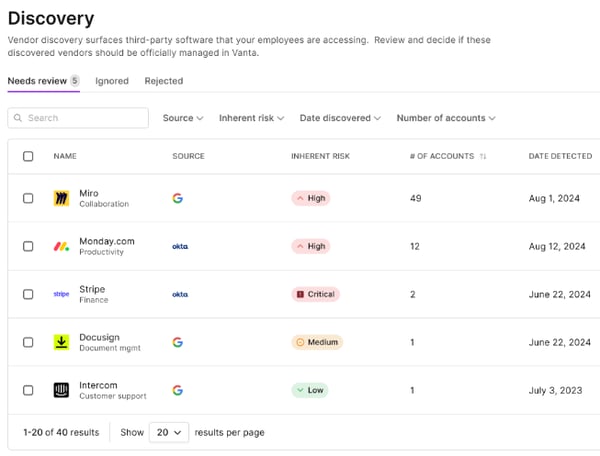
Multiple people mention how that shift alone stops the “screenshot chase” and frees them up to focus on fixing gaps instead of proving they exist. I also saw a lot of love for the structure Vanta brings with policy templates, guided task checklists, cross-framework control reuse, and a clear control health view that’s easy to share during audits or customer RFPs.
That ease factor is backed by the satisfaction ratings: ease of use sits at 92%, ease of admin at 92%, ease of setup at 91%, and quality of support at 92%.
A newer strength running through G2 reviews is Vanta's reliance on embedded AI. Reviewers describe reaching for the built-in assistant daily for vendor reviews and quick framework questions, and many note that vendor risk, access reviews, the risk register, and policy management now sit in one connected place rather than scattered tools, which makes gaps far easier to catch when everything's linked.
Another thing that stood out to me is Vanta’s broad real-world footprint. The top industries represented by the computer software sector, IT and services, financial services, hospital and health care, and marketing and advertising are basically a map of where cloud compliance pressure hits hardest. Reviewers across those segments kept pointing to the same payoff: continuous visibility into posture, clear ownership of controls, and faster, calmer audits.
There's a learning curve to getting the initial control mappings right across complex, multi-tool environments, so the first configuration pass takes some real attention, though once it's dialed in, the automation quietly carries that load for you from then on.
Teams running older or less common tools may need to supplement with a bit of manual evidence at first, but Vanta keeps adding integrations every month, so most stacks fall into full automation before long.
Putting it all together, Vanta earns its place among the best cloud compliance software because it delivers the kind of day-to-day reliability teams actually need, like automated evidence, always-on monitoring, solid cross-framework mapping, and a workflow that keeps compliance moving without constant handholding. So if you want a platform that makes audits feel routine and gives you a posture you can confidently show customers anytime, Vanta is one of the strongest bets out there.
"Vanta democratizes SOC 2, ISO, and other certification preparation and audits. It tells me exactly what to do, when to do it, and what I’m missing along the way. I could have hired a larger, expensive consulting firm to handle all of this work for me, but with Vanta I didn’t need to. That’s allowed me to repurpose those budget dollars to where they’re most needed: my security stack."
- Vanta review, Gary P.
"While the automation is robust, there is a learning curve associated with setting up the initial mappings correctly across complex, multi-tool environments. I’ve also found that as we scale, managing third-party vendor risks can occasionally feel manual if the vendor isn't already within the Vanta ecosystem."
- Vanta review, Digvijay C.
If you’re also evaluating compliance, check out G2’s roundup of the best GRC software to manage governance, risk, and compliance with ease.
G2 rating: 4.7/5
I keep seeing Wiz show up as a default shortlist pick among top-rated cloud compliance tools for large enterprises that want a clean, real-time view of risk across their cloud stacks. In fact, Wiz is one of the best cloud compliance software for multi-cloud environments.
At a high level, it’s an agentless CNAPP/CSPM tool that connects to your cloud environments, inventories assets, and maps issues across misconfigurations, vulnerabilities, identities, secrets, and compliance gaps in one place. After digging through the G2 reviews, I get why it shows up so often in “best cloud compliance software” conversations.
What jumps out first in the review data is how frequently users talk about visibility without friction. People like that Wiz can light up a full cloud environment quickly, without agents, and then show risk in context instead of a giant flat list.
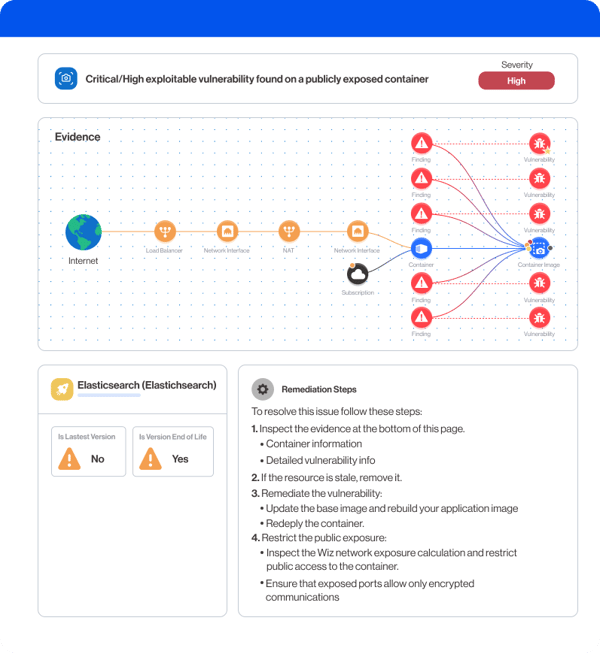
Reviewers keep coming back to the security graph and prioritization angle. Wiz doesn’t just surface findings, it ties them to exposure paths and sensitive data, so teams can focus on what actually matters. You can see that in the G2's highest-rated feature set too: security auditing and SSO are both at 93%, and compliance monitoring is close behind at 91%.
Users increasingly treat Wiz's AI as a real time-saver rather than a gimmick. They single out the built-in assistant for letting them query the security graph in plain language and pull reports without digging. They also praise the step-by-step GenAI remediation guidance that explains how to actually fix an issue instead of just flagging it. Several also like catching misconfigurations and exposed secrets earlier by running Wiz inside their CI/CD and Terraform pipelines.
Another theme is how engineer-friendly the platform feels. Multiple reviewers mention dashboards that make daily risk checks almost routine, plus remediation guidance that’s practical for SecOps and DevOps teams working together. I also notice a lot of praise for integrations and workflow fit — users like hooking Wiz into SIEMs, ticketing systems, and existing cloud workflows so findings don’t just sit there. That’s the kind of stuff that makes compliance feel less like paperwork and more like a living system.
While many users praise Wiz for its depth and extensive cloud security capabilities, reviewers also note that the platform can feel complex to manage out of the box, especially around alert tuning and configurations. Teams might need to adjust policies and fine-tune notifications so they don’t become overwhelming. However, once connected, Wiz surfaces an exceptionally broad set of insights, giving teams deep visibility across their environment.
The volume of findings can be a lot for smaller teams out of the gate, so some upfront alert tuning helps; put in that early effort and the noise drops fast, leaving you with a clear, prioritized view of what actually matters.
Overall, if you’re a SaaS, fintech, healthcare, or high-growth cloud team that wants to stay continuously audit-ready while also tightening your real security posture, Wiz looks like a very solid fit.
"What I like best about Wiz is its ability to provide risk-based visibility across our cloud environment in a way that is actionable for both security and engineering teams.The most valuable aspect is the contextual risk prioritization. Rather than managing large volumes of findings, Wiz helps us focus on the exposures that matter most and drive remediation where it has the greatest impact. The platform is intuitive, scales well, and provides strong executive-level visibility into cloud risk."
- Wiz review, Verified User in Education Management.
"The platform can feel a bit overwhelming at first, and there’s a learning curve to fully understand the depth of features and data.
- Wiz review, Verified User in Hospital & Health Care
It depends on what you need. The easiest way to choose is to line them up against your stack and priorities. Check the G2 Vanta vs. Drata compare page for a side-by-side on features and real review patterns.
G2 rating: 4.7/5
At its core, Sprinto is a cloud compliance and GRC automation tool: you connect your cloud providers and key SaaS systems, Sprinto pulls evidence continuously, maps it to controls and frameworks, and gives you a live view of what’s done, what’s pending, and what needs attention before audit time.
Reading through G2 feedback, the vibe is pretty consistent. People lean on Sprinto as the central hub for audit readiness, especially when they want a guided path instead of piecing it together across docs and tickets.
What users seem to love most is how much Sprinto reduces the “herding cats” part of compliance. Reviewers keep calling out the structured workflows and clear task tracking, plus the way evidence collection runs in the background once integrations are set. That shows up in the product scores too: compliance monitoring is one of Sprinto’s top-rated features, and users also rate security auditing and policy enforcement very highly.
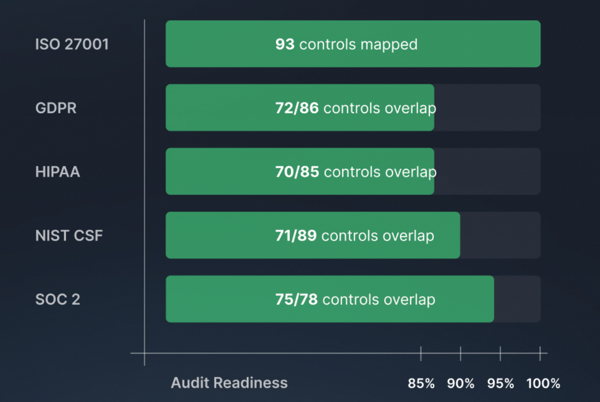
In plain English, teams feel like the platform doesn’t just tell them “be compliant,” it actually helps them stay there day-to-day, with dashboards that surface progress and ownership in a way that’s easy to share internally.
A theme that jumps out of G2 reviews is how comfortably teams run several frameworks at once. Reviewers describe pursuing SOC 2, ISO 27001, and GDPR in parallel off one shared set of controls, with auditors plugged directly into the dashboard so the usual evidence back-and-forth largely disappears. Many also credit a named technical account manager with chasing auditor questions and keeping the whole certification on track.
And support is a big part of the story I saw. Sprinto’s satisfaction ratings are sky-high for quality of support, ease of doing business with them, and ease of setup, which tracks with all the shoutouts to hands-on onboarding and fast answers when teams hit a blocker. Even reviewers who say they’re new to formal audits talk about feeling guided instead of overwhelmed.
There’s also a strong “built for modern SaaS” theme in who’s reviewing it. Most feedback comes from software and IT services orgs, with solid representation from regulated sectors like financial services and security-minded teams too.
A lot of users appreciate how broad the integration catalog is and how smoothly the big-name connectors work once they’re live. Teams that want every integration to be instantly plug-and-play, especially for niche tools, may need a little extra setup time or light customization before everything hums along in autopilot mode.
Based on G2 reviews I analyzed, customizing workflows or reports beyond Sprinto's standard setup can feel a little rigid, but the defaults are so well-structured that most teams find they cover the job without needing to go off-script.
Teams seeking a highly polished, low-maintenance experience may want to plan for light monitoring, while those comfortable with occasional troubleshooting are less likely to find this an issue.
On the whole, I’d recommend Sprinto most for cloud-first startups and mid-market SaaS companies that want a guided, automation-heavy path to SOC 2/ISO readiness and ongoing continuous compliance, especially if you value strong human support alongside the software.
"Simple yet comprehensive interface, great onboarding through the portal and with support, and very customizable. It had all the integrations we needed for our main systems, pricing was exceptional, and the performance of the console and integrations was great in order for us to do a first setup and audit for ISO 27001:2022. Our Customer Support Engineer, Joe Aksharan, did an amazing job in onboarding and supporting us toward our successful certification with our complex, multi-platform and hybrid remote-user environment."
- Sprinto review, Jason E.
"Honestly, there’s not much to dislike. The overall experience was quite smooth and well-managed. If anything, a bit more flexibility in customizing certain workflows or reports would make it even better, but it didn’t really impact our overall experience."
- Sprinto review, Rohit N.
G2 rating: 4.7/5
Drata is another popular and well-known compliance software, especially for cloud-first teams that want audit readiness without living in spreadsheets. As a matter of fact, Drata is one of the top tools for ensuring cloud compliance with GDPR and HIPAA, along with Vanta, Scrut Automation, and Sprinto.
From what I read, Drata automates evidence collection from your cloud and SaaS stack, maps controls across frameworks like SOC 2 and ISO 27001, and keeps those controls monitored continuously so you can spot drift early.
What jumped out to me right away in the G2 data is how strongly users rate the day-to-day experience. The quality of support is rated at 96%, ease of use at 93%, meeting requirements at 93%, ease of administration at 93%, ease of doing business with at 97%, and ease of setup at 91%.
That lines up with the review themes I saw: people keep saying Drata feels intuitive, prescriptive, and easy to ramp on — even for smaller orgs or one-person GRC teams. Users love that auditors can work directly inside the platform, create evidence requests there, and cut out the messy back-and-forth that used to happen in ticketing systems. I also saw a lot of appreciation for multi-framework control mapping and “no-bloat” workflows that help teams reduce overlap instead of re-doing the same checks across every standard.
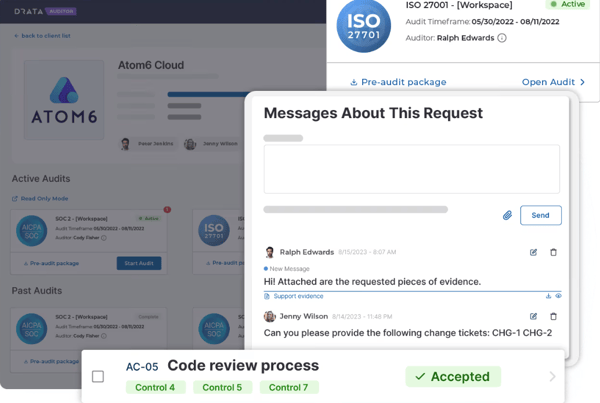
Feature-wise, Drata’s strengths look very “cloud compliance core.” Security auditing and compliance monitoring are both rated 96%. Reviews reinforce that continuous monitoring, automated tests, and integrations with AWS, Google Workspace, Microsoft 365, GitHub, Jira, Slack, and other staples do much of the heavy lifting.
Drata's reviewers call out the AI policy builder as a standout. They say it starts you off with a solid template, then checks policies you've drafted yourself against the underlying controls and flags what's missing, so it doubles as a gap-finder. Teams also appreciate that subscriptions bundle in onboarding hours with GRC specialists, so standing the platform up doesn't mean going it alone.
Once the connectors are live, Drata quietly pulls evidence in the background, surfaces gaps clearly, and gives them a clean posture view they can trust during audits, board updates, or customer security reviews. The Trust Center and SafeBase tie-in also gets called out as a useful way to share security posture externally without rebuilding a portal from scratch.
Drata’s footprint lines up with the kinds of teams it’s clearly built to serve. You see it show up most in cloud-native software and IT-heavy environments, with strong traction in regulated spaces like finance and healthcare, too.
With that, when a test fails, the raw JSON output can make it slow to pin down exactly which resource triggered the error, though Drata's AI-generated summaries have steadily improved this, and they get sharper with each release.
Users also like how prescriptive the platform is, though teams wanting more clarity, like extra documentation, deeper “why this test failed” context, or clearer guidance on what to tackle first, might wish for a little more explanation built into the workflow. The current design keeps the experience lightweight and action-oriented.
On the whole, if you’re a fast-growing SaaS business, a lean security/compliance team, or a mid-market org that needs multi-framework readiness without hiring a giant GRC function, Drata is a really strong fit.
"The best feature Drata has is the mapping of recurring requirements of different frameworks/standards to generic Drata Controls. What this means is that if multiple of your frameworks require pretty much the same thing, you only have one Drata control you need to comply with to satisfy all the requirements of your frameworks. This also means only one place to store evidence, add policies, do tasks, etc. This is tremendous time-saver compared to other GRC tools."
- Drata review, Dylan E.
"The way test failures are presented in the pure JSON test output can sometimes make it take an unnecessarily long time to figure out which resource is causing a compliance error. The AI-generated output for these failures has improved, but they could still benefit from better JSON parsing so that, even when the raw output is shown, the user only sees the failures.
- Drata review, Nate S.
G2 rating: 4.9/5
Scrut Automation comes across as a very founder-friendly compliance hub: it pulls your policies, controls, evidence, and cloud tests into one place, then automates the busywork around audit readiness so lean security or GRC teams aren’t stuck living in spreadsheets.
From the reviews I read, it’s positioned as both a compliance automation platform and a hands-on partner. People talk about Scrut not just as software, but as a guided path to SOC 2, ISO 27001, GDPR, HIPAA, and similar frameworks.
Reviewers repeatedly call out the structured workflows, pre-populated policy templates, and automated evidence collection as the difference between a slow, manual slog and a steady, trackable program. That’s backed up by the satisfaction snapshot I saw: ease of use, ease of setup, and ease of admin are all sitting in the high-90s, and “ease of doing business with” is basically a love letter at 99%.
On the feature side, security auditing score 98%, with governance right behind at 96%, which lines up with the way users describe the product: strong at turning messy, multi-framework work into an organized, audit-ready system.
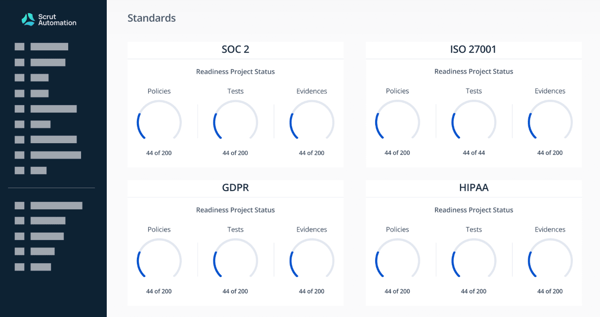
It's noticeable how often people highlight the humans behind the platform. Customer success managers and compliance consultants get lots of specific shout-outs for weekly check-ins, helping teams interpret requirements, and keeping the certification timeline moving. For smaller orgs or first-time compliance owners, that kind of embedded coaching seems to be part of the value prop as much as the automation itself.
One feature that lights up Scrut Automation's reviews is its AI questionnaire autofill. Using a Chrome plugin or a spreadsheet uploader, teams say it knocks out the security questionnaires that used to swallow hours of senior engineers' time, with one reviewer estimating it handles the bulk of the work for them. For the lean crews Scrut tends to serve, that's a meaningful chunk of busywork gone.
And adoption looks most concentrated in the G2 Data I looked at: Computer software, IT services, and financial services, with a smaller but visible presence in healthcare and HR, basically the industries that live and die by audit speed, customer trust, and regulated data.
There's a noticeable learning curve for anyone new to compliance, the terminology and controls can feel daunting at first, and some would like more room to customize workflows or reports — but those early hurdles fade quickly, and most reviewers feel fully at home once they've spent a little time in the platform.
Similarly, a lot of reviewers appreciate how many modules Scrut packs in, and teams that want a super lightweight, minimal-surface UI for occasional stakeholders might plan for a little onboarding so those users feel confident navigating all the sections.
Overall, if you’re a startup or scaling company building SOC 2/ISO readiness with a small security or GRC crew, or you want a tool that pairs solid software with real guidance, Scrut looks like a very safe bet, in my view.
"Scrut Automation simplifies compliance and audit workflows through automation and continuous monitoring. The platform is easy to use, integrates well with existing tools, and significantly reduces manual effort during audits. The support team is responsive, and overall it has improved visibility and efficiency in compliance management."
- Scrut Automation review, Lakshmi R.
" Scrut Automation provides a strong set of features, but there is a noticeable learning curve, especially for users who are new to compliance. Initially, the terminology and controls can feel a bit daunting. It would also be helpful if there were more options to customize specific workflows or reports. However, as you spend more time with the platform and get accustomed to its capabilities, these early difficulties become much less significant."
- Scrut Automation review, Eric.
Explore the best enterprise risk management platforms on G2 to support your compliance efforts.
Got more questions? G2 has the answers!
Wiz, Drata, and Vanta are the best for tracking cloud compliance across regions because they continuously scan multi-cloud environments and map findings to global frameworks, giving you a live, cross-region risk view in one place.
Scrut Automation, Sprinto, and Vanta are the top platforms for managing cloud compliance documentation since they centralize policies, controls, evidence, and audit trails in a single workspace with structured workflows.
Drata, Vanta, and Sprinto are the top tools for GDPR and HIPAA compliance because they offer prebuilt framework mappings, automated evidence collection, and continuous control monitoring for privacy and healthcare/security requirements.
Wiz is the easiest to deploy for cloud compliance because it’s agentless and connects quickly to cloud accounts. Vanta and Drata are also easy to roll out thanks to guided onboarding and fast connector setup.
Wiz, Scrut Automation, and Sprinto offer real-time monitoring by continuously checking cloud configurations, controls, and evidence status instead of relying on point-in-time audits.
Drata, Vanta, and Scrut Automation are the best for regulated industries since they’re built around audit readiness, evidence rigor, and framework depth that regulated teams need.
Wiz and Drata integrate cloud compliance with security tools most tightly because they connect into security workflows (like ticketing/SIEM paths) and prioritize compliance issues using security context. Vanta also supports strong security-stack integrations for passing evidence cleanly into compliance workflows.
Wiz is the standout for multi-cloud setups because its agentless platform connects across AWS, Azure, and GCP in one place and ties findings to exposure paths, so you get a single, context-rich view of risk no matter how many clouds you run.
Vanta leads here — it continuously pulls evidence from your cloud and SaaS tools and maps it to frameworks, so audit prep is mostly push-button. Drata and Sprinto are close behind, both automating evidence collection and control monitoring to keep teams audit-ready year-round.
Vanta, Drata, and Sprinto are top picks for automating SOC 2 and ISO 27001. All three continuously pull evidence from your cloud and SaaS stack, map controls across both frameworks, and keep monitoring live, so software teams stay audit-ready without manual evidence work.
Drata, Vanta, and Sprinto lean heavily on automated tests and continuous evidence collection. They connect to systems like AWS, GitHub, and Google Workspace, run control checks automatically, and gather audit artifacts in the background, cutting the "screenshot chase" that slows manual audit prep.
CISOs should weigh continuous monitoring depth, framework and control mapping, automated evidence collection, risk-based prioritization, and integration fit with existing security tooling. Among these platforms, Wiz stands out for context-based risk prioritization, while Vanta, Drata, and Sprinto excel at automated, always-on audit readiness.
Vanta and Drata both integrate directly with AWS, GitHub, Google Workspace, and similar staples to pull evidence and monitor controls automatically. Wiz also connects natively across cloud providers and runs inside CI/CD and Terraform pipelines to catch issues during development.
Sprinto, Drata, and Scrut Automation are known for guided, structured SOC 2 paths. Reviewers describe step-by-step workflows, clear task tracking, and hands-on onboarding — Sprinto and Scrut in particular pair the software with named specialists who keep implementation on track.
Sprinto, Drata, and Vanta all cut auditor back-and-forth by letting auditors work directly inside the platform. Reviewers note auditors can pull evidence and create requests in-app, which largely eliminates the ticket-and-email exchange certifications used to require.
The most common friction points are learning curves on initial control mapping (noted with Vanta and Scrut), alert-tuning complexity (Wiz), and raw JSON test-failure output that can make pinpointing the failing resource slow (Drata). All four have been steadily improving with AI summaries and better onboarding.
Sprinto and Scrut Automation are frequently maintained long-term by lean, founder-led teams. Reviewers credit responsive CSMs, guided workflows, and low day-to-day maintenance for keeping small teams engaged with the platform well beyond initial setup.
Scrut Automation and Sprinto are the highest-rated picks for early-stage teams pursuing SOC 2. Both combine automated evidence collection with hands-on guidance, which reviewers say makes first-time certification feel guided rather than overwhelming.
Across G2 reviews, Vanta, Drata, and Sprinto earn the strongest trust at technology companies. Vanta is valued for broad automation and framework coverage, Drata for prescriptive, intuitive workflows, and Sprinto for guided compliance backed by strong human support.
If there’s one takeaway from this guide, it’s that cloud compliance isn’t a once-a-year audit scramble anymore. It’s a living system. The best platforms don’t just help you “pass” frameworks; they help you see risk as it forms, tie it to real cloud context, and keep teams moving in the same direction without drowning in spreadsheets.
So instead of asking “Which tool is best overall?”, the smarter question is “Which tool best fits how my cloud actually runs and how fast my compliance needs to move?” Once you pick based on that reality, the rest gets a lot simpler.
Also managing vendor risk? Explore the best third-party and supplier risk management software to stay ahead of supplier issues and external dependencies.


I evaluated over 20 platforms to find the best security compliance software, including Vanta,...
 by Harshita Tewari

Recently updatedSummer 2026 Grid® Report · Published May 26, 2026 The 10 best Audit...
 by Barkha Bali

Every time I sit down with my InfoSec team, one thing becomes clear: managing governance,...
by Soundarya Jayaraman