

Main takeaway: G2 reviewers praise AI recruiting for sourcing and ease of use, but vendors say buyers now expect decisions that are explainable, defensible, and repeatable as regulation tightens.
What G2 reviews show (2,000++ verified reviews, Aug 2025 – Nov 2026)
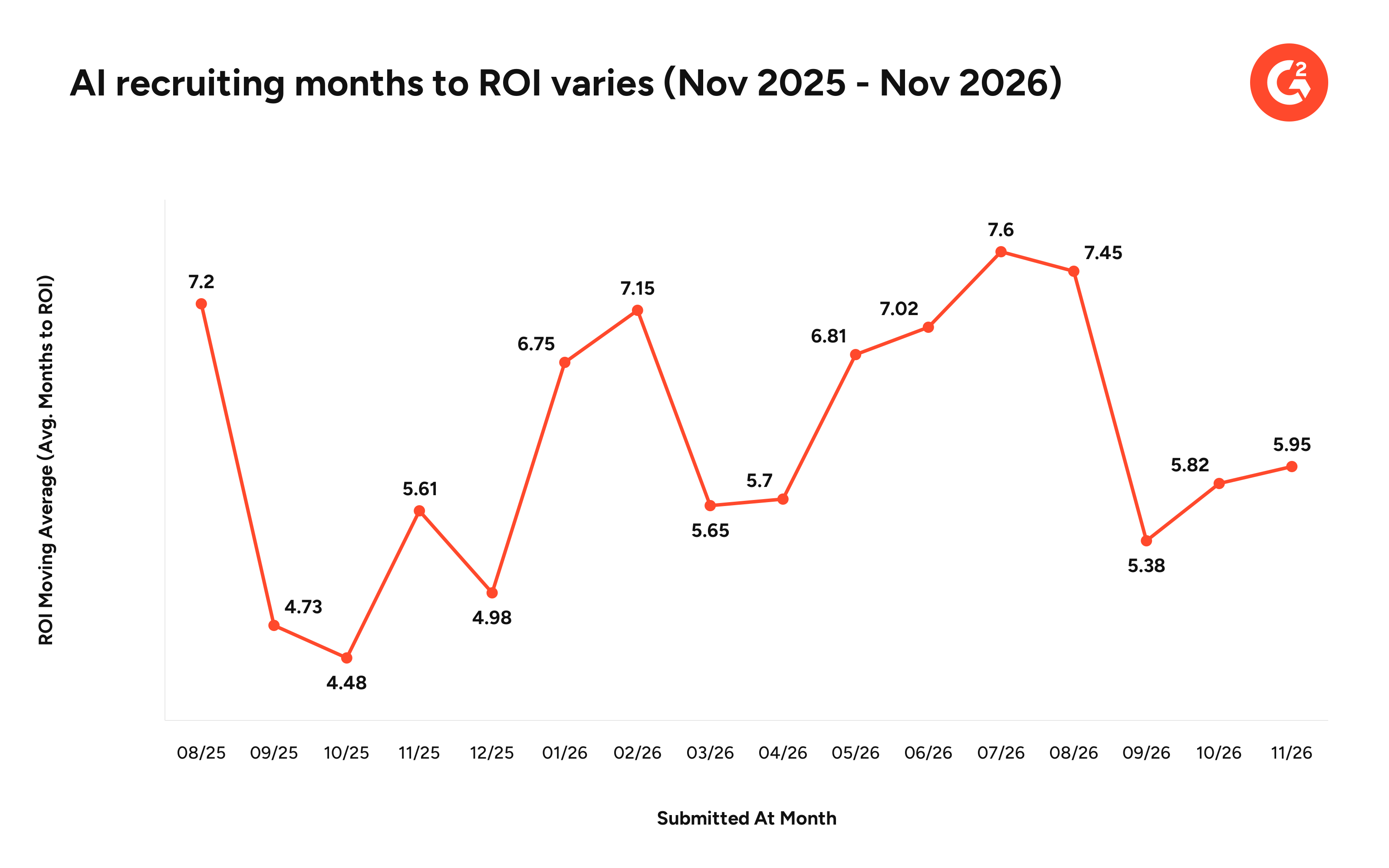
According to G2's analysis of 2,100+ verified AI for Recruiting reviews, ease of use leads buyer praise but reproducibility is where the gap shows. ROI timing varied from 4.48 months to 7.6 months across the 15-month analysis period, even as review volume grew 453%. The buyers and vendors agree on what closes that gap: systems that explain and reliably replicate their results.
G2 Review Data:
Vendor Research
This report combines G2's proprietary review data with structured input from leading AI Recruiting vendors. Vendor insights are clearly attributed throughout and represent platform-level observations.
Buyers want defensibility out of AI for recruiting in 2026. It’s not enough to merely optimize the hiring process end-to-end, making it more efficient, increasing sourcing, and driving better matches. Instead, buyers need systems that not only make AI-assisted decisions but can also explain them. Fredrik Östgren, CEO and Co-Founder of Hubert, describes how buyer expectations shifted.
“In 2024 we led with efficiency, because that's what buyers asked for. It opened doors, but it put us in conversations where every vendor claimed time savings. What changed was the buyer. Legal, compliance, and works councils joined the deal, and the question became, ‘Can you defend this decision?’ So we now lead with trust: defensibility and proof, with named customers like ManpowerGroup and Securitas and specific outcomes rather than generic AI claims. What didn't work was trying to serve every hiring scenario. Focusing on high-volume hiring, where structured interviews matter most, sharpened everything.”
Fredrik Östgren
CEO & Co-Founder Hubert
G2 reviews show that even though the number of reviews in the AI Recruiting category grew a whopping 453% from its first year in 2025 to 2026, the average return on investment has been less stable. Instead of being on a clear upward or downward trajectory, it oscillated wildly. At its height, companies reported seeing ROI after 4.48 months in October of 2025, whereas the average was up to 7.6 months in July of 2026.
Teams should measure whether AI for recruiting works by whether it produces the same results twice. One round of great candidates is a good sign, but can the algorithm reproduce this time and time again? Testing a new AI recruiting program against specific benchmarks is essential. Test efficiency claims through measures like candidate completion vs. drop-off, time savings for individual recruiters, screening turnaround time, and, above all, remember to account for extra time spent on QA in any and all AI measures.
Overall, nearly 9% of all AI recruiting reviewers mention that sourcing is one of the top problems that AI recruiting solves. However, making these results uniform and repeatable remains difficult.
Yet again, CEO & Co-Founder Fredrik Östgren brings insight into the process.
“What unblocks it is evidence over promises: reproducible scoring, published methodology, regular bias audits, and decision data customers can see for themselves. When a talent leader can show their legal team exactly why one candidate ranked above another, adoption stops being a risk decision and becomes an operational one. That trust has to be earned with candidates as well as customers, and it's what our deterministic models are built to deliver.”
Fredrik Östgren
CEO & Co-Founder Hubert
Trust in AI recruiting is built on one thing: reproducible results. If you run the process to find the best possible candidate and get a number of good matches, great! If you run the same process with the same parameters and come up with a completely different candidate list, questions about how well the process works when stress-tested creep in.
Ben Sesser, CEO and Co-Founder of BrightHire, frames repeatability as the foundation of buyer trust.
“To understand the difference, test whether you trust the AI output. If an AI-generated summary isn’t useful, people rewrite it. If the same conversation scores differently with AI each time, nobody trusts the score. Either way, the time savings disappear. Be skeptical of anything that promises to make the hiring decision for you. The vendors worth buying from show you what the AI saw and why, and leave the call to your people.”
Ben Sesser
CEO and Co-Founder of BrightHire
AI-generated applications and deepfake candidates are now a core hiring risk, and vendors are building against it. Job seekers flocked to the new tech in droves, some building entire workflows of their own to mirror their potential employers. Identifying bad actors and candidates who seem too good to be true because they are surges as a vital function in recruiting software.
Ben Sesser, CEO and Co-Founder of BrightHire, describes how fraud shifted BrightHire's product focus.
“What changed was where customers needed help. Application volumes surged, and fraud became a core hiring risk, so we brought on a team with years of application review experience, expanded our AI interviewer, and built fraud detection into the product instead of selling it standalone.”
Ben Sesser
CEO and Co-Founder of BrightHire
AI for recruiting delivers value at multiple points in the recruiting funnel. The table below shows where AI delivers value across the recruiting funnel and where human review remains essential.
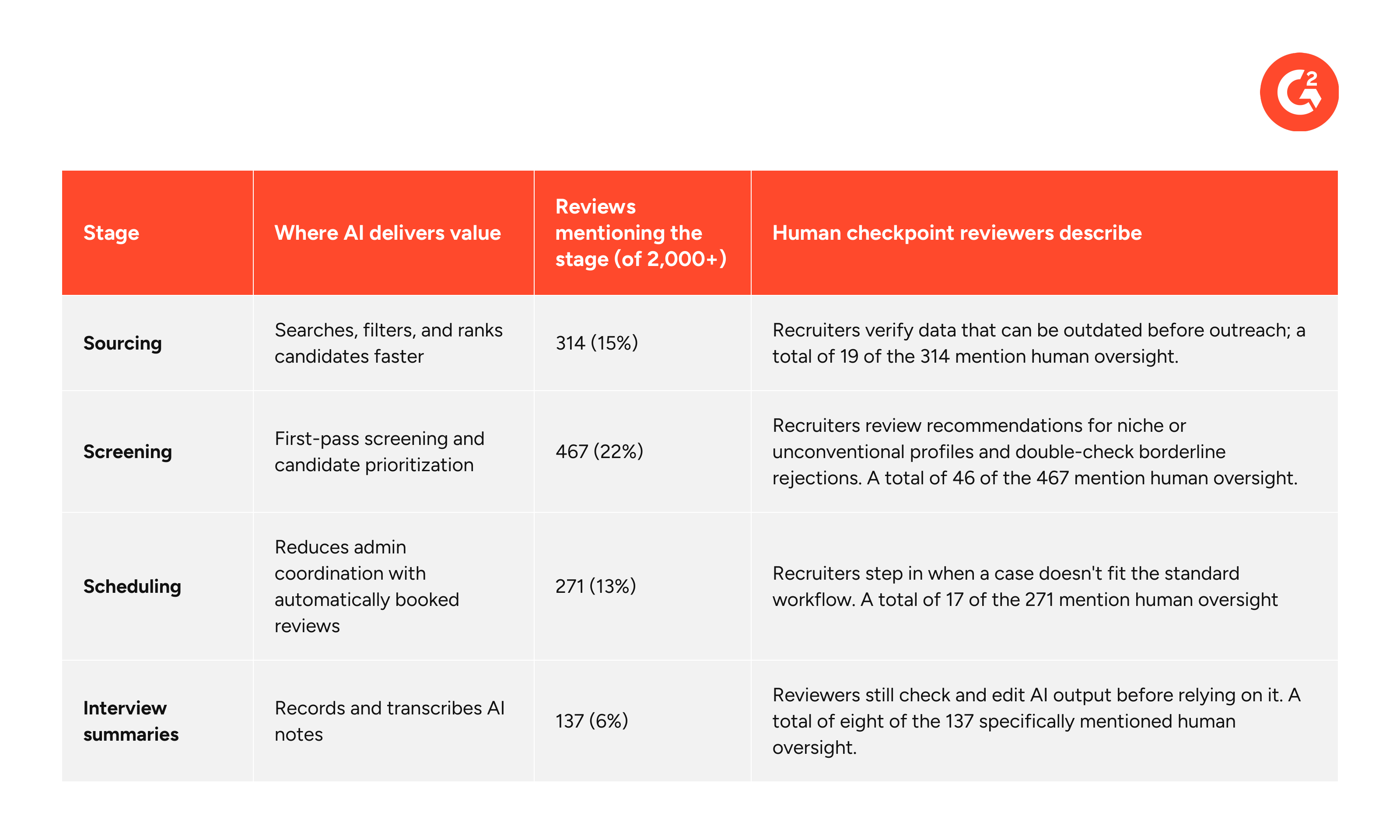
Based on G2's analysis of 2,000+ verified AI Recruiting reviews, synthesized using AI-assisted categorization. Human oversight figures reflect reviewers who explicitly described it — actual oversight rates in practice may be higher.
The best AI recruiting software depends on your hiring volume, compliance requirements, and need for explainability. Users can start researching AI recruiting vendors here or compare different potential matches here.
AI recruiting software works by combining sourcing, candidate engagement, interviewing, qualifying, and moving candidates through the recruiting funnel with end-to-end automation, including agentic bots that can handle significant parts of the workflow. While it’s one of the most AI-savvy branches of HR, many buyers still require human-in-the-loop decisions where AI handles repetitive tasks and humans make the final call..
Fairly AI is a good resource that shows the laws for when AI recruiting software is legal to use by country. Whether it’s legal or not to use AI in recruitment and to what degree the automation is allowed depends on local legislation. Recent pieces of legislation such as the EU Artificial Intelligence Act (also known as Regulation (EU) 2024/1689) have highly regulated AI use in the EMEA region. This was entered into force on August 1, 2024. New York City Local Law 144 (AEDT) went into effect on January 1, 2023. Meanwhile, the Illinois Human Rights Act (HB 3773) & Video Interview Act set requirements on January 1, 2026. It’s essential to find vendors compliant with local, national, and international laws for ethical reasons and litigation risks.
Bias is a potential risk and challenge for AI tools for recruiting. Every AI tool is based on a specific dataset. One study from Stanford University in May of 2026 showed that 26% of Black applicants and 15% of Asian applicants had applied to a system where the AI discriminated against their racial group. Another report from ResumeBuilder showed that nearly all companies believe that AI produced biased results.
In order to pick an AI that isn’t biased, ask the buyers specific questions about the methods to get results. Look for how they train AI to identify false rejections, what they do to review procedures, and how the evaluation method works when it comes to protected identity. Ultimately, this is a very serious and ongoing conversation, so users should be vigilant when understanding what safeguards are or aren’t in place to combat potential issues.
Whether or not candidates like AI interviews is ultimately a subjective opinion. Some prefer the ease of use and the way AI recruiting can speed up early screens, thus moving the process along faster. Others may dislike the process depending on the specific deployment of an AI product and avatar that’s used. Tools that are effective, dependable, and cut down on the friction candidates deal with are likely to be more popular. Tools that malfunction, waste candidates' time, or lead to an overall dehumanizing experience tend to be less popular.
What was once experimental in AI recruiting is now expected. Overselling experimental features is losing ground to vendors who can prove reliability and reproducibility. BrightHire and Hubert both point to the same buyer expectation: results that can be explained and reproduced. With regulation tightening across EMEA and North America, AI recruiting platforms must produce reproducible results, detect fraudulent candidates, and explain every decision to stay competitive. In 2026, the buyer question has shifted from 'can your AI do this?' to 'can you prove it did it the same way twice?
Sunrise. Sunset. Time marches on. AI isn’t an obscure tool anymore, and what was once experimental is now expected. That means that overselling experimental features is on the way out, and reliable AI partners are on the way in. If there’s anything vendors like BrightHire and Hubert showcase, it’s that users want not only results, but a comprehensive summary of how the algorithm got there. With legislation ramping up and compliance ever-present on the HR mind, AI recruiting needs to replicate uniform results time and time again, fight fraudulent candidates, and keep transparency top of mind to stay competitive in this market. As we look toward 2027, recruiters want more accountability than ever before from their providers.
Explore how to navigate ethics in the new world of AI Recruiting here.

In 2024, an enforcement case over facial-recognition data resulted in a €30.5M fine for...
 by Rimzhim Dubey
TL;DR: Key findings about Chatbot Setup According to G2’s analysis of 18,900+ verified...
 by Tian Lin
TL;DR: What G2 Data Reveals About the State of Proofreading Software in 2026 According to...
 by Emma Stein