

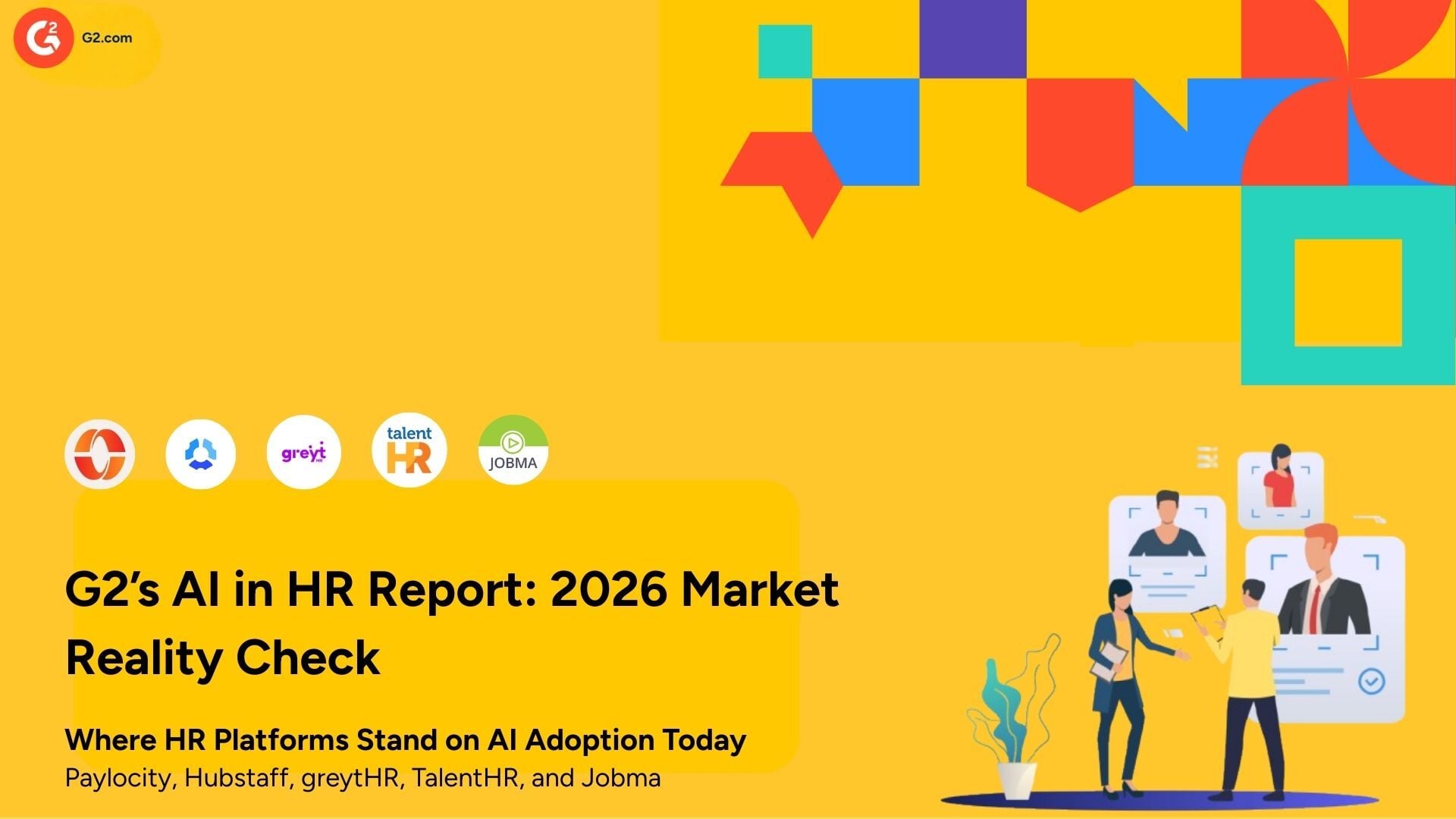
AI is now shaping how modern HR technology is built, deployed, and evaluated. Rather than isolated use cases, AI capabilities are increasingly integrated into core HR systems, influencing how platforms handle scale, accuracy, and operational efficiency.
In this report, we analyze how HR software vendors are applying AI within live product environments, the practical constraints affecting adoption depth, and how these capabilities factor into HR leaders’ platform decisions as they plan for 2026.
To ground the analysis, we spoke with leaders from five established HR technology vendors, Paylocity, Hubstaff, greytHR, TalentHR, and Jobma, who support HR teams across core workflows like payroll, time tracking, HR administration, talent management, and hiring. We asked them what’s already live, what’s still evolving, and what they expect next with regard to AI in HR. Taken together, their insights point to a shift in how AI is positioned within HR platforms.
Although vendors vary in their current level of AI maturity, the direction of investment is aligned: HR teams are gravitating toward platforms where AI is tightly integrated into everyday workflows and delivers consistent, execution-level value rather than isolated intelligence features.
At the center of HR’s AI transformation are five vendors whose products, customer experiences, and technical maturity offer a clear glimpse into the direction of the industry.
These five companies spoke candidly about both their progress and their challenges, offering a clear, grounded view of what’s working today and where meaningful work still remains.
For this report, I relied entirely on qualitative survey responses collected from the five HR technology vendors mentioned above. To ensure comparability, all participants responded to a standardized set of questions, allowing differences in perspective to reflect genuine variations in product maturity and strategy rather than methodology. The survey focused on the following areas:
To strengthen the analysis, I also reviewed G2 profile data for each product, with a focus on recurring review themes and overall customer sentiment trends. Together, these qualitative inputs provide a consistent, experience-backed view of the current state of AI in HR and its expected trajectory toward 2026.
AI adoption across HR software has moved beyond surface-level features, but the depth of integration still varies widely. The key differentiator today is not whether AI exists within a platform, but how consistently it operates across workflows and how reliably it supports everyday HR decisions. That uneven maturity also reflects the broader adoption challenges shaping AI in HR software.
Some platforms, such as Jobma and Paylocity, have embedded AI across multiple HR functions rather than limiting it to isolated use cases. This level of maturity shows up in areas like automated screening, workflow optimization, and predictive workforce insights. Feedback on G2 reinforces this depth, with customers frequently pointing to reduced manual effort, dependable automation, and improved operational efficiency.
Other platforms, including greytHR and Hubstaff, reflect a more measured phase of AI integration. Here, AI is introduced in specific workflows and expanded incrementally based on user response. Customer sentiment highlights ease of use, process automation, and streamlined operations, indicating that these platforms are establishing the operational foundations needed for broader AI maturity.
TalentHR positions itself between these groups. The team indicates that AI has moved well beyond experimentation and has become part of their product fabric. This forward movement mirrors the experience of TalentHR’s customers, who often highlight the platform’s intuitive workflows and intelligent automation in G2 reviews.
What stands out is not whether vendors offer AI capabilities, but how mature those capabilities are in practice. AI maturity is increasingly defined by how seamlessly intelligence is embedded into everyday HR workflows — reducing manual oversight, operating reliably at scale, and enabling more forward-looking decisions. Vendors further along this curve are seeing value from consistent, low-friction automation, while those earlier in the journey are deliberately expanding AI in narrower, well-defined use cases to build trust before scaling.
AI is reshaping the way HR teams operate, driving measurable improvements in efficiency, decision-making, and employee growth across critical workflows.
Recruitment and talent acquisition continue to be the most active adoption zones. Vendors like Jobma and TalentHR emphasize the value AI brings by accelerating screening, identifying candidate–role fit, and eliminating repetitive administrative tasks that traditionally slow down hiring teams. Jobma’s users, for example, often mention the platform’s ability to significantly reduce hiring bottlenecks, while TalentHR customers appreciate the smarter, streamlined workflows.
This momentum is also reflected in how the market is evolving. In September 2025, G2 introduced the AI Recruiting category to recognize solutions built around intelligent, AI-led hiring:
“As companies increasingly turn to AI to streamline hiring, we’ve introduced the AI Recruiting category to spotlight solutions that go beyond traditional automation. These platforms apply core machine learning and natural language processing to deliver intelligent decision-making capabilities from candidate matching to personalized engagement, helping businesses hire faster, smarter, and with greater confidence in a competitive talent market.”
Inia Debnath
Associate market research analyst of HR and customer service.
Workforce and productivity management is another area where AI has become deeply relevant. Hubstaff and Paylocity highlight how AI-supported insights help managers understand patterns of work, assign schedules more effectively, and improve oversight for remote or distributed teams. Customer reviews reinforce this by praising the transparency and accuracy these platforms offer.
At the same time, AI is also evolving from back-end analytics to frontline assistance through digital HR partners and AI agents that support both HR teams and employees:
“Given the increasing complexity faced by HR teams and employees' demand for immediate, personalized assistance, AI agents are no longer a luxury but a strategic imperative. These digital HR partners do more than simply automate tasks; they are constantly available, scalable solutions that enhance efficiency and significantly improve the employee experience.”
Shalaka Joshi
Senior research analyst for data and AI
Learning and development is emerging as a test of whether AI can move beyond efficiency gains and meaningfully influence employee growth outcomes. Vendors describe rising interest in skill-based recommendations and intelligent career pathways. As HR evolves from administrative oversight to strategic support, employees increasingly expect learning recommendations that are personalized, timely, and rooted in real performance patterns.
Across all these functions, AI succeeds because these workflows share an underlying complexity that benefits from automation. They involve repeated decisions, high-volume data, and a need for consistent ideal conditions for AI-driven systems to operate effectively.
Even with progress, vendors acknowledge several challenges that slow down the pace of adoption. These barriers go beyond technology itself and often relate to how data is managed, how prepared HR teams are to use AI-driven features, and how organizations navigate change and trust as AI becomes more embedded in daily workflows.
The first is data quality and fragmentation. AI systems rely heavily on structured, consistent information. When HR data is spread across multiple tools or incomplete, the effectiveness of AI-powered recommendations declines. Vendors repeatedly emphasized that reliable insights depend on clean inputs. This mirrors what some G2 users express in reviews: their expectations from AI features are rising, and any inconsistency — whether caused by product limitations or input data — can impact trust in the output.
Several vendors pointed out that many HR professionals are still early in their understanding of AI features. This gap often results in under-utilized capabilities or hesitation to automate processes fully. The industry clearly needs stronger enablement experiences, including in-product education, clearer explanations of AI decisions, and guided workflows that help HR teams adopt new behaviors at their own pace.
Finally, change management remains a central barrier. HR is a people-centric function, and shifts in processes can create resistance. Vendors observe that teams sometimes worry about losing control or fear being replaced, which slows adoption even when AI tools are designed to support rather than replace human roles. Building transparency into AI outputs is therefore essential for wider acceptance.
The vendor responses reveal a clear shift in what HR teams expect AI to help them achieve over the next year.
Improving employee experience emerges as one of the strongest priorities. HR leaders increasingly want tools that simplify processes, provide guidance in context, and support employees throughout their lifecycle — from hiring to onboarding to learning.
Did you know? According to G2 Data, employee engagement software sees an average 72% user adoption rate and delivers ROI in just 16 months. These tools aren’t just for large enterprises either. 23% of users are small businesses, 49% mid-market, and 27% enterprise
The takeaway? Most organizations don’t just roll these tools out successfully. They see measurable value within a relatively short time.
Explore the best employee engagement software on G2 to see which platforms help teams improve employee experience across the entire lifecycle.
Vendors report that HR teams, regardless of company size, seek to automate tasks like attendance management, resume screening, benefits queries, and reporting. Customer reviews across several platforms reflect similar expectations. Users want to spend less time managing manual tasks and more on strategic discussions and initiatives.
As organizations adopt more flexible and distributed work models, HR leaders require intelligent dashboards, real-time visibility, and predictive insights to guide workforce planning. Products like Paylocity and Hubstaff, whose customers frequently praise strong reporting features, are particularly aligned with this direction.
Vendors unanimously agree that hiring will continue to depend heavily on AI-driven matching, automated workflows, and structured evaluation frameworks — areas where they are already seeing strong customer demand.
Beyond hiring, HR leaders are increasingly prioritizing AI to help manage workforce agility. As business needs shift faster, teams want clearer visibility into capacity, skills availability, and workload distribution. AI-supported workforce modeling enables HR to anticipate gaps, redeploy talent more effectively, and support leaders with scenario-based planning rather than reactive adjustments.
Another emerging priority is skills visibility across the organization. Vendors note growing interest in AI-driven skills mapping that helps HR teams identify existing capabilities, surface adjacent skills, and support internal mobility. This allows organizations to fill roles more efficiently while giving employees clearer pathways for growth without relying solely on external hiring.
As AI becomes more embedded across HR workflows, ensuring consistency is becoming a strategic priority. HR teams are increasingly focused on using AI to standardize evaluations, reduce bias in decision-making, and apply policies more uniformly across distributed teams. This emphasis reflects growing awareness that AI can support not just efficiency, but also fairness when governed responsibly.
Finally, HR leaders are prioritizing AI readiness at scale. This includes investments in data quality, system interoperability, and governance frameworks that define how AI-driven recommendations are reviewed and applied. Rather than rushing adoption, organizations are focusing on building durable foundations that allow AI capabilities to scale safely and sustainably through 2026.
Across Paylocity, Hubstaff, greytHR, TalentHR, and Jobma, one message resonates: AI is steadily becoming the infrastructure of modern HR. While challenges remain, particularly around data quality, adoption readiness, and change management, the overall momentum is strong and consistent. Vendors expect 2026 to mark a meaningful transformation in how HR teams operate, shifting from process management to strategic leadership, supported by systems that are smarter, faster, and more adaptive than ever.
Organizations should prepare for AI to reshape accountability. When insights are continuously available, the differentiator is no longer access to data, but how quickly and thoughtfully leaders respond to it. The most effective HR teams in the next phase will be those that treat AI not as a replacement for judgment, but as a decision framework — one that sharpens focus, clarifies tradeoffs, and elevates the impact of human leadership.
Explore G2’s HR software marketplace to see which AI-powered features are delivering real value today and shortlist platforms ready to scale into 2026.

Navaneeth Mohanan is an SEO Outreach Specialist at G2, focused on strategic outreach initiatives, backlink acquisition, and content collaborations that support long-term organic growth. He is particularly interested in SEO experimentation, AI’s impact on search, and building sustainable link ecosystems through data-backed content. In his free time, he enjoys exploring new destinations, staying updated on digital trends, and optimizing workflows.
-2.png?width=400&name=dark%20(10)-2.png)
TL;DR HR analytics vendors are experimenting more with AI. While they’re using new tech to...
 by Grace Savides
Key Findings Finding 1: G2's analysis of 2,770+ verified AI writing assistant reviews...
 by Brandon Summers-Miller
Mobile user acquisition has entered a contradictory phase. On paper, the stack looks more...
 by Priyal Dangi
TL;DR HR analytics vendors are experimenting more with AI. While they’re using new tech to...
by Grace Savides
Mobile user acquisition has entered a contradictory phase. On paper, the stack looks more...
by Priyal Dangi