

Mobile user acquisition has entered a contradictory phase. On paper, the stack looks more advanced than ever. AI-driven targeting, predictive LTV models, and automated optimization promise efficiency at scale. Yet for many growth teams, day-to-day reality tells a different story.
Rising CPMs, weaker attribution signals, and fragmented user data have made it harder to prove profitability, not easier. Despite more intelligence in the system, decisions still feel reactive, budgets still leak into low-value cohorts, and optimization often arrives too late to matter.
That’s why, for this report, I went directly to the platforms building the next generation of AI-driven predictive segmentation for mobile user acquisition. Over the past several weeks, I gathered candid input from eight companies shaping how predictive models, automation, and decision intelligence are actually implemented in user acquisition (UA) today: Mixpanel, Singular, CleverTap, Liftoff, Kochava, Apptrove, WebEngage, and Phiture.
Collectively, these platforms power acquisition, measurement, and mobile marketing attribution, engagement, and optimization for thousands of mobile-first brands across gaming, fintech, ecommerce, subscriptions, and consumer apps. Their perspectives offer a rare view into how mobile UA teams are using AI to decide who to acquire, how much to spend, and what actions to take earlier with less manual intervention.
Here are the key trends shaping 2026:
These are based on what leading platforms are seeing across their own customer bases today. To show how I arrived at these takeaways, here’s a quick look at the methodology behind this report.
Between late November and early December 2025, I sent a structured survey to eight platforms building and scaling AI-driven predictive segmentation and decision intelligence for mobile user acquisition.
I asked each platform to share:
I analyzed the responses to identify clear patterns, recurring themes, and early signals shaping the future of AI-driven mobile user acquisition.
Together, these insights offer a grounded view into how predictive segmentation is being built, operationalized, and scaled across leading platforms and where AI-powered UA efficiency is heading next.
This report includes insights from the following platforms:
Collectively, these platforms define how predictive segmentation and AI decisioning are being built and applied in mobile user acquisition today. Their perspectives form the foundation for the analysis that follows.
From G2’s perspective, this reflects a broader shift from optimization tooling toward decision infrastructure, where AI actively shapes growth decisions rather than simply reporting on performance.
Efficiency pressure is now the defining force in mobile user acquisition. Across platforms such as Liftoff, Kochava, Singular, WebEngage and Apptrove, vendors described a landscape where performance outcomes are increasingly volatile. As deterministic attribution weakens, even small changes to targeting, bids, or creative can lead to large and often unpredictable swings in performance.
Rather than a uniform decline, UA efficiency has become uneven. Phiture and Mixpanel noted that while some segments still perform well, others deteriorate quickly without a clear explanation. This volatility is one of the strongest signals that legacy segmentation and optimization approaches are reaching their limits.
In vendor responses across mobile attribution, analytics, and engagement platforms, several structural shifts are converging:
In this environment, platforms such as Kochava and Singular increasingly view predictive segmentation as a way to reintroduce signal and control, by estimating user value earlier and acting on probability rather than certainty.
“As traditional attribution weakens, AI-driven predictive segmentation gives marketers a smarter way to scale, by dynamically grouping users based on expected value, intent, and growth potential.”
Udit Verma
Co-Founder & CMO, Apptrove
Segmentation is no longer a fixed audience exercise; it has become adaptive and dynamic. Responses from Liftoff, CleverTap, Kochava, WebEngage, and Singular revealed a clear progression from rules-based logic to adaptive systems that continuously update as new signals arrive.
Most platforms now support multiple segmentation modes simultaneously. Rule-based segmentation still exists, but it increasingly serves as a fallback or guardrail rather than the primary engine. Predictive scoring models, ranking users by likelihood to convert, churn, or generate long-term value have become table stakes across platforms.
More advanced platforms, including Liftoff and CleverTap, have moved into AI-driven adaptive segmentation, where audiences update automatically as behavior changes. At the far end of the spectrum, real-time or autonomous segmentation systems continuously recalculate user value without requiring manual refreshes or rule changes.
What stood out across responses was flexibility. Platforms consistently emphasized giving customers control over how AI is applied, whether as recommendation support, execution automation, or a blend of both.
One platform framed this shift less as a tooling evolution and more as an experience design challenge. CleverTap described the future of AI-driven journeys through a 3I framework:
This framework reflects a broader trend across platforms: predictive segmentation is increasingly used to shape how users experience acquisition and engagement, not just who gets targeted.
“Customers have rapidly evolving expectations fueled by their own use of AI. For marketers, this means reimagining campaigns as conversations and context-aware journeys. At CleverTap, we frame this through a 3I lens: Interactive, Immersive, and Inconspicuous experiences"
Subharun Mukherjee
Senior Vice President - Marketing, CleverTap
Across responses from Mixpanel, Kochava, and Singular, one pattern was clear: segmentation is no longer treated as a reporting artifact. Instead, it functions as an execution engine that directly informs downstream actions.
Predictive segments now feed decisions such as who to target, how much to bid, which channel to use, which creative to serve, and when to engage. This shift, from describing audiences to driving actions, is where segmentation begins to materially impact UA efficiency.
“Fully ML-driven targeting is essential to ensure the best advertiser outcomes in today's environment. Optimal budget allocation is not a result of coarse segmentation, but rather a result of many user-level decisions coming from well-calibrated predictive models.”
Benjamin Young
Director of Product – ML, Liftoff
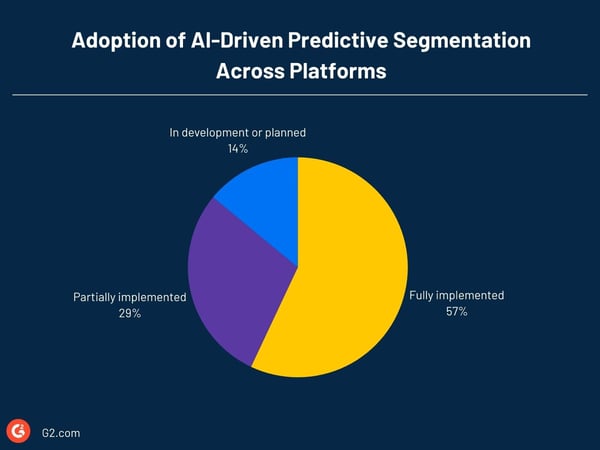
When asked to assess their own maturity, most participating platforms positioned their capabilities in the advanced or autonomous range. Importantly, vendors were careful to distinguish between platform capability and customer adoption.
Several platforms noted that while their systems support autonomous segmentation and decisioning, many customers still operate in hybrid or recommendation-led modes. Adoption tends to scale alongside data readiness and organizational trust.
Confidence was highest among platforms emphasized by Kochava and Liftoff, where stronger data foundations (identity resolution, lower-latency pipelines, and closed feedback loops) supported more reliable predictive accuracy, as outlined in the data foundations section.
Across participating vendors, a shared technical foundation has emerged. While implementations vary by product and customer maturity, vendors described a converging AI decision stack that now underpins most advanced mobile UA systems.
Rather than relying on isolated signals or single-purpose models, platforms increasingly combine multiple predictive models and decision engines to guide acquisition strategy end to end.
Platforms consistently referenced a shared set of predictive models that form the backbone of modern UA decisioning:
Rather than operating in isolation, these models increasingly work together. Vendors noted that balancing short-term conversion probability with long-term value is now a core requirement for sustaining UA efficiency at scale.
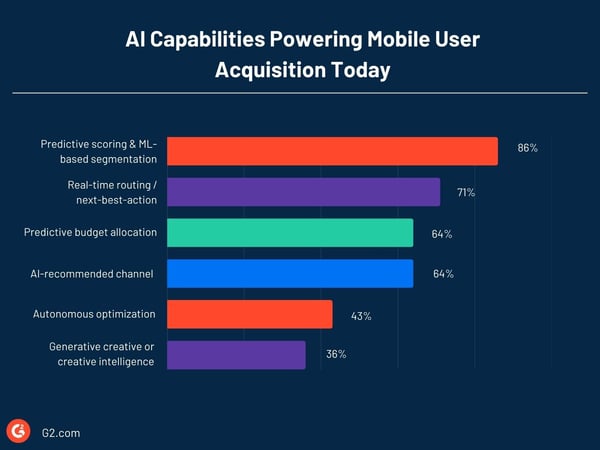
In practice, these predictive models power a growing set of AI-driven capabilities across acquisition workflows.
Most platforms reported live usage of:
Autonomous optimization, highlighted most strongly by Liftoff and Kochava, is becoming more common in high-scale environments. In these setups, systems continuously adjust targeting, bids, creatives, and spend without requiring manual intervention, operating within predefined guardrails.
Importantly, vendors described these capabilities not as replacements for human strategy, but as mechanisms to absorb executional complexity, allowing teams to focus on experimentation, creative differentiation, and long-term growth planning.
Looking ahead, vendors pointed to investments in real-time optimization engines, predictive LTV as a planning signal, generative creative systems, cross-channel decision intelligence, and AI-driven experimentation and attribution modeling.
WebEngage also emphasized the shift from predictive UA toward agentic UA systems, where AI autonomously manages optimization while marketers focus on creative and strategic differentiation.
AI-driven predictive segmentation is only as strong as the data systems underneath it. Across attribution, analytics, and engagement platforms in this report, the same pattern showed up repeatedly: teams can deploy sophisticated models, but performance gains plateau when identity is fragmented, signals are incomplete, or validation is weak.
Below are the five data foundations that most directly determine whether predictive segmentation improves mobile UA efficiency or fails to scale.
Predictive models depend on knowing whether behaviors belong to the same user. When identity resolution is incomplete, models misclassify intent and value, leading to wasteful targeting, misallocated budget, and misleading LTV signals.
What “good” looks like:
Segmentation loses value when signals arrive late. Platforms noted that the difference between “AI for reporting” and “AI for execution” is often latency: the faster the system learns, the faster it can prevent spend waste and capture high-intent cohorts.
What “good” looks like:
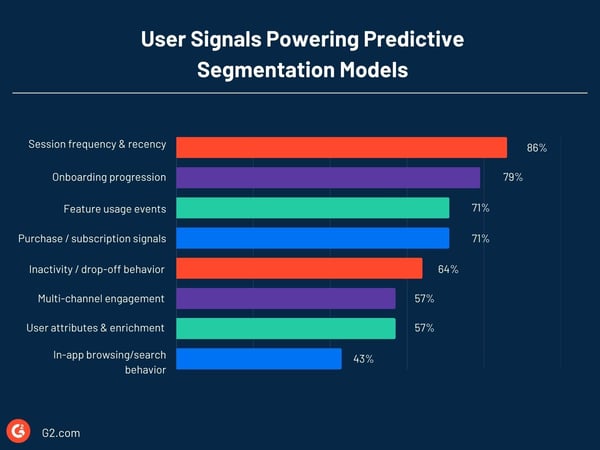
Most platforms rely on early behavioral signals to infer value before conversion happens. But when tracking is shallow or inconsistent, models lose predictive power and cohorts become noisy.
Signals most commonly required:
While not every platform uses every signal equally, vendors consistently emphasized that early behavioral and engagement signals carry the most weight in predictive segmentation.
Multiple platforms emphasized a growing gap between “predicted lift” and “real lift.” As deterministic attribution weakens, teams need stronger validation frameworks to confirm whether AI-driven decisions actually drive incremental growth, not just better-looking attribution.
What “good” looks like:
Privacy regulations and platform restrictions now shape what data can be captured, how identities can be resolved, and which models are viable. The most scalable systems are built to maintain segmentation performance even when signals become probabilistic.
What “good” looks like:
Predictive segmentation becomes a compounding advantage only when these foundations are in place. Without them, even advanced AI systems underperform or remain stuck in recommendation-only mode.
One clear insight emerged from platform responses: the biggest efficiency gains don’t come simply from better insights, but from eliminating the delay between insight and action.
In traditional UA workflows, insights are surfaced first and acted on later. Teams analyze performance, interpret signals, adjust rules, and relaunch campaigns, often days or weeks after behavior has changed. Decision intelligence compresses this cycle by embedding predictive segmentation directly into execution.
Liftoff, Kochava, Apptrove, and CleverTap noted that AI supports decisions spanning audience targeting, channel selection, budget allocation, creative selection, send-time optimization, journey routing, and real-time performance optimization.
The key difference is not the breadth of decisions, but the timing. Instead of waiting for performance to stabilize before acting, AI-driven systems continuously update decisions as new signals arrive. This allows platforms to respond to behavioral shifts continuously, rather than through periodic optimization cycles.
Responses highlighted that speed is now a competitive advantage in itself. AI accelerates execution by reducing manual rule creation, speeding up experimentation, enabling real-time decisioning, and allowing systems to adapt continuously rather than in discrete optimization windows.
As attribution weakens and user behavior becomes less predictable, the ability to act quickly on probabilistic signals often determines whether efficiency gains compound or erodes. Decision intelligence closes the gap between knowing and doing, setting the foundation for the measurable performance improvements described next.
For all the discussion around models, maturity, and infrastructure, the most important question remains simple: does predictive segmentation actually change outcomes?
Across the participating platforms, the answer was consistent. When AI-driven segmentation is tightly integrated into execution, rather than sitting alongside it, the impact shows up both inside the platform and in real-world customer performance.
At the platform level, AI-driven segmentation reshapes how decisions are made and executed at scale. Vendors reported that once predictive models are embedded into core workflows, systems become faster, more resilient, and easier to operate over time.
Common platform-level gains included:
Several platforms noted that these gains compound over time. As automation adoption increases, feedback loops strengthen, further improving model performance and reducing friction for both internal teams and customers.
On the customer side, the impact of predictive segmentation becomes visible in efficiency and performance metrics. Platforms consistently pointed to improvements in how spend is allocated, how quickly campaigns adapt, and how effectively high-value users are identified and prioritized.
Reported outcomes included:
Importantly, platforms emphasized that these outcomes were strongest when predictive segmentation was paired with validation mechanisms such as incrementality testing and attribution-aware measurement. AI-driven efficiency is not just about acting faster, it’s about acting with confidence that decisions are creating real lift.
“Predictive segmentation powered by AI isn’t just about efficiency—it’s about unlocking compounding returns. The platforms that can unify signals, model with precision, and dynamically adapt to user behavior will define the next frontier in mobile growth.”
Jason Hicks
GM of Measurement Solutions, Kochava
Despite the progress described across participating platforms, none positioned AI-driven predictive segmentation as a solved problem. Vendors were clear that the challenge is no longer model sophistication, but the ability to operationalize these systems reliably at scale.
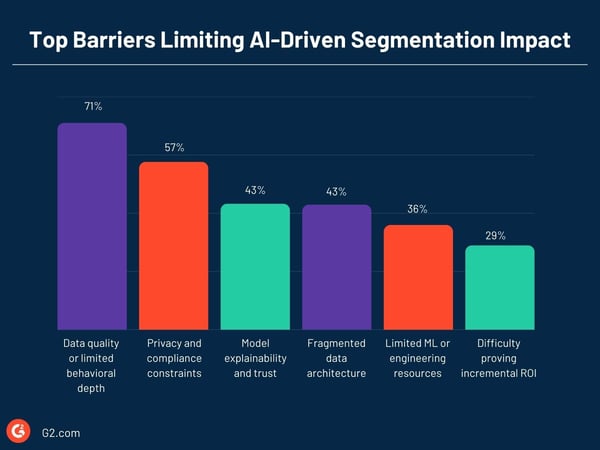
Beyond data readiness, responses consistently pointed to execution-level barriers as the primary source of failure.
As predictive capabilities advance, the gap between what platforms can technically support and what teams can confidently operationalize has become increasingly visible. Across responses, vendors consistently surfaced a shared set of friction points that continue to limit adoption, trust, and impact.
Strong data foundations remain a baseline requirement for AI-driven segmentation to work at all. Platforms such as Singular, Apptrove, and Mixpanel emphasized that failures often begin upstream in identity resolution, signal completeness, or data latency.
Even advanced models struggle when user behavior cannot be stitched across sessions, devices, or channels, limiting the reliability of early value predictions. As discussed in the data foundations section, unified identity, timely pipelines, and consistent signal capture remain critical enablers rather than differentiators.
Kochava and Liftoff highlighted explainability and trust as essential, particularly as AI begins to control high-impact decisions such as budget allocation and audience prioritization. As AI-driven automation expands, customers expect visibility into why a model made a recommendation, not just what it decided. Without transparency, teams hesitate to scale automation or revert to manual overrides.
Privacy and regulatory constraints surfaced repeatedly across vendor feedback, particularly from CleverTap, WebEngage, and Apptrove, as a growing source of complexity. Compliance requirements can limit signal depth, restrict cross-device modeling, or force greater reliance on probabilistic inference, requiring platforms to constantly balance predictive performance with responsible data use.
Even when predictive segmentation improves performance metrics, several vendors noted that attributing gains directly to AI-driven decisions remains challenging.
Without strong incrementality testing and attribution-aware validation, teams struggle to separate true lift from market effects, creative changes, or platform noise. This difficulty in proving ROI slows trust, limits automation adoption, and makes it harder to justify scaling AI-driven decisioning internally.
Finally, internal and organizational barriers surfaced across responses from Phiture, Mixpanel, and Singular. Limited ML resources, slow experimentation cycles, and change-management challenges often prevent teams from fully leveraging advanced segmentation capabilities.
Taken together, these constraints explain why AI adoption continues to lag behind platform capability. The tooling may be ready, but its impact depends on data foundations, organizational trust, and measurement discipline catching up.
“Predictive segmentation only creates value when it is grounded in incrementality and attribution. AI allows marketers to predict which users matter, then validate that impact through incremental lift rather than surface level attribution.”
Saadi Muslu
VP of Marketing, Singular
If today’s challenges highlight the limits of AI and predictive segmentation, they also clarify where the technology is headed. Across responses, vendors were aligned in one core direction: greater autonomy, paired with stronger validation and control.
Rather than replacing marketers, platforms see AI increasingly taking responsibility for executional decisions, handling complexity at a speed and scale humans simply can’t match, while humans define goals, guardrails, and success metrics.
As autonomy increases, predictive segmentation shifts from supporting optimization to orchestrating entire workflows.
Vendors described a future shaped by always-on optimization engines that continuously learn from live performance data, rather than waiting for manual reviews or scheduled updates. Predictive attribution will increasingly be paired with incrementality validation, helping teams move beyond surface-level performance signals to understand what decisions truly drive growth.
Several platforms pointed to the rise of agentic AI systems, capable of managing end-to-end workflows from audience selection and budget allocation to creative testing and journey routing within clearly defined constraints. In parallel, creative production is expected to evolve from batch-based processes to self-learning loops, where generative systems continuously produce, test, and refine creative variations based on predicted user response.
Together, these shifts signal a move toward AI systems that do more than predict outcomes. They adapt, execute, and optimize continuously, turning predictive segmentation into the operational backbone of mobile user acquisition.
“AI will finally make true 1:1 marketing possible. Rather than relying on broad segmentation and imperfect signals, brands will be able to unlock hyper-specific segmentation that enables brands to surface creative/messaging that is truly tailored to each and every customer. ”
Nick Lin
Senior Manager of Product Marketing, Mixpanel
While this report focuses on patterns, maturity, and directional shifts across platforms, several participating companies also shared real-world examples that illustrate how AI-driven predictive segmentation translates into measurable outcomes across mobile user acquisition and lifecycle growth.
The following examples are drawn from publicly documented case studies shared by participating platforms and highlight how predictive models move from insight to execution when embedded directly into acquisition, creative, and optimization workflows.
One participating platform shared a gaming use case where predictive segmentation and creative intelligence were used to dynamically match creative variations to high-intent user cohorts at scale. By continuously testing and optimizing creative against predicted engagement and value signals, teams improved install quality and budget efficiency across large acquisition programs.
- Read the full case study
During a global gaming launch, AI-driven predictive segmentation was used to prioritize high-LTV user cohorts early in the funnel. By shifting spend toward users predicted to generate long-term value, teams reduced acquisition cost per high-value user by 32% and increased 90-day ROAS by 21%, while cutting manual campaign setup time by more than half.
- Source: Kochava
Another platform highlighted how predictive creative intelligence helped teams understand which creative elements drove incremental performance rather than surface-level attribution results. By combining predictive modeling with incrementality-aware measurement, marketers were able to optimize faster while maintaining confidence that AI-driven decisions were delivering real lift.
- Read the full case study
Beyond acquisition, predictive segmentation is increasingly used to inform engagement and lifecycle decisions. One platform shared multiple examples across banking, food-tech, and e-commerce where AI-driven segmentation and journey orchestration improved engagement, conversion, and retention outcomes. These use cases illustrate how predictive signals extend beyond UA into long-term customer value.
- Read the full case study
Note: These examples are drawn from publicly available case studies shared by participating platforms and are referenced here to illustrate how predictive segmentation is applied in real-world mobile growth environments.
Based on insights from Liftoff, Mixpanel, Phiture, Kochava, CleverTap, Singular, WebEngage and Apptrove, and what G2 is seeing across the market, several priorities stand out. Growth leaders should:
Predictive segmentation is becoming the operating layer for mobile UA efficiency. Platforms that unify signals, validate impact, and automate decisions responsibly will define the next phase of mobile growth.
“Predictive segmentation will become the bridge between acquisition and lifecycle because it turns UA from a cost game into a value game.
When AI can continuously classify users in the first 24 hours by intent and predicted LTV, and not just by what they clicked, teams can automate the micro-decisions and stop waiting weeks for performance to “settle” before acting.”
Avlesh Singh
CEO and Co-founder, WebEngage
AI-driven predictive segmentation is quickly becoming the system that determines how efficiently mobile user acquisition teams operate. The question is no longer whether these capabilities exist, but how deliberately they are applied and measured.
The most effective next step for growth teams is to narrow the scope. Rather than rolling out predictive segmentation everywhere at once, teams should focus on a single, high-impact decision where early signals can meaningfully change outcomes. This might be prioritizing high-value users earlier in the funnel, aligning creative to predicted intent, or reallocating spend before inefficient patterns solidify. The goal is to create a closed loop where signals inform decisions, decisions trigger action, and outcomes feed learning back into the system.
Just as important is how progress is evaluated. Platforms consistently emphasized that predictive segmentation creates value when teams track the right signals, not just surface-level performance. This means watching how quickly campaigns adapt, how accurately predicted value matches realized value, and whether efficiency improves at the cohort level rather than only in aggregate. Teams that monitor speed of learning, quality of users acquired, and consistency of outcomes over time gain a clearer picture of whether AI-driven decisions are truly improving performance.
Predictive segmentation is increasingly the connective layer between acquisition and lifecycle growth. When used intentionally, it allows teams to act earlier, spend more efficiently, and learn faster without adding operational complexity.
From G2’s perspective, the next phase of mobile growth will favor teams that treat predictive segmentation not as a feature, but as a core operating capability, one grounded in reliable data, measurable impact, and responsible automation.
To go deeper into how AI is transforming decision-making across marketing and growth, explore G2’s AI Decision Intelligence report, a research-backed look at the tools and systems powering the next generation of data-driven marketing.

Prospecting has become an attention problem.
by Priyal Dangi

Quick summary AI in B2B marketing uses machine learning and automation to improve targeting,...
 by Aditi Rai
Scroll through a few marketing blogs, and you’d think the marketing tools have already taken...
by Priyal Dangi