

AI image generation software has quickly become a practical tool for creating visual content across industries. From marketers building ads for social media campaigns to ecommerce teams producing product imagery and educators creating illustrations and learning materials, businesses are increasingly using this technology in their everyday creative work.
The rapid pace at which AI image generation technology is being developed and adopted is reshaping the category. As organizations increasingly incorporate AI image generation into their workflow, they are realizing measurable business value while also navigating new challenges around pricing, iteration, and integration. At the same time, vendors continue investing in the capabilities they believe will define the category's next stage of growth, prioritizing more scalable, collaborative, and consistent AI image generation.
G2's analysis of 2,111 verified AI generation software reviews and the survey responses of seven leading AI image generation vendors explores the current state of AI image generation through both the buyer and vendor perspective. It examines who is driving adoption, the value organizations are realizing, where friction remains, and how vendors expect the category to evolve.
This report combines G2's proprietary review data with structured input from 7 leading AI image generation software vendors. Vendor insights are clearly attributed throughout and represent platform-level observations.
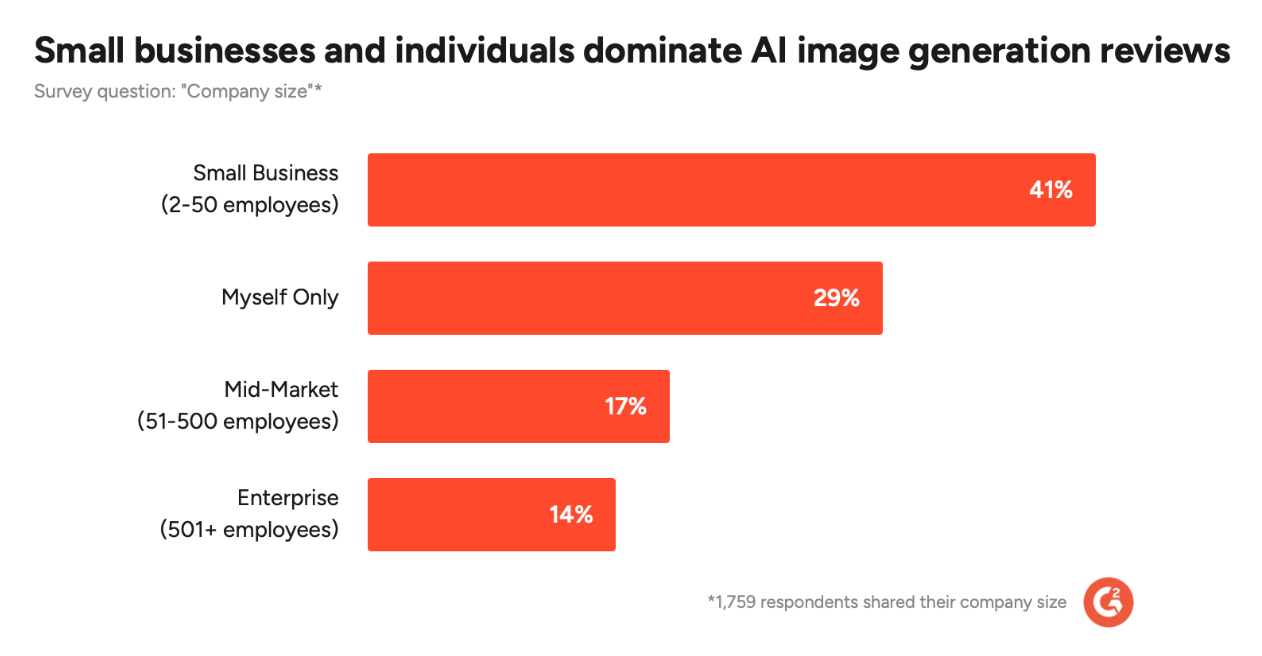
According to G2 review data, today's AI image generation market is largely represented by individual users and small businesses. Among verified reviewers who identified their company size, 70% are either individual users or small businesses, compared to just 14% from enterprise organizations. This concentration of buyers suggests that AI image generation has resonated most strongly with those seeking a faster and more accessible approach to creating compelling visual content.
G2 surveyed seven vendors at the forefront of AI image generation, representing both creator-focused tools and enterprise-grade platforms. This research reinforced how quickly the category has matured. All seven vendors surveyed reported that AI image generation adoption increased significantly over the past 12 months, while five said their customers now generate AI images daily, and the remaining two reported weekly usage. Three vendors described AI image generation as a core part of content and design production, while the others reported regular use for specific creative tasks, experimentation, and casual use.
Together, these findings suggest AI image generation has moved beyond the experimentation phase and has been adopted as an everyday productivity tool.
For buyers, AI image generation software delivers value across multiple stages of the creative process. G2 review data shows that one in four reviewers primarily use AI image generation to reduce design time and effort, followed by concept visualization and creation of professional brand imagery.
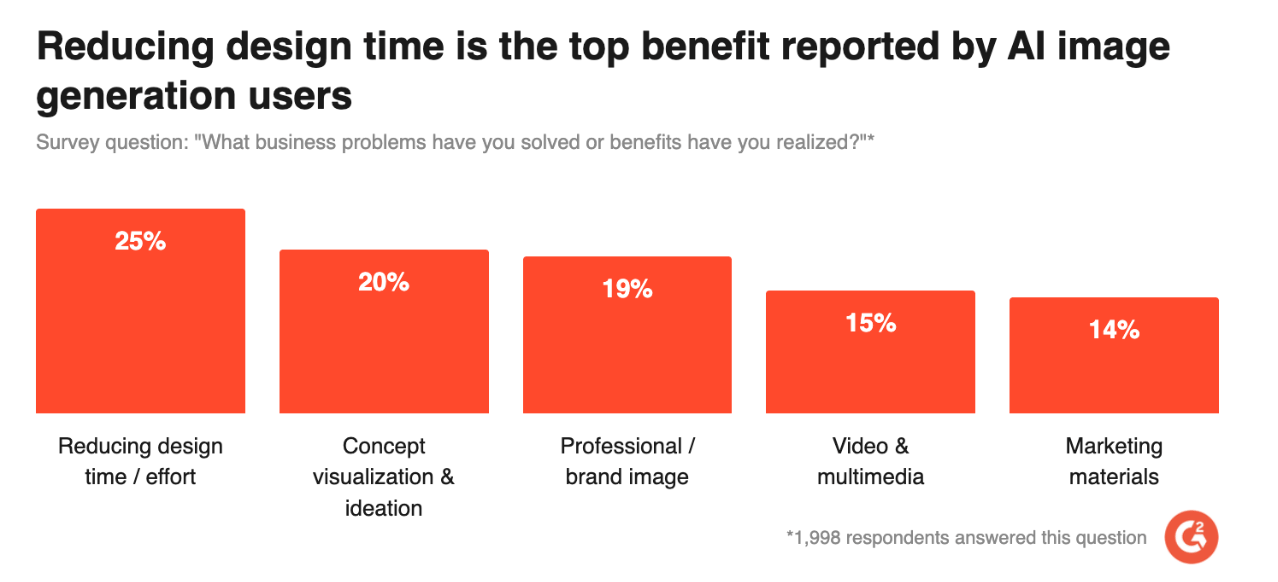
The composition of today's buyer base helps explain these findings. In a market dominated by individual users and small business buyers, it’s no surprise that reducing design time and effort emerges as the most frequently reported business benefit. This same buyer concentration is also realizing value quickly.
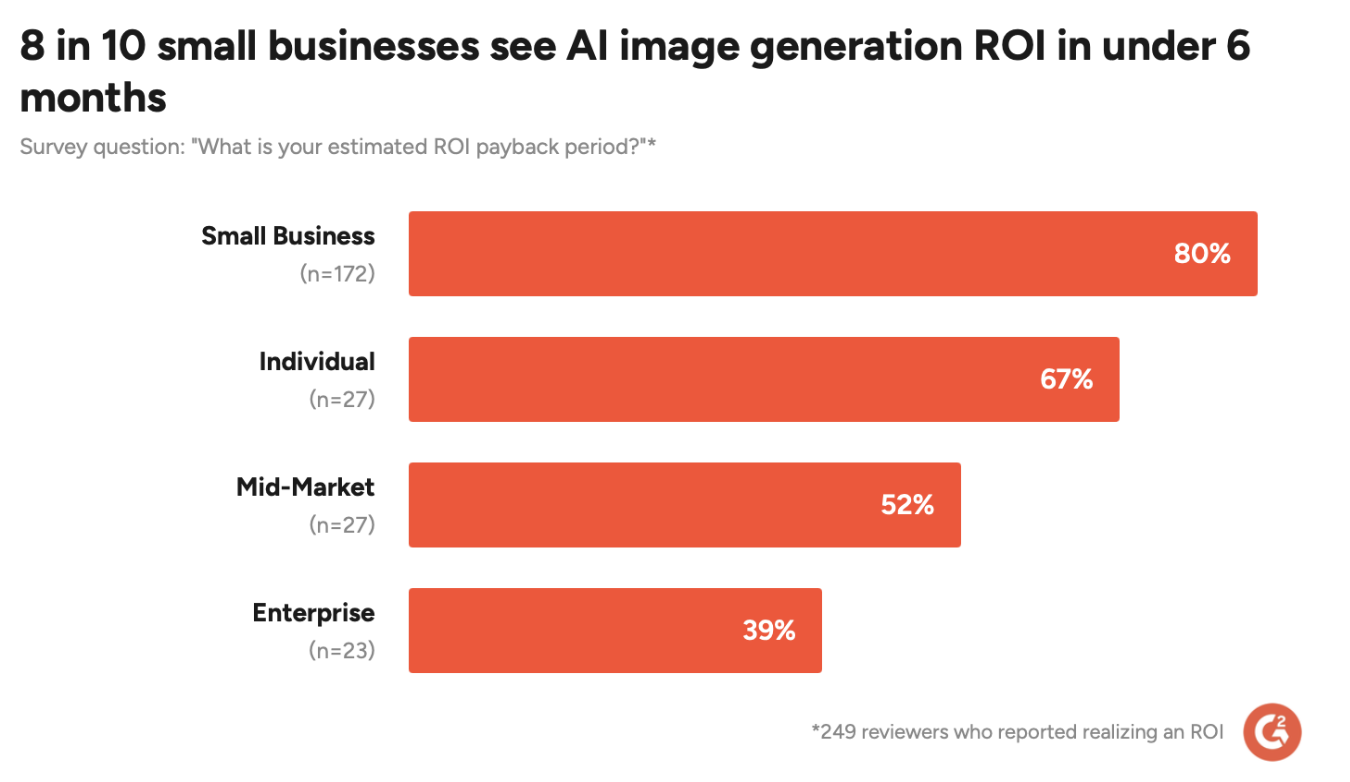
Among G2 reviewers who reported their ROI, small businesses achieved the fastest return on investment, with 80% reaching ROI in less than six months. Individual users followed at 67%, suggesting AI image generation is able to deliver measurable business value relatively quickly, particularly for smaller organizations.
Vendor responses reinforce these findings. When asked what improvements customers have seen from using AI image generation software, all seven vendors cited faster content creation, increased output volume, improved experimentation, and reduced production costs. Five of the seven also reported improved engagement and content performance. The alignment between buyer experiences and vendor response reinforces AI image generation’s business value in today’s market.
While there are many realized benefits to AI image generation software, its value is not without challenges. Buyers most frequently express frustration around credit and pricing limits first, followed by prompt accuracy, suggesting that the iterative nature of AI image generation may also contribute to how users experience cost.
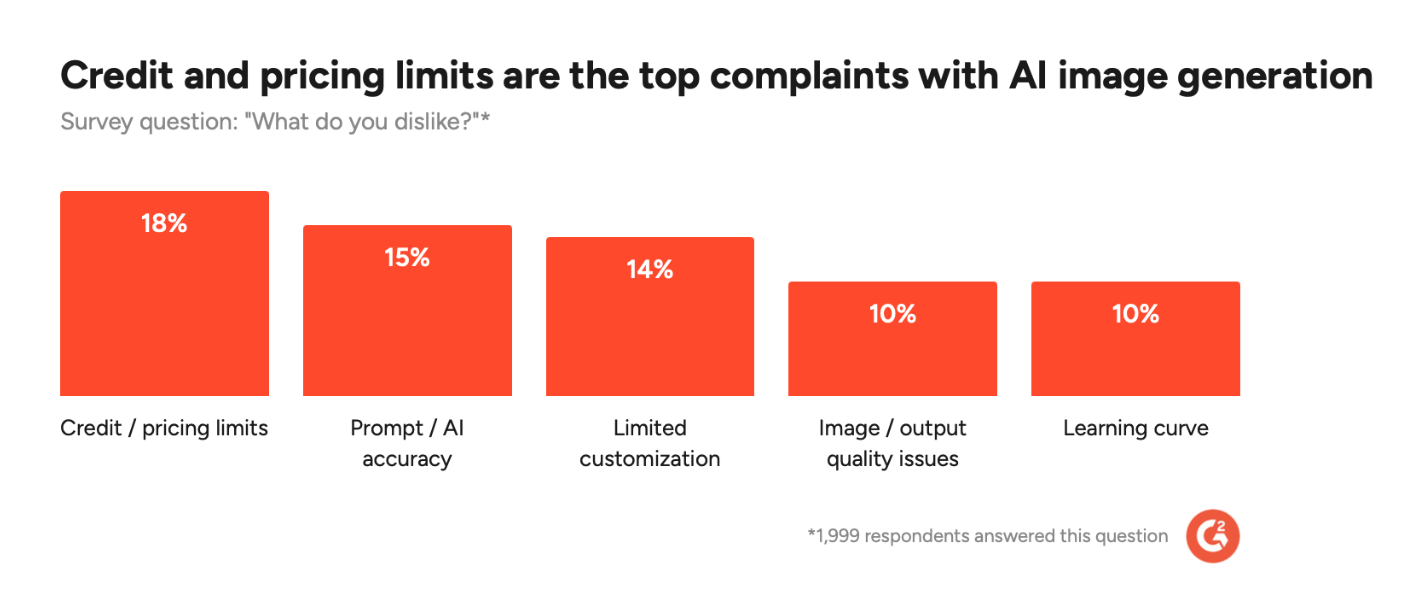
One small business reviewer described this challenge directly: "The cost of credits and the rate at which you use up credits is prohibitive for most small businesses."
Vendor responses provide additional context for these frustrations. When asked where hidden costs most commonly arise, vendors identified iteration time, post-editing, prompt optimization, infrastructure usage, and switching between tools as the primary contributors.
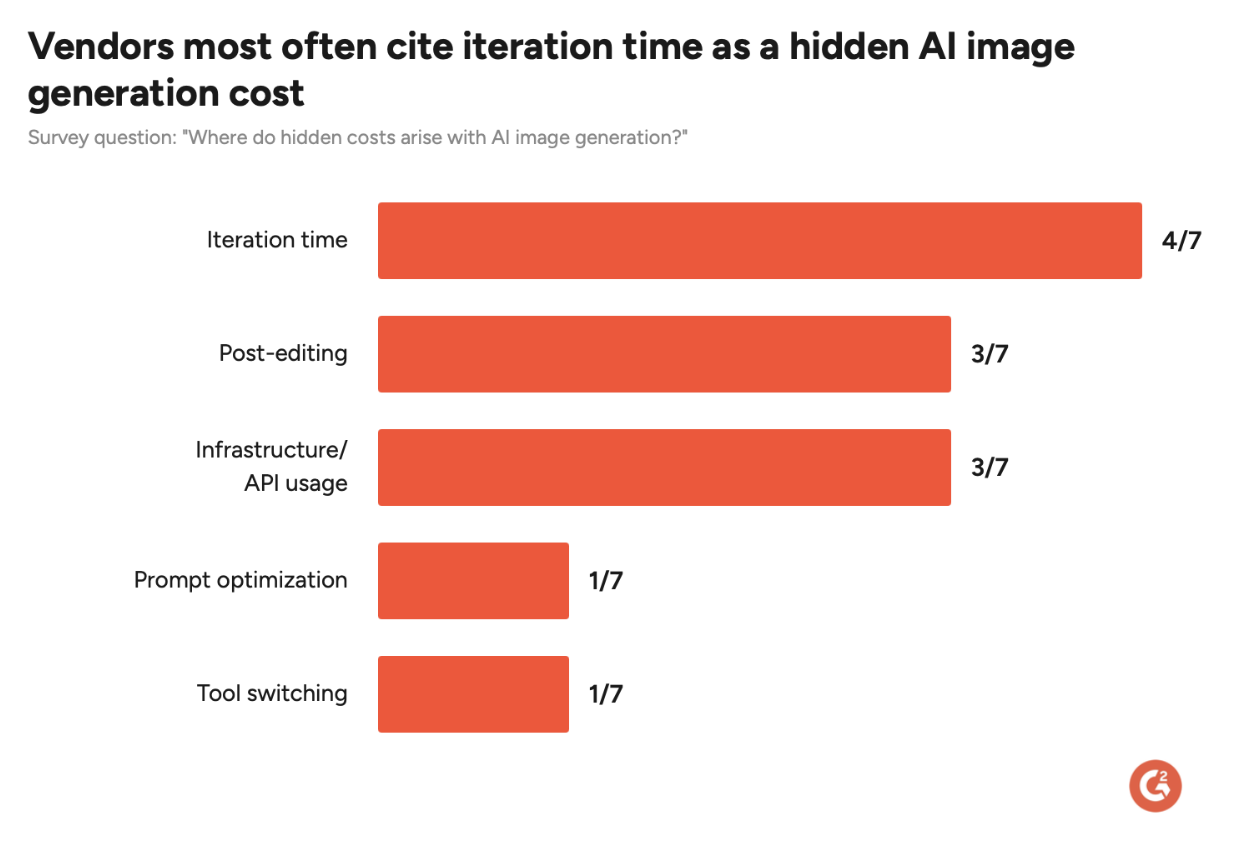
Although vendors acknowledge that hidden costs can arise throughout the creative workflow, they overwhelmingly agreed that AI image generation remains a lower-cost alternative to traditional design. Six of the seven vendors reported that AI image generation is significantly less expensive than traditional design workflows or stock imagery, while one reported it is moderately less expensive.
While individual and small business buyers represent the majority of verified AI image generation reviewers, vendor responses often frame cost in terms of replacing traditional design workflows and reducing overall production expenses. For smaller buyers, cost is experienced through day-to-day usage, where pricing limits and iteration directly affect affordability.
While the buyer experience established where the AI image generation market is today, vendor perspectives provide insight into where the category is headed. Five vendors shared their predictions on the future of this market. Across their responses, two consistent themes emerged: AI image generation that can scale with consistency and AI image generation that can operate as a personalized creative collaborator. Collectively, their insights reflect a category that is evolving to support more structured, personalized, collaborative, and scalable approaches to visual content generation.
Vendors consistently described a shift in focus from generating individual images to building reliable, repeatable creative workflows. In their view, successful AI image generation will depend on how well these technologies integrate into existing creative processes.
“The next phase of AI progress will not come from refining prompts, but from designing scalable workflows that turn isolated outputs into repeatable systems.”
Maciej Lukowski
Co-founder of getimg.ai
Yair Adato, CEO of Bria AI, reframes the competitive question entirely:
“The next phase of visual AI isn't about better pixels — it's about making generation controllable, predictable, and safe enough to embed inside enterprise workflows. The platforms that win will be the ones that pair foundation models with structured control layers and rights-clean training data, not the ones with the best prompts.”
Yair Adato
CEO of Bria AI
The shift from prompting to scalable workflows is also echoed by Varunram Ganesh, CEO of Lapis:
“In the near future, organizations will use AI to directly augment marketing workflows inside developer tools like Claude Code, enabling A/B testing and creative generation at a scale we've never seen before.”
Varunram Ganesh
CEO of Lapis
AI image generation embedded in developer tools, coupled with testing tools, points to creative outputs becoming more measurable to create structure and control around AI imagery.
While all vendors seem to be focusing less on prompting, quality, and technicality of imagery, NightCafe and Recraft center their vision on the creative element of AI image generation. Both envision AI as a creative collaborator that understands a user's intent and helps produce imagery with greater consistency, personalization, and creative judgment.
“The next era of AI image generation isn't about getting 'better' at making pretty pictures, it's about moving from unpredictable magic to precision-surgical control. We're shifting from the 'lottery' phase of prompting and entering an age of brand-aware consistency, where tools will finally respect the nuances of a design system as much as they do a creative brief. The future isn't just about pixels; it's about AI that understands structure, layers, and intent well enough to be a true collaborator, not just a high-speed generator.”
Elle Russell
Co-Founder and COO of NightCafe
Anna Veronika Dorogush, CEO of Recraft, extends that idea by emphasizing the importance of creative judgment in personalized AI imagery:
“The next generation of AI image tools will be defined by taste, aesthetics, and personalization. It will not be enough to generate technically correct images. The best tools will understand what makes an image visually strong, distinctive, and emotionally compelling. Personalization will also be essential. Different brands, creators, and teams have different visual languages. AI image tools need to adapt to those preferences and help users create work that feels specific, not generic. At Recraft, we believe the future is not just faster image generation, but better creative judgment: tools that understand style, maintain consistency, and help people produce imagery with real aesthetic quality.”
Anna Veronika Dorogush
CEO of Recraft
These perspectives highlight how vendors are defining the future quality of AI image generation technology. Tools need to be creative partners that collaborate with users, applying creative judgment to understand nuances of design and adapt to a brand's unique visual identity.
An AI image generator is software that uses generative AI and deep learning to create images from text prompts, allowing users to produce original visual content without relying on stock photos or manual design.
Photo editing software manually manipulates existing images. AI image generators use machine learning to analyze patterns and produce entirely new visuals from a text description, rather than editing something that already exists.
AI image generators speed up concept exploration and asset production, but designers still handle brand consistency, final polish, and creative direction that requires human judgment.
AI image generators reduce the time and cost of producing visual content, remove the need for stock photography, and let teams quickly iterate on style, composition, and color to explore multiple concepts before committing to one.
Key considerations include image rights and licensing, whether the vendor offers IP or copyright indemnity, whether user prompts or uploaded content are used to train the underlying model, and how well outputs meet quality standards for the intended use case.
Looking ahead, the AI image generation market is being shaped by how well vendors balance the priorities of today's buyers with the capabilities needed for the next stage of the category's evolution. Individual users and small businesses continue to make up much of today's market, prioritizing speed, accessibility, and affordability, while pricing and credit models remain a source of friction.
At the same time, vendor perspectives point toward a future defined by workflow integration, brand consistency, and AI image tools that act as a personalized creative collaborator. The platforms that successfully balance both sets of priorities are likely to redefine how AI image generation software is evaluated and be well-positioned as the market continues to mature.
Explore the Top AI Image Generator Tools of 2026 to compare the latest platforms, features, and market trends.


Key Findings Search and summarization lead AI usage. According to G2’s analysis of 600+...
 by Julie Jung
-1.png?width=400&name=dark%20(14)-1.png)
TL;DR: Where AI video compliance stands today The market is scaling faster than its...
 by Lauren Worth
TL;DR According to G2's analysis of 1,250+ verified Emerging AI reviews and survey responses,...
 by Nathan Calabrese