

According to G2's analysis of 1,250+ verified Emerging AI reviews and survey responses, nearly 1 in 3 buyers explicitly mention replacing or consolidating tools - yet every vendor surveyed admits AI still cannot fully replace humans, as they are needed for human-dependent steps, such as exception handling, approvals, or one-off judgment calls.
There’s no doubt that we’re constantly told that AI software can replace existing disparate software, workflows, and even entire tech stacks. Yet the reality of what gets replaced is far more nuanced than vendors typically pitch. But when G2 surveyed six vendors building agentic AI, AI agents, and similar emerging AI tools about what their software actually replaces, a clearer picture has emerged showing emerging AI software as less "fully autonomous" and more "selectively powerful". Regarding full autonomy, every respondent confirmed that there's still a part of the workflow that no AI system can handle on its own, such as making one-off judgment calls and handling exceptions.
Most deployments replace some tools, augment others, and still need humans for key decisions. Buyers need to know this before signing a contract.
For this report, we treat emerging AI software as products built around foundational AI capabilities, such as generative AI, retrieval-augmented generation, and autonomous agents, that are actively transforming or replacing a workflow a buyer used to run with multiple tools.
This software goes beyond AI agents or agentic AI because it covers AI-native platforms inside categories like content management, demand planning, and product analytics that have rebuilt their core workflow around AI, rather than adding AI onto an existing tool. Kanerika makes this clear by describing that their products entered the market as a system replacing an entire workflow from day one.
The honest answer is that it depends on how big the workflow is to begin with, and our data shows two distinct patterns rather than one stand-out trend.
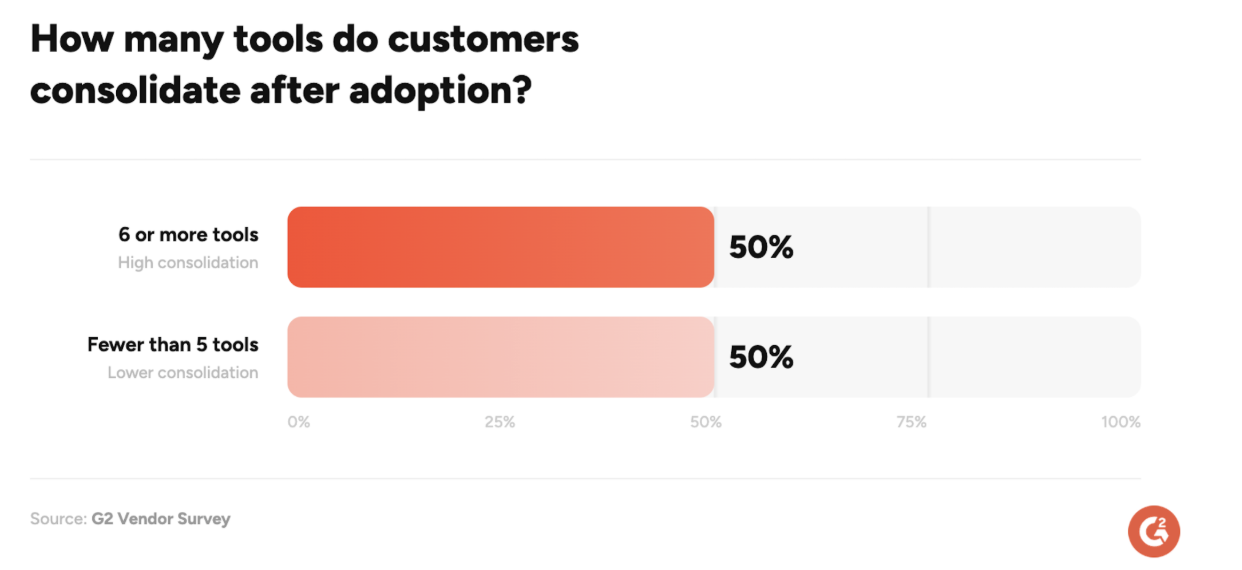
Two respondents, Rapidops, and invent.ai, reported that their main workflow required 10 or more discrete tools before their product was adopted, such as BI and analytics, workflow automation, internal dashboards, and custom-built internal tools. After adoption, all three respondents reported consolidating 6 to 10 of those tools into their platform. Amplitude reported replacing 3-5 tools, while completing 75–90% of the workflow inside the platform.
This doesn’t necessarily mean it’s a weaker result. Kanerika's product typically entered a workflow with fewer pre-existing tools to begin with, and the company says it completed 75 to 90 percent of the workflow within its own platform, regardless of the initial tool count. This data means that the number of tools replaced by highly rated emerging AI tools is superficial unless it's read and measured against the size of the tech stack to begin with.
“We entered as a transformation partner that evolved from solving specific workflow and integration challenges into delivering end-to-end AI-driven systems across functions.”
Sourabh Gurga
Marketing Manager, Rapidops
“What previously required multiple tools and manual handoffs is now managed within a single, continuous decisioning loop. Planners shift from manually creating and adjusting decisions to supervising outcomes and handling exceptions.”
Hayley Brown
Content & Communications Strategist, Invent.AI
Two other survey respondents, Kanerika and Leo AI, both noted smaller starting workflows (3 to 10 tools) and reported consolidating only 1 to 2 tools after adoption. However, even consolidating or updating one workflow can make a big difference depending on the needs of a specific team.
When asked how customers position their product internally, every vendor described a hybrid model, replacing some tools while augmenting others. Leo AI was the only exception, with customers treating it as a layer on top of existing tools rather than a replacement.
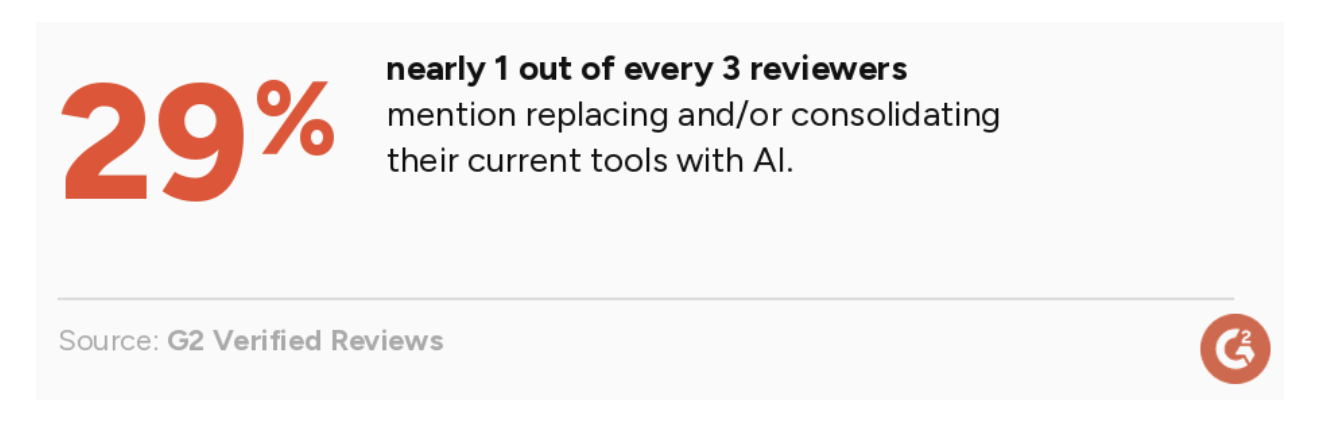
In fact, based on 1,250+ verified G2 reviews from the Emerging AI category, 29%, or nearly one out of every three reviewers, mention replacing and/or consolidating their current tools with AI.
“One customer initially switched from ChatGPT to Leo because they needed higher fidelity technical sources they could actually trust.”
Maor Farid
CEO & Co-Founder, Leo AI
According to our respondents and G2 review data, users of emerging AI applications in 2026 commonly underestimate and overestimate how it can affect their workflow.
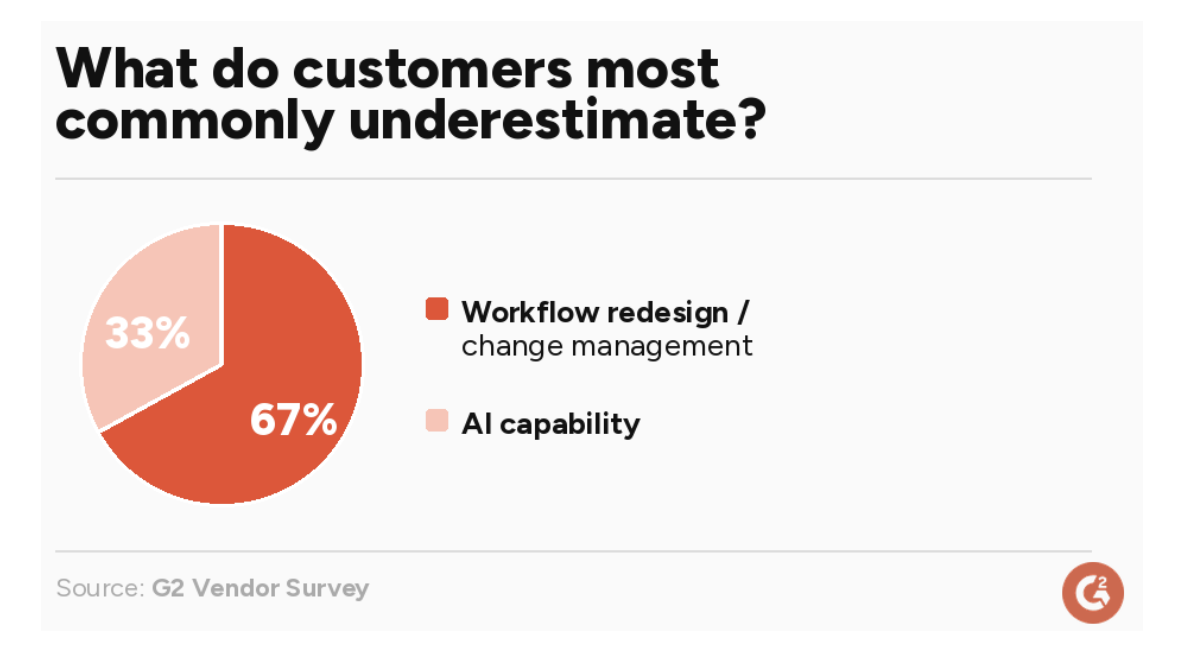
Emerging AI is marketed and intended to change and/or replace workflows, and this change management becomes a complex project. Often, buyers assume using the technology is the hard part when, in fact, the implementation becomes more challenging. Because the platforms can be so comprehensive, users can’t just ‘plug and play’ in a few minutes. The AI needs to be taught the specific business logic of the company, and this initial setup can especially feel overly complicated for a smaller team with fewer resources and less experience with this type of technology. Our survey response data confirms that 67% of them named workflow redesign or change management as the issue that customers most commonly underestimate. Amplitude also named change management as the most commonly underestimated factor.
Potential buyers also overestimate what is possible with emerging AI software. Kanerika's Sushree Swagatika says customers most commonly overestimate "reduction in human involvement" - the expectation that AI will eliminate headcount or fully automate human-dependent steps. Users often assume that one AI platform will clean up their tech stack by replacing all tools, making them redundant. This isn’t to say emerging AI products are failing their customers; rather, customer expectations don’t align with what these tools actually deliver.
“Customers most commonly overestimate reduction in human involvement.”
Sushree Swagatika
B2B Marketing, Kanerika
Emerging AI is a catch-all category for products built around generative AI, retrieval-augmented generation, or autonomous agents that don't yet fit an established G2 category. It typically includes AI-native platforms that have rebuilt an existing workflow like content management, demand planning, or product analytics around AI from the ground up, rather than adding AI features onto an existing tool.
Emerging AI is broader - it covers AI-native products across many different workflows and functions that haven't yet developed into their own distinct category.
Buyers most often underestimate the workflow redesign and change management required to implement it, and overestimate how much it reduces human involvement. These tools need to be taught a company's specific business logic before they deliver value, which makes setup more involved than a typical software rollout.
Key considerations include how large and complex the existing workflow is, since consolidation results vary by starting tool count; the time and cost of implementation and training the system on internal processes; and where human oversight will still be required after deployment.
First and foremost, buyers need to keep in mind that emerging AI software can consolidate tools, but the number of tools is uneven. Depending on the size of the workflow, a vendor able to replace a vast workflow with 10 tools and another company with a lean workflow of only 2 tools can both be successful in integrating emerging AI software, albeit with different goals.
Second, full autonomy won’t happen as of now, and vendors cite that human involvement is still needed for exception handling, approvals, or one-off judgment calls. And lastly, buyers can’t underestimate the financial and time investment needed just for implementation.
Regardless of the company, team, or workflow size, any emerging AI software will need to be taught about existing workflows and specific business logic. As emerging AI software continues to evolve, buyers should evaluate these platforms not only for what they can automate today, but also for how well they can adapt to future business needs. Organizations that invest in scalable AI solutions and thoughtfully redesign their workflows will be better positioned to unlock greater efficiency and long-term value as the technology matures.
Explore the top-rated Emerging AI tools on G2 and see how verified buyers are evaluating them.


Key Findings The market is driven by individual users and small businesses. 70% of reviewers...
 by Alanna Iwuh

Key Findings Search and summarization lead AI usage. According to G2’s analysis of 600+...
 by Julie Jung

Key Findings Finding 1: G2's analysis of 2,770+ verified AI writing assistant reviews...
 by Brandon Summers-Miller