

By now, you have likely heard about OpenClaw and its spinoff, Moltbook. It’s captured the imagination of both technical and non-technical people alike. And in my opinion, it’s the Netscape moment for AI agents. There’s no going back from here.
OpenClaw (originally named Clawbot) was released by Peter Steinberger on GitHub on November 25. In just the last week alone, he reported that it had received over 100,000 stars on GitHub and had 2 million visitors. According to The Verge, Steinberger’s post helped Clawbot go viral — so viral that Anthropic’s legal team requested a name change to avoid confusion with their own Claude.
OpenClaw is touted as “an agent that actually does things.” It’s an open-source, always-on personal AI assistant that can run proactive background work (cron jobs, reminders, tasks) and can be hosted on your own machine. You can run one locally (no cloud required) on a Mac mini or powerful laptop.
Its defining feature is that you give the agent device control, the ability to run your machine on your behalf, including having computer vision of your screen, files, and systems.
This is in sharp contrast to chatbots (many of which have been presented as agents), which only make suggestions that a human must then manually put into the real world. It’s also a step up in autonomy from enterprise task agents, which can access tools and systems but don’t typically control personal or company devices.
OpenClaw users report game-changing use cases, mostly in the form of scheduled tasks such as research reports, email drafting, travel updates and planning, software updates, content production, and expense reporting. Set it and forget it. Review their work later and tweak instructions.
This creates an entirely new software category: the executive assistant. This is different from previous AI assistants in that you trust OpenClaw bots as you would a seasoned, savvy human.
Think of a CEO’s human executive assistant. They have unfettered access to their boss’s calendar, inbox, credit cards, and, in some cases, social media credentials, plus the tools and systems they use every day. Many leaders will tell you that their EA is their most important human resource.
Previous AI assistants did background work and completed tasks with a human in the loop. They didn’t manage processes with device control or the ability to act in any significant way without human oversight.
Moreover, as we are learning with OpenClaw’s spinoff, Moltbook (a viral social network for agents), these executive assistants can spawn their own agents to act as sub-assistants and schedule cron jobs. After all, they were trained on humans and likely read about Tom Sawyer’s clever use of Huck Finn to paint a fence for him.
That’s why the number of these “moltbots” is spawning faster than a virus outbreak. Spin them up and ship them to Moltbook for orientation and training.
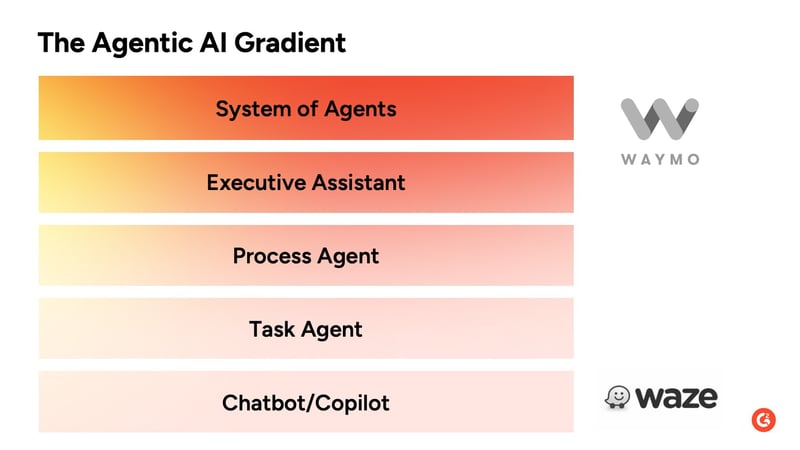
As a result, I’m revising my Agent Gradient, which plots different forms of agents according to their autonomy and impact. Executive assistants sit near the top of the list. They are more Waymo (self-driving) than Waze (turn-by-turn directions) and will likely change everyone’s expectations for AI.
While the picture taking shape is one of rapid innovation, it is also stoking our greatest fears about AI. Everything we’ve seen in the movies or read in pulp fiction seems to be unfolding in real time, depending on how much you trust social media and self-reported incidents.
Examples include:
On top of that, the launch of Moltbook has garnered even more sensational headlines than OpenClaw did. This Reddit-like community shares (alleged) agentic posts where they compare notes, suggest creating their own shared language instead of English, and reveal ways to jailbreak their instructions. They even created their own religion.
Again, this could very well be humans having fun with us, but still, there are confirmed examples of real OpenClaw agents being sent to Moltbook and posting content. This Wired article provides an entertaining perspective on the fastest-growing social network in history.
OpenClaw may have commoditized the cost of agents from a software perspective (as DeepSeek disrupted LLMs last year), but that doesn’t mean agents will be free in the future.
There’s still the issue of LLM access, which can be expensive through Claude or ChatGPT. One workaround has been the use of Kimi, which has become the de facto model of choice for cost-conscious OpenClaw users. But really, the cost of running the agent pales in comparison to the risk of it going rogue — and exposing a user’s credentials and systems to hackers.
In G2’s latest report on Agents, we revealed that while security was a concern to buyers, they were willing to shoulder the risk to realize the cost savings and autonomy that agents could bring to bottlenecked parts of their organizations. But that was only because stories of “agents gone wild” had yet to grace the headlines.
Now all of that has changed. Companies are telling employees to avoid installing and running OpenClaw. CEOs are reaching out to their InfoSec teams to update and clarify their agent policies. Even OpenClaw’s website is blocked by many companies.
Over the coming weeks, I anticipate that even more examples of OpenClaw bot shenanigans will cause buyers to be security-first when it comes to any agentic implementations.
"This means that instead of security being a check-the-box motion for buying enterprise agents, it will be the lead attribute that due diligence centers on, from reviews to certifications."
Tim Sanders
Chief Technology Officer, G2
Additionally, there will be a market for agent governance systems that demonstrate strong governance in their design. So I don’t expect the agent category to become open source in the long run. I also continue to believe that the market for third-party agent guardrails will continue to grow, which was one of my predictions for 2026.
I remember when early browsers like Mosaic/Netscape hit the mainstream in the mid-1990s. By January 1995, it was the buzz across media and boardrooms alike. Non-techies were now empowered to roam the internet and find useful content. Startups were born. Everyone quickly developed FOMO to get on the web or get left behind.
It was a moment of such widespread awareness, the paradigm of “how do we ____” changed.
To quote Yogi Berra: “It’s déjà vu all over again.”
Although agent adoption by companies has been brisk (40% of enterprises spent $1 million on them last year), personal adoption has lagged. I would speculate that few of us have actually set up an agent and given it the power to complete a task on our behalf.
Expect that to change as safer versions of OpenClaw are released (think tighter guardrails and permissions) in response to the tsunami of coverage and water-cooler talk unfolding in 2026. Even if executive assistants don’t become as ubiquitous as personal websites three decades ago, FOMO for agents will spread faster than ever.
Personally, I’m sitting this one out. I haven’t downloaded OpenClaw or bought a Mac mini to run it on. I believe the risks are too high and, to be honest, I’m not ready to turn over the keys to my life to a machine.
I’m just over here, eating popcorn while reading about it and talking to a variety of peers in the AI, security, software coding, and academic communities.
And we all agree on one point: Things will never be the same.


While everyone was busy talking about OpenAI’s new o3 and o4-mini models, the company quietly...
 by Sudipto Paul
A few weeks ago, I called OpenClaw the “Netscape moment” for AI agents. Since then, three...
by Tim Sanders

Let AI pick the right tool for your use case Decide with AI 1 Click on the button below
 by Yashwathy Marudhachalam