



Nothing humbles a customer marketer quite like a 5-star rating paired with a one-word review: "Nice." Or the end-of-quarter scramble to track down every customer who ever said "We love your product!" on a call, hoping they'll say it again in a review.
Getting customers to love your product is one thing. Getting them to consistently put that love into words is a whole different ball game. When I asked Charlie Albuery, G2's customer community and education manager, what software sellers struggle with most when it comes to their review strategy, his answer was immediate: a consistent flow of reviews. So we turned to customer stories and G2 review data to find out how the pros are getting it done.
The hard part isn't the ask. It's everything around it.
Charlie sees three sticking points for customer marketing teams and vendors: who to ask, when to ask, and getting internal buy-in. This is Part 1 of a 3-part series where we will help you with review collection tactics, building a strong review strategy, and operationalizing your reviews in GTM assets.
First, let’s zoom in on the more tactical and operational channel every team reaches for: email.
Yes, but not on its own. Your request competes with a crowded inbox: In Sendoso's 2026 Digital Fatigue Report, 83% of 400+ buyers reported fatigue from marketing emails and 82% from sales emails. Here's how to flip the script, based on tried-and-tested G2 customer stories:
Email isn't broken. It's one lane, not the whole road. So what do the other lanes look like?
In-app prompts put the ask where customers already are.
And voice reviews remove another barrier: Charlie says they take effort off the reviewer and typically yield richer insight. memoryBlue is already experimenting with video, voice, and AI-powered extraction of customer proof, which helps them drive results.
💡 Did you know? Your customers can easily use the G2 voice review feature to submit a review in just 3 minutes! Learn more about G2 voice reviews here.
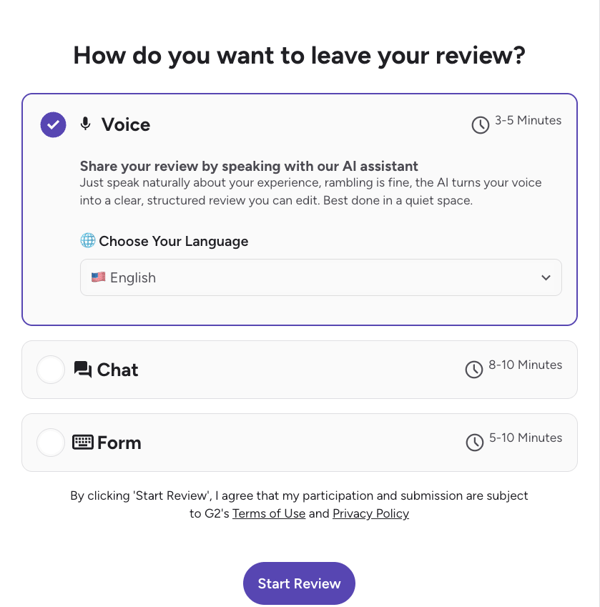
Source: G2.com
In-app works when customers log in often and have just experienced value from your products. If your customers don't open your software or app daily or frequently, you need to look elsewhere to capture reviews at scale.
Canvas's audience didn't respond to pop-ups: "People are busy, and they just didn't want to do another thing.", says Brittany Gooding, Senior Marketing Manager, Instructure. When Canvas’s audience didn't respond to in-app pop-ups, and the digital noise was relentless, their team took the ask into the room.
Give people a way to review on the spot: a QR code, a branded landing page, an incentive, and a team member who asks while the experience is fresh.
Customer case study:
At InstructureCon in July 2025, Canvas ran a G2 Review booth for about 3,000 attendees. The target was about 180 reviews. They were halfway there in under a day and finished with 312 verified reviews. Six to seven months later, Canvas rose from #41 to #1 on G2's 2026 Best of Education Software list. The booth wasn't the only factor, but it reset recency fast. "We couldn't buy jumping from 41 to one," said Brittany Gooding, Senior Marketing Manager at Instructure. "We could incentivize people leaving us reviews and actually building that credibility."
Self-Serve Events lets you run the same play yourself:
Events give collection a timely boost. Keeping that feedback fresh is the next job.
A review's weight decays — gradually for 90 days, held strongly to about 18 months, then fading to roughly 3% after about three years. Updating a review resets the clock. Your Review Activity tab shows decaying reviews and lets you request a refresh.
AI engines don't publish a review-age formula. Google describes freshness systems that favor newer content when a query calls for it, and ChatGPT may search the web when a question benefits from current information. We’ve covered how reviews surface in AI answers in our November 2025 analysis.
So how often should you collect customer reviews? Continuously.
This is a suggested cadence and not a G2 rule: Check review age monthly. Our How to Win on G2 video is a good companion if you want to learn how to prime your G2 Profile for winning in the AI search era, where G2’s Sr. Director of Product Marketing, Alexandria Snow, covers review recency.
Source: G2 YouTube
Which raises the question: What does a steady review collection strategy actually look like? Let’s find out.
We analyzed 126 CRM products to find that about 15,900 reviews were submitted between November 2025 and October 2026.
The big insight is this: Grid leaders don't collect reviews in bursts. They run an always-on baseline of about 26 reviews per product per month, then add event-driven spikes. Niche products averaged about one review per month.
💡 Did you know? About a third of the roughly 875,000 reviews submitted on G2 over the last 12 months were seller-initiated. Sellers who ask for reviews proactively move the needle.
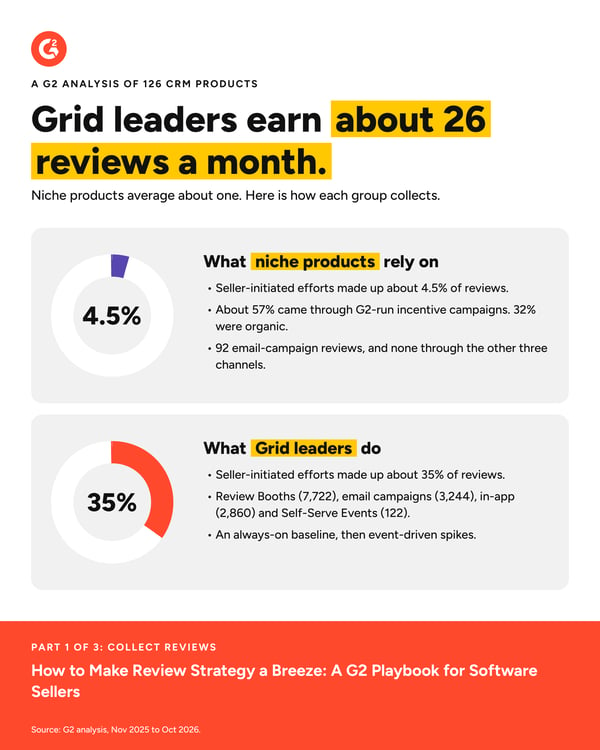
So, does this insight prove that specific channels drive higher G2 Grid positions? Not necessarily, but G2 Grid leaders are often larger vendors, and Market Presence reflects more than reviews. What it does show is that leaders pair a steady flow with multiple channels and methods for collecting customer reviews.
Start with your next customer moment. Tighten the email ask, test one new channel, and check your review age this month.
Then read Part 2, where we cover how to overcome the wider challenges around review collection strategies, who owns the ask, and how to scale.
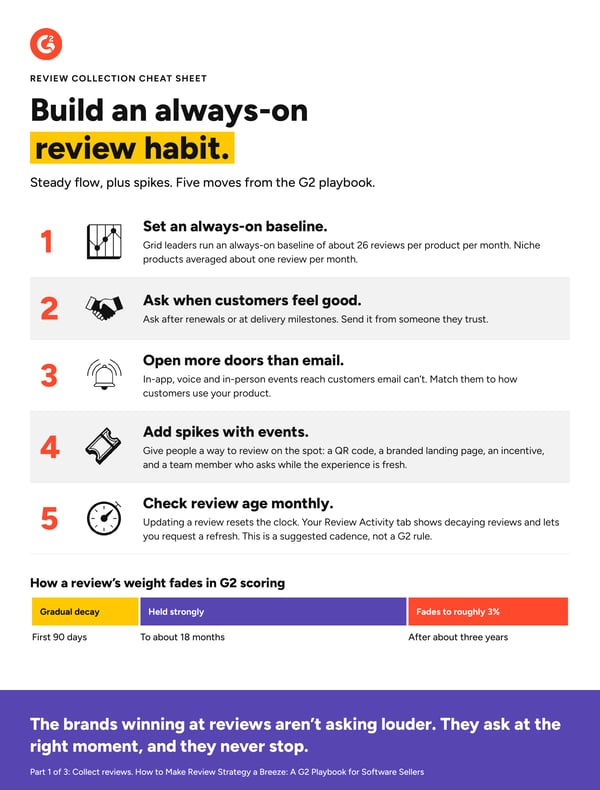
The brands winning at reviews aren't asking louder. They ask at the right moment, and they never stop.
Ready to kickstart your review collection strategy? Explore G2 Review Generation.
Q. What are the best channels to collect customer reviews beyond email?
A. In-app prompts, voice reviews, and in-person events. Match them to how customers use your product: Canvas collected 312 verified reviews at a conference booth after its audience ignored in-app pop-ups.
Q. How often should you collect new reviews?
A. Continuously. memoryBlue keeps at least one campaign active. In our CRM data analysis sample, leaders averaged about 26 reviews per product per month. Treat that as descriptive, not a target.
Q. How do AI LLMs like ChatGPT and Gemini weigh recent vs. old reviews?
A. No AI engine publishes a review-age formula. G2's own scoring fades reviews to about 3% of their weight after roughly three years, so fresh reviews give buyers more current evidence.
Q. Why do customers ignore review request emails?
A. Inbox fatigue and generic review asks are the core reasons. A relevant moment and a familiar sender make the request feel less routine.
Q. Can you collect reviews at live events?
A. Yes. You can use G2’s Self-Serve Events to provide a QR code and landing page so customers can easily submit reviews at scale; attendees verify within 30 days. This also means you can collect reviews at events without having a large on-site team.
Edited by Supanna Das