



I used G2 Data and reviews to finalize the 12 best marketing account intelligence software options. These are GTM Workspace - Powered by ZoomInfo, 6sense Revenue Marketing, Lead Forensics, GTM Studio - Powered by ZoomInfo, Apollo.io, Demandbase One, Crossbeam, INFUSE Demand Accelerator, Brandwatch Consumer Intelligence, Cognism, A-Leads, and RocketReach.
Your buyer has already shortlisted your competitors before your Sales Development Representative (SDR) knows they exist. B2B buyers now contact sellers at only 61% of the way through their journey, and in 95% of cases, the winning vendor was already among a handful of finalists assembled on day one. By the time someone fills out a form, the window has already narrowed. You didn’t lose the deal at the pitch. You lost it weeks ago. Wondering what just happened? You might just be missing out on one of the best marketing account intelligence software in your tool stack.
Marketing account intelligence software gives you an edge, arming you with intent data quality and signal depth, accurate account identification, and the segmentation flexibility to act on what you find before your competitors do.
To help you cut through the noise and pick the platform that actually moves the pipeline, I used the G2 Fall 2026 Grid® Report to identify the top vendors. From there, I analyzed verified G2 reviews on each product page, looking for the platforms that deliver on what they promise and earn their place in a revenue-focused stack.
Whichever stage your pipeline is at, the right platform to fill the gap is in here.
* According to the Fall 2026 Grid® Report and market reputation, these marketing account intelligence tools are top-rated in their category. I’ve included their strengths and ideal use cases to help you choose the right solution for your team’s workflows.
Marketing account intelligence software does one thing that changes how revenue teams operate. It tells you which accounts are actively in-market before those accounts tell you themselves. Firmographic filters get you a list. Intent signals, technographic overlays, and behavioral data get you a pipeline.
The difference between a tool that sits in your stack and one that drives revenue comes down to whether it makes the signal actionable. The best ones connect account identification directly to how your SDRs prioritize their day, how your ads get served, and how your marketing measures what’s actually working.
Who uses these tools matters too. Smaller teams need fast setup and clean contact data. Mid-market orgs want CRM sync that holds up under real usage. Enterprise buyers want the full stack: intent, advertising, orchestration, and reporting that survives a QBR. The right fit depends on where you are, not where a vendor’s marketing says you should be.
What every team in this category is ultimately buying is focus. Fewer wasted calls, tighter account lists, and a defensible reason to prioritize one opportunity over another.
I started with the G2 Fall 2026 Grid® Report for Marketing Account Intelligence to build the initial shortlist, filtering for tools with meaningful review volume and strong satisfaction scores. Grid position alone didn’t determine inclusion; distinct positioning mattered as much as high ratings. I haven’t personally used any of these tools, so every conclusion here comes from the G2 review data.
I then analyzed verified G2 reviews, looking for recurring patterns around intent data quality, CRM integration reliability, onboarding friction, and whether each platform’s support model matches the complexity of its feature set. G2 review patterns shaped every pro and con in this article.
G2 satisfaction ratings and feature scores provided a secondary validation layer, particularly around account identification, predictive scoring, and ease of setup. Where scores aligned with strong review evidence, I used them as supporting data. Visuals and product references are sourced from G2 vendor listings and publicly available product documentation.
What separates the tools that compound value from the ones that generate reports nobody acts on comes down to a handful of workflow-level factors. Here’s what I weighed most heavily.
Some of the tools prioritize data breadth and accept a steeper setup ramp. Others optimize for ease of use and accept shallower intent signals. The right tool depends on your team’s technical capacity, your sales motion, and how mature your account-based approach already is. Use the criteria above as a lens, not a checklist.
To qualify for inclusion in the Marketing Account Intelligence category, a product must:
This data was pulled from G2 in 2026. Some G2 reviews may have been edited for clarity.
A channel manager, a BDR, and an enterprise AE all open the same platform on Monday morning, each with a different job to do. GTM Workspace - Powered by ZoomInfo is one of those platforms that ends up touching more roles than the original buying decision anticipated, combining contact data, buying signals, and CRM intelligence in one sales execution workspace. I’d point mid-market and enterprise revenue teams to it, and I’d scope the purchase for the three teams that will end up relying on it.
Multiple G2 user data points mention the sheer volume of verified direct dials, mobile numbers, and email addresses available, particularly for mid-market and enterprise accounts across North America. The account identification score for the platform sits at 87% in G2 Data, and that number is backed by reviewers who describe pulling targeted lists by industry, seniority, revenue band, and technology stack without needing a second tool to fill the gaps.
For teams running campaigns across multiple segments simultaneously, multi-criteria filtering is where speed matters most. G2 reviewers describe pulling export-ready lists of 500 or more contacts in minutes, with role, geography, company size, and intent topic combined in a single search, as their daily list-building workflow. G2’s lead analysis score sits at 86%. In my reading of the reviews, the filters are specific enough to produce clean results and flexible enough to scale when campaign needs shift quickly.
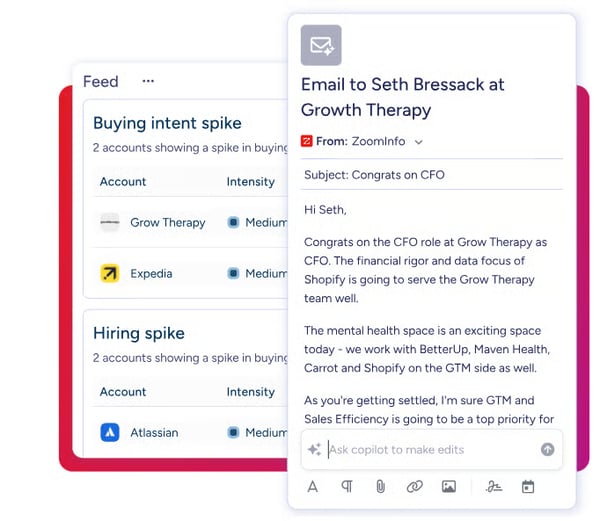
CRM integration integration with Salesforce and HubSpot performs reliably across the review set. Reviewers cite bidirectional sync that keeps contact records enriched automatically, data flowing into campaigns without manual cleanup, and new contacts appearing in the CRM on the same day they are sourced. That level of integration reliability is rare enough in this category that it registers as a genuine differentiator, not a standard feature.
Accounts actively researching relevant solutions show up here before a rep ever reaches out. That signal-based prioritization is what separates this platform from a straight contact database, and reviewers describe it as the shift that moved their team from spray-and-pray prospecting to a targeted, intent-led workflow. What pulled my attention was how often that outcome surfaced, regardless of team size or industry.
The Copilot feature surfaces frequently in recent reviews as a meaningful upgrade to daily workflow. It pulls together org charts, funding events, buying signals, and account context into a single pre-call view, collapsing the manual research step most reps run across multiple tabs before a call. G2 user reviews describe arriving at conversations with a level of account context that previously took an hour to assemble independently.
Responsive CSMs and proactive workflow configuration help are what the review text describes specifically about GTM Workspace - Powered by ZoomInfo, backed by a quality of support score of 89% on G2 Data. Support is the detail I wouldn’t overlook here, particularly for teams buying a platform this feature-rich. The ramp is real, and having a support model that meets it makes a measurable difference to time-to-value.
G2 reviewers note that contact records for SMB accounts, niche roles, and markets outside North America go stale faster than the platform refreshes them, leading to bounced emails and calls to contacts who have moved on. Despite this, G2 review data shows that mid-market and enterprise prospecting in core North American markets holds up reliably, and that is where most revenue teams in the review set concentrate the majority of their outbound effort.
Feature complexity creates friction during onboarding, and G2 users mention this across multiple recent reviews. Advanced Boolean search, intent configuration, and workflow automation take time to master, and the volume of features can make the platform feel heavy in the first weeks. However, once teams clear that ramp, the platform becomes a prospecting essential most describe as irreplaceable to their daily motion.
All considered, GTM Workspace earns its place for North American revenue teams where outbound volume is high and the ROI case needs to be traceable back to a single source of truth. It holds the highest G2 Score on the Fall 2026 Grid at 95, with a Market Presence score of 99 and a Satisfaction score of 92 across 2,502 reviews. Its 4.5 rating is solid, though an NPS of 63 sits below the 70 category average. G2 user reviews with long-term accounts describe it as the platform their entire prospecting motion runs through. For structured enterprise outbound at scale, that level of dependency tends to reflect value, not lock-in.
“GTM Workspace provides company data, contacts, intent signals, and engagement insights in one place. This helps the team to find lucrative accounts to target in B2B sales and marketing.”
- GTM Workspace - Powered by ZoomInfo review, Prateek V.
“The contacts sometimes are not valid (they no longer work there) or the information is not always correct. They should do a better job vetting the clients - we find we see a lot of data in Canada that is old or not valid.”
- GTM Workspace - Powered by ZoomInfo review, Bill L.
Looking to activate the accounts your intelligence platform surfaces? Explore G2’s guide to the best account-based advertising software to reach decision-makers before your competitors do.
A pipeline review ends with sales and marketing pointing at different numbers and neither side able to explain the gap. 6sense Revenue Marketing is built for that moment, mapping accounts to buying stages so teams can agree on where pipeline is going, not just where it came from. I’d point mid-market and enterprise B2B teams running full ABM programs to it first.
The platform maps accounts to stages: target, aware, considering, deciding, purchasing, using a combination of intent signals, firmographic fit, technographic data, and engagement history. The account identification score sits at 87% on G2 Data, and marketers and SDRs note confidence in knowing not just who is in-market, but where they are in the journey and how to sequence outreach accordingly.
Catching an account mid-research, before it fills out a form or responds to an email, is the outcome I see driving the strongest results in 6sense Revenue Marketing’s G2 Data. Anonymous visitor identification is what makes that possible, surfacing accounts already evaluating competitors while the window is still open. Many users describe this as the capability that changed how they approach prioritization, shifting focus from guesswork to accounts that are actively in-market.
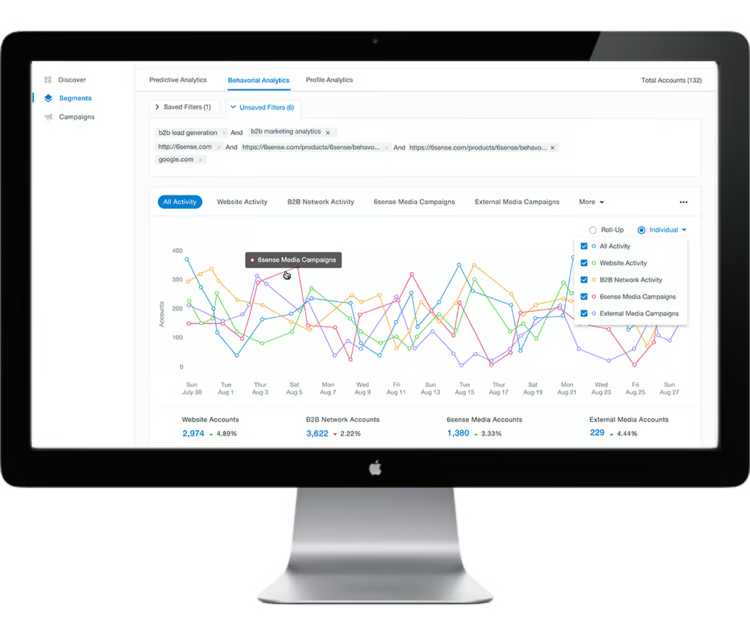
Account segmentation is where the platform’s operational depth becomes clear. For teams running Account Based Marketing (ABM) across sales and marketing simultaneously, building dynamic segments by intent topic, buying stage, firmographic profile, and engagement behavior changes how tightly aligned both functions can be. Those segments feed directly into campaign targeting and sales alerts, and the segmentation score of 87% on G2 reflects that. Multiple reviews note segments as the structural backbone of their entire GTM motion.
What the review data made clear to me is how much weight G2 user reviews place on 6sense’s advertising capability. The platform’s native DSP lets teams serve B2B display ads directly to in-market accounts with no separate ad platform, and reviewers describe shifting spend away from broad audiences toward accounts already showing buying intent. The result, across multiple reviews, is the same: less wasted ad spend and a cleaner line between marketing activity and pipeline contribution.
6sense Revenue Marketing’s RevvyAI is a conversational AI interface that lets revenue teams query account data, campaign performance, and pipeline metrics in plain language, cutting the time spent navigating dashboards to find answers. Campaign orchestration across email, advertising, and sales workflows runs as coordinated and automated once segments and triggers are configured correctly. That combination is what I see compressing the gap between insight and action most directly in the G2 feedback.
CRM integration with Salesforce sits at the center of how most G2 reviewers operationalize the platform. Users note buying signals, account scores, and segment membership appearing directly inside Salesforce without switching tools, which is worth understanding before you go into evaluation, because the depth of that integration determines how quickly your sales team actually acts on what 6sense surfaces.
G2 user reviews of 6sense Revenue Marketing flag that some intent signal noise, particularly from keyword-based intent topics, can produce false positives, routing sales attention toward accounts that aren’t actually in-market and leading to wasted outreach cycles. What holds up regardless, according to G2 review patterns, is that the buying stage model and account scoring continue to provide a reliable prioritization framework even when individual signals require additional validation before acting on them.
Platform configuration demands real time investment before value flows, and multiple G2 reviewers highlight this as the most significant friction in their experience. Getting segments, keywords, and scoring models set up to reflect a team’s actual ICP takes longer than most expect. All the same, reviewer accounts show that teams who push through the configuration period describe the platform running their ABM motion with a consistency that manual workflows never matched.
6sense is the platform for B2B marketing and sales leaders who have moved past debating whether ABM works and are now focused on making it compound. It holds a G2 Score of 93 on the Fall 2026 Grid, with a Satisfaction score of 98 across 762 reviews and a 4.2 rating. An NPS of 52 sits well below the 70 category average, and ease of setup scores 79% against an 89% average, which fits the configuration load reviewers describe. It rewards organizational alignment more than most platforms in this list, based on what the review data shows. If your revenue team operates from a shared account plan and has the RevOps capacity to support it, this is where I’d anchor that program.
“6sense is the north star for all of our outbound and ABM efforts. I am in the product daily because it gives us invaluable data to prioritize our target account lists and in-market insights to effectively personalize our messaging for buying stage.
We’re made more successful thanks to the tenacious support of our account manager. They work as an extension of our own team, offering resources and thought leadership designed to support us in reaching our goals.
The integration between SFDB helps our sellers keep their focus locked on their target account lists.”
- 6sense Revenue Marketing review, Liz B.
“6sense Revenue Marketing has a bit of a learning curve when it comes to understanding all of the features within the system and how each of them work/play into each other. It took our Marketing team about 2-3 months to setup and get the hang of the platform, then another month to enable our sales team.”
- 6sense Revenue Marketing review, Emily R.
Pipeline needs proof. See G2’s picks for the best marketing attribution software to connect your account intelligence to revenue.
A company’s pricing page gets a dozen visits overnight and nobody on the sales team has any idea who they were. Lead Forensics turns that anonymous traffic into company-level intent and routes it into outbound workflows, reframing the problem: the opportunity has already found you, it just did not leave a name. I’d point B2B teams with meaningful inbound traffic and a sales team that can’t see who is behind it to it first.
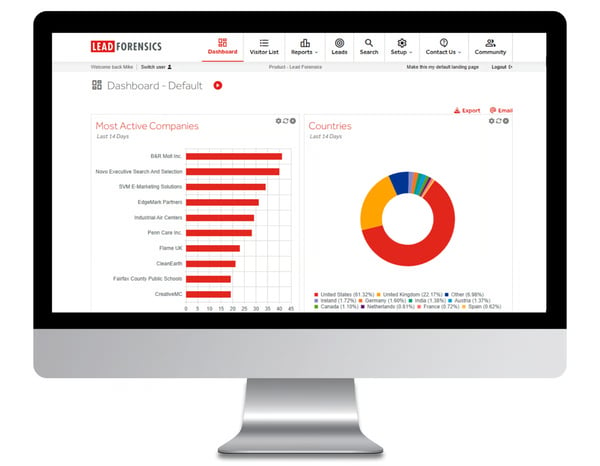
Real-time alerts are one of the most practically used features. The platform notifies sales reps or sends automated reports to HubSpot, Salesforce, or email the moment a target account lands on the website. Several G2 reviews note building their entire daily prospecting workflow around these alerts, checking which accounts visited overnight and prioritizing calls accordingly. As I dug into G2 reviews, I noticed praise for Lead Forensics’ trigger report feature for removing the manual step of distributing leads to the right rep each morning.
Page-level behavioral data shifts how reps approach outreach, and that’s the kind of detail that changes how you open a conversation. Knowing which pages a company visited, how long they spent on each, how many times they returned, and which products they were researching before a single call was made removes the cold from cold outreach. Users who note closing deals off the back of Lead Forensics data point to this page-level visibility as the reason conversations started warmer.
Lead Forensics’ support model is the detail I’d highlight early when evaluating this platform. Quality of support is rated at 96% on G2 Data, against a 92% category average, and the review text behind it is unusually specific. Dedicated account managers schedule regular check-ins, proactively surface optimization opportunities, and help configure the platform around each team’s specific sales motion.
Knowing which companies landed on pricing pages, product pages, and case studies only matters if the identification is right, and an account identification rating of 89% on G2 Data is what makes the visitor identification layer here specific enough to act on. G2 users describe accuracy at mid-sized and larger companies as strong enough to skip manual validation entirely and move straight to outreach.
Visitor data flowing into the CRM automatically, campaigns trackable back to specific account activity, and conversion tracking mapped to referral sources and campaign tags: that combination is what caught my attention in Lead Forensics’ review data. The ability to connect website visit data to specific marketing campaigns and measure which assets drive the most relevant traffic is what several reviewers describe as changing how their marketing team allocates budget.
Setup speed is a genuine differentiator here. Before you commit to any prospecting workflow built around website intent, it matters that the platform is live and producing data quickly. G2’s ease of setup score for Lead Forensics sits at 90%, and multiple reviewers describe getting the tracking script live, filters configured, and first alerts running within days of signing.
Individual-level contact identification is a boundary that G2 user data surfaces. The platform identifies companies visiting the website but cannot pinpoint which specific person clicked through. Several G2 reviewers flag this as a gap, particularly those working enterprise accounts where knowing the exact contact matters before outreach. Even so, company-level identification remains accurate and actionable for the majority of use cases, with reviewers describing it as sufficient to start a targeted conversation in most scenarios.
Lead Forensics’ reporting exports add manual steps to weekly workflows for some users, and feedback across G2 reviews points to this as a recurring friction point. Downloading segmented reports, managing multiple data cuts, and getting the right information to the right person manually takes more effort than reviewers expect, particularly for marketing teams running regular campaign performance reviews. What remains clear in the review data is that the underlying visibility into website activity is strong. Reviewers describe the data itself as accurate and useful, even where the export process adds steps.
Taken together, this is the right platform for companies where inbound traffic is already meaningful, but the sales team has no visibility into who’s behind it. It holds a G2 Score of 88 on the Fall 2026 Grid, with a Satisfaction score of 99 across 560 reviews, a 4.4 rating, and an NPS of 73 that sits above the 70 category average. Marketing teams running campaigns and wanting to close the loop between spend and pipeline activity will find it earns its keep quickly. The narrower your use case, the faster the return.
“What I like best about Lead Forensics, is that it helps us to identify potential customers that we may otherwise never have known were interested in our products or services. It enables us to be the first company in contact with the customer and it provides valuable insights that support our sales efforts. Also, our rep David has been incredibly helpful, making the initial set up smooth and continuing to provide us with excellent ongoing support.”
- Lead Forensics review, Chloe O.
“The main limitation I experienced was around reporting exports. For our weekly workflow, we needed to download and manage multiple segmented reports, which made the process more manual and time-consuming than ideal. But the team promptly helped fix that.”
- Lead Forensics review, Andrea P.
A RevOps lead is stitching together enrichment, audience building, and CRM routing across three tools, and every campaign waits on someone to run the export. GTM Studio - Powered by ZoomInfo is ZoomInfo’s upgraded successor to ZoomInfo Marketing and ZoomInfo Operations, and reviewers describe it as the place where audiences get built and CRM records stay clean from the same source. I’d point mid-market RevOps and marketing teams to it first.
G2 reviews still use both of the older names, which tells you who adopted it first. Marketers describe the ZoomInfo Marketing side, building audiences from intent and firmographic filters, while operations users describe the ZoomInfo Operations side, enriching and routing CRM records. Segmentation scores 89% on G2 Data, ahead of GTM Workspace’s 86%, which matches reviewers who say the filters build relevant segments quickly.
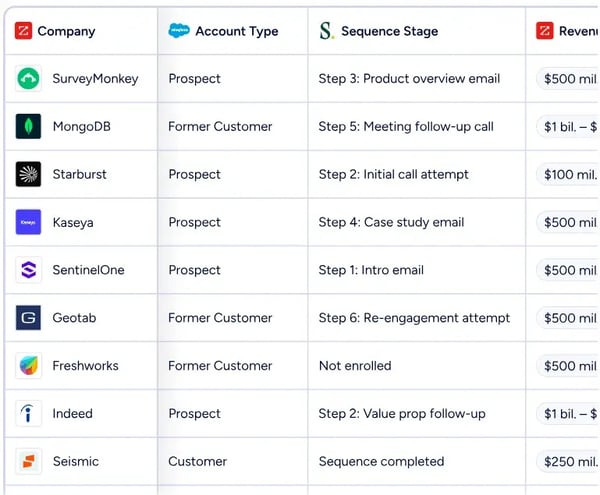
Audience building is where the marketing-side reviews concentrate. One reviewer says the intent and firmographic filters help build highly relevant segments quickly, saving research time and improving campaign quality, and another describes the ability to sort and segment as incredible, narrowing by location and sector. Account identification scores 90% on G2 Data, which is the number that backs those descriptions.
Combining intent data, visitor identification, and account-level insights is what reviewers say focuses effort on accounts that are actively researching solutions. The result they describe is higher-quality conversations and tighter alignment between sales and marketing around the same target accounts. Account-level insights score 87% on G2, matching GTM Workspace.
The operations side earns its mentions for data quality. Reviewers describe automatic enrichment, standardization, and routing of lead and account data, with less manual cleanup and fewer duplicates keeping the CRM and marketing systems aligned. One reviewer calls the automation builder one of the best tools for creating business automations, and the data connectors into CRM and marketing platforms are credited with cutting manual work.
Integrations reach the tools revenue teams already run. Reviewers cite Salesforce, HubSpot, and Marketo as the connections that make data enrichment and workflow automation seamless, and several describe the side plug-in as an easy way to check contact details and push them into the CRM. That breadth is what lets one team’s audience become another team’s routed lead without a handoff.
The feature set overwhelms new users, and that is the most consistent complaint in the review data. Several G2 reviewers describe a learning curve, a lengthy first setup, and CRM configuration that needs technical knowledge to fully integrate. Ease of setup scores 88% on G2 against an 89% category average, so the friction is real but close to what the category asks of every buyer.
Data freshness and price round out the dislikes. Reviewers report occasional outdated contacts that need validation, credit limits that feel restrictive on larger campaigns, and pricing that runs high for smaller teams. Lead analysis is its weakest feature score at 81% on G2, which fits the reviewers who say the data is mostly accurate but not always current.
GTM Studio holds a G2 Score of 86 on the Fall 2026 Grid, with a Market Presence score of 92 and a Satisfaction score of 80 across 456 reviews in this category. Its 4.5 rating is solid, though an NPS of 59 sits below the 70 category average, so I’d expect the experience to vary more by team than the score suggests. I’d reserve it for RevOps and marketing teams that want audience building and CRM enrichment in one workspace and have the capacity to configure it properly.
“I really like the ability to sort and segment in ZoomInfo Marketing; it’s incredible. You can narrow by so many factors, and while it’s not perfect, it can also give you an idea of what kind of companies to target by viewing by location or sectors, both primary or secondary. The lists provided have so much information, and it’s a great resource since many come with links to LinkedIn profiles as well as company LinkedIn pages.”
- GTM Studio - Powered by ZoomInfo review, Kathryn H.
“I find that ZoomInfo Operations can be somewhat complicated to configure, often needing a certain level of technical knowledge to achieve full integration with CRM systems. Additionally, the quality of the data is not always consistent, and the cost can be quite steep, especially for smaller teams.”
- GTM Studio - Powered by ZoomInfo review, Rashad S.
An outbound team is juggling a database, a sequencer, a dialer, and a CRM enrichment tool, and the seams between them cost hours every week. Apollo.io puts prospecting, sequencing, and enrichment in one platform, and I’ve read enough of these reviews to know when consolidation is a marketing claim and when it’s what people actually experience. With Apollo, the reviews agree: the switch stuck. I’d point SMB and mid-market outbound teams to it first.
Multi-step sequences combining email, call tasks, and LinkedIn touches, tracked from the same dashboard across open rates, reply rates, and meeting bookings, are what keep the entire outreach motion inside one workflow. In my reading of the reviews, this is the all-in-one argument that holds up under real usage: sequences run automatically once configured, with triggers that adjust cadence based on prospect behavior.
Apollo.io’s granular filtering runs deeper than standard firmographic options, and it surfaces frequently across G2 reviews. SIC codes, technographic filters, and natural language AI search let users build lists that reflect very specific ICP definitions without manual cleanup afterward. The AI search feature draws specific praise for translating a plain-language prospect description into filter-ready output in seconds.
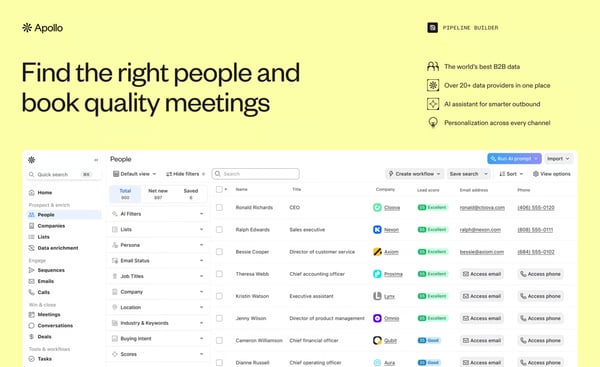
Pre-call briefs pulling company news, hiring signals, and technology data into a single view before outreach are what AI-assisted research delivers here. CRM enrichment is the capability that compounds this. What I see in the data is reps arriving at calls with contacts already updated, job changes flagged, and champion movements tracked across accounts, removing the manual research step that slows most outbound motions before the first dial.
Contact data breadth and verified email accuracy are where Apollo.io builds its floor in the G2 review data. It pulls segmented lists by industry, seniority, geography, technology stack, and company size, then exports directly into sequences without switching tools. On G2, the lead analysis score sits at 92%, the kind of accuracy your outbound motion depends on, and multiple reviewers describe Apollo as the first tool where verified emails land without the bounce rate that makes other databases unreliable at volume.
Buyer intent signals sitting alongside the contact and sequencing layer mean teams prioritize which accounts enter sequences first from directly within Apollo.io. The technographic data layer adds a targeting dimension that reviewers describe as changing how they personalize the first touchpoint. Account identification scores 91% on G2 Data, specific enough to inform personalization and broad enough to apply across large lists.
Once your CRM is connected, the enrichment loop runs without manual intervention. Apollo syncs bidirectionally with Salesforce and HubSpot, updating contact records automatically as job changes and company data shifts. The ease of setup score sits at 93% on G2 Data. The initial CRM connection is straightforward, with enriched data appearing in existing records quickly and sequences triggering from CRM fields without additional configuration once the integration is live.
Contact data accuracy is inconsistent across segments, and G2 reviewers describe this across various reviews. Outdated job titles, incorrect phone numbers, and email addresses that bounce despite showing as verified are the specific issues that surface most often. It is most felt by SDRs running high-volume outbound where every bad record compounds across a full sequence. Yet G2 users mention that Apollo’s verified email filter and enrichment capabilities meaningfully reduce bounce rates for teams that apply them correctly before launching sequences.
Multiple G2 reviewers highlight that feature density creates genuine friction for new users, the most immediate challenge after signing up. The platform covers prospecting, sequencing, dialing, enrichment, and analytics in one interface, and the volume of options makes it hardest for first-time users without prior experience on complex sales intelligence platforms. All considered, G2 reviews note that Apollo’s onboarding resources and in-platform guidance help new users find their footing faster than the feature volume suggests.
Apollo.io is the platform I’d point to for SMB and mid-market sales teams making their first serious investment in outbound infrastructure. It holds a G2 Score of 82 on the Fall 2026 Grid, built on a Satisfaction score of 95 across 2,257 reviews, with a 4.7 rating and an NPS of 91. A Market Presence score of 68 is what keeps it behind the ZoomInfo and 6sense platforms, not satisfaction. It delivers enough capability across prospecting, sequencing, and enrichment that the tool-consolidation argument holds up under real usage. For teams where budget discipline matters as much as feature depth, the value case here is hard to match.
“It offers great ability to find up to date contact information for prospecting and the advanced filters allows us to drill down and segment potential leads based on a wide range of attributes such as industry, seniority, geography and more.”
- Apollo.io review, Luzette K.
“Have come across outdated contacts within the system of people that we know to be retired.”
- Apollo.io review, Peter S.
Sales and marketing have finally agreed on a target account list, and now someone has to execute against it across ads, outreach, and reporting. Demandbase One is the platform enterprise teams use to do that from a single place, and what you get goes well beyond account identification. I’d point enterprise B2B teams with dedicated RevOps capacity to it, and G2 reviews mention the depth of the stack as the reason they stopped evaluating alternatives.
Anonymous website visitors identified, mapped to known accounts, and routed to reps in real time: that sequence is what the 89% account identification rating actually reflects. G2 user reviews mention catching high-value accounts mid-research, before those accounts filled out a form or responded to outbound, while engagement was still at its peak.
Demandbase One aggregates intent signals across third-party sources and first-party website activity, mapping them to accounts and buying stages so sales and marketing teams share a common view of who is warm and who is not. G2’s account-level insights score sits at 88%, and multiple reviewers describe intent as the layer that retired firmographic fit as the sole basis for account prioritization, replacing it with a signal that reflects what accounts are actually doing rather than what they look like on paper.
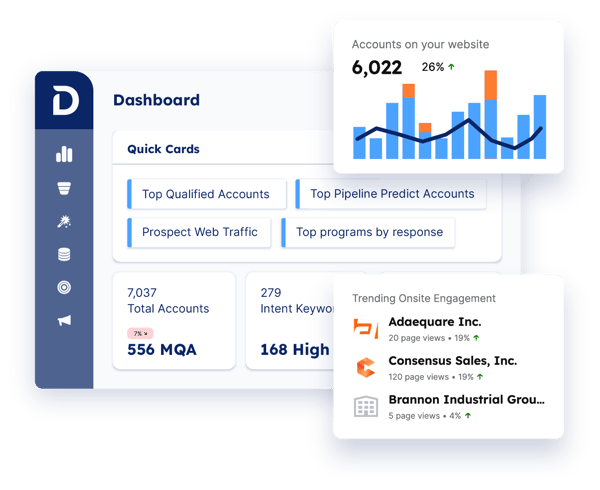
The engagement minutes model is where the data surprised me most. The platform rolls up every interaction from every contact at an account into a single buying committee score, so marketing and sales are not chasing individual leads but reading account-level heat. That shift from person-level to account-level scoring is what multiple reviewers describe as the most practically useful change to how their ABM program operates.
Native B2B advertising through Demandbase One’s own DSP is where I see the clearest ROI signal in the review data. The platform serves display ads directly to in-market accounts without a separate ad platform, and reviewers describe shifting budget away from broad audiences toward accounts already showing intent. The result across recent reviews is cleaner attribution and a tighter connection between ad spend and pipeline.
The orchestration layer eliminates the manual handoffs between marketing and sales that slow most revenue teams down. When a target account hits an intent surge, the platform triggers a Slack alert, adds the account to an advertising audience, and notifies the assigned rep simultaneously. This coordinated automation is the capability that most directly compresses time between signal and first outreach.
CRM integration with Salesforce and HubSpot performs well according to user reviews. Account scores, intent signals, and engagement data appear inside Salesforce without reps needing to leave their existing workflow, and the bidirectional sync keeps account records enriched without manual updates. On G2, the omni-channel tracking score is 83%, and the detail stuck with me across the review set: the ability to track account engagement across ads, website, CRM, and email in one view is the capability that finally made users’ ABM reporting defensible in a QBR.
A few G2 user reviews show that Demandbase One’s setup demands significant time. Intent configuration, CRM mapping, and audience setup all require dedicated ops resources before the platform delivers value. Smaller marketing teams without a RevOps function feel this most acutely. Notwithstanding this, feedback across G2 reviews shows that once operational, the platform runs account prioritization and campaign coordination on autopilot.
Reporting customization creates friction across multiple G2 reviews, with dashboard setup requiring multiple steps and technical knowledge. Marketing ops leads running regular campaign reviews feel this most when speed of insight matters. Though G2 review patterns show the underlying account intelligence is strong, and the account-level view consistently surfaces accurate, actionable data across the review set.
Demandbase One is built for enterprise B2B teams with dedicated RevOps capacity, a defined ICP, and an account-based program that needs to run across marketing, sales, and advertising from one place. It holds a G2 Score of 78 on the Fall 2026 Grid, with a Market Presence score of 85 doing more of the work than a Satisfaction score of 71 across 678 reviews. Its 4.4 rating is steadier, but an NPS of 58 and an ease of setup score of 82% both sit below the category averages of 70 and 89, which matches the setup load reviewers describe. The organizations with the strongest outcomes in G2 reviews are those where leadership is fully committed to the platform, not partially. That level of commitment is worth factoring into your evaluation.
“It unifies all my accounts and marketing journeys into a single source, so I don’t have to juggle multiple apps. I can easily identify anonymous profiles and focus only on real buyer accounts.”
- Demandbase One review, Masood A.
“Some reports and dashboards can take a bit of time to customize exactly the way you want. I’d like to see more flexibility in reporting and a simpler way to build custom views without having to dig through multiple settings.”
- Demandbase One review, Varun K.
A partner leader is asked to prove the ecosystem is worth the investment in a QBR, and the evidence lives in a dozen spreadsheets. Crossbeam replaces those with a live view of account overlap across partners, turning what used to be a gut-feel conversation about ecosystem value into something a revenue leader can act on. I’d point teams running a formal partner program to it first, and I’d say that shift alone justifies the evaluation.
Account mapping is the capability that stands out in the data, to me, because of how specifically reviewers describe its impact. The platform replaces a manual, spreadsheet-heavy process of emailing partner contacts, waiting for lists, and cross-referencing in Excel with a live, automated overlap view that updates as CRM data changes. Multiple G2 reviews note running partner QBRs, qualifying new partnerships, and identifying co-sell opportunities in minutes.
The data escrow model is what makes partner overlap data actionable at scale. Crossbeam shows only the accounts that overlap between two partners. Neither side sees the other’s full customer list. This security model removes the trust barrier that typically slows partner data sharing to a crawl, making adoption faster on both sides of a partnership.
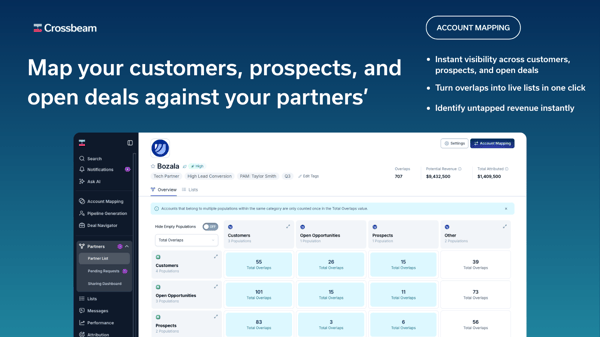
Partner overlap data surfacing inside Salesforce opportunity records, without reps needing to log into a separate tool, is a signal I wouldn’t ignore when evaluating this platform. Which partners are already engaged with a prospect, which mutual customers exist nearby, and which accounts are worth a warm introduction before cold outreach all become visible at the deal level. That context changes how AEs approach accounts in their pipeline.
Partner qualification is one of the most underrated applications on Crossbeam, and the G2 data makes a specific case for it. Overlap data used early in the partner evaluation process validates whether a partner’s customer base aligns with your ICP before legal agreements or co-marketing commitments are made. That data-led validation prevents low-value partnerships from consuming budget and resources before they start.
Slack and CRM alert automation draws frequent attention across G2 reviews. The platform notifies sales reps and partner managers automatically when a target account shows up in a partner’s book, removing the manual step of checking dashboards and distributing overlap data across teams. Reviewers describe this automation as the feature that moved the platform from a partner team tool to one the whole revenue function relies on.
Where I see the support model paying off most is in the co-sell motion, and the review set is specific about why. G2’s quality of support score sits at 96%, with CS teams helping configure sharing rules, build partner enablement workflows, and proactively surface new use cases as the ecosystem grows. For partner programs that are still maturing, that level of hands-on support is the difference between a tool that gets adopted and one that sits unused after the first month.
Partner data quality depends on what partners share, and G2 users note this as the most significant factor determining how much value Crossbeam delivers in practice. Several reviewers note that when a partner’s CRM is messy or their sharing rules are conservative, overlap data looks thin and AEs start to distrust the signals. That notwithstanding, the platform’s overlap identification and Salesforce integration continue to deliver reliable account visibility where partner data is maintained well, and that reliability is what drives daily adoption across sales teams.
Reporting depth draws feedback across multiple G2 reviews, with several reviewers describing the analytics layer as less flexible than the account mapping functionality. Pulling historical trend data, understanding how overlap has grown over time, and customizing what shows up in dashboards all require more effort than reviewers expect. Bearing that in mind, the core overlap and co-sell functionality, the part most sales and partner teams use every day, performs without friction and delivers the account-level visibility reviewers come for.
The teams getting the most from Crossbeam are ones where partnerships already have a seat at the revenue table. It holds a G2 Score of 74 on the Fall 2026 Grid, with a Satisfaction score of 89 across 355 reviews, a 4.8 rating, and an NPS of 89, against a Market Presence score of 58 that keeps it lower in the ranking than satisfaction alone would. It’s not a tool for building a partner program from scratch. It’s for making a mature one measurably more effective. For organizations where ecosystem intelligence is already part of the GTM conversation, this is the infrastructure that makes it real.
“Crossbeam is great for account mapping and for working with my partners to uncover hidden GTM opportunities.”
- Crossbeam review, Joseph M.
“Reporting is basic and the UI experience could be better.”
- Crossbeam review, Verified User in Computer Software
Messy account data limits what any intelligence tool can do. Check out G2’s breakdown of the best account data management software to clean up the foundation first.
A marketing director runs demand programs through an agency and learns how campaigns performed from a weekly status email, two days after the data went stale. INFUSE Demand Accelerator is the real-time dashboard layer for demand programs run with INFUSE, putting account reach, intent scoring, and lead delivery in one live view. I’d point enterprise marketing and field teams buying managed demand to it, with one caveat on fit that I cover below.
That caveat is about what you are buying. Reviewers describe the platform alongside INFUSE’s account team and campaigns, so it reads as the reporting layer of a managed program rather than a standalone data subscription. 56% of its Grid reviewers are enterprise, and only 32 reviews are counted in this category, which is why I weigh its scores with more caution than the larger platforms.
Usability is the pattern I saw most often. Ease of use scores 95% on G2 and ease of setup 94%, against 90% and 89% category averages, and reviewers say they can log in and read campaign performance immediately without digging through menus or waiting on a report from someone else.
The filtering depth is what makes the dashboard useful beyond a summary. One reviewer describes slicing performance by geography, account, job title, company size, revenue band, industry, ad size, and intent score, then reallocating budget toward the segments driving results. Account identification scores 92% on G2 Data and account-level insights 91%, both ahead of every other platform on this list except A-Leads.
Reporting up to leadership is where reviewers say the time savings land. Having performance data, account-level activity, and engagement trends in one interface cuts the time spent compiling status updates and cross-checking performance across campaigns, and one reviewer says it makes results easy to report on to leadership at a glance. Market insights score 90% on G2.
Support is the standout number. Quality of support scores 99% on G2, the highest on this list alongside A-Leads, against a 92% category average, and reviewers credit the INFUSE team for fast fixes, including one who saw a campaign missing from the dashboard after launch and had it resolved quickly. The direction score of 96% against a 91% average points the same way.
Depth is where reviewers want more. One asks for finer granularity and AI that explains why an ad or campaign is underperforming, instead of leaving them to tweak campaigns themselves. Predictive scoring is the weakest of its feature scores at 81% on G2, and omni-channel tracking and opportunity timeline both sit at 78%, so I wouldn’t buy it for forecasting.
Data timing and cadence draw smaller complaints. A reviewer using the dashboard from Europe describes occasional data lag because the feed runs on UTC, another notes inconsistent pacing of nurture reports, and one flags the quality of new video display banners. These read as operational rough edges, and reviewers describe the INFUSE team responding quickly when something is missing.
INFUSE Demand Accelerator holds a G2 Score of 69 on the Fall 2026 Grid, with a Market Presence score of 73 and a Satisfaction score of 66 across 32 reviews. Its 4.5 rating is solid and an NPS of 75 sits above the 70 category average. I’d reserve it for enterprise teams already running or considering INFUSE programs, where live visibility into delivery matters as much as the leads themselves.
“The dashboard is genuinely easy to pick up and navigate. I can log in and immediately get a clear read on how campaigns are performing without digging through menus or waiting on a report from someone else. Having everything centralized, performance data, account-level activity, and engagement trends in one clean interface saves me a lot of back-and-forth.”
- INFUSE Demand Accelerator review, Thomas G.
“I think it can get more granular so I can just hover around and get more details out of it. If we can integrate some sort of AI that can help us with insights on its own. Like, okay, your ad is not performing, so and so. CTR or your campaign is not reaching out to a certain segment, that would be better than for me to tweak my campaigns accordingly.”
- INFUSE Demand Accelerator review, Karandeep S.
A communications lead needs to know what the market is saying before the campaign brief is written, not after it launches. Brandwatch Consumer Intelligence starts with the market rather than the account list, pulling conversations from across the web into one query environment. I’d point enterprise brand, PR, and insights teams to it, and I wouldn’t evaluate it as a sales intelligence platform.
G2 feedback describes access to a volume of online data that competing social listening tools don’t match, with conversations across platforms, languages, and geographies pulled into a single query environment. The tool’s market insights score sits at 89% in G2 Data, and segmentation stands at 86%, reflecting coverage that most enterprise listening tools narrowed to fewer sources cannot replicate.
AI-powered sentiment analysis and trend detection sit at the core of how Brandwatch Consumer Intelligence delivers value, and that’s what I see making the AI layer genuinely useful here. The tools go beyond keyword matching, grouping topics automatically, detecting sentiment shifts across languages, and surfacing emerging trends before they show up in structured reporting. The Iris AI assistant draws specific attention for cutting the manual analysis step between raw data and usable insight.
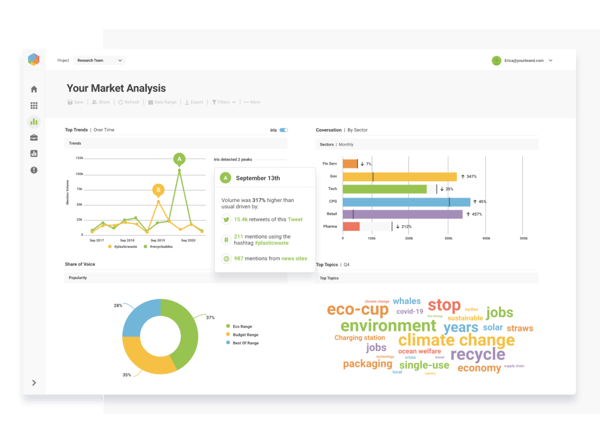
Highly specific Boolean queries filtering by source, language, geography, topic, and sentiment simultaneously change how precisely you can define what you are listening for across a 100M+ source environment. That level of query depth is what separates this platform from more rigid listening tools. It makes it possible to isolate a specific consumer behavior, sentiment shift, or emerging topic without the noise from broad keyword-matching returns, producing output specific enough to act on without a secondary filtering pass.
Real-time data access means signals surface as conversations happen, and that detail comes through in Brandwatch Consumer Intelligence’s review data clearly. Brand mentions, competitor activity, and emerging topics are trackable as they develop, with alerts firing when specific thresholds are crossed. The tool’s omni-channel tracking score sits at 80% in G2 Data, and the real-time layer is described as essential for crisis communication and campaign tracking simultaneously.
The competitive monitoring capability is where my attention landed most in the review data. Competitor brand sentiment, share of voice, and campaign performance benchmarks against category peers are all trackable from a single environment. For brand strategy and communications teams that need to place their own performance in a competitive context, this is a capability the account-focused platforms in this list aren’t built to address.
Dashboard and reporting tools give teams the ability to build custom views and schedule automated reports for senior stakeholder consumption. Metrics covering brand health, campaign performance, or competitor benchmarking surface in views tailored to each team’s remit. Brandwatch Consumer Intelligence scores 86% for customization on G2, reflecting a reporting layer flexible enough to serve very different internal audiences from a single data environment.
Query configuration and initial setup take significant time before output is clean, and G2 reviews note this as the most consistent friction in the early experience. Marketing and communications professionals new to structured social listening feel this most acutely, expecting plug-and-play output from day one. Beyond that, data quality and depth of insight improve significantly as queries are refined over time.
Coverage gaps in YouTube analytics and Instagram dark posts limit the depth of data on those channels, and G2 reviews flag this as a platform boundary. Social teams whose primary audiences live on video and paid social feel this most directly. Outside of that, G2 review patterns show coverage across mainstream social, news, and blogs is described as broader than competing tools at the same price point.
Brandwatch Consumer Intelligence belongs in the stack of enterprise brand, PR, and insights teams tracking market sentiment and competitive positioning at scale. It holds a G2 Score of 69 on the Fall 2026 Grid, with a Market Presence score of 75 and a Satisfaction score of 63 across 128 reviews, a 4.4 rating, and an NPS of 72. I wouldn’t evaluate it as a sales intelligence platform, but for the audience it is built for, there’s little that matches its depth.
“What I appreciate most about Brandwatch Consumer Intelligence is how it transforms vast amounts of unstructured data into clear, actionable insights. The platform’s comprehensive social listening, along with its robust segmentation and sentiment analysis features, makes it significantly easier to gain a genuine understanding of consumer behavior and market trends.
I also highly value the platform’s flexibility, whether I’m building tailored queries or designing dashboards that effectively communicate insights to various stakeholders. Additionally, the support and training team is exceptional. They are responsive and knowledgeable.”
- Brandwatch Consumer Intelligence review, Karla D. S.
“YouTube is captured directly without query, but does not have the analytical data.”
- Brandwatch Consumer Intelligence review, Verified User in Market Research
An outbound team expanding into Europe gets a campaign flagged for data compliance three weeks into the quarter. Cognism was built around that reality, pairing GDPR-compliant contact data with phone-verified mobile numbers. I’d point EMEA-focused outbound teams to it first, and the teams in the review data describe it as the reason they switched.
The Diamond Data capability is where the review data caught my attention most. The platform manually verifies a subset of mobile numbers. Users mention these as the contacts where a human has confirmed the number is correct and the person is still in the role. Diamond Data is the feature that most directly improved their connection rates on cold calls, with several noting that verified mobile numbers reach decision-makers at rates that unverified data rarely matches.
Cognism was designed to operate where real compliance friction is most pronounced: European markets. Teams that switched from US-centric databases report eliminating the compliance overhead that used to slow down their EMEA campaigns. That’s because data protection standards apply at the point of export, flagging any contacts that fall outside GDPR-compliant parameters before they enter a sequence.
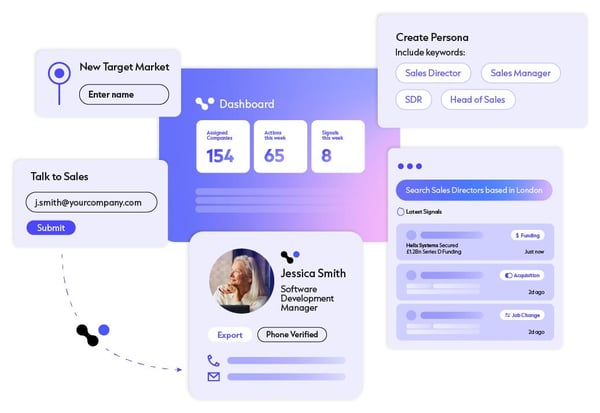
Clicking through to a LinkedIn profile and surfacing verified contact details, direct dial, mobile, and email, without leaving the browser, is what the Chrome extension delivers, and that detail stuck with me as I read through the reviews. Multiple G2 user reviews describe it as the feature they use most in their daily workflow, collapsing what used to be a multi-tool research step into a single click. Some user reviews note that they reduced their pre-call research time by more than half after adopting it as their primary prospecting method.
Cognism’s granular filtering across geography, job title, seniority, company size, technographics, and revenue allows SDRs to build precise lists without manual cleanup afterward, and the kind of filter depth that changes how you define a target list is exactly what multiple reviewers describe. G2’s segmentation score sits at 87%, with reviewers describing the combined regional, city-level, and technographic filters as providing depth that eliminated the need for manual cleanup between list-building and campaign launch.
Clean, fast syncing with Salesforce, HubSpot, Outreach, and SalesLoft is what the CRM integration pattern delivers, and it stood out as a genuine strength across the review set. Contacts flow into existing records and sequences without manual import steps, and users mention going from signed contract to first data export within days, a setup speed that most platforms in this category don’t match.
Job change tracking surfaces in multiple recent G2 reviews as a capability worth knowing before you commit to an EMEA outbound motion. The platform alerts users when a tracked contact changes role or organization, and several reviewers describe this as the feature that turns cold outreach into warm outreach. A champion moving to a new company is a high-conversion opportunity. The platform flags it automatically, and reviewers describe acting on those alerts as one of their highest-yield prospecting triggers across the week.
Record freshness is an inconsistent experience in niche industries and smaller markets, and several G2 reviews surface this as a sticking point in Cognism’s daily use. Outdated job titles, contacts who have already left their organization, and missing direct dials surface regularly, particularly where refresh cycles lag behind fast-moving sectors. What is clear regardless is that Diamond-verified contacts hold up significantly better, and reviewers describe verified records as reliable enough to act on directly.
Email accuracy is a separate friction point from mobile data, and G2 reviewer accounts point to this across multiple reviews. Several G2 user reviews describe email addresses flagged as verified that bounce on send, formats listed as guessed, and personal mobile numbers surfacing in place of business lines. That much is clear in the review data, though: phone-verified Diamond Data outperforms the email layer, and mobile connect rates still stand as the platform’s most dependable output for outbound teams.
Cognism is the natural starting point for outbound teams whose primary markets sit outside North America. It holds a G2 Score of 68 on the Fall 2026 Grid, with a Satisfaction score of 71 across 260 reviews, a 4.5 rating, and an NPS of 78. Ease of admin scores 94% on G2 against a 90% average, which supports the picture of a platform outbound teams run without much overhead. The GDPR-first architecture and the depth of mobile verification are not add-ons. They reflect what the platform was designed for. For revenue teams where European and APAC market penetration is the growth priority, your evaluation should start here before looking elsewhere.
“Accuracy and freshness of the contact data are strong. I also value the depth of the B2B intelligence, especially details like direct dials, mobile numbers, and verified emails. On top of that, the platform is easy to use, with an intuitive interface that makes it straightforward to navigate.”
- Cognism review, Verified User in Computer Software
“I sometimes find contacts not updated, emails missing or even companies missing at all. It’s rare but it happened. Diamond verification is 50% effective to fix it and I believe there’s room for improvement.”
- Cognism review, Mauro V.
An SDR spends the first hour of every day validating contacts before making a single call. A-Leads made a specific commercial bet that revenue teams would pay more for data they could act on immediately than for a larger database they had to check first, and the reviews suggest that bet landed. I’d point high-volume outbound teams where data quality is the bottleneck to it first.
The reliability pattern across reviews led me to notice that the contact data is accurate enough to act on straight out of the platform, with no manual validation step before first contact. Reviewers across industries describe this as the change that most directly compressed the time between sourcing a contact and making the first call.
Direct dial and mobile coverage together drive outbound connect rates, and the mobile coverage story is one I kept returning to in the data. G2 user reviews note a measurable increase in connections and meeting volume after switching to A-Leads from platforms with weaker mobile data. Verified mobile numbers reach decision-makers at a rate that email-only prospecting cannot match, and the pattern across those reviews is specific enough to take seriously.
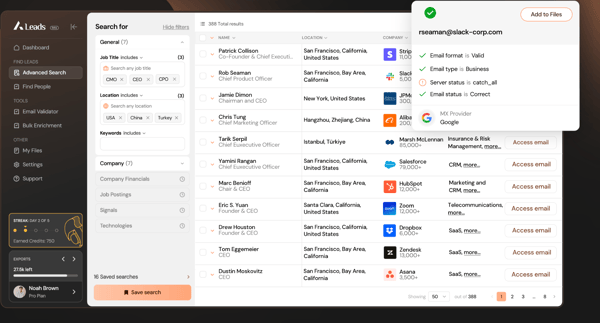
GDPR-compliant data isn’t a checkbox feature for reviewers in this data set. It is an operational requirement that unlocks outreach in regulated and European markets, and the kind of compliance layer that changes how you approach regulated markets is exactly what multiple reviewers describe. Reviewers across healthcare, cybersecurity, financial services, and the public sector describe A-Leads as the platform that gave them confidence to run outbound campaigns without legal review overhead. The compliance layer is built into the data at the point of export.
Targeting filters across geography, job function, seniority, industry, and company size allow revenue teams to build precise segments without manual cleanup afterward. Filtering by regional headquarters, city-level location, and specific seniority bands in a single search produces export-ready lists that map directly to campaign requirements. G2’s segmentation score sits at 99%, and that number stood out to me in the review set. It reflects what reviewers experience in practice, not just the availability of features.
Reps navigating the interface and exporting lists from day one, without a formal training process, is what the ease-of-setup story here is actually about. The platform integrates into existing CRM workflows, and sales and marketing teams are often working from the same data within the first week. Several reviewers describe time-to-value as immediate, with outreach beginning within days of implementation and no operational overhead required to get teams productive, supported by an ease of setup score of 99% on G2.
Outbound efficiency compounding over time is the outcome I see repeated across the review data most clearly. Less time lost to bad data translates into a more consistent pipeline rather than a one-time lift in activity, and reviewers describe that improvement as something that builds quietly without requiring process changes.
Coverage gaps in niche and highly specialized industry segments surface across multiple G2 reviews as the most relevant boundary in A-Leads’ data. Contact volume thins out in emerging and highly niche industries, and G2 reviewers also name government-adjacent verticals as a weaker area. Anyone building lists deep inside those segments runs into it first. Even so, G2 reviewers selling into specialized and public-sector markets say coverage stays solid for most of their outreach, and support responds when gaps are flagged.
G2 reviewers note that in-platform reporting lacks the depth that leadership and operations teams need as usage scales. G2 users mention wanting clearer visibility into usage trends, team-level performance, and pipeline impact rather than exporting to a separate reporting tool, a friction point most felt by revenue operations managing multi-team outbound programs. For all this, G2 users note that the core prospecting and enrichment capabilities perform well, and reviewers describe outbound output improving consistently, even where reporting requires supplementing externally.
A-Leads fits a specific motion: high-volume outbound where the bottleneck is data quality, not strategy. It holds a G2 Score of 67 on the Fall 2026 Grid, with a Satisfaction score of 95 across 113 reviews, a 4.8 rating, and the highest NPS on this list at 98. A Market Presence score of 39 is what keeps its score down, not its reviews. The platform is built for teams that already know who they want to reach and need the data to hold up at the moment of contact. If your pipeline problem is execution speed rather than audience definition, this is the tool that gets out of the way and lets the outbound run.
“I enjoy using A-Leads as it is highly user-friendly and straightforward, allowing for seamless navigation and use. I am impressed by how quickly I can export data, which is crucial for building effective lead lists for our marketing outreach campaigns. The reliability of A-Leads’ data stands out, providing verified real-time data that supports our efforts to scale marketing campaigns efficiently. I am particularly satisfied with A-Leads as a robust data source for enhancing our marketing objectives. Additionally, the platform’s ability to provide the necessary leads at an impressive speed, for instance, obtaining over 80,000 leads per month in just 10 minutes, outperforms other platforms significantly. The ease of setup further solidifies my trust in A-Leads, and the platform’s capacity to clean leads for export is a substantial advantage. Given these features, I confidently rate A-Leads a perfect 10 on the recommendation scale.”
- A-Leads review, John D.
“I would like more leadership level reporting in the platform, mainly to see usage patterns and impact across teams without exporting data elsewhere. Not a blocker, but it would be a nice upgrade as we grow.”
- A-Leads review, Vahit K.
A recruiter, an M&A analyst, and a founder all need the right contact today, and none of them is buying a platform built for a team ten times their size. RocketReach serves that spread with a broad contact database at flexible price points. I’d point individual contributors and small teams to it first, and what they share is a need to find the right person fast.
Database breadth makes the platform worth evaluating for teams whose ICP includes privately held companies, regional businesses, and decision-makers in specialized fields. These are the segments where competing tools return empty results, regardless of how large their headline database numbers are. G2 reviews describe a success rate of 80 to 90% on finding the right contact across these segments, which, for a database at this price point, holds up under scrutiny.
As I dug into G2 reviews, I noticed several reviewers mention RocketReach’s CRM integration. HubSpot and Salesforce connections pull contact data directly into existing pipelines. For individual contributors and small teams managing outreach without dedicated ops support, that direct connection keeps RocketReach inside the daily workflow rather than sitting as a separate research step.
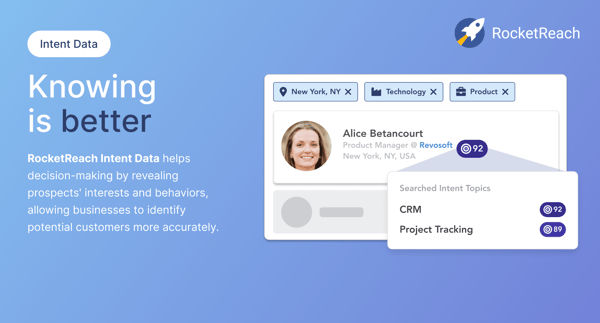
The LinkedIn Chrome extension draws praise across the review data as the feature most directly integrated into daily workflow. It pulls verified emails and phone numbers directly from LinkedIn profiles right in the browser, collapsing what used to be a multi-step research process into a single click. This is worth highlighting before you settle on a more expensive alternative that offers the same core capability at a higher price point.
Search and filtering flexibility lets users narrow by job title, company, geography, industry, and seniority across the full database. Multiple G2 user reviews describe running bulk lookups at scale and exporting thousands of contacts in a single pull, removing the manual research step entirely. The ease of setup score sits at 93% in G2 Data, and that detail emerged clearly as I read through the reviews: value starts flowing immediately, with a one-click signup and nothing to configure first.
Flexible, lookup-based pricing is the differentiator that G2 reviewers mention as the reason they chose RocketReach over more expensive alternatives. Individual plans, team plans, and credit-based lookup models let smaller teams only pay for what they use.
Ease of use is what keeps RocketReach in the daily workflow rather than becoming a platform people dip into occasionally and have to relearn each time. Reviewers describe the interface as clean and direct, with nothing buried behind menus or platform-specific logic. At 91% for ease of use on G2, that score reflects what reviewers consistently describe: a platform that behaves predictably and gets out of the way.
Contact data becomes stale faster than the platform can refresh it, and G2 feedback mentions outdated records as the most consistent friction in daily use. Contacts who left their company months ago remain listed, which hits SDRs running high-volume outbound sequences where every wasted credit and bounced call compounds across a full day of prospecting. Weighing that, accuracy for active contacts at mid-sized and larger companies holds up well, and the hit rate on finding the right person remains strong.
Email accuracy is a separate friction point from general staleness, with verified addresses bouncing on send and guessed formats appearing across RocketReach’s G2 reviews. This affects email-first outbound teams most directly, where deliverability issues damage sender reputation and reduce campaign effectiveness at scale. Setting that aside, phone number accuracy and database breadth continue to deliver consistent value, and the platform remains the go-to when other tools come up empty.
RocketReach suits individual contributors, small teams, and anyone whose prospecting needs outpace what free tools offer but fall short of justifying an enterprise data contract. It holds a G2 Score of 67 on the Fall 2026 Grid, with a Satisfaction score of 74 across 245 reviews and a 4.4 rating. An NPS of 61 sits below the 70 category average, and quality of support scores 85% against a 92% average, which fits a self-serve tool more than a managed one. The decision to choose it tends to be fast and practical rather than strategic. For users who need to find the right person quickly across a wide range of company types, it delivers.
“RocketReach is a no-nonsense app that delivers results without adding unnecessary steps. It is easy to use and gets us exactly what we need every time.”
- RocketReach review, Sarah F.
“I have some issues with the consistency of getting high-quality email records that don’t bounce back. Right now, I’m only getting about fifty percent success with that. It would be great if I could get higher quality emails. Also, there are times when every single email for a company bounces back, even if they all have a good rating. I might go through numerous pages and still not find a single verified email.”
- RocketReach review, Verified User in Packaging and Containers
|
Software |
G2 rating |
Free plan |
Ideal for |
|
GTM Workspace - Powered by ZoomInfo |
4.5/5 |
No, free trial available |
Enterprise and mid-market revenue teams running intent-led GTM motions |
|
6sense Revenue Marketing |
4.2/5 |
No |
Mid-market and enterprise B2B teams running full ABM programs |
|
Lead Forensics |
4.4/5 |
No, free trial available |
B2B sales and marketing teams converting website traffic into an outbound pipeline |
|
GTM Studio - Powered by ZoomInfo |
4.5/5 |
No |
RevOps and marketing teams automating GTM plays and data enrichment |
|
Apollo.io |
4.7/5 |
Yes |
SMB and mid-market teams running high-volume outbound prospecting |
|
Demandbase One |
4.4/5 |
No |
Enterprise B2B teams running account-based marketing with dedicated RevOps |
|
Crossbeam |
4.8/5 |
Yes |
Partner and ecosystem teams mapping account overlaps for co-selling |
|
INFUSE Demand Accelerator |
4.5/5 |
No |
Enterprise demand and field marketing teams tracking program performance in real time |
|
Brandwatch Consumer Intelligence |
4.4/5 |
No |
Enterprise insights, PR, and comms teams running consumer and brand intelligence programs |
|
Cognism |
4.5/5 |
No, demo only |
Outbound teams prospecting into EMEA markets requiring verified mobile data |
|
A-Leads |
4.8/5 |
No, free trial available |
SDR teams and agencies needing high-accuracy verified contact data at scale |
|
RocketReach |
4.4/5 |
Yes, 5 lookups/month |
Individual contributors and small teams needing flexible contact lookup access |
* These software products are top-rated in their category, based on G2’s Fall 2026 Grid® Report.
Got more questions? G2 has the answers!
Trust shows up in recommendation scores and review volume. Among these platforms, A-Leads posts the highest NPS on the Fall 2026 Grid at 98, followed by Apollo.io at 91 and Crossbeam at 89, against a category average of 70. GTM Workspace - Powered by ZoomInfo holds the highest G2 Score at 95 across 2,502 reviews, which makes it the most heavily reviewed name on the list.
Targeting the right accounts depends on identification and segmentation accuracy. A-Leads leads this list for account identification at 99%, followed by INFUSE Demand Accelerator at 92%, Apollo.io at 91%, and GTM Studio - Powered by ZoomInfo at 90%. Segmentation tells a similar story, with INFUSE and Apollo.io both at 91% and GTM Studio at 89%.
Adoption splits by team size. Lead Forensics reviewers are 59% small business and 38% mid-market, and it scores 90% for ease of setup. 6sense Revenue Marketing skews 41% enterprise and scores 79% for ease of setup against an 89% category average, while Demandbase One reviewers are 37% enterprise and its 82% for ease of setup shows the same ramp.
G2 reviewers flag stale records most often on RocketReach, where contacts who left their company months ago stay listed and some verified emails bounce, and on GTM Workspace - Powered by ZoomInfo, where SMB accounts, niche roles, and Canadian data age faster than the platform refreshes them. Cognism reviewers report the same in niche industries and smaller markets, though its phone-verified Diamond Data holds up better.
Lead Forensics gives reps page-level visit data, so conversations open with what a company actually researched, and it holds a 99% Satisfaction score. 6sense Revenue Marketing identifies anonymous in-market accounts and places them in buying stages before they fill out a form. Demandbase One triggers alerts and ad audiences when a target account hits an intent surge.
Apollo.io pairs 2,257 Grid reviews with a 92% lead analysis score, and its filters by seniority, industry, and technology stack export straight into sequences. A-Leads scores 99% for lead analysis, and reviewers describe acting on its verified contacts without a manual check before the first call.
Cognism and RocketReach both run Chrome extensions on LinkedIn. Cognism surfaces verified direct dials, mobile numbers, and emails from a profile in one click, while RocketReach pulls verified emails and phone numbers the same way and supports bulk lookups that export thousands of contacts in a single pull. Email accuracy is inconsistent on both, so verified addresses are worth checking before launching high-volume sequences.
Start with how the platform verifies contacts and where its coverage is strongest. Cognism’s phone-verified Diamond Data and EMEA coverage suit European outbound, while A-Leads scores 99% for segmentation and reviewers describe acting on its data straight out of the platform. Then check regional and segment fit, since GTM Workspace - Powered by ZoomInfo performs best on North American mid-market and enterprise accounts, and test CRM sync before committing.
Demandbase One rolls every interaction at an account into a single buying committee score and serves ads to in-market accounts through its native DSP. Crossbeam surfaces partner overlap on accounts already in your pipeline so reps can ask for warm introductions before cold outreach. GTM Studio - Powered by ZoomInfo builds audiences from intent and firmographic filters and scores 89% for segmentation.
GTM Workspace - Powered by ZoomInfo is the strongest for decision-maker data, with verified direct dials and mobile numbers across mid-market and enterprise accounts and the highest G2 Score on the Grid at 95. 6sense Revenue Marketing adds buying stage prediction for sequencing outreach, and Demandbase One covers enterprise buying committees with account-level scoring.
The shift happening in this category is not about adding more data. Most revenue teams already have more data than they can handle. What’s changing is the expectation that the platform does more of the interpretation work, surfacing the right account at the right moment, not just making the data available somewhere in a dashboard.
That changes how you should evaluate these tools today. The question to ask is not “what data does this platform have?” It’s “how quickly does this data change what my team does tomorrow morning?” Platforms that answer that question cleanly, through tight CRM sync, predictive prioritization, and workflow-level automation, are the ones pulling ahead. The ones that stop at the data layer are becoming expensive reporting tools.
Buying committees are shortlisting faster, engaging sellers earlier, and arriving at first contact with most of the decision already made. The platform you pick shapes your ICP model, your segmentation logic, your ad targeting, and how your SDRs start their week. The teams with the right infrastructure already in place will be on those shortlists. The ones still evaluating will be watching deals close without them.
Want to turn account intelligence into pipeline conversations? Explore G2’s guide to sales engagement software and find the tools that move prospects from signal to outreach.