

This piece breaks down who actually buys NLG software, how fast it pays back, and where verified buyers say it still falls short.
Natural Language Generation (NLG) is a branch of artificial intelligence that automatically converts structured data into readable, human-like text such as reports, summaries, and product descriptions.
Unlike analytics tools that visualize numbers, NLG narrates them, so a dashboard can effectively explain itself in plain English to non-technical readers. On G2, buyers primarily evaluate NLG software on two factors: the quality of its AI-generated narratives and how well it integrates with existing business intelligence and analytics platforms.
NLG works in three broad steps:
Most modern NLG tools are built on the same large language models that power general-purpose generative AI, which is why today's platforms need far less manual rule-building than the template-based systems of a few years ago. It helps to remember that generation is one half of the wider field of natural language processing (NLP): NLP reads and interprets language, while NLG produces it.
According to G2 review data, natural language generation software is used most by hands-on practitioners rather than IT departments. Its most common jobs are automated reporting, data-to-text summaries, and scaled content creation.
End users account for over 1,353 reviews, nearly ten times the 142 reviews from administrators. Consultants and agencies add several hundred more. Most buyers adopt NLG software to solve their own workflow challenges first, whether that's producing reports faster, generating content at scale, or reducing repetitive writing tasks.
That is where integration becomes the deciding factor: connecting the NLG tool to systems the organization already runs, such as BI dashboards, CRMs, and content platforms, so generated text flows into everyday workflows instead of living in a separate window. Operations, marketing, and analytics teams are among the most active reviewers, which is why buyers frequently search for the most trusted NLG tools for operations teams based on user reviews.
By industry, G2 Data shows the heaviest NLG reviewers come from Information Technology and Services (309 verified reviews), Computer Software (249), and Marketing and Advertising (124), followed by Accounting (80), Education Management (78), and Financial Services (54).
The pattern is telling: NLG is no longer just a marketing copy story. Verified reviews from accounting, education, and financial services buyers show the category spreading into regulated, reporting-heavy functions where turning structured data into plain-language narrative saves real hours. Small businesses drive the volume, contributing 55% of all verified NLG reviews, so pricing, self-serve onboarding, and ease of use are judged first by lean teams without dedicated IT, not by large procurement committees.
For those teams, a tool that works out of the box and shows value in days beats a more powerful one that needs weeks of configuration.
The honest answer from G2 Data: natural language generation tools improve speed far more than they improve quality.
The same capabilities show up at the top of both the "pros" and "cons" lists. According to G2's theme analysis, "artificial intelligence" is the single most-loved theme (97 verified reviews) yet also a top complaint (37). "Productivity enhancement" is loved in 68 reviews and disliked in 47. In other words, the engine that saves buyers time is the same one they flag for inconsistent output.
Verified buyers are specific about where quality breaks down. One verified user noted that with longer content, some tools start to use similar words and tonality repeatedly, degrading the quality of the content. Another reviewer highlighted weak handling of highly specialized industry terminology, while a third found that generated copy became generic and repetitive unless prompts were carefully refined. Pricing was the fourth most common complaint theme (39 verified reviews), a reminder that perceived value drops fast when output needs heavy editing.
Still, satisfaction stays high on the core promise of speed: category leaders like Microsoft Copilot, Quill, and Anyword carry G2 star ratings from 4.4 to 4.8. Put simply, NLG handles the hard part of starting, turning raw data or a blank page into a first draft in seconds, but it does not yet handle finishing, which is the human review needed to fix tone, check facts, and tailor wording to a specific audience. For most buyers, the best natural language generation platforms are the ones with easy setup and configuration that get that first draft into a human's hands fastest.
According to G2's analysis of verified NLG reviews, payback is fast for most adopters. Of the 260 reviewers who reported an estimated ROI period, 149 (57%) recouped their investment in six months or less, and 203 (78%) did so within twelve months. Long paybacks are rare: only about 12% of those reviewers reported a return that took longer than two years.
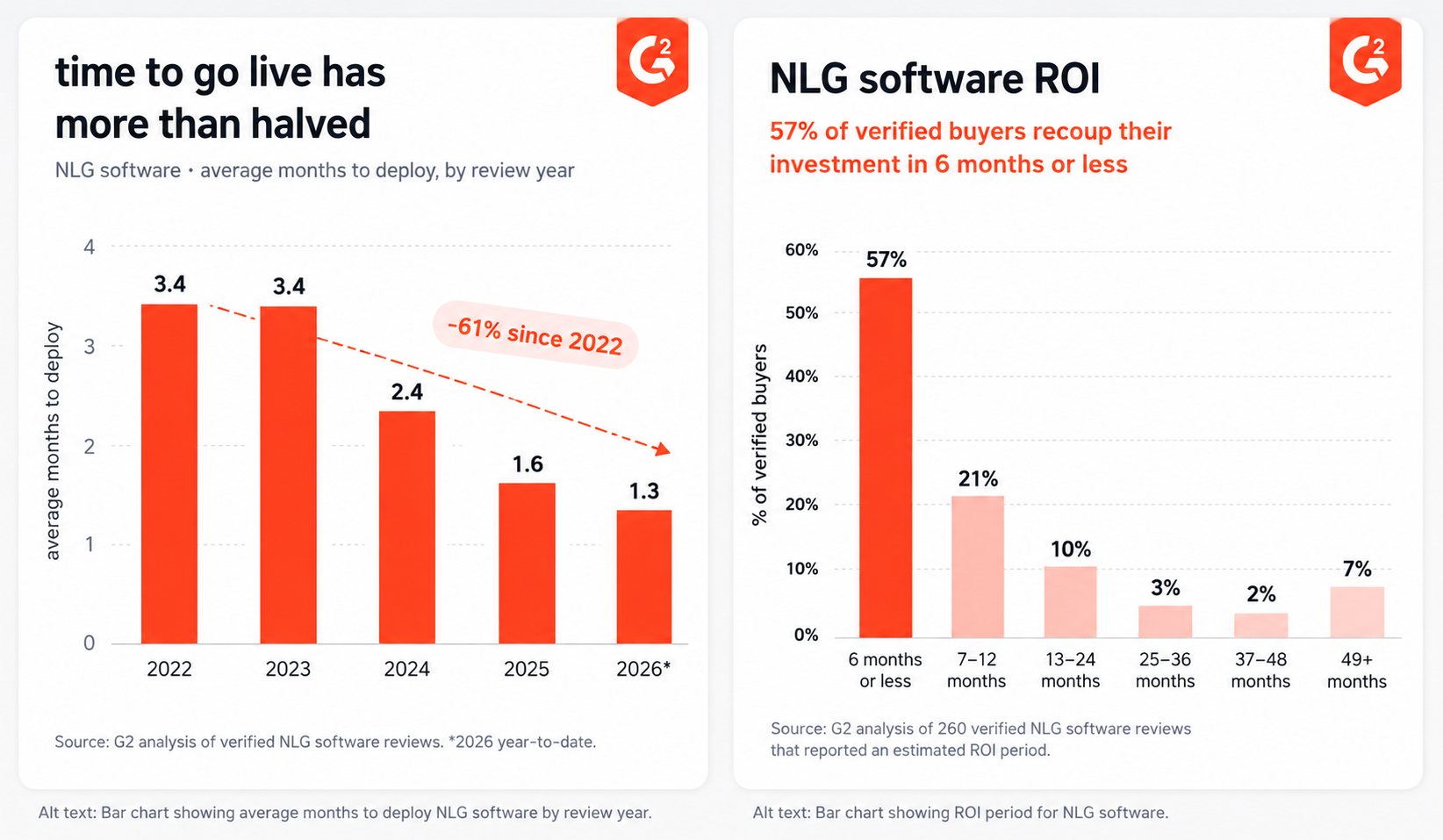
Time-to-value is shrinking; the time between buying an NLG tool and getting usable work out of it keeps getting shorter. G2 Data shows the average time to go live with NLG software dropped from roughly 3.4 months in 2022 and 2023 to about 1.3 months so far in 2026.
The reason is technical: as NLG tools moved onto general-purpose generative AI models, they arrived pre-trained and ready to use, so buyers no longer had to hand-build language rules or templates before seeing results. The outcome is lighter onboarding, meaning less setup, less configuration, and a faster path to first output. The headline for buyers: an NLG tool that took a quarter to deploy three years ago now often goes live in weeks. A tool bought this quarter is creating value this quarter, not the next.
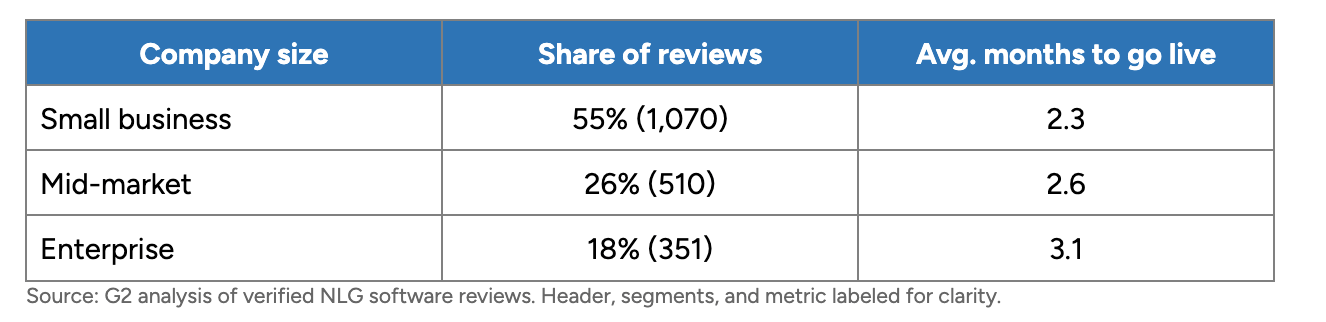
According to G2 Data, the deployment gap by company size is real but narrow: enterprises take about 3.1 months to go live versus 2.3 months for small businesses. Bigger buyers wait longer, but not because the software is more difficult to operate. Enterprises simply have more to connect, including existing data systems, security and compliance reviews, and internal approval steps. The extra time comes from the process, not from the product being harder to use.
According to G2 Data, verified NLG reviews jumped from 116 in 2022 to 1,034 in 2023, a nearly ninefold rise in a single year. The trigger was the public arrival of mainstream generative AI, which was launched by ChatGPT in late November 2022. Within months, general-purpose language models moved from research demos into everyday business tools.
Public data shows the same shift across the wider economy. The U.S. Census Bureau's Business Trends and Outlook Survey found the share of American firms using AI in production climbed from roughly 4.6% in early 2024 toward 10% by 2025. For NLG buyers, the practical signal is not market size but maturity. By maturity, we mean the category has moved past early hype into proven, repeatable results: G2 now holds far more verified reviews, faster reported deployments, and clearer ROI evidence than it did just two years ago.
Natural language generation (NLG) software turns structured data into plain-language text, and the 2026 verdict from verified buyers is clear: it delivers speed, but not yet finished quality.
Based on G2's analysis of 1,940 verified Natural Language Generation (NLG) software reviews, buyers adopt these tools to save time, and most do. Among reviewers who reported a payback period, 57% recouped their investment in 6 months or less. But the same reviews expose a speed-versus-quality gap: buyers love how fast NLG works, yet they do not always trust its output.
What is an example of natural language generation?
→ A common example is an automated performance report: an NLG tool takes a spreadsheet of sales figures and writes a short narrative such as "Q2 revenue rose 8% over Q1, driven by strong demand in the Northeast." Product descriptions, financial summaries, and dashboard commentary are other everyday examples.
What is the main purpose of NLG?
→ The main purpose of natural language generation is to turn data into clear, human-readable language at scale, so people can understand and act on information without reading raw numbers or building the narrative themselves.
What is the difference between natural language generation and natural language processing?
→ Natural language processing (NLP) is the broad field of teaching machines to work with human language. NLG is the subfield focused on producing language. In short, NLP reads; NLG writes.
Is ChatGPT NLG?
→ Partly. ChatGPT is built on large language models and performs natural language generation when it writes text, but it also does understanding and reasoning. NLG is one of the things ChatGPT does, not the whole of what it is.
How does natural language generation software handle data privacy?
→ It varies by vendor. Enterprise NLG tools typically offer controls such as data encryption, options to avoid using customer data for model training, and regional data hosting. Because these tools often connect to sensitive business data, buyers in regulated industries should confirm compliance certifications and data-handling terms during evaluation. This is a key reason enterprise deployments include added security review.
Which is the highest-rated natural language generation software for rapid deployment and quick adoption?
→ On G2, the highest-rated NLG products include Anyword (4.8 stars), Quill (4.5 stars), and Microsoft Copilot (4.4 stars). Rapid deployment is now the category norm: verified reviewers report average time to go live has fallen to about 1.3 months in 2026, supporting quick adoption.
What are the most trusted NLG tools for operations teams, based on user reviews?
→ G2 does not rank by team specifically, but NLG adoption is led by hands-on practitioners: end users file 1,353 verified reviews versus 142 from administrators. The most-reviewed, highest-rated options are the most trusted by verified users overall, with operations, analytics, and marketing teams among the most active reviewers.
What are the best natural language generation platforms for easy setup and configuration?
→ Easy setup is a top category strength, since NLG tools now run on pre-trained generative AI models that need little rule-building. Small businesses, which file 55% of verified reviews and have the least IT support, go live fastest (about 2.3 months), so the best platforms for easy setup and configuration are the ones that work out of the box.
Which top NLG solutions deliver measurable ROI within 12 months?
→ Most do. According to G2's analysis, 78% of NLG buyers who reported a payback period saw measurable ROI within 12 months, and 57% within six, so a return within a year is a realistic expectation from the top NLG solutions.
What are the fastest natural language generation solutions for time to value?
→ The fastest solutions reach value in weeks, not quarters. G2 Data shows average time to go live dropped to about 1.3 months in 2026, down from 3.4 months in 2022-2023, with the quickest deployments at small businesses and teams that carry light integration and approval requirements.
According to G2's analysis of 1,940 verified NLG software reviews, the category now delivers fast, measurable value; most buyers see ROI within six months and go live in under two, with the strongest adoption among end users in IT, software, marketing, and increasingly finance and education. The open question is not speed but trust. Verified buyers say NLG output still needs a human edit for quality, so the best-fit buyer treats these tools as a drafting engine that speeds up the first version, not an autopilot that ships final, publish-ready content on its own.
The best NLG output starts with solid data. Explore G2's top-rated data extraction software.

Key Findings The market is driven by individual users and small businesses. 70% of reviewers...
 by Alanna Iwuh
-2.png?width=400&name=dark%20(10)-2.png)
TL;DR HR analytics vendors are experimenting more with AI. While they’re using new tech to...
 by Grace Savides

TL;DR According to G2's analysis of 1,250+ verified Emerging AI reviews and survey responses,...
 by Nathan Calabrese