


The agency you hire for PPC will either grow your returns or quietly eat your budget. Most teams only realize which one it is three months in. By then, spending has run, campaigns have drifted, and switching costs have grown — a pattern that shows up even when working with the best PPC agencies.
With the global PPC market projected to reach about $218.3 billion in 2026, the stakes around agency selection have never been higher. The right PPC agency moves fast, reports clearly, and ties every decision to revenue. The wrong one runs campaigns on autopilot and sends polished decks that obscure flat results.
My perspective comes from analyzing G2 review patterns across the best PPC agencies at different stages of growth. I focus on what separates agencies that deliver consistent results under budget pressure from those that rely on surface-level optimizations. Strategy clarity, reporting transparency, channel expertise, and campaign adjustments based on real performance data are what matter most. When these fall short, teams deal with unclear attribution, reactive changes, and spend that never converts into a measurable pipeline.
I’ve mapped ten PPC agencies to the problems they most consistently solve. SmartSites and WebFX appear where full-service execution and scalable campaign management are priorities. KlientBoost shows up where conversion improvement and ongoing testing drive decisions. OpenMoves fits teams balancing paid media with broader digital strategy, SmartBug Media suits inbound-led organizations extending into paid channels, and DashClicks supports white-label execution and Uproas focuses on creative-driven campaigns. The goal is clear guidance so teams can choose with confidence.
*These PPC agencies are top-rated in their category based on G2’s Winter Grid® Report. I’ve included their strengths and ideal use cases to help you choose the right partner.
At its core, a PPC agency helps businesses turn ad spend, targeting decisions, and campaign execution into measurable revenue outcomes. Teams that already understand how paid search works expect more than just campaign management; they look for partners who connect strategy, performance data, and optimization workflows to scale acquisition with control and consistency.
What I consistently see in stronger PPC agencies is a move beyond basic campaign management. The best partners focus on conversion performance, audience strategy, and continuous testing that allows teams to improve results over time instead of reacting to fluctuations. Whether it is refining targeting, improving landing page performance, or aligning paid channels with broader growth goals, effective agencies create structure instead of fragmented execution.
This capability is not limited to large enterprise teams. G2 adoption patterns span startups, mid-market companies, and established organizations navigating rising acquisition costs and increasing pressure on ROI. Many teams rely on PPC agencies as a core growth function, especially where paid media plays a direct role in pipeline generation and revenue growth.
Ultimately, effective PPC agencies deliver what growth teams depend on: predictable performance, efficient budget allocation, and clear visibility into results. When those elements are missing, inefficiencies compound, spending is misallocated, and campaign performance becomes difficult to scale.
I used G2’s Winter Grid® Report 2026 to shortlist PPC agencies based on real user satisfaction scores and market presence across startups, mid-market companies, and enterprise growth teams. This approach ensured the list reflected agencies actively managing paid media performance rather than general digital marketing firms with limited PPC specialization.
I then used AI to analyze verified G2 reviews and identify recurring feedback patterns tied to real campaign execution. These insights helped separate agencies that drive measurable growth from those that rely on surface-level optimizations or inconsistent execution.
Because I haven’t personally worked with every PPC agency covered, I validated findings against insights from marketing leaders, demand generation teams, and performance marketers using these services in live environments.
All visuals and agency references included in this article are sourced from G2 vendor listings and publicly available service pages.
After reviewing a large volume of G2 user reviews, studying real-world paid media operating models, and analyzing feedback from marketing leaders, demand generation teams, and performance marketers, the same themes kept recurring. Here’s what I prioritized when evaluating the best PPC agencies:
Based on these criteria, I narrowed the list to PPC agencies that consistently support teams with performance clarity, budget efficiency, and scalable campaign execution. No single agency excels in every area, so the right choice depends on whether your team prioritizes conversion improvement, multi-channel strategy, reporting depth, or growth stage alignment. The strongest agencies fit into existing workflows and growth models rather than forcing rigid processes.
Below, you’ll find authentic user reviews from the PPC Agencies category. To appear in this category, an agency must:
This data was pulled from G2 in 2026. Some reviews may have been edited for clarity.
SmartSites is focused on paid search, paid social, SEO, and email marketing for businesses across the United States. The New Jersey-based agency operates as a Google Premier Partner and Meta Business Partner. Its nine consecutive Inc. 5000 rankings reflect a growth trajectory built on long-term client relationships.
G2 Data shows SmartSites draws heavily from small business buyers, who account for 82% of its reviewer base. Mid-market teams make up 13%, with a small enterprise segment rounding out the rest. This distribution reflects a model aligned with owners and lean marketing teams that rely on external PPC expertise instead of building in-house capability. Teams working with limited budgets describe focusing on efficiency per dollar rather than total spend.
Responsiveness appears frequently, from what I evaluated in user feedback. Reviews mention same-day email replies, weekend availability from account managers, and proactive check-ins when campaign conditions shift. SmartSites holds a G2 communication skills score of 99% and a level of responsiveness score of 99%. For teams that have worked with agencies operating on fixed reporting cycles, this level of ongoing communication is cited as part of day-to-day collaboration.
Performance outcomes are detailed in many reviews. Users cite higher conversion rates, more efficient acquisition, and revenue reaching new highs after campaign restructuring. Teams across industries describe campaigns improving within weeks, and several note stronger results compared to previous agency engagements.
Account managers are referenced directly across the review set. Users name analysts who track platform changes, adjust campaigns based on performance data, and stay engaged in ongoing optimization. SmartSites holds a G2 expertise team score of 99% and an ability to execute score of 99%. Teams with prior PPC experience point to the depth of execution in day-to-day account management.
SmartSites operates across PPC, SEO, web development, and email within a single service structure. Users describe working within one coordinated system instead of managing multiple vendors. PPC analysts flag website issues, and project managers coordinate across services so clients do not manage internal handoffs. Teams without dedicated marketing operations support refer to this coordination as simplifying execution.
Campaign strategy is built around business context, including industry dynamics, buyer intent, and growth goals. G2 users describe account managers developing keyword strategies and ad copy aligned with how customers search and convert. Teams in specialized industries point to this alignment when evaluating campaign relevance and targeting accuracy.
Campaign management follows an ongoing optimization cycle. Users describe weekly adjustments, performance-driven changes, and new ideas introduced during monthly reviews. This pattern of iteration supports continuous improvement across campaigns and is reflected in the performance gains noted in user feedback.
Despite the strengths, some G2 reviewers noticed areas of improvement. Implementation timelines can extend longer than expected, especially during onboarding and web development phases. Teams with fixed launch deadlines or time-sensitive campaigns feel this gap more than those with flexible schedules. However, reviewers consistently note that communication remains strong throughout the process, and the final outcome is seen as worth the extended timeline.
Visibility into campaign changes between reporting cycles can leave teams relying on periodic reports for full context, according to G2 reviewers. This shows up most in accounts where performance is tracked closely and internal stakeholders expect frequent updates. However, SmartSites is described as responsive to feedback, with teams able to refine communication workflows and reporting cadence to better match their needs.
Taken together, SmartSites is a well-structured PPC partner for small businesses and lean marketing teams that want expert-managed paid search without the overhead of a large agency relationship. Its model works best for teams that need fast response times, hands-on account management, and continuous campaign adjustments without building internal PPC infrastructure.
“SmartSites stood out as the superior choice because they were willing to be flexible and listen to our ideas, goals, and desires without fitting us into a pre-built system. They are helping us freshen up our website with SEO goals in mind by implementing changes based on our research. Our project manager, Drew, is outstanding at organizing our relationship and keeping everything moving forward, which has been invaluable given the complex technical issues we faced at the start. Drew and his team addressed and overcame each challenge in a timely manner and managed to get the plugins to our website running smoothly and efficiently. What I like most is that they LISTEN! Drew is open to the newest ideas from events we attend, demonstrating that SmartSites is a partner in optimizing our online presence by implementing current best practices. I am delighted with SmartSites and our exceptional project manager, Drew.”
- SmartSites review, Woodie A.
“Like any larger company, the contract folks are not always on the same page as the actual service providers, but our analyst was fully capable in helping us sort any issues that arose.”
-SmartSites review, Chad C.
OpenMoves works with B2B and ecommerce brands that need paid media and lifecycle channels to translate directly into pipeline and revenue. The agency manages paid search, paid social, SEO, and email as connected parts of a broader performance strategy rather than isolated campaigns. As a New York–based Google Premier Partner, it brings both platform access and hands-on execution depth.
Recent G2 feedback highlights the pace of impact in the first weeks of engagement. Reviewers consistently describe an increase in conversions shortly after onboarding, noting that prior agency relationships had taken longer to produce visible movement. Teams describe early-stage improvements driven by rapid diagnosis and execution, with changes implemented quickly once account gaps are identified. The speed and clarity of this initial phase align with OpenMoves’ high ratings for responsiveness (98%) and ease of doing business (99%), which reviewers associate with a smooth and efficient onboarding experience.
Performance outcomes are detailed with specific metrics across recent reviews. Users cite reduced lead costs alongside an increase in MQLs, reflecting improved targeting efficiency. A university client describes consistent reductions in cost-per-lead across a multi-location program. These KPI-level shifts appear across both B2B and e-commerce engagements.
Transparency appears consistently in recent user feedback. G2 reviewers describe clear explanations of strategy, direct communication about performance, and reporting formats that support internal decision-making. This clarity is referenced by teams that continue working with the agency over time. These experiences are closely tied to the company’s 96% communication score and 98% professionalism rating, suggesting that clarity and accountability are central to long-term client relationships.
Multi-location and multi-channel account structures are handled with depth across engagements. One reviewer managing a national franchise describes restructuring a Google Ads account to consolidate historical data across locations, improving CPA and CPC over a 12-month period. Teams working across Google, Microsoft, and social platforms describe coordinated execution across business lines and geographies.
Account managers are described as actively engaged in campaign direction and planning. Users refer to teams that understand industry-specific dynamics, contribute new ideas during regular reviews, and align campaign strategy with business goals. Agencies managing multiple client relationships describe OpenMoves as a partner they are comfortable representing in front of their own clients.
OpenMoves’ cross-channel execution is described by users as tightly integrated rather than siloed. Reviewers highlight how SEO, PPC, and social efforts are aligned into a single plan, with insights from one channel informing decisions in others. Teams running multi-channel programs note that this reduces fragmentation and improves consistency in targeting and messaging, especially compared to working with separate vendors across channels.
While satisfaction remains high, G2 feedback surfaces a few consistent areas where teams can improve. New project assignments can involve multiple team members at once, and clients managing several simultaneous initiatives are the ones who feel the coordination gap earliest. This may create some overhead before roles are fully aligned. However, OpenMoves is quick to adjust when this is flagged, and collaboration typically streamlines once the team structure settles.
G2 users state that self-serve reporting access is not available for teams that want real-time visibility into campaign performance between cycles, especially those sharing frequent updates internally. Teams running fast-moving accounts tend to notice this absence more. However, OpenMoves provides structured reporting and regular calls that most teams find sufficient.
Overall, OpenMoves is a capable and well-resourced performance marketing partner for B2B and e-commerce teams that want measurable paid media outcomes managed by a team that operates with transparency and a clear focus on revenue metrics. The franchise and multi-location execution depth, combined with the speed of early-engagement impact, makes it a strong candidate for teams with structural campaign complexity.
“OM is incredibly experienced and savvy in the search space. They are transparent in what they find and honest with their recommendations.”
- OpenMoves review, Samantha W.
“Would love to have a Dashboard in the future for easier reporting.”
- OpenMoves review, Jessica F.
WebFX is a full-service digital marketing agency managing paid media, SEO, web development, and analytics within a single engagement. G2 review patterns show it functioning most consistently for teams that want long-term performance improvements across multiple channels under one structured partnership, supported by proprietary attribution technology.
WebFX assigns multi-person teams to each engagement, with specialists responsible for individual channels. G2 users describe working with dedicated experts across PPC, SEO, social, email, and programmatic rather than a single generalist. Reviews reference clear ownership across functions, with each area managed by someone focused on that channel.
MarketingCloudFX connects campaign activity to lead flow, CRM data, and revenue attribution. G2 reviewers describe using the platform to understand how paid media contributes to pipeline and revenue, with insights extending beyond standard analytics tools. Teams refer to clearer visibility into lead sources and performance, supporting faster budget and strategy decisions — an experience that complements WebFX’s high ability to execute (97%), particularly in data-driven environments.
G2 feedback highlights consistent outreach and campaign monitoring. Users describe teams reaching out when performance shifts, adjusting budgets in response to changes in demand, and identifying issues before they affect results. Long-term clients refer to this pattern of engagement as part of ongoing campaign management rather than isolated interactions.
Managing PPC, SEO, web development, email, social, and content within one engagement allows teams to operate within a unified system. Users describe working across multiple channels without coordinating separate vendors, with campaign data and attribution remaining connected. This integrated model contributes to WebFX’s 99% ease of doing business rating, reflecting how streamlined workflows reduce operational friction.
Long-term engagements show sustained performance improvements over time. G2 reviewers working with WebFX across multiple years describe consistent growth tied to ongoing optimization and expanded service adoption. Teams refer to improving results as they deepen their use of the agency’s full service mix.
WebFX supports teams that lack in-house marketing expertise by providing structured guidance on benchmarks, goal setting, and long-term planning. G2 reviewers describe the agency helping define performance targets, build marketing roadmaps, and connect campaign activity to broader business outcomes. For smaller teams in particular, this reduces the need to develop internal strategy capabilities, with WebFX functioning as both execution partner and strategic advisor.
While the performance is strong, a few themes in G2 reviews suggest gaps. According to G2 reviewers, pricing sits at the premium end of the category, and smaller businesses committing to the full service stack are the ones where budget pressure shows up most clearly. Some teams with internal bandwidth note that certain services can be managed in-house, making the full investment harder to justify. However, reviewers who commit at the level WebFX recommends consistently describe the ROI as justifying the cost, with the structured offering delivering strong results.
G2 users note that the structured, proprietary workflow model works well for standard engagements but can require adjustment for teams in niche industries or with non-standard requests. However, this same structure enables consistent quality at scale, and teams that clearly define their requirements during scoping are able to align the engagement effectively.
Overall, WebFX stands out for teams that want campaign performance tied directly to revenue attribution, a specialist team model, and an agency relationship designed to compound returns across channels over time. Its proprietary technology platform and long-term client relationships reinforce its position as a leading, performance-focused partner.
“They are an agency, and we are not its only client. I view them as an extension of my team, so I often treat them just like I treat my own employees. At times, that means I have to be patient and wait for them to work through their workflow queues with the rest of the clients. It is still fast and produces high-quality results for an agency; that is just the reality of the model."
- WebFX review, Jake V.
" WebFX does a great job guiding us in areas where we don't have in-house subject matter expertise. They help us size up industry benchmarks and set performance goals, establish a roadmap for website and marketing enhancements, capture lead information, and attribute closed deals back to the appropriate marketing channel."
- WebFX review, Chris B.
KlientBoost manages Google Ads, Meta, LinkedIn, and Microsoft Advertising for B2B, SaaS, and ecommerce teams that want continuous testing built into the engagement from day one. Across G2 reviews, it appears most consistently with teams that prioritize continuous testing, fast iteration, and communication tied directly to revenue outcomes.
Campaign testing runs as a continuous cycle across ad copy, landing page layout, creative, audience segmentation, and bidding strategy. Across G2 feedback, this shows up as structured experimentation rather than periodic updates between reporting cycles. KPI targets have been reached within 45 days of onboarding in some cases, and landing page redesigns driven by customer interviews have produced more than 50% increases in visitor-to-signup rates. This consistent iteration aligns with KlientBoost’s 96% ability to execute score and 97% team expertise rating, reflecting a methodical approach to performance improvement.
CRO and landing page design are included within the engagement rather than treated as a separate service. G2 users highlight landing pages being built, tested, and iterated alongside campaign execution, keeping conversion performance aligned with traffic strategy. This integrated model removes the common bottleneck where campaign performance depends on client-managed landing pages, allowing faster iteration across both sides of the funnel.
Task management and communication follow a structured workflow using Asana for tracking and Slack for day-to-day coordination. Active work remains visible without follow-up, supported by weekly calls, strategy reviews, and shared dashboards. Recommendations are tied directly to performance data, with alignment maintained across planning and execution — reflected in 97% communication scores and 97% responsiveness ratings, both slightly above category averages.
Campaign strategy is built around business context, including industry dynamics, buyer vocabulary, and competitive positioning. Account teams contribute new ideas in each review cycle and align execution with revenue goals. Sustained performance improvements, including 10% year-over-year sales growth while maintaining target ROAS, reflect this ongoing alignment. When targets are met consistently, expectations are raised rather than held steady.
Cross-industry experience contributes to execution depth. Strategies tested across multiple accounts are applied quickly, reducing time spent on ineffective experimentation. In B2B SaaS and lead generation, this pattern recognition accelerates ramp and improves efficiency in high-cost acquisition environments.
KlientBoost works closely with internal teams across planning, testing, and optimization, with G2 users describing ongoing collaboration throughout the engagement. Reviews reference account teams contributing ideas beyond initial scope, aligning on strategy during regular check-ins, and staying involved as campaigns evolve. This shows up in how decisions are made jointly, with teams maintaining alignment without relying on handoffs between agency and client.
According to G2 reviewers, Creative production is still developing relative to the agency's broader capability. Some reviewers describe a limited early benefit and note that creative services come at an added cost on top of the management fee. However, KlientBoost has been transparent about this and is actively improving the capability, and teams that scope and price creative services upfront are able to plan effectively and avoid misalignment.
The onboarding process is thorough but requires a significant upfront investment, particularly for teams with urgent timelines or limited internal bandwidth. Reviewers describe a detailed knowledge-transfer process that takes time before campaigns go live. However, those who fully engage in onboarding consistently describe it as worth the effort, with stronger alignment and faster performance once campaigns are underway.
Taken together, KlientBoost is best suited to teams that want performance improvements driven by frequent experimentation, clear alignment on revenue targets, and an engagement where strategy, testing, and optimization move in sync rather than in separate cycles.
“They have deep marketing knowledge across the team, from new campaign generation to creating marketing images and more. The team is also extremely responsive and helpful in the process!”
- KlientBoost review, Brendan S.
“The main downside was creative production. They were in the middle of building out their image and ad creation capabilities while working together, so we didn’t get much benefit there early on. And then the image creation was an added cost on top of an already premium fee. That said, they were transparent about it, and it sounds like this is actively improving, so I expect this to be less of an issue going forward.”
- KlientBoost review, Eric W.
Uproas provides pre-warmed, whitelisted agency ad accounts on Meta, Google, and TikTok for performance marketers and ecommerce brands whose own accounts keep getting flagged, capped, or banned. It is not a managed PPC agency. The service gives high-spend teams access to higher trust tiers, uncapped budgets, and faster ad approvals that standard self-managed accounts cannot reach.
G2 Data shows 100% of Uproas users come from small business buyers. This reflects its primary audience of independent media buyers, DTC ecommerce operators, and boutique agencies running high-volume campaigns. These teams rely on account stability and scalability without access to enterprise-level platform relationships. Larger organizations typically have alternative routes to platform support, while lean performance teams use Uproas to access infrastructure that standard self-service accounts cannot provide.
Account stability is the core value reflected in G2 feedback. Standard Meta and Google accounts face spend caps, automated flags, and bans that interrupt campaigns during active scaling or testing phases. Uproas agency accounts run with fewer interruptions, allowing campaigns to remain live during critical growth windows. One user running supplement campaigns credits the platform with maintaining active ads after repeated bans on standard accounts. Others describe accounts remaining stable after onboarding and continuing to run without downtime.

Removal of spending caps changes how campaigns scale. Standard accounts limit budget increases and require manual escalation, slowing momentum. Uproas accounts operate at higher trust levels, allowing higher spend without restriction. This enables simultaneous creative testing and scaling across campaigns without budget constraints. G2 users describe reaching previously inaccessible spend levels, supported by high execution scores (98% ability to execute) and a 100% ease of doing business rating, reflecting fewer operational barriers during scaling.
Lower CPMs, faster delivery, and quicker creative approvals are tied to account trust levels. Accounts with established platform history receive more consistent delivery and lower costs in auction environments. G2 users describe campaigns running with lower CPMs and improved ROAS compared to identical setups on standard accounts. Faster approval cycles reduce delays in launching creatives, supporting high-volume campaign execution.
Uproas provides access to Meta, Google, and TikTok accounts within a single relationship. This simplifies operations for teams running multi-channel campaigns by consolidating account infrastructure, support, and billing into one system. Agencies managing multiple brands describe this as reducing the complexity of coordinating across separate providers.
The cashback model offsets part of the subscription cost through ad spend rebates. G2 users describe this as improving the overall economics of the service compared to providers that charge a percentage of spend without returning value. For teams maintaining consistent ad spend, the cashback structure changes how pricing is evaluated relative to performance outcomes.
Support extends beyond account access into media buying guidance. G2 feedback highlights insights on scaling strategies, campaign structure, and platform behavior. The team’s background in managing large e-commerce ad budgets shows up in how issues are handled and resolved. Users describe receiving actionable guidance alongside infrastructure support, supported by 99% responsiveness, 98% communication, and strong execution scores that reinforce hands-on, expert-led support.
According to G2 reviewers, onboarding takes longer and involves more setup effort than many teams initially expect, particularly for those without prior experience using agency account infrastructure, where documentation and technical steps can feel unfamiliar. However, this upfront effort supports platform compliance and long-term account stability, and teams that plan for additional lead time describe a smoother experience once fully onboarded.
Using agency-owned accounts instead of self-owned accounts limits direct access to certain data and controls, which is more noticeable for teams that require full ownership or deeper account-level visibility. Communication through Telegram and WhatsApp can also feel unconventional for some workflows. However, reviewers describe this as a small adjustment compared to the stability the service provides, and teams that align expectations early are able to operate effectively within this structure.
Uproas occupies a distinct position in this list. It is not a managed PPC agency. It is infrastructure for teams whose scaling is driven by platform mechanics rather than strategy, with a clear focus on enabling stable, high-spend campaign execution across major ad platforms.
“What I like most about Uproas is the reliability and support. Their accounts are stable, the setup process is smooth, and whenever there’s an issue, their team responds quickly and actually solves it. It feels like having a real partner rather than just a provider; they make advertising much more predictable and stress-free.”
- Uproas review, Marten M.
“Onboarding took longer than expected. Documentation could be simpler for non-tech teams.”
- Uproas review, MD Khairul I.
DashClicks is a white-label fulfillment and agency management platform designed for digital marketing agencies that want to scale client delivery without expanding internal teams. It combines services across PPC, SEO, social media ads, content, and web design with built-in tools for CRM, client reporting, dashboards, and funnel building. The white-label fulfillment model sits at the center of the platform.
Agencies submit orders for Google Ads, Facebook Ads, SEO, social media management, and web development, with DashClicks executing delivery under the agency’s branding. G2 users tie this directly to increased client capacity, describing the ability to take on more accounts and deliver services without building those capabilities internally.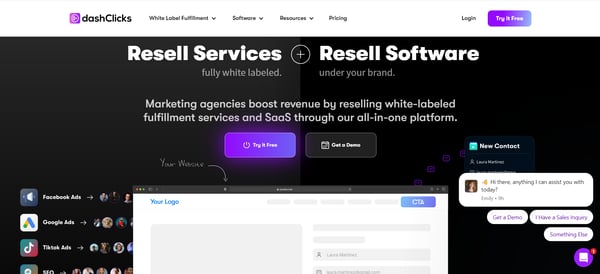
The platform consolidates CRM, reporting, fulfillment, analytics, and funnel building into a single system. This removes the need to manage separate tools for client management and campaign tracking. G2 feedback highlights the client-facing dashboard as providing clear visibility into performance without manual reporting. Features like Instareports support real-time website audits and bulk lead generation, allowing agencies to generate insights for multiple prospects from a single input file.
Automations cut the time spent on admin tasks, reduce manual coordination across services, and allow agencies to manage more clients without increasing internal workload. Multiple reviewers describe the platform as solving the challenge of running multiple marketing services under one roof, with everything centralized in a way that reduces time jumping between tools and vendors.
Instareports and Instasites function as built-in prospecting and delivery tools. Instareports generate audits covering SEO health, website performance, listings, reviews, and ad presence. Instasites allow agencies to create client-ready websites using niche-specific templates. Agencies use these tools to accelerate outreach and shorten the time between prospecting and onboarding.
Support responsiveness appears consistently in G2 reviews. Users describe quick live chat responses and support teams that resolve issues without escalation delays. In onboarding scenarios, support teams assist with detailed questions and help bridge gaps where documentation is not sufficient, supporting consistent execution for agencies relying on external fulfillment.
The platform offers a free version alongside its paid plans, allowing agencies to explore core features before committing. The subscription model includes unlimited sub-accounts, meaning agencies can scale client volume without incremental platform fees. G2 users describe the pricing structure as aligned with agency growth, with access to core tools upfront and paid tiers unlocking additional capabilities.
The platform continues to evolve through frequent updates and feature additions. G2 feedback reflects ongoing iteration based on user requests, with agencies noting improvements over time and active engagement from the product team. This development pace matters for agencies building workflows around the platform, as gaps are addressed incrementally.
I noticed a few recurring themes in G2 reviews. The platform's breadth creates an initial adjustment period, and teams coming from simpler or single-purpose tools are the ones who feel the navigation gap most in the first week. Some reviewers describe the early days as requiring more orientation than expected. However, once users engage with onboarding materials, tutorial videos, and support, usability improves clearly and quickly, with many reviewers noting a clear improvement after the initial phase.
G2 users describe the CRM and contacts management area as less polished, with friction showing up in workflows that depend heavily on contact organization and direct support interaction. However, live chat remains responsive, and most reviewers describe these issues as limited to specific areas, with the broader platform continuing to deliver a strong and reliable overall experience.
DashClicks is a fulfillment and operations platform for lean digital marketing agencies that want to scale client delivery without expanding their internal team. The white-label services, unified dashboard, and integrated prospecting tools provide a complete infrastructure for managing client acquisition, fulfillment, and reporting in one place, allowing agencies to operate efficiently under their own brand.
"As a marketing agency, I appreciate the easy access to the Instareports feature, where I can get a one-time report for a client or submit a file with hundreds of local businesses to receive potential leads and clients based on the reports. The dashboard is very user-friendly and easily accessible. The white label options available for presenting to my clients are excellent. I also like Dashclicks because they haven't spammed my email like some other white-label sites I’ve come across.”
- DashClicks review, Andrew L.
“There’s a bit of a learning curve when getting started, especially if you're unfamiliar with similar platforms. Some features feel like they could be even more customizable, but they’re always rolling out updates, so I’m hopeful that will keep improving.”
- DashClicks review, Stephen R.
SmartBug Media is a full-service digital marketing agency and HubSpot Elite Partner delivering paid search, paid social, SEO, inbound marketing, email, SMS, and web development for B2B, SaaS, healthcare, senior living, and ecommerce brands. Its work connects paid media with CRM, lifecycle workflows, attribution, and content, allowing campaigns to operate within a broader marketing system rather than as standalone channels.
HubSpot implementation and strategic enablement appear consistently in G2 feedback. Teams describe support that goes beyond execution, including guidance on platform configuration, workflow design, and internal enablement. In more complex setups, SmartBug helps consolidate disconnected data sources and adapt HubSpot to fit non-standard business requirements. This reduces gaps between campaign execution and attribution, particularly for teams already operating within the HubSpot ecosystem.
Where standard HubSpot configurations fall short, reviewers describe SmartBug finding workable solutions without requiring clients to restructure around the platform. This shows up in engagements involving consolidating disconnected data sources, integrating offline signals, and building custom CMS modules for requirements the platform does not natively support. For organizations with complex marketing infrastructure, this flexibility stands out, supported by a 98% professionalism score, indicating structured and solution-oriented engagement.
Performance outcomes are tied to ongoing optimization and structured campaign management. G2 users describe account managers reviewing campaign data continuously, identifying underperforming areas, and proposing adjustments backed by analysis. Reported results include increased lead volume, reduced acquisition costs, and sustained improvements across paid and organic channels. In healthcare and multi-location environments, campaigns show significant gains in engagement, placements, and conversions.
Strategic direction and transparency shape the engagement model. G2 feedback highlights clear communication around performance, including what is working, what is not, and what changes are needed. Teams describe ongoing input that aligns campaigns with broader marketing objectives, with forward-looking recommendations introduced regularly. This approach is reflected in 96% communication scores, indicating alignment between strategy and execution.
Industry-specific experience contributes to campaign execution across verticals such as senior living, healthcare, and B2B SaaS. Teams describe working with account managers who understand sector-specific dynamics and audience behavior early in the engagement. In multi-location organizations, SmartBug manages website builds, SEO, and paid media together to support lead generation goals tied to occupancy or pipeline growth.
For lean marketing teams, SmartBug operates as an extension of internal resources. G2 users describe managing email, paid media, and strategy through the agency while internal teams focus on creative or brand work. In some cases, this model supports significant year-over-year growth in demand generation and lead volume. Long-term engagements reflect consistent support across multiple channels without requiring internal expansion.
According to G2 reviewers, cost is consistently highlighted as the primary concern, particularly for teams comparing SmartBug against lower-priced alternatives or operating within tighter budgets. Some reviewers describe the rates as a significant investment. However, long-term reviewers consistently frame the cost as justified by strong ROI, with results outweighing the higher price when engagements are evaluated against outcomes rather than fees alone.
The structured engagement model can slow down quick pivots or short-notice adjustments, as noticed by a few G2 users. Teams with fast-moving product cycles or frequently shifting creative needs are where this constraint registers most. However, when initiatives are well planned, the model supports consistent execution and delivers reliably across channels.
SmartBug Media is a strong fit for teams running HubSpot as their marketing and CRM backbone who want paid media managed as part of a connected, multi-channel strategy. The integration depth, vertical expertise, and full-funnel service model make it a natural extension for teams looking to unify marketing, sales, and revenue operations under one partner.
"Very nice team of competent people that care. Been working with them for a while, so they know our business, way of working, etc. We can leverage different people based on the needs of the moment."
- SmartBug Media review, Samuel S.
“The biggest pain point for us is the high rates for their services.”
- SmartBug Media review, Nicole B.
|
Agency |
G2 rating |
Free plan |
Ideal for |
|
SmartSites |
4.8 / 5 |
No |
SMBs needing full-service PPC with strong lead generation and scalable search and social campaigns |
|
OpenMoves |
4.9 / 5 |
No |
Teams combining PPC with SEO, email, and analytics to improve lead quality across channels |
|
WebFX |
4.9 / 5 |
No |
Companies prioritizing data-driven PPC with clear revenue tracking and performance reporting |
|
KlientBoost |
4.8 / 5 |
No |
Growth teams focused on conversion-driven PPC with landing page testing and CRO |
|
Uproas |
4.9 / 5 |
No |
Advertisers running high-volume campaigns who need reliable ad accounts and strong creative execution |
|
DashClicks |
4.7 / 5 |
No |
Agencies needing white-label PPC fulfillment and scalable service delivery infrastructure |
|
SmartBug Media |
4.8 / 5 |
No |
Organizations using HubSpot or inbound strategies that want PPC aligned with CRM and lifecycle marketing |
*These PPC agencies are top-rated in their category based on aggregated user feedback reflected in G2’s latest Grid® evaluations. Most operate on custom pricing models tied to ad spend or monthly retainers, with consultations or performance audits available on request.
Got more questions? G2 has the answers!
KlientBoost is the strongest fit for B2B SaaS teams prioritizing lead quality over volume. Its continuous testing model across ad copy, landing pages, and audience segmentation is built to improve conversion rates rather than just increase clicks. OpenMoves is worth evaluating where paid search needs to connect with lifecycle channels to improve lead quality at scale.
WebFX stands out for reporting transparency through MarketingCloudFX, which connects campaign activity directly to lead flow and revenue attribution. OpenMoves also receives strong marks for clear performance explanations and reporting formats that support internal decision-making.
KlientBoost focuses on structured testing across creatives, audiences, and landing pages to improve conversion performance for e-commerce teams. WebFX brings multi-channel management with revenue attribution reporting that connects ad spend to actual sales outcomes rather than traffic metrics.
KlientBoost performs well on Meta with structured creative and audience testing built into every engagement. Uproas is the stronger option for teams hitting spend caps or approval delays, providing pre-warmed agency accounts that allow Meta campaigns to scale without the interruptions that affect standard self-managed accounts.
SmartSites delivers strong execution and responsiveness for local targeting across U.S.-based multi-location businesses. WebFX supports scalable campaign structures with consistent reporting across regions, connecting local performance to pipeline outcomes through its attribution platform.
SmartSites is the strongest fit for small local businesses needing expert-managed paid search without in-house PPC capability. DashClicks suits teams that want scalable fulfillment at accessible pricing, with a free entry tier available before committing to a paid plan.
DashClicks offers the most accessible pricing in this list, with a free plan and subscription tiers that scale without large upfront commitments. Uproas provides a cashback model that offsets subscription costs through ad spend rebates, improving overall economics for teams with consistent monthly spend.
KlientBoost includes CRO and landing page optimization within the engagement, meaning both the ad and the post-click experience are tested and improved together. WebFX connects campaign activity to revenue attribution, helping teams understand which campaigns are driving sales rather than just generating clicks.
SmartBug Media has specific experience in healthcare, senior living, and regulated B2B environments where audience sensitivity shapes campaign strategy. SmartSites also handles specialized and local service industries reliably, with G2 reviewers in regulated sectors describing consistent execution throughout engagements.
KlientBoost raises targets once they are consistently met and builds continuous testing into every engagement rather than settling into maintenance mode. WebFX connects campaign activity to revenue attribution through its proprietary platform, giving teams reporting they can take directly to leadership.
The agencies in this list are not interchangeable. Each one has a buyer profile, an engagement model, and a capability depth that fits some teams well and others poorly. Matching those variables to your specific situation matters more than picking the highest-rated option on paper.
What separates good agency decisions from expensive ones is how clearly you define what you actually need before you start evaluating. A lean ecommerce team hitting platform spend limits needs different infrastructure than a B2B SaaS company building its demand generation function from scratch. A HubSpot-centric marketing team needs a different kind of partner than an agency owner looking for white-label fulfillment.
Start with your operational reality: team size, internal bandwidth, channel complexity, and budget range. Work backward from there to the agency that fits it. That sequence produces better outcomes than starting with a shortlist and rationalizing backward.
Want to get more from your paid traffic? Explore G2's best conversion rate optimization tools for testing, optimization, and better conversion rates.


I evaluated 20+ tools using G2 Data and reviews to finalize the 10 best website design services
 by Somya Jain

Finding the best content writing services is harder than it looks. Most teams discover the gap...
by Disha G

I've watched a WordPress build go two very different ways. Done right, your team never thinks...
 by Disha C