If you make decisions about the best blogger outreach software, you already know this category is not optional. Outreach breaks when prospecting drifts, follow-ups leak, and reporting bends under scale.
Global influencer marketing spend is projected to exceed $24 billion in 2025, signaling how embedded outreach-driven relationships have become in content and PR workflows.
In this guide, I separate the category into distinct problems teams are actually trying to solve. G2 reviewers commonly choose Pitchbox for high-volume, rules-driven outreach without losing control over sequencing. BuzzStream is commonly picked for long-term relationship management and shared contact history. Respona is commonly picked for content-led teams, tying outreach tightly to digital PR workflows. This guide gives you decisive clarity, not polite summaries.
These conclusions are based on AI-assisted analysis of verified G2 review patterns, G2 Grid Reports, and cross-checking across SEO, digital PR, and content teams.
*These blogger outreach platforms are widely recognized based on the G2 Winter 2026 Grid report and broader market reputation. I’ve also added their monthly pricing to make comparisons easier for you.
Blogger outreach software helps turn scattered contact lists, manual pitches, and untracked conversations into a structured workflow that teams can actually scale. The right tool does not just send emails. It brings order to prospecting, follow-ups, and relationship tracking that would otherwise drift across inboxes and spreadsheets.
What I have found is that the strongest blogger outreach platforms go beyond basic outreach automation. They help teams understand who is worth contacting, why a site matters, where conversations stand, and what the next action is. Whether it is surfacing response patterns, tracking links and placements, or automating follow-ups without burning relationships, good tools replace guesswork with control.
This is not limited to large agencies or enterprise PR teams. G2 Data shows adoption is spread across small SEO teams, mid-market marketing orgs, and larger digital PR operations. Most teams adopt these tools because manual outreach breaks quickly as volume grows. Faster setup and clearer workflows mean fewer dropped conversations and more consistent outcomes.
Ultimately, good blogger outreach software gives me what outreach workflows need most: visibility into who has been contacted, predictability in follow-through, and confidence that valuable relationships are not being lost in the process.
I started by using G2’s Grid Reports to shortlist leading blogger outreach platforms based on verified user satisfaction and market presence across small teams, mid-market organizations, and enterprise users.
From there, I used AI to analyze hundreds of verified G2 reviews and pulled out recurring feedback patterns tied to real outreach workflows. I focused on what consistently matters in practice: prospect discovery quality, contact data accuracy, follow-up automation, relationship tracking, collaboration across teams, reporting clarity, and how well tools hold up as outreach volume increases. This helped separate platforms that streamline outreach from those that create friction once campaigns scale.
Since I have not personally used every tool listed, I validated these patterns against ongoing exposure to SEO teams, digital PR agencies, and content marketing groups actively running blogger outreach programs. All visuals and product references in this article come from G2 vendor listings and publicly available product documentation.
After reviewing a large volume of user feedback and examining how SEO, digital PR, and content teams actually run outreach, the same patterns kept appearing. The best blogger outreach software is not defined by how many emails it can send or how large its database is, but by how reliably it manages conversations, handles follow-ups, and reduces manual coordination as outreach volume grows.
The criteria below reflect what consistently separates tools that support repeatable outreach workflows from those that become another system teams work around.
Based on these criteria, I narrowed the list to platforms that consistently improve outreach execution, relationship continuity, and coordination across SEO, digital PR, and content teams. Not every tool excels at everything, so the right choice depends on whether your priority is prospecting accuracy, follow-up automation, relationship management, or scaling outreach without adding manual work.
Below, you’ll find authentic user feedback from the Blogger Outreach Software category. To appear in this category, a tool must:
This evaluation framework reflects aggregated user feedback and workflow analysis from the Blogger Outreach Software category in 2026. Some reviews may be edited for clarity.
Within the blogger outreach category, Sprout Social Influencer Marketing is positioned as a platform designed to bring structure, consistency, and control to influencer programs operating at scale. G2 Data reflects this emphasis on governance and coordination.
Small businesses account for 42% of users, mid-market teams 37%, and enterprise organizations 21%, showing appeal across company sizes with a stronger pull toward teams managing recurring influencer programs rather than one-off campaigns.
G2 users describe being able to assess creator fit using demographic insights, historical performance data, and past collaboration context within a single view. The selection criteria feature, rated at 82%, supports structured comparisons and shortlisting, helping teams move from discovery to decision without relying on screenshots, spreadsheets, or manual cross-checking.
Keeping sourcing, evaluation, communication, contracts, and reporting in one place is what G2 review patterns most consistently describe as the platform's core value. The import/export feature, rated at 82%, supports smooth data movement across campaign stages without disrupting workflows or requiring manual re-entry.
Native analytics replace manual proof collection, reducing back-and-forth with creators and keeping campaign timelines moving. The blogger search engine, rated at 82%, is most effective once creators are organized into active programs rather than during wide, exploratory discovery.
Managing multiple influencers and campaigns simultaneously stays manageable, with performance metrics remaining accessible throughout each stage. Reporting is frequently described as clear and presentation-ready, helping teams present outcomes to clients without exporting data into additional tools.
Keeping influencer communications, contracts, and performance history in one system directly benefits collaboration across marketing, agency, and client stakeholders. G2 reviewers note that having full relationship context available at every stage reduces repeated conversations and prevents gaps in continuity between campaigns.
The affinity tool helps teams find similar creators quickly, which matters when clients provide preferred collaborator lists as a starting point. G2 reviewers describe the platform's ability to surface niche creators consistently as a practical advantage for campaigns requiring fresh, relevant rosters. Teams note that having a reliable pipeline of discoverable creators reduces the time spent rebuilding prospect lists from scratch between campaigns.

G2 reviewers point to a few limitations as well. The updated interface introduces additional navigation steps that were not present in the earlier layout, making it less intuitive for teams accustomed to the previous design. This added structure can support a more organized interface as features expand, helping teams manage a broader set of tools within a unified layout.
Creator location data and search filtering do not always return precise results, particularly for teams targeting specific geographic markets. Campaigns requiring tight regional targeting feel this more than broad-market outreach programs. The platform's demographic breakdown and audience data remain detailed enough to support most standard discovery and vetting workflows.
Taken together, Sprout Social Influencer Marketing reflects a platform built around repeatability, oversight, and long-term program management. For organizations running ongoing blogger outreach programs with multiple stakeholders, it remains a strong fit for centralized intelligence, structured evaluation, and end-to-end campaign control.
"What I like best about Sprout Social Influencer Marketing is how easy it makes managing everything in one place. It’s really simple to track performance, see what’s working, and stay organized with campaigns. I also like that it helps build more authentic connections with influencers instead of feeling transactional."
- Sprout Social Influencer Marketing review, Daniel S.
“Their new version is not so easy to use. I prefer the old design with fewer clicks and more easily navigated menus. It's not impossible to use the new layout, but the old one was better. Also, they have a higher price in my market, so you need to use it every day to justify the investment."
- Sprout Social Influencer Marketing review, Pietro B.
Explore the full list of top influencer marketing tools to expand your outreach strategy.
Respona is an all-in-one outreach platform that brings blogger outreach, link building, and PR workflows into a single system. G2 review analysis shows it is commonly adopted by smaller, execution-focused teams, with 58% of users coming from small businesses, 34% from mid-market organizations, and only 8% from enterprise environments. That distribution points to teams that want outreach to feel structured and repeatable without building complex systems around it.
The interface is smooth and easy to navigate, with teams describing setup as fast and workflows as clearly defined once campaigns are live. G2 review patterns consistently reference low operational friction as the primary reason teams stay on the platform without ongoing maintenance overhead.
Outreach automation covers nearly the entire workflow, from prospecting and personalization through sending and tracking, reducing reliance on supplementary tools. Automatic follow-up, rated at 95%, reflects how consistently teams rely on the platform to keep campaigns active without manual intervention. Teams describe follow-ups being handled systematically, freeing time for higher-priority outreach decisions.
Campaign sequencing stays coordinated rather than reactive. Content scheduling, rated at 94%, allows teams to plan outreach with clearer timing and cadence rather than sending one-off emails. This structure keeps campaigns predictable and easier to manage as volume increases.
Prospect list movement stays clean across campaign stages. Import/export, rated at 93%, allows teams to move lists and results in and out of the platform without disrupting active workflows. G2 review patterns describe prospecting, personalization, sending, and tracking as naturally connected steps rather than separate manual tasks.

Contact discovery and email verification run reliably at scale, supporting large outreach programs without the manual checking that slows smaller tools down. Blogger database, rated at 92% against a category average of 87%, reflects strong prospect data quality across the campaigns G2 reviewers describe running.
Personalized outreach at scale is a recurring theme across G2 reviews, with teams describing stronger response rates after combining intuitive prospecting with well-timed follow-ups. The platform's backlink strategy guidance helps teams understand not just how to send outreach but how to structure campaigns for actual link acquisition outcomes.
According to G2 reviewers, the platform operates on a credit-based pricing model with no free trial, requiring teams to commit before validating fit at their actual outreach volume. Smaller teams running exploratory campaigns feel this more than established programs with predictable monthly volumes. Structured onboarding and responsive support help most teams move past the initial commitment quickly.
Prospect data can occasionally include outdated emails, adding verification steps for teams with strict contact accuracy requirements, as noted by a few G2 reviewers. Teams targeting broad publisher lists notice this more than those working within tight, well-defined niches. Once lists are cleaned, campaign execution moves smoothly without further disruption.
Taken together, Respona aligns closely with teams that prioritize clarity, automation, and repeatable outreach execution. Its high satisfaction scores reflect strong day-to-day workflow fit, while its more modest market presence reflects adoption concentrated among smaller buyers. For organizations focused on scalable backlink acquisition where consistency matters more than enterprise breadth, Respona remains a practical and execution-oriented choice.
"That they give you the full strategy on actually how to acquire backlinks.
Otherwise, the other option is to just buy backlinks. Or do both.
The software is easy to use and provides a lot of value to the user. It does a lot of the work for us.”
- Respona review, Armstrong L.
“Overall, Respona works really well, but sometimes the contact search results can include a few outdated emails. Also, it would be great if there were more advanced filters for prospect selection and a slightly faster loading speed when handling large lists. However, these are minor issues compared to the overall efficiency it provides.”
- Respona review, Mahendra B.
Pair outreach with these top SEO tools to maximize link-building impact.
Upfluence supports influencer marketing through coordinated workflows that connect discovery, outreach, follow-ups, and results tracking in a single environment. G2 review patterns describe it as a structured system where influencer programs run with clear process rather than ad-hoc coordination. Teams reference consistent visibility across outreach activity, responses, and outcomes, which supports internal accountability as programs scale.
Bulk outreach and automated follow-ups reduce manual effort across daily campaign tasks, keeping programs moving without constant supervision. Automatic follow-up, rated at 95%, reflects how consistently teams rely on the platform to maintain outreach momentum without manual reminders. Teams describe launching campaigns to 150 or more influencers within hours and maintaining follow-up discipline without tracking responses manually.
Managing outreach, communications, shipping, commissions, contracts, and payments in one place is what G2 review patterns describe as the platform's clearest operational advantage. Curation, rated at 96%, supports this by helping teams organize and scale influencer lists as programs grow. Teams switching from fragmented tools describe this consolidation as the primary reason they stay on the platform long term.
The Live Capture feature identifies influencers directly from existing customer databases, allowing commerce teams to build networks from proven buyers rather than cold lists. Content scheduling, rated at 98%, supports coordinated campaign execution across ecommerce and email workflows without switching systems. Shopify and Klaviyo integrations mean teams can stand up an influencer network within days rather than weeks.
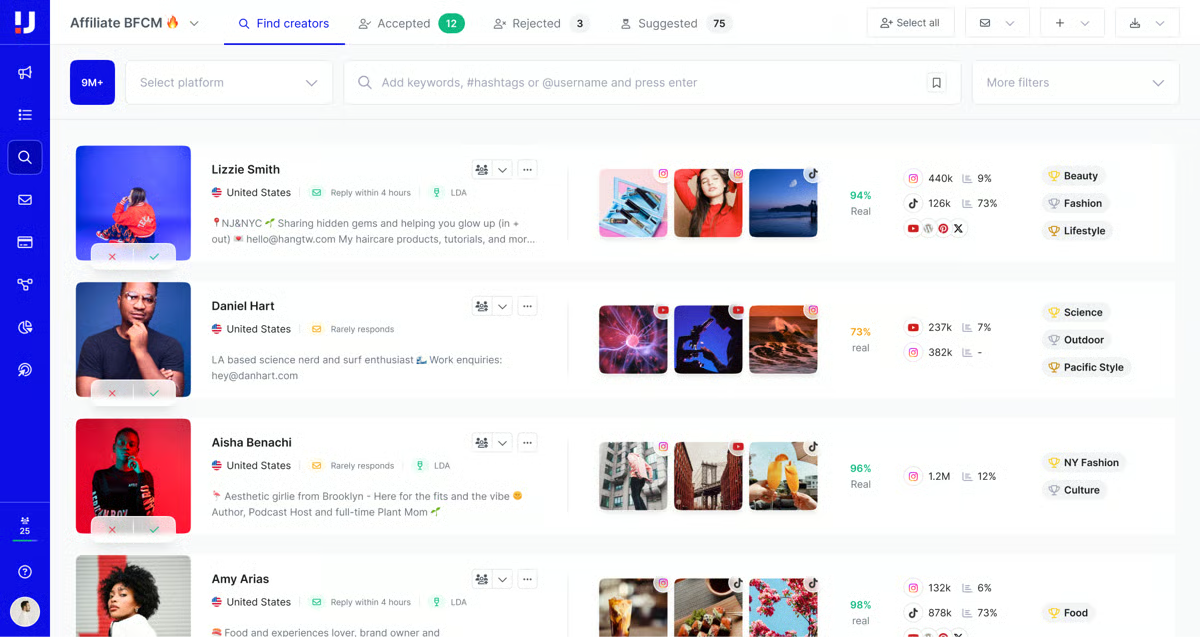
Tracking actual return on investment is a recurring theme across G2 reviews, with teams describing clear visibility into affiliate link performance and revenue contribution. Attribution through discount codes and affiliate links connects influencer activity directly to sales data, removing the guesswork from performance reporting.
Personalized email templates and campaign invitation workflows help teams move from discovery to active outreach quickly. The email feature is described as practical for maintaining relevance across different influencer tiers without rebuilding templates each time. The UX around campaign invitations is straightforward enough for non-specialist team members to use without additional training.
Influencer relationship management stays structured across the full collaboration lifecycle. Teams describe communicating, collaborating, and aligning goals with creators in one place, which supports content authenticity and reduces back-and-forth outside the platform. G2 reviewers note this structured approach helps maintain campaign quality as influencer rosters grow.
Despite the strengths, there are a few areas of improvement. According to G2 reviews, initial setup across multiple modules takes more time than expected, particularly for agencies managing several brands simultaneously. Teams newer to structured influencer operations feel this most during early configuration. Once workflows are in place, daily execution runs with considerably less manual effort.
Attribution and sales visibility can take time to validate at scale, particularly when outreach spans multiple brands and affiliate links simultaneously. Agencies with tight client timelines feel this more than in-house teams running longer program horizons, where results compound gradually. Once outreach programs mature and tracking is properly configured, revenue contribution becomes clearer and easier to defend in client reporting.
Taken together, Upfluence operates as an execution-focused system for influencer programs built around structure, scale, and measurable outcomes. Its combination of outreach automation, campaign coordination, integrations, and performance visibility supports repeatable execution rather than ad-hoc outreach. For commerce-led teams treating influencer marketing as an ongoing performance channel, it remains a strong operational fit.
“ Had an Individual Onboarding in my package, which made setup and adaptation super easy as they walked me through each step and gave me customized training.
Was able to find 150 influencers to reach out to within a few hours and then make a campaign for bulk outreach. I liked the automated follow-up emails if an influencer didn't answer. They have live customer support calls every week that I joined last week, where they answer any questions I had an we were able to get my Shopify and Outlook email integrated easily."
- Upfluence review, Rachael B.
“Since it offers all features from finding influencers to tracking campaign performance, it took me 2-3 meetings with their team before I felt I had mastered the tool. There are many useful tricks that you'll need to attend a few meetings to learn.”
- Upfluence review, Even X.
Compare the best email marketing platforms to strengthen your outreach delivery.
G2 reviews consistently highlight that Pitchbox is a purpose-built outreach execution platform rather than an all-in-one marketing suite. G2 review analysis shows the platform stays tightly focused on blogger outreach, link building, and partner communication, shaping how teams use it in day-to-day operations. This narrow scope supports teams that want outreach to remain structured, repeatable, and execution-driven without introducing unrelated marketing workflows.
Campaign creation, list imports, and navigation feel straightforward, allowing outreach to start quickly once prospect lists are ready. Import/export, rated at 98% against a category average of 91%, supports high-volume workflows by keeping prospect movement consistent without manual intervention. Teams describe standing up new campaigns and moving large prospect lists without operational drag.
Follow-up discipline stays consistent across extensive prospect lists without adding manual overhead. Automatic follow-up, rated at 98% against a category average of 92%, keeps outreach cycles moving across sustained campaigns. Teams describe maintaining momentum across hundreds of prospects simultaneously without losing track of where each conversation stands.
Performance visibility stays focused on outreach outcomes rather than layered reporting complexity. Campaign analytics, rated at 95%, supports decision-making across active campaigns without overwhelming teams with data. G2 review patterns describe this as particularly useful for agencies managing multiple client campaigns simultaneously.
Prospect discovery covers a wide range of publisher types and outreach use cases. Blogger Search engine, rated at 89%, supports targeted discovery across niche publishers and geo-specific outreach targets. Teams describe finding relevant link opportunities systematically without extensive manual filtering.
The inspect-and-personalize feature allows teams to review article content and validate fit before campaigns go live. AI-assisted templates support personalization at scale, with variables like recipient name, role, and location built directly into outreach sequences. G2 reviewers describe this combination as key to maintaining relevance across large publisher lists without sacrificing individual message quality.
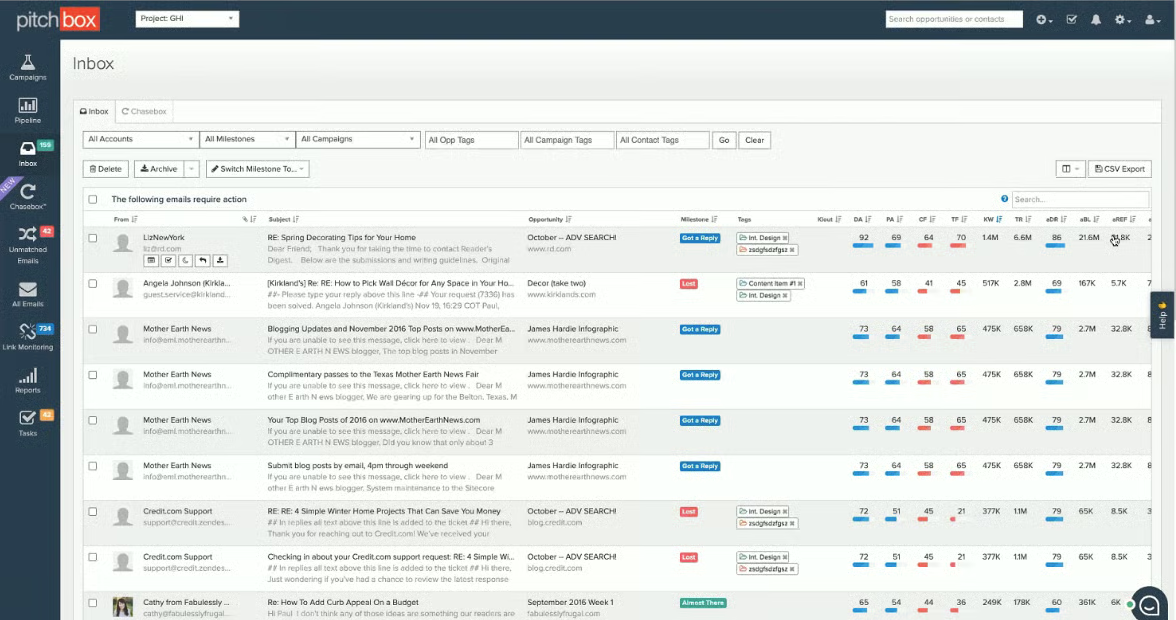
The Pipeline feature gives teams a clear view of where each opportunity stands, from initial prospect identification through to a live link. Integration with third-party tools like Ahrefs, Majestic, and SEMrush pulls domain metrics directly into the workflow, reducing the need to switch between systems during prospecting.
found similar themes across G2 reviews. G2 users state that contact suggestions within the platform can be inconsistent, surfacing contacts that do not always match campaign targeting requirements. Response rate metrics improve meaningfully once the automation workflow feature is properly configured, giving teams cleaner campaign data to work from.
G2 users note that email setup requires manual configuration of SPF, DKIM, and DMARC records outside the platform before campaigns can launch. Teams moving from fully managed email environments feel this most, as the process sits outside Pitchbox's interface rather than within it. The built-in MXright tester catches any remaining deliverability issues before campaigns go live, reducing the risk of inbox placement problems once sending starts.
Adoption skews heavily toward small businesses at 76% and mid-market teams at 22%, with enterprise usage remaining minimal, reflecting a user base built around execution-focused SEO agencies and PR teams running structured, high-volume outreach programs.
From an operational perspective, Pitchbox functions best as a focused execution engine for blogger outreach and link-building programs. Its emphasis on automation discipline, personalization controls, and high-volume workflow stability supports teams that rely on consistent publisher engagement rather than broad marketing coverage. For SEO agencies and PR teams running repeatable outreach campaigns, it remains a reliable choice based on how users describe its role in daily execution.
“I really appreciate the simplicity of setting up Pitchbox. The platform is quite intuitive, and I love its built-in MXright tester, which makes managing email configurations easier despite the complexities with SPF, DKIM, and DMARC records. The AI templates, CRM, and Dashboard are standout features for me, offering a great deal of utility and efficiency in my workflow. I'm particularly impressed by Pitchbox for its email and prospecting capabilities, finding the data quality exceptional. Using it for reaching out to niche and geographically relevant link placements has been a huge benefit, particularly as these placements help keep my clients visible and boost their organic traffic. The prospect AI extension and the list-building ability enhance my experience significantly, supporting efficient partner outreach and coordination of PR campaigns. Pitchbox's capacity to support my role as a local SEO agency owner is invaluable, providing tools crucial for ongoing client relevance and success."
- Pitchbox review, Chris R.
“There are a lot of great features, and it takes time to learn how to use them to their full potential, but we have no actual negative impressions from all the time we've used the tool.”
- Pitchbox review, Uros B.
BuzzStream is built around organization, follow-ups, and repeatable outreach execution rather than broad influencer discovery. G2 review patterns describe a platform oriented toward consistency and process control, making it a natural fit for SEO and digital PR teams running structured, long-running outreach programs.
Maintaining contact databases, pitching history, and campaign timelines in one place is what G2 review patterns describe as BuzzStream's core operational value. Import/export, rated at 92%, supports smooth data movement across campaigns without disrupting active workflows. Teams describe this centralized setup as reducing dependence on inboxes and spreadsheets across long-running digital PR efforts.
Scheduled sequences, nested campaigns, and reusable templates keep outreach programs moving without constant monitoring. Automatic Follow-up, rated at 94, reflects how consistently teams rely on the platform to maintain follow-up discipline across active campaigns. G2 reviewers describe bulk email functionality combined with automated reminders as cutting the manual effort that typically slows digital PR execution.
Link monitoring runs on a recurring basis, with teams describing monthly checks across published links to verify whether placements are still live. Reports and Visualization, rated at 91%, supports workflows where tracking links, placements, and outcomes is essential for SEO and client reporting. G2 reviewers describe this as particularly valuable for teams managing ongoing publication relationships where placement continuity matters.
The Chrome extension and Hunter email finder integration help teams build and verify contact lists without leaving the platform. G2 reviewers describe the CSV uploading feature and CRM integrations as practical additions that keep contact data current without manual re-entry across campaigns.
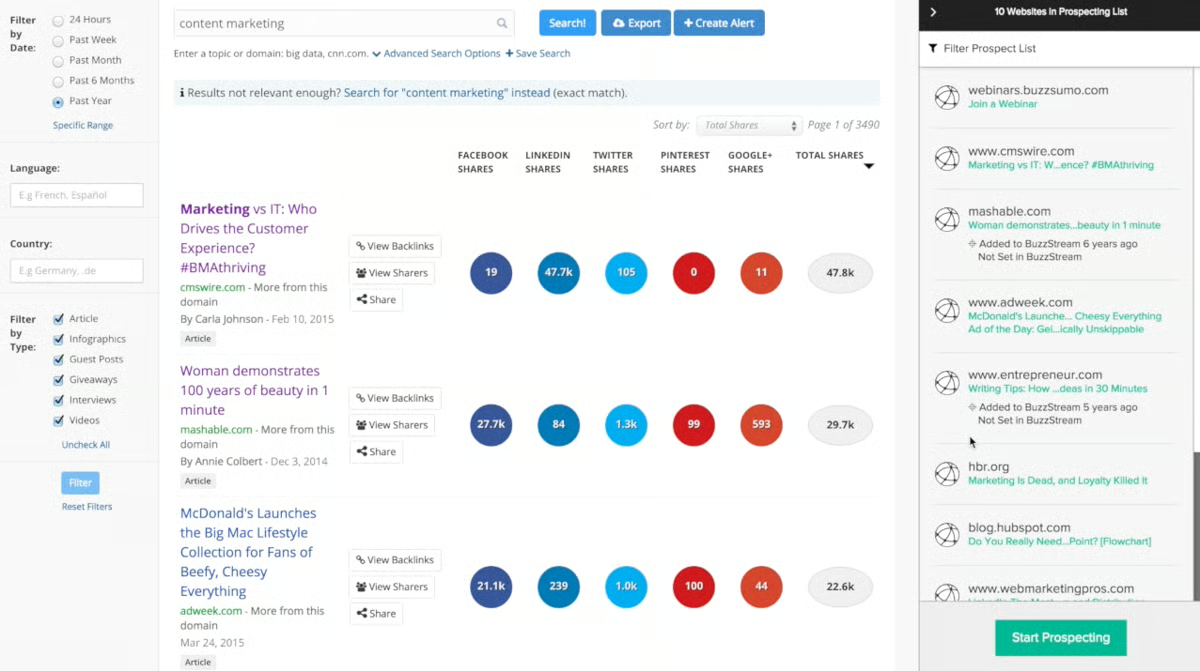
Research and pitching stay organized across campaigns, with teams describing BuzzStream as easy to navigate, even for new team members joining mid-program. The interface leads users in the right direction without requiring extensive onboarding, which supports faster ramp-up across lean outreach teams.
Detailed analytics on open rates, click-through rates, and engagement patterns give teams visibility into what is working across active campaigns. This helps teams make adjustments based on actual response data rather than gut feel, keeping execution grounded in evidence. G2 reviewers describe this performance visibility as keeping outreach predictable rather than reactive across sustained programs.
As per G2 reviewers, link status checks can occasionally return inaccurate results, flagging live placements as removed when the link is still active on the target site. Although overall reporting and placement tracking across the platform remains dependable enough that most teams continue to rely on it as their primary outreach record.
Pricing is another theme mentioned commonly among G2 reviews. It sits above what some smaller teams and startups expect for an outreach tool at this scope. Teams evaluating BuzzStream against lighter, lower-cost alternatives feel this gap more. G2 reviewers consistently describe the feature depth and time savings as justifying the investment once the platform is integrated into daily workflows.
Taken together, BuzzStream reflects a tool designed for disciplined outreach execution rather than expansive scale. For SEO and digital PR teams that value follow-up discipline, historical tracking, and repeatable processes, it remains a focused and relevant option within the blogger outreach category.
“It checks all the paid links for the website on a monthly basis. We just need to update all the published links on BuzzStream, and keep a check on all the links if they are still published or have been removed.”
- BuzzStream review, Kiran R.
“As a relatively new starter to outreach, I find the interface quite hard to navigate in terms of remembering how to get to different parts of the tool, but that may get better with time.”
- BuzzStream review, Lindsay B.
|
Software
|
G2 rating
|
Free plan
|
Ideal for
|
|
Sprout Social Influencer Marketing
|
4.3/5
|
Yes, free trial
|
Enterprise teams managing large-scale influencer programs and reporting
|
|
Upfluence
|
4.6/5
|
No
|
Performance teams aligning influencer discovery with ecommerce data
|
|
Respona
|
4.8/5
|
Yes, free trial
|
Content teams running SEO-driven blogger outreach and digital PR
|
|
Pitchbox
|
4.7/5
|
Yes, free trial
|
Agencies executing high-volume, structured outreach campaigns
|
|
BuzzStream
|
4.2/5
|
Yes, free trial
|
Teams prioritizing long-term blogger relationship management
|
*These blogger outreach tools are top-rated in their category, based on G2’s Winter 2026 Grid Report. Pricing tiers and demos vary by vendor.
Got more questions? G2 has the answers!
Respona and Upfluence are most often associated with strong discovery and prioritization. Review patterns suggest teams pick them when they need reliable prospecting signals and faster shortlisting.
Compare how well they preserve relationship history across campaigns, prevent duplicate outreach, and show clear ownership. BuzzStream and Pitchbox come up most often for structured tracking and continuity.
BuzzStream is commonly mentioned when teams care about link-centric outcomes and SEO signals. Review patterns suggest they are used to connect outreach activity to placement results.
Pitchbox and BuzzStream are most frequently referenced for integrations that support team workflows and handoffs. Review patterns suggest they fit better when outreach data needs to stay aligned with other systems.
Look for tools that support scalable personalization without turning sequences into spam. Pitchbox and Respona are commonly picked for automation depth with control over messaging and follow-ups.
Prioritize prospect filtering accuracy, contact data freshness, and manual control over outreach cadence. Review patterns suggest that Respona appears more often when relevance matters more than volume.
Check whether reporting ties outreach activity to replies, placements, and link outcomes, not just opens. BuzzStream and Sprout Social Influencer Marketing are often cited for clearer performance visibility across campaigns.
Respona and Pitchbox are commonly referenced for built-in outreach flows that standardize pitching. Review patterns suggest they help teams move faster without losing process consistency.
Ask how the tool handles multiple campaigns, shared contact pools, role-based access, and duplicate prevention at scale. Pitchbox and BuzzStream are most often mentioned when teams need repeatable operations across many campaigns.
Start by checking whether pricing is public, how limits scale with usage, and what support looks like during onboarding and ongoing operations. Review patterns suggest tools with custom quotes vary widely, so support quality and implementation guidance matter as much as the sticker price.
If there’s one thing that stands out after evaluating this category, it’s that blogger outreach software is no longer about sending more emails or building larger lists. It is about putting structure around relationships that would otherwise fray as volume increases. The strongest platforms quietly reduce friction in prospecting, follow-ups, and handoffs, allowing teams to stay focused on intent and relevance rather than chasing execution gaps.
In real workflows, the difference between a strong and weak choice rarely shows up on day one. It appears gradually as response rates drift, context gets lost between campaigns, and teams spend more time managing the process than running it. Good software lowers cognitive load, preserves relationship history, and keeps outreach tied to strategy as pressure increases. Poor choices compound risk by introducing noise and inconsistency into a channel built on trust.
The right decision comes down to fit, not features. The best blogger outreach software supports how your team operates today while absorbing the scale, complexity, and expectations of tomorrow. Choose with that in mind. Outreach success is not about working harder or sending more. It is about building a system that holds up as the stakes rise.
Want to turn blogger outreach into measurable results? Explore affiliate marketing software on G2 to track performance and scale outcomes


I don’t judge free influencer marketing tools by how many creators they claim to have. I judge...
 by Amita Jain

Recently updatedSummer 2026 Grid® Report · Published May 26, 2026 This guide was last...
.png) by Shreya Mattoo
by Shreya Mattoo

If you’re evaluating the best ad network software, this isn’t a category you’re exploring;...
 by Gunisha